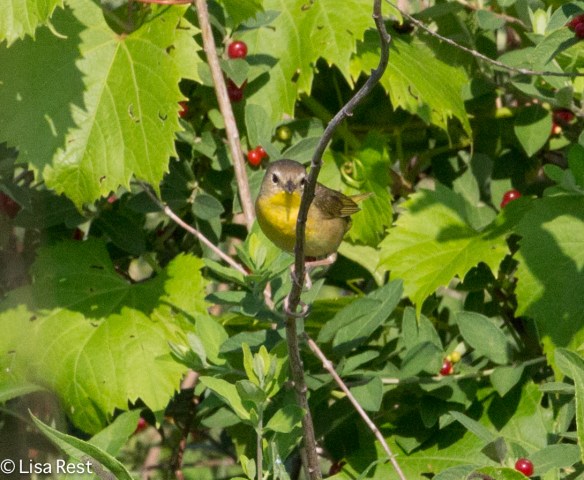
I was determined to go out this morning after being tricked by the forecast yesterday which predicted rain that did not happen. If I had not awakened with a sore knee, I might have been tempted to go out yesterday, but I spent much of the day without too much exertion, focusing instead on my three-and-a-half hour cleaning chore last night that was made possible with ibuprofen. This morning I woke up to clouds and wind. Clouds i could deal with, but consistent wind gusts made it prohibitive to go out for a walk, because birds aren’t crazy about windy days. I watched the birds in the yard come and go in between gusts.
These pictures are from last Saturday’s visit to McGinnis Slough. Not a lot going on yet, but at least there was some sunshine. I went to the Portage on Sunday and have decided to make that a separate post.
McGinnis Slough
There are plenty of Red-Winged Blackbirds setting up territories. I also saw one or two females but they were not available for photos. Yet.
In addition to the predictable Mallards there were some other ducks but they were too distant to photograph. Likely if I had my scope I might have seen more species.
Gadwall and Bufflehead
No Great Egrets yet but there were at least one or two Great Blue Herons.
American Coots are always a presence here. They aren’t numbering in the hundreds yet but they will.
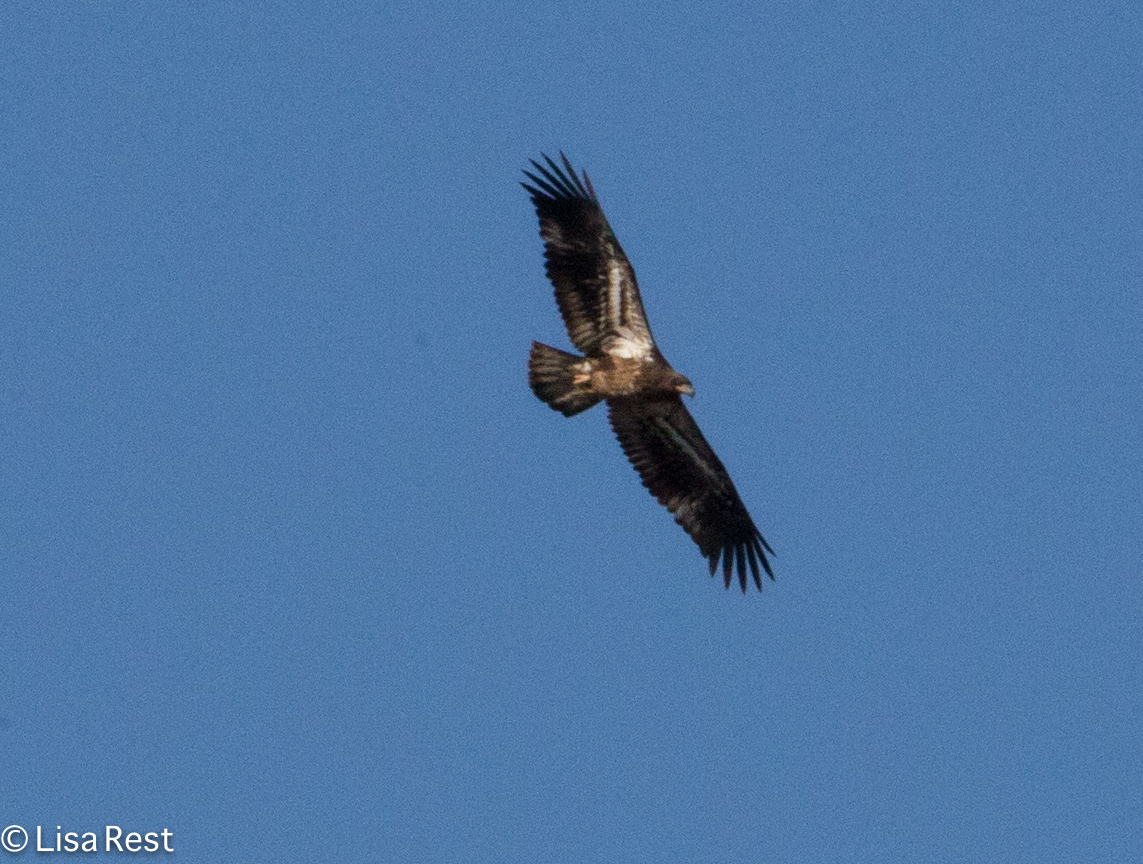
It was particularly rewarding to see a juvenile Bald Eagle fly over. The plumage is at about two and a half years old.
Below, a late, extremely backlit American Tree Sparrow.
Quick flyover Osprey…
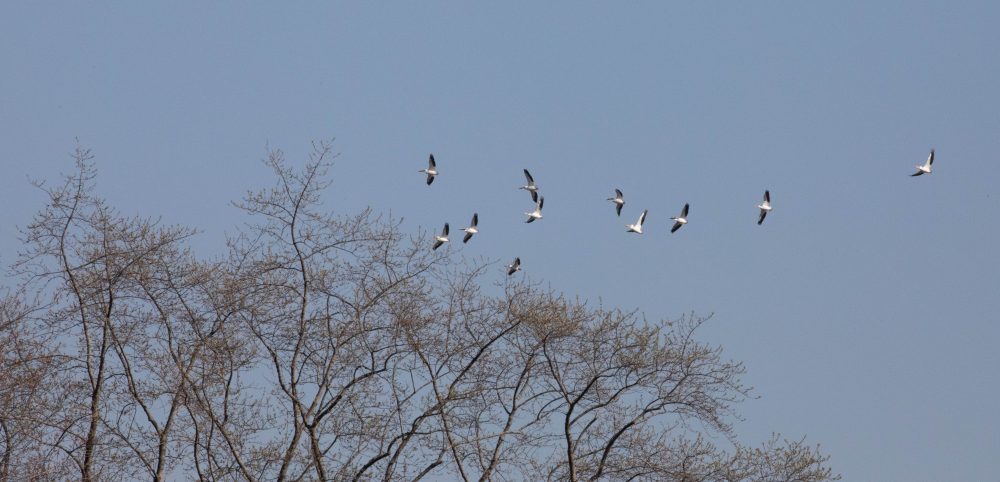
Always love to see the American White Pelicans, even if they are distant.
A last glimpse at well-preserved seed heads.
Last year’s oriole nests are easy to spot now.
Just one more Coot – closely cropped and brightened up a bit to show of its red eye.
I’ll be back soon with my Portage visit and with any luck I will be going out next weekend, which promises to be warm, sunny and dry – so far!
I started writing this post to coincide with setting the clocks forward, and now it’s taken me over another week to get back to it. But when considering all the photographs were taken a year and a month ago – on April 19th, 2020, to be exact – and I never got a chance to finish processing them until now, it’s taken even longer! I hope it’s kind of a sneak preview of what to expect in the coming days and weeks as spring unfolds at the Portage.
One of my first encounters was a pair of Downy Woodpeckers exhibiting their exuberant version of courtship behavior. At first I thought they were arguing! I have never witnessed this before so I’m glad I was able to capture it. If you click on the right panel and keep going you can see the sequence.
It appears I had way too many photographs from this excursion which might explain why I never managed to post them. Still it’s nice to revisit them, like the female Northern Cardinal below.
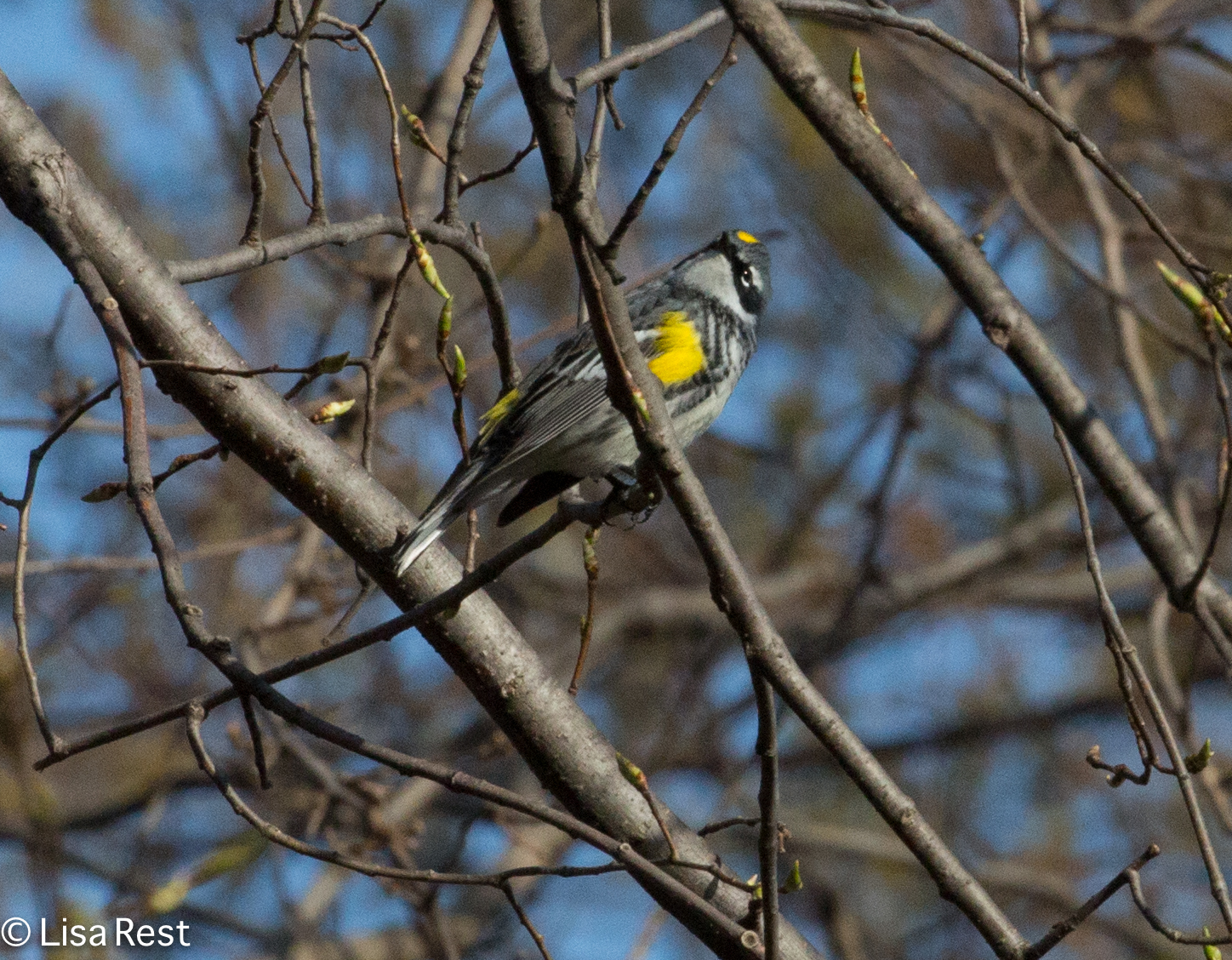
Below, often the first warbler to visit, a Myrtle Yellow-Rumped Warbler.
Surprised to find this photograph in the mix – likely my first sighting of an Eastern Bluebird last year.
An Eastern Phoebe, dreaming of flying insects, perhaps.
Another Downy Woodpecker.
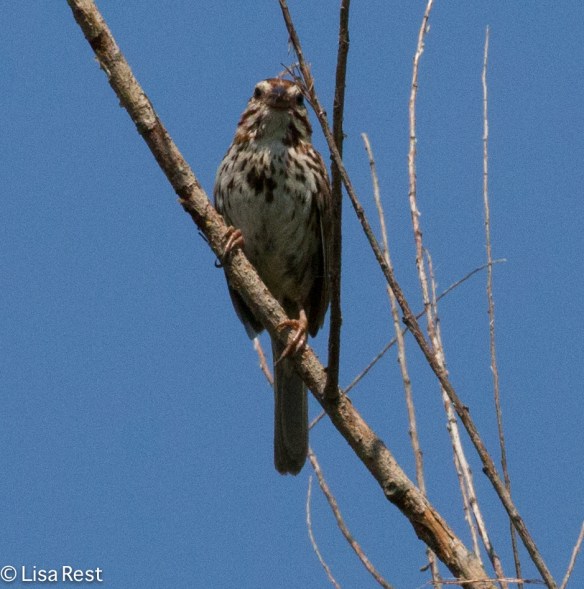
Song Sparrows…
Red-winged Blackbirds…
I don’t think there’s enough water on site anymore to attract herons, but there is plenty nearby so I should still see them flying over on occasion.
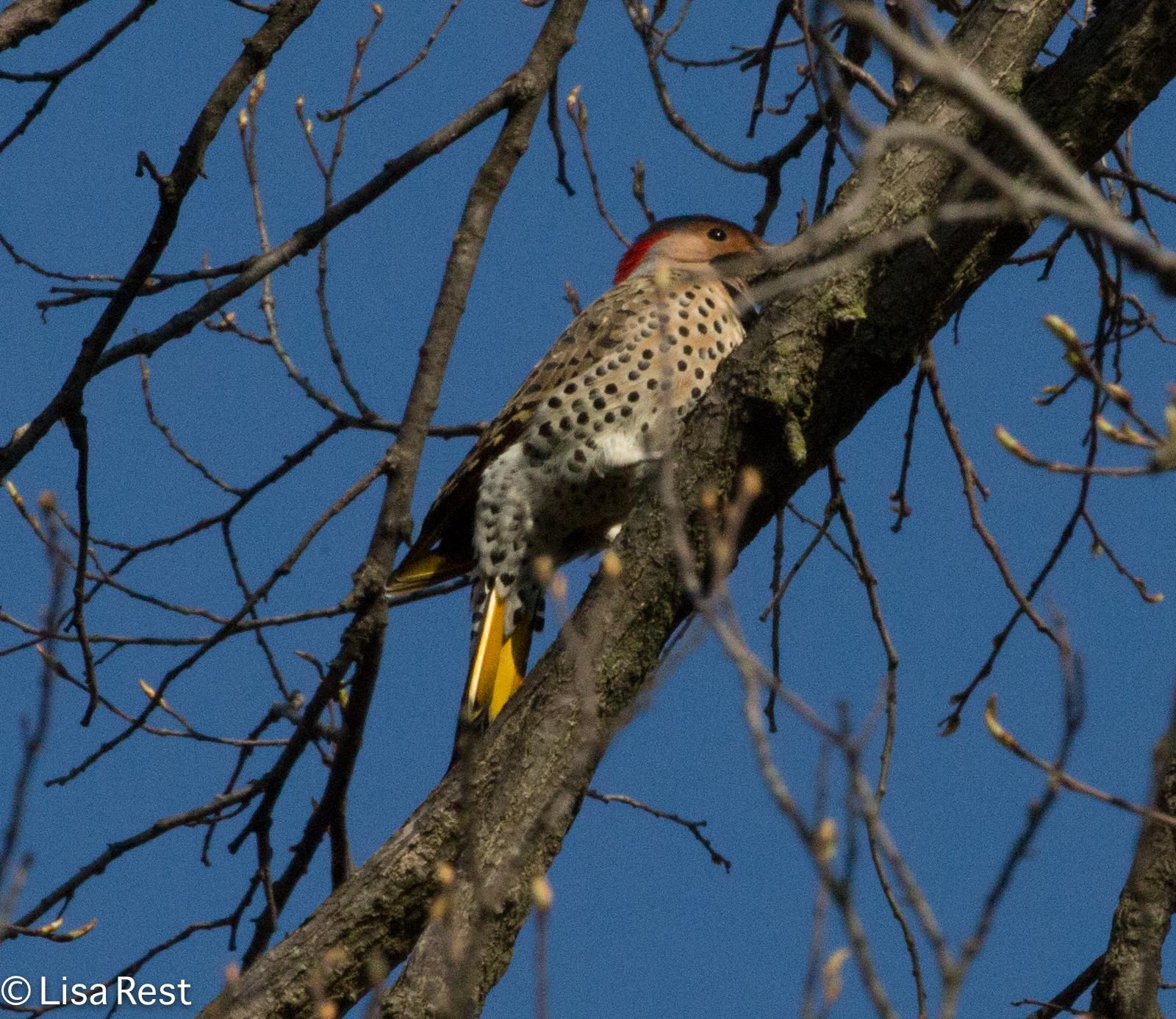
A Northern Flicker showing just a little of its golden shafts.
There were two Yellow-Bellied Sapsuckers on this tree and one flew away.
A Black-capped Chickadee showing off.
Red-tailed Hawk
White-breasted Nuthatch
A singular turtle…
An assortment of early fungus, moss and flora.
A singing American Robin
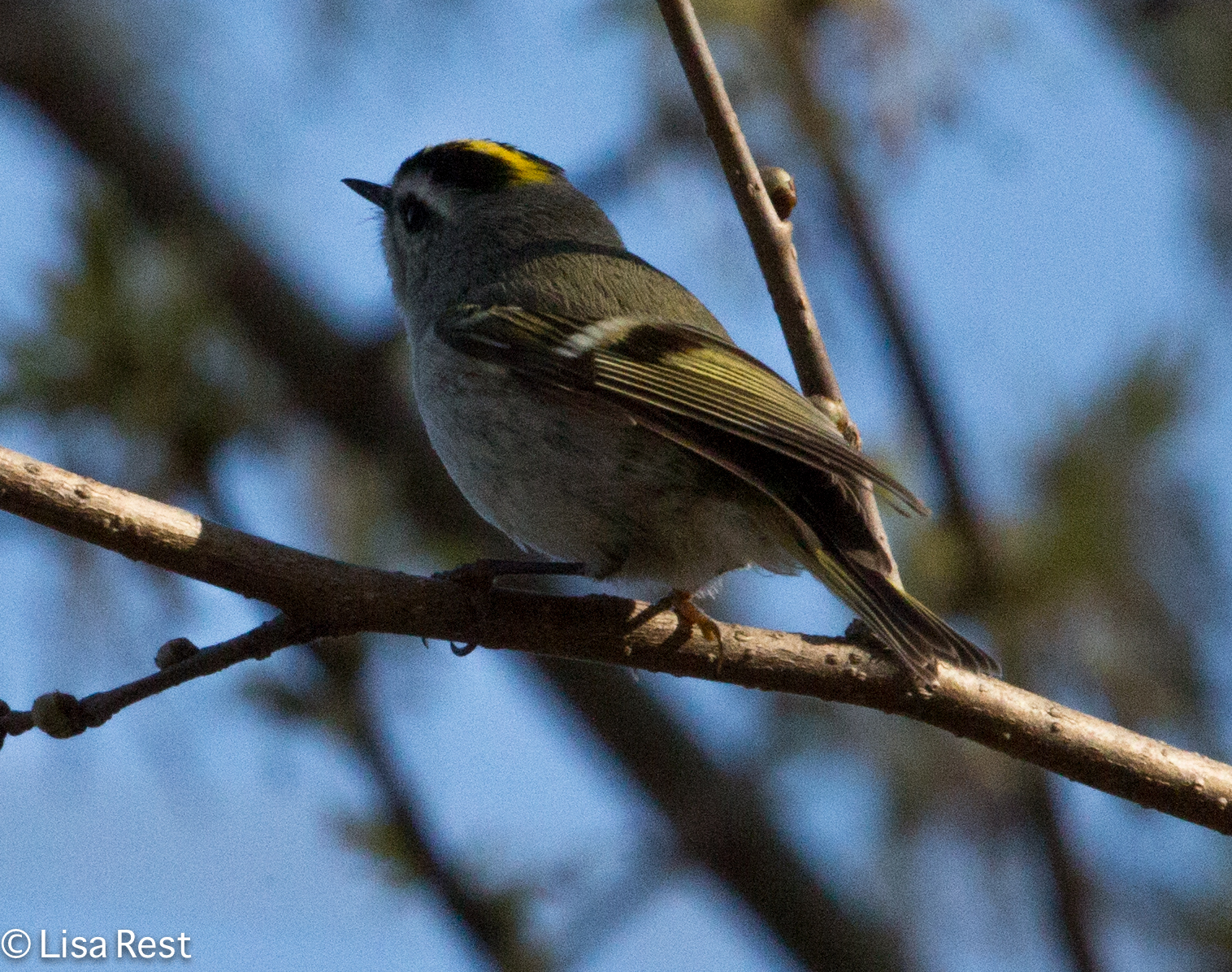
Here’s a Golden-Crowned Kinglet – unfortunately the lighting didn’t do its colors justice.
This Brown-headed Cowbird was foraging on the ground.
Canada Geese and the clouds…
Chipping Sparrow
Robins often seem like they want to engage in a conversation.
A Wood Duck drake in a tree. I remember trying to get this shot after I saw him land, with a lot of branches between us.
Mallards…
Blue-winged Teal…
So the Portage will still be slowly coming to life, but we’re warming up, the days are getting longer and migration has begun. Springing forward with hope.
In my typical fashion, I have been trying to write this post for the last week and a half. So while we are all wondering how to get through the holidays this year-like-no-other, I feel a sense of loss too, even though I likely would not have had any plans to go anywhere myself. But there’s also a sense of opportunity in any day I really don’t have to think about work.
Even though it was a cool, late spring and in the middle of the pandemic, there’s something oddly comforting these days about looking back.The Portage looks about like this now – no leaves on the trees, everything muted in browns and grays – but the birds are different in appearance, and most of these species have left for the winter. I took way too many photographs on this day, which might explain why it’s taken me seven months to process them. I won’t be doing a lot of explanation…that might take me another seven months. just hope you enjoy the images.
It will be a while before male American Goldfinches look like the one below.
Out over the Des Plaines River that day, there were three Belted Kingfishers flying around. I didn’t do a very good job of capturing them, they were quite far away. But at least one flew close enough to be recognizable.
A returning Song SparrowA Blue Jay, blending in with the sky and the barren treeWaiting to come back to life.
Eastern Phoebe
I keep trying to get a decent photograph of the golden shafts on a Flicker and usually fail, but this time I got close.
There were a couple Blue-Winged Teal hanging out with the Mallards.
One Ring-Billed Gull flew over low enough to be identifiable.
Robins started coming back to their territories. The one in the second photograph is barely discernible from the tree it’s in.
Of course nothing says spring like the return of Red-Winged Blackbirds.
It was early enough in the morning to encounter a couple deer.
Please forgive me, I took way too many pictures of Golden-Crowned Kinglets. They are all gone now, but it was a joy to see them return in April.
Downy Woodpecker – the Portage’s most numerous resident woodpecker
Here’s a thrush I don’t see often – a Veery.
I took a few too many pictures of this Ruby-crowned Kinglet too, but at least I did get somewhat of a shot at the ruby crown.
A Yellow-bellied Sapsucker…
Yellow-bellied Sapsucker
I am always happy to see a White-Breasted Nuthatch, even though they are with us all year long. I never tire of them.
The light was nice on this Red-Bellied Woodpecker.
Red-bellied Woodpecker
Brown-headed Cowbirds are…what they are.
The pair of Eastern Bluebirds this year were such a welcome sight. Although I saw them for several weeks, I don’t think they wound up staying to breed. I can only hope they give the Portage a second chance next year.
The first warbler to show up in the spring, and the last to leave in the fall… the trusty Myrtle, or as long as it’s still lumped with Audubon’s (last time I checked), it’s a Yellow-Rumped Warbler.
I will be back with more from last spring (!) and some more current observations. I hope you are safe and well, wherever you are. And I hope you continue to find moments of peace and solace. There is still a lot to be thankful for.
I haven’t been able to go forward too far so I am going backward in time. These photographs are from one lovely day in the middle of July at the Portage. A highlight was a pair of Orchard Orioles. The male is at the top of this post.
Even though the Green Herons did not have enough water to make a go of it this summer, they still came to visit.
Pollinators were busy.
Below are some more images of the male Orchard Oriole, and one of the female in the same frame as a Red-Winged Blackbird female. They were foraging in the vegetation that sprung up in the absence of water this summer.
A female Red-Winged Blackbird is showing off below.
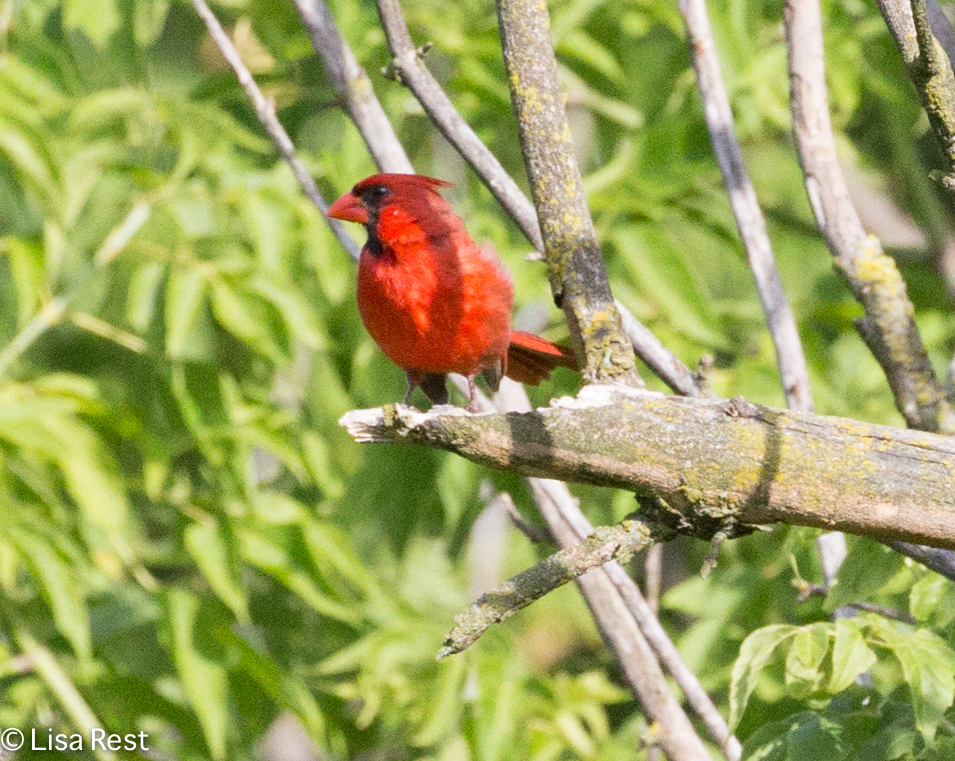
Male Northern Cardinals aren’t typically willing subjects, so it was a rare treat to capture this one.
Robins were present in all stages of plumage.
Not sure but this might have been my last opportunity to photograph and record a singing male Indigo Bunting.
It was a good year all around for seeing Eastern Wood-Pewees. I usually always hear them but rarely see them. Something about the change in habitat, I suspect.
The Goldfinches spent a lot of time foraging in the duck weed. I didn’t realize that the Portage has a storyboard describing duck weed as the smallest flowering plant until I led a bird walk recently.
Not a very good photograph, but I this was the last time I saw a Great-crested Flycatcher.
The Gray Catbird below epitomizes the attitude of these loquacious birds.
The days are dramatically shorter and the heat has been on in the house for over a week. But now it looks like we are due for a spell of pleasant temperatures before the cold takes over. I am healing from my fall and always seem to feel better in the evenings. Thanks for stopping by!
Not always sure where I’m coming from with one-handed typing, but the slowness with which I have had to express myself has given berth to more measured thoughts, perhaps, and, like bird-watching, there is something almost meditative in it.
Before I stray further, I want to dedicate this post to my dear friend Linda Rios and her husband Ed who got me through my awful post-injury and surgery situation with loving aplomb. It occurred to me after I struggled to finish the last post that I was bereft in my focus and needed to at least acknowledge how much my friends have meant to me during this blotch on my existence.
These photos are from August 29th, mostly taken at the Portage. After I was done there I checked out what the Army Corps of Engineers has done to the part of Ottawa Trail that runs along the Des Plaines River, expecting there wasn’t much to photograph there except for the habitat destruction.
Below, a very cooperative White-breasted Nuthatch.
Eastern Wood-Pewee
Eastern Phoebe
The Chestnut-sided Warbler below was pretty well-hidden but now that I can’t take any photographs for a while I am glad I managed to get these when I did.
The bird below is a Nashville Warbler.
American Redstart
Red-winged Blackbird
The last of the Baltimore Orioles. I had one visit my feeder later that afternoon…
Baltimore Orioles
A juvenile American Robin
Red-bellied Woodpecker
There were a few Indigo Buntings still around as late as September 19, which was the first bird walk I led after my surgery. Most of them looked like the two below.
On my way out of the Portage on August 29, I spotted this Cooper’s Hawk who just sat, and sat, and I took way too many pictures expecting that it would do something interesting. I was too exhausted by the time it finally took off.
A little Portage flora – I am always amazed at the height of the trees so maybe the cell phone conveys them somewhat. Then there are parts of the trail that are lined with blooming flowers now – a vast improvement over the burdock from years past.
Juvenile Northern Flicker
So this is what Ottawa Trail is looking like now that the levee has been finished on one side of the Des Plaines. It was relatively devoid of birds but I expected that. Others have told me, though, that the levee affords great looks at the Des Plaines River when there are water birds present, so I shall have to check that out another time.
I was able to capture a few signs of life.
On my way out of Ottawa Trail, over the parking area, a Red-Tailed Hawk flew overhead.
Elbow-wise, the cast is gone, stitches removed, and I have 12 weeks of physical therapy ahead. I actually had one physical therapy session on Friday and was reassured I had chosen the right location when I heard a crow calling as I went back to my car. As I mentioned, I managed to lead bird walks these past two Saturdays and I am so grateful to the participants who showed up and helped me feel alive again. I didn’t master the one-handed binocular skill, but now that I am cast-free, I am able to raise my left arm enough so maybe I can go looking for a few more birds this fall even if I cannot commemorate the sightings in photos. In these uncertain times it’s all the more grounding to continue one’s connection with the natural world.
A couple lazy uneventful Saturdays at the Portage the first two weekends yielded a few photographs and a little singing to go along with it.
Below is the last time I saw an Eastern Bluebird. I barely saw it – it was in the darkness of the trees as I first walked in and I had no idea what it was until I adjusted the exposure and cropped the photograph. I will likely never know if the two bluebirds stayed and raised a family. But it was still nice to realize maybe they were still around two weeks ago.
Then I got lucky and saw a female Ruby-Throated Hummingbird, just like the one that visits my feeders.
This was the last hurrah for Indigo Buntings too. They are still present but not as visible. This one had a distinctive song.
Here’s a little recording of this Indigo Bunting’s song
Below is a female Indigo Bunting with an insect prize.
Two photographer acquaintances I run into frequently, Steve and Mike, were taking photographs of the juvenile Wood Duck below. Another mystery. I had seen a couple Wood Ducks early in the season but I have no idea whether they nested. I can’t imagine with the water levels so low what they would have done with their ducklings once they fledged (if you can call falling out of a tree nest onto the ground fledging).
There are still Robins around although not so many. Most I am seeing are juveniles like the ones below.
Goldfinches are abundant now. They never really disappeared but because their breeding season starts later, they tend to re-emerge later.
A few miscellaneous photos from the summertime abundance. Blue Vervain and Common Chicory are the flowers.I cannot resist photographing the shelf fungus. The dragonfly is a female Common Whitetail, there’s a Paper Wasp, and the butterflies are Painted Lady and Delaware Skipper all the way down at the bottom of this group. The Skipper is a tiny butterfly.
I took note of this House Sparrow because I rarely see them here.A reminder that August is spider web time.
The management of the water levels at this place continues to frustrate me. I suspect it has more to do with the fact that it is a low-lying area close to the Des Plaines River, and all this has less to do with beavers than predictions of future flooding due to climate change. It’s hard not to feel as if the wild places, such as they are, that we have left will soon be managed out of existence. But I will continue to visit and try to look for silver linings to these clouds.
A desolate-looking segment on a hot, dry day.
A few birds in flight, above – a Robin at the top and a Red-Winged Blackbird at the bottom right.
I was surprised to see this Eastern Kingbird with its insect prey, as I have only seen a pair of Kingbirds once or twice all season. This seems to indicate they stayed.A singular Cedar WaxwingThis is how the statue appeared on the 8th of August. I have not heard of any plans to remove it, as seems to be prevalent in the current environment. So much about the place has changed already, though, nothing would surprise me.
A few more photos from those two Saturdays, the 1st and the 8th. The birds were busy but not so visible.
Red-winged Blackbird
American Robin
American Goldfinch
It’s hard to believe that we are now looking toward the end of August and fall migration has already begun for some species. Sometimes this year seems interminably long, but the weeks are catching up with me. I will try to be back soon with more summer observations before the next phase.
After groveling about making the long drive all the way up to McHenry County around Memorial Day, I went back on July 5th to celebrate my birthday and then again on July 25th. Needless to say now I’m getting used to the drive and the trail and I may have a hard time staying away before October which is when I plan to go back for Sandhill Cranes that purportedly congregate in the fallow farm fields.
I feel like I could start giving some of the individual birds names, like the Willow Flycatcher at the top of the post. I even heard a confirming “fitz-bew” on the last Saturday.
Yellow-headed Blackbird (female)
Yellow-headed Blackbird (male)
I expected to see more Yellow-headed Blackbirds. On the fifth, the males were really too far away for decent photographs, but I did get to see a female close to the observation deck. I went back on the 25th because I wanted to see many juveniles like I did years ago, but I couldn’t find one Yellow-headed Blackbird anywhere. I must have just missed them. But that’s okay, because I saw some other interesting birds, and it’s just so peaceful to be there. In fact on the second visit when I got there, I had the whole place to myself. I didn’t stay long though because it was very hot.
Pied-billed Grebe
I found the Gallinule below in my photographs from both visits. This is a great place to go if you carry a spotting scope. But I don’t have the energy to carry a scope and a telephoto lens. Perhaps I should rethink my philosophy of cutting corners. For instance, the combination of two visits in this blog post – it’s becoming evident as I write it that it’s entirely too long.
Common Gallinule
I did see a pair of Sandhill Cranes on each visit. I have not seen any with offspring, which is a bit disappointing.
Sandhill Cranes
Another “only in my photos” discovery – a last Black Tern seen on the 5th. Well, my camera saw it.
Black Tern
Here’s the turtle covered with duck weed that appeared in the background of one of the Yellow-headed Blackbird photos above. If you click on the pictures you can see how the duck weed makes it look like something from another planet.
There are still a lot of Red-winged Blackbirds here and everywhere. They are in no hurry to leave, I suppose, because they won’t have so far to go in the fall.
Red-winged Blackbirds (mostly juveniles)
Not a Red-winged Blackbird but a juvenile Cedar Waxwing
I was hoping I would find a Yellow-headed Blackbird when I blew this up but it turned out to be a Red-winged Blackbird. That’s okay, it’s kind of nice to see the feather pattern, albeit faded. Below the photo, two different Red-winged calls I heard on these visits.
A Killdeer in flight…
The “other” blackbird – Brown-headed Cowbirds.
Dragonflies like this place.
On both occasions there were swallows, but in particular on the 25th there seemed to be a lot of them. It was nice to see the Bank Swallows – I don’t see them very often.
Barn Swallow
Bank Swallow
The Song Sparrow below was on the 5th. There are two more individuals further down the post whose songs I recorded and put underneath their photographs.
This Yellow Warbler was the last one I saw, on the 5th.
Yellow Warbler
I am quite sure this is probably the same Great Blue Heron, although the photos are from both occasions.
I always seem to startle this Great Egret, which must have been right by the viewing platform as I approached.
A Green Heron flew by twice on the 25th.
Here’s Song Sparrow No. 1 and Song Sparrow No. 2. Song Sparrows reportedly have thousands of songs so it’s not unusual that they were singing different tunes…
And another singer I was happy to record – and manage to photograph, as they are often elusive in the marsh – a Marsh Wren.
My most cooperative subject at this location has been a Willow Flycatcher.
Willow Flycatcher
There were a couple distant Wild Turkeys hanging out not far from the Sandhills on the 25th.
Always happy to see a Monarch Butterfly… – I stand corrected. The two on the left are Viceroys!
I think it might be a ground squirrel on the left… there are holes on the trail that look perfect for a ground squirrel. But they could both be Chipmunks…
I found this feather interesting on my walk back to the car on the 25th. I thought it might belong to a hawk or a turkey, even, but none of the extensive feather identification webpages have given me the answer. My first thought was a crow, actually. Maybe I should go with that…
My reward for showing up on the later visit was to see these two Black-crowned Night-Herons arrive and perch not far from the viewing platform. One is an adult, and the other a juvenile.
Black-crowned Night-Herons (adult and juvenile)
Many thanks for making it to the end of this long post. As hot as it was a week and a half ago, as I finish writing this, we have dropped down into fall-like temperatures for a couple days. A reminder. I suppose, that nothing stays the same, as if I needed it. No, honestly, it’s absolutely delightful to have the windows open: I feel less confined and it’s delightful. Stay safe and I will see you again soon in another post. 🙂
I spent the mornings of July 4th and Sunday, June 28th, at the Chicago Portage, mainly to see how the birds that spend their breeding season there are doing. Fledglings are starting to show themselves. Sometimes they look so different from the adults it takes a moment or two to figure out exactly who they are.
American Goldfinch
A Green Heron occasionally stops by to see what’s happening, perhaps to see if the water it used to fish in has returned. I suspect the herons miss the water even more than I do. A frequent dog-walker I have exchanged conversation with for years told me that he heard the amount of water flowing into the Portage was being controlled to discourage beavers. That’s extremely disappointing to me, if true. I had read somewhere that efforts were being made to restore the habitat to its original state but I really don’t know how that could happen. I will keep trying to find out the true story. In the meantime the habitat change attracts other species that were absent before, but I miss the old “regulars.”
Green Heron
All that vegetation in the middle used to be water…
Something else: just as I was beginning to explore farther afield, the fence gate has been closed and locked. I am not surprised, with all the extra foot and bicycle traffic – I am sure it is a matter of liability between the water reclamation district and the railroad. Of course I would be able to crawl through the opening on the righthand side of the gate but I don’t think it’s worth doing now. It might be hard to resist during fall migration though. I guess it will depend on how many people are still using the trails.
So the stars of both visits were the male Indigo Buntings. There were plenty of them everywhere and quite a few volunteered for photographs. Since I always take too many pictures and have a hard time deciding which ones to use I have just piled them up here.
There seems to be a good number of Northern Flickers this year.
I am always happy to see a Monarch Butterfly. But sadly I haven’t seen more than two at a time.
Starting to see more dragonflies too.
Blue Dasher
Common Whitetail (female)
European Starlings always look more interesting to me in their juvenile plumage.
I never know when I’m going to run into a deer.
Red-winged Blackbirds are less visible now that they’ve accomplished their mission of setting up territories and making babies. This may be the last time I will have seen a male singing.
I found the photos below confusing until I realized, upon closer inspection, that the breast is yellow and the tail has rufous coloration to it. Voila, this is a juvenile Great-crested Flycatcher. I don’t believe I’ve ever seen a juvenile before, so I am really happy I managed to capture it.
Great-crested Flycatcher (juvenile)
Another Indigo Bunting…
Here’s a Baltimore Oriole feeding his fledgling.
These are juvenile Red-winged Blackbirds checking out their surroundings.
This is the time of year when robins take on all kinds of plumage variations, particularly among the juveniles.
Downy Woodpecker (juvenile)
Below are photos of an adult Red-bellied Woodpecker and a juvenile, for comparison.
Juvenile Red-bellied Woodpecker
Red-bellied Woodpecker (adult)
I was intrigued by the House Wren below who disappeared into the cavity in the tree…
The Blue-gray Gnatcatcher below seems to have a strange sort of tumorous growth on its back.
My lucky one-shot of a juvenile Rose-breasted Grosbeak. I haven’t seen any of this species otherwise for quite a while so it’s nice to know they are here.
Well it’s taken me almost two weeks to write this post… I will try to keep up with posting. Today was a gift in that there were clouds and thunderstorms to keep me inside and less tempted to go out. If it were up to me, I would have as many mornings as I wanted each week to do everything I like to do.
The 4th of July always reminds me to make my annual visit to Goose Lake National Prairie. I am not exactly sure why I don’t visit at other times of the year, and maybe I will decide to visit more often if I ever retire, but I like to go at this time because it’s not crowded, the prairie is beautiful and in bloom, and I can usually count on seeing Dickcissels and Henslow’s Sparrows.
As it turns out, this year it was particularly “not crowded” – I was the only human the entire length of my visit. I went on July 3rd instead of the 4th. It was already hot and sunny at 7:40 a.m. when I got out of my car and saw Killdeer in the parking lot.
As I started to walk the trail that goes out from the back of the Visitor’s Center, I was welcomed by a few Barn Swallows, one of which was having fun swooping close to my head. Perhaps it was trying to startle me, because it was pretty persistent, but I am quite used to birds flying around my head! My challenge was to try to capture the bird in flight. When I used to go down to the lakefront in the summertime on my lunch hour, there were swallows swooping around constantly close to people, but people were everywhere and pretty unavoidable. On this occasion, the handful of Barn Swallows outnumbered me.
Barn Swallow
As for “target” birds, I saw only one Dickcissel and it was quite far away. I didn’t hear any more of them, either. I neither heard nor saw any Henslow’s Sparrows. I heard a lot of Marsh Wrens but could not see one.
Dickcissel
But you can’t go birding on expectations and then be disappointed when they don’t pan out. There’s always a surprise or something interesting. I was delighted to see an Eastern Meadowlark.
Eastern Meadowlark
Common Yellowthroats seem particularly abundant this year. I think that is making them less skulky.
Common Yellowthroat
The prairie wasn’t in full bloom, but the Monarda and Prairie Spiderwort were attractive. At least I think it’s Prairie Spiderwort and not Ohio, although the leaves looked thicker than the variety I have in my backyard. Either one is native to Illinois.
Monarda
It is always nice to see Orchard Orioles. I found a female perched and one male in flight.
Song Sparrow
Song Sparrows were abundant.
A distant male Northern Harrier was harassed by a few Red-Winged Blackbirds.
I think this was the same Great Egret I saw perched at the pond by Cragg’s Cabin later.
Great Egret
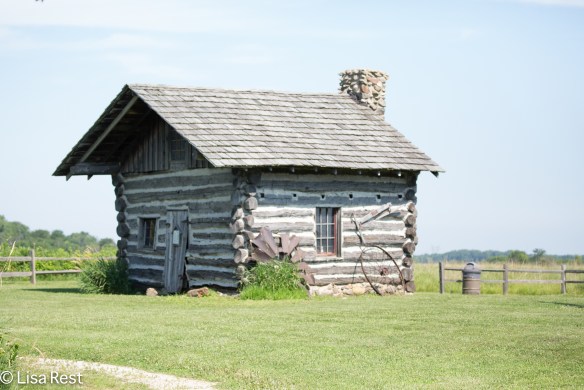
Cragg;s Cabin
One tern flew by. It didn’t stay long enough to fish. There is a big man-made lake nearby, Heidecke Lake, which was formerly a cooling reservoir. That could be where the tern hangs out more often.
A Caspian Tern
Two Great Blue Herons flew by. Likely one of them was the individual below who was fishing from the partially submerged boardwalk that is no longer functional for human use but served this bird’s purpose.
Mallards in flight
Red-winged Blackbirds typically outnumber everything else. But it seems like every place I go, I hear a new vocalization from them. Listen to this little trilly sound below.
Another Song Sparrow…because.
Eastern Kingbirds were the prevalent flycatcher species.
There were a few Field Sparrows, not very close but still delightful to see and hear.
More birds…
American Goldfinch
Common Yellowthroat (female)
Savannah Sparrow
On my way out, a Kildeer flew by.
The last bird I saw was a House Sparrow by the Visitor’s Center.
Another Song SparrowA look across the prairie from the observation deck.
This was only my first outing of last weekend. I came home to do some work later in the afternoon. But I got up and went to the Portage on Saturday morning and back to Goose Lake Natural Area on Sunday. I’ll try to get caught up before summer’s over!
Even though I never go to McGinnis Slough these days prepared to see a lot of birds – which would require bringing my scope – I invariably see something interesting. It used to be a great place for hundreds of Great Egrets and multiple Great Blue Herons, but for the past several years the numbers have dwindled to a few individuals. During waterfowl migration it’s still a place to see good numbers of several species. My last two visits were sort of before and after spring migration. But I like the fact that it’s not crowded. You can’t your bike through it, so that likely keeps people away. And you could miss it driving by at 50 mph on LaGrange Road, even though the entrance is newly paved and there’s a lovely wrought-iron fence, maybe to keep the deer from crossing the highway.
So these photographs are from April 4 and June 7 of this year. From grays and browns in early April to greens and blues in June. April 4 was a good day for Tree Swallows, even if they look washed-out on a cloudy day.
Tree Swallow
Tree Swallow and a Northern Shoveler
Mallard
Blue-winged Teal
Green-winged Teal
The gray and brown was enhanced by a little low-lying fog on the April visit.
I haven’t seen an awful lot of Eastern Phoebes this year. I think flycatchers in general have been scarcer, which I can only assume speaks to the lack of insects. I hope they can recover somehow.
Eastern Phoebe
Eastern Kingbird, another flycatcher
In the tail end of waterfowl migration, some Lesser Scaup were close enough to photograph.
Lesser Scaup
Female Red-winged Blackbird
Song Sparrow
Those white blobs are actually American White Pelicans on the far shore.
The slough was quite marshy in June.
The June visit featured Warbling Vireos chasing around at eye-level, and then one sang for me. I managed to record a bit of his song below after having him pose for all these pictures.These guys are hard to spot normally so I indulged.
I often see Wood Ducks lined up on this fallen log. The June visit was no exception.
Wood Ducks
Baltimore Orioles aren’t advertising for mates anymore so they’re a little harder to spot.
Eastern Kingbird
Going down the path to the north, I encountered a couple does.
There were a few Cedar Waxwings in the same general area as the Warbling Vireos.
Cedar Waxwing
This White-breasted Nuthatch would have been even better if he had turned around.
Red-winged Blackbirds abound.
And in the flying-by department…
Herring Gull
Northern Rough-winged Swallow
Double-crested Cormorants
I’m used to seeing rose mallow, and maybe it will appear later in the summer, but I think this wild iris is new.
Thanks for making it to the end of this long post! We are in for a long, hot, sunny weekend around here. With luck, I will find more birds to share with you.