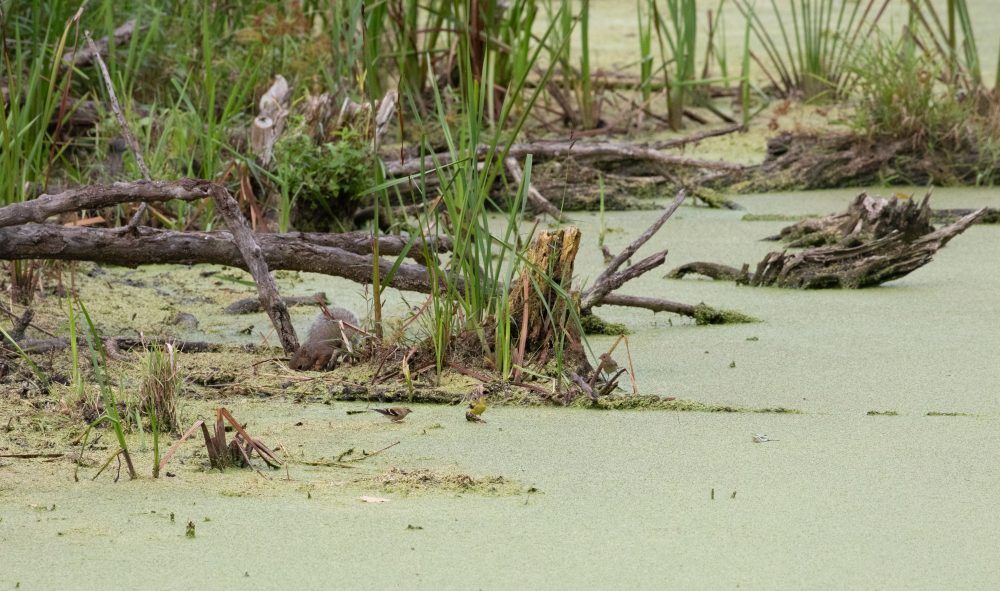
We were scheduled to start our Saturday walks at Thatcher Woods, but the flooding from recent downpours will make walking, not to mention parking there, prohibitive for quite a while. So we went to Columbus Park. It was a chilly and windy morning, but we saw a lot of birds anyway. I found it especially nice to have good views of a Pine Warbler, the bird at the top of the post.
We always start off walking across the big lawn to the edge of the water to see what’s up. There were Wood Ducks and a Black-crowned Night-heron, for starters.
There was also a very chilly-looking Tree Swallow.
Ruby-crowned Kinglets are still happening.
This Brown Creeper was not daunted by the weather,.
White-throated Sparrows are to be expected.
Here are a couple more photos of the Pine Warbler.
Palm Warblers are comparatively easy to see, so maybe that’s why we tend to pass them over later in the season, but I still find them beautiful.
I caught the Black-crowned Night-heron relocating to another spot.
It was a treat to see two Greater Yellowlegs toward the end of the walk.
For what it’s worth, we had some Yellow-rumped Warblers.
We got nice looks at a Great Blue Heron and a Pied-billed Grebe.
As spring always tests my memory for vocalizations I haven’t heard for months, I invariably learn something new. I now recognize the chattery calls of female Red-winged Blackbirds, in addition to the various vocalizations that the males produce.
I will be back with more spring migration photos as the birds start showing up. For the moment, my focus is on preparing for and playing in the annual Spring Music Festival this Saturday night with Linda Rios on flute and Ray Holdsworth and Kate Burch on percussion. I’m looking forward to playing and also to hearing the other performers, especially those I have never heard before. It will be a fun evening for all.
Along the river and beyond, this is the part of summer I always look forward to. I have seen Osprey more frequently the last two weeks, and now that they are hunting over the river in the morning, it’s sheer bliss.
Last Friday morning began auspiciously enough with a Great Egret fishing by the wall left after the dam removal, across from the Hofmann Tower.
As I started to walk along the paved trail, a Northern Cardinal came decidedly into view, perhaps emboldened by his state of molt and the fact that he hasn’t been a constant object of attention lately.
Then, as soon as I got past the trees, an Osprey began flying over the river. It’s hard to decide which photos to include in this post, but rest assured there were way too many of them.
As the Osprey moved behind the trees, I caught a few interesting maneuvers.
Meanwhile, a Great Egret was busy preening on a dead branch sticking up from the middle of the river. The water levels have been quite low lately.
Then, much to my surprise, I encountered a juvenile Black-crowned Night-heron tucked under the trees by the bend in the river where I step off the paved trail to walk through the grass behind the library. This is the first Black-crowned Night-heron I have ever seen on my walks along the river. My friend Chris has frequently told me he sees them periodically, but I had never seen one until Friday.
My walk through Riverside Lawn was uneventful after all that excitement.
The Osprey had taken to sitting on top of a distant dead tree overlooking the river. Since those grainy backlit photos aren’t worth reproducing, I will leave you with two more closer views of the Osprey flying over the river.
I’ll be back soon with more of this sort of thing. Fall migration has already started for shorebirds, and nesting season is coming to a close. We are finally getting some rain, which is good for everything even though it will embolden my jungle which I have to try taming a bit today.
I was hoping to make this post manageable and not too long. These are some of the birds from the last three spring migration walks of the Oak Park Migration Bird Walkers, starting with Thatcher Woods on Thursday, May 30. We got a glimpse of the Great Blue Heron by the Trailside Museum.
Last Thursday was yet another challenge in flycatcher identification. If only it were possible that when these guys all show up at once, they at least announce themselves vocally. We got very distant looks at what turned out to be an Alder Flycatcher. Henry actually heard it.
There was also a Willow Flycatcher.
And I am thankful for Eastern Wood-Pewees having long, fluted tails.
For the record, an American Robin and a Northern Cardinal.
A pair of Blue Jays showed up and put on a little show.
It was a cool and cloudy morning but the lack of light did not dim the plumage of an Eastern Bluebird.
The now-Northern House Wren blended into its preferred surroundings.
We had a somewhat obscured view of a Great-crested Flycatcher, matching the colors of the branches and leaves.
The next day we were at Miller Meadow. Ir’s a huge expanse dominated by non-native, extremely invasive teasel. Somehow the birds tolerate it, even if it frustrates us. We saw one or two Willow Flycatchers.
The wide open expanse often makes this location a favorite of raptors. We had a pair of American Kestrels. They appeared to be using a nest box.
An Indigo Bunting provided a brief glimpse in the teasel.
Wide open spaces are good for Eastern Kingbirds as well.
And a Song Sparrow serenaded us as we walked by.
We had an Eastern Bluebird here too. This is the same individual at the top of the post.
I followed a Killdeer as it flew by.
Someone’s excellent spotting led to the discovery of a female Orchard Oriole by a nest, which I did not see, but I did manage a couple photos of the male when we caught up with him.
And a Red-shouldered Hawk made an appearance at the end of the walk.
The last gathering was on May 31 at Columbus Park. I saw a rather conspicuous Great Egret.
There was a Red-shouldered Hawk here too, perched on the fishing line recycling station by the larger body of water.
A Double-crested Cormorant was drying off its feathers.
We had a first-summer Black-crowned Night-heron in addition to a few adults.
The Great Egret started flying and landed in a tree.
We found a Black-crowned Night-heron in a tree as well.
We had a Least Flycatcher, conveniently identified after the Merlin app heard it first.
Here are two more Black-crowned Night-herons.
We will resume the Oak Park Migration Bird Walks at the end of August. Now that Henry is back in town, I will get a break from leading most of the Saturday walks, but I will likely join the group for most of them.
We are experiencing pleasant temperatures, but have also been under an air quality alert due to the Canadian wildfires. I try not to think about the added pressure on the migrants heading in that direction.
In spite of the anticipated quiet during breeding season, there are still a lot of birds we don’t get to see in the colder months, and I will continue to try to keep up with them. To be continued.
I managed to show up for only two organized walks at Columbus Park this spring with the Oak Park Migration Bird Watchers. The second one was this past Saturday on May 17. The first was almost exactly a month earlier on April 19. Both mornings were overcast, making the birds a little harder to see, but they are perhaps fitting bookends to the height of what we hope to see during spring migration. While migration continues, the warblers are fewer and farther between. I will be back later with other outings that produced more warblers, but first, here’s a roundup from Columbus Park, beginning with highlights from last Saturday’s walk.
We always walk across the lawn and look toward the lagoon to see what’s happening out there first. We found several Ring-billed Gulls and a Caspian Tern, along with an occasional Canada Goose on the “island.”
There was also a Great Blue Heron on another, smaller island.
After trying to no avail to make one of the gulls into another species, we began paying more attention to the trees, watching for movement. We began to see some American Redstarts in varying plumages. I got photos of what appear to me to be first spring males, differentiated from females by splashes of black on the face and breast.
To better illustrate the point, but unfortunately with less-clear photos, check out the two pix of the bird below.
I also captured a very pale female individual. These look like young birds, taking a little longer, perhaps, to leave for their first spring migration.
Later, I caught the face of another interesting-looking first-spring male.
We eventually started seeing several flycatchers which I tried to capture and for the most part, figure out later. Flycatchers can be really confusing to identify. One bird that had its back to us was a little difficult to figure out until I was finally able to see a little yellow on its belly feathers later. I also check the bill shape, arrangement of the wingbars, whether there’s an eyering, and general overall appearance, such as how the bird carries itself. It’s a lot easier if you can place a vocalization with a flycatcher, in particular the empidonax species, but we didn’t get very lucky with calls despite many Merlin apps listening. Merlin did hear an Alder Flycatcher, and there might have been one, but I didn’t find it in my photographs.
That said, I used several sources to finally determine some of these IDs. The bird below turned out to be a Yellow-bellied Flycatcher.
My head full of flycatcher photos, I didn’t figure out this one until later when it occurred to me that it had to be an Eastern Phoebe. I’ve been looking at Eastern Phoebes for a month or morel, and yet in the presence of several other species it appeared confusing.
In between the flycatchers, we caught fleeting glimpses at Magnolia Warblers
Returning to the flycatchers, we had a Willow Flycatcher or two. Merlin was helpful with this ID, first telling us the species was present. Again, I am generally quite familiar with Willow Flycatchers, or so I think, but I have to admit it’s more often been where I expected to see them.
To make matters more confusing, here is an Eastern Wood-Pewee. I just started hearing this species, anticipating its return. I am happy to start seeing them.
We saw several Canada Goose families on the lawn as we walked around toward the wildflower garden and the trail that runs through it.
Once inside the wildflower garden enclosure, we saw hardly any small birds, but we noticed a Red-shouldered Hawk in the distance. I should probably take a moment to mention that as of yet we saw only foliage and no wildflowers as it is too early for the natives.
The sequence of my photos tells me I must have seen this Least Flycatcher nearby.
A Mallard was resting inside a log.
A Double-crested Cormorant flew by.
Then, as we started to approach the end of the little winding trail through the wildflower enclosure, we saw a backlit heron that, as we started to approach closer, appeared to be a first-summer Black-crowned Night Heron.
Sitting down low by the first summer bird was an adult. This is the same individual at the top of the post.
And down by the water in the same area was this beautiful individual. This is a cropped closeup of the same bird in the header. In all, we reported five Black-crowned Night-Herons. Since they forage at twilight and at night, then can sit so still during the day, I often wonder if they are asleep with their eyes open.
Now here’s a little roundup of the first visit back in April, for comparison purposes only – I was a bit surprised to find I had never reviewed or processed the photos, and I apparently forgot before taking them to adjust the exposure i my camera settings, so I had to lighten up most of them…
Here’s what the “island” looked like that day. One indomitable Caspian Tern and a few Canada Geese.
We spotted a Black-crowned Night Heron sitting at the edge of a planned island in the lagoon.
Throughout the morning I was paying attention to the Caspian Tern(s).
This was the beginning of spring warbler migration. Basically, all we were seeing on that cool, cloudy day were hearty Yellow-rumped and Palm Warblers. However much we take them for granted, they are still beautiful little birds.
Magnolia Warbler
The Palm Warbler below started out singing.
Among other birds that day, we saw a Pied-bllled Grebe.
We can nearly always count on a Great Blue Heron.
An Eastern Phoebe, that earliest of the flycatchers, had returned. Here it doesn’t look particularly like anything at all, but we likely heard it vocalize. Lighting, posture, everything comes into play.
I was surprised to find photos of a Ruby-crowned Kinglet with just a hint of the elusive ruby crown. The crown was a hard thing to see this spring.
We were also introduced to the location of a Red-shouldered Hawk nest. All we could see at the time was the adult’s tail. This nest likely belongs to the bird we saw sitting in a tree on May 10.
For what it’s worth on such a gloomy day, a Red-winged Blackbird’s perch on a stump must have attracted my attention.
And toward the end of our walk. we were fortunate enough to see a Swamp Sparrow. Although not rare, they are less common.
I am not scheduled to return to Columbus Park until the fall migration walks begin, but I might be tempted to take a walk through before then.
We have a forecast of rain and possible storms all day today and tomorrow, and possible into Thursday. We did get some rain overnight which was at least enough to wash the dirt off my car from the rare dust storm on May 16 – yes, that’s right, a dust storm. I am taking advantage of the rainy forecast to get caught up with photos, posts, mail, laundry, cooking. It’s not raining presently, so I put the bird feeders back out in the yard. After a short-lived heatwave last week, we are now experiencing cooler-than-normal temperatures this week, making gardening a little precarious as I don’t want to disturb the bees, for instance. But for now, I’ll settle for rain as we really need it. Send in the clouds.
It was cool enough on Sunday morning to return to the Chicago Portage. Rain from the night before had cut through Saturday’s oppressive heat.
Of course, I was looking for the Black-crowned Night-heron. As I was walking the main trail after the first turn, I thought I saw something in the distance near the edge of the water. It was the heron with its back to me.
It turned its head around but was still difficult to see at that distance. I hoped to catch up with it later.
Luckily I did find it again and I was closer to it, but its back was still toward me. There was a lot of tedious preening on the heron’s part.
Eventually it decided to start looking for food, an errant feather still tucked in its bill.
Then it started its slow, graceful hunt.
Not much else to report but I made note of a few things, like the clouds.
And there was a Ruby-throated Hummingbird perched out on a limb of a dead tree by the bridge.
A Northern Cardinal stood out in the green.
A different dragonfly. This is a Black and White-winged Dragonfly.
While I’m at it, I’m going to clean up a few photos from two earlier June visits. On June 4, there were more insects.
Pearl Crescent ButterfliesSix-spotted Tiger BeetleCommon Whitetail Skimmer female
Then way back on June 1, it was all about Indigo Buntings.
Tadziu was also on hand that day.
I may still get over to the Portage sometime this week if the weather permits to see how things are wrapping up for the very end of June which has been a busy month for the breeding birds. Here’s one more photo of the Black-crowned Night-heron.
The last time I was at the Chicago Portage was on Thursday morning. We were experiencing a brief respite from the heat. Soon after I started walking, I was surprised to see a Black-crowned Night-heron fly overhead.
I was hopeful, but never knowing what to expect, I first checked the spot on the water where herons like to fish and saw nothing. I walked back to the bridge closest to Harlem and apparently flushed another Black-crowned Night-Heron that was likely right near the bridge.
As I walked along the trail trying to spot a heron, I found other creatures. I haven’t seen this butterfly in a long time and it was pretty far away, but I managed to get an image.
Great Spangled Fritillary
American Robins are now starting to show up not just as adults, but offspring as well.
Backtracking here for a moment, I memorialized European Starlings were guarding their nesting spot on the statue when I first arrived.
When I did my list, I thought I had not seen or heard a Great-crested Flycatcher, but I found one in my photos later.
Other residents made brief appearances: a Northern Cardinal and a Red-bellied Woodpecker.
But when I got around to the heron spot again, on my last trek past it, I found a Black-crowned Night-Heron after all. It could have been either of the two I saw before or perhaps a third. The first photo below might give you an idea of how far away I was standing with my 400mm lens.
I was tempted to go back this morning, but after I went outside to fill the feeders, I determined it was already too hot. We may get some storm activity later this evening and things will cool off a bit. We could sure use some rain along with that.
The last time I saw herons at the Portage was way back on June 6. As I started walking the trail, I found a Green Heron that was close but difficult to photograph through the tall grasses.
A male Baltimore Oriole was doing his best to stay hidden.
Common Whitetail dragonflies have been abundant all month.
But just as it seemed not much more was happening, a Great Egret flew in.
Soon it became apparent that the Red-winged Blackbirds were going to be a problem for the Great Egret. I started walking away.
As I walked past where the egret had finally claimed a spot, I was able to barely capture it through the vegetation.
I did also have a Great-crested Flycatcher that day.
And a Northern Flicker flew by for good measure.
It was still party time for Brood XVII of the periodical cicadas. They are pretty much over by now.
Every day feels like starting over with this hot weather. While the over-the-top temperatures are disorienting to my routine, I don’t have to read too many articles about heat-related deaths and the dangers of heatstroke to remain cautious and stay inside. There are still plenty of things to do. I might be back sooner than later. Stay safe wherever you are.
After groveling about making the long drive all the way up to McHenry County around Memorial Day, I went back on July 5th to celebrate my birthday and then again on July 25th. Needless to say now I’m getting used to the drive and the trail and I may have a hard time staying away before October which is when I plan to go back for Sandhill Cranes that purportedly congregate in the fallow farm fields.
I feel like I could start giving some of the individual birds names, like the Willow Flycatcher at the top of the post. I even heard a confirming “fitz-bew” on the last Saturday.
Yellow-headed Blackbird (female)
Yellow-headed Blackbird (male)
I expected to see more Yellow-headed Blackbirds. On the fifth, the males were really too far away for decent photographs, but I did get to see a female close to the observation deck. I went back on the 25th because I wanted to see many juveniles like I did years ago, but I couldn’t find one Yellow-headed Blackbird anywhere. I must have just missed them. But that’s okay, because I saw some other interesting birds, and it’s just so peaceful to be there. In fact on the second visit when I got there, I had the whole place to myself. I didn’t stay long though because it was very hot.
Pied-billed Grebe
I found the Gallinule below in my photographs from both visits. This is a great place to go if you carry a spotting scope. But I don’t have the energy to carry a scope and a telephoto lens. Perhaps I should rethink my philosophy of cutting corners. For instance, the combination of two visits in this blog post – it’s becoming evident as I write it that it’s entirely too long.
Common Gallinule
I did see a pair of Sandhill Cranes on each visit. I have not seen any with offspring, which is a bit disappointing.
Sandhill Cranes
Another “only in my photos” discovery – a last Black Tern seen on the 5th. Well, my camera saw it.
Black Tern
Here’s the turtle covered with duck weed that appeared in the background of one of the Yellow-headed Blackbird photos above. If you click on the pictures you can see how the duck weed makes it look like something from another planet.
There are still a lot of Red-winged Blackbirds here and everywhere. They are in no hurry to leave, I suppose, because they won’t have so far to go in the fall.
Red-winged Blackbirds (mostly juveniles)
Not a Red-winged Blackbird but a juvenile Cedar Waxwing
I was hoping I would find a Yellow-headed Blackbird when I blew this up but it turned out to be a Red-winged Blackbird. That’s okay, it’s kind of nice to see the feather pattern, albeit faded. Below the photo, two different Red-winged calls I heard on these visits.
A Killdeer in flight…
The “other” blackbird – Brown-headed Cowbirds.
Dragonflies like this place.
On both occasions there were swallows, but in particular on the 25th there seemed to be a lot of them. It was nice to see the Bank Swallows – I don’t see them very often.
Barn Swallow
Bank Swallow
The Song Sparrow below was on the 5th. There are two more individuals further down the post whose songs I recorded and put underneath their photographs.
This Yellow Warbler was the last one I saw, on the 5th.
Yellow Warbler
I am quite sure this is probably the same Great Blue Heron, although the photos are from both occasions.
I always seem to startle this Great Egret, which must have been right by the viewing platform as I approached.
A Green Heron flew by twice on the 25th.
Here’s Song Sparrow No. 1 and Song Sparrow No. 2. Song Sparrows reportedly have thousands of songs so it’s not unusual that they were singing different tunes…
And another singer I was happy to record – and manage to photograph, as they are often elusive in the marsh – a Marsh Wren.
My most cooperative subject at this location has been a Willow Flycatcher.
Willow Flycatcher
There were a couple distant Wild Turkeys hanging out not far from the Sandhills on the 25th.
Always happy to see a Monarch Butterfly… – I stand corrected. The two on the left are Viceroys!
I think it might be a ground squirrel on the left… there are holes on the trail that look perfect for a ground squirrel. But they could both be Chipmunks…
I found this feather interesting on my walk back to the car on the 25th. I thought it might belong to a hawk or a turkey, even, but none of the extensive feather identification webpages have given me the answer. My first thought was a crow, actually. Maybe I should go with that…
My reward for showing up on the later visit was to see these two Black-crowned Night-Herons arrive and perch not far from the viewing platform. One is an adult, and the other a juvenile.
Black-crowned Night-Herons (adult and juvenile)
Many thanks for making it to the end of this long post. As hot as it was a week and a half ago, as I finish writing this, we have dropped down into fall-like temperatures for a couple days. A reminder. I suppose, that nothing stays the same, as if I needed it. No, honestly, it’s absolutely delightful to have the windows open: I feel less confined and it’s delightful. Stay safe and I will see you again soon in another post. 🙂