It’s time to seriously think about fall. The fall migration bird walks have begun, anticipating the birds gracefully bringing us into the autumnal season as they have in the past. August at the Chicago Portage has been quiet, the summer breeding birds having all but left and the migrants from the north starting to pass through. Here’s a little compilation of some birds I managed to see and photograph at the Chicago Portage with the smaller camera.
Starting with August 4, the Bird of the Month has to be an American Goldfinch. They have been everywhere.
On August 8, I got a rare view of a Muskrat.
Indigo Buntings were abundant, the adults were getting ready to leave.
On August 18, I encounted a White-tailed Deer doe and one of her fawns.
Eastern Wood-Pewees have been constant all summer. I will miss their sweet little songs cascading through the woods.
I’m always happy to see a butterfly. This is a Hackberry Emperor.
On August 20, I saw a juvenile Blue-Gray Gnatcatcher and a few Cedar Waxwings.
I found a juvenile Red-bellied Woodpecker.
Turkey Vultures were on the move.
I saw my first fall warblers that day, with a couple Blackburnian Warblers easiest to photograph.
On August 22, right by the little bridge near Harlem Avenue, I was joined by a female Ruby-throated Hummingbird who was enjoying a patch of Jewelweed.
On August 23, I saw a Black-and-White Warbler and a Blackburnian Warbler.
A Northern Flicker was checking the “flicker” tree, perhaps to see if anyone was left behind.
I saw Eastern Wood-Pewees again.
On August 25, I saw a juvenile Indigo Bunting.
And again on August 27, another late Indigo Bunting.
I took note of a Pearl Crescent butterfly.
Northern Flickers will continue to be quite visible throughout the fall.
And just when I had given up on seeing any more birds, this juvenile Red-tailed Hawk flew right overhead and I complied. I have found the Sony RX10 to be great at focusing on birds in flight against a clear background. I am glad I finally got some good use out of this camera. I may have to learn how to use my Canon set up all over again…
While we’re waiting for fall passerine migration to properly distract us, here are some photos from the last month taken in various places. Well, it was almost August – starting withJuly 31 a the Chicago Portage.
Butterflies and flowers made an impression on me. I saw a Silvery Checkerspot Butterfly, a blossom on a Cup Plant growing near the bridge closest to Harlem, and a Zebulon Skipper Butterfly.
I noticed a very young American Robin.
And a fawn made a brief appearance.
Indigo Buntings were starting to wind down.
I managed to capture a couple Barn Swallows in flight.
Then Indigo Bunting juveniles began to show up, like the one below.
Two more butterflies, an Eastern Comma and a Monarch.
A Turkey Vulture flew overhead.
And an Osprey made a brief, if distant, appearance.
On August 26, nearly a month later, at the Chicago Portage, I noted a Downy Woodpecker.
I saw a Tennessee Warbler.
I also caught glimpses of a Blackburnian Warbler and another Tennessee Warbler.
The Common Grackle below looks like a young bird.
And I had nice looks at a female Baltimore Oriole, who is also featured at the top of the post.
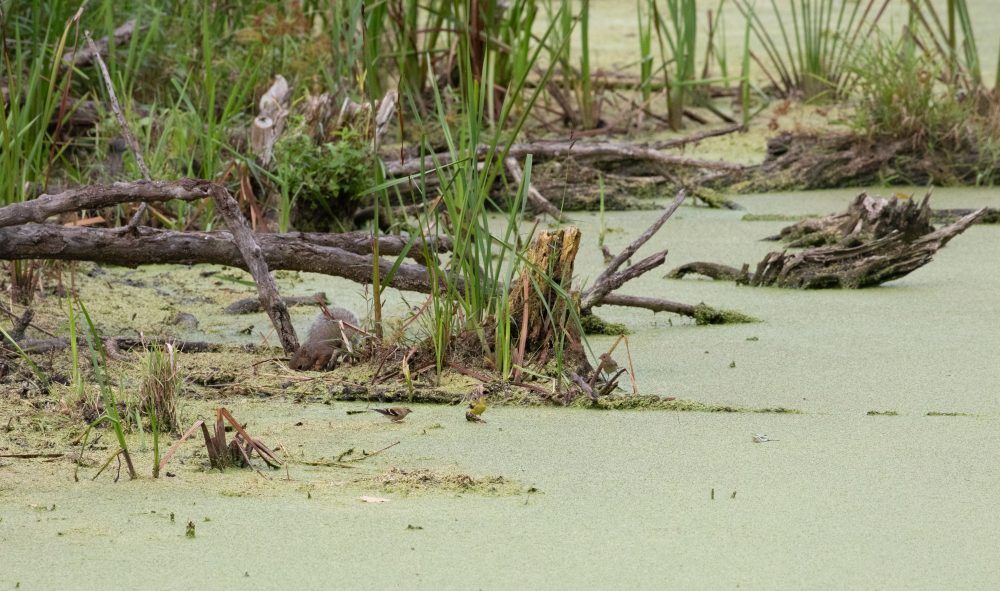
American Goldfinches were foraging in the duckweed, as usual.
I caught a glimpse of a Warbling Vireo.
And here are just a couple photos from a visit on August 17 to Deadstick Pond and Big Marsh with Joann and Steve. We spent most of our time trying to identify shorebirds which I never got halfway-decent photos of, so here are a few other things.
It was possible to get a couple Killdeer photos.
And I have a hard time ignoring Caspian Terns.
It’s always good to see a Green Heron.
A look at a juvenile Barn Swallow.
And I got a rare look at a not-so-rare bird – a Northern House Wren.
Good looks at a juvenile Common Yellowthroat…
And there was a juvenile Indigo Bunting.
For the most part, birds are moving around in flocks. I have managed to see a few stragglers here and there over the past few days, but fall passerine migration, and more specifically warbler migration, has barely begun. There are reasons for optimism, however. Tomorrow’s forecast is for rain, possibly stormy weather, and with winds from the north, cooling down. I’m hoping for a little fallout at the Chicago Portage on Thursday. We shall see.
It’s been pretty quiet at the Chicago Portage lately, but that’s not surprising.
On August 5, I first noticed an Eastern Kingbird flying off with a cicada.
A Blue Jay was in flight too. Looks like it was on the cloudy side.
American Goldfinches still like hanging out in the duckweed.
Butterflies and dragonflies are having a good time, I think.
I think this is a Hobomok SkipperFemale Pondhawk
Normally Gray Catbirds are quite elusive, but this one wanted to do a photo shoot.
Back down on the ground, I saw an interesting caterpillar.
American Dagger Moth Caterpillar
Sort of along the same color scheme, a turtle covered in duckweed stuck its head up from its shell.
I found a young Northern House Wren.
And I caught a very brief view of a Muskrat.
I had a singing Indigo Bunting, for good measure.
Hackberry Emperor butterflies seem to like bridges and walls.
I was taking not great photos of a young Northern Flicker at a distance, when it suddenly left, upside down.
Two days later, on August 7, things were even a bit quieter. I focused on a bee checking out the prairie coneflowers.
And I found a Pearl Crescent Butterfly.
Pearl Crescent
A Blue Jay looked pensive and very blue behind the leaves.
Then, an Osprey flew over, carrying a strange-looking object. It doesn’t appear to be prey, but perhaps nesting material. But who’s nesting in August?
A short while later, another Osprey came flying through with a branch. I’ll never know. I think it might be nest repair, after the kids fledged and tore it up. Getting it ready for next year?
I found a juvenile European Starling and a female Red-winged Blackbird.
A juvenile American Robin flew at a distance.
Here are two Indigo Buntings, a female or more likely an immature bird, and a male.
And an Eastern Comma Butterfly for good measure.
I still have to make more room on the hard drive so I will try to be back again sooner. A new wave of extreme heat and subsequent rain should make that even more possible.
Before I get caught up with the past week, here are some reflections from July 30 and August 1. I was just starting to see Great Egrets again on the river. The fewer the birds, the more I take notice of the ones I do see. July 30 started off quietly enough. I first noted a Mallard on a rock.
As I started walking along the paved trail in Riverside, some Blue Jays drew my attention to a Cooper’s Hawk across the river.
A Great Egret was fishing.
Canada Geese gathered in their favorite beach spot along the river just past the swinging bridge.
When I crossed the bridge, I saw Cook County Forest Preserve workers busy shredding wood and brush.
I had to get past them to avoid the newest obstacle on the trail not far from the entrance spot where they were working. When I first encountered this earlier, I managed to crawl underneath it, but my knees were cracking loudly and I have decided to avoid this fallen tree. I can check on it easily when I get past it going in the other way, to see if there’s been any change in the situation.
Nothing much was going on in Riverside Lawn that morning. I saw a deer.
Perhaps the presence of the Cooper’s Hawk sitting in another tree made things quieter.
I encountered one of my favorite butterflies, a Hackberry Emperor.
When I got back to the wall overlooking the river by the Hofmann Tower, I found a Canada Goose trying to do back flips,
Two days later, on August 1, I first saw a Great Egret across from the Hofmann Tower.
After I crossed the street to go over the bridge toward Riverside, a Belted Kingfisher flew by.
The busy Indigo Bunting who’s been singing off the paved trail was in fine form that morning.
I found a Northern House Wren perched high atop a dead tree.
Then, while I stood talking with a new acquaintance, I took note of several butterflies in the swamp milkweed.
Cabbage WhiteClouded SulphurFiery Skipper
I was keeping an eye on Great Egrets.
A Double-crested Cormorant was hanging out with some turtles.
Two Canada Geese, one balancing on one foot.
As I crossed the bridge, a Cedar Waxwing came into backlit view.
I saw a Mourning Dove in a favorite spot.
That morning there were House Sparrows in the Wild.
A Song Sparrow was trying to not let the heat get to him too much.
Then in Riverside Lawn, it was butterflies and damselflies..
Zabulon Skipper
The Blue-fronted Dancer Damselflies seem to delight in my presence.
I’ll be back next with the return of the Osprey(s).
It has been disorienting to wake up every morning wondering whether I should go for a walk or not, and if not, how to plan the rest of the day. I have become such a creature of habit, if I don’t have a plan, it’s depressing, so I try to have likely alternatives for the next day sketched out before I go to sleep. It may sound simple, but the overwhelming heat has made it somewhat daunting. It’s not that I don’t have other things to do. But a walk in the woods or by the river centers and grounds me in a way that helps to make everything that follows fall into place.
Here are some photos from three recent visits to the Chicago Portage, starting with June 17, a bunny rabbit and a cabbage white butterfly.
We always hear Common Yellowthroats singing, but rarely see them. I believe there are two males with distinct territories at the Portage. I was standing at the top of the “hill” looking over the marsh and the water down below and heard one of them singing not too far away. It was not easy to capture his image, but that he was visible at all was remarkable, and he was so enthusiastic.
I captured a couple Red-winged Blackbirds in flight through the marshy area, and caught a glimpse of a deer.
A Northern Flicker seemed interested in the nest hole used last year, and I managed to see the Indigo Bunting I now call “TJ”.
On June 19, an American Goldfinch stood out for a moment.
I saw a couple Cedar Waxwings. I’ve been on the lookout for them.
The Common Yellowthroat at the top of the post is also below, where he was perched and sitting quietly not far from the bridge near Harlem. This is the second male. As I walked around and got to the opening in the fence, I took a peek at the water levels by the river after recent rain.
A male Red-winged Blackbird was hamming it up on the little bridge at the other end of the dirt trail.
I saw some Indigo Bunting action in the vegetation. I was unable to capture a female well, but the males were on display.
I wonder if this is the same turtle that I always seem to see covered in duckweed.
I got good looks at a Yellow Warbler, but I think it was the last time. I suspect they are still here but I have not heard or seen them lately. No doubt they are busy raising families.
One more American Goldfinch sat still.
On June 24, the first bird I found was an Indigo Bunting singing his heart out.
Two Pearl Crescent butterflies appeared: one with badly damaged wings, another in fine shape.
I caught a glimpse of a Red-winged Blackbird female in the marsh.
As I walked back along the paved trail, I found a female Orchard Oriole. I haven’t seen a male in a month or more, but this gives me hope.
A Great Blue Heron flew over.
I have taken to sitting on the picnic table placed under a tree by the water. Often enough, when I am sitting there looking for activity or just chilling, a bird comes into the tree above me and visits for a while. This time was no exception. A juvenile White-breasted Nuthatch offered its company.
Here’s one more photo of an Indigo Bunting. I like this photo because it shows off the blackness of his otherwise blue-appearing feathers.
I will be venturing out less frequently for walks in the next couple of weeks, thereby modifying my routine. One reason is the weather. The other reason is that it is time to try to clean up and contain the immense overgrowth in my front and back yards. I inadvertently have added incentive to do this work, as I found a citation from the city on Friday in my mailbox, demanding my appearance in municipal court on July 16. What convenient timing! I talked with my new alderman today to voice my concerns and sent him a copy of the citation. He will investigate and get back to me. In the meantime, I am enjoying seeing the fireflies in the early evening, and also welcoming back other insects and pollinators as well, even as their numbers seem greatly reduced. I did my part to insure their survival by not cleaning up my yard any earlier this year. I doubt I will have an opportunity to educate the magistrate at my hearing about climate change and the environment, but I am still glad I have a habitat to offer the birds, butterflies and bees.
I would have gone to the Chicago Portage this morning if it hadn’t started raining. The rain stopped early, however, and did not amount to much. I am tired of living under the threat of heat and rain, but the humidity is certainly real. In cooler weather, these decisions would not consume so much of my mental energy. Suffice it to say after I refilled the birdbaths and one of the hummingbird feeders, I decided to devote myself to grocery shopping. I need to get over feeling guilty for not taking a walk, so I will try to do a blog post instead.
My last visit to the Portage was on Tuesday morning. In spite of the fact that I encountered perhaps 10 cyclists on the paved parts of the trail, it was otherwise relatively quiet and I saw quite a lot in a little over an hour of a slow summer morning.
Pearl Crescent butterflies were prevalent.
It was nice to see this Delaware Skipper.
I have been following a snail’s progress for a few visits. The photos below are from July 23, July 25 and then on July 30.
A Chipmunk appeared on a branch close to the trail and insisted I take its photograph.
I did manage to capture a couple Indigo Buntings. First, a juvenile, and later, Tadziu on his latest favorite perch off his bridge.
There were a couple Red Spotted Purple butterflies. The one in the third photo unfortunately had some chunks taken out of its wings.
The Northern Flicker below blends so well into the tree stump, it’s a challenge to see it.
I haven’t seen or even heard too many Red-bellied Woodpeckers lately but I did find this young-looking one.
The challenge this time of year is often with identifying some juvenile birds. This Baltimore Oriole wasn’t hard to identify but it was quite far away.
American Goldfinches have been attracted to the duckweed.
When I went back to check the bridge near Harlem before I left, I saw two ducks I quickly assumed were Mallards but later when I cropped the photo, I realized they were actually Blue-winged Teal. Could be a pair, with the male in eclipse plumage looking just like the female.
This is the same Blue Jay at the top of the post. It looks like a young bird to me.
This Red Admiral butterfly on some blooming burdock was not shy. For as much burdock as the volunteers have removed, it still persists in a few spots.
I was done then, I was sure, but I decided to walk back along the paved trail and out the other side. My extra walk was rewarded by a look at a Ruby-throated Hummingbird.
Not too easy from this distance, but I managed to get a few images before another pair of cyclists came through. You have to use your imagination on the last photo.
My last reward was a Tiger Swallowtail on the paved trail, attracted to one of several piles of dog poop. I have cropped out as much as I could so you could see the butterfly. I had seen someone coming out from the trail walking three dogs when I first arrived. But I have never seen this much mess left on the trail. I’m hoping for enough rain to at least wash it away.
So that’s it for my last visit. Next, I will backtrack through some others that proved interesting. The forecast for tomorrow morning is again for rain, but I’ll believe it when I see it.
Last Thursday morning it was nice outside, so I decided to go to the Chicago Portage, but it was closed. I continued on to McGinnis Slough to see if maybe I could check on the Trumpeter Swans or the Wood Ducks. As it turns out, I saw neither. The slough is incredibly overgrown. I definitely heard more birds than I saw.
When I opened the hatch of my car to take out the camera, I was dismayed to discover I had grabbed my older camera body with the smaller lens attached, so perhaps it’s just as well that there weren’t too many birds to focus on.
McGinnis Slough
What few photos I managed are here.
American Robin – juvenile
A young-looking Downy Woodpecker was figuring out its feathers.
A Great Blue Heron flew past me. There was also one Great Egret in a tree but I could not capture it adequately with the smaller lens. It appears in my header for this post.
Another Great Blue was standing in what is left of the water.
A few Mallards had gathered as well.
I managed to capture a couple dragonflies.
Common WhitetailBlue Dasher
The moon stood still for me.
Then, just as I was leaving, a Green Heron flew into a tree, and out again to another perch
When I came home, I found some activity in the front yard. The Common Milkweed is in full bloom – and scent – and the Pink Coneflowers have opened up as well.
Later on when I was in the backyard, I was thrilled to see a Hummingbird Moth, also known as Clearwing, on the Bergamot I planted last year. Everything has grown so tall in the yard this year, it was often at eye level. With my phone, I captured glimpses of the moth in the video below.
My next visit to the Portage clarified the reason for the closure. The lines between the parking spaces all received fresh paint. There are also new plantings around the statue.
I will be back with more slow summer adventures soon. We have been in the midst of a cool-down which is blissfully welcome. Even the predicted increasing temperatures don’t look so terrible, yet.
It was cool enough on Sunday morning to return to the Chicago Portage. Rain from the night before had cut through Saturday’s oppressive heat.
Of course, I was looking for the Black-crowned Night-heron. As I was walking the main trail after the first turn, I thought I saw something in the distance near the edge of the water. It was the heron with its back to me.
It turned its head around but was still difficult to see at that distance. I hoped to catch up with it later.
Luckily I did find it again and I was closer to it, but its back was still toward me. There was a lot of tedious preening on the heron’s part.
Eventually it decided to start looking for food, an errant feather still tucked in its bill.
Then it started its slow, graceful hunt.
Not much else to report but I made note of a few things, like the clouds.
And there was a Ruby-throated Hummingbird perched out on a limb of a dead tree by the bridge.
A Northern Cardinal stood out in the green.
A different dragonfly. This is a Black and White-winged Dragonfly.
While I’m at it, I’m going to clean up a few photos from two earlier June visits. On June 4, there were more insects.
Pearl Crescent ButterfliesSix-spotted Tiger BeetleCommon Whitetail Skimmer female
Then way back on June 1, it was all about Indigo Buntings.
Tadziu was also on hand that day.
I may still get over to the Portage sometime this week if the weather permits to see how things are wrapping up for the very end of June which has been a busy month for the breeding birds. Here’s one more photo of the Black-crowned Night-heron.
I managed to visit the Chicago Portage briefly yesterday morning before it got too hot. It was cloudy, which helped with the temperature if not with photographs, and it was quite windy as well. We are promised slightly cooler temperatures tomorrow so I might go for a walk there again, although the heat and lack of rain has really slowed things down considerably. Below is what the sky looked like yesterday morning. We have had blistering sunshine since.
Here are some photos from my last 3 visits, starting on June 8, June 11 and yesterday, June 18. To start, there was not much happening on the 8th. I first encountered a doe.
The dragonflies and butterflies were posing on the gravel path ahead of me.
Common Whitetail Dragonfly femaleRed Admiral
There was a female Baltimore Oriole at work in a tree.
I eventually wound up sitting on the bench of the picnic table that has been down by the water. Looking across to a dead tree stump, I noticed some activity with a couple Northern Flickers. It turned out they had a nest hole and were feeding young. I was reminded of the first chapter in Bernd Heinrich’s book, One Wild Bird at a Time, in which he described his observation of a pair of Northern Flickers nesting in his cabin wall. He estimated the parents made 32 trips a day to feed the nestlings, for a total of 700 feedings over a 22-day period.
When I returned to the Portage on the 11th, there was again some activity at the nest hole.
Here’s what the Portage looked like that day.
I caught a glimpse of a Yellow Warbler. I have heard them on every visit but don’t see them often now.
I was surprised to find two American Crows, a juvenile and its parent. The juvenile is below. I had a harder time spotting the parent but I could hear its calls.
I managed to find Tadziu, the Indigo Bunting on my way out. Unfortunately he was not in a very good spot for a photo.
Then yesterday, the heat and lack of rain was taking its toll.
It was cloudy, and so bird photographs were nearly out of the question, except for the cooperative Indigo Bunting at the top of the post and again below.
I tried to capture a female American Goldfinch.
Then a Great Blue Heron flew by, providing only its silhouette.
Dragonflies and butterflies, again, here and there.
Eastern CommaRed Admiral
12-Spotted Skimmers were everywhere.
For good measure, a rare Red-winged Blackbird – rare only because they are everywhere unseen these days.
Just as I was turned around to leave, a fawn appeared on the path in front of me.
I didn’t see her mother around, and barely captured her image as she took off.
So even in the dead heat and lockdown of breeding season, life goes on at the Chicago Portage. I will continue to walk when I can, but for now the heatwave continues, and I have a weekend full of social engagements. I hope to return soon.
The end of May brought the cicadas, the end of spring migration and a settling down into warmer temperatures and longer days. It portends a long summer season with a lot less activity and more leaves on the trees.
We have had so much more rain than last year’s drought, it seems as if plants are making up for it. That, combined with early warm weather, has accelerated growth and the flowering and fruiting season. Mulberries are already staining the cement. My currant bushes are laden with fruit. And it seems like after every rain, I have to eliminate more plants to walk through the backyard.
Here are photos selected from 3 consecutive visits to the Chicago Portage on May 25, May 28 and May 30.
On May 25, I was happy to see the Green Heron at one of its favorite fishing spots, hanging out on a log with the turtles.
An American Goldfinch was foraging in the duckweed.
And a House Wren was having a quiet moment.
On May 28, I saw the Green Heron again.
Cicadas were impossible to ignore.
Galls were already on the leaves of a hackberry tree. The galls provide a treat in the fall when the warblers come back through.
The bottomlands close to the Des Plaines River have been flooded most of the time.
I found another House Wren.
A distant Hairy Woodpecker
I often encounter American Robins along the trail.
On May 30, my first subject was a young doe.
Two Canada Geese were hanging out with the turtles.
A backlit Indigo Bunting looks nearly black.
I followed a female Brown-headed Cowbird. She matched the color of the branch she sat on.
I had an early Cicada pinup.
I caught a Gray Squirrel with cicada-mouth.
Swallows were flying over the marsh. I managed to photograph a Tree Swallow and then Northern Rough-winged Swallows.
Baltimore Orioles aren’t as easy to see now that they’re nesting.
I found a distant Northern Flicker scaling a dead tree.
Butterflies started to emerge.
Pearl CrescentTiger Swallowtail
Red-winged Blackbirds are everywhere but not always visible either.
I found a female American Goldfinch in a tree.
And then another down by the water.
One more of the very blue-looking Indigo Bunting at the top of the post. In case I haven’t mentioned it before, their feathers are actually all black and the degree of blueness is what you see in light reflection.
The breeding birds are in place. The cicadas are everywhere. The days are getting longer and waking up at 5:00 AM now feels normal, unless I remind myself that had we not set the clocks ahead, it would be 4:00 AM. I’m going back to writing a book, in between navigating a calendar full of summertime concerts and gatherings. And gardening, looking for birds, playing piano, swimming and blogging, of course. Sometimes all I can do is take a nap.