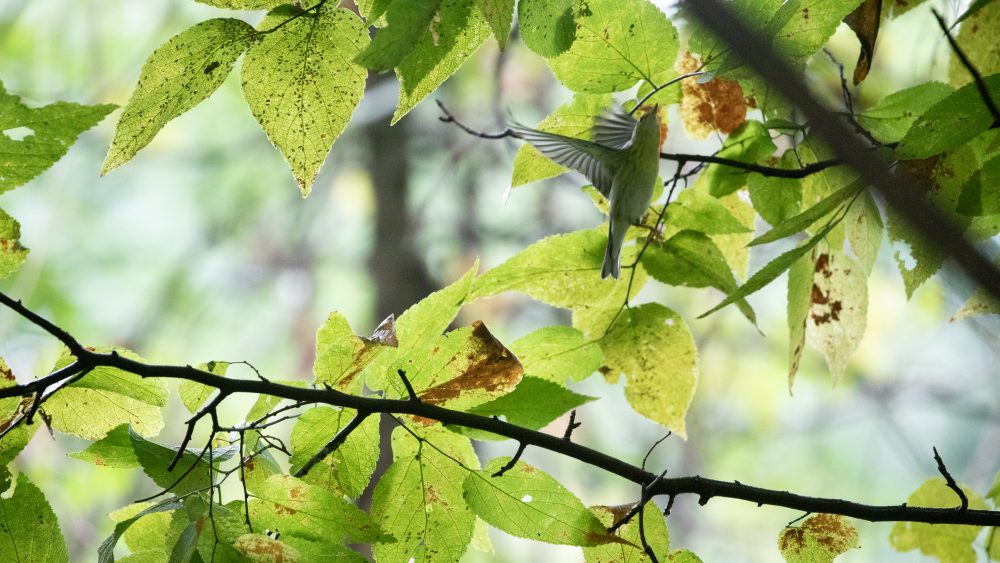


It’s been a busy week. While the days are getting shorter, fall weather is suspiciously in exact sync with the calendar, and evidence of passerine migration has picked up on the ground, making for some long-awaited encounters. But first, here’s how the Chicago Portage appeared on September 15, looking back at the bridge near Harlem.

Of course the Portage attracts creatures more than birds. But below the young doe, two year-round residents were present: a Hairy Woodpecker and a female Northern Cardinal.


And then, I started seeing Blackpoll Warblers. A lot of them must have come through our flyway, because I have been seeing them consistently and in numbers. However confusing they may look in the fall, with no “black” poll to relate to, they consistently have orange-to-pink colored feet which always distinguishes them from everybody else. And after a while, maybe, you start to notice what their face looks like, or the way their feathers are arranged, and you can sense their identity before the confirming feet.


Below, a glimpse of a Gray-cheeked Thrush, and a juvenile Indigo Bunting.


I never turn down a Magnolia Warbler.


Then the Black-throated Green Warbler, also at the top of the post, appeared. I especially appreciated his effort to make sure I saw his black throat.


Two days later, on September 17, I observed an American Goldfinch still feeding a fledgling.


I saw Blackpoll Warblers again.


There were several Rose-breasted Grosbeaks. Most seemed to be juveniles, except for what appears to be an adult female in the top right of the first photo below.


I was surprised to see a Lincoln’s Sparrow.


This was the last time I saw a Green Heron.

A Magnolia Warbler brightened up the leaves.

And then, I heard and saw a couple Yellow-Rumped Warblers. This one was a bit too far away to capture well, but they are often among the last warblers to be seen in the fall.

I was still seeing Bay-breasted Warblers.


I caught a brief glimpse of a Chestnut-sided Warbler.

And another Indigo Bunting.

Blue Jays have been very vocal and not so difficult to see, now that breeding season is over.

So with the weather cool and autumn-like, the subtle signs accumulate. I went out back to fill and hang feeders this morning and encountered a bee still asleep in a flower. I am back to wearing jeans and long-sleeved t-shirts. It’s been hard to come by seasonal weather for quite a while, but I am gratefully reminded that fall has always been my favorite time of year.


