
I went birding with three friends Monday morning to the far reaches of the southeast side of the city of Chicago known as the Calumet region. It’s a former industrial area with large tracts of undeveloped land near the Little Calumet River that provide habitat for a lot of birds, in particular, waders and shorebirds. Among other species, we hoped to see a Stilt Sandpiper.
We started out walking along the road at Indian Ridge where we saw several Caspian Terns, Great Egrets, Great Blue Herons and a couple Mute Swans.


Mourning Doves had gathered in the tops of some dead trees. Here’s a small group.

I noticed a Killdeer flying by.

Then we spotted a Coyote in the distance.

Great Egrets were everywhere.

Some Great Egrets were in unusual places.


There was a pair of Mute Swans…

And a Black-crowned Night Heron in a less-than-lovely spot.

Great Blue Herons were here and there, fading in with their surroundings.


We spotted a couple Green Herons with some Great Egrets.


Below, a little negotiation for space between a Great Egret and a Great Blue Heron.


I took note of a Northern Rough-winged Swallow.


A fetching female House Finch paid us a personal visit.


Onward to Deadstick Pond where we searched for shorebirds. The photo below illustrates how this site got its name. After peering through chainlink fence, we climbed through a decent-sized hole in the fence for better views.

There were some Lesser Yellowlegs.


Then we saw a Lesser Yellowlegs with two Stilt Sandpipers.

We had three Stilt Sandpipers at one time. I was glad to get good photos as I was not familiar with this species.


A Peregrine Falcon swooped in briefly and disturbed all the birds,

I caught a couple Barn Swallows in flight over the course of the outing.


Here’s one more Stilt Sandpiper.

For a grand finale, we visited the Monk Parakeet hangout in a nearby neighborhood.


The heat later this week has been exhausting. But I have managed to go out a few times and it’s generally been better than I thought, which just goes to show you never know what you might see.


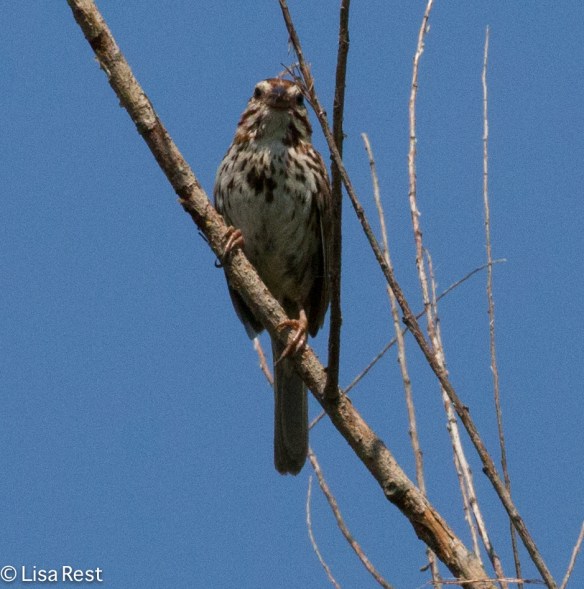






 I grew tired of trying to figure out the one below but it’s pretty in its isolation. I believe it was at Hegewisch. I didn’t take many pictures at Hegewisch – we weren’t there long. We went to see the Common Gallinules – who used to be Common Moorhens – that have been breeding there this year. We caught glimpses but not much else behind the tall grasses.
 I was happy to see Northern Rough-winged Swallows as I have missed seeing them in my usual haunts this year.


 One more swallow.


 If you’ve made it all the way down to the end of this post, you deserve a reward. I invite you to enjoy the beautiful song of a Wood Thrush recorded at the Little Red Schoolhouse.

 At opposite ends of the slough, I ran into two other individual birders and we exchanged information. The second one suggested I go to the newest section of Orland Grasslands to look for Lapland and Smith’s Longspurs. I find it a bit funny that I exchanged names with neither of these people, but it’s probably all any of us can do to talk to each other with the distraction of looking for birds first and foremost in our minds.
 And more Caspian Terns.
 As for Sunday’s choir performance, below is the poster that tells it all.
 This beautiful and moving experience will be part of me for a long time to come. And in a moment of reflection later, about the unifying experience while we were singing, I realized maybe I gained an insight into something the birds do all the time…
 I will be back with one more post from Nicaragua. I hope soon!


