A Change of Scenery

Instead of going to the Chicago Portage Sunday morning as I had originally planned, I wound up going to Montrose Point Bird Sanctuary.

I haven’t been to Montrose in years, so when the opportunity arose to go with two friends, I decided it was my duty to get up early and see what it was like after all these years. I’ve never been there in the summer. It’s a popular hot spot during spring and fall migration, and I went several winters ago to see a Snowy Owl, but this time it was especially good to go with others. I had read about the changes made to the landscape, with paved trails and protected areas, but I was not prepared for such dramatic improvements. It’s much better organized and accessible than it used to be, without affecting the habitat space for birds.

Part of the project was to establish a protected area of the beach for the endangered Great Lakes Piping Plovers that have nested successfully the past several years. Our first mission upon arrival was to see this year’s three new chicks. We started to walk toward the beach.

Our first view of the beach was of a lot of gulls, mostly Ring-billed.

Apartment buildings create a skyline view. The lake was very calm.

We managed to find one Piping Plover chick as we stood north of the protected area.

We could see people looking from another vantage point on the other side, so we started walking over there.

On the way, we encountered Barn Swallows and Bank Swallows near a roped-off area that is protected for the Bank Swallows.

Below are photos I took as we walked. We found a Yellow Warbler, and I caught a Barn Swallow in Flight. The third photo is of a Bank Swallow and a Barn Swallow.

Then when we reached the pier structure overlooking the protected area from the south, we found the other two Piping Plover chicks along the shoreline. All three hatched on June 20, and were subsequently named “Bean,” “El” and “Ferris” after a naming contest inspired by names reflecting things Chicago.

Now I had an extended view of the partitioned beach, with lots more gulls in attendance.

Along with the Piping Plovers, we saw a Spotted Sandpiper.

Here are more photos of the other two Piping Plover chicks.

We started walking back through the rest of the sanctuary, and we encountered many more Barn Swallows and five Bank Swallows.

Walking adjacent to a meadow area, we encountered a couple Eastern Wood-Pewees in branches of a distant dead tree,

We also saw a Ruby-throated Hummingbird briefly.

There were a few other birds, rather common species, but I could not get decent photographs of them. I got luckier with what looked like a juvenile female Baltimore Oriole that was close to the trail.

Now that Montrose is no longer a mystery in my mind, I intend to visit more often. Due to the distance and parking options, not to mention crowds during peak migration, I will try to go with other birders. Thanks to Joann and Steve for inviting me!

I couldn’t resist just one Ring-billed Gull flying overhead.

We are promised cooler weather tomorrow. I am looking forward to visiting Riverside in the morning. It’s been a while.

Double-dipping Goose Lake Natural Area

After groveling about making the long drive all the way up to McHenry County around Memorial Day, I went back on July 5th to celebrate my birthday and then again on July 25th. Needless to say now I’m getting used to the drive and the trail and I may have a hard time staying away before October which is when I plan to go back for Sandhill Cranes that purportedly congregate in the fallow farm fields.

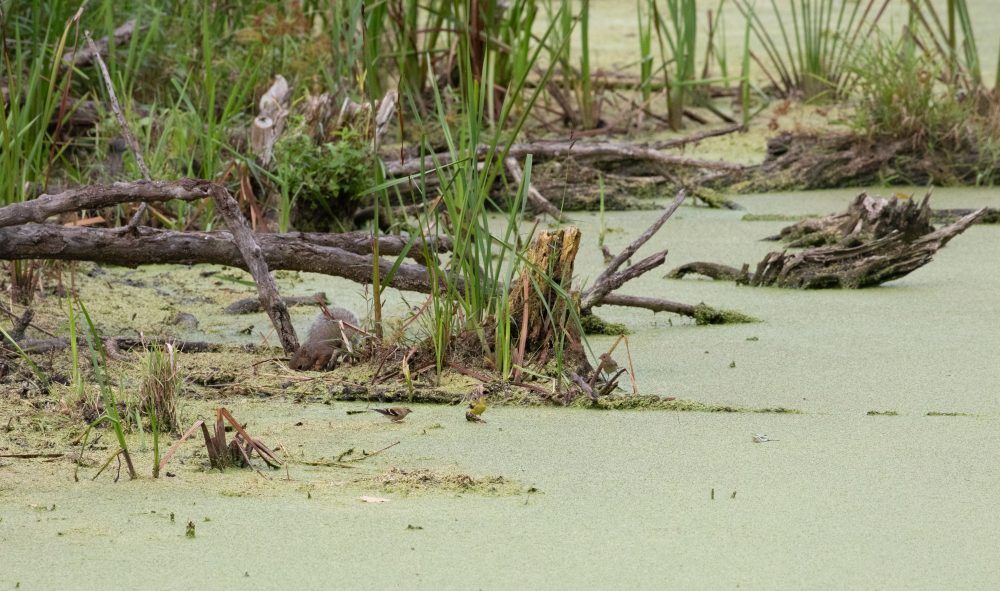
I feel like I could start giving some of the individual birds names, like the Willow Flycatcher at the top of the post. I even heard a confirming “fitz-bew” on the last Saturday.

Yellow-headed Blackbird (male)

I expected to see more Yellow-headed Blackbirds. On the fifth, the males were really too far away for decent photographs, but I did get to see a female close to the observation deck. I went back on the 25th because I wanted to see many juveniles like I did years ago, but I couldn’t find one Yellow-headed Blackbird anywhere. I must have just missed them. But that’s okay, because I saw some other interesting birds, and it’s just so peaceful to be there. In fact on the second visit when I got there, I had the whole place to myself. I didn’t stay long though because it was very hot.

I found the Gallinule below in my photographs from both visits. This is a great place to go if you carry a spotting scope. But I don’t have the energy to carry a scope and a telephoto lens. Perhaps I should rethink my philosophy of cutting corners. For instance, the combination of two visits in this blog post – it’s becoming evident as I write it that it’s entirely too long.

I did see a pair of Sandhill Cranes on each visit. I have not seen any with offspring, which is a bit disappointing.

Another “only in my photos” discovery – a last Black Tern seen on the 5th. Well, my camera saw it.

Here’s the turtle covered with duck weed that appeared in the background of one of the Yellow-headed Blackbird photos above. If you click on the pictures you can see how the duck weed makes it look like something from another planet.

There are still a lot of Red-winged Blackbirds here and everywhere. They are in no hurry to leave, I suppose, because they won’t have so far to go in the fall.

Not a Red-winged Blackbird but a juvenile Cedar Waxwing

I was hoping I would find a Yellow-headed Blackbird when I blew this up but it turned out to be a Red-winged Blackbird. That’s okay, it’s kind of nice to see the feather pattern, albeit faded. Below the photo, two different Red-winged calls I heard on these visits.

A Killdeer in flight…

The “other” blackbird – Brown-headed Cowbirds.

Dragonflies like this place.

On both occasions there were swallows, but in particular on the 25th there seemed to be a lot of them. It was nice to see the Bank Swallows – I don’t see them very often.

The Song Sparrow below was on the 5th. There are two more individuals further down the post whose songs I recorded and put underneath their photographs.

This Yellow Warbler was the last one I saw, on the 5th.

I am quite sure this is probably the same Great Blue Heron, although the photos are from both occasions.

I always seem to startle this Great Egret, which must have been right by the viewing platform as I approached.

A Green Heron flew by twice on the 25th.

Here’s Song Sparrow No. 1 and Song Sparrow No. 2. Song Sparrows reportedly have thousands of songs so it’s not unusual that they were singing different tunes…

And another singer I was happy to record – and manage to photograph, as they are often elusive in the marsh – a Marsh Wren.

My most cooperative subject at this location has been a Willow Flycatcher.

There were a couple distant Wild Turkeys hanging out not far from the Sandhills on the 25th.

Always happy to see a Monarch Butterfly… – I stand corrected. The two on the left are Viceroys!

I think it might be a ground squirrel on the left… there are holes on the trail that look perfect for a ground squirrel. But they could both be Chipmunks…

I found this feather interesting on my walk back to the car on the 25th. I thought it might belong to a hawk or a turkey, even, but none of the extensive feather identification webpages have given me the answer. My first thought was a crow, actually. Maybe I should go with that…

My reward for showing up on the later visit was to see these two Black-crowned Night-Herons arrive and perch not far from the viewing platform. One is an adult, and the other a juvenile.

Black-crowned Night-Herons (adult and juvenile)

Many thanks for making it to the end of this long post. As hot as it was a week and a half ago, as I finish writing this, we have dropped down into fall-like temperatures for a couple days. A reminder. I suppose, that nothing stays the same, as if I needed it. No, honestly, it’s absolutely delightful to have the windows open: I feel less confined and it’s delightful. Stay safe and I will see you again soon in another post. 🙂