What’s Up, McGinnis?

I’ve been to McGinnis Slough only twice this season, once on June 15 and then more recently on August 22.

On June 15, the story was swallows and Wood Ducks. There were a few Great Egrets and Great Blue Herons. It was a day for the breeding passerines as well, with Red-winged Blackbirds and Baltimore Orioles.

Great Blue Herons

Northern Rough-winged Swallows were busy catching insects, I suspect to feed offspring planted in a spot of dirt on the lawn. There were also some Tree Swallows like the one at the top of the post.

A Great Egret was busy preening all those plumes.

I’ve had luck all season with flying Killdeer.

Wood Ducks were present in their favorite spot, which was reassuring.

A Great Egret was hanging out with the Wood Ducks, and a Great Blue Heron flew out over the marsh.

An Eastern Kingbird looked pensive.

And a female Red-winged Blackbird gave me a piece of her mind.

A male Baltimore Oriole was not shy.

I followed this Great Egret’s decision to change locations.

On August 22 which was last Friday, I decided to visit the slough before I took my last swim in the Orland Park pool. Now two months later, the story was an interesting moth, enthusiastic dragonflies and swamp rose mallow. Only Blue-WInged Teal and Mallards were close enough to photograph. There were a lot of Great Egrets and a few Great Blue Herons, but they were too far away.

The first creature I paid attention to was a Clover Looper Moth. I don’t think I’ve ever seen one before.

The Swamp Rose Mallow gets me every time.

Five Blue-winged Teal flew in and around, and stayed briefly.

The Mallards in the first two photos below appear to be in eclipse plumage. The others appeared to be serenely enjoying the space that was taken up by the Wood Ducks in June.

An Osprey flew over just as I had returned to my car.

Blue Dasher Dragonflies were everywhere in various poses and light situations. The one in the last photo below looks really battle-worn.

And last, I noticed a Ruby Meadowhawk. I have never photographed this species before.

I have been out birding with friends to a couple places in Chicago that are closer to the lake over the weekend, and I can attest to the fact that fall passerine migration has begun. It was a matter of running into small mixed flocks for the most part, although I have seen a few individuals around here the last two days. I already have a lot of catching up to do. I welcome Migration Madness as a divine distraction.

Cedar Waxwings at the Chicago Portage

Although I have seen a Cedar Waxwing here and there over the last couple months, I’m just now starting to see them in numbers as they organize feeding flocks comprised of adults and juveniles. A lot of other species are doing the same sort of thing, but none have been quite so obvious as the waxwings over the last week or so.

These photos are from two visits to the Chicago Portage, August 14 and August 18. While things have been generally quiet and slow, there always seems to be something to look at.

Before I left the house on the 14th, I noticed a Monarch Butterfly on my Joe Pye Weed.

When I got to the Chicago Portage, standing overlooking the bridge closest to Harlem, I noticed a small duckweed-adorned turtle.

American Robins have been less frequent, although I still see a few. They’re congregating elsewhere, but they’ll be back. Here’s a young one I spotted.

The Cedar Waxwings I saw that day were on the young side too. You can tell by the streaked breast.

One field mark often clinches it for me: that yellow tip of the tail.

On the insect-side of things, below, a female Twelve-spotted Skimmer Dragonfly, one of several Pearl Crescent Butterflies, and an orb-weaver spider web.

The Indigo Buntings were still singing, if somewhat less enthusiastically.

I caught a glimpse of a White-tailed Deer.

On the woodpecker side of things, a Northern Flicker, a Red-bellied Woodpecker and a Downy Woodpecker.

Barn Swallows were flying overhead

On the 18th, when I walked in, I was greeted by a feast of green.

Cedar Waxwings were present, but in distant groups.

Most of the birds were far away in the bare branches of the treetops, like these Northern Flickers.

Two Blue-winged Teal flew in over the water.

And then by the bridge near Harlem again, I found an American Goldfinch…

and one of the Blue-winged Teal.

Here’s another Monarch Butterfly. I hope to keep seeing them, even if they’re only one or two at a time and here and there.

I’ve been swimming elsewhere this week while my pool is receiving its annual cleaning. Meanwhile, the temperature and air quality are heavenly compared to previous weeks, so it’s pleasant enough to go for a walk even if there aren’t a lot of birds to see. It will be more comfortable working in my backyard jungle too.

It was very, very quiet – even quieter than it has been – at the Chicago Portage this morning. Hardly a peep out of anyone, and even fewer birds to see. Sort of reminds me of a too-long intermission when you’re just waiting for the next act.

Here’s a quick summary of this morning’s characters. A sort of post post-script, if you will.

Mourning Dove on the bridge near Harlem
Warbling Vireo
American Goldfinch
Two Great Egrets flying in the distance
A Blue Dasher Dragonfly
Another Monarch Butterfly capturing my attention
A juvenile Indigo Bunting
A Northern Flicker and an American Robin
A juvenile Red-bellied Woodpecker

I’ve been to and have plans to visit other places. I’ll be back soon.

Spring Starts at the Slough

I have been to McGinnis Slough twice this month – on April 8 and this past Sunday, the 23rd. It’s been such an on-again, off-again spring, it’s really hard to imagine, let alone anticipate, what to expect. But I always find a visit to this site full of potential surprises.

It was warm and sunny on April 8, and there were even some dragonflies I could not capture with the camera, but it certainly seemed like spring was imminent. The dominant species in the water – Northern Shovelers, Blue-winged Teal, and American Coots – were still present two weeks later, with a few additions. But the visit on the 23rd was cold and cloudy, which presented some extra challenges.

There are a lot of Northern Shovelers. Their numbers are exceeded perhaps only by the American Coots. But it has been hard to get a close view of them. They were a bit closer on the 23rd, when the light was less forgiving.

But I did manage to capture them in flight on the earlier visit.

I often inadvertently flush the Coots out of the marshy areas as I walk by, but for whatever reason I was able to capture a few of them somewhat closer than usual.

Blue-winged Teal have been everywhere this spring.

I managed to get quite close to a pair of teal nestled by the back end of a Canada Goose. You can’t see the birds very well, but I found the exposure of the preening male’s feathers fascinating.

Two more Blue-winged Teal photos.

I adore Pied-billed Grebes. They always look like they’re smiling, if rather sardonically. I was very close to a couple of them on the earlier visit.

The slough has greened up considerably in the last two weeks.

I managed to grab a few photos of a small group of Bufflehead on the last visit.

Also last Sunday, one Great Blue Heron testing the chilly water.

There were a considerable number of Ring-necked Ducks this last visit, but they were too far away to capture well. This was the best I could do from a distance.

Ring-necked Ducks

The Mallard drake below was likely guarding his nest location.

Red-winged Blackbirds simply own the marsh.

Black-capped Chickadees were enjoying the warm sunshine on my earlier visit.

The obligatory American Robin

I have seen Tree Swallows off and on all month, but mostly on the warmer days.

I always expect to see Wood Ducks here, but they are a bit more secluded right now. In a month or two they should be easier to find hanging out on their favorite fallen log.

Just another reminder that it is nesting season already.

Common Grackle
Blue-winged Teal

It was cold and rainy this morning. I kept arguing with myself about going out for a walk anyway, as soon as the rain stopped. The rain, as miserable as it is with the cold, has not been a downpour. But it has kept me in, and now the day is getting away from me. This afternoon, Linda and I have our likely last rehearsal before we perform in the 2023 Spring Music Festival. The run-through is Friday night and the actual event Saturday evening. It will be our comeback performance after the 2019 SMF.

I have many more observations to share from my other two most-frequently-birded locations, but the balancing act between musical endeavors and spring migration will be a bit more sporadic this week.

Back at the Chicago Portage

I walked around the Chicago Portage on Tuesday and Thursday mornings. Against a quiet backdrop of very little activity, a few different species emerged.

I stayed home yesterday in part due to a tornado watch and also waiting all day for someone to never show up to check a leaky pipe in the basement. It was windy and off-and-on threatening anyway so it’s probably just as well I stayed in. I have already lined up a rainy day next week to wait again.

I heard Wood Ducks over the past couple weeks and had fleeting glimpses. Then on Thursday I saw one fly in, and when I got to the section of the water where he was headed, there were five.

I can’t ignore some American Robins when they don’t seem to mind me.

Tuesday was not a good day to photograph this Red-winged Blackbird but he was busy vocalizing in the gloom anyway.

The Dark-eyed Juncos are still around and they’re singing now too.

I haven’t heard American Tree Sparrows singing – I guess it’s because they’re quite far away from their breeding grounds. But they are still busy eating and storing up energy for their flight north.

It’s been a while since I have seen a Red-bellied Woodpecker well enough to photograph, although I usually hear one or two.

A distant Cooper’s Hawk was flying toward the water reclamation district property on Thursday.

Downy Woodpeckers are just plain cute

I was attracted to the contrasting plumage with this pair of Canada Geese.

Both days I saw a pair of Blue-winged Teal. I hope they continue.

And on Thursday morning a Belted Kingfisher was perched in the top of the tallest tree by the water. That’s a European Starling below him.

The palette is going to change soon, but I am still attracted to the black-and-white-and-brown birds.

American Tree Sparrow

Thursday as I was coming back along the inside trail, I saw a distant stream of about 200 Sandhill Cranes flying northwest – silently. They would have been easy to miss, except for there being so many of them relatively low in the air.

Bad light, but this time of year any bird could be different, and so few appear they each deserve my attention, like this female Red-winged Blackbird.

European Starling

Below, two Northern Cardinals and a Dark-eyed Junco on the paved part of the trail.

Periodically I have seen a White-throated Sparrow. This one was digging around in a mess of leaf litter until he flew up to a perch and sat a while.

We are supposed to get a break from the cold, gray, windy weather tomorrow morning, just in time for Choir Sunday. I am simply in love with the piece we are singing and looking forward to giving it my best. I remember being excited and moved by the last featured work we sang, but now I can’t remember what it was for the life of me. I have a feeling this music will be in my heart and head for a long time beyond tomorrow morning.

We made it to April.

Warming Up … Two Steps Forward

On this first day of a four-day warm up not to be missed, I visited the Chicago Portage. I have been there several times in the past few weeks, alternating between the Portage and Riverside, but have not had a chance to do another post for over a week and I apologize. Things have just suddenly gotten so busy I have gone out in the morning when the weather has been tolerable, but have not been able to catch up with my photographs. I apologize for my temporary abandonment of this blog, but this is just a short post before I have to re-immerse myself into figuring out how to play and sing a somewhat complicated arrangement of a song for the Spring Music Festival next week. I spent hours and hours writing out the score just so I could identify where and what chord changes occur. It’s been about 40 years since I last did this sort of thing…

It started out a bit cloudy and cool but the sun emerged and with its warmth came the beautiful bright blue sky which I could not ignore.

Somewhat surprisingly, there was not a lot of new bird activity this morning. I heard far more birds than I saw. But we had some rain yesterday and there are likely storms ahead tomorrow, which just might encourage more birds to visit. I was most thrilled to see a Great Egret at the far end of the stream as I was walking in its direction. I proceeded as slowly as possible but knew that I would eventually be closer than it could tolerate, especially on such a quiet morning this early in the season. But this is the first Great Egret I have seen this year, which makes it likely to expect numbers of them on the Des Plaines River at Riverside where I have been looking out for them. And it’s so special to have a heron on the water at the Portage after last year’s drought made them so scarce. I am hoping for Green Herons to return.

As can be expected, Red-winged Blackbirds were going about their business.

Also on the water, there have been Blue-winged Teal for the past couple weeks. I counted 14 on April 19. Today there were two pair. I didn’t get great photos through the vegetation but at least this couple perched conveniently on a log. I promise more Blue-winged Teal photos when I start getting caught up with previous visits.

In the sparrow department I heard Song Sparrows but didn’t get on them with the camera. I did manage to record a couple Fox Sparrows though.

The Northern Flickers are doing everything they can right now to avoid my lens. It should be easier to capture them later.

With the sunshine, turtles emerged.

For what it’s worth I found some interesting white foliose lichen growing on a dead log.

For the most part there were a heck of a lot of American Robins. Everywhere. So I have to give them some credit, even if none of it is terribly interesting.

American Robin in flight

So, that’s it for my short post today. I hope to be back sooner than I think I can make it. If it rains as predicted tomorrow, maybe I can catch up a bit with some photos from other locations as some warblers are starting to arrive. Indeed I was a bit surprised I didn’t have any warblers this morning as I had several individuals yesterday in Riverside. So I guess I know what my next post should be!

Golden Crowns in Riverside

I’ve been trying to write this post since last Tuesday. Spring migration has begun, and at this rate I will not be able to get caught up until next spring. On my visit the morning of April 5 to Riverside, one species stood out, albeit the smallest: Golden-crowned Kinglet. I first encountered several by the paved path in Riverside, but on the Riverside Lawn side of the river, there could easily have been more than the 50 I reported. They were slightly outnumbered by Red-winged Blackbirds that I did not bother to photograph in cloudy light, but I did record them because some of their vocalizations reminded me a bit of other blackbirds I have heard and you can hear the beautiful cacophony in the second recording below. The first recording has the sound of the Kinglets – that little tiny tinker bell sound on top of the blackbird chorus.

Golden-crowned Kinglets
Red-winged Blackbirds

I took way too many pictures of the Kinglets because they were practically at eye level or on the ground…

Here’s how the Des Plaines River looks these days from the paved path in Riverside.

On the other side of the paved path, the flood plain was flooded a bit, providing enough water for a group of Blue-winged Teal along with Mallards and Canada Geese. As for the geese, I have been seeing 68B a lot lately.

In addition to all the Golden-crowned Kinglets I saw my first Ruby-crowned Kinglet of the season.

Here’s how the river looked that morning from the Lyons side by the Hofmann Tower.

When I came back to the bridge on Joliet Avenue I could just barely see a Belted Kingfisher perched far away in this tree. I had followed her in flight from another location. I have usually seen a male at this location so it was nice to see her with her rufous breast band.

There were still some Red-breasted Mergansers in the river, although they were pretty far away.

I always have room for a perching Northern Cardinal. Here are my two volunteers from that morning.

With the available light on and off, I thought these Mallards looked rather content in the fluddle.

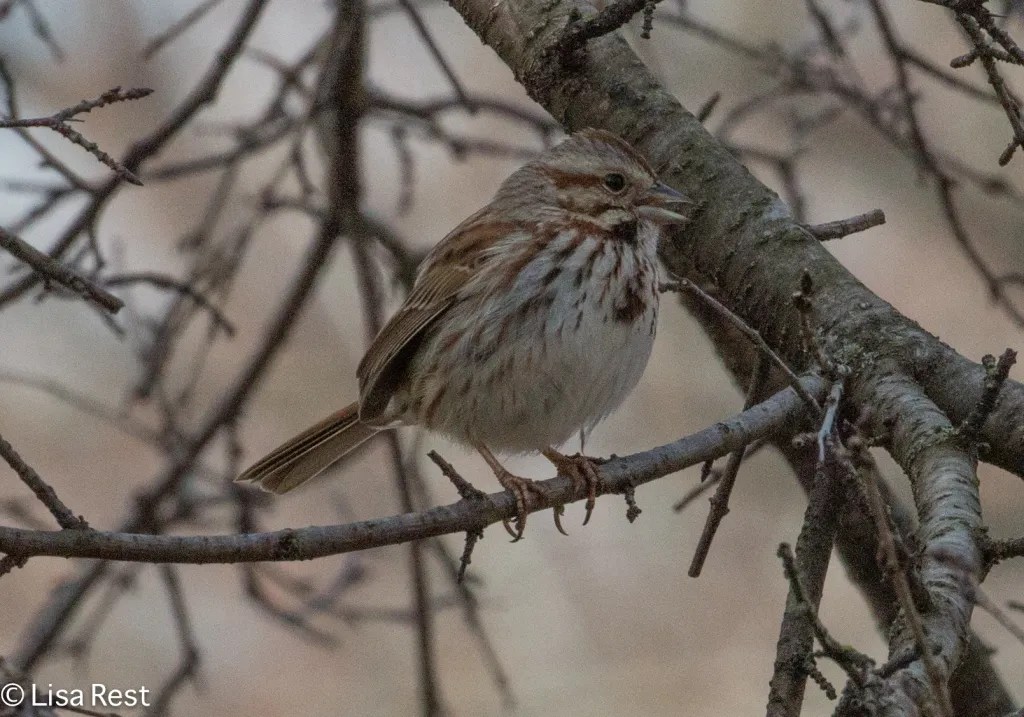
The perched Song Sparrow sat and talked to me, he didn’t sing this time. The one on the ground looks to be a different individual.

Brown Creepers never really disappeared but they seem to be making a comeback for spring anyway.

I wasn’t able to capture a Great Blue Heron by the river that morning but I sort of managed to commemorate these two flying over.

Here are two more of my favorite Golden-crowned Kinglet photos.

I will try to get back sooner. I have been alternating visits to Riverside with the Chicago Portage and every day I have gone out, I have seen something new.

I also have been spending time visiting with my flute-playing friend Linda who very unfortunately broke her femur a week and a half ago. She is recuperating well from a successful surgery which put her back together, and she is now in rehab. I will miss playing with her in this year’s Spring Music Festival but pray for her complete recovery and making music together again.

Sounds of Spring

On that warm weekend nearly three weeks ago – I write this as we chill again after a bit of April Snow yesterday morning and into freezing overnight – I went to McGinnis Slough for a few birds and was greeted by a lot of singing in the sunshine. Thankfully, there was not a lot of traffic noise from LaGrange Road. The primary contributors to the recording are Red-Winged Blackbird males.

Birdsong at McGinnis Slough

This time I got to see one of the Sandhill Cranes that I missed the weekend before. I have to wonder if they are nesting there…

No shortage of Red-Winged Blackbirds showing off.

And not showing off…

A male Wood Duck managed to swim by my lens.

Northern Cardinals didn’t offer many looks, but I managed to add these two for the record.

The iridescence of this Common Grackle’s neck caught my eye first.

This was the best I could do for a Song Sparrow, even though I heard a few singing. The song of one is below the picture.

Song Sparrow

This view overlooking a part of the slough perhaps conveys the feeling evoked by the toad chorus below it.

American Toads, I think

Never at a loss for American Coots this time of year. But I was most impressed with the one standing on a log poking out of the water, preening and showing off its pretty green legs.

Mallards… one hen very comfortable in her chosen spot.

It wouldn’t be an authentic visit to the Slough without a Great Blue Heron flying somewhere.

I was excited to see an Osprey, however briefly.

One male Blue-Winged Teal was close enough to capture.

Perhaps my most thrilling bird sighting that day was this lone Tree Swallow. It was actually warm enough for it to catch bugs in the air.

I always have hope to be back to this page sooner than later. Here’s to more sunshine, warmer weather and more reasons to treasure longer days while they last.

Looking Back to Spring Forward

I started writing this post to coincide with setting the clocks forward, and now it’s taken me over another week to get back to it. But when considering all the photographs were taken a year and a month ago – on April 19th, 2020, to be exact – and I never got a chance to finish processing them until now, it’s taken even longer! I hope it’s kind of a sneak preview of what to expect in the coming days and weeks as spring unfolds at the Portage.

One of my first encounters was a pair of Downy Woodpeckers exhibiting their exuberant version of courtship behavior. At first I thought they were arguing! I have never witnessed this before so I’m glad I was able to capture it. If you click on the right panel and keep going you can see the sequence.

It appears I had way too many photographs from this excursion which might explain why I never managed to post them. Still it’s nice to revisit them, like the female Northern Cardinal below.

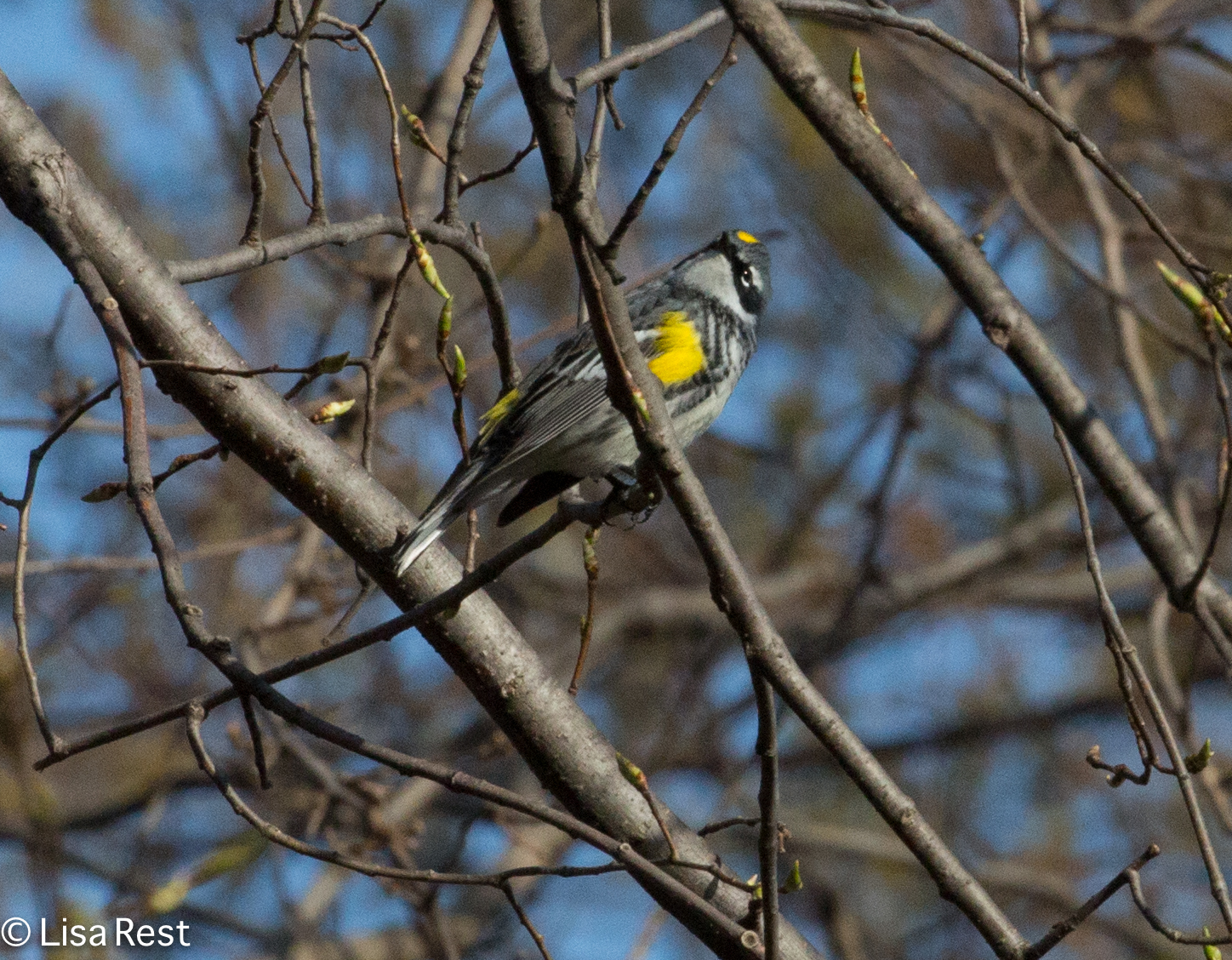
Below, often the first warbler to visit, a Myrtle Yellow-Rumped Warbler.

Surprised to find this photograph in the mix – likely my first sighting of an Eastern Bluebird last year.

An Eastern Phoebe, dreaming of flying insects, perhaps.

Another Downy Woodpecker.

Song Sparrows…

Red-winged Blackbirds…

I don’t think there’s enough water on site anymore to attract herons, but there is plenty nearby so I should still see them flying over on occasion.

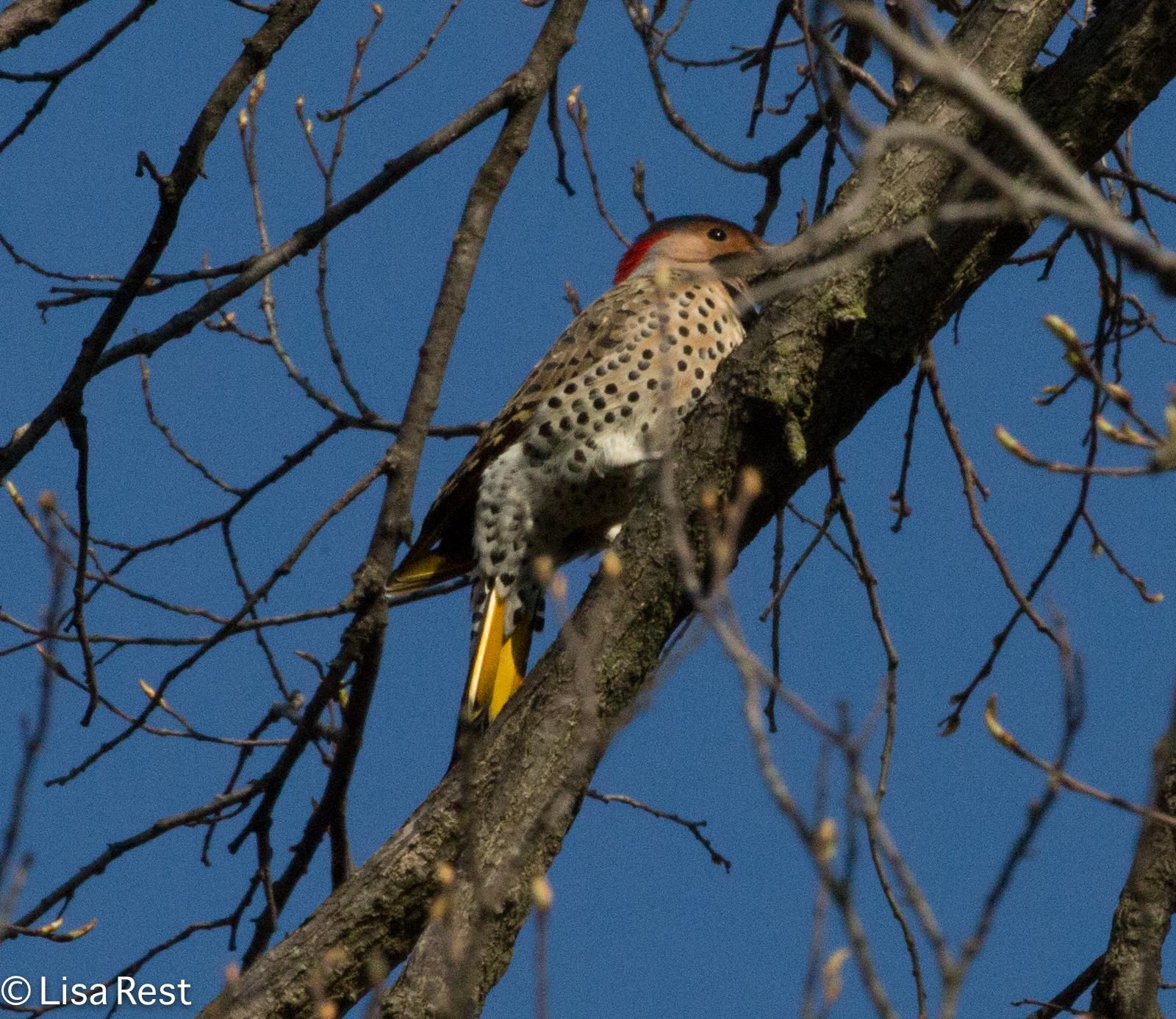
A Northern Flicker showing just a little of its golden shafts.

There were two Yellow-Bellied Sapsuckers on this tree and one flew away.

A Black-capped Chickadee showing off.

A singular turtle…

An assortment of early fungus, moss and flora.

A singing American Robin

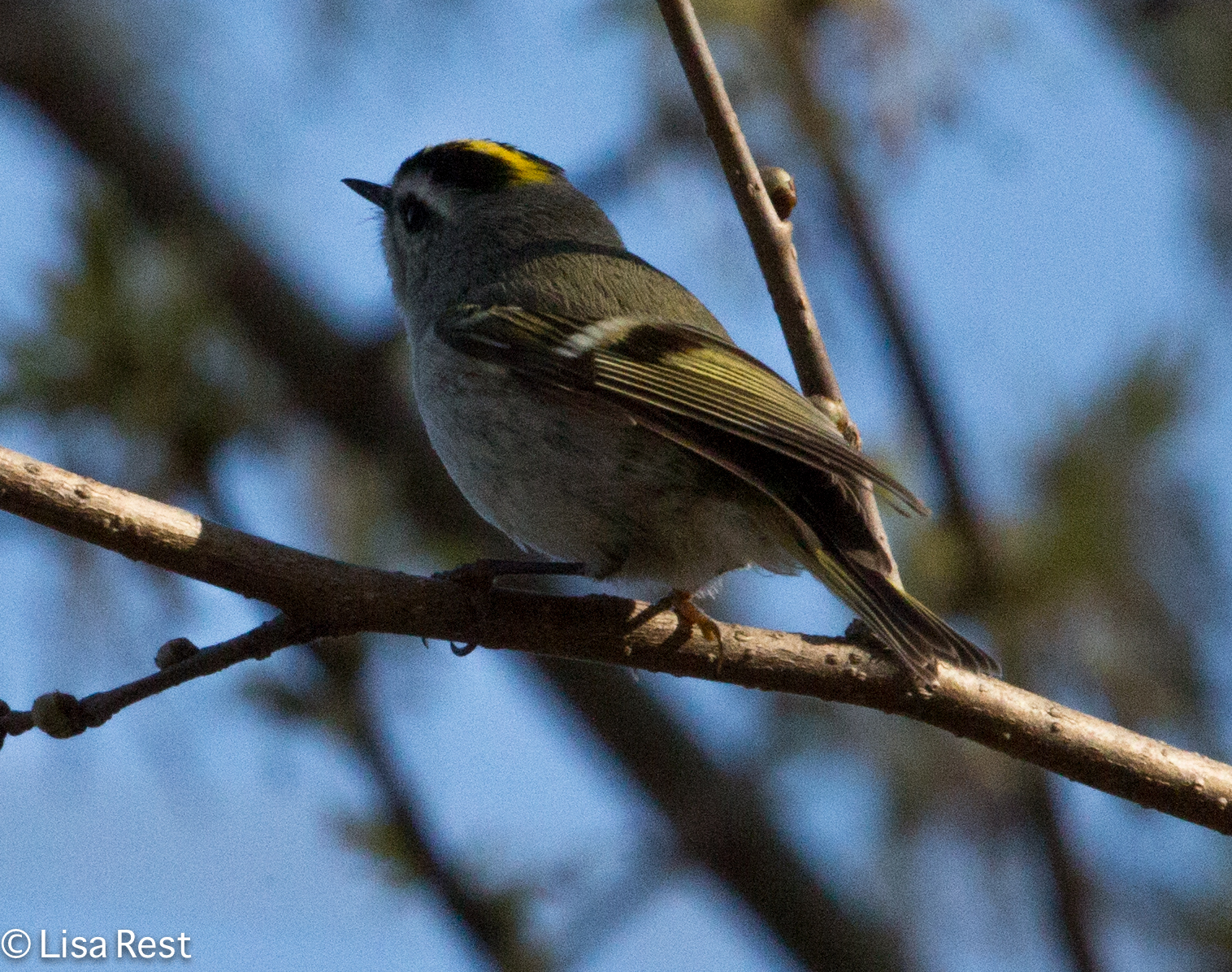
Here’s a Golden-Crowned Kinglet – unfortunately the lighting didn’t do its colors justice.

This Brown-headed Cowbird was foraging on the ground.

Canada Geese and the clouds…

Robins often seem like they want to engage in a conversation.

A Wood Duck drake in a tree. I remember trying to get this shot after I saw him land, with a lot of branches between us.

Mallards…

Blue-winged Teal…

So the Portage will still be slowly coming to life, but we’re warming up, the days are getting longer and migration has begun. Springing forward with hope.

Back to Mid-April

In my typical fashion, I have been trying to write this post for the last week and a half. So while we are all wondering how to get through the holidays this year-like-no-other, I feel a sense of loss too, even though I likely would not have had any plans to go anywhere myself. But there’s also a sense of opportunity in any day I really don’t have to think about work.

Even though it was a cool, late spring and in the middle of the pandemic, there’s something oddly comforting these days about looking back.The Portage looks about like this now – no leaves on the trees, everything muted in browns and grays – but the birds are different in appearance, and most of these species have left for the winter. I took way too many photographs on this day, which might explain why it’s taken me seven months to process them. I won’t be doing a lot of explanation…that might take me another seven months. just hope you enjoy the images.

It will be a while before male American Goldfinches look like the one below.

Out over the Des Plaines River that day, there were three Belted Kingfishers flying around. I didn’t do a very good job of capturing them, they were quite far away. But at least one flew close enough to be recognizable.

A returning Song Sparrow
A Blue Jay, blending in with the sky and the barren tree
Waiting to come back to life.

I keep trying to get a decent photograph of the golden shafts on a Flicker and usually fail, but this time I got close.

There were a couple Blue-Winged Teal hanging out with the Mallards.

One Ring-Billed Gull flew over low enough to be identifiable.

Robins started coming back to their territories. The one in the second photograph is barely discernible from the tree it’s in.

Of course nothing says spring like the return of Red-Winged Blackbirds.

It was early enough in the morning to encounter a couple deer.

Please forgive me, I took way too many pictures of Golden-Crowned Kinglets. They are all gone now, but it was a joy to see them return in April.

Downy Woodpecker – the Portage’s most numerous resident woodpecker

Here’s a thrush I don’t see often – a Veery.

I took a few too many pictures of this Ruby-crowned Kinglet too, but at least I did get somewhat of a shot at the ruby crown.

A Yellow-bellied Sapsucker…

Yellow-bellied Sapsucker

I am always happy to see a White-Breasted Nuthatch, even though they are with us all year long. I never tire of them.

The light was nice on this Red-Bellied Woodpecker.

Red-bellied Woodpecker

Brown-headed Cowbirds are…what they are.

The pair of Eastern Bluebirds this year were such a welcome sight. Although I saw them for several weeks, I don’t think they wound up staying to breed. I can only hope they give the Portage a second chance next year.

The first warbler to show up in the spring, and the last to leave in the fall… the trusty Myrtle, or as long as it’s still lumped with Audubon’s (last time I checked), it’s a Yellow-Rumped Warbler.

I will be back with more from last spring (!) and some more current observations. I hope you are safe and well, wherever you are. And I hope you continue to find moments of peace and solace. There is still a lot to be thankful for.

Two Visits to McGinnis Slough

Even though I never go to McGinnis Slough these days prepared to see a lot of birds – which would require bringing my scope – I invariably see something interesting. It used to be a great place for hundreds of Great Egrets and multiple Great Blue Herons, but for the past several years the numbers have dwindled to a few individuals. During waterfowl migration it’s still a place to see good numbers of several species. My last two visits were sort of before and after spring migration. But I like the fact that it’s not crowded. You can’t your bike through it, so that likely keeps people away. And you could miss it driving by at 50 mph on LaGrange Road, even though the entrance is newly paved and there’s a lovely wrought-iron fence, maybe to keep the deer from crossing the highway.

So these photographs are from April 4 and June 7 of this year. From grays and browns in early April to greens and blues in June. April 4 was a good day for Tree Swallows, even if they look washed-out on a cloudy day.

Tree Swallow and a Northern Shoveler
Blue-winged Teal

The gray and brown was enhanced by a little low-lying fog on the April visit.

I haven’t seen an awful lot of Eastern Phoebes this year. I think flycatchers in general have been scarcer, which I can only assume speaks to the lack of insects. I hope they can recover somehow.

Eastern Kingbird, another flycatcher

In the tail end of waterfowl migration, some Lesser Scaup were close enough to photograph.

Those white blobs are actually American White Pelicans on the far shore.
The slough was quite marshy in June.

The June visit featured Warbling Vireos chasing around at eye-level, and then one sang for me. I managed to record a bit of his song below after having him pose for all these pictures.These guys are hard to spot normally so I indulged.

I often see Wood Ducks lined up on this fallen log. The June visit was no exception.

Wood Ducks

Baltimore Orioles aren’t advertising for mates anymore so they’re a little harder to spot.

Going down the path to the north, I encountered a couple does.

There were a few Cedar Waxwings in the same general area as the Warbling Vireos.

This White-breasted Nuthatch would have been even better if he had turned around.

Red-winged Blackbirds abound.

And in the flying-by department…

Herring Gull
Double-crested Cormorants

I’m used to seeing rose mallow, and maybe it will appear later in the summer, but I think this wild iris is new.

Thanks for making it to the end of this long post! We are in for a long, hot, sunny weekend around here. With luck, I will find more birds to share with you.