Our First Spring Migration Bird Walk at Columbus Park

We were scheduled to start our Saturday walks at Thatcher Woods, but the flooding from recent downpours will make walking, not to mention parking there, prohibitive for quite a while. So we went to Columbus Park. It was a chilly and windy morning, but we saw a lot of birds anyway. I found it especially nice to have good views of a Pine Warbler, the bird at the top of the post.

We always start off walking across the big lawn to the edge of the water to see what’s up. There were Wood Ducks and a Black-crowned Night-heron, for starters.

There was also a very chilly-looking Tree Swallow.

Ruby-crowned Kinglets are still happening.

This Brown Creeper was not daunted by the weather,.

White-throated Sparrows are to be expected.

Here are a couple more photos of the Pine Warbler.

Palm Warblers are comparatively easy to see, so maybe that’s why we tend to pass them over later in the season, but I still find them beautiful.

I caught the Black-crowned Night-heron relocating to another spot.

It was a treat to see two Greater Yellowlegs toward the end of the walk.

For what it’s worth, we had some Yellow-rumped Warblers.

We got nice looks at a Great Blue Heron and a Pied-billed Grebe.

As spring always tests my memory for vocalizations I haven’t heard for months, I invariably learn something new. I now recognize the chattery calls of female Red-winged Blackbirds, in addition to the various vocalizations that the males produce.

I will be back with more spring migration photos as the birds start showing up. For the moment, my focus is on preparing for and playing in the annual Spring Music Festival this Saturday night with Linda Rios on flute and Ray Holdsworth and Kate Burch on percussion. I’m looking forward to playing and also to hearing the other performers, especially those I have never heard before. It will be a fun evening for all.

Catching Up at the Chicago Portage

Spring is coming to the Chicago Portage. The buds are starting to open up on the trees. Hints of green shoots are everywhere. Birdsong is constant. One recent arrival is the Hermit Thrush at the top of this post.

Going back to March 24, a pair of Blue-winged Teal stopped by.

Golden-crowned Kinglets have been consistent.

On March 26, I was pleased to see a very active female Belted Kingfisher. I have been seeing a male over the past few weeks, so I’d like to think this is a pair.

I found a White-breasted Nuthatch in a sneaky spot.

The Blue-winged Teal were still around, hanging out with a Canada Goose and some turtles.

By April 7, Yellow-rumped Warblers started to appear here and there.

I was surprised to find a pair of Pied-billed Grebes.

I’ve missed Black-capped Chickadees for a little while, but now they seem to be returning.

American Goldfinches are rapidly becoming more colorful.

An Eastern Phoebe has been around for a few weeks. Sometimes I only hear him, so I can’t resist taking his picture when I can see him.

On April 9, shortly after I entered the preserve, I saw this Cooper’s Hawk surveying everything imperiously from a distance. I later encountered a woman who told me she saw a Cooper’s Hawk and its “baby” a few days earlier, sitting on top of the pavilion. The woman said she knew it was the hawk’s offspring because it was smaller and still had its pin feathers. So maybe this bird is half of the pair I first saw several weeks ago around a nest and they did actually have success. I often checked the nest for activity, but it was up high and so well-hidden I never managed to see much of anything.

Two Tree Swallows flew over the water.

The Mallard pair was still ensconced on their favorite log.

One Pied-billed Grebe was present, but very far away. I sat down on a log close to the water and watched it from afar for several minutes. It then came swimming my way as if to see what I wanted, and then after it checked me out, it turned around a flew off.

I had another curious Golden-crowned Kinglet that day.

Two Turkey Vultures were flying around as I left. I managed to capture one of them.

I have more to share, and the race has just begun… At least it starts to feel like a race. Linda the flutist and I are also getting ready for the Spring Music Festival. So many finish lines!

Winter Waning

We went from over 70 degrees on Saturday to wind gusts from the north on Sunday up to 32 miles per hour. I went out both days in search of more signs of spring.

On Saturday, I decided to visit McGinnis Slough. The overcast made it even harder to see waterfowl which was typically far away, but I did manage to see a few birds. It was hard to resist a near, displaying Red-winged Blackbird.

Swimming close enough for an identifying photograph, anyway, was a pair of Ring-necked Ducks. I am sure there were at least 100 more that I couldn’t see well enough to count.

There were quite a number of Northern Shovelers as well, and I got lucky when some nearer ones took flight.

A Great Blue Heron flew overhead.

Easiest to see were about 20 American Coots closer to the trail.

Most unusual was an Eastern Comma butterfly.

On Sunday, I was at the Chicago Portage, where I barely saw a White-throated Sparrow.

Not surprisingly, I had a male Northern Cardinal and a male Red-winged Blackbird posing,

Then I saw an Eastern Phoebe. I recall this bird returning at what I consider early to this location last year. For all I know it could be the same individual. I saw him get lucky with a worm.

I was about to leave when I was stopped by a fairly close Golden-crowned Kinglet. I had heard their calls but had not seen one up to this point. While I was photographing this one, two more arrived, and then another five came flying over from the other side of the water. I imagined them saying, “Quick, she’s counting, let’s get in on it.”

I then went to see if there was any activity by what I believe might be a Cooper’s Hawk nest I noticed on a couple recent visits. I did see a Cooper’s Hawk in flight.

It began on March 12, when I saw a Cooper’s Hawk around the nest location and just barely saw another on the nest. I haven’t been able to see anything going on with the nest since, but a Cooper’s Hawk has often been present.

One more photo of a Cooper’s Hawk on March 19.

We are set to experience temperatures all over the place the rest of this week and next, with some rain. I am hoping to set up my rain barrels by Monday if the overnight temperatures stay above freezing. Then I will start looking forward to even warmer overnight lows so I can start cleaning up the yard. Musical engagements are coming up as well. It’s all in the reawakening.

Springing Forward at the Portage

We were in the midst of a warm spell, which always comes as a welcome surprise this time of year. I needed a morning walk before singing with the choir Saturday afternoon in a memorial service for a beloved choir member. It was cloudy but not too windy, and warm enough for turtles to emerge.

I saw only a few of the usual suspects, but everybody was singing, like this Song Sparrow.

Red-winged Blackbirds have been about for over a month now, but they still fulfill their purpose as official spring arrivals.

Red-winged Blackbird

I was delighted to see a Brown Creeper. I never tire of seeing this bird.

And there were a couple White-tailed Deer, one of which posed nicely

Then on Sunday morning, with a promise of sunshine and continued warmth, I went out again, although it was extremely windy and passerines were simply not available. But I hedged my bets, so to speak, and after walking the trail without seeing much of anything, I decided to sit on the picnic table bench by the water and wait a few minutes to see what might occur. After a moment or two, I saw my first Turkey Vulture of the season, albeit at a distance.

A moment or two later, a male Belted Kingfisher dropped in and back out again.

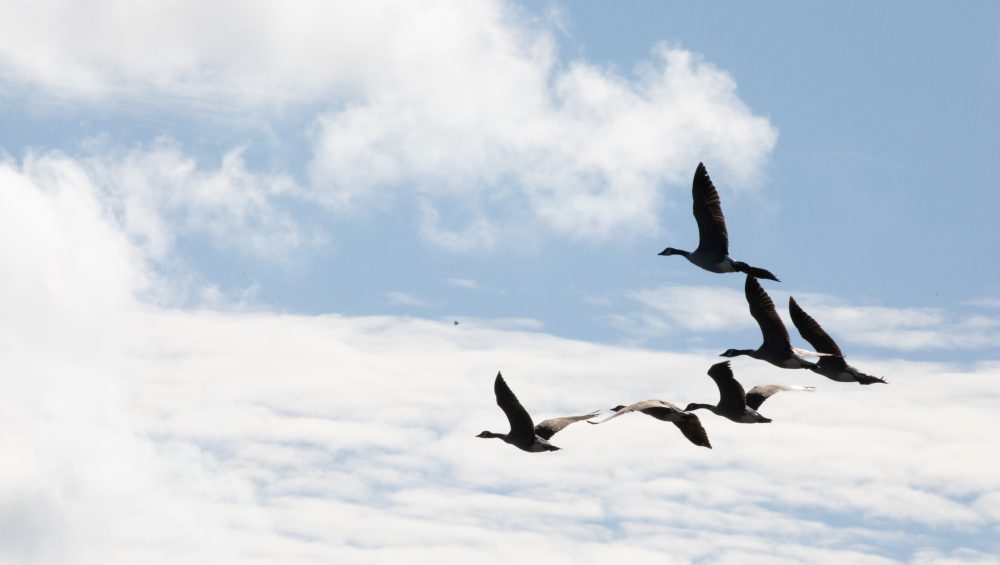
I had checked the wind direction on my cell phone weather app and it seemed that I had a good chance to see some Sandhill Cranes. Sure enough, a group of eight Sandhills flew over, in silence, but low enough for the camera to record them.

I am still recuperating from the sudden loss of my internet connection which occurred yesterday afternoon. After figuring out that my router had died, I was lucky enough to call tech support and visit a store to exchange the dead device for a new one. Everything is working fine again, but it was just such an exhausting spell of adrenaline, I never got around to eating anything substantial until dinner. But what a lovely meal it was.

Our brief flirtation with spring weather is over and we are anticipating stormy weather as the temperature drops. I did go out for a brisk walk this morning to clear my head for attending to some boring-but-important tasks ranging from vacuuming to passport renewal… To be continued.

One of Those May Days

The trees were just leafing out. The warblers were arriving. There were too many photographs. Here are just a few of those photos from that day. And in the process of going through them, I found another species I had not reported, for a total of 45 at the Chicago Portage.

I am just going to post a few and in the process get mentally ready for how different some of these birds will look when they come back through very soon. Some of them will look like barely sketched in versions of their former selves. Nothing like a new set of feathers to wear in.

American Goldfinch

What makes this a Nashville Warbler? It helps to have more than one view, but sometimes you don’t…

A Black-and-White Warbler is easier to identify.

Not a warbler, but an adult White-crowned Sparrow. I expect to see more juveniles in fall migration, which is later in the season for most sparrow species. The juveniles will not have white crowns yet.

A female Rose-breasted Grosbeak took me by surprise.

Black-throated Green Warblers will always be amongst my favorites.

Yellow-rumped Warblers won’t look anything at all like this flashy-looking fellow. Sometimes I have to rely on their distinctive tails and eyes.

Here’s the bird I didn’t notice I had that day: a Philadelphia Vireo.

And here’s a more-common Warbling Vireo for comparison.

Also that day, a Northern Flicker investigating a former nest hole, and a Baltimore Oriole just being attractive.

So much for this blast from the past. I won’t have time for too many more of these, which will banish all the unexplored spring photos to external storage. I doubt I will ever have a reason to review them, much like all the tapes and manuscripts stored in boxes, not to mention digital recordings, but it still seems too hard to simply throw them away. I suspect there will soon be better things to look forward to than reflecting upon too much accumulated stuff, and I can let go of these thoughts for another year.

We had some storm activity last night with a lot of rain, which has nearly knocked over just about every tall plant. I have only been outside this morning to empty collected water and inspect the damage. I’m not sure how much I want to let stay. The female hummingbird came into the yard earlier as if to see whether anything had changed, but she did not stop at a feeder, so I am taking that as a request for new sugar water. If I go back outside to work in the yard a bit, I will be well-sprayed to ward off the mosquitoes and midges. At least we have cooled off for a while and the air quality is good for a change. Summer is winding down.

Cooler Times: A Look Back at April 30

One day’s worth of photos seems worth going back to look at. These were taken on April 30 in Riverside. Spring migration was beginning, the temperatures were much cooler, and there were only a few leaves starting on the trees. I’m taking a break from the heat.

I first encountered a Killdeer by the Hofmann Tower.

I also took note of a Northern Rough-winged Swallow.

I noticed a Solitary Sandpiper on the rocks, and another on the sloping sidewall of the defunct dam.

Then they took off and I got some flight shots, with both of them in the frame of the last photo.

I was seeing Yellow-rumped and Palm Warblers pretty regularly.

Baltimore Orioles stood out.

I found two Tree Swallows perched on the swinging bridge.

A Ring-billed Gull was flying.

More Yellow-rumped Warblers.

A few Black-and-White Warblers were around too. This is the same individual as at the top of the post.

An Osprey flew over.

A female Downy Woodpecker went about her business.

And a Red-winged Blackbird attending to his.

I noticed a Great Blue Heron across the river when I walked through Riverside Lawn. It caught a fish and then swallowed it.

Warbling Vireos were arriving.

I got to see a male Eastern Bluebird who periodically checked with me this spring.

There were Ruby-crowned Kinglets here and there.

Then I noticed a female Scarlet Tanager.

One more of the Great Blue Heron.

Heading back to my car, I found a Northern Rough-winged Swallow on the wall by the Hoffman Tower.

We are promised some cooler weather and even rain later today. I worked in the yard this morning. and slowly but surely, there is more visual breathing space. It seems there is always something surprising going on and it’s not all bad. May we all be surprised by something good these days. I’ll be back shortly with some more recent observations.

Looking Back a Bit

While I’ve been stuck inside, more or less, during the heat wave, it’s been almost refreshing to look back at photos from the end of April still on the laptop. Spring migration was starting, and even though many of the trees did not yet have leaves and the temperatures were chilly, birds were on the way.

But first, I found even more photos I didn’t know I still had, from April 17 at the Chicago Portage. Below, an American Robin sneaking nesting material, and a late American Tree Sparrow.

Northern Flickers were coming back.

An Osprey flew over.

A Song Sparrow was checking out the marshy area.

On April 21 in Riverside, Yellow-rumped Warblers were easy to find.

A Northern Cardinal, a Song Sparrow and a White-throated Sparrow made the cut.

On April 24 at the Chicago Portage, I found two American Robins preoccupied.

Yellow-rumped Warblers were easy to find.

I noted the return of a Green Heron.

Blue-winged Teal had been at the Chicago Portage for weeks.

Palm Warblers were showing up too.

Palm Warbler

On April 28 in Riverside, I saw an Eastern Bluebird. While they were setting up a territory, I saw the bluebirds quite frequently, but now that they are busy raising young I haven’t seen them lately at all.

An interesting fungus

Palm Warblers were showing up everywhere.

A pair of Northern Cardinals were enjoying the sunshine.

And a Great Blue Heron was in the river.

Then on April 29, back at the Chicago Portage, I had a Field Sparrow.

Warbling Vireos were arriving and claiming territories.

One of several Palm Warblers…

A Yellow Warbler was most likely heard first and then seen. There are at least two if not three breeding pairs at the Chicago Portage this year.

A Green Heron first appeared in a tree and then flew down to the water.

An Osprey flew over.

Then, the surprise bird at the top of this post, a beautiful male Rose-breasted Grosbeak. I don’t believe I have seen one since. If they are nesting here, they are extremely well hidden.

White-throated Sparrows didn’t seem to be as plentiful this spring.

Just before the leaves would make them nearly impossible to see, Warbling Vireos were singing and reminding me they were going to be everywhere.

I managed to go for a walk yesterday before the heat increased again. We did get some rain last night and we’ve cooled off a bit, so I will go for a soggy walk by the river and then immerse myself in the pool. I will be back with more current reports, and I still have a lot of notable leftovers from spring warbler migration to share.

A Three-Walk Roundup

I was hoping to make this post manageable and not too long. These are some of the birds from the last three spring migration walks of the Oak Park Migration Bird Walkers, starting with Thatcher Woods on Thursday, May 30. We got a glimpse of the Great Blue Heron by the Trailside Museum.

Last Thursday was yet another challenge in flycatcher identification. If only it were possible that when these guys all show up at once, they at least announce themselves vocally. We got very distant looks at what turned out to be an Alder Flycatcher. Henry actually heard it.

There was also a Willow Flycatcher.

And I am thankful for Eastern Wood-Pewees having long, fluted tails.

For the record, an American Robin and a Northern Cardinal.

A pair of Blue Jays showed up and put on a little show.

It was a cool and cloudy morning but the lack of light did not dim the plumage of an Eastern Bluebird.

The now-Northern House Wren blended into its preferred surroundings.

We had a somewhat obscured view of a Great-crested Flycatcher, matching the colors of the branches and leaves.

The next day we were at Miller Meadow. Ir’s a huge expanse dominated by non-native, extremely invasive teasel. Somehow the birds tolerate it, even if it frustrates us. We saw one or two Willow Flycatchers.

The wide open expanse often makes this location a favorite of raptors. We had a pair of American Kestrels. They appeared to be using a nest box.

An Indigo Bunting provided a brief glimpse in the teasel.

Wide open spaces are good for Eastern Kingbirds as well.

And a Song Sparrow serenaded us as we walked by.

We had an Eastern Bluebird here too. This is the same individual at the top of the post.

I followed a Killdeer as it flew by.

Someone’s excellent spotting led to the discovery of a female Orchard Oriole by a nest, which I did not see, but I did manage a couple photos of the male when we caught up with him.

And a Red-shouldered Hawk made an appearance at the end of the walk.

The last gathering was on May 31 at Columbus Park. I saw a rather conspicuous Great Egret.

There was a Red-shouldered Hawk here too, perched on the fishing line recycling station by the larger body of water.

A Double-crested Cormorant was drying off its feathers.

We had a first-summer Black-crowned Night-heron in addition to a few adults.

The Great Egret started flying and landed in a tree.

We found a Black-crowned Night-heron in a tree as well.

We had a Least Flycatcher, conveniently identified after the Merlin app heard it first.

Here are two more Black-crowned Night-herons.

We will resume the Oak Park Migration Bird Walks at the end of August. Now that Henry is back in town, I will get a break from leading most of the Saturday walks, but I will likely join the group for most of them.

We are experiencing pleasant temperatures, but have also been under an air quality alert due to the Canadian wildfires. I try not to think about the added pressure on the migrants heading in that direction.

In spite of the anticipated quiet during breeding season, there are still a lot of birds we don’t get to see in the colder months, and I will continue to try to keep up with them. To be continued.

Last Sunday after the Rain

It was a little chilly and quite gloomy last Sunday morning after the rain overnight, but I went for a walk anyway at the Chicago Portage, getting there early enough to encounter no other humans for quite a while. From the parking lot, I caught a European Starling leaving the statue where the starlings are nesting in the throat and the sleeve of the cloak. A male Baltimore Oriole was messing around in the grass between the start of the paved trail and the fence.

It was quiet walking to the bridge near Harlem, where I stopped to take a look and see if there was any activity. I found an Eastern Phoebe.

The Merlin app said it heard an Olive-sided Flycatcher. I found this intriguing as I had seen the species with the Oak Park Migration Bird Walkers at Thatcher Woods the day before. As if by command, I soon found the Olive-sided perched on a twig not too far from the trail. It didn’t vocalize, but it was unmistakable. After taking way too many photos of this very cooperative bird, I tried to move just a bit farther left to get a better frontal view, but that was when the Olive-sided decided it had seen enough of me and left. Still, I will treasure this close encounter with a bird I have rarely seen, and hope to call upon my memory of it in the future to more quickly identify the next one I might see.

Next, I found what appeared to be a fledgling Red-winged Blackbird – already! It has none of the color associated with the female so I think this is indeed a very young bird.

Also, well-hidden by vegetation, I found a Song Sparrow.

And then, as if in defiance of the weather and the late date and everything else, I encountered a flurry of activity high in the tree tops along the dirt trail that runs parallel to the chain link fence separating the Chicago Portage from the Metropolitan Water Reclamation District (MWRD). It has occurred to me while I’m sitting here writing that a map would be helpful. I was unable to find a drawn map, but I managed to take a screenshot from Google Maps of the Chicago Portage and some of its surrounding area, which I have inserted below. The “Portage Creek” and “Portage Trail” labels show the preserve and its location next to the Des Plaines River, the MWRD, train tracks and surrounding development. That little purple crown is next to the parking lot.

Peering up into the treetops, I managed to make the camera see what looks like a female Bay-breasted Warbler.

Then I found a female Blackpoll Warbler.

A male Bay-breasted Warbler came into view.

And another Blackpoll Warbler.

A female Yellow Warbler was not too shy.

I found yet another Blackpoll Warbler.

Then a Red-eyed Vireo appeared overhead.

I caught a brief look at a Gray-cheeked Thrush by the chain link fence.

And then I started to see a Canada Warbler.

A Gray Catbird was sitting in the barbed wire, which somehow seems appropriate for this species.

There was yet another Bay-breasted Warbler.

And one of those interesting-looking first-summer male American Redstarts.

I briefly saw a female Blackburnian Warbler. By the way, here’s a thought about why the female warblers are all showing up late. For the most part, the male warblers have already gone farther north to establish their territories. I suspect the females want everything in place before they have to get down to the hard work of choosing a mate, nest-building and egg-laying.

Then I caught up with the Canada Warbler, up close and personal. I have seen some other individuals over the last week or two and their images might eventually make it to this page, but this was the longest look I got this season of a particular individual, and I am grateful (after being greedy).

I had a brief and rather distant view of a male Indigo Bunting. I haven’t seen a female yet but I suspect several have arrived for the summer.

Briefly, a Least Flycatcher. I heard this one, too, with i’s “cheh-BECK” call.

Another Yellow Warbler turned up.

I have seen some deer lately.

This looks like a young Great-crested Flycatcher. Already!

Another first-summer male American Redstart was singing.

And a Swainson’s Thrush made an appearance.

As if all that were not enough, on my way out along the newly paved section of trail that hugs the marsh, I found a male Orchard Oriole. This is exciting, so even though the photos aren’t completely clear, I’m adding them all anyway.

So far this week, nothing has compared to Sunday. Things have slowed down quite a bit. As it happens, I was supposed to get up early and over to Columbus Park this morning to join Henry and the Oak Park Migration Bird Walkers at 7:00 AM, but the walk was called because of rain. As it has been usual lately, the rain is not a downpour but a steady drizzle-to-droplet routine that will be over this afternoon. I am embracing the extra rest – my cold or whatever it is seems to be diminishing, however gradually – and it has been fun writing this post, this morning. I’m going swimming shortly, and I’ll be back again.

Two Walks at Thatcher Woods

Here’s a roundup of the birds I was able to photograph on two visits a month apart. The first was on April 26, and the second just this past Saturday, May 24. There will be one more organized walk at Thatcher this Thursday morning with Henry leading and if I can manage to get up before dawn, I will attend. Here are my photos, starting with last Saturday and a couple high-foraging warblers across the water by the Trailside Museum. A very large number of participants showed up for this walk after we received some publicity in the local Oak Park newspaper, and eventually we broke off into more manageable groups but that meant we didn’t all see the same birds.

I managed to capture the back of a Blue Jay.

A Canada Goose family was on board.

I barely managed to get images to identify this Blackburnian Warbler.

We crossed the street over to the woods and walked along the road, but saw very few birds. By the time we reached the grass where often birds can be seen along the edge of the woods, we started seeing a few species, such as this well-hidden Northern House Wren.

A male Eastern Bluebird was here and there. The female was present for a moment too but I didn’t get a good enough photograph.

Then, much like the edge of the lawn at Columbus Park the week before, we had another flycatcher extravaganza. They were all quite far away, so even with my big lens, some of these photos are unmercifully blown up and cropped.

We saw several Willow Flycatchers. Two had a brief disagreement.

We had a couple Olive-sided Flycatchers. We only see these during migration.

Eastern Kingbirds can be seen all summer, and they are mercifully easy to identify.

Eastern Kingbirds

I captured a Warbling Vireo in the mix.

I eventually added what i think is an Alder Flycatcher to the list.

And I caught a Great-crested Flycatcher in flight. It appears to be a young bird.

We were treated to several views of a young Red-tailed Hawk.

A White-breasted Nuthatch showed up for good measure.

At the end of the walk we were treated to a pair of Hairy Woodpeckers. The male was very vocal.

On April 26, we were treated to good looks of the Great Blue Heron that often hangs out by the Trailside Museum. It had caught a catfish but I was too late to get a good photo of that potential action shot.

We also had wonderful views of a Red-shouldered Hawk.

We also had a Great-crested Flycatcher that morning.

There was a Spotted Sandpiper foraging on the shore.

Back out on the grassy area we found a male Eastern Bluebird.

Ruby-crowned Kinglets are gone now, but we were still seeing them a month ago.

And there was a Red-headed Woodpecker although, between the lack of good light and branches in the way, I could only manage a half-baked photo.

There was also a Red-tailed Hawk present.

One of the last birds we saw well was the Red-bellied Woodpecker below. This photo and the individual in it are noteworthy for the fact that you can actually see the “red” belly.

And Brown Creepers such as the one below were more prevalent a month ago. I haven’t seen one for a couple weeks.

Blue-gray Gnatcatchers like the individual at the top of the post were a lot easier to see without leaves on the trees.

Here’s one more of the Great Blue Heron in flight.

I’m likely to be short on narrative for a few more posts as I don’t want to get in the way of so many photos. I haven’t seen as many birds the last couple days, and we are settling down to breeding season, which means most birds have gone where they intend to stay. I have many more birds to share with you and I’ll try to be back as soon as possible.