Here, There and Anywhere

Here’s a little roundup of a few places I’ve been the last couple of months that are only slightly off my beaten track.

The last Oak Park Migration Bird Walk in the fall was at Thatcher Woods on October 11. I didn’t get a lot of photos, but I am taking this opportunity to note the presence of a Yellow-bellied Sapsucker and an Eastern Bluebird.

The next day, I joined Steve and Joann on a Chicago Bird Alliance walk at Steelworkers Park on the south side of the lakefront. The land has been reclaimed from industry, thus the name. We soon found a Blue-headed Vireo.

A Red-breasted Nuthatch was also available.

And I took a look at a Swamp Sparrow.

There were other birds too far away to photograph adequately. Maybe next time… After Steelworkers, the three of us went to nearby Rainbow Beach, which I have heard about for years but never visited. I was immediately attracted to the grasses and flowering plants that grow in the sand dunes.

We saw a Common Buyckeye butterfly, which prefers this habitat. That could explain why I had never seen one up until now. I look forward to revisiting this place.

Then, on a whim, I visited McGinnis Slough on November 12. I arrived rather late in the morning and didn’t know what to expect. After taking ample time putting on my binoculars and strapping the camera on my shoulder for my usual perusal routine, I walked toward the center area that juts out from the parking lot and was immediately greeted by a small flock of Rusty Blackbirds. They didn’t stay long, but I managed a couple photos and I was glad, after having Rusties evade me for a couple weeks.

Out on the biggest stretch of the slough, a distant gathering of Great Egrets and Great Blue Herons was taking place. Notice they’re standing up in the middle of the deepest part. Water levels have been low for a long time.

Then on November 15, Chicago Bird Alliance hosted a walk at Thatcher Woods and we decided to attend. We walked in the opposite direction from where we normally conduct the Oak Park walks, so it was interesting to me to see more of Thatcher.

Des Plaines River

We saw a White-breasted Nuthatch well.

A Red-bellied Woodpecker took off from the tree where I had been watching it.

A beautiful Eastern Phoebe was busy still finding insects to catch and eat. This is the same bird at the top of the post.

A Black-capped Chickadee was busy cracking open a seed.

The Brown Creeper below was rather far away, but I got clear views.

We saw some White-throated Sparrows.

I liked the way this Dark-eyed Junco looked among the spent boneset seeds.

A Red-tailed Hawk flew overhead.

Toward the end of the walk, we parked by the river bank to watch Cedar Waxwings and other birds foraging and bathing on the other side.

The birds were rather far away and the light was poor, so I didn’t know until I got home that one of the birds we thought was a House Finch actually turned out to be a Pine Siskin.

Joanne spotted a Rusty Blackbird foraging along the river bank, and I finally located it after several tries to see the bird in the leaves.

In addition to more recent recaps, I will be back soon with the first of perhaps a few posts of previously “unattached” photos which I am now slowly but surely deleting from my media stash on WordPress. They date back to the earliest years of this blog project when I didn’t know what I was doing, uploaded photos randomly and gave no thought to how much space I was using… until I was politely threatened by WordPress a week or so ago that I was running out of space. Given the continuing saga of digital photography and what-do-you-do-with-all-those-photographs, I should not have been surprised. The positive side of freeing up some space is that I have been taking a trip down memory lane, so to speak. It has been entertaining to see a lot of the old photos, from trips I took to other countries to rare birds showing up on the lakefront. To be continued…

McGinnis Morning

This morning started off cool and a bit cloudy, but I was feeling up to an outing and, after checking eBird for recent sightings, I decided to visit McGinnis Slough. I haven’t been there in months and it was time to see some more birds in a different habitat. It was especially gratifying to see that the recent rain has improved the water level from last year.

Predictably perhaps, the first birds I saw were some American Coots. They weren’t in huge numbers but they were just about everywhere.

And this is a very popular place for Red-winged Blackbirds. In addition to scores of males on territories, I saw my first female of the species.

Then I started seeing some distant Ring-necked Ducks. All these photos were taken at quite a distance and have been heavily cropped.

There were a couple Pied-billed Grebes.

Here’s a male Ring-necked Duck and a Pied-billed Grebe,

More Ring-necked Ducks. You’ll hardly ever see the ring on their necks. I have seen it only once and the bird was much closer than these were.

Then I was very happy to see a Horned Grebe rather close in the marshy area next to the mowed trail. I used to see these birds frequently on the lakefront when I worked downtown, but it’s been years since I’ve seen one. This is the same bird at the top of the post.

There were a couple Northern Shovelers at the far edge of the same area and the male suddenly took off.

I walked all the way back to the northern end of the trail where you can view the largest part of the slough. There wasn’t a lot to see as the waterfowl were sparsely distributed at quite a distance, but the toads were making a racket. I sat on the picnic table and listened to them.

Then, as I walked back toward the center and the parking lot, an Osprey flew overhead.

I said goodbye to the Horned Grebe and headed home. In my backyard, the birds had emptied the feeders, except for the American Goldfinches who were still working on the nyjer seeds that I refill their feeders with daily. They have had it good all winter. The photos were taken through the back porch screened windows.

A male House Finch flew in for a second and I almost caught him on his way out except for a photo-bombing goldfinch.

It’s been a good day. The sun is shining and it looks like we have a few more cold days ahead but soon it will be warm enough to start cleaning up the yard and welcoming the greening of everything. I hope to be done with this cold by my next post. I’ve been improving steadily.

McGinnis Moments

I was going to the Chicago Portage Tuesday morning, but the gates were locked with big “CLOSED” signs. Since last week we found out that the park service was preparing the site around the statue for planting native plants, we can only surmise the work has begun. The parking lot was full of workers and big trucks.

I had errands to run and it was too early to start them, so I decided to visit McGinnis Slough because I hadn’t been there in a while. The first birds I saw were a Great Egret, a Green Heron and a Great Blue Heron.

I found some land birds off the trail, such as the Song Sparrow and Baltimore Oriole below.

As I started to walk back to check out the main slough, a male Rose-breasted Grosbeak landed right in front of me.

I took note of other birds I encountered along the way.

American Robin

Common Grackles seem to be abundant this year everywhere I go. There were some encounters between some grackles and the Red-winged Blackbirds.

I took a close-up of an interesting-looking grass head. I suspect it looks quite different because of how dry everything is.

Here’s what the slough looked like from the observation point at the end of the trail. There was no visible water.

On the way back I captured a somewhat fractious encounter between what appeared to be a juvenile Common Grackle and a male Red-winged Blackbird.

An Eastern Kingbird left its perch and flew right over my head.

When I got around to the south end where there is some open water, the first bird I saw was a wet Double-crested Cormorant drying off in the sun.

If this year is like previous years, this will be the perch spot for Wood Ducks in August.

There were a few Wood Ducks available. And a mother Mallard with her ducklings.

One more of the Mallard clan.

The Portage was still closed today. I expect it will be closed again tomorrow morning.

While I am eager to see what has been done at the Chicago Portage, I also need to do a lot of garden cleanup in preparation for my participation in the West Cook Wild Ones 2023 Native Garden Tour. So, while workers are putting native plants around the statue at the Chicago Portage, I can be managing my native plant jungle.

Back to the Slough

It was a nice weekend – two cooler mornings before the anticipated heat returned. I went to the Portage on Saturday morning and decided to visit McGinnis Slough Sunday. This is a brief summary of the McGinnis encounter.

There is very little water. Maybe it’s a little more water than last summer, but some birds I could always count on are not present. I saw no evidence of Trumpeter Swans, for instance. And last year there was a pair of Sandhill Cranes, but I haven’t seen any of those either. There was only one Great Blue Heron fishing close to the log where the Wood Ducks hang out. I could barely see anything through the reeds.

Later I managed a somewhat clearer picture of the Great Blue Heron and a couple deer.

I was surprised to see more people at the preserve than I expected, but I had forgotten that it was a holiday – Father’s Day – and beautiful weather, and why not? I got there fairly early anyway and first encountered a group of Tree Swallows.

This is always an attractive place for dragonflies and I found several beautiful Blue Dashers. I am always chuckling to myself as I try to do macro photography with a 100-400mm lens.

There were a lot of Song Sparrows singing. I only photographed this one, but recorded another briefly. Then at one point I just stood and recorded all the songs of several species I was hearing.

Song Sparrow song
Song Sparrow and Red-winged Blackbird singing
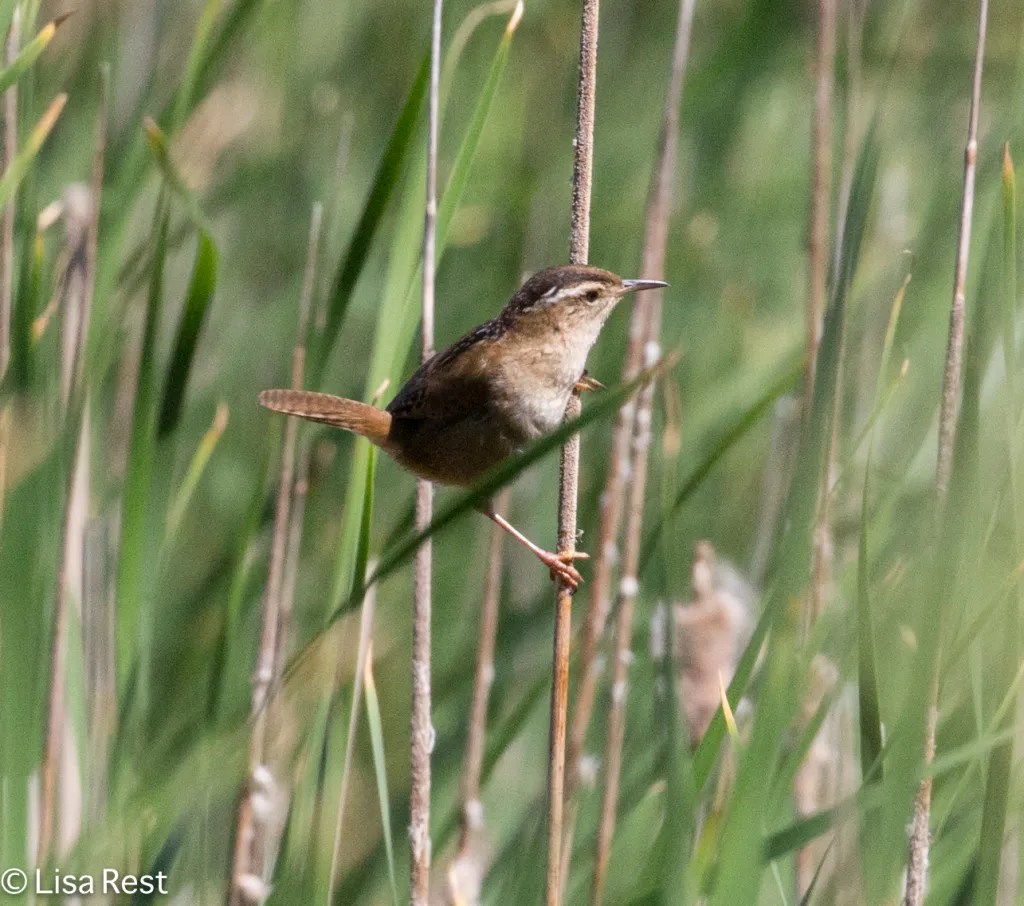
Marsh Wren, Red-winged Blackbird and Common Yellowthroat singing

I barely managed to capture a male Common Yellowthroat who had retreated to a perch inside a small tree.

At one point I noticed a Downy Woodpecker feeding its fledgling.

A young American Robin was looking out over the vast expanse of the slough from its perch near the path, as if to reflect upon the world now at its wingtips.

Another young American Robin caught my eye. More of a keeping cool perch.

The water alongside the trail going north

I kept hearing a Virginia Rail, but never even hoped to see it. I followed it with my ears as it moved around, at times not too far from the center lawn that juts out into the slough from the parking lot. Before I left, I sat at a picnic table there to cool off and just observe, when I caught a distant view of a Common Gallinule in my binoculars. It was nearly impossible to photograph but I tried anyway. I have never seen one of these here before. Perhaps this is an indication of the habitat changing.

There was a very tiny Least Skipper.

Least Skipper

And I was surprised this Chipmunk stuck around just long enough for me to snap its photo.

Red-winged Blackbirds were everywhere but this female turned out to be my best photo op.

Here’s one more of a Blue Dasher.

I don’t know how much energy I will have tomorrow, but with any luck I will be back with more sleepy summertime photos. As luck would have it — tomorrow being the summer solstice and the longest day of the year — it may be the hottest day we have had so far. I almost look forward to the days getting shorter.

Quick Visit to McGinnis

So while I had other things in mind, after a quick visit to McGinnis Friday morning I decided to make this my next post. Singing Marsh Wrens greeted me, You can hear a little snippet of this one’s song below.

Marsh Wren

I never know if I am going to see these guys, but sometimes I get lucky and this time I did.

There were Great Egrets and Great Blue Herons at a distance and I tried to leave them be. They managed to rearrange themselves in spite of my caution anyway.

The only decent photograph of a Great Egret was in flight. I managed to count four of them but they were distant.

There’s usually Wood Ducks by the same fallen log.

On my way to the overlook of the main slough I encountered this Great-crested Flycatcher.

I can never predict these days when or where I will see a European Starling.

There was a very vocal pair of Eastern Kingbirds.

So far I have only had one token Double-crested Cormorant flying over anywhere and this location was no exception.

But that might be easier to understand here as there was barely any water. What looked like the slough a couple months ago – April 4 to be exact – now looks like a bog.

You can’t totally ignore the Red-winged Blackbirds.

There was a tiny Pearl Crescent.

Lots of things to do with performances to attend and things opening up everywhere. I am still trying to be cautious but it gets harder the better I feel. There’s a nugget of wisdom in there somewhere that escapes me. I’ll try to be back soon.

Return of the Slough

All the rain we have had has made McGinnis a slough again. The water levels are now deep enough to support a lot of birds and to attract visiting American White Pelicans. I read someone’s post about seeing them flying over McGinnis Slough on Sunday, which would have been a lovely sight, but that was enough to motivate me to see if perhaps some had decided to stay. I remember seeing hundreds of them years ago. I was happy to see perhaps forty or so, albeit too distant for a decent photograph, on Monday morning.

Even if there weren’t a lot of birds that I could see very well, it was good to see the slough again.

There were Bufflehead and Ring-necked Ducks at a distance, as is everything at McGinnis right now. I did manage to see one male Ring-necked Duck near enough for a photo. I haven’t seen these birds in a while. Look closely and you can see the ring on his neck.

Unsurprisingly, there were a lot of American Coots, some of which I inadvertently disturbed walking back through the trail.

Also predictably, there were a lot of Red-winged Blackbirds deciding on their territories. I took too many shots of this one trying to hold onto his perch in the wind.

Below, another male and a female, perched in the marsh.

Toward the end of last summer the water was non-existent. It’s good to see it again.

It started to get really cloudy before I left.

There were several Pied-billed Grebes but they were too far away to photograph except for maybe this one.

I barely captured this female Northern Cardinal but she proved how few photo opportunities there were.

The next series of photos is from one of my last visits on November 8 of last year. There were not many birds on that visit either although I attribute much of that to the fact that the grass was being cut very noisily.

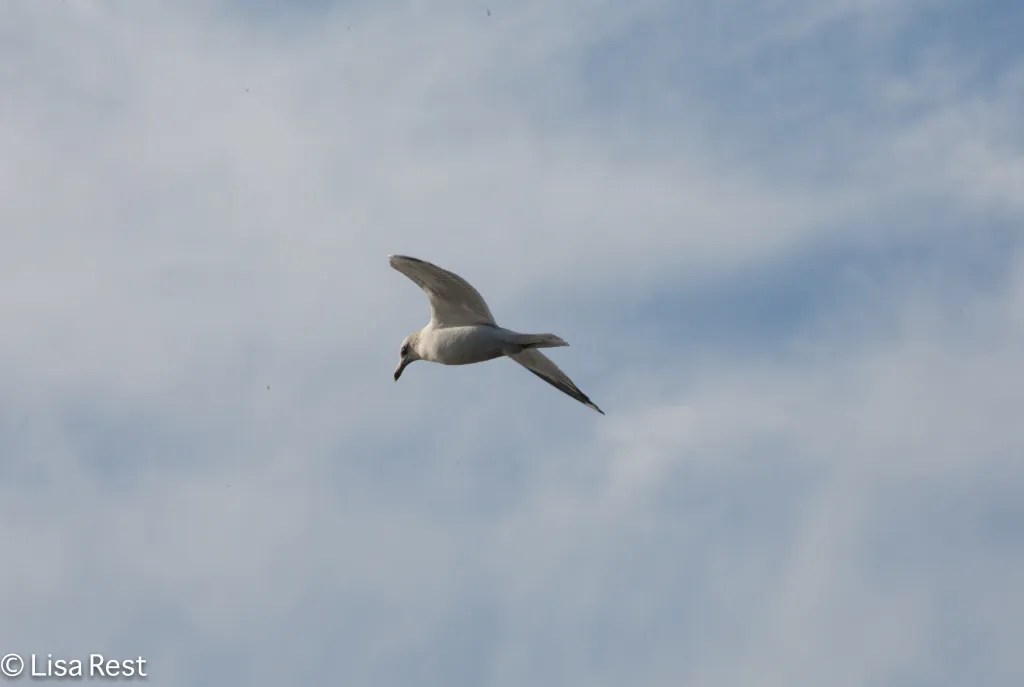
The water levels were returning by November, which I guess was attractive to some Ring-billed Gulls.

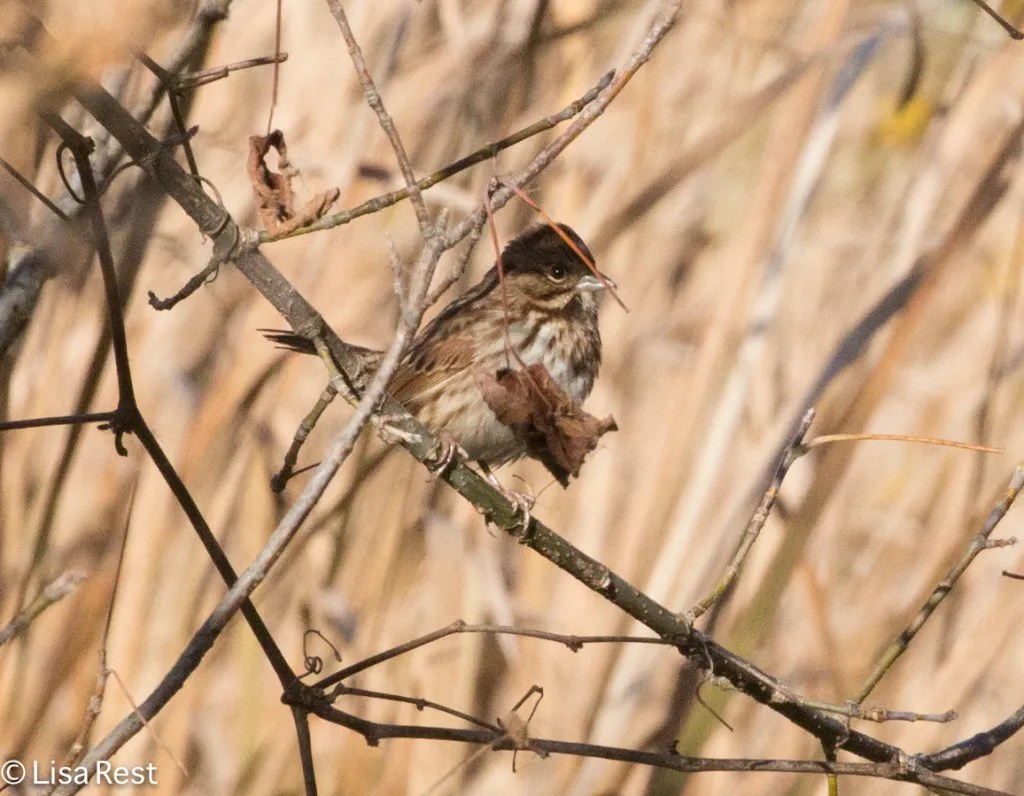
Song Sparrows were still around here and there.

There were several Pied-billed Grebes that day as well.

And the American Coots were less skittish.

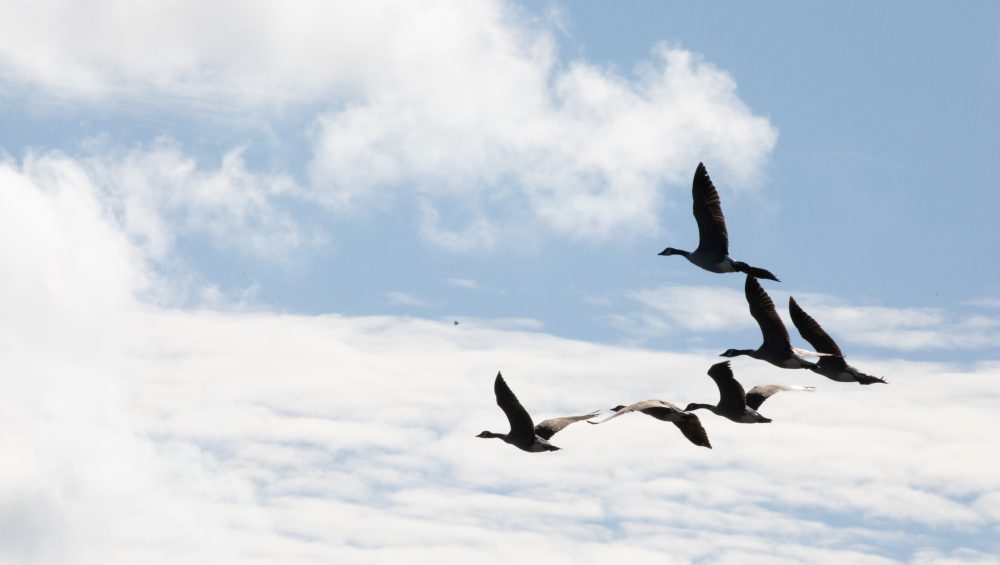
Canada Geese in formation

Now I will be start going to McGinnis more often. I will likely branch out and visit more places in the Palos area too, as there are a lot of them.

I am looking forward to choir rehearsal tonight. We sang half-masked on Sunday. The sanctuary was full of congregants so it was slowly starting to feel a little bit more normal. One inch at a time.

Long Before the Rain

It’s been almost 3 months, which seems hard to believe, but this is a more historical account from McGinnis Slough for birds seen on September 19th, when the slough looked more like a marsh at best. Yet there was more bird activity and a couple less common sightings.

It started off inauspiciously with a European Starling.

But at some point I found a Northern Waterthrush, which is a warbler species I haven’t seen in a long time. They aren’t particularly rare but they don’t travel around in warbler flocks and are often close to water and the ground.

One of my first White-throated Sparrows of the season was in the grass.

Perhaps the bird of the day as far as offering itself up for photographs was Palm Warbler.

Among the land birds was this Swainson’s Thrush.

The Double-Crested Cormorant below gave me several expressions of its flight pattern.

More views of the faded-looking Spicebush Swallowtail butterfly at the top of the post.

I never know exactly where I can expect to see a Great Blue Heron here but I practically always do.

More flying birds to capture – a Great Egret and, of all things, a Blue Jay or two, which don’t normally make themselves so available.

Two warblers – a Nashville and then below, a female Common Yellowthroat.

I saw Gray Catbirds at this location more than once.

The light played interesting tricks on these two Wood Ducks flying through the marsh.

The rose mallow flowers seemed late and sparse but they prevailed.

A Yellow-rumped Warbler blending in below.

More flying birds. Cedar Waxwings directly below, and below them, the inevitable Canada Geese.

A couple views of the parched-looking slough.

And a closer-cropped view of the Great Egret seen in the flight sequence above, after it landed.

I have been seeing some amazing birds all week which has kept me more than busy. Even though migration has slowed down, there are still birds to be seen. I will be back as soon as possible with more recent sightings.

Water Returns to McGinnis Slough

This will be brief. I went to McGinnis Slough last Sunday to see if maybe I might be present when some Sandhill Cranes were flying over, or just in general to see what the water levels were like. All the rain had made a difference. Where there was no water to be seen before, now the slough looks like a slough again.

No Sandhills flew over. Indeed, not much was flying.

I saw my last Yellow-rumped Warblers of the season.

Red-winged Blackbirds linger.

I’m always happy to see a Pied-billed Grebe.

.

A Northern Cardinal blended in well with the leaves turning red.

This Song Sparrow wasn’t interested.

It was best to see water again.

For the most part, there were perhaps 200 American Coots scattered all over the slough. They were quite distant, however.

I’m running out of room on the hard drive again so I will be back soon with lots more.

Sundays at McGinnis – Part 2

As promised, here’s my last visit to McGinnis Slough. I have been out birding every morning since, mainly at the Chicago Portage but a couple other places too, and fall passerine migration is in full swing. I don’t know if I will ever get through all my photographs, but I intend to start posting them soon as much as possible.

It was delightful to spend a little time with a Blue-Gray Gnatcatcher at McGinnis.

This Song Sparrow perched nicely for me.

Another bird I felt very privileged to see well was the Marsh Wren below. I could hear wrens in the reeds but they are always nearly impossible to see. Then, while I stood in the same spot looking at whatever waterfowl I could see, this one popped out in a bush to get a closer look at me.

I also saw a Brown Thrasher – a bird I used to see a lot more of but now rarely. And then my first Palm Warbler of the fall season.

A few more of the Marsh Wren…

Finally, a cooperative flower. It appears to be a hibiscus. But I am used to seeing the big pink rose mallow flowers that bloom here every year and they have been few and far between.

More views of the American Redstart that is at the top of the post.

I wonder if the slough will ever have enough water again to host the hundreds of ducks that usually show up in the early spring.

Common Green Darner

Tall Boneset is now blooming with the Canada goldenrod.

Several Barn Swallows took a break from scooping bugs out of the air…

And there was one lone Tree Swallow.

I managed to barely see the Trumpeter Swans – and noticed there was only one Cygnet. I fear the other two did not survive. I suppose the likeliest predator would be a coyote.

Peter Mayer has just written a beautiful song called “Trumpeter Swans” which I have already listened to maybe a hundred times…

The Herons were all hanging out in what little water is left.

And I caught a Wood Duck in flight.

I was a little surprised to see Northern Shovelers.

These fuzzy-looking acorns caught my eye. They are not acorns. They are called “hedgehog galls” and are formed by wasps.

Northern Crescent

This Blue-Gray Gnatcatcher is probably halfway to its winter home by now.

Okay. I hope to be back very soon with a feast of warbler photographs. There have been other interesting birds too. Thanks for checking in!

Sundays at McGinnis – Part 1

This is the first of two short posts from recent visits to McGinnis Slough. I visited the slough the past two Sunday mornings. The 29th of August was cloudy as reflected in these photos. Just as I was about to leave, it started to rain, thus the rainbow farther down the page.

There were not many birds to photograph. The Wood Ducks were visible through the vegetation that has taken over much of the slough.

The Common Green Darner below is a marvelous dragonfly. This is the female of the species.

A brief visit from a Red-tailed Hawk…

A few Great Blue Herons remain on site.

These berries caught my eye – but I bet they’re all gone by now.

I don’t know why I try to capture swallows in flight, but sometimes I almost do. Barn Swallow below.

When I sat down on the picnic table at the north end, I inadvertently disturbed an American Toad that was sitting underneath it.

Milkweed beetles, chicory flowers and a Monarch Butterfly.

One more of the Great Egret that’s also at the top of this post.

The Rainbow

I came home to a cloudy situation in the yard, not many birds available, but sort of captured this female House Finch leaving.

I’ve been busy birding every morning and now I have to keep up with all the photographs as fall migration kicks off.

I’ll be back with another brief stop at McGinnis from yesterday and some different birds.