Cloudy Afternoon

I never intend to go birding in the afternoon, but on Friday I jumped at the chance when we were encouraged to take the afternoon off. It was cloudy, and you can never count on what birds will be up to after lunch. Sometimes I like the cloudiness, though, because it reminds me of birding in South America.

Cloudy at the Portage

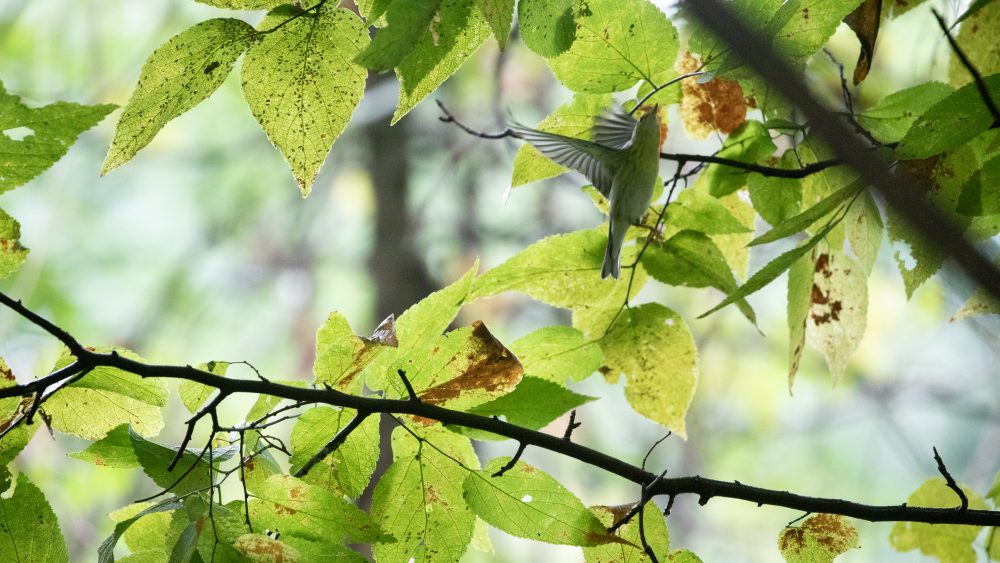
Maybe cloudy was okay for capturing this Cape May Warbler.

Then there was a very active, backlit Warbling Vireo. This is likely the only Warbling Vireo I will photograph this year. There’s always one. But they are all very busy singing now and protecting their territories.

Sometimes I hardly ever see goldfinches, and at other times they seem to be everywhere. All I know is they’re not in my yard too much anymore so I suspect many of them are at the Portage or other nearby forest preserves.

With all the rain and now warmer temperatures, the green-up is happening rapidly.

I often hear Killdeer but don’t always see them. I managed to capture this one flying across the compost piles on the MWRD property.

Starlings have been entertaining. I have seen one doing happy dances a couple times, although unfortunately it was hard to get him in focus on this trip. But I did capture him flying.

And now how about paying some attention to the ladies? It seemed to be a good day to capture pictures of the girls. Maybe they thought they were less noticeable on a cloudy day.

Mallard female
Brown-headed Cowbird (male)

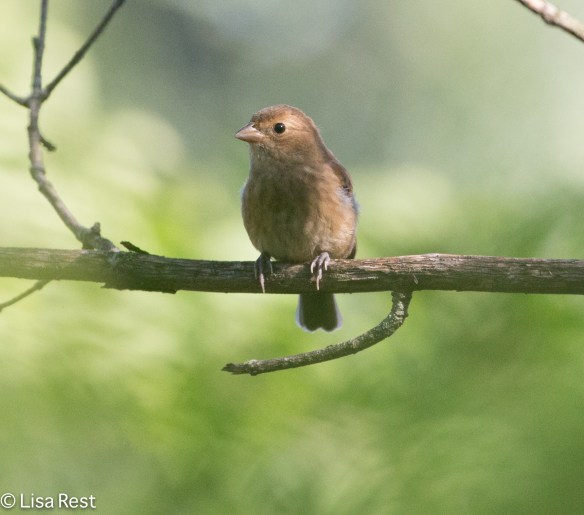
I found the female Indigo Bunting below quite fascinating, in that she was preening or otherwise trying to get a grip on her feathers and the photos reveal her black and bluish feathers underneath. Who knew? (Forgive me for thinking “only her hairdresser knows for sure.”)

As a comparison to the above, here’s the male in all his glory and various feather colors.

Song Sparrows are more often heard than seen so it was nice to catch this one foraging for something.

And it’s not often I see a pair of Downy Woodpeckers. Maybe afternoons are lazier for the birds.

Pair of Downy Woodpeckers

I had a wonderful encounter with a Philadelphia Vireo a couple years ago. I hope to see more of this species. And this was the first day I saw the Eastern Kingbird. By Memorial Day there were two Kingbirds hunting for bugs from their perches over the water.

Early on there was a small flock of Cedar Waxwings but they were hard to distinguish in the shadows and blended in perfectly with the tree colors.

Cedar Waxwing

Another elusive Black-and-White Warbler. These warblers are relatively easy to see, but so far had been defying my lens. However stay tuned because I have had some more productive encounters.

Part of a Black-and-White Warbler

Even the Baltimore Orioles looked a bit washed out. But I noticed a nest, and that was a welcome sign. The female builds the nest, so I can only imagine she was inside of it.

Baltimore Oriole Nest

It has been hard to go back to work after a long weekend, even though I have not yet returned to the office. Most amazing to me has been the time spent in the field, so to speak. I never feel like I have this luxury to fully absorb my surroundings except when I am on vacation. But something about the pandemic has slowed down everything after eliminated many social commitments. I can embrace birding religiously three days straight as a spiritual exercise. Even though I am encountering several more people on the trails, there is still enough space and quiet, with many moments left to witness how life continues beyond our immediate concerns.

October’s End

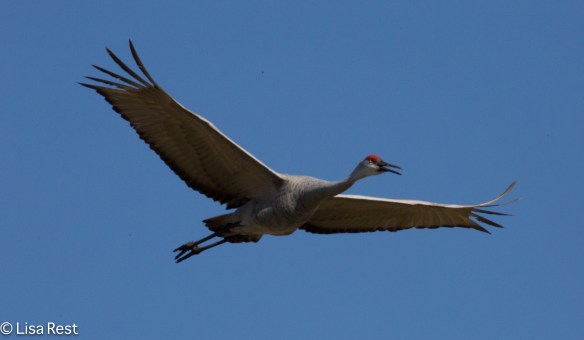
A goal for the last two years has been to get up to Goose Lake Natural Area and the Hebron Trail in October to see Sandhill Cranes. October weekends were flying by with other commitments and I kept hoping for decent weather, should I attempt the trip on the last Sunday of the month. I was rewarded with available sunshine and went to investigate. I saw only 18 Cranes eventually, when there had been a few hundred reported earlier in the week, but I was lucky to have three calling raucously and flying right overhead.

My start down the eastward Hebron Trail, which is a gravel trail built on an old railroad bed, yielded a flurry of Cedar Waxwings, Robins and Starlings at the start.

Hebron Trail
Cedar Waxwing
European Starling

The more often I visit this place, the more I fall in love with it. But it takes me an hour and a half to drive up there, no matter which way I go. The first time or two I wasn’t sure I was ever going to find it, but now I know the route and the landmarks and it’s easy – just a long haul.

Not long after I reached the end of the tree-lined part of the trail, I saw this male Northern Harrier fly across the field and then maybe twenty minutes later it flew by right in front of me.

Sparrow migration is in full force and I saw plenty of sparrows to prove it. It was especially nice to see the Vesper and Savannah Sparrows. Also this was my first American Tree Sparrow of the season. Since I’m already over seeing Juncos come back, I see no problem welcoming the Tree Sparrows, as both species herald the return of colder months.

Vesper Sparrow
Savannah Sparrow
American Tree Sparrow

There weren’t a lot of birds in the water, mainly American Coots. There were some Pied-Billed Grebes, but they were too far away to capture adequately.

American Coots

As I went through my photographs last Sunday, I realized I still had photos from my last visit back at the end of July, when I wondered if there were any Yellow-Headed Blackbirds left. I’m including some of those photos below.

Yellow-Headed Blackbird (female)
Song Sparrow
American Goldfinch
This Halloween Pennant would have been much more appropriate if I’d managed to post this last week!
Another reason why I like this place – I always see Crows!
Widow Skimmers look even better in retrospect.

A couple more of the Sandhills… My resolution for next year is to visit this place more often, maybe even closer to the peak times for certain species. Either way, it’s a beautiful place and I am happy to share it with you.

Catching Up

Ruby-Crowned Kinglet

After weather and whatever have kept me inside the past couple weeks, I am looking forward to birding both mornings this weekend and then next Saturday “officially” for the Christmas Bird Count. Then I know what will likely happen: the immediate will foreshadow the past, and I’ll still never get around to what are soon to become “last year’s photographs.” So with this post I hope to catch up with a couple dangling picture portfolios… Starting with the last fall migration bird walk in Columbus Park on October 20th.

Juvenile Rusty Blackbirds

The most unusual birds we barely saw were the Rusty Blackbirds above (two out of five of them). It was too hard to tell exactly what they were until I developed my photographs. We were otherwise seeing the usual suspects …lik Yellow-Rumped Warblers, Cedar Waxwings, Fox Sparrows.

I did not expect to see a robin sharing space with a Red-Tailed Hawk.

Robin and Red-Tailed Hawk

Just barely caught this adult White-Crowned Sparrow and saw a juvenile later.

Two more of the Red-Tailed Hawk.

As I’m hard-pressed for anything colorful around here lately, I’m sharing a few photos from the Missouri Botanical Garden, visited last month when the choir went to St. Louis. Not many birds made themselves available that afternoon but the garden is lovely.

Thanks to all readers, followers and commenters for checking out my blog and tolerating my state of flux. Gotta go now, but winter’s just getting started!

Yellow-Rumped Warbler

Fall Migration Continues

RBNU Portage 9-29-18-1399

Red-Breasted Nuthatch

I think fall must be my favorite season at the Chicago Portage. The birds blend in with the autumn colors, the leaves start to fall from the trees and then every once in a while a bird takes a quick leaf-like descent as well. This past Saturday, after my morning commitment to Thatcher Woods where we had scores of Yellow-Rumped and Palm Warblers, I decided to see what was up at the Portage. Below are two of perhaps 100 Robins…

Directly below, two Common Yellowthroats at Thatcher Woods.

I always take a picture of the water, such as it is, at the Portage to document how it changes from season to season…

Portage 9-29-18-1268There is water enough to bathe in as this female Red-Winged Blackbird was finding out.

RWBL Portage 9-29-18-1577

Red-Winged Blackbird (male)

The Yellow-Rumped Warbler below was at Thatcher Woods…

And the Palm Warbler below was at the Portage.

PAWA Portage 9-29-18-1565Tennessee Warblers and Orange-Crowned Warblers often get confused in the spring but these two made it easier for me.

TEWA Portage 9-29-18-1279

Tennessee Warbler

Orange-Crowneds always looks to me like they have a slight eye-ring.

OCWA Portage 9-29-18-1591

Orange-Crowned Warbler

I missed seeing a flashy male Black-Throated Blue Warbler this year but I’m glad to have found a female of the species, wearing her muted fall clothes.

BTBL Portage 9-29-18-1473

Black-Throated Blue Warbler (female)

Blackpoll Warblers in their fall plumage are stamped permanently on my brain after a few years ago when there were many for several days at my old stomping grounds, Lake Shore East Park, so I was delighted to find this lovely individual.

At one point I encountered some workers who were taking down a tree. I spent some time talking to one while another was driving wedges into what was soon to be the stump. It turns out the trees were not birch but white poplar, which is an invasive species and that is why they were removing it. Come to think of it I don’t recall ever seeing a bird in those trees although they had become a landmark and I thought they were rather attractive. After I was given clearance to go beyond the workers, I grabbed two quick clicks in the distance as the tree fell.

For all the Robin activity there were only a few Cedar Waxwings…

My view from the first bridge at the Portage yielded a Mourning Dove and a House Wren.

MODO Portage 9-29-18-1265HOWR Portage 9-29-18-1255I almost thought I had missed all the Indigo Buntings but there were still a few youngsters left.

INBU Portage 9-29-18-1526

Indigo Bunting

NOCA Portage 9-29-18-1510

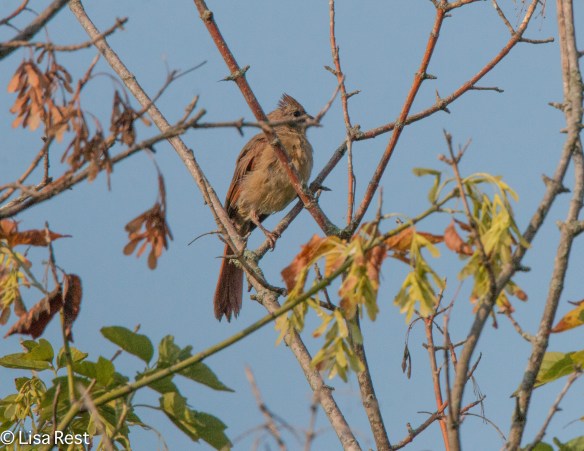
Northern Cardinal (female)

I was delighted to see a Swainson’s Thrush if only for a moment…

SWTH Portage 9-29-18-1417

Swainson’s Thrush

Eastern Phoebes…

Just starting to see Dark-Eyed Juncos, the harbinger of colder weather coming, I suppose. But after not seeing them all summer I am glad to have them back.

DEJU Portage 9-29-18-1454

Dark-Eyed Junco

Yellow-Bellied Sapsuckers are coming through as well.

YBSA Portage 9-29-18-1405

Yellow-Bellied Sapsucker

GREG Portage 9-29-18-1318The Des Plaines was so low, this Great Egret was wading out into it quite a ways from the shoreline.

We had a lot of Northern Flickers at Thatcher Woods. Here’s one of them checking out a future home, perhaps.

YRWA Portage 9-29-18-1486

Yes I am a Yellow-Rumped Warbler

And Monarch Butterflies are still migrating. I love the way the Poke Weed looks this time of year. I knew the birds were attracted to it but I guess the Monarchs like it too.

Monarch Portage 9-29-18-1497After hearing and rarely seeing Eastern Wood-Pewees all summer, it was nice to get good looks at this one.

EAWP Portage 9-29-18-1395

Eastern Wood-Pewee

DOWP Portage 9-29-18-1550

This last photograph is of a Downy Woodpecker who was foraging low and obscured by the vegetation but I like the pastel colors.

More to come, I have three more Saturday bird walks, weather permitting. We seem to be entering a rainy spell but from the looks of the Des Plaines last week we can use it.

Lazy Labor Day Weekend

COGR 9-2-18-8899

Common Grackle

At least today, on Labor Day, I decided to be lazy by not getting up two hours before dawn so I could go birding. After meeting at the destination on Saturday, we canceled the walk due to thunderstorms looming in the wings. Even so, I had stayed back with another participant to get a handle on the layout of the trail setup when suddenly a crash of thunder and lightning striking right in front of us convinced us it was indeed time to leave.

So yesterday I got up and decided I would not go far, but as long as it wasn’t raining or threatening to, I may as well try to see what I could find. I went to Ottawa Trail Woods and encountered some obstacles on the trail (above). It became even more evident that I was the only person to have traversed the river trail in a while as I managed to avoid only one of two spider webs strewn above the footpath. The first sign of life was the deer below.

Deer 9-2-18-8770

oven 9-2-18-8796

Ovenbird

There were not a lot of birds. Or at least not a lot of species. But this time I got to see an Ovenbird for a few seconds although it was nearly the only warbler I saw.

A dozen Common Grackles showed up in the trees right above my head. So much for dark backlit birds.

Ottawa Trail is usually good for Thrushes and I was not entirely disappointed. At least I got to see this Gray-Cheeked long enough to photograph it.

GCTH 9-2-18-8918

Gray-Cheeked Thrush

Early on I saw one Cedar Waxwing, but knew there was no such thing as a solitary Cedar Waxwing and on my way back on the trail I encountered at least sixty in the branches of one tree. Click on the upper righthand photo below if you don’t believe me.

The bottomlands by the river were flooded from all the recent rain and I was able to relocate this Great Blue Heron after it flushed, when I surprised it by my walking the path even though at a considerable distance.

GBHE 9-2-18-8881I am still puzzled over the image below but the bug capture is more interesting…

HOWR 9-2-18-8811So it was mostly distant unspectacular sightings . A Red-Bellied Woodpecker, an Eastern Kingbird…

Indigo Buntings were nearly unrecognizable. The one on the right was an up-and-coming male hiding from me at the Portage which was where I went next.

The Portage still had a couple hummingbirds, perhaps the same ones I saw on Friday. Plenty of Jewelweed everywhere. A few years ago on a September day I saw what seemed like a hundred Ruby-Throated Hummers in one visit, all over the Jewelweed, but it was not repeated yesterday. If you look closely at the third image of the hummer you an see a little bit of red emerging on his young throat.

By the time I got to the Portage it was closer to midday, the heat was becoming oppressive and I didn’t expect to see many birds. So I appreciate one Gray Catbird after hearing them but never catching even a glance at one Friday.

GRCA 9-2-18-9002All my bushwhacking resulted in pollen all over the lens hood…

img_2910In front of me on the trail, a baby Snapping Turtle.

Baby Snapping Turtle 9-2-18-9026There were fewer dragonflies than last week. And I keep running into Eastern Commas that don’t want to pose correctly: or is it a Question Mark???

The Robins all seemed to be at Ottawa Trail yesterday with only a few at the Portage. I imagine it’s the same flock going back and forth.

AMRO 9-2-18-8840Monarch Butterflies are still coming through, although they will all be down to Mexico soon. Migrations of the soul…

Monarch 9-2-18-8941I came up with a new mantra this weekend, so I guess it’s only appropriate on Labor Day that I share it with you. I have been muttering “I have to stop working” for far longer than I want to recall. But I decided now my mantra should be, “I have to start writing.” I have been thinking about a book for the last several years. It changes every five minutes, but I think it’s finally starting to come together in my head because I found the first sentence yesterday. So it’s time to start writing it. Which may make my contributions to this page even more infrequent, I don’t know, it’s hard to imagine writing anything after working all day at a computer in an office. But by declaring my intentions sometimes I can force myself to get going so as not to risk eternal embarrassment. Thank you.

Portage Vacation Day

CEWA 8-31-18-8696

Cedar Waxwing

I took today off. It was a bit difficult getting up early this morning after swimming last night but I managed to get over to the Portage a little after 8:00 a.m. and took note of how deserted the place was on a weekday. No dog-walkers or cyclists. Only one runner, who was probably as amazed to see me as I was him.

img_2889img_2888A long shot of the duckweedy water above and just below it, an untrimmed path I decided not to take.

AMRO 8-31-18-8397The robins are back, and the waxwings are still numerous. Literally nobody in the mucky water. I was treated to American Redstarts and a couple Ruby-Throated Hummingbirds early on, which gave me hope to find a few more migrants.

AMRE 8-31-18-8409

American Redstart (First Year Male)

Ruby-Throated Hummers above, an adult male American Redstart below.

The only other warblers I could barely photograph were the Chestnut-Sided below left and the Black-Throated Green on the right. I missed the Ovenbird that landed briefly in  the tree I later found them in.

In the beginning with the immature male Redstarts was a chattering young House Wren.

Butterflies were out for the sunshine today. Red Admiral, Pearl Crescent and Monarch butterflies.

I saw a few White-Breasted Nuthatches too.

WBNU 8-31-18-8715I heard the Eastern Wood-Pewee long before I saw the one below.

EAWP 8-31-18-8745This time of year I expect to see lots of Indigo Bunting children and I did, but they were playing hard to get with the camera.

Yellow is the predominant color this time of year and I found a bumblebee and a goldfinch taking advantage of it.

One Eastern Kingbird…

EAKI 8-31-18-8640There was a lot of chatter from catbirds but I only barely saw the youngster below.

GRCA 8-31-18-8474A couple more Cedar Waxwings. The one on the left is an immature.

The last photograph I took was of this stunning little Silvery Checkerspot.

Silvery Checkerspot Butterfly 8-31-18-8756My walk tomorrow will take place if we are not totally rained out. Scattered thunderstorms are in the forecast. We shall see… This evening as I write this I have just heard the rumble of thunder. And now it is starting to pour.

By the way it feels nice to have the time to do a same-day blog post. Perhaps if I – no, let’s say when I retire – I will be up to the task more often.


Winding down…

Mallow McGinnis 8-19-18-8037

Rose Mallow at McGinnis

As the days get ever-so-slightly shorter, commitments increase. I’m not sure why that is. But suddenly it seems there is less time for more things to do. A visit to McGinnis Slough had been on my mind for weeks ever since the last time I drove by the entrance was closed for paving the driveway, and there was no access. I got up as early as I could Sunday morning to visit the Slough and then the Portage.

McGinnis 8-19-18-7939

A Slough in name only…

I think the last time I posted from the Slough, I was commenting on the low water levels following perhaps a flooding situation. But the summer weather since has not been kind to the Slough. Indeed it is all overgrown and there is barely any water, so all the birds I would normally see have gone somewhere else.

There were Mallards and Wood Ducks. I saw two distant Great Egrets, but no Great Blue Herons. Normally the slough would be hosting scores of these herons. No such luck this year.WODu w MALL McGinnis 8-19-18-8024Perhaps indicative of the situation was the first bird I saw, the bedraggled-looking Northern Cardinal below.

NOCA McGinnis 8-19-18-7914There were a few blackbirds around too, but the breeders are gone.

RWBL McGinnis 8-19-18-8000

Red-Winged Blackbird, hiding the red

When not distracted by birds, the vegetation grabs my attention. Could this be a new grass taking over? I think it is Bristly Sedge.

It was then I went to the Chicago Portage. I got there just in time to encounter all the dog-walkers, runners and cyclists, but it is always worth checking out. I have to remind myself sometimes that seeing fewer birds than I might want is still worthwhile from a reporting standpoint…

Portage 8-19-18-8147There were more Cedar Waxwings (below) than any other species. I can only assume they were cleaning up whatever mulberries the robins, who were absent, had left behind. That’s right, the robins that virtually take over the landscape have all gone somewhere else. I’m envisioning large fruit-eating flocks already in mini-migrations.

There was one distant but distinct Ruby-Throated Hummingbird. I hope to see more, as  there is plenty of Jewelweed in bloom, but the window is narrowing for this species. Maybe I’ll have another week or two…

RTHU Portage 8-19-18-8072The theme for the day, perhaps, was shaping up. These were young birds starting to find their way in the big wide world, like the Eastern Kingbird below.

And the scraggly youngster below appears to be a young Great Crested Flycatcher.

GCFL 8-19-18-8173I expect to see a lot of juvenile Indigo Buntings in the next few weeks, but Sunday just about the only bunting I encountered I could barely see.

INBU 8-19-18-8121

Indigo Bunting

I was happy to see a Turkey Vulture (adult) in the neighborhood. I think seeing so many different vulture species in East Africa years ago instilled a love and respect for them. Lately I have seen groups of these hanging out by the highways, where I’m sure they make a decent living off of roadkill.

TUVU 8-19-18-8184The most accommodating bird at the Portage was the cardinal below who was singing with his back toward me but I guess that feeling of somebody looking at you caught his attention and he turned his face toward me.

NOCA 8-19-18-8106

Northern Cardinal

Starting this Saturday, I will be leading weekly bird walks in two alternating locations. I was recruited for this position by a fellow bird-watching choir member. We’ll see how it goes. I plan on taking the camera with me, but the leading and listing responsibilities will make photography challenging. If nothing else, I will become more familiar with the two destinations which up until now I have rarely visited. The whole purpose of this is to catch the fall migration wave. I promise to report back as often as possible.

I almost forgot my little insect sampler from the Portage. Worth mention, perhaps, is the fact that there were at least 20 Monarch Butterflies. But it’s still hard for me to believe that is a larger number than I have seen all summer.

So as we experience the changes in the weather, the environment, the species we see… the changes are unsettling, but that’s still another glass is half-empty/half-full quandary.

My last thought is a little summertime-feeling music – Trois Gymnopedies by Eric Satie. The recording is from almost 4 years ago when I had fewer birds, it was the start of the second flock, and most of the Zebra Finch solos are the beginnings of my star singer, Arturo Toscanini, whose songs have progressed far beyond this and they continue to grow. One of these days I’ll have to see if I can trace the evolution of his song cycle.

Portage Summer Day

GRHE 7-28-18-7115I got out early last weekend to beat the heat which was nothing compared to what kept me indoors most of this weekend. Last Saturday was a beautiful day. And usually when the weather is good, the birds are out enjoying it too.

Summer is the time for confusing juveniles, and the first bird I saw, below, suggested to me that it was a juvenile Eastern Wood-Pewee…

EAWP 7-28-18-7095Not to be confused with the juvenile Eastern Phoebe I saw later, below.

EAPH 7-28-18-7100I couldn’t get this Downy Woodpecker kid to turn around and smile for the camera but it was good enough to see his adult feathers coming in…

DOWP 7-28-18-7126The House Wren below just has that newbie look about it.

The Red-Bellied Woodpecker kids were out and about. I was surprised to see no red at all on the head of the one below on the top right.

Robins always look like something else this time of year, but I am no longer fooled.

AMRO 7-28-18-7192I was beginning to wonder if all the Red-Bellied Woodpeckers were gone, but then I found a bunch of them hanging out on the bare limbs of a dead tree. They were all juveniles.

These two young Northern Flickers seemed to be practicing pairing up already.

NOFL 7-28-18-7350

Nothing going on, on the Des Plaines, which was looking low.

Not much in the way of butterflies. A Monarch here and there, and this one Red-Spotted Purple.

But the dragonflies were quite amazing.

Widow Skimmer 7-28-18-7252

Widow Skimmer

I’m going out on a limb with the ID below. I have a fancy book on dragonflies and damselflies but there are way too many choices.

Russet-tipped Clubtail female 7-28-18-7265

Russet-tipped Clubtail female

I’ll keep trying to figure this one out…

? Bluett 7-28-18-7272

Some kind of Bluet

I’m not confusing Twelve-Spotted Skimmers with Widow Skimmers anymore…

Twelve-Spotted Skimmer 7-28-18-7281

Twelve-Spotted Skimmer female

or with Common Whitetails.

Common Whitetail male 7-28-18-7322

Common Whitetail male

Then there was this beautiful Grasshopper that is likely a Differential, but I am absolutely ignorant about grasshoppers so I’m not guessing.

Unidentified Grasshopper 7-28-18-7298And if anybody knows the identity of the beautiful wasp below, please chime in. All my reference books have failed me.

Unknown Wasp 7-28-18-7166Back to the birds. The fruit-eaters were enjoying the mulberry tree. That’s a Cedar Waxwing on the left and an adult American Robin on the right.

This Eastern Kingbird looks mature, but looks can be deceiving.

EAKI 7-28-18-7312Some interesting things on the trail for the juvenile Song Sparrow below…

SOSP 7-28-18-7177and for a male House Sparrow. I rarely see House Sparrows at the Portage but there were these two.

HOSP 7-28-18-7392

Juvenile House Sparrow

Saturday mornings tend to be work days. There was some burning of invasive vegetation going on.

Controlled burn 7-28-18-7176Goldfinches are late breeders, so I haven’t seen many in my yard lately, but I did see this pair at the Portage briefly.

AMGO 7-28-18-7255Always happy to see a Great Blue blending in.

GBHE 7-28-18-7234And it was even pleasant enough for a couple cardinals to make an appearance.

NOCA 7-28-18-7291I heard more Indigo Buntings than I saw, but was finally rewarded by the adult male below.

INBU 7-28-18-7382For as much time as the Green Heron spent on this frog I am not sure he or she managed to eat it.

GRHE 7-28-18-7130I hope the heatwave ends in time for next weekend. In the meantime I guess I can’t complain about being stuck in an air-conditioned office this coming week.


Three Days in Michigan, Part I

BWHA 7-17-18-6967

Broad-Winged Hawk, Hartwick Pines 7-17-18

I had the good fortune to meet up with my roommate from previous trips to Ecuador and Panama, and join her for a family reunion a couple weekends ago. The lodging was a remote location near a sprawling golf resort in Michigan. I could have been out of the country because my GPS quit working right before I arrived, and I did not always have cell phone coverage, so it felt like a real getaway. Four of us were birders, so we spent the better part of the three full days we had together exploring various locations. These pictures are from the Manistee National Forest.

My car was too small to be comfortable enough for the day trips, so I was a lucky passenger. I tend not to pay close attention to where I am being taken, and I don’t keep a journal when I’m on a trip, so if it were not for my friend’s son keeping an ebird list I wouldn’t be able to recall where we went. My contribution was to bring a book on birding locations in Michigan, which I gladly handed over to Oliver and his wife, and they decided where to go. I was happy to be away and would have gone anywhere. Even though my drive up was only about 4 hours, the ecosystem and even the time zone were sufficiently different, so the feeling was equivalent to going much farther away.

I had planned to do only one blog post for the whole trip because I felt like I didn’t get very many pictures, the birds were far away and when the birds were closer the lighting was difficult, but now that I’ve processed everything it seems a better idea to break it up into a couple posts. Birds were not all that easy to find. We heard the swamp sparrow, above right, singing like crazy but until we found him and he moved around on his perch a little bit, he was half-hidden behind a leaf. The bird on the left is a Cedar Waxwing.

It was wonderful to see multiple Turkey Vultures. Not that they aren’t in Illinois but I have missed seeing one in the neighborhood this year. And we were out in the middle of some kind of nowhere, so it was possible to see groups of them soaring high in the sky. It was also nice to see a Yellow-Bellied Sapsucker (with all the sap holes in the tree). They breed in Michigan. At home I get to see them only in migration. That’s a Wood Duck below left-hand corner.

I think I have seen Cliff Swallows before only in Ohio and perhaps Michigan so it was hard for me to recognize the youngsters below.

CLSW 7-16-18-6840

Cliff Swallows

The last pictures I took in Illinois of Dickcissels were all of their backs to me, so even though the bird below is hidden in the foliage you can at least see its pretty yellow throat. It looks like a young bird, as does the Bobolink below it.

DICK 7-15-18-6746

Dickcissel

BOBO 7-16-18-6726

Boblink

I found the dragonflies more cooperative than the birds. And, in the presence of a dragonfly expert, I learned I have been misidentifying some of them. Below left is a Ruby Meadowhawk. The upper righthand ID is a female Little Blue Dragonlet, and below it is a Halloween Pennant – which I think we saw every day. More dragonfly pictures to come.

Here’s one of the Swamp Sparrow singing.

SWSP 7-15-18-6616I intend to be back soon with more from Michigan. It’s been busy at work and all of a sudden, even though the entire month of August is ahead, it seems like summer is already on the wane. I do appreciate the cooler temperatures we have had lately but I know better than to expect them to stay. However it’s heavenly to open the windows overnight.

Geese and Mallards 7-15-18-6655

Surprises at the Chicago Portage

SORA 10-8-2017-9396

Sora behind duckweed-covered Mallards

Last Sunday I got up early enough to pick up Susan at 7:15 and get to the Chicago Portage, only to find the cable barring entry to the parking lot was still strewn across the entrance. I locked the car and we walked around the parking lot area for about 10 minutes before the designated person showed up. It was well past sunrise, which is when the preserves are supposed to be open… But it was still early enough to see a Sora Rail across the duckweed not long after we started down the trail.

I have never seen a Sora at the Portage. Rails are hard enough to see just about anywhere. The usual scenario is that I might hear their beautiful song and take for granted I will never find them. This one was silent, but virtually out in the open. Susan looked across the water with her binoculars and said, “Is that a Sora?” and then I spent the next several minutes trying to get a decent picture of it.

The other surprise Sunday was a Marsh Wren, also a first for me, for the Portage. But though we saw it well for a half second, it was not interested in seeing us again so I got no photographs.

I do have one more surprise, though, from the previous weekend. I saw a juvenile Red-Headed Woodpecker, another species I have never seen at the Portage and only infrequently anywhere, and I managed to get the pictures below. I can’t help but wonder if the change in habitat, the opening up, so to speak, of more marshy areas, will attract this species more often.

Birds became visible from their foraging behavior. The tiny Golden-Crowned Kinglet below was interested in something contained in the bark of a tree down the trail from us.

I caught the Ruby-Crowned Kinglet below in a more contemplative phase.

Not to be outdone by other species adopting its favorite foraging spots, here is one of two Brown Creepers we saw.

BRCR10-8-2017-9579Closer to the end of our walk the intense sunlight started playing tricks with color and it wasn’t until I got home and processed the next few photos that I realized what we had.

WTSP 10-8-2017-9591

White-Throated Sparrow

The Yellow-Rumped Warbler below looked so blue in the light, I didn’t recognize it while taking the pictures.

The Black-Capped Chickadee below would not show its face but I was intrigued by its foraging calisthenics anyway.

And we managed to find one more Magnolia Warbler to add to the list.

Downy Woodpeckers are common all year round at the Portage but not always available for picture-taking. But this one was so busy with whatever it was working on, she put on a little show.

When we checked the Des Plaines River, the Belted Kingfisher was still hanging out.

Yellow-Rumped Warblers were the most numerous species on our visit, but it was still tempting to take the pictures below. At least you can see the yellow rump…

Shadowy images of a White-Breasted Nuthatch on the left and a Cedar Waxwing on the right. We didn’t have a huge flock of waxwings but there will still a dozen or so.

We saw some other thrushes but this was the only one I managed to capture. I have never seen more than one Gray-Cheeked Thrush at a time which makes me think maybe they tend to be solitary.

GCTH 10-8-2017-9570

Gray-Cheeked Thrush

Others have been to the Portage since our visit and a couple rarities, at least for the time of year, have been reported. I want to go back soon but this weekend is already booked with people activities, unless the forecast for rain and thunderstorms changes Saturday morning.

DOWP 10-8-2017-9684