 I got out early last weekend to beat the heat which was nothing compared to what kept me indoors most of this weekend. Last Saturday was a beautiful day. And usually when the weather is good, the birds are out enjoying it too.
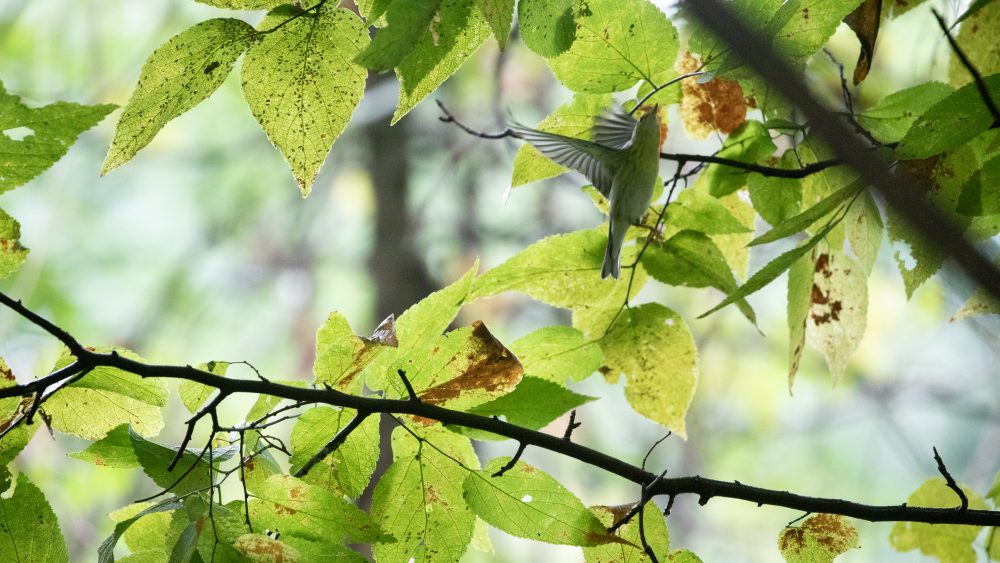
Summer is the time for confusing juveniles, and the first bird I saw, below, suggested to me that it was a juvenile Eastern Wood-Pewee…
 Not to be confused with the juvenile Eastern Phoebe I saw later, below.
 I couldn’t get this Downy Woodpecker kid to turn around and smile for the camera but it was good enough to see his adult feathers coming in…
 The House Wren below just has that newbie look about it.


The Red-Bellied Woodpecker kids were out and about. I was surprised to see no red at all on the head of the one below on the top right.


Robins always look like something else this time of year, but I am no longer fooled.
 I was beginning to wonder if all the Red-Bellied Woodpeckers were gone, but then I found a bunch of them hanging out on the bare limbs of a dead tree. They were all juveniles.


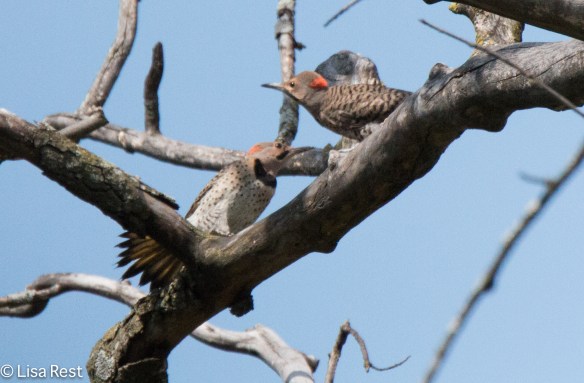
These two young Northern Flickers seemed to be practicing pairing up already.


Nothing going on, on the Des Plaines, which was looking low.


Not much in the way of butterflies. A Monarch here and there, and this one Red-Spotted Purple.


But the dragonflies were quite amazing.

Widow Skimmer
I’m going out on a limb with the ID below. I have a fancy book on dragonflies and damselflies but there are way too many choices.

Russet-tipped Clubtail female
I’ll keep trying to figure this one out…

Some kind of Bluet
I’m not confusing Twelve-Spotted Skimmers with Widow Skimmers anymore…

Twelve-Spotted Skimmer female
or with Common Whitetails.

Common Whitetail male
Then there was this beautiful Grasshopper that is likely a Differential, but I am absolutely ignorant about grasshoppers so I’m not guessing.
 And if anybody knows the identity of the beautiful wasp below, please chime in. All my reference books have failed me.
 Back to the birds. The fruit-eaters were enjoying the mulberry tree. That’s a Cedar Waxwing on the left and an adult American Robin on the right.


This Eastern Kingbird looks mature, but looks can be deceiving.
 Some interesting things on the trail for the juvenile Song Sparrow below…
 and for a male House Sparrow. I rarely see House Sparrows at the Portage but there were these two.


Juvenile House Sparrow
Saturday mornings tend to be work days. There was some burning of invasive vegetation going on.
 Goldfinches are late breeders, so I haven’t seen many in my yard lately, but I did see this pair at the Portage briefly.
 Always happy to see a Great Blue blending in.
 And it was even pleasant enough for a couple cardinals to make an appearance.
 I heard more Indigo Buntings than I saw, but was finally rewarded by the adult male below.
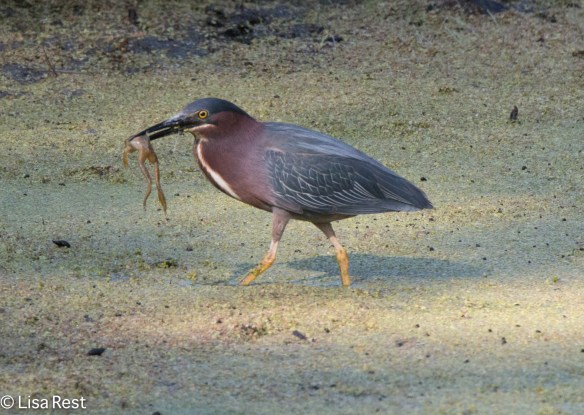
 For as much time as the Green Heron spent on this frog I am not sure he or she managed to eat it.
 I hope the heatwave ends in time for next weekend. In the meantime I guess I can’t complain about being stuck in an air-conditioned office this coming week.


 I intend to be back soon with more from Michigan. It’s been busy at work and all of a sudden, even though the entire month of August is ahead, it seems like summer is already on the wane. I do appreciate the cooler temperatures we have had lately but I know better than to expect them to stay. However it’s heavenly to open the windows overnight.


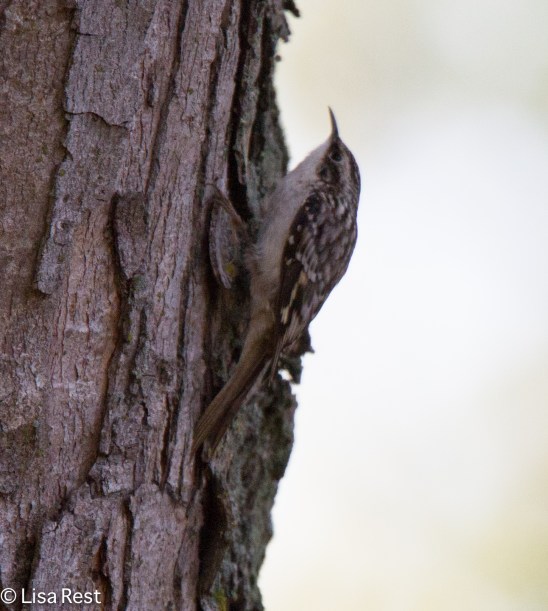 Closer to the end of our walk the intense sunlight started playing tricks with color and it wasn’t until I got home and processed the next few photos that I realized what we had.


 Continuing with last month’s visits to nearby Cook County Forest Preserves, young birds like the Cedar Waxwing and Red-Winged Blackbird above were getting ready to leave. It’s become evident to me over the past few years that European Starlings like the one below are not necessarily winter residents either. But the young Mourning Dove blending in with the dead stump below the it will likely stay.
 Hidden in the leaves about waist-length from the ground at Ottawa Trail was the Ovenbird below.
 And there just seemed to be too many ways to capture Northern Flickers. They have likely pretty much disappeared by now too. For a last look you can click on the pictures below for larger images.


 A few more Red-Winged Blackbirds.

 I am grateful for Northern Cardinals. They will be here all winter to brighten up the landscape.


 Indigo Buntings were still a presence but getting a bit harder to find. They are likely getting ready to leave.


 Also nearly absent are Red-Winged Blackbirds.


 Abundance below, of Pokeweed berries and Jewelweed blooms. Unfortunately I couldn’t find any hummingbirds enjoying the Jewelweed.

 Below, three first-year birds.


 I couldn’t decide which photograph of the Common Yellowthroat below to include, so here are both.
 And one more of a Tennessee Warbler, adorning Giant Ragweed. Tennessees were most numerous yesterday.
 Apologies for being absent of late. My work situation is in flux, which creates a different kind of distraction. But I promise I’ll be back soon with an update from the yard. It’s been cool enough overnight to leave the windows open all weekend. I think Fall is my Favorite Season.
 I’ve had hummingbird feeders up since May. Three feeders in the backyard, and a couple weeks ago after a hummingbird hovered in my front yard, I added another feeder for the front porch. The best feeder for me is the one I can see while I’m standing at the kitchen sink looking out the window to the branch of the sumac tree it’s hanging from. And Saturday early evening my eye immediately followed that quick, darting flight of a hummingbird to that exact feeder. I grabbed the camera, went out the back door and waited. The hummingbird, a female Ruby-Throated Hummingbird, to be exact, decided she’d rather be at another feeder that hangs from the redbud tree, so that’s where I got these few pictures. But at last my wish was granted and hanging the feeders was no longer in vain.


 I didn’t get great pictures of any individual American Goldfinches but they stand out against the duckweed palette below.
 Below, one very distant Tiger Swallowtail butterfly and another Indigo Bunting.

 I lost track of the warbler but then found the nuthatch, below.

 There was not a lot of activity. The large numbers of swallows and swifts were gone and nothing else had noticeably replaced their activity. But I did get a couple interesting photographs of three of the same species I had at the Portage.


 This time of year I may not be seeing many birds but everything is in a state of growth and worth attention. I visited the Chicago Portage last Saturday because I wanted to go elsewhere on Sunday and still felt like I needed to keep track of whatever was going on there. I was surprised to see the fruits of some restoration efforts in the vegetation. There is a lot of Tall Bellflower I don’t recall seeing before, mixed in with the Burdock which is about to bloom. Last time the Common Burdock was in bloom, butterflies were everywhere, so I will have to go back soon to see if that happens again.


 There have not been a lot of dragonfly species. It’s a female Common Whitetail Skimmer on the left below. I still don’t understand the attraction to gravel. On the right is a type of Spreadwing damselfly, but I am not able to identify it.

 Some juvenile-appearing Flycatchers below: Eastern Kingbird, Eastern Phoebe and what I’m pretty sure is an Eastern Wood-Pewee.


 Below is a Northern Flicker in the most popular tree bearing fruit. Now I’m realizing I was so busy following the birds in it, I didn’t bother to figure out the tree itself. More challenges ahead.
 I fully intended to do a post encompassing all last weekend’s experiences but there’s too much so I will be back shortly with a couple more installments.


 The little trio below leaves me stumped as to who the sparrow is, again. Since all juvenile sparrows tend to be on the streaky side no matter how they wind up as adults, I think this one has the look of a juvenile Field Sparrow but I’m not going to bet on it.
 Summer simmers on. I’ll be back soon.


 Down by the Chicago River last week, a Ring-Billed Gull enjoys his perch on one of the last remaining rotting pilings. And the only bird in the Boeing garden nearby was what appears to be a Yellow-Bellied Flycatcher below, after checking Crossley’s pictures as a reference, but empidonax flycatchers are hard to nail down unless they say something and this guy was silent.


 I’m looking forward to cataract surgery on my right eye tomorrow morning, because that’s the eye I use to focus the damn camera lens with, so I’m hoping for future sharper images!!


