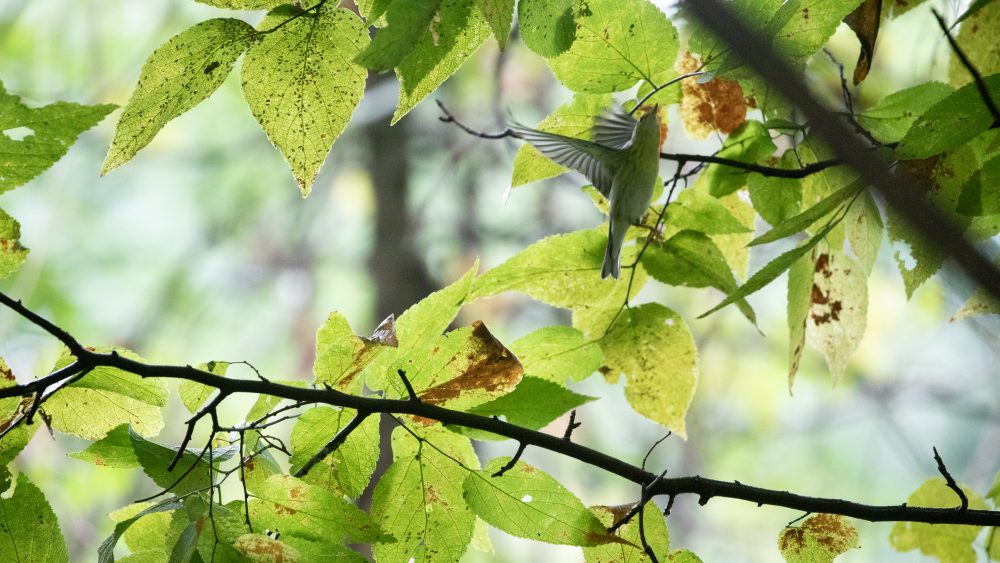
Yellow-headed Blackbirds at Goose Lake Natural Area

The Yellow-headed Blackbirds have been on my mind since April. I was hoping I would not be too late to see them this year. And anyway, I like going to this place for all the other species that make it their summer home. I just needed a day without rain that fell on the weekend so I could avoid rush-hour traffic. Even early on Sunday morning, it still takes an hour and a half to drive there. And then there’s the walk that feels longer than 2-1/2 miles roundtrip and 3 hours.

It was still very cloudy when I arrived at 8:14 AM. As I walked the long tree-lined path, I heard a lot of birds but saw none. One bird I have rarely heard or seen previously was a Vesper Sparrow, singing beautifully. Maybe I could locate it on my way back out.

As I approached the open marshy area where there once was enough water to name it “Goose Lake”, I saw a large group of birders. It turned out they were leaving just as I approached. We exchanged smiles.

The marsh is a vast expanse surrounded by farmland. The sounds of the birds are varied, and I am including one early sample recording below the photo.

Goose Lake Natural Area

The first birds I saw were Yellow Warblers.

It was fairly easy to detect several male Yellow-headed Blackbirds, although they were at quite a distance. By the end of my visit, I estimated 12 males. There were likely even more.

A Willow Flycatcher was singing, and fly-catching. I caught up with him again later.

This place is always good for Song Sparrows and Common Yellowthroats. As difficult as it is to locate Common Yellowthroats almost anywhere else, the bird below was simply sitting quietly right in front of me.

Song Sparrow
Common Yellowthroat

After I got to the viewing platform, a pair of Sandhill Cranes flew by. I barely managed to capture one.

Of course, in addition to the Yellow-headed Blackbirds, there are lots of Red-winged Blackbirds here. It’s really hard to estimate how many, although I wouldn’t be surprised if there were at least 50 nesting pairs.

I noticed a couple Yellow-headed Blackbirds closer to the trail, a little bit farther beyond the viewing platform, so I started to walk that way.

I encountered a Yellow-headed Blackbird just sitting on a dead tree next to the trail. I was able to get fairly close to him and then another showed up. There was also a Song Sparrow singing. In addition to the song in the short video below, he gave me a concert including three more songs. One of those songs is in the short video of the Yellow-headed Blackbird. I was hoping the Blackbird would sing, but he didn’t. He sat there and listened along with me to the Song Sparrow.

Song Sparrow – Song 1
Song Sparrow – Song 2
Song Sparrow – Song 3
Yellow-headed Blackbird listening to Song Sparrow – Song 4

Along the trail on my way back, I saw a Ground Squirrel.

And a lek of Brown-headed Cowbirds…

There was even a noisy murder of American Crows in some distant trees.

Further along my way back to my car through the long tree-lined walk, I heard the Vesper Sparrow singing again. There was a clear spot to the side of the trail that looked like a tractor or truck had trampled the vegetation. I stepped out into the edge of the farm field and found the Vesper Sparrow at the top of a dead tree. He was backlit against the cloudy sky, but I managed to capture him somewhat and his song as well.

Vesper Sparrow

Here’s another Common Yellowthroat I photographed.

Black Terns have also been seen this year, but I did not see them during my visit. I will have to go back in early July, I think, to see more Yellow-headed Blackbirds as their offspring fledge, and maybe I will get to see the Black Terns and who knows who else.

One note: I realized that I didn’t see one periodical cicada the whole time I was there. I suppose it could be that there simply is not enough concentration of trees. The northern part of Illinois and southern tip of Wisconsin are definitely on the Brood XIII range map. It’s okay. I didn’t miss the distraction.
October’s End

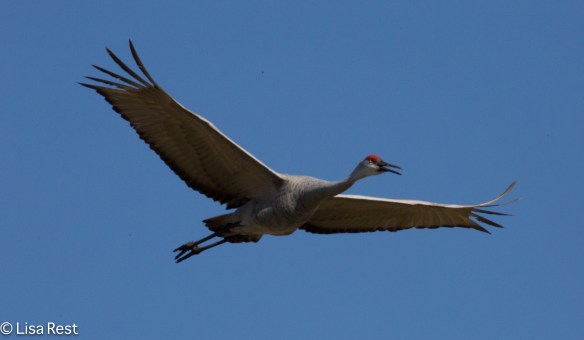
A goal for the last two years has been to get up to Goose Lake Natural Area and the Hebron Trail in October to see Sandhill Cranes. October weekends were flying by with other commitments and I kept hoping for decent weather, should I attempt the trip on the last Sunday of the month. I was rewarded with available sunshine and went to investigate. I saw only 18 Cranes eventually, when there had been a few hundred reported earlier in the week, but I was lucky to have three calling raucously and flying right overhead.

My start down the eastward Hebron Trail, which is a gravel trail built on an old railroad bed, yielded a flurry of Cedar Waxwings, Robins and Starlings at the start.

Hebron Trail
Cedar Waxwing
European Starling

The more often I visit this place, the more I fall in love with it. But it takes me an hour and a half to drive up there, no matter which way I go. The first time or two I wasn’t sure I was ever going to find it, but now I know the route and the landmarks and it’s easy – just a long haul.

Not long after I reached the end of the tree-lined part of the trail, I saw this male Northern Harrier fly across the field and then maybe twenty minutes later it flew by right in front of me.

Sparrow migration is in full force and I saw plenty of sparrows to prove it. It was especially nice to see the Vesper and Savannah Sparrows. Also this was my first American Tree Sparrow of the season. Since I’m already over seeing Juncos come back, I see no problem welcoming the Tree Sparrows, as both species herald the return of colder months.

Vesper Sparrow
Savannah Sparrow
American Tree Sparrow

There weren’t a lot of birds in the water, mainly American Coots. There were some Pied-Billed Grebes, but they were too far away to capture adequately.

American Coots

As I went through my photographs last Sunday, I realized I still had photos from my last visit back at the end of July, when I wondered if there were any Yellow-Headed Blackbirds left. I’m including some of those photos below.

Yellow-Headed Blackbird (female)
Song Sparrow
American Goldfinch
This Halloween Pennant would have been much more appropriate if I’d managed to post this last week!
Another reason why I like this place – I always see Crows!
Widow Skimmers look even better in retrospect.

A couple more of the Sandhills… My resolution for next year is to visit this place more often, maybe even closer to the peak times for certain species. Either way, it’s a beautiful place and I am happy to share it with you.

Kirtland’s Warblers and Friends

KIWA 05-27-17-3239

Kirtland’s Warbler

Sorry I haven’t been back to the page sooner but I’ve been down with a nasty cold that doesn’t seem to want to go away.  Yet I could speak above a squeak this morning, so I will have to take that as a sign of improvement. Here is a quick post from part of a visit to Michigan with friends over the Memorial Day Weekend. Specifically, these photographs were taken at the Kirtland’s Warbler Restoration Project in Iosco County. We visited this site on the morning of the 27th. The Kirtland’s breeding population is established well enough now at this location to warrant offering tours by the AuSable Valley Audubon Society. Thanks so much to Sam Burckhardt and the Chicago Ornithological Society for another memorable trip.

To go along with the pictures of a singing Kirtland’s above, here is a brief sample of his song:

Kirtland’s Warblers are a fire-dependent species, breeding only in young Jack Pine forests. They winter in the Bahamas. Their fascinating story was chronicled a few years ago by William Rapai, the author of The Kirtland’s Warbler: The Story of a Bird’s Fight Against Extinction and the People Who Saved It

The Kirtland's Warbler: The Story of a Bird's Fight Against Extinction and the People Who Saved It by [Rapai, William]

NAWA 05-27-17-3137

Nashville Warbler

There were also several Nashville Warblers on territory and although they were a bit elusive I did manage to obtain a few distant photos of this one and a clip of him singing as well. To confuse the issue his song is overlapping the Vesper Sparrow’s, which is also below.

Perhaps the unexpected treat for me was a singing Vesper Sparrow. I have not seen these guys too often. A clip of the Vesper Sparrow’s song is below the pictures which were taken at an unfortunate distance. It can be distinguished from the Nashville’s bubbly song by the three introductory notes all at the same pitch.

Perhaps the birds most seen over the weekend were the huge flocks of non-breeding Canada Geese. This is only a small sampling of one flock passing overhead.

Below, a female Orchard Oriole on the left (you have to click on the picture and still look hard to find her, she is so well-camouflaged) and a male Orchard Oriole on the right.

Brown Thrashers were singing quite a bit too, now I’m sorry  didn’t bother to record one. Below is one very cooperative bird.

Now the challenge is to get through another busy weekend and a lot more photographs (and, I hope, a lot less facial tissue). I am trying to stay optimistic! Please have faith, I shall return, lots to share with you.

BRTH 05-27-17-3340

Brown Thrasher