I didn’t think I’d be back here before next year, but this morning’s late, cold, cloudy visit to the Chicago Portage was a bit of a surprise and I may as well write while my memory of it is still fresh.
No surprise that the volunteers were busy at work. They were the first thing I saw when I got out of my car.
I was resigned to the expectation that I would probably not see much, and that which I did see would be difficult to photograph. But it was good to go for a walk, as long as I had the liner of my new jacket zipped in. The temperature had gone down to freezing overnight and the water had a thin layer of ice on it.
Two woodpeckers, a Downy and a Red-bellied, revealed themselves briefly.
I stopped and talked to a man and a woman walking with their son. They had just seen a large deer, and asked me a woodpecker question. Shortly after they continued on their way, a flock of birds flew in from the north across the tracks and landed in the trees. The birds were flitting about and just far away enough to make them almost impossible to capture with the cloud cover. But what amazed me was the number of Northern Cardinals. Although I could not get them to cooperate for a group photo, there were at least a dozen. Mixed in were White-throated Sparrows and Black-capped Chickadees.
There were a couple Downy Woodpeckers and a White-breasted Nuthatch in the flock.
Then, after not having located them for a week or more, I found the flock of American Tree Sparrows in the goldenrod closer to the newly paved trail.
So that’s about it. I may never see that many Northern Cardinals together again. Just when you’re not expecting anything…
The clearest photo of a White-throated Sparrow this time was of its back. A fitting farewell to 2023, perhaps.
Some things will never change. Water keeps flowing out under the bridge near Harlem.
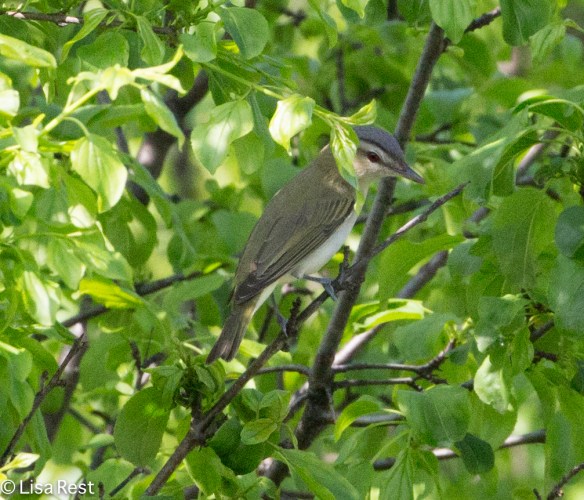
There were still some warblers on May 24, but the Bird of the Day for me was Red-Eyed Vireo. I had been wondering where these birds were, and then they all seemed to show up at once. Usually you hear them singing and don’t see them very well as they move through the trees chasing insects. But this time they were more often seen than heard. In some of these photographs you might actually be able to see the red eye for which they are named.
Red-eyed Vireo
Many of the warblers I saw that day were females. The females tend to migrate later than the males who are in a hurry to set up their territories. Spring migration this year seemed strange for many reasons – the pandemic affecting where you could go to find birds, the weather which is always a factor, and I guess the knowledge in the back of your mind that birds are in decline and you wonder just how many you’re going to see anyway.
Magnolia Warbler (male)
Magnolia Warbler (female)
Wilson’s Warbler (female)
Bay-breasted Warbler (female)
Blackburnian Warbler (female)
Below is a Yellow Warbler who likely is on territory for the summer. I recorded him singing, and you can hear him three times in the little clip below his picture. Some people find the mnemonic “sweet sweet sweet I’m so sweet” helpful in distinguishing this song from others they might be hearing.
Yellow Warbler
I feel fortunate to have seen a Canada Warbler more than once this spring. Unfortunately they prefer somewhat shady spots which I guess they blend into better than bright sunlight. I love the steel-gray blue color of their backs. I would support a Pantone color called Canada Warbler Blue.
Canada Warbler
Northern Cardinals are all around but not seen too often. This one was far away but distinct.
A Blue Jay on the fly.
Baltimore Orioles are getting harder to see now that they are busy rearing families.
Baltimore Oriole nest
Indigo Buntings are busy too but there are so many of them, they are easier to see.
Indigo Bunting
Indigo Bunting (female)
This might have been the last time I saw a Blue-gray Gnatcatcher. Actually I’m surprised I got to see more than its tail. I still hear them, but only on occasion, certainly not constantly like a few weeks ago when they first arrived.
Blue-gray Gnatcatcher
Even Red-Winged Blackbirds are assuming a lower profile.
Scenes from the Portage
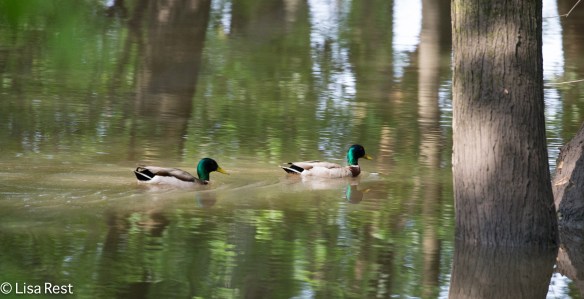
Two Mallards navigating the flood waters adjacent to the Des Plaines River which were still quite high that day.Double-Crested Cormorant – an occasional flyoverThe back of a Chipmunk
House Wren
A couple more warblers – there seemed to be fewer American Redstarts this year, at least where I was. And I just learned something I never bothered to look up before about distinguishing the female Chestnut-sided Warbler from the male – the bright chestnut sides don’t extend as far down the side on the female. So the pictures below are of a female. And since I continue to hear a male singing at the Portage I can only wonder if there might be an actual breeding pair.
American Redstart (female)
Chestnut-sided Warbler (female)
I still hear the Eastern Wood-Pewee but this might have been the last time I got photo ops.
The big surprise walking back in the opposite direction across the first bridge was to see this Robin’s nest right off the side of the bridge, in plain sight – and I had never noticed it before. Mom was in a nearby tree, waiting to revisit her brood.
A bird more often heard than seen..Gray Catbird.
Red-eyed Vireo
I love this last picture of the Red-eyed Vireo. Having said that, I realized a few days ago that I need to bring more control to my blog posts when I take so many pictures and can’t decide what to do with them and invariably end up with too many – believe it or not, this is a pared-down selection. I really need to use my flickr page more often, so I stuck some other photographs there and if you’re really curious, follow the link to them. I will try to be back sooner with the final installment of the Memorial Day weekend excursions and reports from other destinations since. Hope you are staying safe and well and rising to the daily challenges.
Two weekends ago I went to McGinnis Slough. A bit later than I’d planned… weekends seem to be getting away from me, and I just can’t seem to get up and out very early. I arrived at the slough around 8:30 AM, so it was still cool. The moment I got out of the car everything else became irrelevant when I saw two Sandhill Cranes standing in the overlook area that juts out toward the slough from the parking lot. I didn’t want to disturb them, so as I started to walk toward the south end, I took pictures at a considerable distance. But later after they had left, I found the two feathers in the grass, above. I arranged the feathers a bit to photograph them and left them there. Once upon a time I collected a feather or two, but I have never done anything purposeful with them and it’s frustrating to inadvertently find them later collecting dust or stuck inside a book or…
Below is what the slough looked like. Overgrown and marshy. Very different from the flooded trails of my last visit.
Walking away from the Sandhills, there were some Wood Ducks at the south end.
I’m always happy to see a Monarch Butterfly, but then am saddened by the fact that I hardly ever see more than one anymore, anywhere.
There were plenty of dragonflies. Blue Dashers are still plentiful and posing this summer.
Below is an Eastern Pondhawk. I don’t think I’ve photographed one before.
Red-Winged Blackbirds are still a presence everywhere.
And it was nice to see Baltimore Orioles.
Some more Red-Wingeds. Those red epaulets really stand out in flight.
(Female RWBL)
Red-Tailed Hawks. Flying together…chased by blackbirds…soaring.
And there were a few Blue Jays who were not camera-shy for a change. This one seemed to think the picnic table might have some promise.
American Goldfinches, so plentiful earlier in the year, are a bit scarce, but I attribute that to the fact that they are late breeders and likely consumed by nesting duties.
American Goldfinch (female)
I was unable to capture a dragonfly on these roses but they turned out to be attractive by themselves.
A glimpse of a Green Heron…
and a Great Egret. There were a few Great Blue Herons but they were too far away.
So that’s my little report from McGinnis. I’ll try to go back there before I leave for my trip to New Brunswick and Grand Manan in just a few weeks. But I’m still not done with the Texas trip! And I have to find a new bird care person for the indoor crowd, which is not so easy these days. Sigh.
And continues and continues and…I have been so busy birding every weekend it’s taking even longer to process the pictures. These are from last week – October 13 – Thatcher Woods and the Chicago Portage.
White-Throated Sparrow at Thatcher Woods
The birds blend in more and more with their surroundings, but I find it so intriguing. Although it does take almost twice as much effort to get the camera to focus on the bird.
Lincoln’s Sparrow, Thatcher Woods
I was very pleased to find a Winter Wren hanging out with the sparrows and remaining warblers at Thatcher Woods. I always think of Don Kroodsma and The Singing Life of Birds when I see a Winter Wren, even if it’s not singing.
Much like two weeks earlier, there were still a lot of Palm Warblers and Yellow-Rumped Warblers at Thatcher Woods.
Here’s what the Portage looked like when I got there.
The Yellow-Rumpeds were foraging in the duckweed.
It was a pleasure to see several Hermit Thrushes. And nice to see them somewhere other than hopping around on park lawns downtown.
Hermit Thrush, Portage
I got a brief, lucky look at a Belted Kingfisher flying over the pond.
Belted Kingfisher
Some Song Sparrows are already practicing singing for next spring, which might explain why I have heard more than I have seen.
Song Sparrow
Out on the road overlooking the compost piles that now decorate the Metropolitan Water Reclamation District property, I saw this Red-Shouldered Hawk land in the tree and sit for a long period of time.
Red-Shouldered Hawk
Other raptors flew overhead, including the Sharp-Shinned Hawk below.
Sharp-Shinned Hawk
It took me a while to realize that the birds below are Purple Finches. There seem to be quite a lot of them at the Portage this fall.
Purple Finch
Not to be confused – much – with House Finches…
House Finch
Ruby-Crowned Kinglets are still abundant. But the bird below right is a Golden-Crowned Kinglet. It was perched about a foot and a half in front of me and we bonded for a while, but it was much too close to get a picture of it then!
Still seeing Eastern Phoebes, although I expect fly catching is becoming more difficult as temperatures drop.
Eastern Phoebe
My last two photos are of Hermit Thrushes. The second one is for the russet color of its back in the sun…
I’ll be on a mission to get through my photos from this past weekend… Our weather seems to have calmed down a bit and we are in a crisp but sunny period. I love fall, maybe for its nostalgia…!
At least today, on Labor Day, I decided to be lazy by not getting up two hours before dawn so I could go birding. After meeting at the destination on Saturday, we canceled the walk due to thunderstorms looming in the wings. Even so, I had stayed back with another participant to get a handle on the layout of the trail setup when suddenly a crash of thunder and lightning striking right in front of us convinced us it was indeed time to leave.
So yesterday I got up and decided I would not go far, but as long as it wasn’t raining or threatening to, I may as well try to see what I could find. I went to Ottawa Trail Woods and encountered some obstacles on the trail (above). It became even more evident that I was the only person to have traversed the river trail in a while as I managed to avoid only one of two spider webs strewn above the footpath. The first sign of life was the deer below.
Ovenbird
There were not a lot of birds. Or at least not a lot of species. But this time I got to see an Ovenbird for a few seconds although it was nearly the only warbler I saw.
A dozen Common Grackles showed up in the trees right above my head. So much for dark backlit birds.
Ottawa Trail is usually good for Thrushes and I was not entirely disappointed. At least I got to see this Gray-Cheeked long enough to photograph it.
Gray-Cheeked Thrush
Early on I saw one Cedar Waxwing, but knew there was no such thing as a solitary Cedar Waxwing and on my way back on the trail I encountered at least sixty in the branches of one tree. Click on the upper righthand photo below if you don’t believe me.
The bottomlands by the river were flooded from all the recent rain and I was able to relocate this Great Blue Heron after it flushed, when I surprised it by my walking the path even though at a considerable distance.
I am still puzzled over the image below but the bug capture is more interesting…
So it was mostly distant unspectacular sightings . A Red-Bellied Woodpecker, an Eastern Kingbird…
Indigo Buntings were nearly unrecognizable. The one on the right was an up-and-coming male hiding from me at the Portage which was where I went next.
The Portage still had a couple hummingbirds, perhaps the same ones I saw on Friday. Plenty of Jewelweed everywhere. A few years ago on a September day I saw what seemed like a hundred Ruby-Throated Hummers in one visit, all over the Jewelweed, but it was not repeated yesterday. If you look closely at the third image of the hummer you an see a little bit of red emerging on his young throat.
By the time I got to the Portage it was closer to midday, the heat was becoming oppressive and I didn’t expect to see many birds. So I appreciate one Gray Catbird after hearing them but never catching even a glance at one Friday.
All my bushwhacking resulted in pollen all over the lens hood…
In front of me on the trail, a baby Snapping Turtle.
There were fewer dragonflies than last week. And I keep running into Eastern Commas that don’t want to pose correctly: or is it a Question Mark???
The Robins all seemed to be at Ottawa Trail yesterday with only a few at the Portage. I imagine it’s the same flock going back and forth.
Monarch Butterflies are still coming through, although they will all be down to Mexico soon. Migrations of the soul…
I came up with a new mantra this weekend, so I guess it’s only appropriate on Labor Day that I share it with you. I have been muttering “I have to stop working” for far longer than I want to recall. But I decided now my mantra should be, “I have to start writing.” I have been thinking about a book for the last several years. It changes every five minutes, but I think it’s finally starting to come together in my head because I found the first sentence yesterday. So it’s time to start writing it. Which may make my contributions to this page even more infrequent, I don’t know, it’s hard to imagine writing anything after working all day at a computer in an office. But by declaring my intentions sometimes I can force myself to get going so as not to risk eternal embarrassment. Thank you.
I took today off. It was a bit difficult getting up early this morning after swimming last night but I managed to get over to the Portage a little after 8:00 a.m. and took note of how deserted the place was on a weekday. No dog-walkers or cyclists. Only one runner, who was probably as amazed to see me as I was him.
A long shot of the duckweedy water above and just below it, an untrimmed path I decided not to take.
The robins are back, and the waxwings are still numerous. Literally nobody in the mucky water. I was treated to American Redstarts and a couple Ruby-Throated Hummingbirds early on, which gave me hope to find a few more migrants.
American Redstart (First Year Male)
Ruby-Throated Hummers above, an adult male American Redstart below.
The only other warblers I could barely photograph were the Chestnut-Sided below left and the Black-Throated Green on the right. I missed the Ovenbird that landed briefly in the tree I later found them in.
In the beginning with the immature male Redstarts was a chattering young House Wren.
Butterflies were out for the sunshine today. Red Admiral, Pearl Crescent and Monarch butterflies.
I saw a few White-Breasted Nuthatches too.
I heard the Eastern Wood-Pewee long before I saw the one below.
This time of year I expect to see lots of Indigo Bunting children and I did, but they were playing hard to get with the camera.
Yellow is the predominant color this time of year and I found a bumblebee and a goldfinch taking advantage of it.
One Eastern Kingbird…
There was a lot of chatter from catbirds but I only barely saw the youngster below.
A couple more Cedar Waxwings. The one on the left is an immature.
The last photograph I took was of this stunning little Silvery Checkerspot.
My walk tomorrow will take place if we are not totally rained out. Scattered thunderstorms are in the forecast. We shall see… This evening as I write this I have just heard the rumble of thunder. And now it is starting to pour.
By the way it feels nice to have the time to do a same-day blog post. Perhaps if I – no, let’s say when I retire – I will be up to the task more often.
As the days get ever-so-slightly shorter, commitments increase. I’m not sure why that is. But suddenly it seems there is less time for more things to do. A visit to McGinnis Slough had been on my mind for weeks ever since the last time I drove by the entrance was closed for paving the driveway, and there was no access. I got up as early as I could Sunday morning to visit the Slough and then the Portage.
A Slough in name only…
I think the last time I posted from the Slough, I was commenting on the low water levels following perhaps a flooding situation. But the summer weather since has not been kind to the Slough. Indeed it is all overgrown and there is barely any water, so all the birds I would normally see have gone somewhere else.
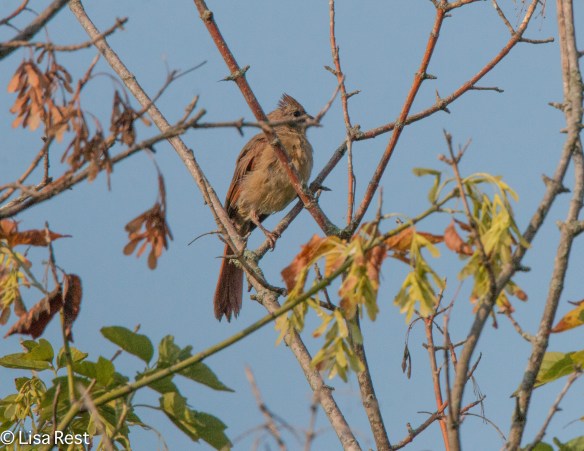
There were Mallards and Wood Ducks. I saw two distant Great Egrets, but no Great Blue Herons. Normally the slough would be hosting scores of these herons. No such luck this year.Perhaps indicative of the situation was the first bird I saw, the bedraggled-looking Northern Cardinal below.
There were a few blackbirds around too, but the breeders are gone.
Red-Winged Blackbird, hiding the red
When not distracted by birds, the vegetation grabs my attention. Could this be a new grass taking over? I think it is Bristly Sedge.
It was then I went to the Chicago Portage. I got there just in time to encounter all the dog-walkers, runners and cyclists, but it is always worth checking out. I have to remind myself sometimes that seeing fewer birds than I might want is still worthwhile from a reporting standpoint…
There were more Cedar Waxwings (below) than any other species. I can only assume they were cleaning up whatever mulberries the robins, who were absent, had left behind. That’s right, the robins that virtually take over the landscape have all gone somewhere else. I’m envisioning large fruit-eating flocks already in mini-migrations.
There was one distant but distinct Ruby-Throated Hummingbird. I hope to see more, as there is plenty of Jewelweed in bloom, but the window is narrowing for this species. Maybe I’ll have another week or two…
The theme for the day, perhaps, was shaping up. These were young birds starting to find their way in the big wide world, like the Eastern Kingbird below.
And the scraggly youngster below appears to be a young Great Crested Flycatcher.
I expect to see a lot of juvenile Indigo Buntings in the next few weeks, but Sunday just about the only bunting I encountered I could barely see.
Indigo Bunting
I was happy to see a Turkey Vulture (adult) in the neighborhood. I think seeing so many different vulture species in East Africa years ago instilled a love and respect for them. Lately I have seen groups of these hanging out by the highways, where I’m sure they make a decent living off of roadkill.
The most accommodating bird at the Portage was the cardinal below who was singing with his back toward me but I guess that feeling of somebody looking at you caught his attention and he turned his face toward me.
Northern Cardinal
Starting this Saturday, I will be leading weekly bird walks in two alternating locations. I was recruited for this position by a fellow bird-watching choir member. We’ll see how it goes. I plan on taking the camera with me, but the leading and listing responsibilities will make photography challenging. If nothing else, I will become more familiar with the two destinations which up until now I have rarely visited. The whole purpose of this is to catch the fall migration wave. I promise to report back as often as possible.
I almost forgot my little insect sampler from the Portage. Worth mention, perhaps, is the fact that there were at least 20 Monarch Butterflies. But it’s still hard for me to believe that is a larger number than I have seen all summer.
So as we experience the changes in the weather, the environment, the species we see… the changes are unsettling, but that’s still another glass is half-empty/half-full quandary.
My last thought is a little summertime-feeling music – Trois Gymnopedies by Eric Satie. The recording is from almost 4 years ago when I had fewer birds, it was the start of the second flock, and most of the Zebra Finch solos are the beginnings of my star singer, Arturo Toscanini, whose songs have progressed far beyond this and they continue to grow. One of these days I’ll have to see if I can trace the evolution of his song cycle.
Last year two fellows I run into occasionally at the Chicago Portage, Steve and Mike, told me they had seen a Great Horned Owl. I believe it was Mike who showed me his stunning photo of the owl sitting on a stump over the water. But I never saw the owl until two weeks ago making my return trip on the trail that runs along the south side of the stream, when I flushed it and watched it fly to perch in a tree on the other side.
Then last weekend I saw two owls perched on the same branch, looking down at me. The first owl decided to take off when I lifted the camera, but the second owl sat there and stared sleepily at me.
So are they a pair? Most likely. I suspect the first owl is the female as it is larger. Then I wonder if they have a nest somewhere or if they’re shopping for one. Will I see baby owls? It’s more excitement than I can handle at the moment. But I do suspect that the owls’ presence will keep the other raptors I normally expect to see at the Portage away.
The Portage keeps changing. More trees coming down. I was saddened to see one of my two favorite birch trees in smaller pieces. I can’t imagine what was wrong with it.
I have seen Blue-Winged Teal the last two visits as well. I suspect they’re just visiting though and will go elsewhere to breed.
And a Canada Goose seems to have found her nesting spot in tree trunk.
Two weekends ago, it was Golden-Crowned Kinglets…
Last weekend there were a few Yellow-Rumped Warblers, although only one captured by the camera.
I was very happy to see a Tree Swallow last weekend.
Not so many sparrow species. Song and Fox Sparrows, still a few Juncos, and American Tree Sparrows still hanging on through the cold not-quite-spring-weather-yet.
Song Sparrow and Fox Sparrow above, Dark-Eyed Junco and American Tree Sparrow below…
A few more captures before I go… White-Breasted Nuthatch, American Robin, preening Mallard, American Goldfinch.
Brown-headed Cowbird
These pictures were all taken on April 8 and April 22. Unfortunately I don’t expect I’ll be getting near the Portage again until May 12 when I’m leading a small group on a bird walk as my donation to the fundraising member auction for Unity Temple. Until then, I will be traveling at a slower pace. Yesterday I had stem cell replacement therapy on my right knee. The procedure itself was not too awful, indeed I told the physician that his description of what he was about to do to me was far worse than the actual operation and I am hopeful recovery goes smoothly. I’m feeling better than last night: I woke up with very little pain, so now it’s more a matter of keeping stable using crutches for a couple more days to keep weight off the joint whenever I can. I’m looking forward to the final portion of the therapy on Tuesday which involves a simple plasma injection. If the weather is nice, which it is predicted to be, I will be spending the time in between blood draw and later injection birding North Pond and the Peggy Notebaert Museum grounds, a local birding hotspot right across the street from the medical building. I couldn’t have picked a better location to have this done!
Some days spring seems inevitable, others it seems to be lagging behind a cold front. I’m trying to get caught up with posts that have escaped my ability to sit down and write them. So these pictures from two weekends ago start off the Slow Spring documentation. I was joined by my friend Lesa and we started off early at the Chicago Portage. Note for Sunday birders: it was easily an hour past sunrise but the forest preserve employees had not shown up yet to unlock the gate to the parking lot. We waited perhaps five minutes…
Song Sparrow, Chicago Portage
I was hoping an earlier start might reveal more activity, perhaps a mammal or two, anything different. But just as I can’t predict surprises I apparently can’t predict nothing happening either. Maybe for the birds, waterfowl in particular, nothing seemed out of whack. Except I wonder what happened to the Mallard on the upper right below, who seems to have lost a lot of neck feathers, perhaps getting caught in something while he was dabbling for food. He otherwise seemed to be okay.
The stream scene at the Portage hadn’t changed too much for the Canada Geese, except that there were fewer of them than the last time. We walked out the back trail by the train tracks that leads to the Des Plaines River and saw distant Common Goldeneye and Common Mergansers, but for the most part, the birds were just too darned far away to see well without a scope. My monster lens managed to identify three Wood Ducks hanging out on a fallen limb enhanced with detritus and trash.
Wood Ducks on the Des Plaines
Song Sparrows were the most visible passerine species…
And one lady cardinal volunteered a brief acknowledgment after sitting with her back to us for several moments. Her expression conveys to me, “Just what do you want?”
Frustrated by the lack of participation at the Portage, we stopped by the house to pick up the scope and drove out to Saganashkee Slough in Palos to see the reported Eared Grebe. Eared Grebe isn’t one we see often in this area, so it seemed like a worthwhile venture. The sun was getting higher which made backlighting a bit of a problem, but we appreciated whatever perceived warmth the sun had to offer. Thanks to generous and helpful birders already at the scene, we located the Eared Grebe. It was swimming around on the far side of the slough, of course, not too far from the men fishing in the first photo below with the Red-Breasted Mergansers flying. The second photo shows the wake behind the Eared Grebe and the last photo was the best I could get from such a distance. You can click on it to get a bit of a better view.
In contrast there were perhaps twenty or more Horned Grebes (top pix below), although I was unable to find one in breeding plumage. And those show-off Red-Breasted Mergansers again.
Horned Grebe, Saganashkee Slough
Mallard drake, Chicago Portage Woods, with neck feathers…
Apologies are in order, I have been a bad blogger lately. It’s not for laziness so much as exhaustion by everything else that has to get done in life. I also think my body slowing down with its latest complaint affects everything since it’s hard to totally dismiss chronic pain. But don’t worry, temporary remedies work well and I’m looking forward to engaging with a more permanent remedy starting in a few weeks. (And I’m thinking beyond the procedure: if I have to sit around a bit more for a few days maybe I can amuse a few of us with on onslaught of blog posts…)
I have more recent excursions to report as soon as I can. I also am waking up to thinking about those big life questions that surprise me every once in a while when I come to realize how I have succumbed to the general malaise reinforced by the bombardment of media, which are designed to distract from reality. I think we’re all hovering around our own versions of this existential enigma, and once I can find all the little nuggets of inspiration that I have gleaned lately from various sources, I will try to offer them up in the context of this blog space. Thank you for being patient and staying with me.
Well, maybe more like Enduring Zero. Sitting inside reliving Ecuador did not seem to be the best way to spend Christmas Day, so I went out for a walk through the Portage and later visited with the yard birds. We had snow on Christmas Eve so the setting was perfect, and if a little cold, at least the sun was shining in the morning. Little did I know at the time that Christmas Day’s weather would be considered balmy by the next day’s standard. And this morning I walked to the train in -4 degrees Fahrenheit, before the wind chill.
Deer tracks in the snow at the Chicago Portage
I drove around for 40 minutes to various Cook County Forest Preserves beyond the Portage, all with closed parking lots. I am not fond of driving but it was pleasant enough listening and singing along with a Peter Mayer (from Minnesota) CD, and there were hardly any cars and the sun was shining brightly. When I did returned to find the Portage parking lot open, I was the only visitor. The trails were covered the deer tracks.
White-Throated Sparrow
When I did find a few birds, for the most part they were half hidden.
The most commanding presence was snow covering everything. Beyond that, I found a few geese and ducks on the Des Plaines River.
Just as I was leaving, an adult Bald Eagle flew over. I didn’t get a picture, but below is a juvenile from last week’s Christmas Count on the Fox River.
I decided to go home, fill the feeders and hang out with whoever showed up in the yard.
House Sparrows have learned to hang upside down if necessary…
There were a number of House Finches, and although the light was waning, I was surprised to see the males looking as red as they did.
I am always happy to see Mrs. Cardinal and any hardy little Dark-Eyed Junco.
My male cardinal swooped in for a remaining hawthorn berry and posed with it. As if to verify his supreme redness.
I still have the weather for Quito on my phone. The temperature seems to stay around 58-60 degrees. I think it’s time to go back to the pictures from Ecuador. If you made it this far, your reward is three pictures of Long-Tailed Sylphs. More to come in the next post.
I find some satisfaction in knowing the days are already getting longer.






 The Yellow-Rumpeds were foraging in the duckweed.


 I’ll be on a mission to get through my photos from this past weekend… Our weather seems to have calmed down a bit and we are in a crisp but sunny period. I love fall, maybe for its nostalgia…!


 I am still puzzled over the image below but the bug capture is more interesting…
 So it was mostly distant unspectacular sightings . A Red-Bellied Woodpecker, an Eastern Kingbird…


 All my bushwhacking resulted in pollen all over the lens hood…
 In front of me on the trail, a baby Snapping Turtle.
 There were fewer dragonflies than last week. And I keep running into Eastern Commas that don’t want to pose correctly: or is it a Question Mark???

 Monarch Butterflies are still coming through, although they will all be down to Mexico soon. Migrations of the soul…
 I came up with a new mantra this weekend, so I guess it’s only appropriate on Labor Day that I share it with you. I have been muttering “I have to stop working” for far longer than I want to recall. But I decided now my mantra should be, “I have to start writing.” I have been thinking about a book for the last several years. It changes every five minutes, but I think it’s finally starting to come together in my head because I found the first sentence yesterday. So it’s time to start writing it. Which may make my contributions to this page even more infrequent, I don’t know, it’s hard to imagine writing anything after working all day at a computer in an office. But by declaring my intentions sometimes I can force myself to get going so as not to risk eternal embarrassment. Thank you.

 A long shot of the duckweedy water above and just below it, an untrimmed path I decided not to take.
 The robins are back, and the waxwings are still numerous. Literally nobody in the mucky water. I was treated to American Redstarts and a couple Ruby-Throated Hummingbirds early on, which gave me hope to find a few more migrants.


 I heard the Eastern Wood-Pewee long before I saw the one below.
 This time of year I expect to see lots of Indigo Bunting children and I did, but they were playing hard to get with the camera.


 There was a lot of chatter from catbirds but I only barely saw the youngster below.
 A couple more Cedar Waxwings. The one on the left is an immature.

 My walk tomorrow will take place if we are not totally rained out. Scattered thunderstorms are in the forecast. We shall see… This evening as I write this I have just heard the rumble of thunder. And now it is starting to pour.


 Perhaps indicative of the situation was the first bird I saw, the bedraggled-looking Northern Cardinal below.
 There were a few blackbirds around too, but the breeders are gone.


 There were more Cedar Waxwings (below) than any other species. I can only assume they were cleaning up whatever mulberries the robins, who were absent, had left behind. That’s right, the robins that virtually take over the landscape have all gone somewhere else. I’m envisioning large fruit-eating flocks already in mini-migrations.


 The theme for the day, perhaps, was shaping up. These were young birds starting to find their way in the big wide world, like the Eastern Kingbird below.

 I expect to see a lot of juvenile Indigo Buntings in the next few weeks, but Sunday just about the only bunting I encountered I could barely see.
 The most accommodating bird at the Portage was the cardinal below who was singing with his back toward me but I guess that feeling of somebody looking at you caught his attention and he turned his face toward me.


 Last year two fellows I run into occasionally at the Chicago Portage, Steve and Mike, told me they had seen a Great Horned Owl. I believe it was Mike who showed me his stunning photo of the owl sitting on a stump over the water. But I never saw the owl until two weeks ago making my return trip on the trail that runs along the south side of the stream, when I flushed it and watched it fly to perch in a tree on the other side.
 So are they a pair? Most likely. I suspect the first owl is the female as it is larger. Then I wonder if they have a nest somewhere or if they’re shopping for one. Will I see baby owls? It’s more excitement than I can handle at the moment. But I do suspect that the owls’ presence will keep the other raptors I normally expect to see at the Portage away.


 Well, maybe more like Enduring Zero. Sitting inside reliving Ecuador did not seem to be the best way to spend Christmas Day, so I went out for a walk through the Portage and later visited with the yard birds. We had snow on Christmas Eve so the setting was perfect, and if a little cold, at least the sun was shining in the morning. Little did I know at the time that Christmas Day’s weather would be considered balmy by the next day’s standard. And this morning I walked to the train in -4 degrees Fahrenheit, before the wind chill.


 I decided to go home, fill the feeders and hang out with whoever showed up in the yard.


 I am always happy to see Mrs. Cardinal and any hardy little Dark-Eyed Junco.
 My male cardinal swooped in for a remaining hawthorn berry and posed with it. As if to verify his supreme redness.
 I still have the weather for Quito on my phone. The temperature seems to stay around 58-60 degrees. I think it’s time to go back to the pictures from Ecuador. If you made it this far, your reward is three pictures of Long-Tailed Sylphs. More to come in the next post.

 I find some satisfaction in knowing the days are already getting longer.