Nothing like a rainy day to give me some extra time for a long overdue blog post. I’ve been trying to find some fall migrants in between weather events. The only problem with seeing just a few individuals is that if they are very cooperative, I take too many photos of them. Such was the case with a few birds on September 8 at the Chicago Portage.
The first birds I saw were juvenile “regulars” – a Gray Catbird dealing with feather management, and a Song Sparrow.
There was quite a display of Chicken-of-the-Woods on a fallen log.
Then I found a couple Bay-breasted Warblers.
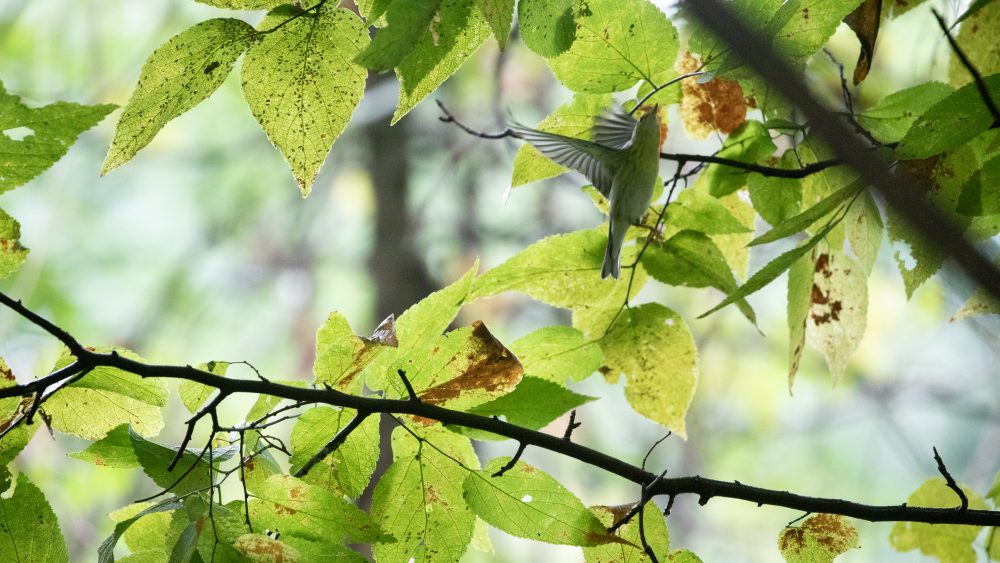
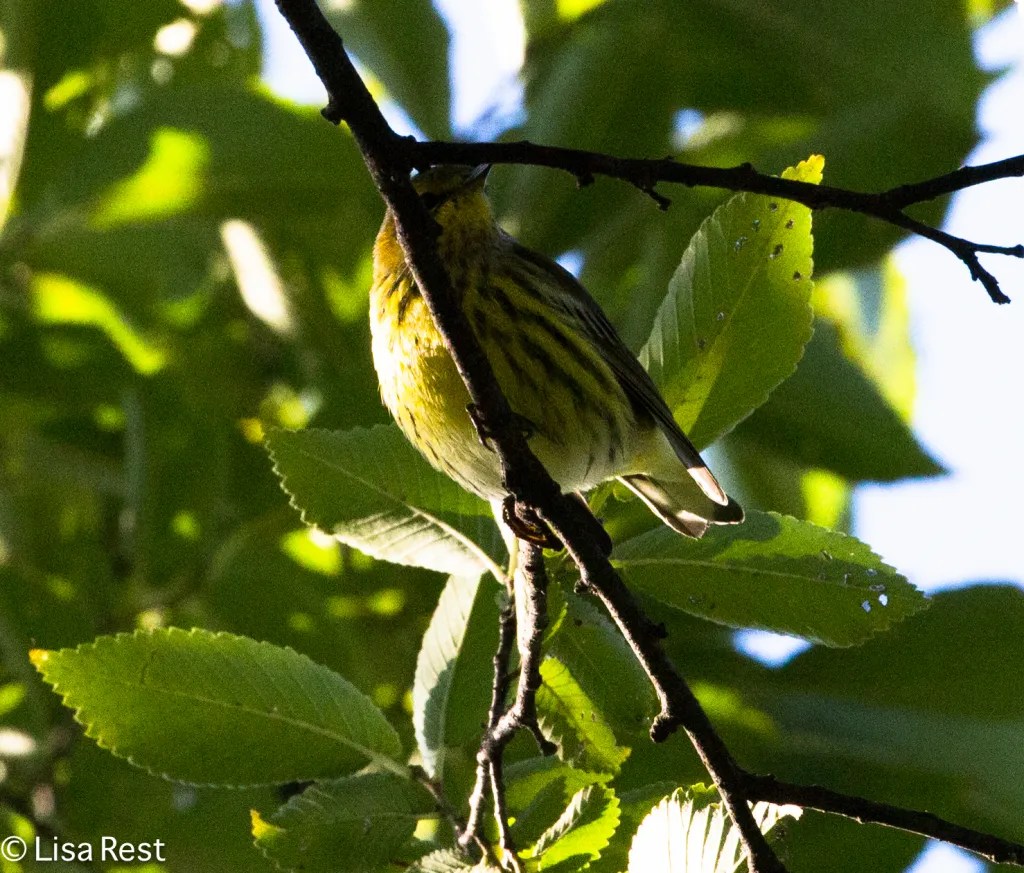
I later found the Cape May Warbler that is at the top of the post. It was having a fine time gleaning galls from the undersides of hackberry leaves.
I was also happy to see a Green Heron that day.
Two days later, it was overcast and I only saw a few warblers, but I didn’t get many photos usable for anything except identification purposes. But I did see two lovely juveniles: a young Indigo Bunting, an American Robin, and I’m throwing in a likely adult American Goldfinch.
Last was a Blue Jay in flight. I think the Sony excels at this with its 600mm zoom.
Seeing as how tomorrow’s forecast is much like today’s with a lot of rain, I should be back that much sooner with more warblers and other migrants. I am also getting ready for a friend coming to stay a couple weeks, so maybe the rainy weather is good timing.
Warblers have been coming in all the colors of the browning leaves. Here are some photos from Riverside from September 17 and September 22. Since then we have had a heat wave of sorts, but migration has been steady if slower. We had hardly any rain in September. On the 17th, the story was still primarily Great Egrets and Great Blue Herons.
On September 22, the Des Plaines River was even lower. Several Great Egrets were still gathering south of the Hofmann Tower.
When I got out of my car, I noticed a young Cooper’s Hawk hunting for house sparrows in the yews by the condominium complex.
I watched a Great Egret fishing in the shallows by the former dam.
Then, when I entered Riverside Lawn, I was greeted by a Hermit Thrush.
Warblers were next, starting with a Magnolia Warbler.
After a brief rain a day or two earlier, a Chicken of the Woods fungus sprung up on the log where I often sit.
I found a Blackpoll Warbler.
I have seen a lot of Gray-cheeked Thrushes this fall, and this day was no exception.
I got a brief look at a Ruby-throated Hummingbird in a small patch of Jewelweed (impatiens capensis), which also has the common name of Touch-Me-Not. Years ago, when the Chicago Portage had a lot of this stuff growing, it was a magnet for these hummingbirds in migration. I can remember walking in on the trail one day and seeing what must have been 100 hummingbirds.
I saw a Chestnut-sided Warbler on the 22nd. This is another species I have seen fairly frequently this fall.
American Redstarts were present. Below is a second-year-or-better male.
It has been good for seeing Cape May Warblers too. The one below is a different individual from the one at the top of the post.
I found a couple Tennessee Warblers.
Here is another Magnolia Warbler from that day. This one appears to be a female.
There was a more dramatic looking Chicken of the Woods mushroom on a tree stump. This is apparently edible. I could almost be tempted.
The Cape May Warbler below is the individual at the top of the post.
And here is yet another Blackpoll Warbler.
I saw a couple more American Redstarts.
The bird below is.a female American Redstart.
And for good measure, I saw a Rose-breasted Grosbeak. I think this is a first-winter male.
I have many more photos to share with you. I was not so optimistic a couple weeks ago, but now things have picked up again, and with a cold front coming in and rain (finally!) expected tomorrow night, I had better make more room on the hard drive.
For what it’s worth, I found some photos from August 20th when we must have been getting more rain. You can see the difference in the water level of the river. I also had one of the last male Indigo Buntings and about 40 European Starlings, some of which you can see in the bare tree against a cloudy sky.
I’ve had some luck with warblers at the Chicago Portage this fall migration season, and now that we should be in the middle of peak warbler migration, it seems only fitting to do this post. Here are warblers and a few others from September 9, and then a week later on the 16th. It’s been a matter of coming across a mixed flock. But sometimes one bird close to the trail will alert me to more activity down the road.
On September 9, I encountered this Blackpoll Warbler.
I caught a glimpse of a Black-throated Green Warbler.
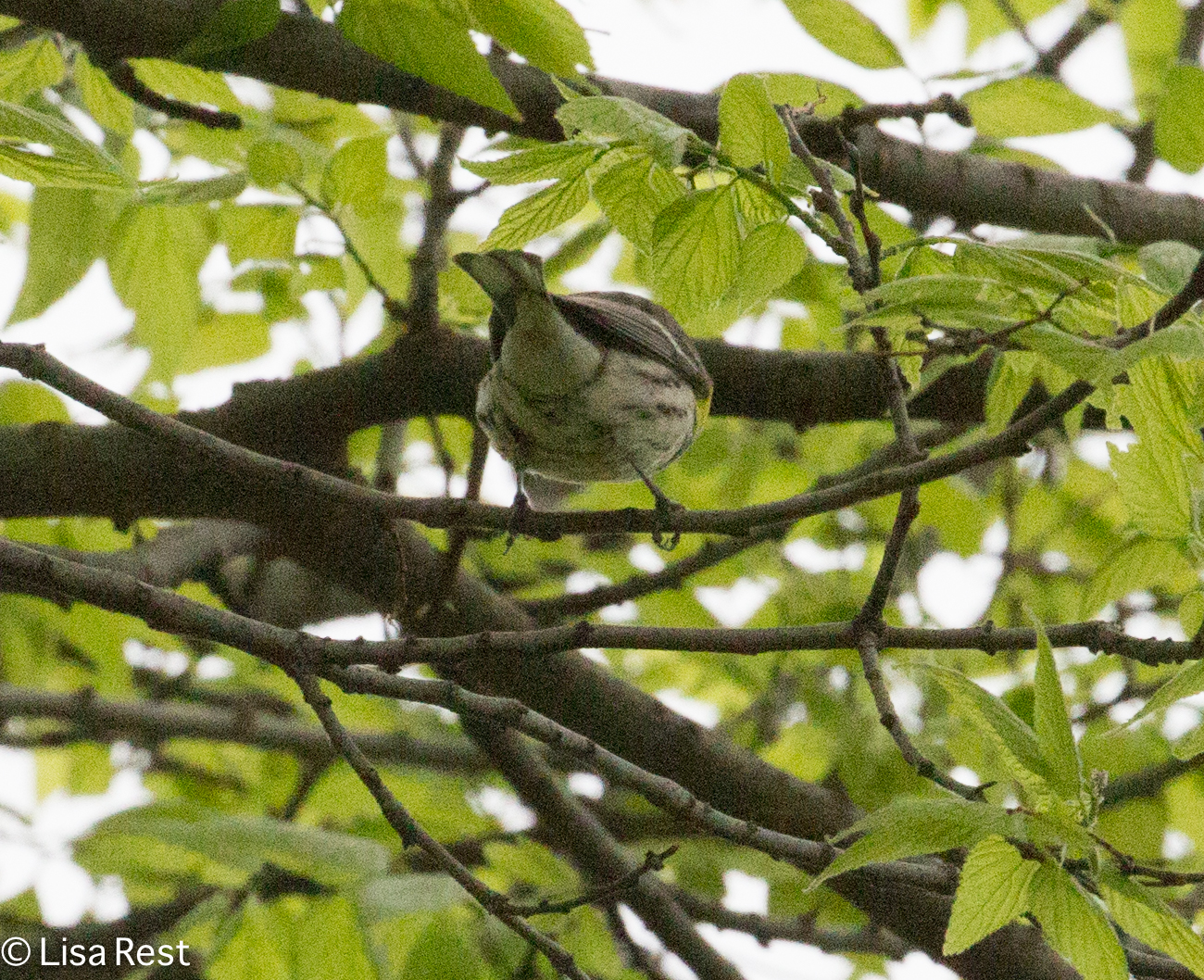
Cape May Warblers were the Bird of the Day. You may occasionally see that they also have yellow on the rump, but they should not be confused with Yellow-rumped Warblers.
Another individual Cape May is below…
and yet another. This bird is at the top of the post.
I caught a distant glimpse of a Black-and-White Warbler behaving like a nuthatch, gleaning insects from the tree bark,
Below is an American Redstart which appears to be a female. I say that because sometimes they are confused with first-year males, but the shade of yellow is generally paler and less orangey on the female.
Other birds noted on the 9th – a European Starling and a Cedar Waxwing.
And I briefly saw a Rose-breasted Grosbeak. The first photo isn’t in focus but it includes the more representative field mark.
Then on September 16, I had a bird that defied description until I figured out it had to be a Pine Warbler. At first I thought it was a Blackpoll, but it didn’t quite fit and I could not find any photos with pinkish feet. Pine Warblers can be confused with just about anybody in the fall. In this case, the wing bars won me over.
I caught a glimpse of a Black-throated Green Warbler, again.
Bay–breasted Warblers came in several different options.
Here’s another individual.
I had a Blackpoll Warbler that day as well.
Other birds that day, nothing spectacular. An American Goldfinch, of which there are many this time of year, and a Double-crested Cormorant flying over the river in the distance.
I also had some unusual looks at the features of a Red-bellied Woodpecker. You can see the “red” belly in the second photo.
I will be back with more fall warbler photos among others, as we seem to be approaching the “now-or-never” part of fall warbler migration. Due in large part to unusual weather and dramatic temperature variations, it seems more birds have kept going than stopped to refuel, at least around here. But I read Bill Hilton’s post yesterday and he is experiencing the same lack of migrants in North Carolina, and even he is stumped by it. He suggests that it’s probably too early to draw any conclusions and to see how the migration patterns sort out in a few more years. Birding will always be looking for the next bird…
The fall warblers are trickling in. Here are a few warblers to get started with from morning walks in Riverside and the Chicago Portage. On August 27 in Riverside, I saw a female American Redstart.
Also present was a Cedar Waxwing. I included the middle photo because if you look closely at the yellow tip of the tail, it appears to have a serrated edge.
I caught a Chimney Swift and a Double-crested Cormorant in flight.
A Great Blue Heron and a Great Egret were available for long views.
On September 1 at the Chicago Portage, I briefly saw a Blackburnian Warbler.
I also had a Cape May Warbler, but only got a glimpse-and-a-half.
The next day, September 2, at the Chicago Portage, I had only a Nashville Warbler.
But I did get an interesting photo of a young Hairy Woodpecker.
And I made the acquaintance of a Chickweed Geometer Moth.
Back again on September 4 at the Chicago Portage, I had an American Redstart that could be a young male.
I then saw a Bay-breasted Warbler.
And I got some fair looks at a Magnolia Warbler or two.
I also had Tennessee Warblers.
I caught a glimpse of a Gray-cheeked Thrush.
And a Field Sparrow sat still for a moment.
Also that day, Bob and I saw a Broad-winged Hawk and a Cooper’s Hawk. They were both in the air at the same time, and then the Cooper’s Hawk made a return solo visit.
Broad-winged HawkCooper’s Hawk
In Riverside on September 5, I saw the Chestnut-sided Warbler who is also at the top of this post.
I also had an American Redstart, again, a young male.
Great Egrets were here and there..
On my walk through Riverside Lawn, I came across a Green Heron perched by the river close to where I was walking.
And I heard and then saw a Northern Waterthrush.
I just had a very interesting morning at the Chicago Portage, so I think I will be back with that recap as soon as possible before I go back a little bit to the five days in between. Anything can happen during fall migration, even when it’s least expected.
I kept trying to get caught up with April, but it’s already May and there are more birds showing up despite some really chilly, windy weather. The other thing is the days keep getting longer and yet there aren’t enough hours in one day. But I can stay inside today after singing two services with the choir this morning, and take some time to recap the last two days of birding before they too become ancient history.
Yesterday morning, the Oak Park Area Migration Bird Walkers (that is such a mouthful, but I think this is the Official Name) met at Columbus Park. It was chilly and partly cloudy, but we found birds. Here are a few photos of some of the birds we saw.
As we stood on the lawn looking over the larger water area, the Great Blue Heron at the top of this post flew in for a landing. Its choice of location was too close to a pair of nesting Red-winged Blackbirds, and I caught some of the action as the male blackbird tried to get the heron to relocate.
I then captured the top photo and the one below as the heron left for another location.
We saw a few Tree Swallows. They were easier to capture perched. I suspect they weren’t catching much for taking so many breaks.
While we saw Palm Warblers in numbers, it took a while before we started to see a few other species across one of the tributaries of landscape architect Jens Jensen’s “Prairie River.” As birds were foraging around near the bank, it was nice to see a male Black-throated Blue Warbler in particular.
A male Common Yellowthroat was more difficult to see.
There were a few Yellow Warblers. Although we heard some singing, I believe the bird below is the first female Yellow Warbler I have seen this season.
Blue-gray Gnatcatchers were showing off for us.
And we heard and saw at least two individual male Baltimore Orioles.
Here’s a token Palm Warbler.
I noticed a singing Warbling Vireo.
A pair of Canada Geese swam by with goslings in tow.
Toward the end of the walk, we got some furtive glimpses of a Cape May Warbler.
I will team up again with the Oak Park group in two weeks. As for now, looking back to Friday morning in Riverside, my walk was pretty tame but eventually rewarding. It only takes one unexpected sighting to make my day. Starting off more predictably, I got close views of a Mourning Dove and a Common Grackle.
As I walked on the paved Swan Pond trail, a Yellow-rumped Warbler was busy trying to catch bugs.
A Pine Warbler sang and sat rather still.
A sidewalk Chipping Sparrow appeared.
I saw a Hermit Thrush after a while.
After I crossed the river and started walking in Riverside Lawn, I was pleased to see a Great Egret across the river and a Double-crested Cormorant as it flew by.
Then suddenly, almost out of nowhere, my surprise bird showed up: a female Ruby-throated Hummingbird. She appeared to have some nesting material in her bill.
I caught a glimpse of a Nashville Warbler, and then the Nashville with a Tennessee Warbler. I didn’t realize I had captured the Tennessee until I developed my photos.
I expect things to get much crazier in the days ahead. That said, yesterday morning around 6:00 AM I was delighted to see one, and then another, beautiful, healthy-looking opossum in my backyard. I went back inside the house to grab the camera and the opossums apparently felt safe enough hanging out by the fence while I took their pictures. You can barely see the second opossum on the left of the third photo.
I know I always say this, but I will try to be back soon with some older photos before I whisk them away to make room for more spring migration.
The spell was finally broken at Columbus Park on Saturday. We actually saw some migrants. It began with a couple Cape May Warblers that I simply could not take my lens off of.
Another individual almost looked like a different species altogether, he was so stripey.
They were both busy in the center of the same tree with a Yellow-rumped Warbler or two. A Yellow-rumped is in the first three photos below and the last photograph in the series shows a Cape May Warbler and a Yellow-rumped Warbler together on the same branch.
There was a Nashville Warbler later on.
A Yellow-bellied Sapsucker was in the same area as the Cape May Warblers but it was moving so quickly from tree to tree, I barely captured the image below.
When we first arrived, there were Mallards tooling around in the shallow water by the Refectory.
Later across the pond on the other side we spotted a juvenile Great Blue Heron standing at the back door of the Refectory.
I made a quick visit to the Chicago Portage after our walk to see if there was any extra activity there. I was going to include those photos in this post but I think I will just do a separate post as I went back there again Sunday morning and found more birds sort of in the same spot.
And actually I simply have way too many photographs of the Cape Mays at Columbus to make room for anything else. I couldn’t help myself. I was surprised to see the bug also making an escape in the first photo below.
I managed to capture a Ruby-crowned Kinglet. There were Golden-crowned Kinglets too but they were elusive this time around.
At one point someone noticed a hawk in the middle of a bare tree with grackles and robins perched all around keeping an eye on it. It turned out to be a Red-tailed Hawk. None of the photos were good with all the branches in the way.
However many Yellow-rumped Warblers were present, they weren’t always easy to photograph. But I kind of like how this one blended into the background in these two shots. The bird was fairly distant so these have been cropped considerably.
Of course I have a few more of the Cape Mays. I will be back very soon with the last two visits to the Portage – before I try to get caught up again with the other visits that preceded them.
We have been blessed with the gift of beautiful fall weather the past few days. That makes it easier to get up and out earlier. With the days getting shorter and the nights getting colder, the time to observe fall migration seems precious and limited. I am grateful.
It’s been a busy birding week and fall warbler migration is only getting started, but I’m already having a hard time keeping up. To add to my confusion, with the pool closed, the break in my routine is making it harder to figure out what day it is. But I have started getting up earlier to join bird walks and I will start leading Saturday walks tomorrow through the second week in October. It’s beginning to look like fall, even if it doesn’t feel like it just yet.
These photographs are from August 31st at Riverside, and I have also added the rest of the birds from August 26th at the same location.
I was happy to see a very cooperative Northern Waterthrush on Wednesday.
American Redstarts are the most numerous and well-distributed fall warbler species so far. I have seen them every day. The one immediately below looks like a first-year male.
Also fairly common are Magnolia Warblers like the one at the top of the post and below.
I discovered something about Blackpoll Warblers I never realized before. Apparently they all have orange toes – so when stumped by a decision between whether you are looking at a Blackpoll or a Bay-breasted, if you can see orange toes, that solves the problem. I was delighted to find photos showing beautiful orange toes. This is nearly impossible to see in the field, however.
I have also seen Golden-winged Warblers all week, starting on Tuesday morning at Columbus Park with Henry G.’s walk. They seem to have all come into the area at once and I have seen them everywhere I have been. I’m sneaking this photo in from Tuesday as it is the best one I have of the whole bird.
Below is another Golden-winged I just barely captured the next morning at Riverside.
Cape May Warblers seem to be numerous this season.
And not a day goes by without a Tennessee Warbler.
Below is a barely-captured Black-and-white Warbler
Thrushes are starting to appear as well. This is a Swainson’s Thrush.
Juvenile Gray Catbirds can’t get enough of the camera. They demand attention.
I don’t think this molting Northern Cardinal wanted to be seen like this but I couldn’t help myself.
In answer to the question, “Where have all the blackbirds gone?”, I have seen huge flocks all week at Riverside.
And Cedar Waxwings are on the move in flocks as well.
I have a feeling House Wrens will be gone soon but the youngsters are still around.
And Great Egrets are busy fishing. The water level has improved in the river.
I will try to come back sooner and more frequently, as the birds just keep coming. I also have some stored surprises still to share. We are starting out very warm going into the Labor Day weekend, with a promise of cooler weather after tomorrow. We could see a lot more warblers with winds from the north.
I have seen some fall warblers, if sparingly, over the past week, so I have pulled the best images from birds seen at the Chicago Portage or Riverside Lawn, just to get a little warbler anticipation going here. Tomorrow morning might actually be a good day because we are experiencing a little storm activity tonight. And since I can’t swim this week – the pool is being cleaned – I will likely be walking a little farther and seeing more birds.
Right off the bat, the bird at the top of the post is a female Cape May Warbler seen at Riverside Lawn on August 24. The bird below, I am not sure but I think is a Blackburnian Warbler seen at the Chicago Portage on August 27. I didn’t get any other shots, oddly enough, to help me identify it.
It’s been a good year all around for Bay-breasted Warblers. They are coming through. And I think I’m getting used to their contact calls. This Bay-breasted Warbler was at Riverside Lawn on August 26.
I don’t remember taking the photos of these two Tennessee Warblers, oddly enough, the same day at Riverside Lawn, but it’s likely I was just too mesmerized by them.
Here’s another Bay-breasted Warbler from that day at Riverside Lawn.
And another Cape May female-type or juvenile, on August 24 at Riverside Lawn.
Yet another Cape May from the same day and location.
Not a great photo, but definitely a Bay-breasted Warbler I saw on the 24th. There have been many more warblers seen along the lakefront, but I will be out a lot this week and I expect to see more around here.
Meanwhile back in my yard, I have two female Ruby-throated Hummingbirds that usually show up individually but sometimes make chases through the yard together. I have taken to calling them my Green Ballerinas.
Over the past couple weeks I have been fortunate enough to capture them…somewhat.
But what really became fascinating to me was seeing them attracted to the Tall Ironweed – of all things. I can’t figure out why, exactly – it doesn’t look like a flower a hummingbird would enjoy – but they keep revisiting it and I can’t imagine it’s for nothing.
A view of the Tall Ironweed in the backyard jungle
So I set out trying to capture one of the birds in the Tall Ironweed.
At first, where I can sit in the middle of the yard, I was close to a hummingbird at the flowers but could barely see the bird on the other side. I decided to stand by the front gate instead and see if one would come to the flowers right by the back steps. Within a moment or two of standing there with the camera, a hummingbird obliged (the second and third photos below).
I am enjoying these little birds so much more now that I have the time to engage with them. Yesterday as I was refilling the birdbaths, the two of them flew right over my head, clicking away, in greeting. The other day when it was cool enough to have the windows open, one came and sat on a branch outside the kitchen window and we discussed refilling the feeders with fresh sugar water. I believe it was later that day, early evening, when I went out to clean and refill the feeders one by one. No sooner did I bring out the freshly refilled one that hangs from the dead Staghorn Sumac tree right by the kitchen window than one of these little charmers came to check it out. I am thrilled to be of service to such a grateful customer.
Now that fall warbler migration has begun, I expect to be back soon – not to mention all those other birds that are emerging, such as juvenile birds that are barely recognizable Needless to say, I am putting the book on hold for a while. But I am learning so much these days from the birds, it’s addicting. Well, something has to fill the swimming void for a week.
I had a lot of other photographs I was going to post from previous visits but they will have to wait. In spite of the rainy forecast Saturday morning, I went to the Portage and even though it was overcast, it was magical. Within a minute or two I had heard 10 bird species. I saw most of them and many more.
Perhaps the first bird I saw and heard was a Baltimore Oriole. There were easily half a dozen males staking out territories. This was the only one sitting out in the open.
I encountered a small flock of warblers fairly early. I was lucky to be able to sit on a big fallen log that has become permanent enough to attract graffiti. The opportunity to sit and look up into the trees was welcome. Below, couple Yellow-rumped Warblers.
I encountered small groups of White-Crowned Sparrows. They were delightful to see, but they weren’t singing. I have had them in my yard for a couple weeks and they have always started singing the minute I open the door. It was nice enough of these guys to pose for pictures.
I’ve been hearing Yellow Warblers for a couple weeks but hadn’t seen one yet at the Portage. But I found this one in my photos.
Yellow Warbler
And then, of course, the Indigo Buntings. I underestimated their ability to look gorgeous even in poor light.
Below is a series of Black-and-White Warblers. There have been times I haven’t been able to capture these guys and girls, so this was a real treat for me.
I think I’ve decided Hackberries are my favorite trees. The birds like them a lot, and the Portage now seems to be full of them. They are in the elm family and I suspect were planted to fill the gaps left by all the elms we lost over the years to Dutch Elm Disease.
Here’s a Black-capped Chickadee demonstrating why he likes Hackberries. They seem to attract good worms.
A few birds I would expect to see all summer…
This female American Robin looks a bit exhausted. She also appears disheveled with her brood patch.A male American GoldfinchGray CatbirdGreat Blue Heron flyover
There were at least 30 swallows over the water. I had three species – Tree Swallows, Barn Swallows and Northern Rough-winged Swallows. They are all represented in the slide show below.
I looked up and saw this Scarlet Tanager. I’m going back to see if I can find another.
I always hear at least one White-Breasted Nuthatch but I haven’t seen any for quite a while. This one made up for all the ones I missed.
Song Sparrow
Here’s what a Magnolia Warbler might look like straight above you. Below I have grouped several views of the “Maggies” who always seem to engage with the camera.
There were some barely-there birds…
Blue JayFemale Cape May WarblerFemale Downy Woodpecker
With one more Magnolia Warbler photo, I am done with this post. We are going to get warm over the next few days. I wish I didn’t have to work, it would be ideal weather to see more birds. But the somewhat crummy weather this morning created conditions for some nice encounters with beautiful birds. I really can’t complain.
I never intend to go birding in the afternoon, but on Friday I jumped at the chance when we were encouraged to take the afternoon off. It was cloudy, and you can never count on what birds will be up to after lunch. Sometimes I like the cloudiness, though, because it reminds me of birding in South America.
Cloudy at the Portage
Maybe cloudy was okay for capturing this Cape May Warbler.
Cape May Warbler
Then there was a very active, backlit Warbling Vireo. This is likely the only Warbling Vireo I will photograph this year. There’s always one. But they are all very busy singing now and protecting their territories.
Sometimes I hardly ever see goldfinches, and at other times they seem to be everywhere. All I know is they’re not in my yard too much anymore so I suspect many of them are at the Portage or other nearby forest preserves.
With all the rain and now warmer temperatures, the green-up is happening rapidly.
I often hear Killdeer but don’t always see them. I managed to capture this one flying across the compost piles on the MWRD property.
Killdeer
Starlings have been entertaining. I have seen one doing happy dances a couple times, although unfortunately it was hard to get him in focus on this trip. But I did capture him flying.
And now how about paying some attention to the ladies? It seemed to be a good day to capture pictures of the girls. Maybe they thought they were less noticeable on a cloudy day.
Mallard female
Scarlet Tanager (female)
Red-winged Blackbird (female)
Brown-headed Cowbird (Female)
Brown-headed Cowbird (male)
I found the female Indigo Bunting below quite fascinating, in that she was preening or otherwise trying to get a grip on her feathers and the photos reveal her black and bluish feathers underneath. Who knew? (Forgive me for thinking “only her hairdresser knows for sure.”)
Indigo Bunting (female)
As a comparison to the above, here’s the male in all his glory and various feather colors.
Song Sparrows are more often heard than seen so it was nice to catch this one foraging for something.
And it’s not often I see a pair of Downy Woodpeckers. Maybe afternoons are lazier for the birds.
Pair of Downy Woodpeckers
I had a wonderful encounter with a Philadelphia Vireo a couple years ago. I hope to see more of this species. And this was the first day I saw the Eastern Kingbird. By Memorial Day there were two Kingbirds hunting for bugs from their perches over the water.
Philadelphia Vireo
Eastern Kingbird
Early on there was a small flock of Cedar Waxwings but they were hard to distinguish in the shadows and blended in perfectly with the tree colors.
Cedar Waxwing
Another elusive Black-and-White Warbler. These warblers are relatively easy to see, but so far had been defying my lens. However stay tuned because I have had some more productive encounters.
Part of a Black-and-White Warbler
Even the Baltimore Orioles looked a bit washed out. But I noticed a nest, and that was a welcome sign. The female builds the nest, so I can only imagine she was inside of it.
Baltimore Oriole Nest
It has been hard to go back to work after a long weekend, even though I have not yet returned to the office. Most amazing to me has been the time spent in the field, so to speak. I never feel like I have this luxury to fully absorb my surroundings except when I am on vacation. But something about the pandemic has slowed down everything after eliminated many social commitments. I can embrace birding religiously three days straight as a spiritual exercise. Even though I am encountering several more people on the trails, there is still enough space and quiet, with many moments left to witness how life continues beyond our immediate concerns.