
I managed to show up for only two organized walks at Columbus Park this spring with the Oak Park Migration Bird Watchers. The second one was this past Saturday on May 17. The first was almost exactly a month earlier on April 19. Both mornings were overcast, making the birds a little harder to see, but they are perhaps fitting bookends to the height of what we hope to see during spring migration. While migration continues, the warblers are fewer and farther between. I will be back later with other outings that produced more warblers, but first, here’s a roundup from Columbus Park, beginning with highlights from last Saturday’s walk.
We always walk across the lawn and look toward the lagoon to see what’s happening out there first. We found several Ring-billed Gulls and a Caspian Tern, along with an occasional Canada Goose on the “island.”


After trying to no avail to make one of the gulls into another species, we began paying more attention to the trees, watching for movement. We began to see some American Redstarts in varying plumages. I got photos of what appear to me to be first spring males, differentiated from females by splashes of black on the face and breast.


To better illustrate the point, but unfortunately with less-clear photos, check out the two pix of the bird below.


I also captured a very pale female individual. These look like young birds, taking a little longer, perhaps, to leave for their first spring migration.


Later, I caught the face of another interesting-looking first-spring male.

We eventually started seeing several flycatchers which I tried to capture and for the most part, figure out later. Flycatchers can be really confusing to identify. One bird that had its back to us was a little difficult to figure out until I was finally able to see a little yellow on its belly feathers later. I also check the bill shape, arrangement of the wingbars, whether there’s an eyering, and general overall appearance, such as how the bird carries itself. It’s a lot easier if you can place a vocalization with a flycatcher, in particular the empidonax species, but we didn’t get very lucky with calls despite many Merlin apps listening. Merlin did hear an Alder Flycatcher, and there might have been one, but I didn’t find it in my photographs.
That said, I used several sources to finally determine some of these IDs. The bird below turned out to be a Yellow-bellied Flycatcher.


My head full of flycatcher photos, I didn’t figure out this one until later when it occurred to me that it had to be an Eastern Phoebe. I’ve been looking at Eastern Phoebes for a month or morel, and yet in the presence of several other species it appeared confusing.


In between the flycatchers, we caught fleeting glimpses at Magnolia Warblers


Returning to the flycatchers, we had a Willow Flycatcher or two. Merlin was helpful with this ID, first telling us the species was present. Again, I am generally quite familiar with Willow Flycatchers, or so I think, but I have to admit it’s more often been where I expected to see them.


To make matters more confusing, here is an Eastern Wood-Pewee. I just started hearing this species, anticipating its return. I am happy to start seeing them.


We saw several Canada Goose families on the lawn as we walked around toward the wildflower garden and the trail that runs through it.

Once inside the wildflower garden enclosure, we saw hardly any small birds, but we noticed a Red-shouldered Hawk in the distance. I should probably take a moment to mention that as of yet we saw only foliage and no wildflowers as it is too early for the natives.


The sequence of my photos tells me I must have seen this Least Flycatcher nearby.


A Mallard was resting inside a log.

A Double-crested Cormorant flew by.

Then, as we started to approach the end of the little winding trail through the wildflower enclosure, we saw a backlit heron that, as we started to approach closer, appeared to be a first-summer Black-crowned Night Heron.

Sitting down low by the first summer bird was an adult. This is the same individual at the top of the post.

And down by the water in the same area was this beautiful individual. This is a cropped closeup of the same bird in the header. In all, we reported five Black-crowned Night-Herons. Since they forage at twilight and at night, then can sit so still during the day, I often wonder if they are asleep with their eyes open.

Now here’s a little roundup of the first visit back in April, for comparison purposes only – I was a bit surprised to find I had never reviewed or processed the photos, and I apparently forgot before taking them to adjust the exposure i my camera settings, so I had to lighten up most of them…
Here’s what the “island” looked like that day. One indomitable Caspian Tern and a few Canada Geese.

We spotted a Black-crowned Night Heron sitting at the edge of a planned island in the lagoon.

Throughout the morning I was paying attention to the Caspian Tern(s).


This was the beginning of spring warbler migration. Basically, all we were seeing on that cool, cloudy day were hearty Yellow-rumped and Palm Warblers. However much we take them for granted, they are still beautiful little birds.


The Palm Warbler below started out singing.


Among other birds that day, we saw a Pied-bllled Grebe.

We can nearly always count on a Great Blue Heron.


An Eastern Phoebe, that earliest of the flycatchers, had returned. Here it doesn’t look particularly like anything at all, but we likely heard it vocalize. Lighting, posture, everything comes into play.

I was surprised to find photos of a Ruby-crowned Kinglet with just a hint of the elusive ruby crown. The crown was a hard thing to see this spring.


We were also introduced to the location of a Red-shouldered Hawk nest. All we could see at the time was the adult’s tail. This nest likely belongs to the bird we saw sitting in a tree on May 10.

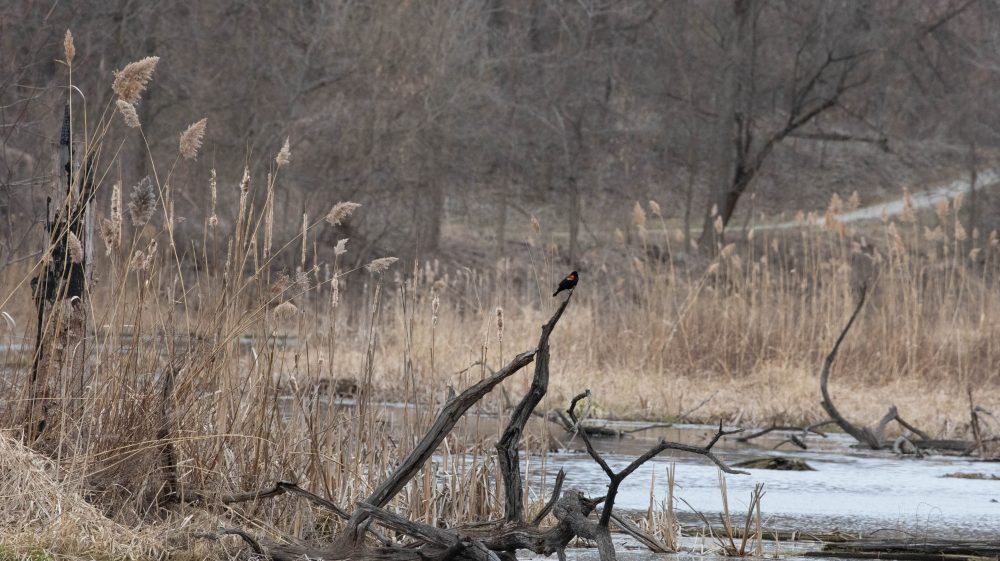
For what it’s worth on such a gloomy day, a Red-winged Blackbird’s perch on a stump must have attracted my attention.

And toward the end of our walk. we were fortunate enough to see a Swamp Sparrow. Although not rare, they are less common.


I am not scheduled to return to Columbus Park until the fall migration walks begin, but I might be tempted to take a walk through before then.
We have a forecast of rain and possible storms all day today and tomorrow, and possible into Thursday. We did get some rain overnight which was at least enough to wash the dirt off my car from the rare dust storm on May 16 – yes, that’s right, a dust storm. I am taking advantage of the rainy forecast to get caught up with photos, posts, mail, laundry, cooking. It’s not raining presently, so I put the bird feeders back out in the yard. After a short-lived heatwave last week, we are now experiencing cooler-than-normal temperatures this week, making gardening a little precarious as I don’t want to disturb the bees, for instance. But for now, I’ll settle for rain as we really need it. Send in the clouds.




 There were still a few Red-Winged Blackbirds hanging out, singing.
 In addition to a lot of Swamp Sparrows, there was my first American Tree Sparrow of the season, the arrival of which always reminds me of winter coming…

 And of course the waterfowl. Below, a view of only a couple hundred of 850 American Coots. Or so I calculated…
 And here are two cute Coots up closer.
 There was a nice little group of Green-Winged Teal…


 At one point two Mute Swans flew overhead. The second time they weren’t entirely mute and I thought they sounded a bit like Snow Geese so they had me fooled for a minute, but my photographs later said Swans.


 A few more of the Yellow-Rumpeds and the tree they were in.


 The trees looking windswept and leafless…
 Sunday morning the choir sang two services, singing “Somebody Prayed for Peace” and “Sweet Freedom” which is based on the national anthem. Afterward I went to city hall for early voting, deciding that it might not be such a bad thing to try, even though I live half a block from my polling place. As I sat in the gallery section of council chambers waiting my turn at the voting machine, I was reminded of sitting in a church pew and struck by the metaphor of voting as a form of prayer.


