Summer Slowdown at the Portage

I went rather late to the Portage yesterday morning. I chalked it up to being tired after swimming late Friday night and not happy getting up in the dark. I have been to the Portage a few more times that I haven’t written about yet, but I didn’t take too many pictures yesterday so this is about the size of a blog post I can handle at the moment.

Sometime this past week, after picking up my new prescription glasses, it occurred to me that the viewfinder on my camera might be dirty. I have had a snap-on cover over the LCD display since 2013, and I don’t think I ever removed it to clean it! There was dust and dirt and who knows what else, and while it doesn’t exactly cover the viewfinder, it snaps onto it to align with the LCD display. So after ordering another cover in case I messed up trying to remove and clean, I cleaned the cover, the LCD display and the viewfinder, replaced the cover and solved the main reason why I haven’t been able to focus the camera. One of those “Duh, is it plugged in?” moments…

There weren’t many birds to see yesterday, and for the most part those that I did see were very far away. But now that I am able to focus…sometimes it’s easier to see them with the camera than my binoculars. Two distant male American Goldfinches below…

There were several male Baltimore Orioles about but they didn’t sit still for long.

I was surprised to find what looks like a juvenile Blue Grosbeak in my photographs. I was listening to chip notes that sounded very metallic like a cardinal’s but wasn’t exactly sure who I was following with my lens in the photos below, due to the backlighting making it difficult to see. Blue Grosbeaks are not common at the Portage.

Just when I was about to give up on Robins, I did find the flock as I was heading out of the woods. I caught this one on its way to join a few others in the bare tree branches below. And way in the upper left is an Eastern Kingbird which otherwise would never have made it to the list. So it pays sometimes to take pictures of distant backlit birds.

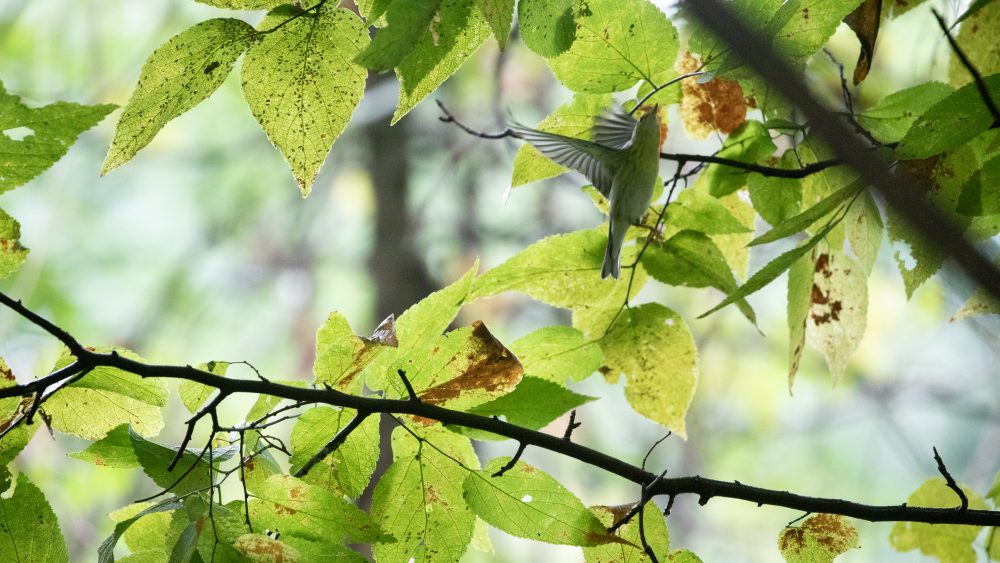
Pretty well-disguised, I had to look at this photograph more than a few times before I could find the bird in it, which appears to be a young Gray Catbird. I heard several along the trail, but did not see the ones I heard.

My best close encounter was this juvenile male House Finch.

I have been looking for these Damselflies on the back trail that leads out to the train tracks and runs parallel to the river. This one was nice enough to stop and pose for me.

Blue Dancer Damselfly

More pollinators…

This young-looking House Wren was quite far away…

Even farther away was a flock of birds that, until I could blow them up on my laptop later, I couldn’t identify. They turned out to be Cedar Waxwings.

My favorite shelf fungus…

I have become more interested in the plant life that seems to be forever changing at the Portage as more and more invasive species are removed. Having said that, there’s still a potpourri of natives and non-natives. The distant fruits on the left appear to be Pokeweed. The pink flowers in the upper righthand corner are persicaria longiseta which I have been pulling out of my yard for years, as it is non-native (it seems to have a million common names, among them, Oriental Lady’s Thumb). The white flowers are White Snakeroot which I have also been pulling out of my yard before they ever got to bloom. It’s native but weedy.

We’re in a moderate drought again, with periodic promises of rain that so far have not amounted to much.

The Des Plaines is low again.

One more photo of the Silver Spotted Skipper which, in this cropping, at least, makes me appreciate Giant Ragweed a bit more.

Silver Spotted Skipper

I have seven more days of work. It seems hard to believe.

I didn’t go out this morning because I wanted to be home for the “live” videotaped broadcast of Unity Temple’s last virtual service. My friend Linda Rios and I contributed with our musical offering recorded about a month ago, after several false starts and some procrastination. We played Schubert’s Sonatine in D Major for the Prelude and two other shorter pieces: Hommage a J.S. Bach by Hans Andre-Stamm for the anthem and Wait There by Yiruma for the postlude. We will be going back to live services which to be streamed online, but without the congregation as originally planned. The choir also had its first rehearsal outdoors in another church’s garden, complete with chairs set up, a keyboard for the accompanist, new music to learn and a cicada chorus which never stopped singing. We are going to continue to rehearse in this format until we run out of daylight, I guess. See what happens…

I know I am always making promises but I will be back with more from previous Portage visits – before fall migration clamors for my remaining disk space.

After the Rain – Part 2

In celebration of my announced retirement to the firm yesterday – my last day at work is scheduled to be August 31st – I am publishing Part 2 tonight.

The last time I saw my friendly Indigo Bunting whose territory was around what I like to call the second bridge, he was claiming the sign as his territory as well, singing “And this is My Sign.” He then hopped over to the end of the bridge and started singing “And this is My Bridge” but when I raised the camera to capture him there, he took off.

More water, but the stream is almost all overgrown.

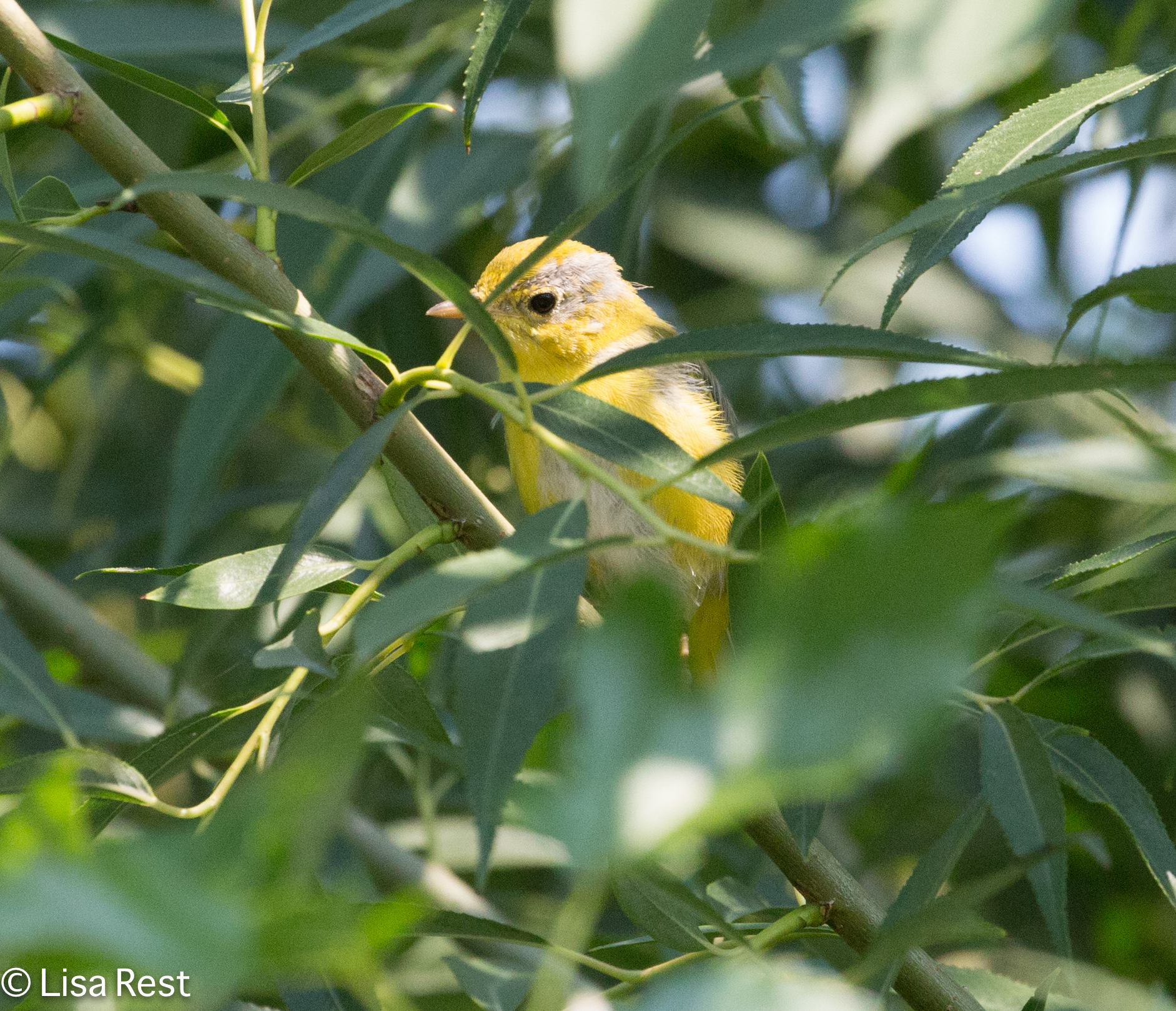
When I was walking around the back trail by the MWRD property, I encountered a couple juvenile Yellow Warblers, which could explain why I haven’t heard or seen any singing males lately.

There aren’t a lot of dragonflies either.

A bedraggled-looking Common Whitetail female.

I did catch a glimpse of a female Baltimore Oriole.

I started taking pictures of this swallow from a great distance by the parking lot when I first got out of the car – and upon blowing them up later found it flying upside down.

Robins are ubiquitous now and their numbers have increased, thanks to a successful breeding season. Worms are plentiful now with the rain.

Another Indigo Bunting…or two. They’re not singing constantly anymore.

Turkey Vulture

A few more scenes from the Portage…

The second bridge spans over very little water.

The bottomlands by the Des Plaines River were flooded, affording a Wood Duck hen a place to shelter her babies. I saw them but it was impossible to capture them in the dark shadows as their mom moved them quickly away.

This looks like a Common Grackle
One more song…

I went back this past Saturday when it started out quite cloudy and cool. Fewer birds posed but I had some interesting observations. I’ll try to round them up before the weekend. Midsummer is quiet in its abundance.

Summer at the Portage

A couple lazy uneventful Saturdays at the Portage the first two weekends yielded a few photographs and a little singing to go along with it.

Below is the last time I saw an Eastern Bluebird. I barely saw it – it was in the darkness of the trees as I first walked in and I had no idea what it was until I adjusted the exposure and cropped the photograph. I will likely never know if the two bluebirds stayed and raised a family. But it was still nice to realize maybe they were still around two weeks ago.

Then I got lucky and saw a female Ruby-Throated Hummingbird, just like the one that visits my feeders.

This was the last hurrah for Indigo Buntings too. They are still present but not as visible. This one had a distinctive song.

Here’s a little recording of this Indigo Bunting’s song

Below is a female Indigo Bunting with an insect prize.

Two photographer acquaintances I run into frequently, Steve and Mike, were taking photographs of the juvenile Wood Duck below. Another mystery. I had seen a couple Wood Ducks early in the season but I have no idea whether they nested. I can’t imagine with the water levels so low what they would have done with their ducklings once they fledged (if you can call falling out of a tree nest onto the ground fledging).

There are still Robins around although not so many. Most I am seeing are juveniles like the ones below.

Goldfinches are abundant now. They never really disappeared but because their breeding season starts later, they tend to re-emerge later.

A few miscellaneous photos from the summertime abundance. Blue Vervain and Common Chicory are the flowers.I cannot resist photographing the shelf fungus. The dragonfly is a female Common Whitetail, there’s a Paper Wasp, and the butterflies are Painted Lady and Delaware Skipper all the way down at the bottom of this group. The Skipper is a tiny butterfly.

I took note of this House Sparrow because I rarely see them here.
A reminder that August is spider web time.

The management of the water levels at this place continues to frustrate me. I suspect it has more to do with the fact that it is a low-lying area close to the Des Plaines River, and all this has less to do with beavers than predictions of future flooding due to climate change. It’s hard not to feel as if the wild places, such as they are, that we have left will soon be managed out of existence. But I will continue to visit and try to look for silver linings to these clouds.

A desolate-looking segment on a hot, dry day.

A few birds in flight, above – a Robin at the top and a Red-Winged Blackbird at the bottom right.

I was surprised to see this Eastern Kingbird with its insect prey, as I have only seen a pair of Kingbirds once or twice all season. This seems to indicate they stayed.
A singular Cedar Waxwing
This is how the statue appeared on the 8th of August. I have not heard of any plans to remove it, as seems to be prevalent in the current environment. So much about the place has changed already, though, nothing would surprise me.

A few more photos from those two Saturdays, the 1st and the 8th. The birds were busy but not so visible.

It’s hard to believe that we are now looking toward the end of August and fall migration has already begun for some species. Sometimes this year seems interminably long, but the weeks are catching up with me. I will try to be back soon with more summer observations before the next phase.

Double-dipping Goose Lake Natural Area

After groveling about making the long drive all the way up to McHenry County around Memorial Day, I went back on July 5th to celebrate my birthday and then again on July 25th. Needless to say now I’m getting used to the drive and the trail and I may have a hard time staying away before October which is when I plan to go back for Sandhill Cranes that purportedly congregate in the fallow farm fields.

I feel like I could start giving some of the individual birds names, like the Willow Flycatcher at the top of the post. I even heard a confirming “fitz-bew” on the last Saturday.

Yellow-headed Blackbird (male)

I expected to see more Yellow-headed Blackbirds. On the fifth, the males were really too far away for decent photographs, but I did get to see a female close to the observation deck. I went back on the 25th because I wanted to see many juveniles like I did years ago, but I couldn’t find one Yellow-headed Blackbird anywhere. I must have just missed them. But that’s okay, because I saw some other interesting birds, and it’s just so peaceful to be there. In fact on the second visit when I got there, I had the whole place to myself. I didn’t stay long though because it was very hot.

I found the Gallinule below in my photographs from both visits. This is a great place to go if you carry a spotting scope. But I don’t have the energy to carry a scope and a telephoto lens. Perhaps I should rethink my philosophy of cutting corners. For instance, the combination of two visits in this blog post – it’s becoming evident as I write it that it’s entirely too long.

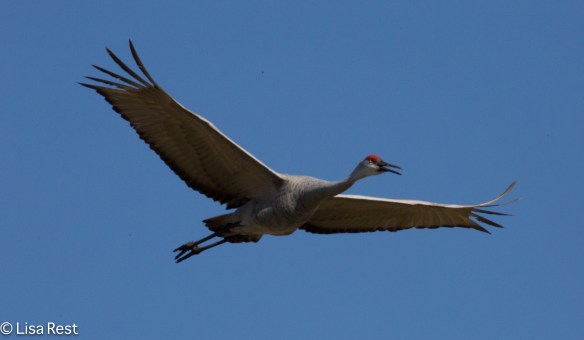
I did see a pair of Sandhill Cranes on each visit. I have not seen any with offspring, which is a bit disappointing.

Another “only in my photos” discovery – a last Black Tern seen on the 5th. Well, my camera saw it.

Here’s the turtle covered with duck weed that appeared in the background of one of the Yellow-headed Blackbird photos above. If you click on the pictures you can see how the duck weed makes it look like something from another planet.

There are still a lot of Red-winged Blackbirds here and everywhere. They are in no hurry to leave, I suppose, because they won’t have so far to go in the fall.

Not a Red-winged Blackbird but a juvenile Cedar Waxwing

I was hoping I would find a Yellow-headed Blackbird when I blew this up but it turned out to be a Red-winged Blackbird. That’s okay, it’s kind of nice to see the feather pattern, albeit faded. Below the photo, two different Red-winged calls I heard on these visits.

A Killdeer in flight…

The “other” blackbird – Brown-headed Cowbirds.

Dragonflies like this place.

On both occasions there were swallows, but in particular on the 25th there seemed to be a lot of them. It was nice to see the Bank Swallows – I don’t see them very often.

The Song Sparrow below was on the 5th. There are two more individuals further down the post whose songs I recorded and put underneath their photographs.

This Yellow Warbler was the last one I saw, on the 5th.

I am quite sure this is probably the same Great Blue Heron, although the photos are from both occasions.

I always seem to startle this Great Egret, which must have been right by the viewing platform as I approached.

A Green Heron flew by twice on the 25th.

Here’s Song Sparrow No. 1 and Song Sparrow No. 2. Song Sparrows reportedly have thousands of songs so it’s not unusual that they were singing different tunes…

And another singer I was happy to record – and manage to photograph, as they are often elusive in the marsh – a Marsh Wren.

My most cooperative subject at this location has been a Willow Flycatcher.

There were a couple distant Wild Turkeys hanging out not far from the Sandhills on the 25th.

Always happy to see a Monarch Butterfly… – I stand corrected. The two on the left are Viceroys!

I think it might be a ground squirrel on the left… there are holes on the trail that look perfect for a ground squirrel. But they could both be Chipmunks…

I found this feather interesting on my walk back to the car on the 25th. I thought it might belong to a hawk or a turkey, even, but none of the extensive feather identification webpages have given me the answer. My first thought was a crow, actually. Maybe I should go with that…

My reward for showing up on the later visit was to see these two Black-crowned Night-Herons arrive and perch not far from the viewing platform. One is an adult, and the other a juvenile.

Black-crowned Night-Herons (adult and juvenile)

Many thanks for making it to the end of this long post. As hot as it was a week and a half ago, as I finish writing this, we have dropped down into fall-like temperatures for a couple days. A reminder. I suppose, that nothing stays the same, as if I needed it. No, honestly, it’s absolutely delightful to have the windows open: I feel less confined and it’s delightful. Stay safe and I will see you again soon in another post. 🙂

Weekends at the Portage

I spent the mornings of July 4th and Sunday, June 28th, at the Chicago Portage, mainly to see how the birds that spend their breeding season there are doing. Fledglings are starting to show themselves. Sometimes they look so different from the adults it takes a moment or two to figure out exactly who they are.

American Goldfinch

A Green Heron occasionally stops by to see what’s happening, perhaps to see if the water it used to fish in has returned. I suspect the herons miss the water even more than I do. A frequent dog-walker I have exchanged conversation with for years told me that he heard the amount of water flowing into the Portage was being controlled to discourage beavers. That’s extremely disappointing to me, if true. I had read somewhere that efforts were being made to restore the habitat to its original state but I really don’t know how that could happen. I will keep trying to find out the true story. In the meantime the habitat change attracts other species that were absent before, but I miss the old “regulars.”

All that vegetation in the middle used to be water…

Something else: just as I was beginning to explore farther afield, the fence gate has been closed and locked. I am not surprised, with all the extra foot and bicycle traffic – I am sure it is a matter of liability between the water reclamation district and the railroad. Of course I would be able to crawl through the opening on the righthand side of the gate but I don’t think it’s worth doing now. It might be hard to resist during fall migration though. I guess it will depend on how many people are still using the trails.

So the stars of both visits were the male Indigo Buntings. There were plenty of them everywhere and quite a few volunteered for photographs. Since I always take too many pictures and have a hard time deciding which ones to use I have just piled them up here.

There seems to be a good number of Northern Flickers this year.

I am always happy to see a Monarch Butterfly. But sadly I haven’t seen more than two at a time.

Starting to see more dragonflies too.

European Starlings always look more interesting to me in their juvenile plumage.

I never know when I’m going to run into a deer.

Red-winged Blackbirds are less visible now that they’ve accomplished their mission of setting up territories and making babies. This may be the last time I will have seen a male singing.

I found the photos below confusing until I realized, upon closer inspection, that the breast is yellow and the tail has rufous coloration to it. Voila, this is a juvenile Great-crested Flycatcher. I don’t believe I’ve ever seen a juvenile before, so I am really happy I managed to capture it.

Another Indigo Bunting…

Here’s a Baltimore Oriole feeding his fledgling.

These are juvenile Red-winged Blackbirds checking out their surroundings.

This is the time of year when robins take on all kinds of plumage variations, particularly among the juveniles.

Downy Woodpecker (juvenile)

Below are photos of an adult Red-bellied Woodpecker and a juvenile, for comparison.

I was intrigued by the House Wren below who disappeared into the cavity in the tree…

The Blue-gray Gnatcatcher below seems to have a strange sort of tumorous growth on its back.

My lucky one-shot of a juvenile Rose-breasted Grosbeak. I haven’t seen any of this species otherwise for quite a while so it’s nice to know they are here.

Well it’s taken me almost two weeks to write this post… I will try to keep up with posting. Today was a gift in that there were clouds and thunderstorms to keep me inside and less tempted to go out. If it were up to me, I would have as many mornings as I wanted each week to do everything I like to do.

Taking Stock

I started writing this post on Friday, after I took a break from the work email and made a trip to The Feed Store to stock up on birdseed, peanuts and spray millet for those inside and out. Working from home is so strange. In my head I am still working, but home has all its necessary distractions. I keep thinking I will have gotten used to it only when I have to go back to the office. It was still good to get out, and even better to get exercise moving everything into the house and the back porch. It was a chilly, gray day, but it is March, which my mother always used to refer to as the “adolescent” month, so I endure its changeability with her blessing.

Speaking of adolescents, I suppose the bird below could be called an adolescent Purple Finch. I am at a loss as to why I took so many photographs of it, but when in this plumage maybe the last thing I’m thinking is “Purple Finch” so it’s a reminder.

As I may have mentioned previously, I moved a lot of photographs off the laptop recently. Many were of winter scenes never shared, but I was tired of winter and it’s more than enough enduring this winter of the soul, so I have gone back to the remaining pictures from my trip to New Brunswick last August. And in that location at that time of year, there were a lot of in-between looking birds getting ready to make their first trips south for the winter.

I particularly got a kick out of this Yellow-Rumped Warbler. My friend Lesa tells me she has already seen some of these guys locally as they start to go back north. I could fantasize this was one of them.

Yellow-Rumped Warbler

I’m too lazy to go back and try to reconstruct exactly when we were wherever on August 20 but my notes say we were on the Salt Marsh Trail and Callendar’s Trail with a beach picnic area in Kouchibouguac National Park, which likely accounts for the shorebird images and others with wide open spaces for a background. We also visited the C. Irving Arboretum.

Red-Breasted Nuthatch
Short-billed Dowitchers
Common Tern
White-faced Meadowhawk (male)
Belted Kingfisher
Common Raven

Thanks for stopping by and joining this visual journey. I will be back soon with more images from last summer. Spring is coming, and with it, hope for renewal.

October’s End

A goal for the last two years has been to get up to Goose Lake Natural Area and the Hebron Trail in October to see Sandhill Cranes. October weekends were flying by with other commitments and I kept hoping for decent weather, should I attempt the trip on the last Sunday of the month. I was rewarded with available sunshine and went to investigate. I saw only 18 Cranes eventually, when there had been a few hundred reported earlier in the week, but I was lucky to have three calling raucously and flying right overhead.

My start down the eastward Hebron Trail, which is a gravel trail built on an old railroad bed, yielded a flurry of Cedar Waxwings, Robins and Starlings at the start.

Hebron Trail
Cedar Waxwing
European Starling

The more often I visit this place, the more I fall in love with it. But it takes me an hour and a half to drive up there, no matter which way I go. The first time or two I wasn’t sure I was ever going to find it, but now I know the route and the landmarks and it’s easy – just a long haul.

Not long after I reached the end of the tree-lined part of the trail, I saw this male Northern Harrier fly across the field and then maybe twenty minutes later it flew by right in front of me.

Sparrow migration is in full force and I saw plenty of sparrows to prove it. It was especially nice to see the Vesper and Savannah Sparrows. Also this was my first American Tree Sparrow of the season. Since I’m already over seeing Juncos come back, I see no problem welcoming the Tree Sparrows, as both species herald the return of colder months.

Vesper Sparrow
Savannah Sparrow
American Tree Sparrow

There weren’t a lot of birds in the water, mainly American Coots. There were some Pied-Billed Grebes, but they were too far away to capture adequately.

American Coots

As I went through my photographs last Sunday, I realized I still had photos from my last visit back at the end of July, when I wondered if there were any Yellow-Headed Blackbirds left. I’m including some of those photos below.

Yellow-Headed Blackbird (female)
Song Sparrow
American Goldfinch
This Halloween Pennant would have been much more appropriate if I’d managed to post this last week!
Another reason why I like this place – I always see Crows!
Widow Skimmers look even better in retrospect.

A couple more of the Sandhills… My resolution for next year is to visit this place more often, maybe even closer to the peak times for certain species. Either way, it’s a beautiful place and I am happy to share it with you.

Sandhills at McGinnis

Two weekends ago I went to McGinnis Slough. A bit later than I’d planned… weekends seem to be getting away from me, and I just can’t seem to get up and out very early. I arrived at the slough around 8:30 AM, so it was still cool. The moment I got out of the car everything else became irrelevant when I saw two Sandhill Cranes standing in the overlook area that juts out toward the slough from the parking lot. I didn’t want to disturb them, so as I started to walk toward the south end, I took pictures at a considerable distance. But later after they had left, I found the two feathers in the grass, above. I arranged the feathers a bit to photograph them and left them there. Once upon a time I collected a feather or two, but I have never done anything purposeful with them and it’s frustrating to inadvertently find them later collecting dust or stuck inside a book or…

Below is what the slough looked like. Overgrown and marshy. Very different from the flooded trails of my last visit.

Walking away from the Sandhills, there were some Wood Ducks at the south end.

I’m always happy to see a Monarch Butterfly, but then am saddened by the fact that I hardly ever see more than one anymore, anywhere.

There were plenty of dragonflies. Blue Dashers are still plentiful and posing this summer.

Below is an Eastern Pondhawk. I don’t think I’ve photographed one before.

Red-Winged Blackbirds are still a presence everywhere.

And it was nice to see Baltimore Orioles.

Some more Red-Wingeds. Those red epaulets really stand out in flight.

Red-Tailed Hawks. Flying together…chased by blackbirds…soaring.

And there were a few Blue Jays who were not camera-shy for a change. This one seemed to think the picnic table might have some promise.

American Goldfinches, so plentiful earlier in the year, are a bit scarce, but I attribute that to the fact that they are late breeders and likely consumed by nesting duties.

American Goldfinch (female)

I was unable to capture a dragonfly on these roses but they turned out to be attractive by themselves.

A glimpse of a Green Heron…

and a Great Egret. There were a few Great Blue Herons but they were too far away.

So that’s my little report from McGinnis. I’ll try to go back there before I leave for my trip to New Brunswick and Grand Manan in just a few weeks. But I’m still not done with the Texas trip! And I have to find a new bird care person for the indoor crowd, which is not so easy these days. Sigh.

Big Bend: The Big Hike to Boot Springs

Colima Warbler

The third day of my trip to Big Bend National Park, the group started the hike up the mountain trail to Boot Canyon. In spite of the fact that my right knee issues had slowed me down, I intended to do the entire hike, which was advertised as a ten-hour expedition up and back, but I’m sure it took me longer than that! The decision whether to continue down to Boot Springs was at the halfway mark with the spectacular view of the “Boot”, and I figured I wasn’t coming back to do this again, so the only way to go was onward.

The object of what is always lovingly referred to as a “forced march” in birding was to see the elusive Colima Warbler. As it turns out, those of us who made the trip to Boot Canyon saw four or five of these individuals, but I don’t remember encountering any on the way up to the decision point, so my election to go the entire hike was fortuitous.

Chisos Basin, with the lodge in distant view…

On the way, we encountered this Black-Crested Titmouse, a species seen almost on the entire trip, but nevertheless a bit challenging to capture, so I was glad to have a picture of this individual.

Black-Crested Titmouse

One thing I discovered, though, on this hike, was that my decision to take the biggest lens may not have been wise. Actually, the Tamron lens barely survived the trip: by the end, the rubber gasket on the focus wheel was loose to the point where I could barely take a picture. I ordered a replacement, but I haven’t attached it yet. Instead, ever since I got back from the trip I’ve been using my Canon 100-400mm lens and, combined with my best camera, I think this is the way to go, so I’m reluctant to pick up the Tamron again although I’m sure I will before I decide what its ultimate fate will be.

But the biggest problem on this particular day was that somehow, on the way down to Boot Springs, my settings on the camera changed, and I was oblivious to the fact that I was shooting on “M” which I guess is the manual setting I never use, until long after the stop at Boot Springs where we encountered all these delightful warblers availing themselves of the water feature. In effect I had nice photographs of some rocks because they required no attention to shutter speed. So there I was in heaven at least looking at these amazingly beautiful birds, but not capturing them entirely with the camera. I am surprised that I was able to salvage the photographs you see here, which are certainly not of high quality but at least you can see what the birds look like. Something to learn from an exhausting hike situation. Be Over-Prepared. Or don’t forget to check your camera settings after: adjusting your pack, tying your boots, grabbing your water…

Anyway, in addition to the Colima, the Lucy’s and the Hermit were lifers for me.

Lucy’s Warbler

Some other species I’ll likely not see again…

Rock Squirrel
Threadleaf Phlox

The Slate-throated Redstart was a very hot item, and I’m sorry I didn’t get a decent picture of it, but it’s here anyway as a memory. Apparently this bird is more common south of the Rio Grande.

Variable Dancer
Eastern Fence Lizard

So all in all it was an exhaustingly beautiful experience, one I will always treasure, and I survived! Now if I can just get through the rest of my pictures from this trip before I go on the next one. More to come. Summer is upon us.

Goose Lake Prairie: Happy Fourth

Field Sparrow

The forecast was for rain not starting until maybe 11:30 or so this morning, so it seemed like a good day to restart my lapsed tradition of visiting Goose Lake Prairie on the Fourth of July. It turned out to be a beautiful morning and the threat of rain never occurred. Even though I arrived later than I had planned, for quite a while I was the only human, which suited me just fine.

Song Sparrow, the first of many

Dragonflies were everywhere. I guess the one I’ll be seeing a lot of this year is the Blue Dasher. Last year it was the Halloween Pennant. Nice to see all of these this morning.

Blue Dasher (female)
Blue Dasher
Widow Skimmer Female
Common Whitetail (female)
Halloween Pennant
Dickcissel
Dickcissel

So I’m trying to write this blog post tonight with the explosions going off all around the neighborhood, frequently sounding like a bomb exploding next to my house. I hate this holiday. I don’t understand why I have to be miserable and endure this every year. Maybe it’s why I decided not to be born until after midnight 71 years ago – it was too scary to start living with all this going on.

Luckily it never seems to bother my birds, they just endure it, likely chalking it up to more stupid human noise. We have pretty music playing on the radio. What’s one or two or fifty explosions?

But I can’t imagine the outdoor birds are too fond of this. Oh well. Back to the blog post. This morning I got to see some nice birds. There are a lot of pictures in this post. Let’s just leave it at that.

Eastern Kingbird

There was one Brown Thrasher who barely showed its face and then hid from me as I tried to see the rest of it.

I hoped for a Henslow’s Sparrow and one complied. Their return to Illinois grasslands is one of the few success stories over recent years. If you provide habitat, they will come.

Henslow’s Sparrow

The Red-Winged Blackbirds weren’t bothering to sing, so the guys looked a little bored with their guard duty.

There were a lot of Common Yellowthroats and as secretive as they sometimes are, I managed to see a few.

I’m still on the verge of tears from the explosions. I guess tomorrow morning I can go around and see how many fireworks shells are in the yard. Something to look forward to. My indoor birds are ready to fall asleep. I keep praying for rain.