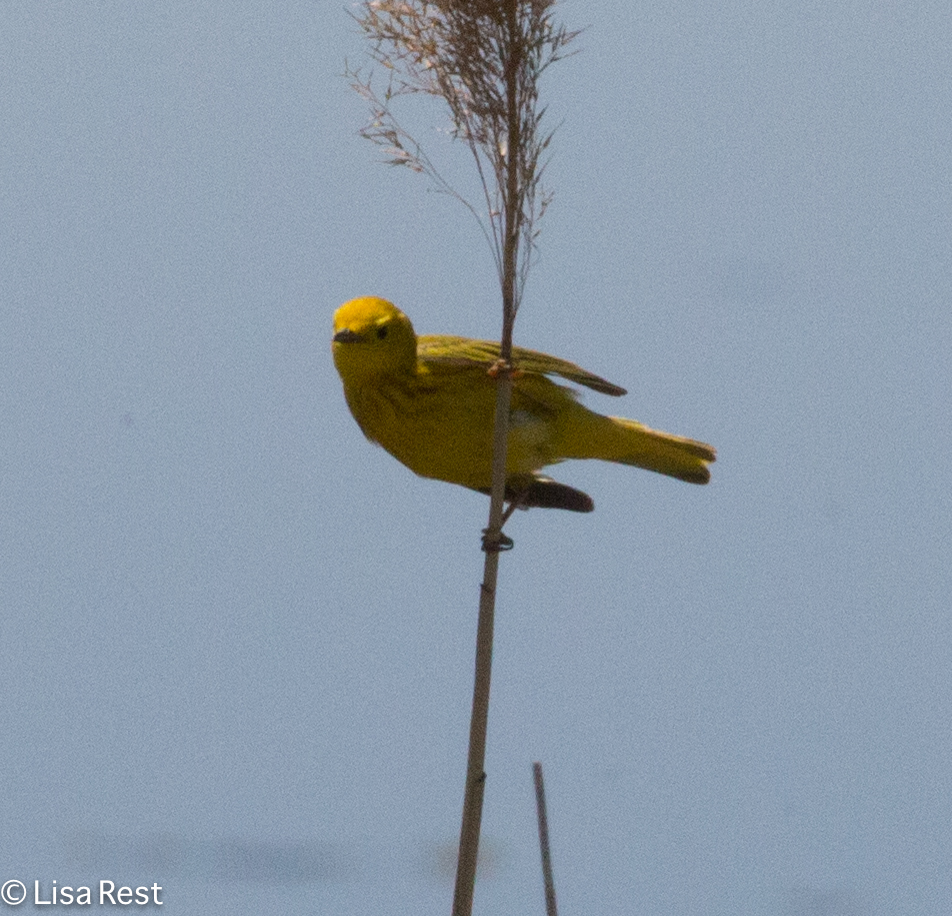
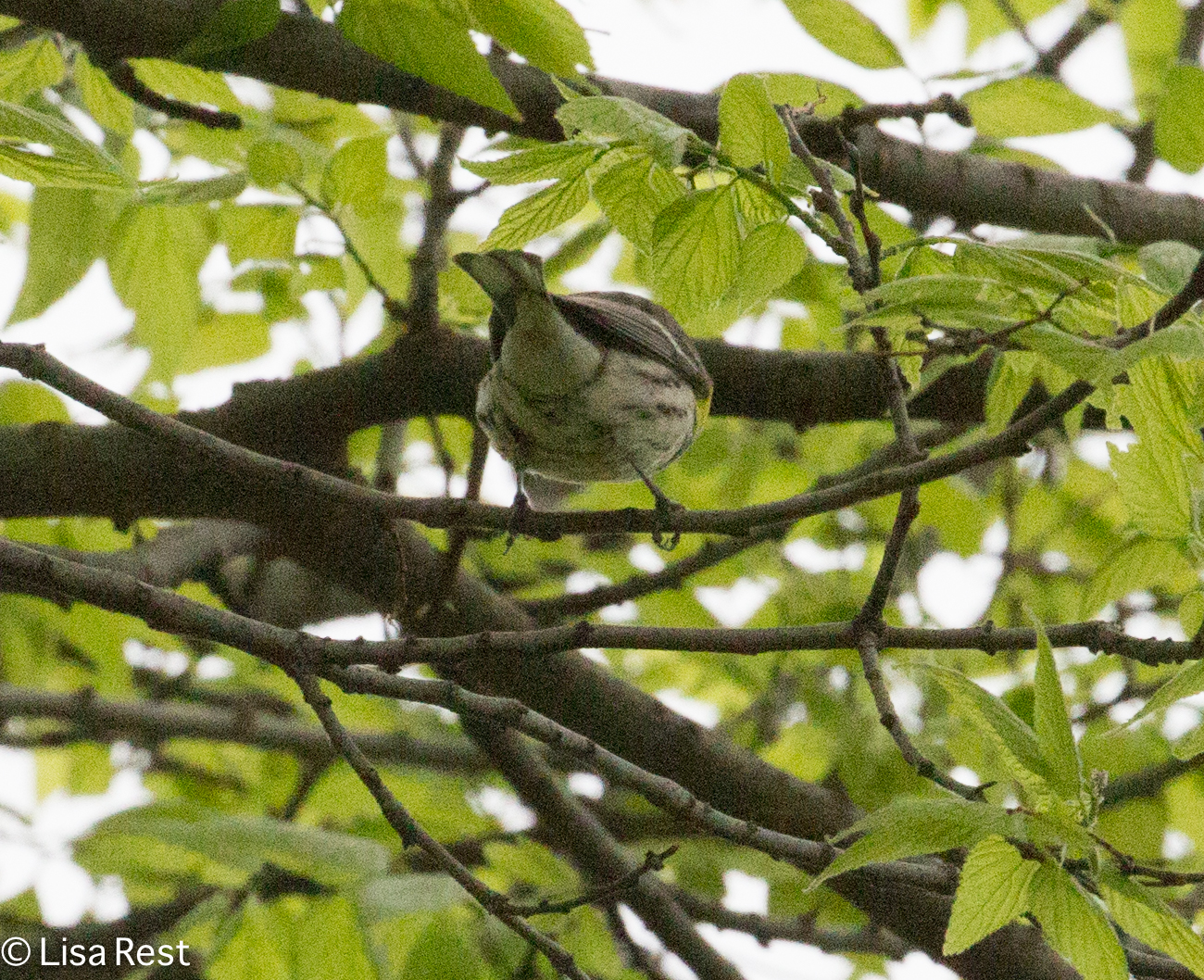
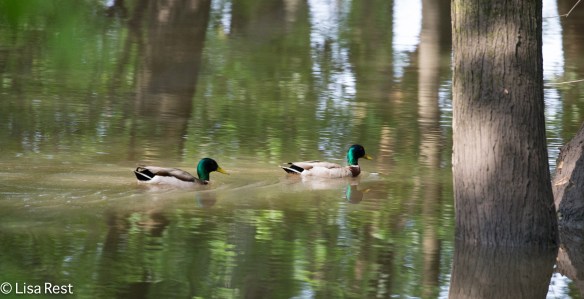
I went up to Goose Lake Natural Area in McHenry County over the Memorial Day weekend to see if I could get any closer looks at Yellow-headed Blackbirds. Unfortunately, due to the drought, the birds were too far away from the trail side or the viewing platform. But I did get some nice looks at Yellow Warblers.
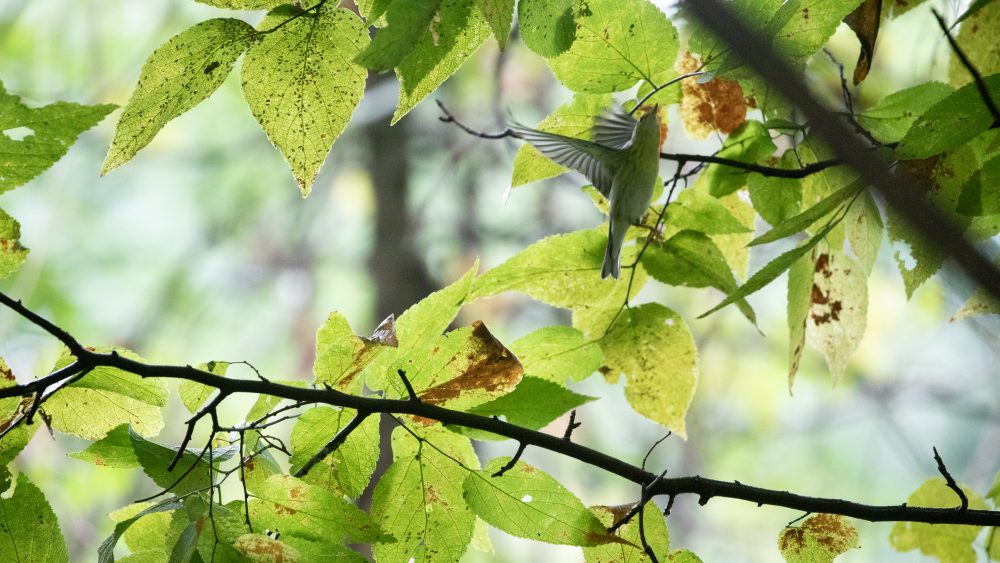
The easiest bird to capture, of all things, was Willow Flycatcher. I can remember having a hard time seeing these guys whenever we heard them years ago on our birding class walks – but at this location I can always count on seeing them well.
It was so hot and dry, this Killdeer looked desperate.
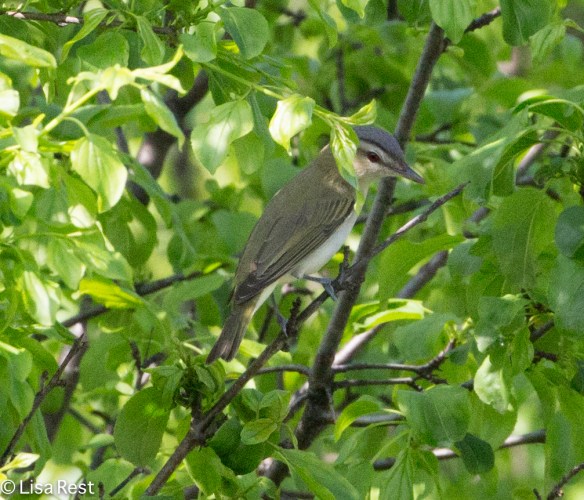
On the wooded part of the trail I spotted a Red-Eyed Vireo.
Even the Red-winged Blackbirds didn’t feel much like showing off.
I think this must be a female Red-winged Blackbird taking in some shade.
A Green Heron flew by.
I will never tire of seeing Sandhill Cranes, and there were two.
So I’ve been kind of in perpetual motion, or so it seems. Last Saturday’s Berwyn Historical Society inaugural Garden Walk was great fun. I never considered that I was doing much planning or had any theme at all for my backyard but it stood out because of all the trees I planted almost 20 years ago. People were calling it a sanctuary! Who in their right mind plants a small forest in a postage-stamp sized yard? I didn’t want the grass that was there, and I wanted birds, so I planted trees, especially as they were offered to me by the Arbor Day Society the moment I moved in. In retrospect, I’m even happier I did this because I lost the original Ohio Buckeye years ago – so I could have been without any trees at all.
The week in preparation for the walk was hot and somewhat hectic but I loved working outside in the yard almost every day. I also had fun discovering the names of many plants I had never managed to identify. Best of all was the day itself. I had a fabulous time talking to people and in the process learned more about myself and my gardens. Maybe it wasn’t so haphazard after all. I look forward to having the time to really take care of the yard through all the seasons and continue to learn what the plants can teach me.
I will be back. I haven’t been birding for over a week, but I did manage to visit the Portage a couple times prior to the garden walk. Now we are in line for thunderstorms, making up for some of the rain we didn’t get in April, so that might curtail my birding activity this weekend. Life goes on, sometimes to my amazement.
I had a lot of other photographs I was going to post from previous visits but they will have to wait. In spite of the rainy forecast Saturday morning, I went to the Portage and even though it was overcast, it was magical. Within a minute or two I had heard 10 bird species. I saw most of them and many more.
Perhaps the first bird I saw and heard was a Baltimore Oriole. There were easily half a dozen males staking out territories. This was the only one sitting out in the open.
I encountered a small flock of warblers fairly early. I was lucky to be able to sit on a big fallen log that has become permanent enough to attract graffiti. The opportunity to sit and look up into the trees was welcome. Below, couple Yellow-rumped Warblers.
I encountered small groups of White-Crowned Sparrows. They were delightful to see, but they weren’t singing. I have had them in my yard for a couple weeks and they have always started singing the minute I open the door. It was nice enough of these guys to pose for pictures.
I’ve been hearing Yellow Warblers for a couple weeks but hadn’t seen one yet at the Portage. But I found this one in my photos.
Yellow Warbler
And then, of course, the Indigo Buntings. I underestimated their ability to look gorgeous even in poor light.
Below is a series of Black-and-White Warblers. There have been times I haven’t been able to capture these guys and girls, so this was a real treat for me.
I think I’ve decided Hackberries are my favorite trees. The birds like them a lot, and the Portage now seems to be full of them. They are in the elm family and I suspect were planted to fill the gaps left by all the elms we lost over the years to Dutch Elm Disease.
Here’s a Black-capped Chickadee demonstrating why he likes Hackberries. They seem to attract good worms.
A few birds I would expect to see all summer…
This female American Robin looks a bit exhausted. She also appears disheveled with her brood patch.A male American GoldfinchGray CatbirdGreat Blue Heron flyover
There were at least 30 swallows over the water. I had three species – Tree Swallows, Barn Swallows and Northern Rough-winged Swallows. They are all represented in the slide show below.
I looked up and saw this Scarlet Tanager. I’m going back to see if I can find another.
I always hear at least one White-Breasted Nuthatch but I haven’t seen any for quite a while. This one made up for all the ones I missed.
Song Sparrow
Here’s what a Magnolia Warbler might look like straight above you. Below I have grouped several views of the “Maggies” who always seem to engage with the camera.
There were some barely-there birds…
Blue JayFemale Cape May WarblerFemale Downy Woodpecker
With one more Magnolia Warbler photo, I am done with this post. We are going to get warm over the next few days. I wish I didn’t have to work, it would be ideal weather to see more birds. But the somewhat crummy weather this morning created conditions for some nice encounters with beautiful birds. I really can’t complain.
The weekend before last was warm – but very windy. I went up to the Hebron Trail/Goose Lake Natural Area anyway to see if I could find any Yellow-Headed Blackbirds. I did eventually see them as tiny little yellow-headed black dots far away. It was almost too windy to see any birds well at all.
Farm buildings adjacent to the trail…The view going…
Where there was a break in the trees, I was surprised to see this one Eastern Kingbird sitting quietly for me to take its picture. I had to think a bit about its identification at such close range!
There were several Blue-Gray Gnatcatchers but they were hard to see.
I don’t know why I make a fuss about Brown-Headed Cowbirds but I still think the males are beautiful.
I had heard Indigo Buntings the day before at the Portage but this was the first one I saw. The closer photographs below are from last year. I will likely get more opportunities this year after the birds establish their territories and start defending them.
Red-winged Blackbirds are easy to see at this location, even on a windy day.
Although it was a hard day for warblers, it was still warm enough for bugs and worms, and I managed to see this Nashville Warbler.
On the trail, coming and going, I saw a Brown Thrasher.
After I had exhausted my patience with the Yellow-headed Blackbirds heard but not seen from the observation deck, I walked a few feet past and stood – only to see a Sandhill Crane take to the air a few yards away. There is nothing quite like seeing a bird with a 77″ wingspan coming toward you.
A few more views…
I was surprised to see a Gray Catbird sitting and calmly looking at me. They are usually quite secretive.
Playing the hiding game was a Yellow Warbler.
Even Song Sparrows were laying low…
A little more Sandhill Crane action…
One more warbler – a Palm Warbler…
Canada Geese are easily dismissed, but they are still striking looking birds.
We are not on the Brood X Cicada a/k/a 17-year locust map this year, but here is a cooperative Cicada from last summer. It hitched a ride into my post with the Indigo Bunting photos.
I have as many more photographs to share as I have other obligations preventing me from doing so. I hope the space between posts will narrow a bit in the not-too-distant future. Hope for the promise of spring.
After groveling about making the long drive all the way up to McHenry County around Memorial Day, I went back on July 5th to celebrate my birthday and then again on July 25th. Needless to say now I’m getting used to the drive and the trail and I may have a hard time staying away before October which is when I plan to go back for Sandhill Cranes that purportedly congregate in the fallow farm fields.
I feel like I could start giving some of the individual birds names, like the Willow Flycatcher at the top of the post. I even heard a confirming “fitz-bew” on the last Saturday.
Yellow-headed Blackbird (female)
Yellow-headed Blackbird (male)
I expected to see more Yellow-headed Blackbirds. On the fifth, the males were really too far away for decent photographs, but I did get to see a female close to the observation deck. I went back on the 25th because I wanted to see many juveniles like I did years ago, but I couldn’t find one Yellow-headed Blackbird anywhere. I must have just missed them. But that’s okay, because I saw some other interesting birds, and it’s just so peaceful to be there. In fact on the second visit when I got there, I had the whole place to myself. I didn’t stay long though because it was very hot.
Pied-billed Grebe
I found the Gallinule below in my photographs from both visits. This is a great place to go if you carry a spotting scope. But I don’t have the energy to carry a scope and a telephoto lens. Perhaps I should rethink my philosophy of cutting corners. For instance, the combination of two visits in this blog post – it’s becoming evident as I write it that it’s entirely too long.
Common Gallinule
I did see a pair of Sandhill Cranes on each visit. I have not seen any with offspring, which is a bit disappointing.
Sandhill Cranes
Another “only in my photos” discovery – a last Black Tern seen on the 5th. Well, my camera saw it.
Black Tern
Here’s the turtle covered with duck weed that appeared in the background of one of the Yellow-headed Blackbird photos above. If you click on the pictures you can see how the duck weed makes it look like something from another planet.
There are still a lot of Red-winged Blackbirds here and everywhere. They are in no hurry to leave, I suppose, because they won’t have so far to go in the fall.
Red-winged Blackbirds (mostly juveniles)
Not a Red-winged Blackbird but a juvenile Cedar Waxwing
I was hoping I would find a Yellow-headed Blackbird when I blew this up but it turned out to be a Red-winged Blackbird. That’s okay, it’s kind of nice to see the feather pattern, albeit faded. Below the photo, two different Red-winged calls I heard on these visits.
A Killdeer in flight…
The “other” blackbird – Brown-headed Cowbirds.
Dragonflies like this place.
On both occasions there were swallows, but in particular on the 25th there seemed to be a lot of them. It was nice to see the Bank Swallows – I don’t see them very often.
Barn Swallow
Bank Swallow
The Song Sparrow below was on the 5th. There are two more individuals further down the post whose songs I recorded and put underneath their photographs.
This Yellow Warbler was the last one I saw, on the 5th.
Yellow Warbler
I am quite sure this is probably the same Great Blue Heron, although the photos are from both occasions.
I always seem to startle this Great Egret, which must have been right by the viewing platform as I approached.
A Green Heron flew by twice on the 25th.
Here’s Song Sparrow No. 1 and Song Sparrow No. 2. Song Sparrows reportedly have thousands of songs so it’s not unusual that they were singing different tunes…
And another singer I was happy to record – and manage to photograph, as they are often elusive in the marsh – a Marsh Wren.
My most cooperative subject at this location has been a Willow Flycatcher.
Willow Flycatcher
There were a couple distant Wild Turkeys hanging out not far from the Sandhills on the 25th.
Always happy to see a Monarch Butterfly… – I stand corrected. The two on the left are Viceroys!
I think it might be a ground squirrel on the left… there are holes on the trail that look perfect for a ground squirrel. But they could both be Chipmunks…
I found this feather interesting on my walk back to the car on the 25th. I thought it might belong to a hawk or a turkey, even, but none of the extensive feather identification webpages have given me the answer. My first thought was a crow, actually. Maybe I should go with that…
My reward for showing up on the later visit was to see these two Black-crowned Night-Herons arrive and perch not far from the viewing platform. One is an adult, and the other a juvenile.
Black-crowned Night-Herons (adult and juvenile)
Many thanks for making it to the end of this long post. As hot as it was a week and a half ago, as I finish writing this, we have dropped down into fall-like temperatures for a couple days. A reminder. I suppose, that nothing stays the same, as if I needed it. No, honestly, it’s absolutely delightful to have the windows open: I feel less confined and it’s delightful. Stay safe and I will see you again soon in another post. 🙂
After the Portage weekend it felt like time to revisit the Yellow-Headed Blackbirds and maybe get to see a Black Tern, so I got up early on the 30th — a month ago already! — and went to Goose Lake Natural Area near Hebron. I am beginning to absolutely love this place, except for the hour-and-a-half it takes to get there, but of course that’s why it’s so special. I hope to go back sometime this coming weekend – after I visit the other Goose Lake, which is less of a drive in the opposite direction.
The Yellow-Headed Blackbirds were on their territories and the one closest to the trail was easier to see than last time. I think I caught an obscure photo of a female in the top center of the photos below.
The Yellow Warbler below stayed partially hidden, but I caught up with its cousin later.
Yellow Warbler
There were plenty of Red-Winged Blackbirds, but the males didn’t offer themselves up for photos. They probably know they are not the main attraction at this place. Below are couple females.
On the walk back to the car I spotted the Wild Turkey below. It was flushed by people approaching from the other direction.
I left thinking I had missed the Black Terns but found this photograph of a fleeting glimpse of one leaving the area.
A family of Pied-Billed Grebes below – I think mom was trying to show the kids how to find food.
I managed to capture the female Belted Kingfisher below flying across the water and then the marsh, looking for a place to perch with her catch.
Willow Flycatchers like this place too.
A couple Great Egrets flew over.
A Common Yellowthroat was bold enough to look me in the lens.
I heard the Great-Crested Flycatcher below before I managed to barely see him when I first hit the trail.
An American Crow…
A bit puzzled by the nest in the reeds below until it proved to be an American Robin sitting on it. So they do nest in places other than trees and the fascia of suburban houses.
A male Mallard flew by, reminding me that he’s a beautiful bird too.
A small flock of Double-Crested Cormorants flying over – of all the flock names, I will choose a “swim” of cormorants. You might prefer “flight,” “gulp”, “rookery” or “sunning”.The Hebron Trail…An unusually cooperative Gray CatbirdOne more of the Yellow Warbler
I’ve been busy at work, so goes the bulk of my laptop time. Hoping for a bit of a respite this coming weekend, and not too many deafening firework explosions. Summer is definitely upon us. Take a deep breath.
There were still some warblers on May 24, but the Bird of the Day for me was Red-Eyed Vireo. I had been wondering where these birds were, and then they all seemed to show up at once. Usually you hear them singing and don’t see them very well as they move through the trees chasing insects. But this time they were more often seen than heard. In some of these photographs you might actually be able to see the red eye for which they are named.
Red-eyed Vireo
Many of the warblers I saw that day were females. The females tend to migrate later than the males who are in a hurry to set up their territories. Spring migration this year seemed strange for many reasons – the pandemic affecting where you could go to find birds, the weather which is always a factor, and I guess the knowledge in the back of your mind that birds are in decline and you wonder just how many you’re going to see anyway.
Magnolia Warbler (male)
Magnolia Warbler (female)
Wilson’s Warbler (female)
Bay-breasted Warbler (female)
Blackburnian Warbler (female)
Below is a Yellow Warbler who likely is on territory for the summer. I recorded him singing, and you can hear him three times in the little clip below his picture. Some people find the mnemonic “sweet sweet sweet I’m so sweet” helpful in distinguishing this song from others they might be hearing.
Yellow Warbler
I feel fortunate to have seen a Canada Warbler more than once this spring. Unfortunately they prefer somewhat shady spots which I guess they blend into better than bright sunlight. I love the steel-gray blue color of their backs. I would support a Pantone color called Canada Warbler Blue.
Canada Warbler
Northern Cardinals are all around but not seen too often. This one was far away but distinct.
A Blue Jay on the fly.
Baltimore Orioles are getting harder to see now that they are busy rearing families.
Baltimore Oriole nest
Indigo Buntings are busy too but there are so many of them, they are easier to see.
Indigo Bunting
Indigo Bunting (female)
This might have been the last time I saw a Blue-gray Gnatcatcher. Actually I’m surprised I got to see more than its tail. I still hear them, but only on occasion, certainly not constantly like a few weeks ago when they first arrived.
Blue-gray Gnatcatcher
Even Red-Winged Blackbirds are assuming a lower profile.
Scenes from the Portage
Two Mallards navigating the flood waters adjacent to the Des Plaines River which were still quite high that day.Double-Crested Cormorant – an occasional flyoverThe back of a Chipmunk
House Wren
A couple more warblers – there seemed to be fewer American Redstarts this year, at least where I was. And I just learned something I never bothered to look up before about distinguishing the female Chestnut-sided Warbler from the male – the bright chestnut sides don’t extend as far down the side on the female. So the pictures below are of a female. And since I continue to hear a male singing at the Portage I can only wonder if there might be an actual breeding pair.
American Redstart (female)
Chestnut-sided Warbler (female)
I still hear the Eastern Wood-Pewee but this might have been the last time I got photo ops.
The big surprise walking back in the opposite direction across the first bridge was to see this Robin’s nest right off the side of the bridge, in plain sight – and I had never noticed it before. Mom was in a nearby tree, waiting to revisit her brood.
A bird more often heard than seen..Gray Catbird.
Red-eyed Vireo
I love this last picture of the Red-eyed Vireo. Having said that, I realized a few days ago that I need to bring more control to my blog posts when I take so many pictures and can’t decide what to do with them and invariably end up with too many – believe it or not, this is a pared-down selection. I really need to use my flickr page more often, so I stuck some other photographs there and if you’re really curious, follow the link to them. I will try to be back sooner with the final installment of the Memorial Day weekend excursions and reports from other destinations since. Hope you are staying safe and well and rising to the daily challenges.
It’s all I can do to keep up with migration this spring, let alone the pictures I have taken…So I’m attempting to do this in chronological order but it won’t be easy. This past Saturday started out cool but sunny. I decided to start my walk in the opposite direction of what I normally do. Then I realized that I had forgotten to put my little portable stool in my backpack so I decided to walk back to the car to get it. As I walked, I heard the Great-Crested Flycatcher, and then saw him in one of the Redbud trees bordering the lawn behind the statue. The morning had promise.
Great-Crested FlycatcherI have decided to photograph the statue every time I go to the Portage now to gauge the light conditions.
Last Saturday was a riot of colorful birds. I counted a dozen male Indigo Buntings. They were everywhere and they were not particularly shy, so I took advantage of their fearlessness. You can see how the light affects the hue of the blueness, when actually their feathers are all black.
I ventured out to the gravel road that runs along the MWRD property and found two male Scarlet Tanagers. They were trading songs.
But I discovered a glimpse at a Summer Tanager later in my pictures.
For all the male Baltimore Orioles singing and displaying these last few weeks, I have seen only one or two females so far. But that’s because they’re busy tending the nest.
Yellow Warblers may stay and breed at the Portage. Invariably I hear them but don’t always see them. So I was glad to capture this one.
White-Breasted Nuthatches are present all year, but are not seen or even heard frequently now.
The female Rose-Breasted Grosbeak below is the last one I have seen. I am not aware of any starting families at the Portage, but it could happen.
We have had a lot of rain, and even more after these pictures were taken. There were two Canada Geese trying out the newly flooded waters.
So this time of year of course I’m looking for warblers wherever I can find them. I just calculated that over the last couple of weeks I have seen 21 species total. I haven’t been able to photograph them all, but most, sometimes discovering them in my photographs. I will try to post as many as possible. They won’t always be textbook-looking photos. For example, the Golden-Winged below I barely captured but it was the details from the photographs that I was able to identify it as a likely female.
Nashville Warbler
Magnolia Warbler
Magnolia Warbler
Golden-Winged Warbler
American Redstart (female)
One more Magnolia Warbler
Then there are the flycatchers. They can be confusing. I have since seen the Eastern Wood-Pewee again in the same location looking more like himself so I am guessing he was having an off day (typically he would look more pointy-headed).
Eastern Wood-Pewee
I think this is a Willow Flycatcher…passing through.
On this day I saw this Turkey Vulture being escorted away by a Red-Winged Blackbird.
Song Sparrows are present, singing, and likely staying to raise families.
i keep hearing and sometimes seeing Chestnut-Sided Warblers every time I have been to the Portage since my first intimate encounter with one last Tuesday.
Chestnut-Sided Warbler
There’s a little rapids under the first bridge where the water runs out of the Portage. No water ever runs into the Portage, as far as I can tell, but It’s still nice to see the flow over the rocks.
More often heard than seen, Blue Jays are out and about but rarely available for photos, so it was nice to see this one.
I found this female Common Grackle to be attractive in her own way.
I had noticed this nest before but wasn’t sure anyone was using it until I managed to capture these two Goldfinches. You will probably have to click on the first photo to see the female poking her head out of it. I have since not been able to find the nest, which was not far from the trail, but it could still be there and hidden in all the plant growth that has occurred since.
American Goldfinch
Sadly, Black-Capped Chickadees are getting harder and harder to find. Long taken for granted, I am convinced they are in decline, at least locally. I caught this one in a hurry.
Here’s my Robin photo of the post.
As the leaves are finally coming out, it’s interesting to see how the spaces change.
Below is one of my favorite birds, a Blue-Headed Vireo. I have seen them a couple times this spring which is surprising to me, as I don’t think I have seen one for years.
Woodpeckers are busy everywhere.
Red-Bellied Woodpecker
Hairy Woodpecker
And last for the moment, I finally was able to catch the male Eastern Bluebird in focus. He has a habit of posing in difficult places, but he sat long enough this time. And although I think I heard him this past week, I haven’t seen him since. I hope the pair is still nesting and I will be looking for baby bluebirds this summer.
I have been to the Portage four times since last Saturday! I am beginning to feel like I live there. Every time I have gone, there has been a different species or a special encounter with one I’ve seen so far this spring. As many people have remarked, the cool start has been difficult for the birds migrating to their breeding grounds. I can only hope those who have visited the Portage are finding what they need in this little hotspot and will survive and flourish on the rest of their journey.
I will be back with lots more. Thanks for checking in, and I hope you are safe, well, and able to get out and enjoy this spring.
We had beautiful weather for the entire trip, which made the drive from Puerto Vallarta to San Blas, Mexico, along the Pacific coast in the state of Nayarit, that much better. It’s a long drive, and we made several stops along the way to look for birds. Some were familiar, like Yellow Warbler, Nashville Warbler, and Summer Tanager which visit my habitat during spring and summer.
Yellow Warbler
Nashville WarblerSummer Tanager (in a too-shady spot!)
Streak-backed Oriole
We had San Blas Jays and Golden-Fronted Woodpeckers in abundance. The Golden-Fronted are common in Texas, but the San Blas Jays are endemic to Mexico.
We encountered some doves and Painted Buntings foraging along a dirt road…
Painted Bunting
Inca Doves, Ruddy Ground-Dove, Common Ground-DovesWhite-Winged Dove – in a non-characteristic view
I don’t know where I saw this heron, but the camera doesn’t lie, so we must have encountered it on that day. I don’t see Yellow-Crowned Night-Herons very often, especially juveniles.
Juvenile Yellow-Crowned Night-Heron
At some point it was temporarily cloudy along the way. So you may wonder why I am including these very dark pictures. The Cinnamon-Rumped Seedeater is of some significance in that it has been split from the White-Collared Seedeater, which makes it an endemic species. And such a close encounter with some Black Vultures seemed friendly enough.
Cinnamon-rumped Seedeater
Black Vulture
One of many Grayish Saltators on the trip.
Grayish Saltator
We would see Sinaloa Wrens again. Which didn’t stop us from searching for a species called “Happy Wren” which we heard quite often, but hardly saw it once.
Sinaloa Wren
This could have been our only Gila Woodpecker. I had thought it was already on my life list but it turns out I haven’t seen it before, except in a field guide, so I am glad I have proof.
Gila Woodpecker
We would see Rufous-bellied Chachalacas again, but for a large bird they are amazing difficult to capture.
Rufous-bellied Chachalaca
Our first Citreoline Trogon. I was surprised to find I actually got a fairly decent picture.
Citreoline Trogon
Later in the day, we were on the beach, and this lone Willet gave us good, if distant, views as it expertly navigated the shore.
An assortment of beach bums were gathered – Brown Pelicans, Black Vultures, Magnificent Frigatebirds, various Herons – I think a man had left them some food.
Black Vultures
Not to be forgotten, a proud Turkey Vulture
We were assured all cormorants would be Neo-tropical…and most of the terns were Royal.
Royal Tern
Neo-tropical Cormorant
Before we checked into our hotel, we stopped at a historical site, El fuerte de la Contaduria, when we arrived in San Blas. It’s situated on a cliff overlooking the ocean. I wish I had paid more attention to the historic significance which our guide, Steve, was trying to impart to us, but I was pretty tired from traveling by then. I believe the statue is of Don Jose Maria Mercado.
One thing I do remember is Steve reading the Henry Wadsworth Longfellow poem, The Bells of San Blas.
A version of what happened at the fort is nicely summarized here.
I hope to make some progress over the weekend. I am fading into the sunset to process more pictures.
It’s been a longer haul than usual, and I apologize, but I find myself finally ready to start writing some posts from my trip to San Blas, Mexico, which occurred officially between January 6 and 14, 2020. I arrived a day early to take advantage of the weekend, since the tour didn’t begin until Monday. The myriad images in this first post are actually from the very first and last days of the tour. That leaves several days in between with more photographs to sort through.
The trip started in Puerto Vallarta. I went for a walk the morning of the 6th and came back for lunch to sit around the pool area which had its own visiting Green Iguana. Click on the images if you want to see any of them more clearly.
Green Iguana
The birds in the immediate hotel vicinity were… a Eurasian Collared Dove, later in the afternoon, an Inca Dove, Great-Tailed Grackles. Then there was a nice Black-Chinned Hummingbird feeding on the red flowers.
Eurasian Collared DoveInca Dove
Great-tailed Grackle
Black-chinned Hummingbird
On my way to the beach in the morning, I encountered a tree full of Orchard Orioles, Streak-Backed Orioles and Yellow-Winged Caciques, the latter two species, for all practical purposes, endemic to the region. There were also Blue-Gray Gnatcatchers everywhere. And of course, Yellow Warblers. Now you know where they go for the winter. In any event it was a good start for birds seen practically every day.
Orchard Oriole (male)
Orchard Oriole (female)
Streak-backed Oriole
Yellow-Winged Cacique
Blue-Gray Gnatcatcher
Yellow Warbler
At the beach, there were some people things going on…
And the reminder of countless daily Magnificent Frigatebirds…
Magnificent Frigatebird (Male)
(Female)
In the afternoon of Monday the 6th, the group met up to go on a short walk with our guide, none other than the incomparable Steve Howell, who is also the author of the impressive field guide, A Guide to the Birds of Mexico and Northern Central America. We were fortunate to see our first Ferruginous Pygmy Owl, below. The Western Flycatcher, Grayish Saltator and Rufous-Backed Thrush were introductory birds we would see often throughout the tour.
Now to the images from our last morning of birding. I am starting off with sketchy-but-the-best-I-could-do-at-quite-a-distance images of the bird that inspired my decision to go on this trip altogether. The Black-Capped Vireo, below, is a beautiful little vireo I missed on the trip to Southwest Texas last spring. I decided to see if I might be able to meet it on its wintering grounds, and this trip to San Blas seemed to be the best opportunity.
I did get a much better first look at the vireo on the Friday of our trip, thanks to Steve who knew I really wanted to see it. I was sick after breakfast the day before so I missed an entire day of the trip, but this made up for it. In any event, I decided not to try taking a picture of it the first time in case I might send it flying a lot sooner than the wonderful view I had.
Black-Capped Vireo
Other vireos from that last morning I will likely never see again are below, the Plumbeous Vireo, and the Golden Vireo, which is an endemic to Mexico.
Plumbeous Vireo
Golden Vireo
Steve found us another pygmy owl, this one, the Colima, also an endemic species.
Colima Pygmy Owl
These are not in any kind of order… we spent some time at the beach that last day.
Royal Tern and (mostly) Heermann’s Gulls
Brown Pelican
Black-necked Stilts
We had seen Magpie Jays off and on flying about but on the last day, this was a rare treat to be able to actually capture one doing its thing. The last Magpie Jays I saw were much closer, hanging out at the breakfast table at the hotel in Nicaragua, which is also very much what jays do, I suppose, depending on their habitat.
Magpie Jay
We had several Grey Hawks on the trip, but this might have been the only juvenile.
Juvenile Grey Hawk
I still have to tally up all the new species I added to my “life list” but I’m pretty sure this was the first time I have seen a Western Tanager. This one appears to be a young male bird.
Western Tanager
One more endemic – the Rusty-Crowned Ground Sparrow. Such a long name! It’s quite flashy-looking for a sparrow, though.
Rusty-Crowned Ground Sparrow
We were taunted by Orange-Fronted Parakeets and other psittacidae throughout the trip, but it was extra special to see these two perched and looking at us.
Orange-fronted Parakeets
I haven’t seen a Masked Tityra in a while. Nice to get a good look at this one.
Masked TityraSocial Flycatcher We saw plenty of its cousins, the Great Kiskadees, but Socials are special to me, in particular because now I will always remember their song as “tortilla, tortilla, tortilla” – thanks to Steve.One more from the Orange-Fronted Parakeets
So I hope to be back with more to report a little sooner. My travel laptop seems to be cooperating, and it probably likes the attention it doesn’t get the rest of the year. I’ve gotten over whatever it was that attacked me, although I think it took maybe a full two weeks to feel totally sound. Work, choir, the birds at home, everything is back in full swing. Thanks for stopping by!
Never knowing what to expect but full of expectation is how I approach the Portage on a regular basis. So arriving late last Saturday morning was bound to be a mixed bag. I stopped on the bridge to talk with another birder I’ve run into lately there, and snapped the photograph of the female Baltimore Oriole below. And then as I started to walk, an adult Bald Eagle flew over. I didn’t have time to capture it the first time but it came back and so the image above.
Baltimore Oriole (female)
As usual there were more birds heard than seen at this hour but I was content to see what I did. Indigo Buntings are still evading the lens, but I will have many more opportunities to endure their frustrating behavior.
Blue-Gray Gnatcatchers are abundant and usually hard to spot, but I found this busy nesting pair.
Tree Swallows used to nest here…this one looks like he’s thinking about it.
Tree Swallow
Warbling Vireos…I always hear several of them, but they are normally very hard to see. However this one was singing and perched at a comfortable height for me to capture him.
This is the time of year when dandelions get a bad rap, but I found it interesting to see a Song Sparrow eating the seeds before they had a chance to disburse. So there, I have proof that dandelions aren’t just attractive to pollinators but they are also a source of food for birds, and of course humans. We may need them some day!
One of the two Green Herons was hunting. At one point it took off across the water and caused a sunning turtle to slide off its stump. There were a lot of turtles out. Click on the images below and you can see what I mean.
A few more pictures of Portage breeders… I’m leading one more walk tomorrow morning as an auction donation to Unity Temple and the forecast is for thunderstorms. But the weather changes every few minutes. We had the same forecast for this morning and except for a few thunderclaps around 6:15 a.m. and a little rain, now it is cloudy but clear. I am hoping for the same sort of cooperation tomorrow, it will make dealing with the muddy spots a lot easier.