Flight of the Equinox

Shoveler followed by Wigeon McGinnis 09-17-17-8293

8 American Wigeon following a Northern Shoveler

Getting up earlier now for work, so it should be a little easier to convince myself to continue getting up early on the weekend and look for migrating birds. I still curse the alarm clock – it’s quite dark at 4:15 A.M. and it won’t be getting any lighter for a while. But even my Zebra Finches have gotten into the new routine. They start in with their morning chorus call well before sunrise.

I have yet to record the morning Zebra Finch reveille, but the week I was off in between jobs, I did manage to get a clip or two of Arturo T., and so I have finally added his arpeggio song to the sidebar. He has more songs I will try to publish soon.

DCCO Ottawa Trail 09-09-17-5364

Double-Crested Cormorant

It was officially fall sometime Friday afternoon, but we have been trapped in the middle of a hot spell longer than anything we had during the summer. Even worse, the forecast for rain keeps diminishing. But I guess compared to other parts of the planet our weather woes are mild by comparison.

These miscellaneous flight shots are primarily from a visit to McGinnis Slough the weekend before last.

BLJA Ottawa Trail Portage 09-17-17-8084

Blue Jay

GREG McGinnis 09-17-17-8184

Great Egret

MALL McGinnis 09-17-17-8283

Wood Ducks

The two Great Egrets below were flying over the Des Plaines River near the Portage the day before.

GREG Portage 09-09-17-7938I’ll let the pictures talk for themselves…

WODU McGinnis 09-17-17-8230WODU McGinnis 09-17-17-8233

DOWP Portage 09-09-17-8029

Downy Woodpecker

Below a little sign that the trees are getting ready for a long winter’s nap even if the weather won’t cooperate.

Fall Color McGinnis 09-17-17-8172I went into the city an hour earlier this morning to see if it was possible to see any birds before getting to the office. It wasn’t easy. The light wasn’t good until I had to leave Lake Shore East Park, after it took me half an hour to get there. I will simply have to find birds close to the river. I will miss the lakefront parks, and particularly my crows. I may have to go downtown a few weekends to see if I can find the crows, because I miss them terribly. I refuse to believe they aren’t around as much because I have been absent, I still think it’s the hot weather. I hope I’m right.

GREG McGinnis 09-17-17-8178I will try to be back sooner. Still getting used to the new regime. I hope the autumnal equinox finds you safe and sound, wherever you are.


Fall Migration Begins

TEWA Portage 09-03-17-4449

Tennessee Warbler

There was no time for birding last weekend. So I decided to visit the Chicago Portage two days in a row this weekend. It’s not a difficult decision to make this time of year. I took my chances that the rain Saturday night might cause a little warbler fallout and I was not disappointed. Not many species but it was still nice to see some activity.

Apart from birds, I saw more Monarch Butterflies the last two days than I have all summer, when I have occasionally seen only one or two. Yesterday I am sure I saw at least 15, which is still nothing compared to previous years.

The other late summer pleasure is spider webs like the huge one on the left below. On the right, the flowers are still laden with the last night’s raindrops.

Cedar Waxwings were everywhere both days, but in particular yesterday. I estimated there could have been a hundred but I reported a conservative 76.

The two robins below seemed to be arguing over the lower bird’s perch.

On the Des Plaines River, one Great Blue Heron and one Great Egret were still present on Saturday, but Sunday morning they were gone.

GBHE and GREG Portage 09-02-17-3862Indigo Buntings were still a presence but getting a bit harder to find. They are likely getting ready to leave.

INBU Portage 09-03-17-4235INBU Portage 09-02-17-3666Likely INBU Portage 09-02-17-3973INBU Portage 09-02-17-3901Also nearly absent are Red-Winged Blackbirds.

RWBL Portage 09-03-17-4318

Red-Winged Blackbird

For excitement, on Saturday I focused on the Red-Tailed Hawk below when it landed in a tree across the water, and then got lucky enough to capture its takeoff when it left.

So where are the warbler pictures? I didn’t get them all, but below are a few. The Orange-Crowned was there Saturday. Apparently it is early because I got the “rare” warning from ebird yesterday when I tried to add it before developing my pictures. I hope the image below will be enough proof.

OCWA Portage 09-03-17-4223

Orange-Crowned Warbler

BLWA Portage 09-03-17-4538

Blackburnian Warbler

BAWW Portage 09-03-17-4554

Black-and-White Warbler

I heard several Warbling Vireos and Saturday I managed to photograph one.

WAVI Portage 09-02-17-3641

Warbling Vireo

The Carolina Wren below was a surprise. This appears to be a youngster. I fussed over the image for a while but decided it has to be a Carolina, even if the eyebrow isn’t finished-looking, the bill, the reddish color and the upturned tail indicate Carolina Wren. I also heard one sing, likely it was this one trying out its pipes.

Below is how the Portage looked yesterday.

Portage 09-03-17-4557Abundance below, of Pokeweed berries and Jewelweed blooms. Unfortunately I couldn’t find any hummingbirds enjoying the Jewelweed.

The shelf fungus seemed a bit diminished on this visit.


Shelf Fungus Portage 09-02-17-3790Below, three first-year birds.

RBGR Portage 09-03-17-4398

Rose-Breasted Grosbeak

EUST Portage 09-03-17-4597

European Starling

MODO Portage 09-02-17-3595

Mourning Dove

The cardinal is a likely candidate for first-year status as well.

NOCA Portage 09-02-17-3784

Northern Cardinal

Another view of the Portage, showing off all the native wildflower planting done lately.

Portage 09-02-17-4016I couldn’t decide which photograph of the Common Yellowthroat below to include, so here are both.

COYT Portage 09-02-17-3671COYT Portage 09-02-17-3670And one more of a Tennessee Warbler, adorning Giant Ragweed. Tennessees were most numerous yesterday.

TEWA Portage 09-03-17-4459Apologies for being absent of late. My work situation is in flux, which creates a different kind of distraction. But I promise I’ll be back soon with an update from the yard. It’s been cool enough overnight to leave the windows open all weekend. I think Fall is my Favorite Season.


Big Marsh, Hegewisch Marsh and a Lifer

Least Bittern Big Marsh 07-30-17-6896

Least Bittern at Big Marsh

Last Sunday I joined Chicago Ornithological Society’s trip led by Walter Marcisz to a couple areas he knows so well, far south in the Cook County limits and to which I had never been. So tempting was this offering, there were an almost unmanageable 40 of us. But all went well, thanks to Walter’s skillful leadership.

The photograph above is of a Least Bittern which was a life bird for me. I wish I’d gotten a sharper image but we were all caught quite unawares standing around looking out when suddenly this bird decided it needed to go somewhere, so I consider myself lucky i got it at all. The rest of my shots of this bird have someone’s head in them so maybe that gives you an idea.

The parking lot where we met before taking off for the marshes not far away afforded these two captures below: a Double-Crested Cormorant on a light fixture and two Barn Swallows hanging out on the barbed wire.

The wildflower investigation continues. The plant below seemed to be everywhere at Big Marsh and I think there was some at Hegewisch too although by that time I was so tired of seeing it I may have been ignoring it. Someone identified it as Spotted Knapweed, so I looked it up on my wildflower app and sure enough, it is an invasive, with somewhat nasty properties. If handled a lot it can cause tumors on the hands. Yuck. Made one bee happy however.

Bee on the Invasive Plant Big Marsh 07-30-17-6934I grew tired of trying to figure out the one below but it’s pretty in its isolation. I believe it was at Hegewisch. I didn’t take many pictures at Hegewisch – we weren’t there long. We went to see the Common Gallinules – who used to be Common Moorhens – that have been breeding there this year. We caught glimpses but not much else behind the tall grasses.

Wildflowers Big Marsh 07-30-17-6958I was happy to see Northern Rough-winged Swallows as I have missed seeing them in my usual haunts this year.

More birds in flight. A Killdeer on the left, and a Great Egret on the right.

Always happy to see a Caspian Tern hunting in good view. This was also at Big Marsh where we spent the most time.

And Eastern Kingbirds still seemed to be everywhere.

HOFI Big Marsh 07-30-17-6946

Female House Finch, Big Marsh

As close in proximity as these areas are to the city, they are big enough to afford an unobstructed view of the sky which was gorgeous that day.

Cloudscape Big Marsh 07-30-17-6960One more swallow.

Northern RW Swallow Big Marsh 07-30-17-6950

Northern Rough-Winged Swallow

Back very soon with a report from my yard as my wishes are slowly being fulfilled!

Spring, Summer, Fall – Which is it?

BWTE McGinnis 4-23-2016-7010

Blue-Winged Teal

It seems we have been through all the seasons in the course of one week. But in spite of the weather, the days are getting longer and although my efforts to observe spring migration have been limited, I still have a post within me struggling to get written.

I went to McGinnis Slough on Saturday. It was overcast but warmer than the past couple days, and not yet the predicted 80 degrees for Sunday. Sunday birding was out of the question anyway as I was singing with the Unity Temple Choir. More about that below.

The surprise right off the parking lot was to see several Great Egrets fishing and a couple Great Blue Herons as well. I expect to see these birds this time of year, but to have so many on the viewer’s side of the slough was what surprised me, although I did not get close enough for great shots because I didn’t want to risk disturbing them anymore than I already was…

Passerines were few and far between.

There were distant American White Pelicans although a couple came in for a second or two.

Among American Coots, Ring-Necked Ducks, a couple Buffleheads and a Scaup or two there were several Northern Shovelers.

Above, a surprise visit from a Muskrat, and a Double-Crested Cormorant drying off.

Maybe my best captures were the Caspian Terns.

Caspian Tern McGinnis 4-23-2016-6863

Caspian Tern McGinnis 4-23-2016-6861At opposite ends of the slough, I ran into two other individual birders and we exchanged information. The second one suggested I go to the newest section of Orland Grasslands to look for Lapland and Smith’s Longspurs. I find it a bit funny that I exchanged names with neither of these people, but it’s probably all any of us can do to talk to each other with the distraction of looking for birds first and foremost in our minds.

Orland 4-23-2016-7143

A section of Orland Grasslands

By the time I got to Orland there were no Longspurs that I could see, but I did have a couple Horned Larks. Next time I’ll go there first and maybe get luckier.

A well-camouflaged Killdeer was present also…

Killdeer Orland 4-23-2016-7096And more Caspian Terns.

Caspian Terns Orland 4-23-2016-7108As for Sunday’s choir performance, below is the poster that tells it all.

Beatitude Mass for the HomelessThis beautiful and moving experience will be part of me for a long time to come. And in a moment of reflection later, about the unifying experience while we were singing, I realized maybe I gained an insight into something the birds do all the time…

So I wrote a little poem about it:

 A choir takes flight.
Sopranos, altos, tenors, baritones, basses all come together
As one organism, on the wave of a vibration
One sound with many voices.
Imperceptibly, a slight hesitation explodes rapid-fire through the entirety,
The entrance dangling in the balance,
Just as imperceptibly, swept back into the fold of the music
Like a murmuration of starlings
Carried far above the trappings of gravity
Weightless,
Wait-less,
Into the rafters

Nicaragua V – This Is It

Now that I have run out of pictures I feel like I should go back to Nicaragua the next chance I get and take more.

The day before we were staying in Granada and it seemed both evenings over the square a large flock of Scissor-Tailed Flycatchers would come in to roost in the trees. I finally got a picture or two of one, albeit far away, on Ometepe.

White-Winged Doves are perhaps unspectacular but I don’t get to see them at home so I find them worth noting.

Our last day and a half was spent on Ometepe, a large volcanic island in Lake Nicaragua. The approach is by ferry. So some of these pictures were taken on the water and others were on land.

On the ferry…with a Laughing Gull or two…

Just as this Magnificent Frigatebird came into view, there was a rainbow.

More views of a Laughing Gull…and the beach, with waves, and a Great Egret below.

On land, and there’s nothing I love more than seeing Cattle Egrets, they always remind me of Edward Hicks’ Peaceable Kingdom.

Below, fruiting cashews, the sign at the entrance to Ometepe, and a fascinating petroglyph left by indigenous peoples.

Hoffmann’s Woodpecker…

Groove-Billed Anis hanging out on a fence…

and a Great-Tailed Grackle.

But perhaps no bird left a bigger impression on me than these White-Throated Magpie-Jays.

We finally have spring weather and I have already begun to see migrants, so stay tuned.

I have tried to reconstruct this post from the vestiges of its original version which were lost due to my overreaction to a software update.

Palm Warbler Readings

Palm Warbler

Palm Warbler – Chicago Portage

This past Sunday I met my friend Lesa at Miller Meadow, which is yet another stretch of Cook County Forest Preserve bordering the Des Plaines River. Miller Meadow has a little wooded area interspersed with marshy habitat. There are also planted lawns and picnic tables, a model airplane field and the like. The trails are not suitable for bike-riding or jogging, but we did have a few dog walkers.

Eastern Bluebird

Eastern Bluebird, Miller Meadow

PAWA Miller Meadow 10-5-14-0506

Palm Warbler, Miller Meadow

We hoped we would see some sparrows, but instead of sparrows all over the ground and in the low vegetation, there were Palm Warblers. Everywhere. By the time we were done we estimated at least 100, but I backed down to 80 and still had to justify the number to ebird.PAWA Miller Meadow 10-5-14-0484

The remainder of the Palm Warbler photographs here and the one at the very top of the post were taken later, though, at the Chicago Portage. All the photographs were taken with a new camera and lens. I’ve been reading about this outfit for months on Bob Zeller’s blog and I finally decided it was time to make the move.

Last week at work I succumbed to the temptation and invested in the new gear to take to Costa Rica. I usually wind up buying new camera equipment either right after a trip, as in “gosh I wish I’d had that,” or before a trip, which is where I am now. The Canon EOS 70D seemed like less of a priority until I decided that it’s time for my 7D to go to Canon for repairs, so I have been taking the 70D with me to work the last few days. On Sunday I broke in a new Tamron 150-600mm lens, using the 70D body because it’s lighter in weight, and I’m not getting any stronger. At first, getting used to swinging around a 600mm lens is almost daunting. But I remember feeling much the same way after I got my 100-400mm Canon L lens years ago, and I got used to it, so I’m sure this is just a matter of practice, practice, practice. I also feel safer. No one had better mess with me when I’m packing this gear.

Northern Flicker

Northern Flicker

NOFL Miller Meadow 10-5-14-0425

Not terribly sharp, but the golden shafts still show.

But it is Fall Migration season and you never know what to expect with birds on the move. We saw a Broad-Winged Hawk, which was rare enough to be a write-in on the ebird list and it later appeared on the alert system. I don’t know why a hawk would be rare anywhere this time of year but maybe it’s a little early for Broad-Wingeds to move. Just guessing. I am not an accomplished hawk watcher.

BWHA Miller Meadow 10-5-14-0569

Broad-Winged Hawk, Miller Meadow

It’s hard for me to remember how far away the birds were, I was so busy just trying to focus on them. I seemed to get a better hang of it with the little birds.

Palm Warbler, Miller Meadow

Palm Warbler, Miller Meadow

Just as we were leaving Miller Meadow around 10:30 or so, the sun was finally coming out and warming up the place, encouraging the birds to come out as well, so I decided to check out the Portage and practice more with the new lens. Of course the light became a challenge with all the deep shadows, but I am encouraged with what I was able to manage with the new setup.

CAGO Portage 10-5-14-0792

Canada Geese, Chicago Portage

CAGO Portage 10-5-14-0756

Hanging off the foot bridge on the south side of the creek, I was able to get close to American Goldfinches and Yellow-Rumped Warblers indulging in the duck weed.

American Goldfinch, Portage

American Goldfinch, Portage

Yellow-Rumped Warbler, Chicago Portage

Yellow-Rumped Warbler, Chicago Portage

YRWA Portage 10-5-14-0592

The interesting thing about this photo to me is the yellow on the crown, which I rarely see on a Yellow-Rumped Warbler.

Of course the Palm Warblers could not resist the Portage either, and I counted about 50 individuals there.

Palm Warbler, Portage

Palm Warbler, Portage

PAWA Portage 10-5-14-0640

I was surprised to see a Great Egret in the creek. I might not have attempted these photographs at all with the 100-400mm lens, but I managed at least usable images from a distance. However unforgiving the direct sunlight with an all-white bird as a subject…

Great Egret, Chicago Portage

Great Egret, Chicago Portage

GREG Portage 10-5-14-0755

So the Palm Warblers picked up the slack this week at the Portage, where last weekend every other bird was an American Robin. I counted no more than 10 Robins this weekend. The large flock has moved on.

PAWA Portage 10-5-14-0933

Okay, by now you should recognize this bird.

I was a bit surprised to see a Scarlet Tanager. I had one a few weeks ago at the Portage. I wonder if this is another response to the change in habitat the tree-cutting and clearing has created.

Scarlet Tanager, Portage

Scarlet Tanager, Portage

AMGO Portage 10-5-14-0949

American Goldfinch, Chicago Portage

I hope to be back soon with photos from the Loop where there has been some interesting bird activity over the past couple weeks. And my crows are begging for some attention too so I should probably try to get you caught up with them.
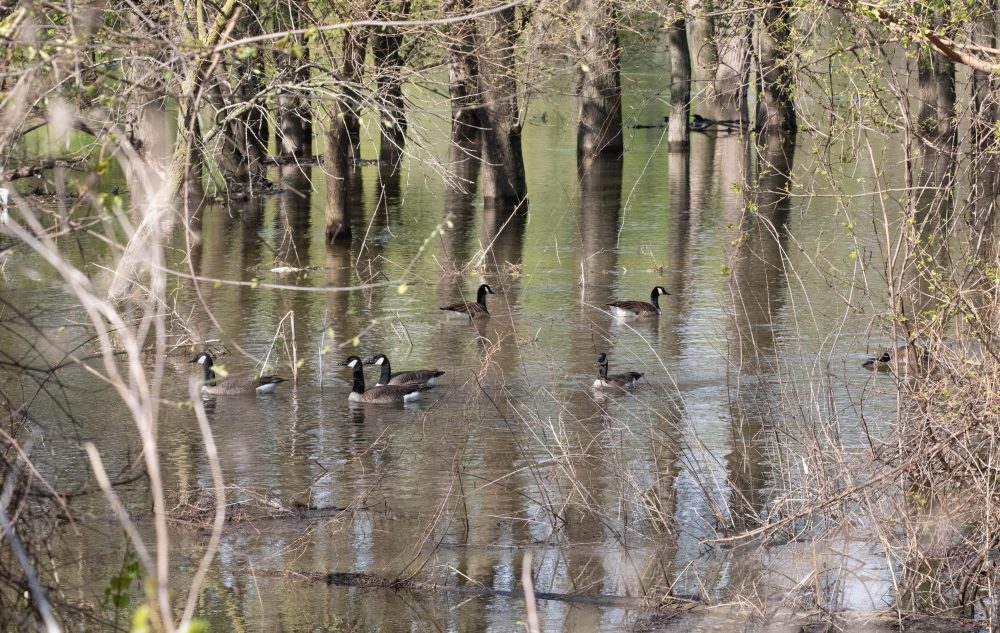
Is it a Slough? Is it a Marsh? It’s McGinnis!

Swamp Rose Mallow, McGinnis Slough

Swamp Rose Mallow, McGinnis Slough

After two weekends of extended field trips, it was good to kick back and save Sunday for a less brutally early rise to visit McGinnis Slough and the Chicago Portage and see how summer is going in my two most frequently visited locations. I originally intended to combine both in one post but it’s more than I can handle, so this is McGinnis and with luck the Portage post will follow tomorrow.

I can always count on seeing Great Egrets at McGinnis this time of year although depending on conditions, I never know quite where. Sometimes several trees are occupied like the one below, but this visit yielded only the one populated tree.

Great Egret Tree, McGinnis Slough

Great Egret Tree, McGinnis Slough

In spite of all the rain we had a couple weeks ago, we have not had enough to keep up with the heat, leaving the water levels nearly nonexistent in both places. The Great Blue Heron below appeared a bit disheveled sitting on a limb that stretched out above an area that nomally has more water than mud.

Great Blue Heron

Great Blue Heron

McGinnis offered more birding by ear than sightings. Particularly frustrating was to hear Marsh Wrens close in the reeds but not see them. One did finally move so I could catch a glimpse but there were no photo opportunities. In spite of this I did record a song and have included a photo that depicts what I did not see.

Marsh Wren in the Reeds

Marsh Wren in the Reeds

House Wren Portage 7-27-14-1678

One House Wren was much easier to see, although I was a bit surprised by its presence.


House Wren Portage 7-27-14-1680


Perhaps the best song of the day was the Song Sparrow I never saw. I did get a picture of a juvenile at McGinnis not far from the House Wren. And a recording of the Song Sparrow, even if it’s not the one in the picture.


Juvenile Song Sparrow

Juvenile Song Sparrow

Green Heron, McGinnis Slough

Green Heron, McGinnis Slough

I have been fortunate to see many Green Herons this summer. I never tire of them.

Cat Tail McGinnis 7-27-14-3533

I’ve concluded that for this summer, McGinnis is a marsh. Cat tails and tall reeds block a view of what must be mud flats, so I have no shorebirds to report. But the dragonflies are having a good time. This looks like a pair of Ruby Meadowhawks to Linda Padera.

Dragonflies McGinnis 7-27-14-3539

Probably Ruby Meadowhawks

There were not many butterflies, but this Eastern Comma caught my eye right out of the parking lot.

Comma Butterfly, McGinnis

Comma Butterfly, McGinnis

I’ll be back with a word or two from the Chicago Portage.

Rollins Savanna Field Trip with Evanston North Shore Bird Club

Female Red-Winged Blackbird

Female Red-Winged Blackbird

It’s been a long day, starting at precisely 3:08 AM, although I was semi-awake at 2:30 in anticipation of the alarm clock. I knew the indoor birds would be a bit confused by my poking around in the dark and I tried to let them sleep as long as possible, but I eventually left a light on a timer to go off after it got lighter. When I left at 5:30 it was just barely starting to get light, for the days are shortening. Following are pictures of a few of the species seen today on the Evanston North Shore Bird Club field trip led by Beau Schaefer.

The long drive north yielded four Red-Tailed Hawks perched on lamp posts by the highway, and a dense foggy dew that just began to lift when I reached my destination around 6:37 AM. I’m a little disappointed that I wasn’t early enough to capture the fog with the camera.

Wood Ducks

Wood Ducks

As it is, I didn’t realize until halfway through the walk that one reason why I was having a hard time capturing photos, other than the birds being pretty far away and often backlit, was that I had attached the wrong lens to the wrong camera (I’ve been getting better luck with the 100-400mm and the 5D, using the 7D for the macro lens – only I had them switched). So I guess the best scenario would have been to assemble the cameras and lenses last night before I went to bed, if I was a little bit more coherent than this morning. Unfortunately one never knows.

Lots of Common Yellowthroats – no surprise there. But the only one that perched in view was in the shadow of the cup plant.

Common Yellowthroat

Common Yellowthroat

One bird I was definitely counting on seeing at Rollins, as I have always seen them there, was a Sedge Wren. I was not disappointed. I had heard them at Goose Lake Prairie but never found one. However, as many Sedge Wrens as we heard this morning at Rollins, they weren’t all that easy to spot, until one finally sat up in a straddled fashion and sang his heart out for us. Below, a couple photographs and recordings.

Sedge Wren

Sedge Wren

SEWR Rollins 7-20-14-3001

Eastern Meadowlark

Eastern Meadowlark

The first Eastern Meadowlark we saw appeared to have taken a bath. There were better views of another individual much later. We also had a few Bobolinks but none close enough for an image.

EAML Rollins 7-20-14-1624 EAML Rollins 7-20-14-1608

Rollins has various small bodies of water and depending on the depth, attracts water birds and shorebirds. I didn’t bother trying to take pictures of the shorebirds although we saw Short-Billed Dowitcher, Pectoral Sandpiper, Solitary Sandpiper, Spotted Sandpiper, Semi-palmated Sandpiper, Least Sandpiper, Lesser Yellowlegs and more Killdeer than we could count. This list is from memory and I may be leaving something out. Toward the end of the walk, the Great Egret below was visible through an opening, and so was a Great Blue Heron earlier, but I think I may have captured them both better in flight.

GREG Rollins 7-20-14-1592

GREG Rollins 7-20-14-1602 GBHE Rollins 7-20-14-1661

I was surprised to find the camera captured a Tree Swallow when I don’t even remember trying for it. I sometimes forget the camera has a mind of its own.

TRSW Rollins 7-20-14-1627

The last picture is perhaps the first bird we saw, an energetic Song Sparrow.

Song Sparrow with his back to us

Song Sparrow with his back to us

In general it was a good day to be out, didn’t get too uncomfortably hot or buggy, and we were a good group of manageable size. Beau Schaefer led us at a fairly rapid pace, thus ensuring we got exercise. And I am grateful to now know where the additional parking lot is on the other side of the preserve, so next time I go, I will not feel overwhelmed about walking the entire trail. There are also a lot of cyclists to watch out for the later it gets, emphasizing the logic of starting out around 6:30 AM.

My car reports it is happy about all the extra driving we did today. I treated it to some cheaper gas and a car wash. Doesn’t get any better.

Lake Katharine

Black-Crowned Night Heron

Black-Crowned Night Heron

Last Sunday morning I managed to get up early and find Lake Katharine, which is directly south from where I live. Dick Riner mentioned it to me when I visited Bartel Grasslands, so I decided to check it out. It’s part of the Cook County Forest Preserve system. Although it’s surrounded by suburban sprawl, it has a variety of well-managed habitats and I will return.

Cabbage White

Cabbage White

I started out walking east from the parking lot to take in the prairie/grassland portion. It was overcast and a bit cool so there wasn’t a lot of activity yet, but I was not planning on staying long anyway since I had a cousins’ lunch to attend in the afternoon.

Is this Purple Loosestrife?

Is this Purple Loosestrife?

Japanese Beetle on Thistle

Japanese Beetle on Thistle.

I didn’t manage to visit the Nature Center this time but I will on my next visit. According to the website, Lake Katharine has many educational and volunteer programs in place to get people involved with nature. I was just enjoying the scenery like this huge sunflower and imagining how many goldfinches would be hanging upside down on it as soon as the seeds ripen.

Sunflower 7-13-14-2732Sunflower Seeds 7-13-14-2735

Out of the wildflowers and heading toward the west end of the lake, I walked a path with a wooded area which is where I encountered the Black-Crowned Night Heron at the beginning of the post. It landed in a tree not too far away, but when it saw me it spent time trying to hide behind whatever branches were between us. I guess when he figured out I wasn’t going to leave until I got a picture with all of his head in it, he gave in.

Dragonflies were one reason why I came, but I was able to barely photograph only this one and I don’t know what it is, fledgling dragonfly observer that I am. I don’t think the picture offers enough detail to be absolutely certain.

Dragonfly - Pond Hawk 7-13-14-1312

Male Blue Dasher – thanks for the ID, Linda!

Grass 7-13-14-2712

Unknown Grass

Froggies 7-13-14-1314

Froggies?

I’m also soliciting identification of the grass – I gave up after clicking on a list with links to pictures and descriptions of maybe 100 different grasses that occur in Illinois.

When I got to the water and stopped to look, the shallows seemed to be bubbling with life. Occasionally I did see bubbles but for the most part I felt as if I was being watched by a couple hundred eyes from submerged frogs. I am not good at identifying frogs so I have no idea if they were really frogs or my overactive imagination.

American Robin

American Robin

Robins are everywhere, busy with their nests and most likely working on a second clutch. I have seen juvenile Robins but this adult felt like posing with a grub. A few robins are still singing a phrase here and there.

Caspian Tern

Caspian Tern

Caspian Tern

Caspian Tern

I saw the Great Egret before the Caspian Tern. I went around the trail to get a closer look at the egret and started talking with another Dick who was also taking pictures. He works at Lake Katherine and maintains the grounds, which is too huge a task for me to imagine. The tern flew over us as we were talking. According to Dick the tern has been making an appearance daily.

GREG 7-13-14-1398When I did finally get close enough for a better picture of the egret, it decided it had had enough of posing and scratched an itch.

GREG 7-13-14-1407I am going to sleep early so I can get up and join the Evanston North Shore Bird Club’s field trip to Rollins Savanna in Grayslake, Illinois. It will take me an hour to get there, even at 5:30 in the morning. Rollins was on my list of places to visit, I haven’t been there in a couple years, and I don’t think I’ve ever seen the entire place, but a four-hour field trip should cover it all and satisfy my curiosity. (Oh, and it’s good for the car to get some exercise beyond running local errands. I need motivation to get up at 3:00 a.m.)

Goose Lake Prairie and Copley Nature Park

Blue Dasher

Blue Dasher

I don’t know what it is about Goose Lake Prairie, but I like going there, so that was my destination on the Fourth of July. I didn’t get out as early as planned but after the hour-plus drive I was walking the gravel trail from the Visitor’s Center around 7:45 AM. The Visitor’s Center is always closed on the Fourth of July. One of these days I’ll have to go when it’s open.

Pollen Orgy: Bee in the Bergamot

Pollen Orgy: Bee in the Bergamot

Not seeing a lot of bees these days so I try to pay attention when I do. This bee appears to be virtually bathed in pollen. I think it’s the little hairs on the flower petals that make it look that way. Click on the picture to see.

The first bird I managed to photograph was a Common Yellowthroat. From the coloring it looks like a juvenile.

Common Yellowthroat

Common Yellowthroat

Female Common Yellowthroat 7-4-14-0520

But there were still plenty of males singing on territory, like the one below. A sample of his song is in the link between the pictures. You might also hear a Song Sparrow and an Eastern Meadowlark singing in the background of the recording: the Common Yellowthroat is the one singing in triplets.

Male Common Yellowthroat

Male Common Yellowthroat

plug
Common Yellowthroat 7-4-14-0569

I also saw a male Northern Harrier soon after I started out, but only because it had been chased into and then out of a tree by a flock of Red-Winged Blackbirds. It was the only raptor I had until I saw a Turkey Vulture from the car as I was driving away.

Northern Harrier

Northern Harrier

Below, some of the many juvenile Red-Winged Blackbirds hanging out in groups.

Juvenile Red-Winged Blackbirds

Juvenile Red-Winged Blackbirds

The Tree Swallows below were probably too far away to photograph, but I like the tandem effect of this picture anyway.

Tree Swallows

Tree Swallows

For the record, here’s a juvenile Song Sparrow. I could not seem to locate the adults that were singing.

Juvenile Song Sparrow

Juvenile Song Sparrow

This is the time of year when anything that flies catches my eye. One thing I’ve noticed is the different dragonflies as they occur in different habitats. Butterflies, anywhere, are entirely another matter; they seem to be scarce and do not like to be photographed except from far away.

Widow Skimmer Male

Widow Skimmer Male

Female Twelve-Spotted Skimmer

Female Twelve-Spotted Skimmer

Viceroy Butterfly

Viceroy Butterfly

The other prominent singer yesterday was a Dickcissel. The bird below eventually tolerated my presence so I could get these pictures. One version of his song is in below his pictures.

Dickcissel

Dickcissel

Dickcissel 7-4-14-0833

Although the weather was relatively cool starting out, the sun was hot and by 10:00 a.m. or so I felt I had probably seen all I was going to see. It’s not the kind of place you want to go off trail.Hunting Sign 7-4-14-2356

Hunting Sign 7-4-14-2367

I decided to stop by Lake Renwick on the way back home, which has a heron rookery. There is a small viewing area at Copley Nature Park, accessible from Route 30 at the edge of Lake Renwick. Lake Renwick rookery itself is closed during the breeding season. This is another place I need to check out when it’s open for business.

A distant family of Great Blue Herons tempted me to shoot a few fuzzy pictures.

Great Blue Heron Nest, Lake Renwick

Great Blue Heron Nest, Lake Renwick

Great Blue Nest Lake Renwick 7-4-14-0895

And birds flying by, like this Double-Crested Cormorant, with its distinctive silhouette.

Double-Crested Cormorant

Double-Crested Cormorant

Perhaps the most numerous species of the day besides Red-Winged Blackbird was Eastern Kingbird. There were many at Goose Lake and several at Copley Nature Park, this one being particularly cooperative.

Eastern Kingbird Lake Renwick 7-4-14-0950

In case I had any doubt about the heron rookery, this Great Egret flew overhead after I had been out of the car only a few minutes.

Great Egret Lake Renwick 7-4-14-0885

Oh well, one more early morning and then it’s back to business as usual. I’m joining Chicago Ornithological Society at Bartel Grassland in Tinley Park tomorrow. It’s an early start and an hour’s drive away, so I should be turning in very soon. After three days off I feel like I’m just beginning to get the hang of it. Being off, that is.

Today also marks my third year blogging with WordPress. I feel like I’m just beginning to get the hang of that too. Thanks to you all for making it fun! 🙂