This is the first of two short posts from recent visits to McGinnis Slough. I visited the slough the past two Sunday mornings. The 29th of August was cloudy as reflected in these photos. Just as I was about to leave, it started to rain, thus the rainbow farther down the page.
There were not many birds to photograph. The Wood Ducks were visible through the vegetation that has taken over much of the slough.
The Common Green Darner below is a marvelous dragonfly. This is the female of the species.
A brief visit from a Red-tailed Hawk…
A few Great Blue Herons remain on site.
These berries caught my eye – but I bet they’re all gone by now.
I don’t know why I try to capture swallows in flight, but sometimes I almost do. Barn Swallow below.
When I sat down on the picnic table at the north end, I inadvertently disturbed an American Toad that was sitting underneath it.
Milkweed beetles, chicory flowers and a Monarch Butterfly.
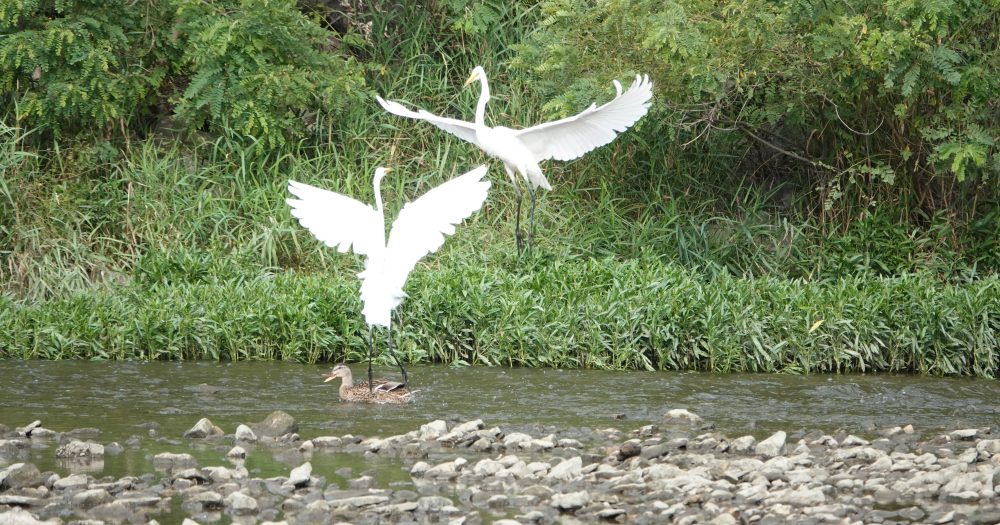
One more of the Great Egret that’s also at the top of this post.
The Rainbow
I came home to a cloudy situation in the yard, not many birds available, but sort of captured this female House Finch leaving.
I’ve been busy birding every morning and now I have to keep up with all the photographs as fall migration kicks off.
I’ll be back with another brief stop at McGinnis from yesterday and some different birds.
After groveling about making the long drive all the way up to McHenry County around Memorial Day, I went back on July 5th to celebrate my birthday and then again on July 25th. Needless to say now I’m getting used to the drive and the trail and I may have a hard time staying away before October which is when I plan to go back for Sandhill Cranes that purportedly congregate in the fallow farm fields.
I feel like I could start giving some of the individual birds names, like the Willow Flycatcher at the top of the post. I even heard a confirming “fitz-bew” on the last Saturday.
Yellow-headed Blackbird (female)
Yellow-headed Blackbird (male)
I expected to see more Yellow-headed Blackbirds. On the fifth, the males were really too far away for decent photographs, but I did get to see a female close to the observation deck. I went back on the 25th because I wanted to see many juveniles like I did years ago, but I couldn’t find one Yellow-headed Blackbird anywhere. I must have just missed them. But that’s okay, because I saw some other interesting birds, and it’s just so peaceful to be there. In fact on the second visit when I got there, I had the whole place to myself. I didn’t stay long though because it was very hot.
Pied-billed Grebe
I found the Gallinule below in my photographs from both visits. This is a great place to go if you carry a spotting scope. But I don’t have the energy to carry a scope and a telephoto lens. Perhaps I should rethink my philosophy of cutting corners. For instance, the combination of two visits in this blog post – it’s becoming evident as I write it that it’s entirely too long.
Common Gallinule
I did see a pair of Sandhill Cranes on each visit. I have not seen any with offspring, which is a bit disappointing.
Sandhill Cranes
Another “only in my photos” discovery – a last Black Tern seen on the 5th. Well, my camera saw it.
Black Tern
Here’s the turtle covered with duck weed that appeared in the background of one of the Yellow-headed Blackbird photos above. If you click on the pictures you can see how the duck weed makes it look like something from another planet.
There are still a lot of Red-winged Blackbirds here and everywhere. They are in no hurry to leave, I suppose, because they won’t have so far to go in the fall.
Red-winged Blackbirds (mostly juveniles)
Not a Red-winged Blackbird but a juvenile Cedar Waxwing
I was hoping I would find a Yellow-headed Blackbird when I blew this up but it turned out to be a Red-winged Blackbird. That’s okay, it’s kind of nice to see the feather pattern, albeit faded. Below the photo, two different Red-winged calls I heard on these visits.
A Killdeer in flight…
The “other” blackbird – Brown-headed Cowbirds.
Dragonflies like this place.
On both occasions there were swallows, but in particular on the 25th there seemed to be a lot of them. It was nice to see the Bank Swallows – I don’t see them very often.
Barn Swallow
Bank Swallow
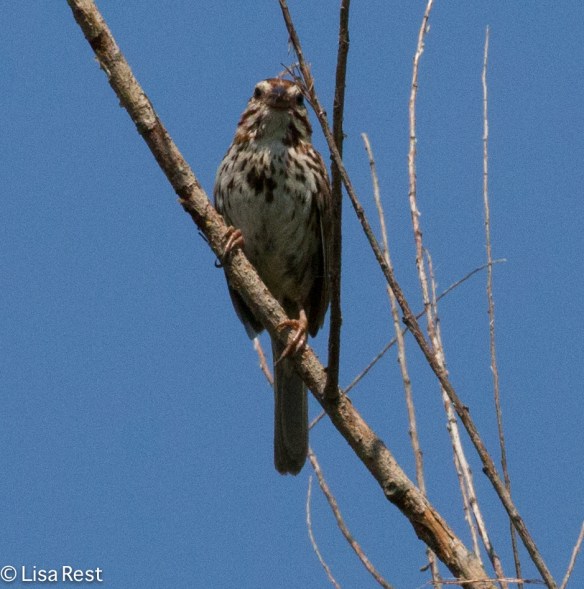
The Song Sparrow below was on the 5th. There are two more individuals further down the post whose songs I recorded and put underneath their photographs.
This Yellow Warbler was the last one I saw, on the 5th.
Yellow Warbler
I am quite sure this is probably the same Great Blue Heron, although the photos are from both occasions.
I always seem to startle this Great Egret, which must have been right by the viewing platform as I approached.
A Green Heron flew by twice on the 25th.
Here’s Song Sparrow No. 1 and Song Sparrow No. 2. Song Sparrows reportedly have thousands of songs so it’s not unusual that they were singing different tunes…
And another singer I was happy to record – and manage to photograph, as they are often elusive in the marsh – a Marsh Wren.
My most cooperative subject at this location has been a Willow Flycatcher.
Willow Flycatcher
There were a couple distant Wild Turkeys hanging out not far from the Sandhills on the 25th.
Always happy to see a Monarch Butterfly… – I stand corrected. The two on the left are Viceroys!
I think it might be a ground squirrel on the left… there are holes on the trail that look perfect for a ground squirrel. But they could both be Chipmunks…
I found this feather interesting on my walk back to the car on the 25th. I thought it might belong to a hawk or a turkey, even, but none of the extensive feather identification webpages have given me the answer. My first thought was a crow, actually. Maybe I should go with that…
My reward for showing up on the later visit was to see these two Black-crowned Night-Herons arrive and perch not far from the viewing platform. One is an adult, and the other a juvenile.
Black-crowned Night-Herons (adult and juvenile)
Many thanks for making it to the end of this long post. As hot as it was a week and a half ago, as I finish writing this, we have dropped down into fall-like temperatures for a couple days. A reminder. I suppose, that nothing stays the same, as if I needed it. No, honestly, it’s absolutely delightful to have the windows open: I feel less confined and it’s delightful. Stay safe and I will see you again soon in another post. 🙂
The 4th of July always reminds me to make my annual visit to Goose Lake National Prairie. I am not exactly sure why I don’t visit at other times of the year, and maybe I will decide to visit more often if I ever retire, but I like to go at this time because it’s not crowded, the prairie is beautiful and in bloom, and I can usually count on seeing Dickcissels and Henslow’s Sparrows.
As it turns out, this year it was particularly “not crowded” – I was the only human the entire length of my visit. I went on July 3rd instead of the 4th. It was already hot and sunny at 7:40 a.m. when I got out of my car and saw Killdeer in the parking lot.
As I started to walk the trail that goes out from the back of the Visitor’s Center, I was welcomed by a few Barn Swallows, one of which was having fun swooping close to my head. Perhaps it was trying to startle me, because it was pretty persistent, but I am quite used to birds flying around my head! My challenge was to try to capture the bird in flight. When I used to go down to the lakefront in the summertime on my lunch hour, there were swallows swooping around constantly close to people, but people were everywhere and pretty unavoidable. On this occasion, the handful of Barn Swallows outnumbered me.
Barn Swallow
As for “target” birds, I saw only one Dickcissel and it was quite far away. I didn’t hear any more of them, either. I neither heard nor saw any Henslow’s Sparrows. I heard a lot of Marsh Wrens but could not see one.
Dickcissel
But you can’t go birding on expectations and then be disappointed when they don’t pan out. There’s always a surprise or something interesting. I was delighted to see an Eastern Meadowlark.
Eastern Meadowlark
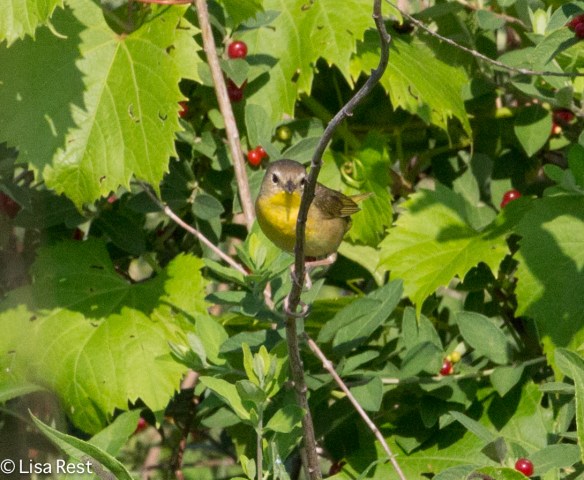
Common Yellowthroats seem particularly abundant this year. I think that is making them less skulky.
Common Yellowthroat
The prairie wasn’t in full bloom, but the Monarda and Prairie Spiderwort were attractive. At least I think it’s Prairie Spiderwort and not Ohio, although the leaves looked thicker than the variety I have in my backyard. Either one is native to Illinois.
Monarda
It is always nice to see Orchard Orioles. I found a female perched and one male in flight.
Song Sparrow
Song Sparrows were abundant.
A distant male Northern Harrier was harassed by a few Red-Winged Blackbirds.
I think this was the same Great Egret I saw perched at the pond by Cragg’s Cabin later.
Great Egret
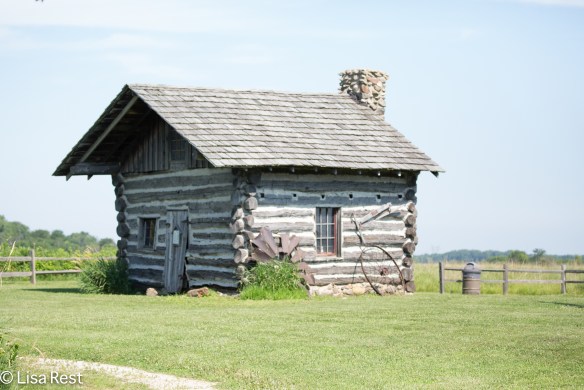
Cragg;s Cabin
One tern flew by. It didn’t stay long enough to fish. There is a big man-made lake nearby, Heidecke Lake, which was formerly a cooling reservoir. That could be where the tern hangs out more often.
A Caspian Tern
Two Great Blue Herons flew by. Likely one of them was the individual below who was fishing from the partially submerged boardwalk that is no longer functional for human use but served this bird’s purpose.
Mallards in flight
Red-winged Blackbirds typically outnumber everything else. But it seems like every place I go, I hear a new vocalization from them. Listen to this little trilly sound below.
Another Song Sparrow…because.
Eastern Kingbirds were the prevalent flycatcher species.
There were a few Field Sparrows, not very close but still delightful to see and hear.
More birds…
American Goldfinch
Common Yellowthroat (female)
Savannah Sparrow
On my way out, a Kildeer flew by.
The last bird I saw was a House Sparrow by the Visitor’s Center.
Another Song SparrowA look across the prairie from the observation deck.
This was only my first outing of last weekend. I came home to do some work later in the afternoon. But I got up and went to the Portage on Saturday morning and back to Goose Lake Natural Area on Sunday. I’ll try to get caught up before summer’s over!
After the Portage weekend it felt like time to revisit the Yellow-Headed Blackbirds and maybe get to see a Black Tern, so I got up early on the 30th — a month ago already! — and went to Goose Lake Natural Area near Hebron. I am beginning to absolutely love this place, except for the hour-and-a-half it takes to get there, but of course that’s why it’s so special. I hope to go back sometime this coming weekend – after I visit the other Goose Lake, which is less of a drive in the opposite direction.
The Yellow-Headed Blackbirds were on their territories and the one closest to the trail was easier to see than last time. I think I caught an obscure photo of a female in the top center of the photos below.
The Yellow Warbler below stayed partially hidden, but I caught up with its cousin later.
Yellow Warbler
There were plenty of Red-Winged Blackbirds, but the males didn’t offer themselves up for photos. They probably know they are not the main attraction at this place. Below are couple females.
On the walk back to the car I spotted the Wild Turkey below. It was flushed by people approaching from the other direction.
I left thinking I had missed the Black Terns but found this photograph of a fleeting glimpse of one leaving the area.
A family of Pied-Billed Grebes below – I think mom was trying to show the kids how to find food.
I managed to capture the female Belted Kingfisher below flying across the water and then the marsh, looking for a place to perch with her catch.
Willow Flycatchers like this place too.
A couple Great Egrets flew over.
A Common Yellowthroat was bold enough to look me in the lens.
I heard the Great-Crested Flycatcher below before I managed to barely see him when I first hit the trail.
An American Crow…
A bit puzzled by the nest in the reeds below until it proved to be an American Robin sitting on it. So they do nest in places other than trees and the fascia of suburban houses.
A male Mallard flew by, reminding me that he’s a beautiful bird too.
A small flock of Double-Crested Cormorants flying over – of all the flock names, I will choose a “swim” of cormorants. You might prefer “flight,” “gulp”, “rookery” or “sunning”.The Hebron Trail…An unusually cooperative Gray CatbirdOne more of the Yellow Warbler
I’ve been busy at work, so goes the bulk of my laptop time. Hoping for a bit of a respite this coming weekend, and not too many deafening firework explosions. Summer is definitely upon us. Take a deep breath.
Here’s the rest of the pictures from the day in my previous post. This was our first of two trips in a panga boat down the Rio San Cristobal near San Blas, Mexico. I was more often than not on the wrong side of the boat this time, but as we were slowly and quietly passed through the water, I managed to get some photos.
Though we saw mostly herons of one sort or another, the likely river raptor is the Snail Kite. This one I caught in flight. Yes, they eat snails.
Snail Kite
We saw lots of White Ibis nearly every day, but for the most part they weren’t very easy to capture. This one stood out against the dark background from a distance.
White Ibis
It was still possible to see some of the usual passerines. Not so usual were the Red-Billed Pigeons. I wish I’d gotten a closer look at them.
Western Flycatcher
Blue-Gray Gnatcatcher
Red-Billed Pigeons
Green Herons are some of the most cooperative subjects. I suspect they are really focused on their quest for food, to not mind me clicking away.
Green Heron
For good measure, more birds I will likely see this spring and summer: Great Egret, Black-Crowned Night-Heron and Great Blue Heron.
Great Egret
Black-crowned Night-Heron
Great Blue Heron
It was a real treat to see this Bare-Throated Tiger Heron out in the open.
Bare-throated Tiger Heron
Little Blue Herons aren’t so blue until they are adults, like the one below.
Little Blue Heron
As dusk curtailed our excursion, we managed to capture good looks at a nocturnal species, the Northern Potoo.
Northern Potoo
A couple more of two foraging herons…
It’s especially nice to look at these photographs today, as a distraction from the accumulating snow that continues into the afternoon, to be followed by drastically dropping temperatures on my way home from work. It’s supposed to be somewhere between 1-2 degrees Fahrenheit tomorrow morning, not counting the windchill, when I walk to the train. But all is not lost. We warm up on Saturday so it can start snowing again. Maybe I can catch a few photographs of the hearty goldfinches at my feeders. The snow was beautiful this morning but it was too early for decent light.
Two weekends ago I went to McGinnis Slough. A bit later than I’d planned… weekends seem to be getting away from me, and I just can’t seem to get up and out very early. I arrived at the slough around 8:30 AM, so it was still cool. The moment I got out of the car everything else became irrelevant when I saw two Sandhill Cranes standing in the overlook area that juts out toward the slough from the parking lot. I didn’t want to disturb them, so as I started to walk toward the south end, I took pictures at a considerable distance. But later after they had left, I found the two feathers in the grass, above. I arranged the feathers a bit to photograph them and left them there. Once upon a time I collected a feather or two, but I have never done anything purposeful with them and it’s frustrating to inadvertently find them later collecting dust or stuck inside a book or…
Below is what the slough looked like. Overgrown and marshy. Very different from the flooded trails of my last visit.
Walking away from the Sandhills, there were some Wood Ducks at the south end.
I’m always happy to see a Monarch Butterfly, but then am saddened by the fact that I hardly ever see more than one anymore, anywhere.
There were plenty of dragonflies. Blue Dashers are still plentiful and posing this summer.
Below is an Eastern Pondhawk. I don’t think I’ve photographed one before.
Red-Winged Blackbirds are still a presence everywhere.
And it was nice to see Baltimore Orioles.
Some more Red-Wingeds. Those red epaulets really stand out in flight.
(Female RWBL)
Red-Tailed Hawks. Flying together…chased by blackbirds…soaring.
And there were a few Blue Jays who were not camera-shy for a change. This one seemed to think the picnic table might have some promise.
American Goldfinches, so plentiful earlier in the year, are a bit scarce, but I attribute that to the fact that they are late breeders and likely consumed by nesting duties.
American Goldfinch (female)
I was unable to capture a dragonfly on these roses but they turned out to be attractive by themselves.
A glimpse of a Green Heron…
and a Great Egret. There were a few Great Blue Herons but they were too far away.
So that’s my little report from McGinnis. I’ll try to go back there before I leave for my trip to New Brunswick and Grand Manan in just a few weeks. But I’m still not done with the Texas trip! And I have to find a new bird care person for the indoor crowd, which is not so easy these days. Sigh.
I think fall must be my favorite season at the Chicago Portage. The birds blend in with the autumn colors, the leaves start to fall from the trees and then every once in a while a bird takes a quick leaf-like descent as well. This past Saturday, after my morning commitment to Thatcher Woods where we had scores of Yellow-Rumped and Palm Warblers, I decided to see what was up at the Portage. Below are two of perhaps 100 Robins…
Directly below, two Common Yellowthroats at Thatcher Woods.
I always take a picture of the water, such as it is, at the Portage to document how it changes from season to season…
There is water enough to bathe in as this female Red-Winged Blackbird was finding out.
Red-Winged Blackbird (male)
The Yellow-Rumped Warbler below was at Thatcher Woods…
And the Palm Warbler below was at the Portage.
Tennessee Warblers and Orange-Crowned Warblers often get confused in the spring but these two made it easier for me.
Tennessee Warbler
Orange-Crowneds always looks to me like they have a slight eye-ring.
Orange-Crowned Warbler
I missed seeing a flashy male Black-Throated Blue Warbler this year but I’m glad to have found a female of the species, wearing her muted fall clothes.
Black-Throated Blue Warbler (female)
Blackpoll Warblers in their fall plumage are stamped permanently on my brain after a few years ago when there were many for several days at my old stomping grounds, Lake Shore East Park, so I was delighted to find this lovely individual.
At one point I encountered some workers who were taking down a tree. I spent some time talking to one while another was driving wedges into what was soon to be the stump. It turns out the trees were not birch but white poplar, which is an invasive species and that is why they were removing it. Come to think of it I don’t recall ever seeing a bird in those trees although they had become a landmark and I thought they were rather attractive. After I was given clearance to go beyond the workers, I grabbed two quick clicks in the distance as the tree fell.
For all the Robin activity there were only a few Cedar Waxwings…
My view from the first bridge at the Portage yielded a Mourning Dove and a House Wren.
I almost thought I had missed all the Indigo Buntings but there were still a few youngsters left.
Indigo Bunting
Northern Cardinal (female)
I was delighted to see a Swainson’s Thrush if only for a moment…
Swainson’s Thrush
Eastern Phoebes…
Just starting to see Dark-Eyed Juncos, the harbinger of colder weather coming, I suppose. But after not seeing them all summer I am glad to have them back.
Dark-Eyed Junco
Yellow-Bellied Sapsuckers are coming through as well.
Yellow-Bellied Sapsucker
The Des Plaines was so low, this Great Egret was wading out into it quite a ways from the shoreline.
We had a lot of Northern Flickers at Thatcher Woods. Here’s one of them checking out a future home, perhaps.
Yes I am a Yellow-Rumped Warbler
And Monarch Butterflies are still migrating. I love the way the Poke Weed looks this time of year. I knew the birds were attracted to it but I guess the Monarchs like it too.
After hearing and rarely seeing Eastern Wood-Pewees all summer, it was nice to get good looks at this one.
Eastern Wood-Pewee
This last photograph is of a Downy Woodpecker who was foraging low and obscured by the vegetation but I like the pastel colors.
More to come, I have three more Saturday bird walks, weather permitting. We seem to be entering a rainy spell but from the looks of the Des Plaines last week we can use it.
This time of year I normally visit Goose Lake Prairie in Grundy County, but I wasn’t going to go that far or walk that much this year, so I followed through with my Fourth-of-July unfulfilled plan and went to Orland Grassland Saturday morning. Orland, which is reclaimed farmland, is surrounded by development, but it’s large enough to afford considerable habitat and much has been restored. Next time I’ll use the ebird app and do a checklist. This time I just wanted to get a feel for the place and see how much walking I could manage before the sun reached an intolerable height in the sky.
Dickcissel
Dickcissels were abundant, but in general I heard more birds than I saw, or the birds I did see were pretty far away like the Eastern Meadowlark below.
There were a lot of Eastern Kingbirds and Tree Swallows hunting insects.
Eastern Kingbird
I caught glimpses of a Great Blue Heron and a Great Egret. Later two Great Blues flew overhead.
An assortment of beautiful dragonflies made themselves available for photographs.
Blue Dasher
Widow Skimmer (Female)
Eastern Pondhawk
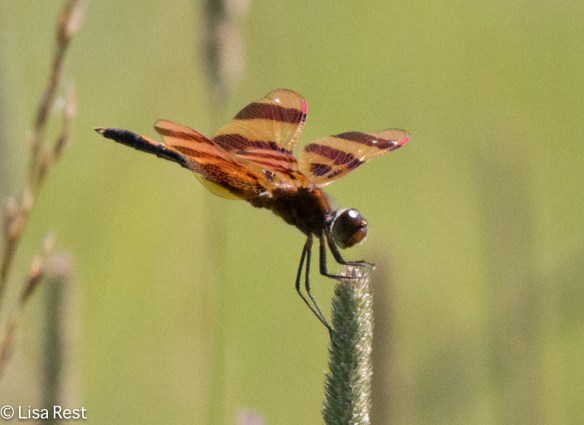
I really couldn’t get enough of the Halloween Pennant. What a dazzling creature.
All I can say is I’ll have to go back to Orland soon. But this weekend I am off to Michigan to meet friends and find more birds and plants and insects… I will be back, I hope, with much to report.
The heat is here and now more than ever the object of the game is to get up and out as early as possible, before it becomes unbearable. Birds are uniquely qualified to hide in the trees and stay cool that way. But it seemed like I was at last seeing numbers of American Robins and Red-Winged Blackbirds the last time I visited the Portage.
I didn’t see any adult Baltimore Orioles but there were a couple youngsters like the one below, who was busy trying to take care of all those feathers.
And in the same color scheme, there were a few Monarch Butterflies making their way through the patches of milkweed.
A young rabbit paused on the trail.
And the Indigo Buntings are quite numerous, even if it’s hard to find them. The hen below is showing off her prize which I’m sure she delivered to hungry nestlings.
I heard more males singing than I saw but I did manage to pluck this image out of the backlighting. The bird on the right looks more like a juvenile than a female.
The Great Egret was more visible this time, if still at quite a distance.
I followed this Green Heron when it landed in the tree, only to realize its partner had been there hiding in plain sight all the time as two herons took off a moment later.
Perhaps my best find was an Orchard Oriole I could photograph. I have been seeing one or two but never long enough to take a picture. This bird was busy preening as well. Sorry to take advantage of the bird’s down-time but it seems like the only way to spend time with the summer residents.
The male and female Brown-Headed Cowbirds below were in the same tree but too far away from each other to catch together. On the way out of the parking lot later I saw four more cowbirds foraging in the grass.
Neither one of the photographs below, of a Great-Crested Flycatcher, are very good since he was partially hidden behind a twig, but I was glad to hear him and see him after I walked over by the railroad tracks to see if there was anything going on at all on the Des Plaines River.
Great-Crested Flycatcher
An inadvertent flying robin.
And the Orchard Oriole taking off.
I have tentative plans to go out early on the 4th if possible, but rain and thunderstorms seem to be in the forecast and that might stop me. It’s awkward to have a day off in the middle of the week, but a day off is a day off. Rain might actually be good enough to quell local firecracker explosions.
I’m not quite up to more adventurous birding spots yet, or so I’ve been telling myself, so I went back to the Portage again last Sunday morning. One of my first most delightful encounters was the Sphinx Moth above. It might also be called a Hummingbird Clearwing Moth. I didn’t see any hummingbirds, although I keep looking for them ever since one zipped by one of my feeders a couple weeks ago.
Great Blue Heron
All the herons that have been hanging out were present, if difficult to get close to. The Great Egret in particular has been trying to stay as far from the trails as possible.
Great Egret, at a distance
One of the Green Herons landed in a nearby tree, and then took off for another location. The other one stayed glued to a small stump in the water and was barely visible.
So much for the one Red-Winged Blackbird that was temporarily available.
Even though I know there are many Indigo Buntings on site, I was only able to see the male below who looks like he had just taken a bath, compromising his ability to reflect very much blue. Below him, a well hidden female, who I found only after hearing her persistent chip note.
Summer sun is just what the painted turtles crave. At least I think they were all painted turtles.
Even the robins were hunkered down somewhat. Below, one serious adult and a couple youngsters.
There are several Song Sparrows, I always hear them singing, but it’s been hard to see one. I did manage to glimpse this one at a distance.
It was a day for bathing and rearranging feathers, I think, such as the Baltimore Oriole below.
The biggest surprise was to see two young Hooded Mergansers. I had to look them up as I’ve never seen juveniles of this species before but I recognized that they had to be mergansers from their bill and head shape. Nice of them to stop by the Portage. I’m sure they were touring several bodies of water. I didn’t expect them to stay very long as the water is hardly deep enough for diving.
Even the one Northern Cardinal I could get to pose was having a bad hair day.
I caught the Great Blue Heron as it left for another one of its haunts.
A couple more pictures of the Sphinx Moth. The Common Milkweed is in full bloom everywhere including my front yard, where it has smelled so strong I could detect its scent halfway down the block.
I can’t believe it’s taken me the whole week to finish this post. I’ve been very busy at work and that takes a lot out of me. I graduated physical therapy Tuesday night so I am looking forward to having that night free again. If nothing else the knee is improving ever so incrementally and I look forward to not having its excuse to curtail any activity.
Beyond that, I just got back this morning from another visit to the Portage. I hope to be back much sooner with that report. The heat has taken hold for a few days, so I should relish sitting here in the air conditioning. I hope you are safe and cool wherever you are!








 There is water enough to bathe in as this female Red-Winged Blackbird was finding out.


 Tennessee Warblers and Orange-Crowned Warblers often get confused in the spring but these two made it easier for me.


 I almost thought I had missed all the Indigo Buntings but there were still a few youngsters left.


 The Des Plaines was so low, this Great Egret was wading out into it quite a ways from the shoreline.


 After hearing and rarely seeing Eastern Wood-Pewees all summer, it was nice to get good looks at this one.


 An assortment of beautiful dragonflies made themselves available for photographs.


 All I can say is I’ll have to go back to Orland soon. But this weekend I am off to Michigan to meet friends and find more birds and plants and insects… I will be back, I hope, with much to report.
 The heat is here and now more than ever the object of the game is to get up and out as early as possible, before it becomes unbearable. Birds are uniquely qualified to hide in the trees and stay cool that way. But it seemed like I was at last seeing numbers of American Robins and Red-Winged Blackbirds the last time I visited the Portage.
 I didn’t see any adult Baltimore Orioles but there were a couple youngsters like the one below, who was busy trying to take care of all those feathers.
 And in the same color scheme, there were a few Monarch Butterflies making their way through the patches of milkweed.
 A young rabbit paused on the trail.
 And the Indigo Buntings are quite numerous, even if it’s hard to find them. The hen below is showing off her prize which I’m sure she delivered to hungry nestlings.


 I followed this Green Heron when it landed in the tree, only to realize its partner had been there hiding in plain sight all the time as two herons took off a moment later.


 And the Orchard Oriole taking off.
 I have tentative plans to go out early on the 4th if possible, but rain and thunderstorms seem to be in the forecast and that might stop me. It’s awkward to have a day off in the middle of the week, but a day off is a day off. Rain might actually be good enough to quell local firecracker explosions.
 I’m not quite up to more adventurous birding spots yet, or so I’ve been telling myself, so I went back to the Portage again last Sunday morning. One of my first most delightful encounters was the Sphinx Moth above. It might also be called a Hummingbird Clearwing Moth. I didn’t see any hummingbirds, although I keep looking for them ever since one zipped by one of my feeders a couple weeks ago.


 So much for the one Red-Winged Blackbird that was temporarily available.


 Summer sun is just what the painted turtles crave. At least I think they were all painted turtles.


 I caught the Great Blue Heron as it left for another one of its haunts.
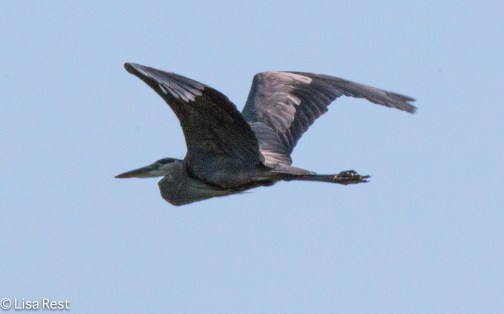 A couple more pictures of the Sphinx Moth. The Common Milkweed is in full bloom everywhere including my front yard, where it has smelled so strong I could detect its scent halfway down the block.
