Something Else from the Chicago Portage

I fully intended to do this post a week and a half ago, while we were still romancing the idea of a warm fall migration season. I’ll still be looking back, but I’ve been busy with the upcoming choir concert and the impending arrival of a house guest – something that doesn’t happen all that often when you live with birds, not that anything in their lives will change – and as life becomes evermore complicated, I find I have an intense determination to simplify things. I’m sorry that doesn’t seem to have made its way into my writing.

So here are some photos from the end of September at the Chicago Portage. The 28th and the 30th, to be exact. I almost wrote the end of December. Our weather has finally and suddenly taken a chilly turn.

There weren’t many birds on the 28th. Perhaps the least common was the Rose-breasted Grosbeak below.

Red-winged Blackbirds started to show up here and there in preparation for joining flocks moving south.

And Common Grackles were amusing themselves with the abundance of huge walnuts.

I caught a glimpse of an American Redstart. Actually, this is the most common view of this species in any season.

And on my way out, a White-tailed Deer crossed the path.

On September 30, I first noticed a Yellow-rumped Warbler on the bridge by Harlem.

Then as I looked out from the bring into the shallow stream covered in duckweed, I saw a Muskrat. I had somehow managed to get out of the house a bit earlier that morning, and I suspect that I might have been keeping Muskrat hours.

Another Yellow-rumped Warbler was in the duckweed.

Then, I caught a new view of a Rose-breasted Grosbeak. I have never seen the red under the wings before!

The camera found an Indigo Bunting or two.

I got lucky with Lincoln Sparrows and took far too many photos of them. This was the first individual I saw.

I saw a Song Sparrow across the water.

Then I found another interesting Song Sparrow that almost looked strongly striped like a Fox Sparrow, while its belly was unstreaked. It’s sometimes amazing to me how varied individuals in this species can be.

Yellow-rumped Warblers can look quite different too.

I found a Downy Woodpecker working hard on a tree limb. The first photo is blurred by how fast she was drumming.

Another Yellow-rumped Warbler was fading into the leaves.

Here’s the second Lincoln’s Sparrow. This might also be the same one at the top of the post. I was sitting on the picnic table close to the water when the sparrow popped up on a nearby log.

I watched a Red-bellied Woodpecker grab something to eat.

And then, when I returned to the bridge near Harlem, I found an Ovenbird foraging in the leaf litter. It was then joined by a Yellow-rumped Warbler.

I caught another view of the Ovenbird after that.

Palm Warblers have been somewhat scarce this fall. I was used to seeing them everywhere in previous years.

Here’s another Palm Warbler, and a Yellow-rumped Warbler below it. The Palm Warbler has yellow underneath its tail, and you can’t always see the yellow on the other’s rump.

Well, that’s about it for the moment. I have lots more to share, I just have to find the time and the mental space to do so. It feels good to be sitting here with some coffee after singing this morning in choir while the temperature fell and it rained steadily. It’s easier to be inside under those circumstances. It looks like we will be much cooler now than we have been, but not freezing yet. I am thankful for the rain on the new plants I put in the ground last week. And I’m looking forward to digging into a challenging week ahead, with rehearsals, arrivals, laughter, tears, more birds, more music, more reasons to keep going.

Back at the Portage

I visited the Chicago Portage a couple times last week. I expected things to be quiet, and they were, but there were still a few interesting things.

I am always excited to see the muskrat. and on July 3rd, it was present. At first it appeared to be eating something. Then I saw it take off, shopping for foliage, and in the photos below you might see where it disappeared behind a log and then emerged swimming off with its bounty.

As I was standing at the bridge near Harlem observing the muskrat, a Brown Thrasher briefly came into view in the distance.

Later, I found a female Orchard Oriole again in the marsh.

American Robins, young and old, are always busy.

I had a chipmunk on the paved trail.

And I saw an Indigo Bunting just barely in the grasses.

An American Goldfinch was enjoying the duckweed.

And a juvenile American Robin was overhead.

July 8 started off as usual, with an American Robin on the paved trail. Robins are getting a lot more notice these days.

An Indigo Bunting was singing.

And then I encountered a family of Orchard Orioles that had gathered in a tree. After seeing the female foraging several times, it was nice to finally see the male and his offspring.

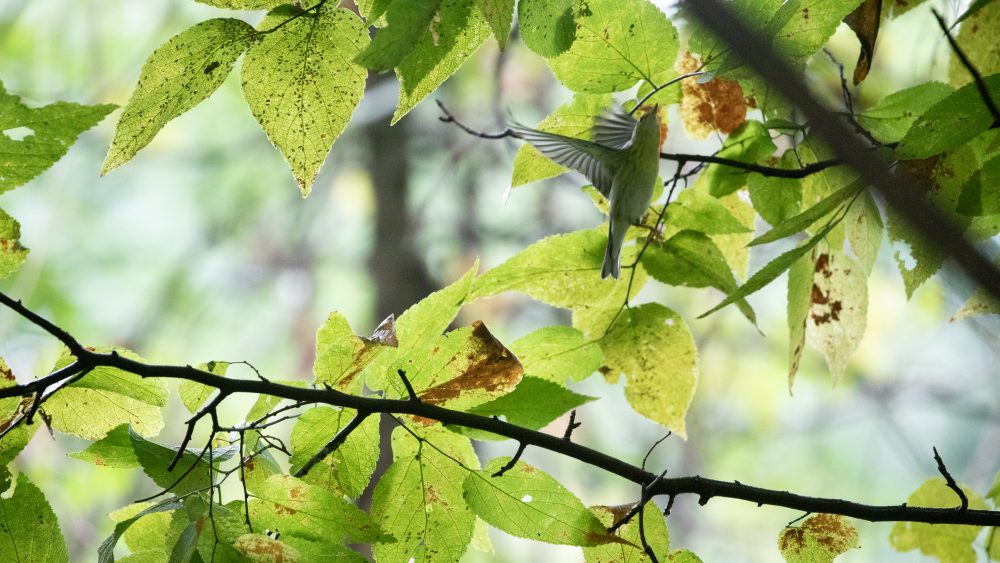
I caught a glimpse of a Warbling Vireo.

Then I was treated to a couple male Indigo Buntings, both of which are in the first photo of the post.

Young Red-winged Blackbirds were at the edge of the water.

As I sat on the picnic table waiting to see if someone else showed up, a Green Heron arrived.

Here’s one more of the male Orchard Oriole.

Early July always feels like an unwanted milestone for me. My reward for surviving the fireworks is to add another year to my existence. It’s a peculiar business, getting older. I planned on finishing this post days ago, but I have been preoccupied with a celebration of life ceremony for my dear friend and sister alto Amanda Thomas, who joined her ancestors on May 21. Those of us in the choir who were able to attend the short rehearsal on Wednesday evening were joined Saturday by additional choir members and people from other choirs in the area who sang with Amanda and under her direction. The service was over two hours long. I finished watching the video recording this morning to better see the speakers and the faces of Amanda’s friends in the sanctuary. It was an amazing tribute to an even more amazing woman. She left a lasting, loving impression on every life she touched.

I went to Goose Lake Prairie in Grundy County on Sunday morning. I will try to be back with a recap of that excursion next. In the meantime, here’s a little long shot from the backyard that I took this morning while working in it. I confess to loving the green, tropical shadiness of it all in the summertime.

Winter Whatever

I have not been to the Chicago Portage regularly lately due to weather or my right knee’s opinion, sometimes both. We had a spell of freezing rain Thursday morning that made it impossible to go down my front steps, so I snuck out the back to go grocery shopping. I would have gone for a walk yesterday, but we were again warned of incipient freezing rain or snow and even though nothing occurred until later in the afternoon, it was cloudy and dreary and I stayed in.

So I really looked forward to going for a walk this morning, just to get out and see what I could. There were some sunny moments and it wasn’t too windy. There were also very few people at the Chicago Portage this morning. That said, I always check back at the bridge near Harlem to look for a muskrat. I have not seen a muskrat in months. And then, this morning, there he or she was, sitting on the ice, chewing on something. That left me no other course of action but to start off with the muskrat in this post. I realize someone else now has been nicknamed “Muskrat”, but I defend real muskrats only.

Going back in chronological order, here are a few photos from January 28.

A European Starling checking out the statue

American Tree Sparrows are probably always on site, but I don’t see them in large flocks or too often.

After seeing a Red-tailed Hawk frequently this year, I mistook a Red-shouldered Hawk for it. The Red-shouldered was back for a couple days.

House Finches have been hanging out in small trees.

I noticed a nice-looking fungus close to the trail.

And briefly, there was a Cooper’s Hawk right off the inside trail as well.

On January 30, a dead deer was lying just off the entrance to the parking lot.

Looking for the muskrat, I saw an American Robin instead on a muskrat pile that did not become a muskrat nest.

I walked over by the train tracks to see if anything was happening in the Des Plaines River besides ice.

It really didn’t look like I would see much that day.

American Tree Sparrow
Two Canada Geese and a Rock Pigeon

Then, quite distant, I saw the Red-shouldered Hawk again.

Then, standing on the bridge near Harlem with Bob, we saw a large number of Canada Geese fly over. What looks like a Frontier Airlines jet appeared to intersect the flock.

On February 1, the ice was starting to melt.

There weren’t many birds to see. There was a deer.

Clouds.

A Downy Woodpecker.

Sunshine on February 4 seemed to help a bit. This American Robin seemed glad to see me.

There were a few Canada Geese in the Des Plaines River.

Northern Cardinal

A Black-capped Chickadee was close by.

I managed to photograph a White-throated Sparrow or two.

And one Dark-eyed Junco posed.

I dd not get back to the Chicago Portage after that until this morning. It was cloudy, cold and quiet, but bearable, and when the sun came out from behind the clouds, it was fine. There were traces of some snow we had late yesterday afternoon.

Canada Geese on the Des Plaines River under the railroad bridge

I dare you to find the House Finches and American Goldfinches in the twiggy mess below,

I revisited the fungus with snow on it.

The clouds were thick.

And then I noticed a raptor. This time it turned out to be a Red-tailed Hawk.

And then, back at the bridge near Harlem, I saw the muskrat.

There are a few signs of spring. Some trees have started to bud. I have heard Northern Cardinals singing. Red-winged Blackbirds were by the feeders in Lyons on Friday morning. All I know is I can hardly wait to be distracted by longer days, more sunshine, more birds, and yes, even more muskrats. A return to the rhythms and songs of renewal seems more important now than ever.

Probing the Portage

I have been hanging out at the Chicago Portage lately and just when it seems like nothing is happening something almost always does. This post covers two visits: November 26 and November 29. And I’ve been trying to write it for several days, so this is It.

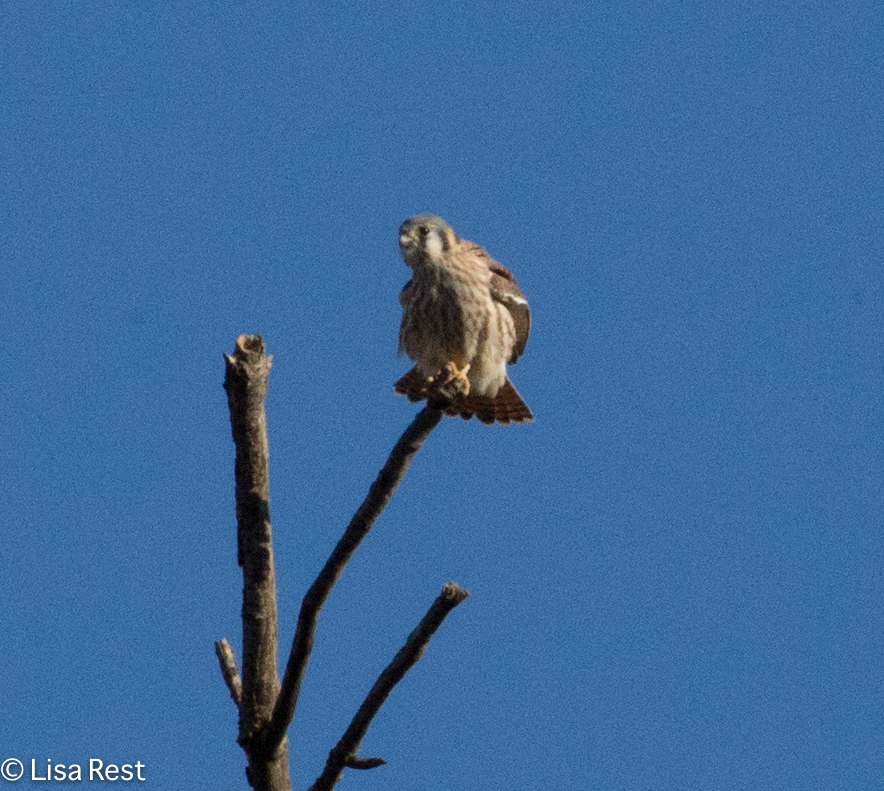
The surprise on the 26th was an American Kestrel sitting way atop a tree overlooking the stream. This is a small falcon, quite a bit smaller than a Peregrine, but because it was so far away I wasn’t sure what it was until it started to fly away and I could see the reddish coloring in its feathers. I was very happy to see all these photos blown up. Kestrels are less common here than they were several years ago.

There was an abundance of sunshine that day.

So sunny, in fact, that shadows were a bit of a problem in the photos below, but this was still a beautiful Fox Sparrow.

The Northern Cardinals were up to their old tricks of hiding in plain sight.

And it proved to be a great day to capture an oriole nest.

Then, three days later, by the bridge closest to Harlem Avenue, I was surprised to see a muskrat. When there was more water years ago, there were beavers too, but I have not seen either rodent for quite some time. This muskrat made up for it.

It was quite cloudy early on.

View from the bridge

Below is what I first saw after crossing the bridge, looking back at the water behind me.

But later that morning the muskrat decided to put on quite a show.

I met Bob at the bridge after going around the trails, and we stood and watched the muskrat herding Mallards away from its territory.

Below is what one Mallard looked like when goosed by the muskrat from below,

There were some peaceful moments before and after all that.

It was cloudy earlier as I approached the second bridge and I was not seeing any birds. It took me quite a while to find the passerine flock.

American Tree Sparrow

I encountered a group of House Finches.

Perhaps my best subject was a White-breasted Nuthatch.

I have been back to the Portage the last two mornings, after taking a break from the weather on November 30. It’s a big decision around here not to go out for a walk in the morning.

I have this thing about extreme wind: I don’t know if I can ever get used to it, but I think it is the most constant reminder of climate change. It seems we have a lot more windy days all year around than we used to. And the winds, depending on what direction they are coming from, bring other weather events with them.

I will try to be back soon. I am singing in the choir Sunday morning so I can’t go out for a walk then, but I will be going to the Portage tomorrow morning for which the forecast is to be cold but sunny, to see if I can manage to capture a clear photograph of a Wilson’s Snipe that Bob found late Thursday morning. (Thanks, Bob! I will elaborate on this event in a future post.) I figured the bird would still be there this morning, which it was, but between cloud cover and missed opportunity I simply could not photograph anything but a blur. I hope to manage something better than this tomorrow.

The snipe is rare for this time of year, and generally rare at this location altogether, I think. They are just difficult birds to see under the best of conditions. So even if I don’t get a good photograph, it’s still exciting to know it’s there. And I give myself permission to “chase” a bird that’s only a few minutes away.

Spring, Summer, Fall – Which is it?

BWTE McGinnis 4-23-2016-7010

Blue-Winged Teal

It seems we have been through all the seasons in the course of one week. But in spite of the weather, the days are getting longer and although my efforts to observe spring migration have been limited, I still have a post within me struggling to get written.

I went to McGinnis Slough on Saturday. It was overcast but warmer than the past couple days, and not yet the predicted 80 degrees for Sunday. Sunday birding was out of the question anyway as I was singing with the Unity Temple Choir. More about that below.

The surprise right off the parking lot was to see several Great Egrets fishing and a couple Great Blue Herons as well. I expect to see these birds this time of year, but to have so many on the viewer’s side of the slough was what surprised me, although I did not get close enough for great shots because I didn’t want to risk disturbing them anymore than I already was…

Passerines were few and far between.

There were distant American White Pelicans although a couple came in for a second or two.

Among American Coots, Ring-Necked Ducks, a couple Buffleheads and a Scaup or two there were several Northern Shovelers.

Above, a surprise visit from a Muskrat, and a Double-Crested Cormorant drying off.

Maybe my best captures were the Caspian Terns.

Caspian Tern McGinnis 4-23-2016-6863

Caspian Tern McGinnis 4-23-2016-6861At opposite ends of the slough, I ran into two other individual birders and we exchanged information. The second one suggested I go to the newest section of Orland Grasslands to look for Lapland and Smith’s Longspurs. I find it a bit funny that I exchanged names with neither of these people, but it’s probably all any of us can do to talk to each other with the distraction of looking for birds first and foremost in our minds.

Orland 4-23-2016-7143

A section of Orland Grasslands

By the time I got to Orland there were no Longspurs that I could see, but I did have a couple Horned Larks. Next time I’ll go there first and maybe get luckier.

A well-camouflaged Killdeer was present also…

Killdeer Orland 4-23-2016-7096And more Caspian Terns.

Caspian Terns Orland 4-23-2016-7108As for Sunday’s choir performance, below is the poster that tells it all.

Beatitude Mass for the HomelessThis beautiful and moving experience will be part of me for a long time to come. And in a moment of reflection later, about the unifying experience while we were singing, I realized maybe I gained an insight into something the birds do all the time…

So I wrote a little poem about it:

 A choir takes flight.
Sopranos, altos, tenors, baritones, basses all come together
As one organism, on the wave of a vibration
One sound with many voices.
Imperceptibly, a slight hesitation explodes rapid-fire through the entirety,
The entrance dangling in the balance,
Just as imperceptibly, swept back into the fold of the music
Like a murmuration of starlings
Carried far above the trappings of gravity
Weightless,
Wait-less,
Into the rafters