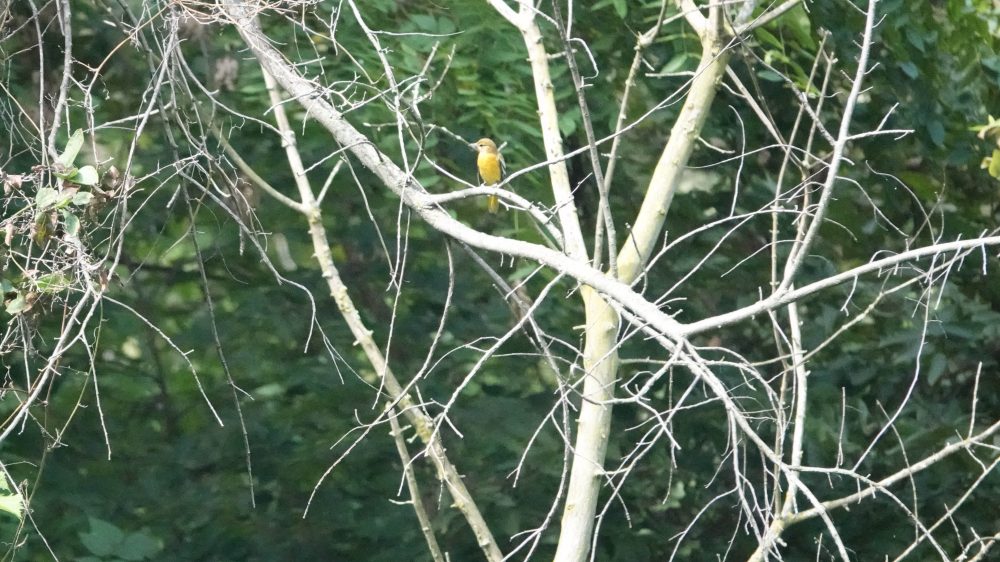

Least Bittern at Big Marsh
Last Sunday I joined Chicago Ornithological Society’s trip led by Walter Marcisz to a couple areas he knows so well, far south in the Cook County limits and to which I had never been. So tempting was this offering, there were an almost unmanageable 40 of us. But all went well, thanks to Walter’s skillful leadership.
The photograph above is of a Least Bittern which was a life bird for me. I wish I’d gotten a sharper image but we were all caught quite unawares standing around looking out when suddenly this bird decided it needed to go somewhere, so I consider myself lucky i got it at all. The rest of my shots of this bird have someone’s head in them so maybe that gives you an idea.
The parking lot where we met before taking off for the marshes not far away afforded these two captures below: a Double-Crested Cormorant on a light fixture and two Barn Swallows hanging out on the barbed wire.


The wildflower investigation continues. The plant below seemed to be everywhere at Big Marsh and I think there was some at Hegewisch too although by that time I was so tired of seeing it I may have been ignoring it. Someone identified it as Spotted Knapweed, so I looked it up on my wildflower app and sure enough, it is an invasive, with somewhat nasty properties. If handled a lot it can cause tumors on the hands. Yuck. Made one bee happy however.
 I grew tired of trying to figure out the one below but it’s pretty in its isolation. I believe it was at Hegewisch. I didn’t take many pictures at Hegewisch – we weren’t there long. We went to see the Common Gallinules – who used to be Common Moorhens – that have been breeding there this year. We caught glimpses but not much else behind the tall grasses.
 I was happy to see Northern Rough-winged Swallows as I have missed seeing them in my usual haunts this year.


More birds in flight. A Killdeer on the left, and a Great Egret on the right.


Always happy to see a Caspian Tern hunting in good view. This was also at Big Marsh where we spent the most time.


And Eastern Kingbirds still seemed to be everywhere.


Female House Finch, Big Marsh
As close in proximity as these areas are to the city, they are big enough to afford an unobstructed view of the sky which was gorgeous that day.
 One more swallow.

Northern Rough-Winged Swallow
Back very soon with a report from my yard as my wishes are slowly being fulfilled!
 This time of year I may not be seeing many birds but everything is in a state of growth and worth attention. I visited the Chicago Portage last Saturday because I wanted to go elsewhere on Sunday and still felt like I needed to keep track of whatever was going on there. I was surprised to see the fruits of some restoration efforts in the vegetation. There is a lot of Tall Bellflower I don’t recall seeing before, mixed in with the Burdock which is about to bloom. Last time the Common Burdock was in bloom, butterflies were everywhere, so I will have to go back soon to see if that happens again.


 There have not been a lot of dragonfly species. It’s a female Common Whitetail Skimmer on the left below. I still don’t understand the attraction to gravel. On the right is a type of Spreadwing damselfly, but I am not able to identify it.

 Some juvenile-appearing Flycatchers below: Eastern Kingbird, Eastern Phoebe and what I’m pretty sure is an Eastern Wood-Pewee.


 Below is a Northern Flicker in the most popular tree bearing fruit. Now I’m realizing I was so busy following the birds in it, I didn’t bother to figure out the tree itself. More challenges ahead.
 I fully intended to do a post encompassing all last weekend’s experiences but there’s too much so I will be back shortly with a couple more installments.


 The little trio below leaves me stumped as to who the sparrow is, again. Since all juvenile sparrows tend to be on the streaky side no matter how they wind up as adults, I think this one has the look of a juvenile Field Sparrow but I’m not going to bet on it.
 Summer simmers on. I’ll be back soon.


 If you’ve made it all the way down to the end of this post, you deserve a reward. I invite you to enjoy the beautiful song of a Wood Thrush recorded at the Little Red Schoolhouse.


 I still have a few photos to share from Sunday’s adventures and that could still happen. The remedy for all this is to just stop taking pictures but there is always more to see.
 If I’d given it much thought I might have gone to the Little Red Schoolhouse yesterday to chase a lifer. There’s a Prairie Warbler there, and to the best of my knowledge I may have heard one but I’ve never gotten a definitive view. But after a too-long-put-off thorough cleanup of the living room (my putting off has consequences – there are a few new residents), I was too tired to think and the best I could muster was a visit to the Portage, and, after all, I haven’t been there for a couple weeks so it’s always good to see what’s happening. American Robins were everywhere, from busy adults feeding their likely second brood to fledged birds figuring things out. I estimated 50 or more.


 On another note, a section of my yard has been plagued by the plant below for two years and I spent an hour yesterday carefully digging out as much as I could, hoping anything I planted around it will take over. I don’t know what it is, so if you are a wizard and can identify it I would be most grateful.


 McGinnis and the Little Red Schoolhouse are on my mental list for next weekend, weather permitting. Even if the Prairie Warbler isn’t available, there are often Red-Headed Woodpeckers, which I don’t get to see too often. Maybe there will be some butterflies too!


![The Kirtland's Warbler: The Story of a Bird's Fight Against Extinction and the People Who Saved It by [Rapai, William]](https://i0.wp.com/images-na.ssl-images-amazon.com/images/I/41A3HC-9nDL.jpg?resize=174%2C269&ssl=1)


