Summertime at Goose Lake Prairie

A week later than my usual annual visit to Goose Lake Prairie, I decided to visit. The forecast was for halfway decent weather, partly cloudy and not too hot. I arrived a little after 8:00 AM. There was another vehicle in the parking lot overtaken by weeds, and no sign of a Killdeer to greet me. Just as I started walking the trail, I encountered two well-established birders – so well-established I decided to keep quiet and confirm their identity later. Suffice it to say that the one without the wheelchair rattled off a list of birds they had encountered. I did not find everything they saw, but I had a good walk.

The first bird I met was an Indigo Bunting.

Common Yellowthroats were predictably everywhere. American Goldfinches as well.

American Goldfinch

The Red-winged Blackbird below looked so excited to be singing, I had to pay attention. Meanwhile, a merciful cloud cover was making the increasing heat more bearable.

I always have to take this picture of Cragg’s Cabin

I saw a Tree Swallow or two.

Northern Cardinals were hanging out.

There were several Barn Swallows.

I was delighted to find a Halloween Pennant Dragonfly, and then another later. In the panel below the Halloween Pennant, a Common Whitetail and a Black Saddlebags.

I was intrigued by a Common Yellowthroat in thorns.

Now, I nearly always expect to see Dickcissels, but I heard only two, and barely managed to capture this one too far away to be barely distinguishable even with my 400mm lens. Logically I am trying to make up an excuse for their absence: their territories are already established, they’re busy raising young and it’s none of my business.

I nearly always expect to see an Eastern Meadowlark or two as well. There were some foraging ahead in the grass on the trail, and this one flew by.

I was a little surprised to see a single Cedar Waxwing.

More Common Yellowthroats. In addition to the male posing very nicely below, I encountered a couple youngsters. It’s been a long time since I’ve seen juvenile Common Yellowthroats. I had to refresh my memory when I processed the photos.

I was hearing Field Sparrows but didn’t think I saw any until I realized later the camera had captured a few. All these birds were so far away and the cloud cover made it difficult to distinguish them. The two in the bottom photo appear to be juveniles.

Here’s another American Goldfinch.

I haven’t been seeing many butterflies, but this is an Orange or Clouded Sulphur.

I walked quite a ways before I encountered some very noisy Bell’s Vireos.

Willow Flycatchers were also on hand.

Noticeable flowering plants were Great Mullein and Silphium (Rosin Weed). I think this is the first time I have seen the Silphium there. It’s not a tall plant, which intrigues me seeing as how I have encountered problems with my natives growing tall this year. Maybe this is something I should consider in my backyard.

When I finally got all the way around the trail to a view of the Goose Lake as such, I did not see anything in the water. Previous years there has been at least a heron or two. I also noticed that the blind structure had been removed.

I heard Yellow-breasted Chats and did finally come across a juvenile that was willing to be photographed. i think the last bird in flight might be a different individual.

Also in flight, a Killdeer and a Red-winged Blackbird.

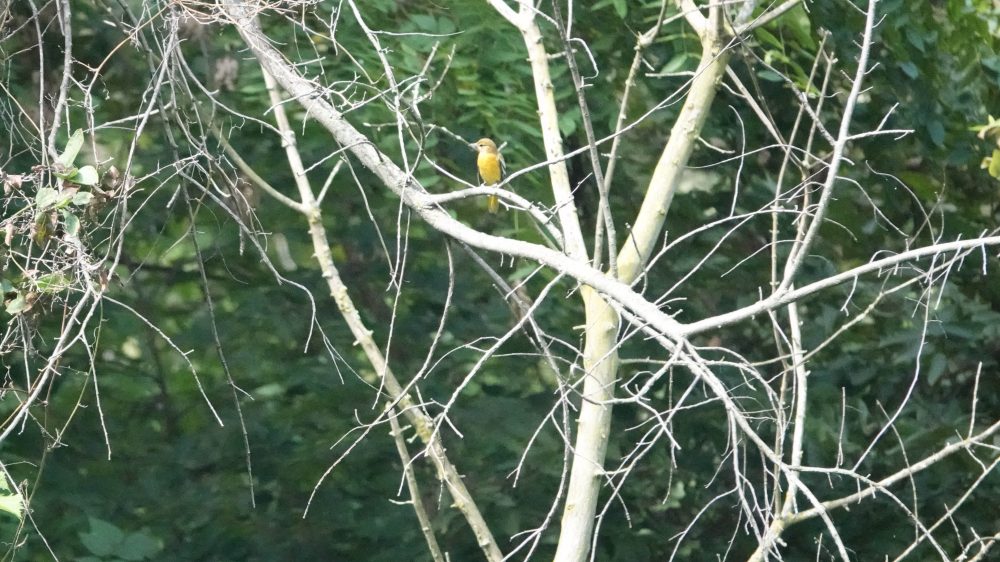
As I was coming to the end of my walk, I noticed an Orchard Oriole on some Great Mullein.

Here’s one more of a Bell’s Vireo. It picked such a beautiful spot to sit in, with the colorful sumac berries.

It shouldn’t have taken me a week to write this post, but I have been busy in the yard, among other things. One thing I have definitely noticed: insects seem to be back. I had been bemoaning the dire lack of insects and consequently swallows, swifts and flycatchers, and I am still sure the number of birds has decreased. But I can attest to the return of insects from one very personal observation. When I got home from Goose Lake Prairie, my legs were covered in bites. I was not aware I was being eaten while I was walking. I had tucked my pants into my socks to oblige the warning sign about ticks at the beginning of the trail, but I did not use any spray as it didn’t seem necessary. Suffice it to say I suffered raging itch for days, more like chigger bites (maybe they were) but the itching has subsided and I will live. Now I am using a little eucalyptus bug spray when I venture out. And I am seeing more birds and dragonflies. Apocalypse Not Quite Yet. To be continued.

Annual Visit to Goose Lake Prairie

Saturday morning was absolutely beautiful. In anticipation of its cooler weather, I got up a bit earlier so I could drive to Goose Lake Prairie State Natural Area for my annual July visit. If I can believe my eBird checklists, I have been visiting every July since 2012. This place has rarely seemed to be anyone else’s destination for the 4th of July weekend, so I was not too surprised when I drove into the empty parking lot. The visitor’s center is not open on holiday weekends. But I go there for the trails, so it doesn’t matter.

I took a photo of the trail map so I would have a better idea what direction I was headed in. Starting out, the “Interpretive Trail” shown with numbers on the map is easy enough to follow, but I wanted to walk back to the water, or the Goose Lake, if you will, without getting lost because even if you can see the Visitor Center in the distance, it can get a little difficult to gauge distance and direction.

A phone photo of the Visitor Center

Right off the bat I saw a rabbit on the trail, and then followed a Barn Swallow to its perch behind the Visitor Center.

I then encountered a pair of Brown Thrashers. I was delighted to see them as I don’t seem to see this species all that often.

There were many more Tree Swallows than I could photograph.

I found a Willow Flycatcher close to the trail.

On the way to Cragg’s Cabin, I saw an Eastern Comma Butterfly.

I did not walk behind the cabin to see the windmill as I have in previous years. I did sit down on the bench that looks over a pond next to the cabin where I have seen birds before, but there was nothing to report. So I continued on the Interpretive Trail and encountered a Song Sparrow.

By this time on previous occasions I would have heard and seen fairly well at least a couple Dickcissels, but this time I was surprised by the lack of them. I did manage to barely capture one far away on his thorny perch.

Two Eastern Meadowlarks appeared briefly. Unfortunately they were distant and backlit.

There seemed to be more Common Yellowthroats everywhere, though not quite as easy to capture as they had been in Hebron. I could let most of them go.

But then, I was quite surprised to see a Bell’s Vireo. This is a bird that’s often very difficult to see. Although this one was at some distance, it did me the favor of staying pretty much in the same place long enough for me to capture its image. It seemed that almost every time I had passed by a bush I heard a Bell’s Vireo’s scratchy-sounding little song, never for the bird to appear, but now I was actually seeing one.

I then reached the water, where I found only Tree Swallows and an Eastern Kingbird flying around after my approach flushed a Great Blue Heron.

I encountered a closer Bell’s Vireo.

Then a Tiger Swallowtail Butterfly caught my attention. Bergamot is very attractive to butterflies.

The vegetation in this location is notable. It is the largest remaining stand of Tall Grass Prairie in Illinois. I made note of some old favorites and others I don’t recall seeing before.

I found an American Goldfinch with nesting material. The bird flying away in the last photo appears to be a different individual, however.

Then I encountered a first-year male Orchard Oriole.

And caught a brief glimpse of a Baltimore Oriole.

Red-winged Blackbirds were everywhere but not posing. I did manage to capture what looks like a female on the left and a juvenile on the right.

A young Gray Catbird popped out to see what was happening.

And I got a closer look at an Eastern Kingbird.

I finally caught a glimpse of some of the Field Sparrows I had been hearing, only these appeared to be juveniles.

And then the most exciting part of the visit occurred when I saw a flash of a goldfinch-sized yellow bird with an insect in its beak. Since goldfinches don’t eat bugs, I wondered … could it possibly be a Yellow-breasted Chat, a Nemesis Bird if there ever was one, the most annoyingly elusive grassland species one hears 99.9% of the time but nearly never sees?

Much to my delight and for whatever reason, the Chat decided to come out from behind its cover and show off its catch.

I can’t help myself. This is the best birthday gift I’ve had in a long time.

Young Field Sparrows flew in and I checked them out while the Yellow-breasted Chat was still there.

After that, I was done for the day. Thanks for making it through this long-on-photos post. Here’s one more of an Orchard Oriole.

All Hail Breaks Loose

I wasn’t too excited about the photographs I found on my laptop for the day after the big hike, but then when I checked my phone I remembered why there were so few. If my memory serves me correctly, we woke up in the middle of the night to the sound of hail hitting the roof and then when we set out for a short local trek before taking vehicles to other trails, finding hail piled up almost a foot high on the gravel road.

So it looks like it was a cloudy, iffy day weather-wise, and eventually we had hail again. Only this time we were safe inside the vehicles.

The video and these images are from the cell phone. A dramatic landscape enhanced by weather.

Two birds willingly posed within range that day: the Audubon’s Yellow-Rumped Warbler at the top of the page and this lovely Say’s Phoebe.

But also ubiquitous on the entire trip were Bell’s Vireos. We didn’t always see them but we definitely heard them every day.

Bell’s Vireo
A distant Yellow-Breasted Chat

Dark, cloudy and distant pictures of two hummingbirds (Lucifer on the upper left and middle and Broad-Tailed below, right) and a Varied Bunting in between them.

We visited this amazing fossil discovery exhibit which is in Big Bend National Park.

Some flora which I might be able to identify if I could just find the laminated checklist of Big Bend wildflowers I purchased at the Visitors Center. Looking through even more pictures on the internet makes it tempting to revisit this area some day. I want to come back as a plant fanatic.

Not sure who this is either…
A distant but very cooperative Loggerhead Shrike.
Black-Chinned Sparrow
This was the vista behind the Bell’s Vireo above.
A Rock Squirrel and his rock.

There are four more days of photographs from the Southwest Texas trip to decipher. Then it’s onward to rejuvenate or replace the travel laptop before I take it on another adventure coming up next month!

Texas Day Two

Yellow-breasted Chat, in a class by itself

It seems a good time to go back to my Texas trip photo memories before I lose track of it entirely. Day Two was a travel day from Del Rio, where we had spent the night, to Big Bend National Park where we stayed three days. Of course we birded along the way.

Black-bellied Whistling Ducks

Yesterday I turned on the reluctant travel laptop to see if it was in any mood to let me look at my Texas pictures. Lo and behold I found more images, and the amazing thing is that I was allowed to process them, so here is everything from that travel day, including the domestic waterfowl below which adorned the first stop.

Northern Shoveler and Blue-winged Teal

Travel notes from my cell phone… I love the rugged terrain of Southwest Texas.

A view of the Rio Grande along the way

It was nice to revisit species I have seen before. Some I saw much better than on previous occasions, while others like the Rufous-Crowned Sparrow below, eluded the camera, even though fairly common. And then there were the life birds.

Rufous-crowned Sparrow
Brown-headed Cowbirds
Olive Sparrow – a lifer which looked much better than the lighting allowed

The Morelet’s Seedeater is not exactly new, if I can believe I have seen a White-Collared Seedeater before. Anyway, it’s been split into its own species, so that makes it a life bird. We searched for this guy for a while and then he practically followed us around for the next quarter hour or more.

Lesser Goldfinch I have seen before, maybe not so well.
Orchard Oriole we get in the Chicago area, though not as common as Baltimore Oriole.
House Finch (of the original population!), not the ones that crowd my backyard.

It would have been nice to see a Western Meadowlark but this Eastern Meadowlark posed nicely for us.

Eastern Meadowlark

I’ve glimpsed Ladder-backed Woodpeckers in New Mexico but have never seen them so well as on this trip.

Ladder-backed Woodpecker

Then to see some old friends really well…

Golden-fronted Woodpecker (female) with White-Winged Dove
Lark Sparrow
Hepatic Tanager
Blue Grosbeak

We arrived at the Chisos Mountain Lodge in Big Bend National Park, checked into our rooms and witnessed this sunset outside the dining hall that evening.

Chisos Mountains sunset

Meanwhile back home, it’s intermittent thunderstorms and cooler weather. I am fond of rain, but not so much.

Goose Lake Prairie

DICK Goose Lake Prairie 07-03-17-5002

Dickcissel

I spent three hours at Goose Lake Prairie State Natural Area this morning. I saw and heard a lot of birds, if not necessarily a lot of species. Most of the birds I photographed were quite far away. Some Northern Rough-Winged Swallows below, then a Field Sparrow.

FISP Goose Lake Prairie 07-03-17-5039

Field Sparrow

Did I see the King Rail? I’m not sure. Maybe I did, so maybe it’s half-a-lifer, but without a scope to clarify anything, my binoculars could not discern any detail on the likely suspect and my camera lens was no better at deciphering a preening bird at the water’s edge.

King Rail Goose Lake Prairie 07-03-17-5157

But rarer birds have a way of showing up when you least expect them. So it is with the Yellow-Breasted Chat. When I think of all the Chats I have heard and never seen on their breeding grounds, seeing and photographing one this morning had all the sweetness of any surprise. I was first drawn to the yellow bird by its behavior kiting after insects. Then when it perched I realized it was a Chat, however far away. This species is still considered a warbler.

I was photographing anything I could focus on before identifying it. So it was with the Grasshopper Sparrow below.

And this elusive Sedge Wren too.

SEWR Goose Lake Prairie 07-03-17-5131

Sedge Wren

This Indigo Bunting was right out in the open. With the abundant sunshine, he picked the right day to do it.

Likewise with this young Baltimore Oriole, but so far away.

Some wildflowers in bloom…the first one is not Blazing Star but similar, and then Bergamot which is now in my yard, and in the lower right hand corner, Wild Parsnip, something I never noticed before but recognized right away this time after all the parsnip growing in my yard.

For all the abundance of Red-Winged Blackbirds I almost tend to ignore them, and in some measure it’s a defensive action because they can get testy this time of year, as you probably noticed in my last post.

RWBL Goose Lake Prairie 07-03-17-5077

Female Red-Winged Blackbird

But sometimes they can be fun to capture anyway.

RWBL Goose Lake Prairie 07-03-17-5224

Male Red-Winged Blackbird

I don’t know if I’ve ever seen a young Eastern Kingbird before, so this was a treat.

EAKI Goose Lake Prairie 07-03-17-5101

Juvenile Eastern Kingbird

And although Common Yellowthroats are constantly announcing themselves, they’re often hard to see, so I was grateful to these two.

COYT Goose Lake Prairie 07-03-17-5026

Common Yellowthroat

COYT Goose Lake Prairie 07-03-17-5078I still have a few photos to share from Sunday’s adventures and that could still happen. The remedy for all this is to just stop taking pictures but there is always more to see.

I’m glad I got to Goose Lake Prairie, I missed it last year. The other Goose Lake Conservation Area awaits exploration.