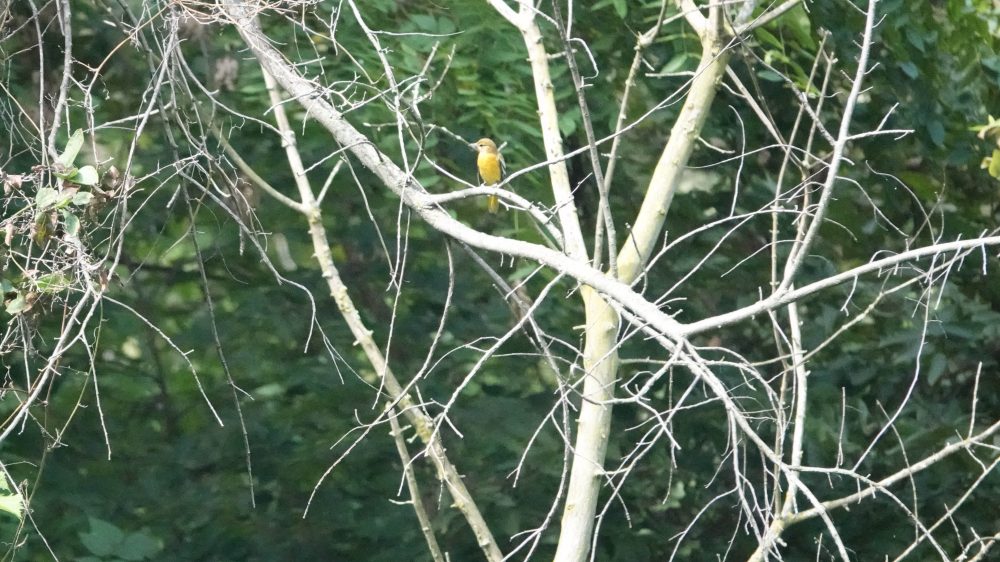

Rose Mallow at McGinnis
As the days get ever-so-slightly shorter, commitments increase. I’m not sure why that is. But suddenly it seems there is less time for more things to do. A visit to McGinnis Slough had been on my mind for weeks ever since the last time I drove by the entrance was closed for paving the driveway, and there was no access. I got up as early as I could Sunday morning to visit the Slough and then the Portage.

A Slough in name only…
I think the last time I posted from the Slough, I was commenting on the low water levels following perhaps a flooding situation. But the summer weather since has not been kind to the Slough. Indeed it is all overgrown and there is barely any water, so all the birds I would normally see have gone somewhere else.


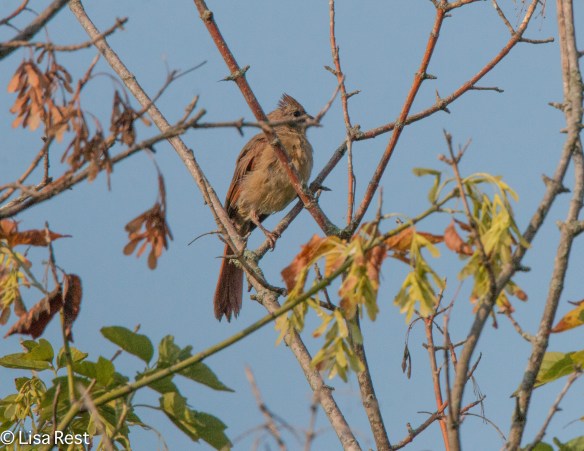
There were Mallards and Wood Ducks. I saw two distant Great Egrets, but no Great Blue Herons. Normally the slough would be hosting scores of these herons. No such luck this year. Perhaps indicative of the situation was the first bird I saw, the bedraggled-looking Northern Cardinal below.
 There were a few blackbirds around too, but the breeders are gone.

Red-Winged Blackbird, hiding the red
When not distracted by birds, the vegetation grabs my attention. Could this be a new grass taking over? I think it is Bristly Sedge.


It was then I went to the Chicago Portage. I got there just in time to encounter all the dog-walkers, runners and cyclists, but it is always worth checking out. I have to remind myself sometimes that seeing fewer birds than I might want is still worthwhile from a reporting standpoint…
 There were more Cedar Waxwings (below) than any other species. I can only assume they were cleaning up whatever mulberries the robins, who were absent, had left behind. That’s right, the robins that virtually take over the landscape have all gone somewhere else. I’m envisioning large fruit-eating flocks already in mini-migrations.


There was one distant but distinct Ruby-Throated Hummingbird. I hope to see more, as there is plenty of Jewelweed in bloom, but the window is narrowing for this species. Maybe I’ll have another week or two…
 The theme for the day, perhaps, was shaping up. These were young birds starting to find their way in the big wide world, like the Eastern Kingbird below.


And the scraggly youngster below appears to be a young Great Crested Flycatcher.
 I expect to see a lot of juvenile Indigo Buntings in the next few weeks, but Sunday just about the only bunting I encountered I could barely see.

Indigo Bunting
I was happy to see a Turkey Vulture (adult) in the neighborhood. I think seeing so many different vulture species in East Africa years ago instilled a love and respect for them. Lately I have seen groups of these hanging out by the highways, where I’m sure they make a decent living off of roadkill.
 The most accommodating bird at the Portage was the cardinal below who was singing with his back toward me but I guess that feeling of somebody looking at you caught his attention and he turned his face toward me.

Northern Cardinal
Starting this Saturday, I will be leading weekly bird walks in two alternating locations. I was recruited for this position by a fellow bird-watching choir member. We’ll see how it goes. I plan on taking the camera with me, but the leading and listing responsibilities will make photography challenging. If nothing else, I will become more familiar with the two destinations which up until now I have rarely visited. The whole purpose of this is to catch the fall migration wave. I promise to report back as often as possible.


I almost forgot my little insect sampler from the Portage. Worth mention, perhaps, is the fact that there were at least 20 Monarch Butterflies. But it’s still hard for me to believe that is a larger number than I have seen all summer.
So as we experience the changes in the weather, the environment, the species we see… the changes are unsettling, but that’s still another glass is half-empty/half-full quandary.
My last thought is a little summertime-feeling music – Trois Gymnopedies by Eric Satie. The recording is from almost 4 years ago when I had fewer birds, it was the start of the second flock, and most of the Zebra Finch solos are the beginnings of my star singer, Arturo Toscanini, whose songs have progressed far beyond this and they continue to grow. One of these days I’ll have to see if I can trace the evolution of his song cycle.

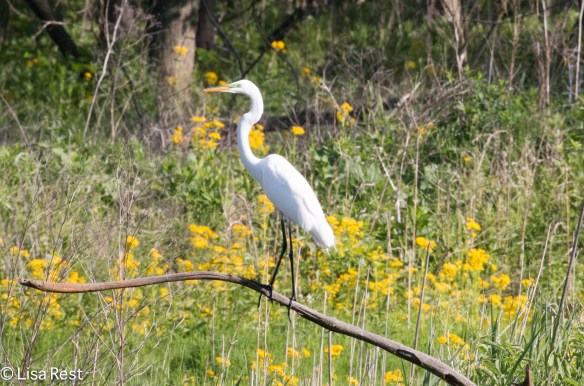 It was nice to get good looks at the Great Egret that seems to be back in the area. The Green Herons were absent this visit but I suspect all the herons go back and forth between the Portage, Ottawa Trail and the Des Plaines River, so I am sure they are still around.


 And the Indigo Buntings did not disappoint.


 Two surprise birds below, neither of which were very visible, but I can now look forward to finding them again. Great Crested Flycatcher on the left, which we saw on our way out, and the camera just barely caught the Yellow-Billed Cuckoo on the right. I had pointed the camera lens at its curious-looking eyes peering out at me from where it was perched, and then it flew. I’ve heard cuckoos before at the Portage but have never seen one there until now.

 There were likely more Common Grackles than we saw, but this one was foraging in the bottomlands by the Des Plaines River.


 Two distinct silhouettes below: Double-Crested Cormorant and Turkey Vulture.


 Waterfowl at McGinnis are usually distant and hard to see. Sometimes I take pictures and blow them up later to see what I was looking at, not that I ever get a very good image. Below the Mallard family are a couple pictures of a Great Blue Heron in flight and more Wood Ducks. I was surprised to not see any Great Egrets yet at McGinnis, as they can be everywhere. Likely they’ve been thrown off by the crazy weather too and I’m more confused than they are. I’m sure I’ll see them as we slide into summer.


 I’ll be staying close to home, there’s much work to do in my yard. Not feeling up to rushing yet. Still savoring life in the slow lane.
 I’ve had hummingbird feeders up since May. Three feeders in the backyard, and a couple weeks ago after a hummingbird hovered in my front yard, I added another feeder for the front porch. The best feeder for me is the one I can see while I’m standing at the kitchen sink looking out the window to the branch of the sumac tree it’s hanging from. And Saturday early evening my eye immediately followed that quick, darting flight of a hummingbird to that exact feeder. I grabbed the camera, went out the back door and waited. The hummingbird, a female Ruby-Throated Hummingbird, to be exact, decided she’d rather be at another feeder that hangs from the redbud tree, so that’s where I got these few pictures. But at last my wish was granted and hanging the feeders was no longer in vain.


 I didn’t get great pictures of any individual American Goldfinches but they stand out against the duckweed palette below.
 Below, one very distant Tiger Swallowtail butterfly and another Indigo Bunting.

 I lost track of the warbler but then found the nuthatch, below.

 There was not a lot of activity. The large numbers of swallows and swifts were gone and nothing else had noticeably replaced their activity. But I did get a couple interesting photographs of three of the same species I had at the Portage.


 If you’ve made it all the way down to the end of this post, you deserve a reward. I invite you to enjoy the beautiful song of a Wood Thrush recorded at the Little Red Schoolhouse.
 I got up early this morning so I could go to the Little Red Schoolhouse Forest Preserve and then stop by McGinnis Slough. I haven’t been to the Schoolhouse in a long time so I made sure I covered every inch of it. I never heard or saw a Prairie Warbler, which would have been a life bird. I was satisfied to see a couple Tufted Titmice and to record a beautiful song of a Wood Thrush. In all, it was a pleasant visit for an hour and a half.


 A few weeks ago I took my car to the dealer for its annual checkup and then went to McGinnis Slough to see how spring was progressing. As I walked through the path next to the marshy area the grass started to move, and I determined there had to be frogs hopping into the water out of sight. After stopping and waiting for a while, I was able to finally see some Bullfrogs and photograph them. They were capable of moving so quickly, I’m glad a few sat still for me.


 One more Bullfrog shot. Who knew they could be so pretty?
 And as promised a few more from the Science March.


 Perhaps the brightest feature at the Schoolhouse was the fungus growing below.
 Here are a few pictures from Thursday, downtown at Millennium Park. There are perhaps 20 or 30 White-Throated Sparrows distributed in several areas. Below are two that came for the birdseed I had brought with me.


 Those tough year-round city natives, Rock Pigeons, are always somewhere in the Loop. Below, two pied pigeons.

 This Robin was interesting too. How much color can I get out of any bird in this light?
 The forecast is for cooler temperatures, rain turning to snow, winter isn’t over yet. But this week I heard some bird song from a Black-Capped Chickadee, an American Robin and a Northern Cardinal. That gives me hope.

 At opposite ends of the slough, I ran into two other individual birders and we exchanged information. The second one suggested I go to the newest section of Orland Grasslands to look for Lapland and Smith’s Longspurs. I find it a bit funny that I exchanged names with neither of these people, but it’s probably all any of us can do to talk to each other with the distraction of looking for birds first and foremost in our minds.
 And more Caspian Terns.
 As for Sunday’s choir performance, below is the poster that tells it all.
 This beautiful and moving experience will be part of me for a long time to come. And in a moment of reflection later, about the unifying experience while we were singing, I realized maybe I gained an insight into something the birds do all the time…


 I
I