A Three-Walk Roundup

I was hoping to make this post manageable and not too long. These are some of the birds from the last three spring migration walks of the Oak Park Migration Bird Walkers, starting with Thatcher Woods on Thursday, May 30. We got a glimpse of the Great Blue Heron by the Trailside Museum.

Last Thursday was yet another challenge in flycatcher identification. If only it were possible that when these guys all show up at once, they at least announce themselves vocally. We got very distant looks at what turned out to be an Alder Flycatcher. Henry actually heard it.

There was also a Willow Flycatcher.

And I am thankful for Eastern Wood-Pewees having long, fluted tails.

For the record, an American Robin and a Northern Cardinal.

A pair of Blue Jays showed up and put on a little show.

It was a cool and cloudy morning but the lack of light did not dim the plumage of an Eastern Bluebird.

The now-Northern House Wren blended into its preferred surroundings.

We had a somewhat obscured view of a Great-crested Flycatcher, matching the colors of the branches and leaves.

The next day we were at Miller Meadow. Ir’s a huge expanse dominated by non-native, extremely invasive teasel. Somehow the birds tolerate it, even if it frustrates us. We saw one or two Willow Flycatchers.

The wide open expanse often makes this location a favorite of raptors. We had a pair of American Kestrels. They appeared to be using a nest box.

An Indigo Bunting provided a brief glimpse in the teasel.

Wide open spaces are good for Eastern Kingbirds as well.

And a Song Sparrow serenaded us as we walked by.

We had an Eastern Bluebird here too. This is the same individual at the top of the post.

I followed a Killdeer as it flew by.

Someone’s excellent spotting led to the discovery of a female Orchard Oriole by a nest, which I did not see, but I did manage a couple photos of the male when we caught up with him.

And a Red-shouldered Hawk made an appearance at the end of the walk.

The last gathering was on May 31 at Columbus Park. I saw a rather conspicuous Great Egret.

There was a Red-shouldered Hawk here too, perched on the fishing line recycling station by the larger body of water.

A Double-crested Cormorant was drying off its feathers.

We had a first-summer Black-crowned Night-heron in addition to a few adults.

The Great Egret started flying and landed in a tree.

We found a Black-crowned Night-heron in a tree as well.

We had a Least Flycatcher, conveniently identified after the Merlin app heard it first.

Here are two more Black-crowned Night-herons.

We will resume the Oak Park Migration Bird Walks at the end of August. Now that Henry is back in town, I will get a break from leading most of the Saturday walks, but I will likely join the group for most of them.

We are experiencing pleasant temperatures, but have also been under an air quality alert due to the Canadian wildfires. I try not to think about the added pressure on the migrants heading in that direction.

In spite of the anticipated quiet during breeding season, there are still a lot of birds we don’t get to see in the colder months, and I will continue to try to keep up with them. To be continued.

Two Walks at Thatcher Woods

Here’s a roundup of the birds I was able to photograph on two visits a month apart. The first was on April 26, and the second just this past Saturday, May 24. There will be one more organized walk at Thatcher this Thursday morning with Henry leading and if I can manage to get up before dawn, I will attend. Here are my photos, starting with last Saturday and a couple high-foraging warblers across the water by the Trailside Museum. A very large number of participants showed up for this walk after we received some publicity in the local Oak Park newspaper, and eventually we broke off into more manageable groups but that meant we didn’t all see the same birds.

I managed to capture the back of a Blue Jay.

A Canada Goose family was on board.

I barely managed to get images to identify this Blackburnian Warbler.

We crossed the street over to the woods and walked along the road, but saw very few birds. By the time we reached the grass where often birds can be seen along the edge of the woods, we started seeing a few species, such as this well-hidden Northern House Wren.

A male Eastern Bluebird was here and there. The female was present for a moment too but I didn’t get a good enough photograph.

Then, much like the edge of the lawn at Columbus Park the week before, we had another flycatcher extravaganza. They were all quite far away, so even with my big lens, some of these photos are unmercifully blown up and cropped.

We saw several Willow Flycatchers. Two had a brief disagreement.

We had a couple Olive-sided Flycatchers. We only see these during migration.

Eastern Kingbirds can be seen all summer, and they are mercifully easy to identify.

Eastern Kingbirds

I captured a Warbling Vireo in the mix.

I eventually added what i think is an Alder Flycatcher to the list.

And I caught a Great-crested Flycatcher in flight. It appears to be a young bird.

We were treated to several views of a young Red-tailed Hawk.

A White-breasted Nuthatch showed up for good measure.

At the end of the walk we were treated to a pair of Hairy Woodpeckers. The male was very vocal.

On April 26, we were treated to good looks of the Great Blue Heron that often hangs out by the Trailside Museum. It had caught a catfish but I was too late to get a good photo of that potential action shot.

We also had wonderful views of a Red-shouldered Hawk.

We also had a Great-crested Flycatcher that morning.

There was a Spotted Sandpiper foraging on the shore.

Back out on the grassy area we found a male Eastern Bluebird.

Ruby-crowned Kinglets are gone now, but we were still seeing them a month ago.

And there was a Red-headed Woodpecker although, between the lack of good light and branches in the way, I could only manage a half-baked photo.

There was also a Red-tailed Hawk present.

One of the last birds we saw well was the Red-bellied Woodpecker below. This photo and the individual in it are noteworthy for the fact that you can actually see the “red” belly.

And Brown Creepers such as the one below were more prevalent a month ago. I haven’t seen one for a couple weeks.

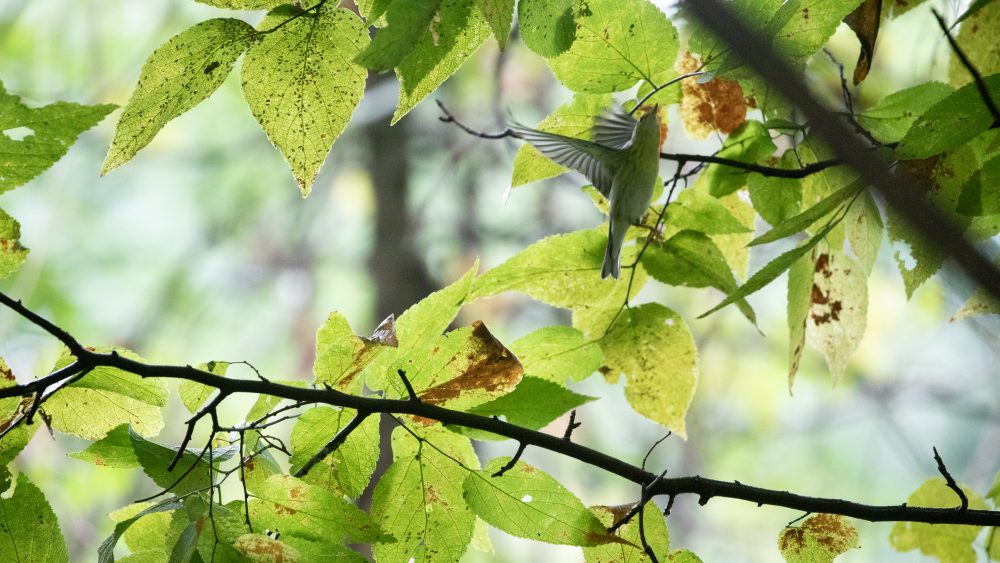
Blue-gray Gnatcatchers like the individual at the top of the post were a lot easier to see without leaves on the trees.

Here’s one more of the Great Blue Heron in flight.

I’m likely to be short on narrative for a few more posts as I don’t want to get in the way of so many photos. I haven’t seen as many birds the last couple days, and we are settling down to breeding season, which means most birds have gone where they intend to stay. I have many more birds to share with you and I’ll try to be back as soon as possible.

III. Thatcher Woods Once More

Here’s a little roundup of Saturday’s return visit to Thatcher Woods. The photo at the top of the post is not from Thatcher Woods but from my front yard as I left the house at 7:30 in the morning. There was an American Goldfinch scavenging the seed heads. It refused to turn around and face me. But it was the closest photo I was to get of any bird for the day.

It was a day filled with Gray-cheeked Thrushes, several flycatchers and more warblers than we had on Monday, although I did not capture them all. So this is a shorter post if not an easier one on the eyes.

I was on time for an 8:00 AM meetup, but I was a bit later than some others who live close by, so I missed seeing a few species. At least I managed to capture the Great Blue Heron that hangs out in the water by the museum parking lot.

We noticed some birds in the wildflowers by the gravel parking lot across the street. I managed to find a Tennessee Warbler when it finally sat out in front of the vegetation.

This might be a different individual – or was it the light?

The first out-of-focus photo below tipped me off to the identity of a Chestnut-sided Warbler.

Then we spotted a very distant Black-throated Green Warbler

It was surprising to see an Eastern Phoebe perched so high.

A Magnolia Warbler appeared.

And we saw what for many of us was our first Ruby-crowned Kinglet of the season.

A Northern Parula was again barely visible.

A Rose-breasted Grosbeak appeared for a refreshing change.

Even a House Wren was a bit challenging.

After some debate we decided this was likely an Olive-sided Flycatcher. Flycatchers are notoriously difficult to distinguish, especially the ones we don’t see except in migration.

Below is a perfect Gray-cheeked Thrush, if I am to rely on Sibley’s note that they have “darker and more extensively olive flanks” than the other thrushes.

More Gray-cheeked Thrush photos. I might note that the bird on the ground in the middle I first called out as a Hermit Thrush as I was hoping to see one, but the camera does not lie. However, I did see two Hermit Thrushes yesterday in Riverside. which made me feel better. It could just be I’ve been seeing so many Gray-cheekeds that I’m trying to turn them into something else.

The bird below looks like a Swainson’s Thrush.

The flycatcher challenge continued. The Merlin app seems to think this is a Least Flycatcher, and after checking with my copy of The Crossley Guide which is extremely helpful, I have to agree.

Palm Warblers are starting to show up in numbers, but I have yet to get a good photo of one.

The last bird I photographed was a fly-by Red-tailed Hawk.

Now that I have bombarded you with three posts on the same day, I promise it will take me a while before I return with yet more migration photos. I had 500 photos to go through from yesterday morning. I’ve narrowed it down to 339 on the first pass, but there’s more work to do. Thanks for your patience and endurance!

A side note: there was a celebration event at The Chicago Portage on Saturday which I intended to check out as well, but by the time I got there it was nearly 90 degrees and since I wasn’t participating, I was asked to park at Ottawa Trail and take a shuttle – it was just too much for me. I settled for buying a 50-lb. sack of black oil sunflower seed at The Feed Store and coming home to the air-conditioning, which already seems like a thing of the past, now that we have cooled off so much.

I. Thatcher Woods Last Monday

The Oak Park Bird Walk group met twice this past week at Thatcher Woods and I took way too many photos on both days. We were there Monday morning and again on Saturday morning. Though fall warblers were our focus, we had some good looks at other birds. The warblers are quite challenging here as they can be too far away even for my long lens, so I often have to piece together some not-quite-in-focus parts of birds for identification.

Below is a case-in-point for a bird barely seen on Monday. It was a Northern Parula. You can click on the photos to get a better idea of where the bird is in the leaves.

I caught a glimpse of a Red-tailed Hawk moving through the woods.

We went out to the field and saw some deer running across it.

There were distant, backlit woodpeckers. Below, a Northern Flicker, a Red-headed Woodpecker and a Northern Flicker flying past a Red-bellied Woodpecker.

And then, capturing our attention for quite a while, a Merlin arrived and perched likely in the same tree, and may even be the same individual we saw last year.

White-breasted Nuthatches are more often heard than seen.

The same could be said for a Red-eyed Vireo except that they’re not singing in fall migration. We managed to see this one briefly.

Eastern Bluebirds were abundant that day.

Below, an Eastern Wood-Pewee, and then the same bird with a White-breasted Nuthatch to its right.

It was delightful to see a couple Chipping Sparrows.

Just when we had about given up on warblers, we started to see some more.

Tennessee Warbler

There was a Bay-breasted Warbler that wouldn’t stop posing.

I was going to attempt to do Saturday’s visit as well in this post, but it’s already long enough, so I’ll be back with Saturday’s photos right away, and then a subsequent visit to Riverside the same day. It’s hard to keep up, all of a sudden!

I will be back with more confusing fall warblers. These two are often mind-boggling to separate.

Bay-breasted Warbler

For comparison purposes, a Blackpoll below.

Blackpoll Warbler