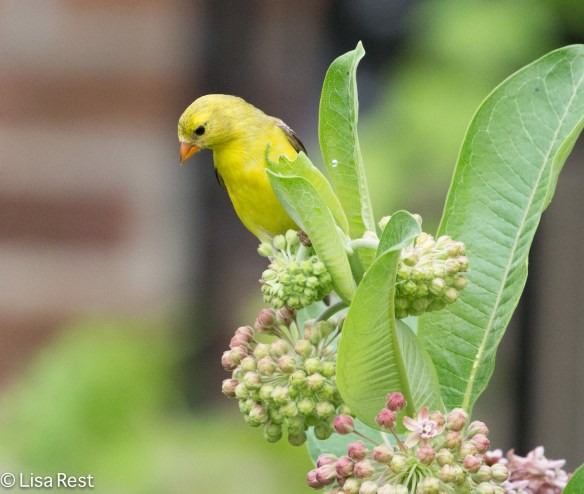
When I came home from the Portage on the 4th, I found the female American Goldfinch above and some butterflies enjoying the front yard. The Common Milkweed was blooming with its heavy perfume. The blossoms are all gone by now and it’s moving on to seed pods.
The little girl below (female Ruby-throated Hummingbird) was visiting the hummingbird feeder hanging on my front porch, where I was sitting with my camera. She took offense to the camera and landed in a nearby tree where I got this shot and the one below.
One morning when I was out walking before work, as I approached my house, I saw her checking out each of my neighbors’ porch fronts to see if they had feeders hanging. Smart little bird. I like her logic. Unfortunately, my neighbors don’t have feeders on their porches.
There have been a few butterflies, individuals of different species.
Spicebush Swallowtail
Monarch Butterfly
These photos are from early July. The yard looks a lot different by now. July has been a busy growing month for everything.
Then there is the backyard. When I try to sneak up on the birds here, I am often unsuccessful, but on the 16th I did manage to capture a few images below.
Not a bird but this tree limb is perfect for a squirrel.
I haven’t seen a lot of House Finches, but that could change as the season progresses.
House Finch (male)
The challenge has been keeping up with four suet feeders this summer. The House Sparrows are very good at clinging (I have seem them climb brick walls), so the feeders designed for Woodpeckers are not challenging to them. They have their own feeder with room for two suet cakes. but it empties out every day. I have come to the conclusion that the reason why suet is so popular in the summer is because it is cheap and easy to feed to offspring. The pictures below were through the back porch windows. I apologize for their softness, but I have a female Hairy Woodpecker who has become a regular, even though I have yet to capture a decent picture of her.
I’ve ventured out every weekend including this one and will have a lot more to post soon, if I can just stay inside and do it. This afternoon is likely a good day to sit inside – it’s very hot now. I am glad I got up early to roam a wild space such as it is still available. It’s reassuring to visit p[aces that in essence remain the same, even as they themselves are changing: my tonic for facing all the rapid and sweeping challenges we do not want or need.
I spent the mornings of July 4th and Sunday, June 28th, at the Chicago Portage, mainly to see how the birds that spend their breeding season there are doing. Fledglings are starting to show themselves. Sometimes they look so different from the adults it takes a moment or two to figure out exactly who they are.
American Goldfinch
A Green Heron occasionally stops by to see what’s happening, perhaps to see if the water it used to fish in has returned. I suspect the herons miss the water even more than I do. A frequent dog-walker I have exchanged conversation with for years told me that he heard the amount of water flowing into the Portage was being controlled to discourage beavers. That’s extremely disappointing to me, if true. I had read somewhere that efforts were being made to restore the habitat to its original state but I really don’t know how that could happen. I will keep trying to find out the true story. In the meantime the habitat change attracts other species that were absent before, but I miss the old “regulars.”
Green Heron
All that vegetation in the middle used to be water…
Something else: just as I was beginning to explore farther afield, the fence gate has been closed and locked. I am not surprised, with all the extra foot and bicycle traffic – I am sure it is a matter of liability between the water reclamation district and the railroad. Of course I would be able to crawl through the opening on the righthand side of the gate but I don’t think it’s worth doing now. It might be hard to resist during fall migration though. I guess it will depend on how many people are still using the trails.
So the stars of both visits were the male Indigo Buntings. There were plenty of them everywhere and quite a few volunteered for photographs. Since I always take too many pictures and have a hard time deciding which ones to use I have just piled them up here.
There seems to be a good number of Northern Flickers this year.
I am always happy to see a Monarch Butterfly. But sadly I haven’t seen more than two at a time.
Starting to see more dragonflies too.
Blue Dasher
Common Whitetail (female)
European Starlings always look more interesting to me in their juvenile plumage.
I never know when I’m going to run into a deer.
Red-winged Blackbirds are less visible now that they’ve accomplished their mission of setting up territories and making babies. This may be the last time I will have seen a male singing.
I found the photos below confusing until I realized, upon closer inspection, that the breast is yellow and the tail has rufous coloration to it. Voila, this is a juvenile Great-crested Flycatcher. I don’t believe I’ve ever seen a juvenile before, so I am really happy I managed to capture it.
Great-crested Flycatcher (juvenile)
Another Indigo Bunting…
Here’s a Baltimore Oriole feeding his fledgling.
These are juvenile Red-winged Blackbirds checking out their surroundings.
This is the time of year when robins take on all kinds of plumage variations, particularly among the juveniles.
Downy Woodpecker (juvenile)
Below are photos of an adult Red-bellied Woodpecker and a juvenile, for comparison.
Juvenile Red-bellied Woodpecker
Red-bellied Woodpecker (adult)
I was intrigued by the House Wren below who disappeared into the cavity in the tree…
The Blue-gray Gnatcatcher below seems to have a strange sort of tumorous growth on its back.
My lucky one-shot of a juvenile Rose-breasted Grosbeak. I haven’t seen any of this species otherwise for quite a while so it’s nice to know they are here.
Well it’s taken me almost two weeks to write this post… I will try to keep up with posting. Today was a gift in that there were clouds and thunderstorms to keep me inside and less tempted to go out. If it were up to me, I would have as many mornings as I wanted each week to do everything I like to do.
The 4th of July always reminds me to make my annual visit to Goose Lake National Prairie. I am not exactly sure why I don’t visit at other times of the year, and maybe I will decide to visit more often if I ever retire, but I like to go at this time because it’s not crowded, the prairie is beautiful and in bloom, and I can usually count on seeing Dickcissels and Henslow’s Sparrows.
As it turns out, this year it was particularly “not crowded” – I was the only human the entire length of my visit. I went on July 3rd instead of the 4th. It was already hot and sunny at 7:40 a.m. when I got out of my car and saw Killdeer in the parking lot.
As I started to walk the trail that goes out from the back of the Visitor’s Center, I was welcomed by a few Barn Swallows, one of which was having fun swooping close to my head. Perhaps it was trying to startle me, because it was pretty persistent, but I am quite used to birds flying around my head! My challenge was to try to capture the bird in flight. When I used to go down to the lakefront in the summertime on my lunch hour, there were swallows swooping around constantly close to people, but people were everywhere and pretty unavoidable. On this occasion, the handful of Barn Swallows outnumbered me.
Barn Swallow
As for “target” birds, I saw only one Dickcissel and it was quite far away. I didn’t hear any more of them, either. I neither heard nor saw any Henslow’s Sparrows. I heard a lot of Marsh Wrens but could not see one.
Dickcissel
But you can’t go birding on expectations and then be disappointed when they don’t pan out. There’s always a surprise or something interesting. I was delighted to see an Eastern Meadowlark.
Eastern Meadowlark
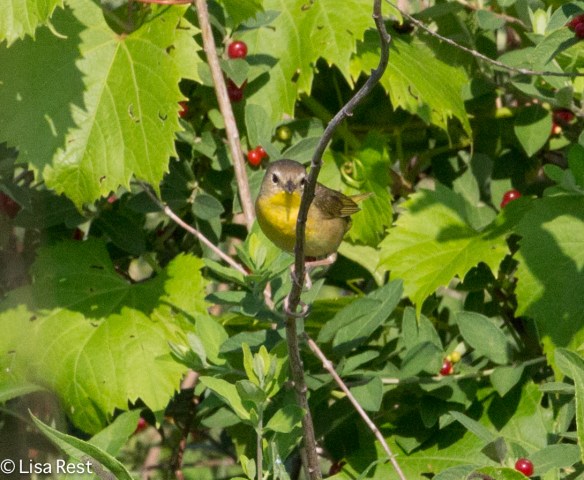
Common Yellowthroats seem particularly abundant this year. I think that is making them less skulky.
Common Yellowthroat
The prairie wasn’t in full bloom, but the Monarda and Prairie Spiderwort were attractive. At least I think it’s Prairie Spiderwort and not Ohio, although the leaves looked thicker than the variety I have in my backyard. Either one is native to Illinois.
Monarda
It is always nice to see Orchard Orioles. I found a female perched and one male in flight.
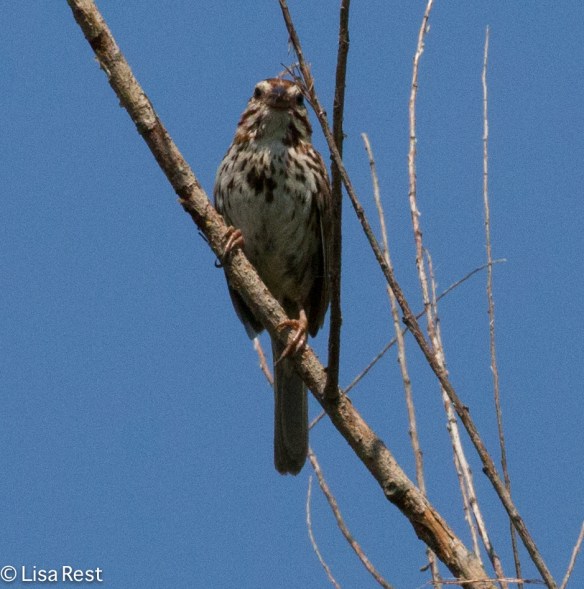
Song Sparrow
Song Sparrows were abundant.
A distant male Northern Harrier was harassed by a few Red-Winged Blackbirds.
I think this was the same Great Egret I saw perched at the pond by Cragg’s Cabin later.
Great Egret
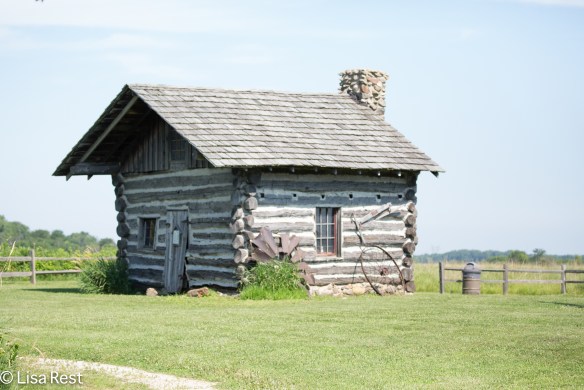
Cragg;s Cabin
One tern flew by. It didn’t stay long enough to fish. There is a big man-made lake nearby, Heidecke Lake, which was formerly a cooling reservoir. That could be where the tern hangs out more often.
A Caspian Tern
Two Great Blue Herons flew by. Likely one of them was the individual below who was fishing from the partially submerged boardwalk that is no longer functional for human use but served this bird’s purpose.
Mallards in flight
Red-winged Blackbirds typically outnumber everything else. But it seems like every place I go, I hear a new vocalization from them. Listen to this little trilly sound below.
Another Song Sparrow…because.
Eastern Kingbirds were the prevalent flycatcher species.
There were a few Field Sparrows, not very close but still delightful to see and hear.
More birds…
American Goldfinch
Common Yellowthroat (female)
Savannah Sparrow
On my way out, a Kildeer flew by.
The last bird I saw was a House Sparrow by the Visitor’s Center.
Another Song SparrowA look across the prairie from the observation deck.
This was only my first outing of last weekend. I came home to do some work later in the afternoon. But I got up and went to the Portage on Saturday morning and back to Goose Lake Natural Area on Sunday. I’ll try to get caught up before summer’s over!
Even though I never go to McGinnis Slough these days prepared to see a lot of birds – which would require bringing my scope – I invariably see something interesting. It used to be a great place for hundreds of Great Egrets and multiple Great Blue Herons, but for the past several years the numbers have dwindled to a few individuals. During waterfowl migration it’s still a place to see good numbers of several species. My last two visits were sort of before and after spring migration. But I like the fact that it’s not crowded. You can’t your bike through it, so that likely keeps people away. And you could miss it driving by at 50 mph on LaGrange Road, even though the entrance is newly paved and there’s a lovely wrought-iron fence, maybe to keep the deer from crossing the highway.
So these photographs are from April 4 and June 7 of this year. From grays and browns in early April to greens and blues in June. April 4 was a good day for Tree Swallows, even if they look washed-out on a cloudy day.
Tree Swallow
Tree Swallow and a Northern Shoveler
Mallard
Blue-winged Teal
Green-winged Teal
The gray and brown was enhanced by a little low-lying fog on the April visit.
I haven’t seen an awful lot of Eastern Phoebes this year. I think flycatchers in general have been scarcer, which I can only assume speaks to the lack of insects. I hope they can recover somehow.
Eastern Phoebe
Eastern Kingbird, another flycatcher
In the tail end of waterfowl migration, some Lesser Scaup were close enough to photograph.
Lesser Scaup
Female Red-winged Blackbird
Song Sparrow
Those white blobs are actually American White Pelicans on the far shore.
The slough was quite marshy in June.
The June visit featured Warbling Vireos chasing around at eye-level, and then one sang for me. I managed to record a bit of his song below after having him pose for all these pictures.These guys are hard to spot normally so I indulged.
I often see Wood Ducks lined up on this fallen log. The June visit was no exception.
Wood Ducks
Baltimore Orioles aren’t advertising for mates anymore so they’re a little harder to spot.
Eastern Kingbird
Going down the path to the north, I encountered a couple does.
There were a few Cedar Waxwings in the same general area as the Warbling Vireos.
Cedar Waxwing
This White-breasted Nuthatch would have been even better if he had turned around.
Red-winged Blackbirds abound.
And in the flying-by department…
Herring Gull
Northern Rough-winged Swallow
Double-crested Cormorants
I’m used to seeing rose mallow, and maybe it will appear later in the summer, but I think this wild iris is new.
Thanks for making it to the end of this long post! We are in for a long, hot, sunny weekend around here. With luck, I will find more birds to share with you.
After the Portage weekend it felt like time to revisit the Yellow-Headed Blackbirds and maybe get to see a Black Tern, so I got up early on the 30th — a month ago already! — and went to Goose Lake Natural Area near Hebron. I am beginning to absolutely love this place, except for the hour-and-a-half it takes to get there, but of course that’s why it’s so special. I hope to go back sometime this coming weekend – after I visit the other Goose Lake, which is less of a drive in the opposite direction.
The Yellow-Headed Blackbirds were on their territories and the one closest to the trail was easier to see than last time. I think I caught an obscure photo of a female in the top center of the photos below.
The Yellow Warbler below stayed partially hidden, but I caught up with its cousin later.
Yellow Warbler
There were plenty of Red-Winged Blackbirds, but the males didn’t offer themselves up for photos. They probably know they are not the main attraction at this place. Below are couple females.
On the walk back to the car I spotted the Wild Turkey below. It was flushed by people approaching from the other direction.
I left thinking I had missed the Black Terns but found this photograph of a fleeting glimpse of one leaving the area.
A family of Pied-Billed Grebes below – I think mom was trying to show the kids how to find food.
I managed to capture the female Belted Kingfisher below flying across the water and then the marsh, looking for a place to perch with her catch.
Willow Flycatchers like this place too.
A couple Great Egrets flew over.
A Common Yellowthroat was bold enough to look me in the lens.
I heard the Great-Crested Flycatcher below before I managed to barely see him when I first hit the trail.
An American Crow…
A bit puzzled by the nest in the reeds below until it proved to be an American Robin sitting on it. So they do nest in places other than trees and the fascia of suburban houses.
A male Mallard flew by, reminding me that he’s a beautiful bird too.
A small flock of Double-Crested Cormorants flying over – of all the flock names, I will choose a “swim” of cormorants. You might prefer “flight,” “gulp”, “rookery” or “sunning”.The Hebron Trail…An unusually cooperative Gray CatbirdOne more of the Yellow Warbler
I’ve been busy at work, so goes the bulk of my laptop time. Hoping for a bit of a respite this coming weekend, and not too many deafening firework explosions. Summer is definitely upon us. Take a deep breath.
Well here it is, the long-anticipated last act to the Memorial Day weekend of birding at the Chicago Portage. Compared to the previous two days, I didn’t have a lot of photographs. I reported as many species as the previous day (41), but between extremely bright light conditions and my inability to focus, perhaps in part due to the light shining in my eyes, the day had a different feel to it.
But it was a great day for discovery and observation. The bird of the day was a Prothonotary Warbler. I have been looking for this species to appear at the Portage for years every spring or fall when the Des Plaines River floods the lowlands because then the habitat reminds me of the Cache River Basin in southern Illinois where I saw my first of many Prothonotary Warblers.
Flooding on the Des Plaines River
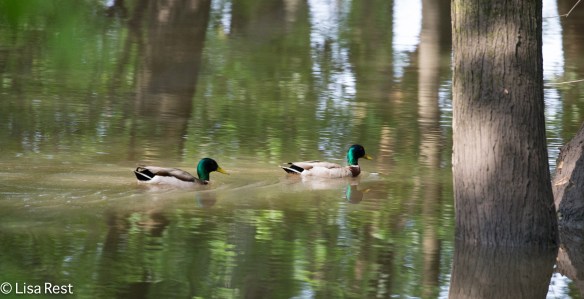
Mallards in the flooded Des Plaines River basin
Prothonotary Warbler
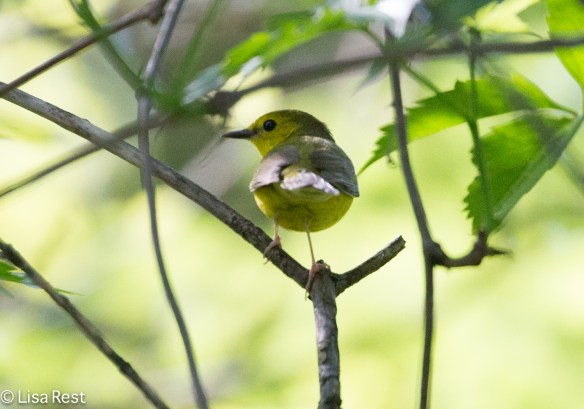
As it turns out, I didn’t see it in the flooded area but directly across the trail from it. Although I got great views with the naked eye, I was not able to capture the bird well with the camera, so going back through these photographs I had my doubts. But the photograph above with the head cut off confirms the ID for me because of the white undertail coverts showing. I confess I still have my doubts about the other photos, but I know I saw the bird, so maybe there will be a next time.
Just so you can appreciate how frustrating this can be and why I sometimes spend entire days thinking about identification challenges, below is a Wilson’s Warbler I photographed on the same day, if not in the exact same spot. I do know the gizz of a Wilson’s since I have seen them frequently enough for years. When I saw the Prothonotary, it appeared larger and moved more slowly and deliberately than the Wilson’s.
And now for another sort-of warbler challenge, the American Redstart below. I have seen this coloration a few times before so I was not confused, only fascinated. The tail immediately gives this bird away as an American Redstart, but it is showing yellow and white with black coming in on the body. What you are seeing is a soon-to-be second-year male American Redstart. When the summer is over he may be entirely black and orange in place of the gray and yellow, and will be considered an adult.
And below is a female American Redstart. She will always be gray, yellow and white. Not the best photograph but you might be able to see just a little of the yellow peeking out on her breast.
That was about it for the warblers that day. I just took a tally for the season and I have seen 24 warbler species this spring. That’s 2/3 of the possible number I might have seen. But given the fact that I was basically birding in only one area I feel pretty fortunate to have seen all these warblers, sometimes even seeing them very well.
On to the rest of the birds I managed to photograph on Memorial Day. Below are some male Brown-headed Cowbirds who don’t seem to have much to do except hang out on bare branches.
I don’t remember how I managed to get the photos below of a flying Red-Bellied Woodpecker but I don’t get this lucky very often! I was probably trying to focus on it perched somewhere and it took off.
Red-winged Blackbirds…are a given. The bird in the second photograph knocked the Northern Flicker in the photos below off its perch, which enabled me to get pictures of some of those elusive but brilliant golden shafts underwing.
There were a couple Eastern Kingbirds for a day or two, and I haven’t seen them since. Maybe they were shopping for nesting spots and decided to go elsewhere.
Below is a trail at the Portage I have only walked recently. For years I stayed away from the gravel road that ran between the official forest preserve and the Metropolitan Water Reclamation District property because it used to be patrolled by police and photographers were not welcome. The past couple years now, I think, restrictions to access have been lifted, but it took this year along with the impression of having extra time to decide to walk the extra mile as it were. The road itself runs along some woods that border the Des Plaines River, and then splits in two, with the one fork below wooded on both sides. This might have been a very good place to look for the earlier warblers back in April. I will definitely keep it on my agenda of places to visit in the fall. Recently, although it’s getting very buggy there were not very many birds available.
Birds that fly over on occasion and if I’m lucky, I can capture them. This time it was more as a record of their presence than anything else.
Great Blue HeronNorthern Harrier – considered rare at this location but I don’t know why, as I have seen them every so often
Indigo Buntings and House Wrens will be available all summer.
The Downy Woodpecker below was challenging to capture.
If you click on the photos below, you will be able to see a Blue-Gray Gnatcatcher that looks more like a Blue-Green Gnatcatcher. This was another ID I struggled with a bit when going through the pictures, but the eye ring in the first photo and the cocked tail in the next give the bird away. It’s a testament to how lighting can change everything. I have never seen this bird look green before.
American Goldfinches foraging in the duckweedAmerican Robin of the Day (there are always at least 20-30 of them about)Baltimore Oriole – too busy now to pose for pictures
I’ve been to the Portage a few times since the big weekend and I will likely be visiting regularly to check up on summertime birds, and I anticipate a return of dragonflies and butterflies. I have been a couple other places too and plan to publish those posts when possible. Lately it’s easier to sit inside on a hot day, slaving over a laptop in air conditioning. Thanks again for stopping by, and congratulations making it to the end of another long post!
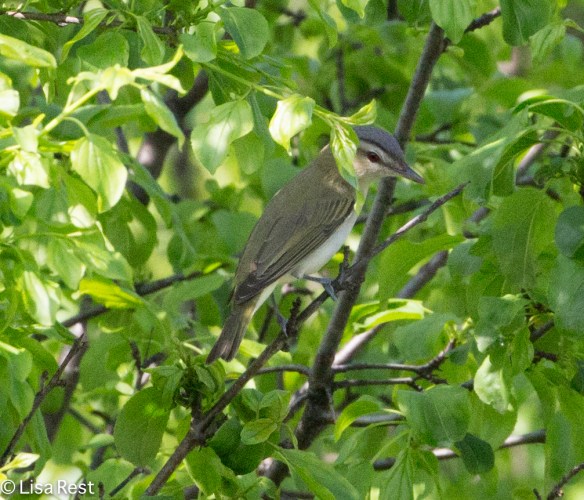
There were still some warblers on May 24, but the Bird of the Day for me was Red-Eyed Vireo. I had been wondering where these birds were, and then they all seemed to show up at once. Usually you hear them singing and don’t see them very well as they move through the trees chasing insects. But this time they were more often seen than heard. In some of these photographs you might actually be able to see the red eye for which they are named.
Red-eyed Vireo
Many of the warblers I saw that day were females. The females tend to migrate later than the males who are in a hurry to set up their territories. Spring migration this year seemed strange for many reasons – the pandemic affecting where you could go to find birds, the weather which is always a factor, and I guess the knowledge in the back of your mind that birds are in decline and you wonder just how many you’re going to see anyway.
Magnolia Warbler (male)
Magnolia Warbler (female)
Wilson’s Warbler (female)
Bay-breasted Warbler (female)
Blackburnian Warbler (female)
Below is a Yellow Warbler who likely is on territory for the summer. I recorded him singing, and you can hear him three times in the little clip below his picture. Some people find the mnemonic “sweet sweet sweet I’m so sweet” helpful in distinguishing this song from others they might be hearing.
Yellow Warbler
I feel fortunate to have seen a Canada Warbler more than once this spring. Unfortunately they prefer somewhat shady spots which I guess they blend into better than bright sunlight. I love the steel-gray blue color of their backs. I would support a Pantone color called Canada Warbler Blue.
Canada Warbler
Northern Cardinals are all around but not seen too often. This one was far away but distinct.
A Blue Jay on the fly.
Baltimore Orioles are getting harder to see now that they are busy rearing families.
Baltimore Oriole nest
Indigo Buntings are busy too but there are so many of them, they are easier to see.
Indigo Bunting
Indigo Bunting (female)
This might have been the last time I saw a Blue-gray Gnatcatcher. Actually I’m surprised I got to see more than its tail. I still hear them, but only on occasion, certainly not constantly like a few weeks ago when they first arrived.
Blue-gray Gnatcatcher
Even Red-Winged Blackbirds are assuming a lower profile.
Scenes from the Portage
Two Mallards navigating the flood waters adjacent to the Des Plaines River which were still quite high that day.Double-Crested Cormorant – an occasional flyoverThe back of a Chipmunk
House Wren
A couple more warblers – there seemed to be fewer American Redstarts this year, at least where I was. And I just learned something I never bothered to look up before about distinguishing the female Chestnut-sided Warbler from the male – the bright chestnut sides don’t extend as far down the side on the female. So the pictures below are of a female. And since I continue to hear a male singing at the Portage I can only wonder if there might be an actual breeding pair.
American Redstart (female)
Chestnut-sided Warbler (female)
I still hear the Eastern Wood-Pewee but this might have been the last time I got photo ops.
The big surprise walking back in the opposite direction across the first bridge was to see this Robin’s nest right off the side of the bridge, in plain sight – and I had never noticed it before. Mom was in a nearby tree, waiting to revisit her brood.
A bird more often heard than seen..Gray Catbird.
Red-eyed Vireo
I love this last picture of the Red-eyed Vireo. Having said that, I realized a few days ago that I need to bring more control to my blog posts when I take so many pictures and can’t decide what to do with them and invariably end up with too many – believe it or not, this is a pared-down selection. I really need to use my flickr page more often, so I stuck some other photographs there and if you’re really curious, follow the link to them. I will try to be back sooner with the final installment of the Memorial Day weekend excursions and reports from other destinations since. Hope you are staying safe and well and rising to the daily challenges.
The Memorial Day weekend this year offered three beautiful days of birding at the Portage. I had no desire to go anywhere else; rather, I was interested to see what different birds I might discover each day, enhanced by the fact that a lot of birds were finally on the move to their summer homes. Here are photographs from Saturday, May 23rd.
While I think this was the last day I saw the male Scarlet Tanagers, there were plenty of Indigo Buntings. I am not aware of Scarlet Tanagers breeding at the Portage, but the Indigo Buntings certainly are a presence now every year. I suspect some of them that return may have hatched at the Portage.
Indigo Bunting
Plenty of sunshine
I don’t know where the Green Herons are hanging out – likely on the Des Plaines River or perhaps across the railroad tracks in the low-lying water-collecting areas of Ottawa Trail – but I still see them fly over nearly every visit. I was fortunate enough to capture this one in flight.
This Scarlet Tanager looks orange compared to the other one. I imagine it is a function of the intensity and angle of the light.
Not too many warblers left…
First-year male American Redstart
Bay-breasted Warbler
Wilson’s Warbler
Blackburnian Warbler
Goldfinches are everywhere but not as easy to see.
American Goldfinch
There were plenty of Baltimore Orioles and they looked like they were busy tending to their nesting sites.
I finally managed to capture a singing Song Sparrow.
The turtles never miss a sunny day.
Daisy Fleabane opening up now – I had some in my yard last year, hope it returns
I love this Common Grackle posing, capturing the epitome of grackleness.
I fear for Black-capped Chickadees. Lately I have seen only one at a time.
One of many House Wrens.
A slow-motion Blue-gray Gnatcatcher.
Gray Catbirds are more often heard than seen but I was fortunate enough to enjoy both with this one.
A questioning look from the Great-crested Flycatcher below.
Perhaps this European Starling had just taken a bath in the last photo.
I have seen more Eastern Wood-Pewee’s this year. There’s even one in my neighborhood.
Subsequent visits gave me much better views than the Red-Eyed Vireo below.
Another Indigo Bunting
Then, most exciting of all, as I was sitting down and contemplating leaving, I heard and then saw the Red-Headed Woodpecker below. I have been waiting to see this species for an entire year. I wonder if this is the same one that I have seen on rare occasions only.
I have no idea what kind of caterpillar this is but it was my last subject as I left for the day.
i will be back with Days 2 and 3 which were also quite birdy. My next visit to the Portage will likely be more challenging but I will continue visiting to keep track of the emerging families. I hope we humans find some peaceful solutions. The days are getting so very long now.
It’s difficult to come to this page after the events of the past week. The Covid-19 depression cycle was insidious enough, but the pain from reopening the festering societal wounds that never heal makes it that much more difficult to rally myself. I started writing a song, the music coming to me over the kitchen sink where I get all my inspiration. I managed to write it down and then, since it is meter-friendly, started writing a few lyrics, but like many things I start and never finish, I don’t know when I will go back to it. At least I have a notebook I can find to write music in: I bought it a week or two ago to start writing down the Zebra Finch songs as they are solidifying. It still fascinates me how it takes years for the males to create and embellish on their songs.
I managed to go back to Goose Lake Natural Area on Saturday morning before the chaos ensued. It was almost like slipping into the fourth dimension if anyone else remembers that Twilight Zone episode. Except that I had to drive an hour and a half to get to another dimension, but I guess that makes it that much more real. I am saving those photographs for a future post.
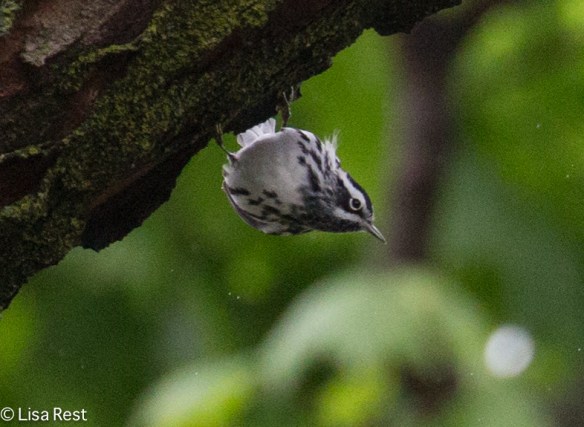
Black-and-white Warbler
Anyway, about the pictures for this post: about two weeks into working at home I decided that I needed to fit a walk into my daily routine, weather permitting, so I began taking a walk every morning before work, a tame walk by any means encompassing perhaps only a mile, but I could look for birds, particularly as it was spring migration. So I have been going out with binoculars and the camera and settled on a route that gets me out and back in time to go to work without feeling rushed or pressured, and always stopping to check on who’s in the backyard upon my return. The pictures in this post are from one particularly delightful morning roughly two weeks ago when I guess migration was in whatever kind of full swing it was finally coming to. It was overcast which didn’t help too much but the birds were there.
For a week or two, no matter where I was, I was seeing or hearing Chestnut-sided Warblers.
Chestnut-sided Warbler
American Robin on her nest
There were not as many White-Crowned Sparrows in the yard this year – I never saw more than one. This particular morning I was lucky enough to capture him. I am convinced he is the same bird whose little syncopated song I heard earlier.
White-crowned Sparrow
More of the White-breasted Nuthatch at the top of the post.
And here was finally a Black-and-white Warbler who was practically at eye-level, making him easier to capture. This species navigates tree bark like the nuthatch.
Swainson’s Thrush
This might be the only Tennessee Warbler I saw this spring. Certainly the only one I was able to photograph. Usually they are more common and noisy about it. I did manage to capture this one singing a bit.
Tennessee Warbler
Northern Cardinal
I missed capturing an Ovenbird in my backyard, but it was likely the same one who was hiding in my apple tree in the front yard, below.
Thanks for visiting. I hope you are doing as well as possible. We all have our own limits, I suppose. I take a short nap when I’m just too tired to continue. But I always feel better getting up and doing something, and my indoor birds provide endless opportunity in that regard. I also revive every time I play music for them. That is how this whole thing started, and it’s turning out to be the one thing that sustains our spirits.
I never intend to go birding in the afternoon, but on Friday I jumped at the chance when we were encouraged to take the afternoon off. It was cloudy, and you can never count on what birds will be up to after lunch. Sometimes I like the cloudiness, though, because it reminds me of birding in South America.
Cloudy at the Portage
Maybe cloudy was okay for capturing this Cape May Warbler.
Cape May Warbler
Then there was a very active, backlit Warbling Vireo. This is likely the only Warbling Vireo I will photograph this year. There’s always one. But they are all very busy singing now and protecting their territories.
Sometimes I hardly ever see goldfinches, and at other times they seem to be everywhere. All I know is they’re not in my yard too much anymore so I suspect many of them are at the Portage or other nearby forest preserves.
With all the rain and now warmer temperatures, the green-up is happening rapidly.
I often hear Killdeer but don’t always see them. I managed to capture this one flying across the compost piles on the MWRD property.
Killdeer
Starlings have been entertaining. I have seen one doing happy dances a couple times, although unfortunately it was hard to get him in focus on this trip. But I did capture him flying.
And now how about paying some attention to the ladies? It seemed to be a good day to capture pictures of the girls. Maybe they thought they were less noticeable on a cloudy day.
Mallard female
Scarlet Tanager (female)
Red-winged Blackbird (female)
Brown-headed Cowbird (Female)
Brown-headed Cowbird (male)
I found the female Indigo Bunting below quite fascinating, in that she was preening or otherwise trying to get a grip on her feathers and the photos reveal her black and bluish feathers underneath. Who knew? (Forgive me for thinking “only her hairdresser knows for sure.”)
Indigo Bunting (female)
As a comparison to the above, here’s the male in all his glory and various feather colors.
Song Sparrows are more often heard than seen so it was nice to catch this one foraging for something.
And it’s not often I see a pair of Downy Woodpeckers. Maybe afternoons are lazier for the birds.
Pair of Downy Woodpeckers
I had a wonderful encounter with a Philadelphia Vireo a couple years ago. I hope to see more of this species. And this was the first day I saw the Eastern Kingbird. By Memorial Day there were two Kingbirds hunting for bugs from their perches over the water.
Philadelphia Vireo
Eastern Kingbird
Early on there was a small flock of Cedar Waxwings but they were hard to distinguish in the shadows and blended in perfectly with the tree colors.
Cedar Waxwing
Another elusive Black-and-White Warbler. These warblers are relatively easy to see, but so far had been defying my lens. However stay tuned because I have had some more productive encounters.
Part of a Black-and-White Warbler
Even the Baltimore Orioles looked a bit washed out. But I noticed a nest, and that was a welcome sign. The female builds the nest, so I can only imagine she was inside of it.
Baltimore Oriole Nest
It has been hard to go back to work after a long weekend, even though I have not yet returned to the office. Most amazing to me has been the time spent in the field, so to speak. I never feel like I have this luxury to fully absorb my surroundings except when I am on vacation. But something about the pandemic has slowed down everything after eliminated many social commitments. I can embrace birding religiously three days straight as a spiritual exercise. Even though I am encountering several more people on the trails, there is still enough space and quiet, with many moments left to witness how life continues beyond our immediate concerns.