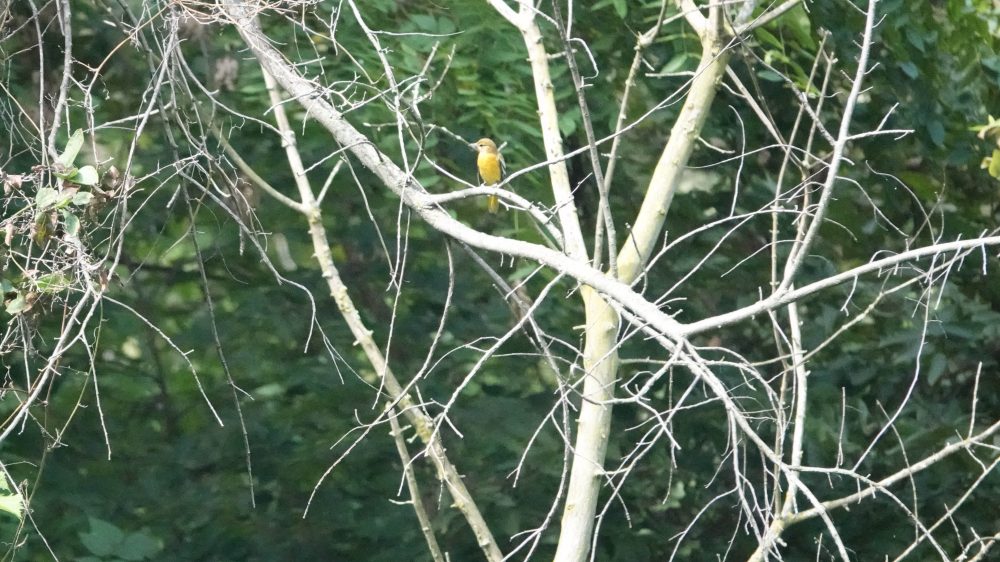
Fall Migration Continues II

YRWA Portage - 10-13-18-2668

Yellow-Rumped Warbler at Chicago Portage

And continues and continues and…I have been so busy birding every weekend it’s taking even longer to process the pictures. These are from last week – October 13 – Thatcher Woods and the Chicago Portage.

WTSP 10-13-18 Thatcher-2188

White-Throated Sparrow at Thatcher Woods

The birds blend in more and more with their surroundings, but I find it so intriguing. Although it does take almost twice as much effort to get the camera to focus on the bird.

LISP 10-12-18 Thatcher-2303

Lincoln’s Sparrow, Thatcher Woods

I was very pleased to find a Winter Wren hanging out with the sparrows and remaining warblers at Thatcher Woods. I always think of Don Kroodsma and The Singing Life of Birds when I see a Winter Wren, even if it’s not singing.

Much like two weeks earlier, there were still a lot of Palm Warblers and Yellow-Rumped Warblers at Thatcher Woods.


Here’s what the Portage looked like when I got there.

10-13-18 Portage-2436The Yellow-Rumpeds were foraging in the duckweed.


It was a pleasure to see several Hermit Thrushes. And nice to see them somewhere other than hopping around on park lawns downtown.

HETH 10-13-18 Portage-2477

Hermit Thrush, Portage

I got a brief, lucky look at a Belted Kingfisher flying over the pond.

BEKI 10-13-18 Portage-2466

Belted Kingfisher

Some Song Sparrows are already practicing singing for next spring, which might explain why I have heard more than I have seen.

SOSP 10-13-18 Portage-2458

Song Sparrow

Out on the road overlooking the compost piles that now decorate the Metropolitan Water Reclamation District property, I saw this Red-Shouldered Hawk land in the tree and sit for a long period of time.

RSHA 10-13-18 Portage-2640

Red-Shouldered Hawk

Other raptors flew overhead, including the Sharp-Shinned Hawk below.

SSHA Portage - 10-13-18-2702

Sharp-Shinned Hawk

It took me a while to realize that the birds below are Purple Finches. There seem to be quite a lot of them at the Portage this fall.


PUFI Portage - 10-13-18-2521

Purple Finch

Not to be confused – much – with House Finches…

HOFI Portage - 10-13-18-2583

House Finch

Ruby-Crowned Kinglets are still abundant. But the bird below right is a Golden-Crowned Kinglet. It was perched about a foot and a half in front of me and we bonded for a while, but it was much too close to get a picture of it then!

Still seeing Eastern Phoebes, although I expect fly catching is becoming more difficult as temperatures drop.

EAPH Portage - 10-13-18-2664

Eastern Phoebe

My last two photos are of Hermit Thrushes. The second one is for the russet color of its back in the sun…

HETH 10-13-18 Portage-2760HETH 10-13-18 Portage-2770I’ll be on a mission to get through my photos from this past weekend… Our weather seems to have calmed down a bit and we are in a crisp but sunny period. I love fall, maybe for its nostalgia…!


Last Saturday at Columbus Park

GBHE Columbus Park 10-6-18-2039

Great Blue Heron with prey

Columbus Day has come and gone for another year. Even after suggestions that we rename it Native American Annihilation Day, it would be cumbersome to re-label everything presently Columbus. Columbus Park has been around for a long time. According to the Chicago Park District, it is considered the finest example of landscape architect Jens Jensen’s output and was designated a National Historic Landmark in 2003.

RCKI Columbus Park 10-6-18-2005

Ruby-Crowned Kinglet

I’ve been too busy looking for birds to photograph the landscaping but I’ll try to keep it in mind since I have one more planned visit next Saturday. After that I will be free to go anywhere or not. The morning started out cloudy and wet but improved. We park in the golfers parking lot, where there were many intrepid golfers by the time I arrived. Early on, the birds were not easy to spot last Saturday. They were either too far away to see clearly and/or tangled in dense multicolored foliage. Above is a Ruby-Crowned Kinglet. Below is a photograph that may or may not have a bird in it, to give you an example…

Puzzle Columbus Park 10-6-18-1997And then when I did eventually find a bird and tried to enlarge the photograph enough for identification purposes…

Baypoll Warbler Columbus Park 10-6-18-1955

This is a Bay-Breasted Warbler. Even after ebird insists nobody can tell a Bay-Breasted from a Blackpoll this time of year, the configuration of the wing bars, the faint rosy wash on the flank and the facial pattern all tell me it’s a Bay-Breasted.

PIWA Columbus Park 10-6-18-2047

This is a Pine Warbler that we actually glimpsed better naked eye than with the camera.

For one thing I have been able to exercise my desire to see a Yellow-Bellied Sapsucker the last week or so. Below is one from Columbus Park…

YBSA Columbus Park 10-6-18-1779and a couple days earlier, from the park at 311 South Wacker, a block away from my office. Notice all the sap-holes in the bark!

YBSA 10-4-18-1747Even though Red-Winged Blackbirds don’t migrate far, I think we’ve seen the last of them in these parts until they return to nest in the spring.

RWBL Columbus Park 10-6-18-1968Another off-site but maybe not off-topic bird is the Ovenbird below. One or two of these have been hanging out at 311 South Wacker. I think I had eight of them at one time in the spring.

I would be remiss if I didn’t include a Nashville Warbler…

NAWA Columbus Park 10-6-18-1982And the large pond that attracts so much waterfowl…

MALL Columbus Park 10-6-18-1823Then I was intrigued by the fungus that had adopted a tree stump.

Fungus Columbus Park 10-6-18-2010We saw the Great Blue Heron early on and then later when it was trying to negotiate a slippery fish.

Our last bird was perhaps the nicest surprise. A Cooper’s Hawk perched directly overhead.

COHA Columbus Park 10-6-18-2055I am going to Thatcher Woods tomorrow morning for the last walk there, and I have absolutely no idea what to expect. We are currently experiencing cold, cloudy weather. The forecast for tomorrow is sunny and moderately cool. I plan to get in as much birding as possible before I tend to my weekend chores because Sunday is going to be challenging. The choir sings in the morning, and in the afternoon I’m attending a “Soul Connections” group I joined several months ago, then directly after that, my first attendance at a writer’s workshop, led by one of the SC group’s participants – an activity I haven’t attempted in many, many years. I think I’ve come to the conclusion that we have to connect with each other on multiple levels if we’re going to get through this. 🙂


September Snippet

NAWA Yard 9-9-18-9612On September 9, I spent a sunny Sunday afternoon in the backyard. We are presently flirting with a three-day return to summer-like temperatures, but the blooms, the pollinators, and the visiting warblers have already left. I am sharing the memory of that afternoon in photographs.

I was delighted by the presence of a Nashville Warbler. I don’t get to see migrating birds in my yard too often, so it was great to just sit and become part of the landscape and observe the warbler and the pollinators on a beautiful afternoon.

I had planted some different goldenrod and asters last fall to see if they would stop the echinacea from taking over the entire back bed now that the shade of the truncated Ohio Buckeye is no longer a force to be reckoned with. After all the rain early in the spring, I have a formidable fortress of goldenrod and heath aster. I think the Nashville was foraging around in the Stiff Goldenrod.

Wasp and Flies on Showy Goldenrod 9-9-18-9497

Paper Wasp and Flies on the Showy Goldenrod

While I sat on my biggest new overturned yard waste container, I was fortunate to witness a quick visit from the Ruby-Throated Hummingbird below.

RTHU Yard 9-9-18-9524

Female Ruby-Throated Hummingbird

I don’t know if I’ve ever seen a large grasshopper in the yard before but this one was having a good time.

Grasshopper 9-9-18-9582

Differential Grasshopper

The Nashville flew into my Scotch Pine from time to time.

The bees were savoring the last of the sunflowers that the birds and squirrels had planted.

Longhorn Bees Yard 9-9-18-9514

Long-Horned Bees!

Last of the Sunflowers 9-9-18-9588

So here’s two more shots of my lovely little Nashville visitor.

NAWA Yard 9-9-18-9613

NAWA 9-9-18-9620Nashvilles were still present last weekend with the Yellow-Rumpeds and Palm Warblers for the tail end of an up-and-down fall warbler migration. With luck I will be back sooner than later with a report from last Saturday’s walk at Columbus Park.

Fall Migration Continues

RBNU Portage 9-29-18-1399

Red-Breasted Nuthatch

I think fall must be my favorite season at the Chicago Portage. The birds blend in with the autumn colors, the leaves start to fall from the trees and then every once in a while a bird takes a quick leaf-like descent as well. This past Saturday, after my morning commitment to Thatcher Woods where we had scores of Yellow-Rumped and Palm Warblers, I decided to see what was up at the Portage. Below are two of perhaps 100 Robins…

Directly below, two Common Yellowthroats at Thatcher Woods.

I always take a picture of the water, such as it is, at the Portage to document how it changes from season to season…

Portage 9-29-18-1268There is water enough to bathe in as this female Red-Winged Blackbird was finding out.

RWBL Portage 9-29-18-1577

Red-Winged Blackbird (male)

The Yellow-Rumped Warbler below was at Thatcher Woods…

And the Palm Warbler below was at the Portage.

PAWA Portage 9-29-18-1565Tennessee Warblers and Orange-Crowned Warblers often get confused in the spring but these two made it easier for me.

TEWA Portage 9-29-18-1279

Tennessee Warbler

Orange-Crowneds always looks to me like they have a slight eye-ring.

OCWA Portage 9-29-18-1591

Orange-Crowned Warbler

I missed seeing a flashy male Black-Throated Blue Warbler this year but I’m glad to have found a female of the species, wearing her muted fall clothes.

BTBL Portage 9-29-18-1473

Black-Throated Blue Warbler (female)

Blackpoll Warblers in their fall plumage are stamped permanently on my brain after a few years ago when there were many for several days at my old stomping grounds, Lake Shore East Park, so I was delighted to find this lovely individual.

At one point I encountered some workers who were taking down a tree. I spent some time talking to one while another was driving wedges into what was soon to be the stump. It turns out the trees were not birch but white poplar, which is an invasive species and that is why they were removing it. Come to think of it I don’t recall ever seeing a bird in those trees although they had become a landmark and I thought they were rather attractive. After I was given clearance to go beyond the workers, I grabbed two quick clicks in the distance as the tree fell.

For all the Robin activity there were only a few Cedar Waxwings…

My view from the first bridge at the Portage yielded a Mourning Dove and a House Wren.

MODO Portage 9-29-18-1265HOWR Portage 9-29-18-1255I almost thought I had missed all the Indigo Buntings but there were still a few youngsters left.

INBU Portage 9-29-18-1526

Indigo Bunting

NOCA Portage 9-29-18-1510

Northern Cardinal (female)

I was delighted to see a Swainson’s Thrush if only for a moment…

SWTH Portage 9-29-18-1417

Swainson’s Thrush

Eastern Phoebes…

Just starting to see Dark-Eyed Juncos, the harbinger of colder weather coming, I suppose. But after not seeing them all summer I am glad to have them back.

DEJU Portage 9-29-18-1454

Dark-Eyed Junco

Yellow-Bellied Sapsuckers are coming through as well.

YBSA Portage 9-29-18-1405

Yellow-Bellied Sapsucker

GREG Portage 9-29-18-1318The Des Plaines was so low, this Great Egret was wading out into it quite a ways from the shoreline.

We had a lot of Northern Flickers at Thatcher Woods. Here’s one of them checking out a future home, perhaps.

YRWA Portage 9-29-18-1486

Yes I am a Yellow-Rumped Warbler

And Monarch Butterflies are still migrating. I love the way the Poke Weed looks this time of year. I knew the birds were attracted to it but I guess the Monarchs like it too.

Monarch Portage 9-29-18-1497After hearing and rarely seeing Eastern Wood-Pewees all summer, it was nice to get good looks at this one.

EAWP Portage 9-29-18-1395

Eastern Wood-Pewee

DOWP Portage 9-29-18-1550

This last photograph is of a Downy Woodpecker who was foraging low and obscured by the vegetation but I like the pastel colors.

More to come, I have three more Saturday bird walks, weather permitting. We seem to be entering a rainy spell but from the looks of the Des Plaines last week we can use it.

Lakefront Parks and Confusing Warblers

BBWA 9-16-18-0289

Palm Warbler

Before I left for downtown two Sundays ago, there was a young rabbit outside my front door between me and my car. There was also a very nicely kept spider web attached to one of my front stair railings.

Rabbit 9-16-18-0273Web 9-16-18-0274This will be brief, as was my last warbler flock experience.

My first lakefront park stop was the area north of Buckingham Fountain.

I saw more warblers than I was able to photograph. In all, there were maybe 8 species. Above, Cape May Warblers, below, American Redstart.

Also available, a Red-Breasted Nuthatch…

RBNU 9-16-18-0502

Red-Breasted Nuthatch

Palm Warblers (above) dominated the flock. Across from all the activity was a fenced-in garden area where this transforming Northern Cardinal was feasting on seeds.

NOCA 9-16-18-0508

Northern Cardinal through a fence

Then there is the warbler below. I struggled over this ID but now I’m thinking it is a Cape May too.Unknown 9-16-18-0480

I made my way over to Millennium Park and went up the stairs to Lurie Garden. The only warbler I found is below. Since it resembles nothing else, even though the mask is barely visible, it must be a Kentucky Warbler. It remained low in the foliage and everything else about it said Kentucky Warbler to me.

Below, one more of my best subject – the Palm Warbler enjoying a worm.

PAWA 9-16-18-0297There was no noticeable activity elsewhere that morning, and it’s been slow ever since. A strange, fitful migration season. But I am grateful for whatever birds I have seen and hope they are making safe trips to their winter homes.

Fall Warbler Fall-Out

COWA 9-10-18-9678

Connecticut Warbler

Last Friday after some rain and wind, I was called down to the front of our office building by a coworker who had gone down for a cigarette. She said there was a little bird in distress. As it turned out there were two birds in distress, the one she saw flopping around almost as if it was having seizures being a first-year Cape May Warbler, and another, the stunned Chestnut-Sided Warbler you can see below on the left. I called the Bird Collision Monitors hotline and got their voicemail. After waiting to hear back for about twenty minutes, I thought I could not leave the two birds alone on the sidewalk surrounded by foot traffic, glass and steel, so I took them both to the park-like setting about a block away at 311 South Wacker Drive. You can see them both on the grass below. I sat with them and observed the Cape May was dead, but when I reached for the Chestnut-Sided, it chirped and flew away, so I felt better for having rescued it. When the Bird Collision Monitors did finally call me, they said they had picked up over 200 birds that day. The little bird you see below on the building ledge wasn’t stunned but it was lost, as it flew up from the sidewalk looking for a way out of the buildings. I believe it’s a Least Flycatcher.

There were a lot of birds in the park Friday, so I went back on Monday afternoon with the camera. But not before checking the potted trees in the front of my building, where I found among other more common species, the Connecticut Warbler at the top of this post.

BPWA 9-10-18-9765

Blackpoll Warbler

There were a lot of Blackpolls but it was difficult to get a decent picture. Although I am thankful for the landscape architects planting lots of locust trees which are great for migrants, the trees are quite tall and I only carry my 300mm lens around with me during the week, so it was a challenge.

WIWA 9-10-18-9925

Wilson’s Warbler

The Wilson’s Warbler never got low enough for me to capture his trademark skullcap but there’s something so Wilson’s about the shade of yellow. I really think whoever names colors could come up with an entire Warbler Collection. For as many field marks as my brain has memorized, I think I sometimes recognize these birds by the shade of yellow, if there’s good light.

MAWA 9-10-18-0083

Magnolia Warbler

There’s a familiar phrase, “warbler neck,” which is what you get looking up at these birds in the tall trees.

How nice of this Chestnut-Sided to almost come down to my level.

CSWA 9-10-18-9895

Chestnut-Sided Warbler

Then there are the birds that prefer ground level, like the Common Yellowthroat below.

COYT 9-10-18-0006

Common Yellowthroat

On the other hand I was surprised to find this Pine Warbler in the grass when I later went through my photographs.

PIWA 9-10-18-9985

Pine Warbler

PIWA 9-10-18-9942

Pine Warbler

It’s been a long time since I’ve gotten close enough to get a good picture of a Black-and-White Warbler and Monday was no exception. This was the best I could do.

American Redstarts come in several color combinations this time of year. The second-year or more adult males are black and orangey-red. The young males are yellow where the red would be, but it’s a warmer yellow than the females. I seem to have captured a bird that is somewhere in between the first and second-year males below the pictures of the older bird, judging from the darker gray on its head and back.

(Click on the pictures just below to see how this male’s plumage is changing.)

AMRE 9-10-18-9818

American Redstart (female)

The biggest surprise perhaps was to see another Connecticut Warbler. These birds are normally hard to find, and here on the same day I had two within a block of each other.

COWA 9-10-18-0060Suffice it to say that the lure of fall migration is irresistible, especially with nice weather. The birds are taking advantage of the calm skies in this part of the country as well. I have been going back to the park every day this week and as of Tuesday all these birds seem to have left and no new ones have come in. I would like to think they all took off Monday night, navigating well out of the city and continuing their trips to Central and South America.

AMRE 9-10-18-9824I’ll have lots more to report if I can manage it. Hope you are having decent weather wherever you are.

Lazy Labor Day Weekend

COGR 9-2-18-8899

Common Grackle

At least today, on Labor Day, I decided to be lazy by not getting up two hours before dawn so I could go birding. After meeting at the destination on Saturday, we canceled the walk due to thunderstorms looming in the wings. Even so, I had stayed back with another participant to get a handle on the layout of the trail setup when suddenly a crash of thunder and lightning striking right in front of us convinced us it was indeed time to leave.

So yesterday I got up and decided I would not go far, but as long as it wasn’t raining or threatening to, I may as well try to see what I could find. I went to Ottawa Trail Woods and encountered some obstacles on the trail (above). It became even more evident that I was the only person to have traversed the river trail in a while as I managed to avoid only one of two spider webs strewn above the footpath. The first sign of life was the deer below.

Deer 9-2-18-8770

oven 9-2-18-8796

Ovenbird

There were not a lot of birds. Or at least not a lot of species. But this time I got to see an Ovenbird for a few seconds although it was nearly the only warbler I saw.

A dozen Common Grackles showed up in the trees right above my head. So much for dark backlit birds.

Ottawa Trail is usually good for Thrushes and I was not entirely disappointed. At least I got to see this Gray-Cheeked long enough to photograph it.

GCTH 9-2-18-8918

Gray-Cheeked Thrush

Early on I saw one Cedar Waxwing, but knew there was no such thing as a solitary Cedar Waxwing and on my way back on the trail I encountered at least sixty in the branches of one tree. Click on the upper righthand photo below if you don’t believe me.

The bottomlands by the river were flooded from all the recent rain and I was able to relocate this Great Blue Heron after it flushed, when I surprised it by my walking the path even though at a considerable distance.

GBHE 9-2-18-8881I am still puzzled over the image below but the bug capture is more interesting…

HOWR 9-2-18-8811So it was mostly distant unspectacular sightings . A Red-Bellied Woodpecker, an Eastern Kingbird…

Indigo Buntings were nearly unrecognizable. The one on the right was an up-and-coming male hiding from me at the Portage which was where I went next.

The Portage still had a couple hummingbirds, perhaps the same ones I saw on Friday. Plenty of Jewelweed everywhere. A few years ago on a September day I saw what seemed like a hundred Ruby-Throated Hummers in one visit, all over the Jewelweed, but it was not repeated yesterday. If you look closely at the third image of the hummer you an see a little bit of red emerging on his young throat.

By the time I got to the Portage it was closer to midday, the heat was becoming oppressive and I didn’t expect to see many birds. So I appreciate one Gray Catbird after hearing them but never catching even a glance at one Friday.

GRCA 9-2-18-9002All my bushwhacking resulted in pollen all over the lens hood…

img_2910In front of me on the trail, a baby Snapping Turtle.

Baby Snapping Turtle 9-2-18-9026There were fewer dragonflies than last week. And I keep running into Eastern Commas that don’t want to pose correctly: or is it a Question Mark???

The Robins all seemed to be at Ottawa Trail yesterday with only a few at the Portage. I imagine it’s the same flock going back and forth.

AMRO 9-2-18-8840Monarch Butterflies are still coming through, although they will all be down to Mexico soon. Migrations of the soul…

Monarch 9-2-18-8941I came up with a new mantra this weekend, so I guess it’s only appropriate on Labor Day that I share it with you. I have been muttering “I have to stop working” for far longer than I want to recall. But I decided now my mantra should be, “I have to start writing.” I have been thinking about a book for the last several years. It changes every five minutes, but I think it’s finally starting to come together in my head because I found the first sentence yesterday. So it’s time to start writing it. Which may make my contributions to this page even more infrequent, I don’t know, it’s hard to imagine writing anything after working all day at a computer in an office. But by declaring my intentions sometimes I can force myself to get going so as not to risk eternal embarrassment. Thank you.

Portage Vacation Day

CEWA 8-31-18-8696

Cedar Waxwing

I took today off. It was a bit difficult getting up early this morning after swimming last night but I managed to get over to the Portage a little after 8:00 a.m. and took note of how deserted the place was on a weekday. No dog-walkers or cyclists. Only one runner, who was probably as amazed to see me as I was him.

img_2889img_2888A long shot of the duckweedy water above and just below it, an untrimmed path I decided not to take.

AMRO 8-31-18-8397The robins are back, and the waxwings are still numerous. Literally nobody in the mucky water. I was treated to American Redstarts and a couple Ruby-Throated Hummingbirds early on, which gave me hope to find a few more migrants.

AMRE 8-31-18-8409

American Redstart (First Year Male)

Ruby-Throated Hummers above, an adult male American Redstart below.

The only other warblers I could barely photograph were the Chestnut-Sided below left and the Black-Throated Green on the right. I missed the Ovenbird that landed briefly in  the tree I later found them in.

In the beginning with the immature male Redstarts was a chattering young House Wren.

Butterflies were out for the sunshine today. Red Admiral, Pearl Crescent and Monarch butterflies.

I saw a few White-Breasted Nuthatches too.

WBNU 8-31-18-8715I heard the Eastern Wood-Pewee long before I saw the one below.

EAWP 8-31-18-8745This time of year I expect to see lots of Indigo Bunting children and I did, but they were playing hard to get with the camera.

Yellow is the predominant color this time of year and I found a bumblebee and a goldfinch taking advantage of it.

One Eastern Kingbird…

EAKI 8-31-18-8640There was a lot of chatter from catbirds but I only barely saw the youngster below.

GRCA 8-31-18-8474A couple more Cedar Waxwings. The one on the left is an immature.

The last photograph I took was of this stunning little Silvery Checkerspot.

Silvery Checkerspot Butterfly 8-31-18-8756My walk tomorrow will take place if we are not totally rained out. Scattered thunderstorms are in the forecast. We shall see… This evening as I write this I have just heard the rumble of thunder. And now it is starting to pour.

By the way it feels nice to have the time to do a same-day blog post. Perhaps if I – no, let’s say when I retire – I will be up to the task more often.


Slow Walks through the Portage

BAOR 5-6-18-3219

Baltimore Oriole

I have never been a hurry-up-let’s-get-this-over-with birder, but I am certainly moving more slowly these days because of my knee. But life in the slow lane has its advantages and the reduced speed has paid off. Two weeks ago I managed to count 55 species when I visited the Portage for four hours instead of the usual two, and last week with my first group we had 51 species in nearly about the same amount of time due in part to the fact that we got off to a late start because of the weather. Between the two lists I had 73 different species total. Of course it is spring migration, and it is not hard to spend a lot of time when you keep seeing more birds. Needless to say I did not get pictures of them all, or some pictures were useful later only for the purpose of identification. But in spite of having hardly any time or place to bird during the week, I feel as if I have seen some nice migrants in spite of my physical limitations. I took these pictures two weeks ago. I felt bad about not being able to do the Spring Bird Count, but I’m glad I managed to get out.
Breeding birds are back, and the most numerous after the Robins, Red-Winged Blackbirds and Goldfinches are probably Blue-Gray Gnatcatchers.

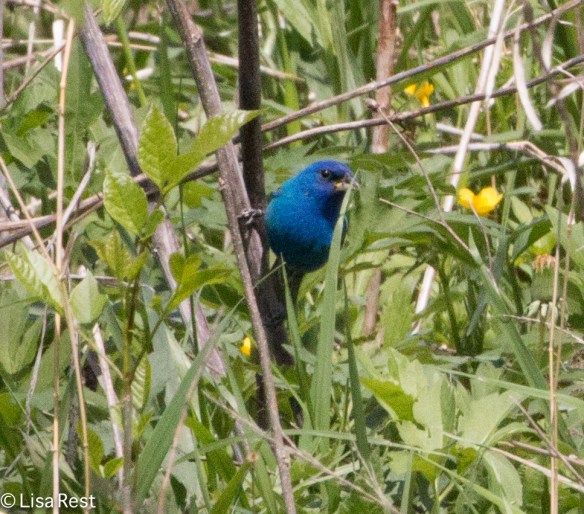
Lots of Indigo Buntings are on site too. Many of them are first-year males like the ones below.

There are also several Warbling Vireos that have set up territories. I usually hear them more than I see them, but I got good views of this individual.

Some Yellow Warblers will likely breed here too.

I don’t think the Portage has breeding Ovenbirds but it was nice to see this one out in the open.

Two more warblers I was able to photograph…but they won’t be staying.

NOPA 5-6-18-2875

Northern Parula

AMRE 5-6-18-2837

Male American Redstart

My best surprise was to briefly see a Hooded Warbler and manage to get a picture of him. These are far less common. I used to see them on the lakefront occasionally. This was a real treat.

HOWA 5-6-18-2754

Hooded Warbler

The Great-Horned Owls appear to have just one owlet but it’s gotten pretty big and last week we saw all three of them all take off from their tree. I took these pictures of junior and mom two weeks ago.

The Downy Woodpeckers are busy.

Migrant thrushes, like the Gray-Cheeked on the left and the Swainson’s on the right, below, are passing through.

I don’t think there are enough places left at the Portage for Tree Swallows to nest.

Goldfinches are in full breeding plumage now.

AMGO 5-6-18-2820

On the sparrow front, I found a Chipping Sparrow, a few White-Crowned Sparrows who have all flown north by now, and one hard-to-see Song Sparrow. The Portage is home to breeding Song Sparrows, but I’m not sure about Chipping Sparrows.

SOSP 5-6-18-3128

Song Sparrow

As ubiquitous as Red-Winged Blackbirds are, they can still be beautiful.

House Wrens breed at the Portage. They’re always singing a lot, and every once in a while I might even see one… But it always takes me a few repeats to remember their song.

I have one more walk to lead at the Portage this coming Saturday. The last time I checked the weather the prediction was for thunderstorms, but that was the forecast last Saturday and we still managed to dodge the rain and see a lot of birds, so I am hopeful. It should be warmer too, which will add a whole new dimension – mosquitoes – after all the rain. As much as I find mosquitoes a nuisance, I also realize they’re food for a lot of birds.

INBU 5-6-18-3185

Suddenly Spring

NOWA 5-1-18-1834

Northern Waterthrush

I almost could have called it “Suddenly This Summer” because on May 1 we skipped spring and went straight into summer temperatures by noon. But along with the sudden push of warm air from the south came a lot of migrating birds, and after all, it was finally the real start to Spring Migration.

As luck would have it I was near the lakefront for the last part of the stem cell procedure on my right knee, which consisted of a blood draw early in the morning and then having a few hours before a return to the doctor’s office for the final injection. I realized the location’s potential the week before when I had the major procedure done. The medical building is virtually right across the street from North Pond, which is a favorite hot spot with lakefront birders. The week before it was blustery and cold with only a few of the hardiest migrants. But now I had a birder in my friend Lesa to whom I am grateful for being my chauffeur for the day. I was walking without crutches if moving slowly, but I was walking, and slow is generally good for birding. The slower you move, the more birds you eventually will see. And seeing birds was a great distraction from whatever pain I was feeling.

Perhaps the first warblers to greet us were four or five Ovenbirds poking about in the grass. Even though the weather was warmer, the trees and accompanying insects had not caught up with it yet and so a lot of birds were foraging on the ground for something to eat. The ground is an Ovenbird’s preferred foraging spot anyway. Ovenbirds can be nearly impossible to see on their breeding grounds, but in migration on the lakefront they are all over the place this year. I have seen them since everywhere I go for midday walks near my workplace.

Then it seemed there were Black-Throated Green Warblers everywhere.

Predictably, especially in the grass, were Palm Warblers. A note about these pictures, being my first warbler photographs of the season. The morning started off a bit overcast, and then I had only my 75-300mm lens as it seemed ridiculous to be carrying around anything larger in my compromised condition, so I didn’t get quite the clarity I wanted for many of these birds. But it was just such a joyous way to spend a medical day and provided an extra therapeutic perk altogether.

I am always so happy to see a Lincoln’s Sparrow. It’s not quite rare, but you never see more than one of them at a time, and they’re such delicate-looking little birds.

Yellow-Rumped Warblers were predictable, but not easy to capture as they frantically searched for food.

Our look at the Pine Warbler below was brief, but this is a more unusual species in migration so I am glad I got this shot.

PIWA 5-1-18-1893The three species below are Yellow, Black-and-White, and Nashville Warblers.

Another spring migrant that seems to be showing up in force is the Blue-Gray Gnatcatcher.

Meanwhile, on their way out were Golden-Crowned Kinglet on the left and Ruby-Crowned Kinglet on the right, below.

Then there are the migrating Thrushes. Two below are a Swainson’s Thrush on the left and a Gray-Cheeked Thrush on the right.

I have been out since last Tuesday and have a lot more pictures to process and share with you, but it’s been really difficult to get caught up. All I can say is every day I’m a little bit better and there have even been a few moments when I’ve forgotten about my knee altogether!

WCSP 5-1-18-1792

White-Crowned Sparrow

Below, two glimpses of a female Eastern Towhee…

I will be back soon with more from Instant Spring Migration. Until then, spring on!

TEWA 5-1-18-1675

Tennessee Warbler