Singing Spring Sparrows

WCSP 5-7-17-7817Virtually every morning I go out to fill the bird feeders in my backyard before I leave for work, and I have been hearing White-Crowned and White-Throated Sparrows singing for weeks, but I never see them. Looking out the windows I am used to see them foraging around on the ground, but this has not happened. So yesterday afternoon, which was absolutely gorgeous and sunlit, when I went out to sit and dig up the patch of pigwort that has invaded one section of the yard, I took the camera with me, just in case.

WCSP 5-7-17-7820I was rewarded with the presence of three White-Crowned Sparrows and two White-Throated Sparrows. The White-Throateds showed up first, digging around at the bottom of the compost pile and then sometimes in it. They didn’t stay very long, however.

Eventually I noticed something interesting: one White-Crowned Sparrow was nibbling on a piece of spray millet that I had just recently added to the compost bin. I realized some time last week that I have been throwing out chewed-up spray millet every day with the cage papers and waste from my indoor birds, which means it’s been going needlessly to the landfill. It never occurred to me that someone might find the uneaten portions of this delightful treat irresistible.

The other attraction seemed to be little leftover bits of shelled peanuts. The squirrels probably get the majority of them but the birds have been onto this use of the tree stump for a while. I keep hoping for crows but I’ll take White-Crowned Sparrows anytime.

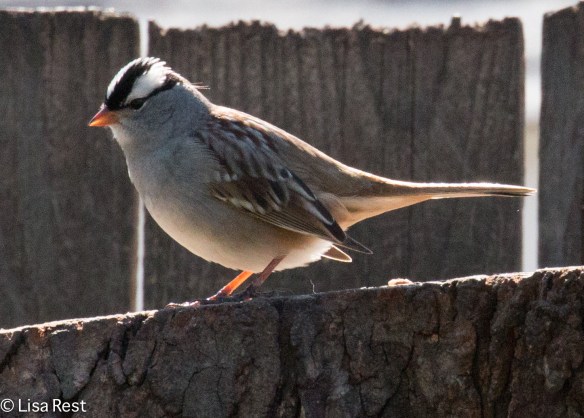
In case you’re wondering what the back view of a White-Crowned Sparrow looks like, here’s one shot from under the feeder pole.

WCSP 5-7-17-7809The weather is still unseasonably cool but that’s nothing for the sparrows. I’m hoping they’ll stick around maybe for another week so I can continue to hear their beautiful songs. Yesterday as I had to go back into the house to resume indoor duties, I was treated to a little late-afternoon/early evening chorus I wish I had been able to record. One White-Throated Sparrow started out singing in B-flat, then a mourning dove joined in, in the same key, and then a House Finch started carrying on with his busy song. No people noise interrupted their singing. This was likely a one-time experience I’ll have to keep in my head, but it will remind me to take the recorder with me next time.

WCSP 5-7-17-7762WCSP 5-7-17-7818

Where Have All The Birds Gone?

Yellow-Bellied Sapsucker

Yellow-Bellied Sapsucker, scaling a building wall next to 155 N. Wacker Drive, Chicago

I could just as easily re-title this post to “Where Has All The Time Gone?” since I’m still trying to make adjustments to my ever-changing schedule. But this will be a brief tribute to some of the birds I have seen passing through downtown Chicago a few weeks ago. (There will be still more photographs from the rest of the month in a future post.)

The following warblers were present at Lake Shore East Park on September 28. This was probably the last “peak” of warbler migration along the lakefront.

AMRE 9-28-15-3081

American Redstart

BLPW 9-28-15-2934

Blackpoll Warbler

TEWA 9-28-15-3092

Tennessee Warbler

MAWA LSE Park 9-28-15 -2902

Magnolia Warbler

Yellow-Rumped Warblers tend to come through and hang around a bit later, so I was not surprised to see this one the following week.

YLWA LSE Park 10-06-15 -3521

Yellow-Rumped Warbler, October 6, 2015

Yellow-Rumped Warbler

Yellow-Rumped Warbler

But I was surprised to find the Connecticut Warbler below poking around in the grass as I was walking through Millennium Park on my way to Lake Shore East. There wasn’t much light and the bird was under some trees so this was the best I could do with the photograph.

COWA Millennium Park 10-05-15 -3296

Connecticut Warbler, Millennium Park, October 5, 2015

I have seen only a few White-Crowned Sparrows this fall, like the one below which popped out at 100 N. Riverside Plaza.

WCSP 10-2-15 (1 of 1)

White-Crowned Sparrow, October 2, 2015

I think the White-Throated Sparrow below was also from this new location. I will have more pictures and more to say about this newly discovered green space area along the Chicago River in a future post.

WTSP 10-05-15 -3319

White-Throated Sparrow, October 5, 2015

There have been a lot of Brown Creepers this fall migration.

BRCR LSE Park 10-06-15 -3595

Brown Creeper, Lake Shore East Park, October 6, 2015

And Ruby-Crowned Kinglets…

RCKI LSE Park 10-07-15 -4043

Ruby-Crowned Kinglet, Lake Shore East Park, October 7, 2015

For a couple weeks, almost, the most ubiquitous bird seemed to be Hermit Thrushes. I am still seeing an individual here and there.

HETH LSE Park 10-07-15 -3954

Hermit Thrush, Lake Shore East Park, October 7, 2015

The Yellow-Bellied Sapsuckers are now all gone.

YBSA LSE Park 10-06-15 -3552

Yellow-Bellied Sapsucker, October 6, 2015

At first I thought the bird below was yet another Hermit Thrush but on closer inspection I have decided it’s probably a Gray-Cheeked Thrush. Light can be tricky, but the heavy spotting on the breast and the darker flanks give him away almost more than his facial pattern.

HETH 9-28-15-2951

Gray-Cheeked Thrush, Lake Shore East Park, September 28, 2015

And for the longer view, here he is again sharing tree space with a shy Lincoln’s Sparrow.

GCTH and LISP LSE Park 9-28-15 -2964

So the warblers are all gone until spring. I did have a late Black-Throated Green Warbler on October 22nd which I posted on my flickr page before I realized I could now just upload it directly into ebird. It was my last “rare bird” sighting.

Below is another picture of the beautiful Blackpoll Warbler from September 28.

BPWA LSE Park 9-28-15 -3013I have more posts in mind and am just working on finding the time and mind space!

Thanks for your patience and indulgence!

City Stopovers

Blackpoll Warbler

Blackpoll Warbler

Here are a few pictures taken at various times over the past few weeks, all in downtown Chicago…

Tennessee Warbler

Tennessee Warbler

Tennessee Warbler

Tennessee Warbler

I never manage to see enough of any one species to tire of them. Although Tennessee Warblers often appear abundant, they are not always easy to capture. For comparison with a species they resemble, I have an Orange-Crowned Warbler below.

Orange-Crowned Warbler

Orange-Crowned Warbler

There seemed to be fewer birds altogether this year, but I don’t know if it is due to loss of habitat, weather patterns, being in the wrong place at the wrong time or a combination of all three.

NOWA 9-22-15 -2652

Northern Waterthrush

I frequently see Northern Waterthrushes on the ground, but less often perched in trees.

Kentucky Warbler

Kentucky Warbler

The day I saw the Kentucky Warbler, there were so few birds altogether at Lake Shore East Park I wasn’t even aware I had seen this rarity until I checked my photographs later. The bird kept ducking in and out of hydrangeas planted near the east end of the park and I was consumed with trying to stop it long enough for a picture.

American Redstart

American Redstart

First-year male American Redstarts seem to be born exhibitionists, on the other hand.

Blackpoll Warbler

Blackpoll Warbler

This Blackpoll was pretty cooperative too on the day I saw it.

Common Yellowthroat

Common Yellowthroat

And Common Yellowthroats, as difficult as they are to see on their breeding grounds…are frequent park visitors.

Hermit Thrush

Hermit Thrush

A Hermit Thrush reminding me It’s The Food, Stupid.

Yellow-Bellied Sapsucker

Yellow-Bellied Sapsucker

At 155 N. Wacker there haven’t been very many birds, but last week there was this sapsucker scaling a wall.

White-Crowned Sparrow

White-Crowned Sparrow

And a White-Crowned Sparrow popped out last week at a new spot on the river that looks promising for future visits.

City Frog 9-24-15-2724

City Frog

Planters 10-2-15 -3215City Frog 9-24-15-2716

Perhaps the strangest thing I saw this fall was a frog in the corner of one of these wrought-iron-encased planters on Randolph near Wacker. How it got there boggles the mind.

It’s time to say goodbye to the warblers until spring. But many more sparrows are likely to be showing up. I’m thankful for that because they tend to be easier to see! And at least I can always carry on a conversation with White-Throated Sparrows.

AMRE 9-28-15-3082

Briefly from the Olympic Peninsula

Pacific Loon

Pacific Loon

Getting home late one week ago from the American Birding Association Olympic Peninsula Birding Rally, I went straight back to work the next morning after making a quick run to the grocery store for a few perishables to tide us over. I am still reviewing all the pictures to clarify gull and shorebird species identification, and I hope to post more seaside pictures later in the week, but I wanted to at least gasp quickly while coming up for air.

I got 13 life birds on this trip, I think, at least that’s the number that’s sticking in my mind at the moment. George Armistead from the ABA promised to send us all complete lists which will be helpful, as I kept somewhat of a list from memory only each day, which is never entirely reliable.

There were life birds that I did not get pictures of, but here are a few ones I did. Light conditions were generally miserable (overcast, drizzly, backlit) but I did the best I could. I’d like to go back someday, spend a little more time and have more lenses ready for different situations. The plant species…trees, shrubs, mosses and fungi to generalize a few…were amazing.

Townsend's Warbler

Townsend’s Warbler

I was very happy to get a good look at the Townsend’s Warbler, especially because it still looks similar to a few other species I don’t know well!

Hutton's Vireo

Hutton’s Vireo

I have seen Hutton’s Vireo before, but never got a picture of one, so this was a lifer for the lens.

Red=Bellied Sapsucker

Red=Bellied Sapsucker

The Red-Bellied Sapsucker kept darting around the tree trunk to the other side but I did manage somehow to capture him and lighten him up enough…

Harlequin Duck

Harlequin Duck

I wasn’t sure if I’d ever seen a Harlequin Duck. I thought perhaps I might have, but now I am 100% certain that I can add to my list as there were several. Not in breeding plumage, but still a remarkable bird.

Thousands of Sooty Shearwaters

Thousands of Sooty Shearwaters

Standing on the beach watching gulls and shorebirds, when suddenly a seemingly endless stream of Sooty Shearwaters flew by over the space of several minutes. The trip leaders estimated 50,000. So I guess I can never say I barely saw this bird if I saw thousands of them!

Juvenile White-Crowned Sparrow

Juvenile White-Crowned Sparrow

The White-Crowned Sparrow is not new on my life list but I heard murmurings that this could be a subspecies to eventually be split. Whatever, I don’t care, it was nice to get a picture of a lovely young cooperative bird.

Heermann's Gulls

Heermann’s Gulls

I know I said gulls will come later, but the Heermann’s Gull is definitely a life bird for me, and what a beautiful bird with the distinctive orange-red bill. Here’s what Cornell has to say about it on their All About Birds website:

“This gray-bodied, white-headed gull breeds in Mexico and then moves north along the Pacific Coast to southern British Columbia.”

White-headed must refer to the adult breeding plumage of this species. I did find the gray bodies to be distinctive too. It’s always a pleasure to get to know an easily identifiable gulls species. I should never have to worry about confusing this bird with any other gull!

Generally the trip was brief but enjoyable, and I will be back with more pictures and thoughts as soon as possible. I also have some catching up to do with a little midwest passerine migration.

Three Weeks: Chicago Portage

Red-Bellied Woodpecker, Chicago Portage, 5-25-15

Red-Bellied Woodpecker, Chicago Portage, 5-25-15

Back on the 10th of May I was at the Chicago Portage and counted 52 species. On the 17th of May, visiting with two friends, we counted 35 species. This afternoon, after gale winds in the morning and some rain, I went over to see what was up and counted 29 species.

Chicago Portage 5-10-15

Chicago Portage 5-10-15

Cape May Warbler, Chicago Portage, 5-10-15

Cape May Warbler, Chicago Portage, 5-10-15

Eastern Phoebe, Chicago Portage, 5-10-15

Eastern Phoebe, Chicago Portage, 5-10-15

Three weeks ago was the height of spring migration, and already by last weekend it was slowing down.

Canada Geese at the Chicago Portage 5-10-15

Canada Geese at the Chicago Portage 5-10-15

CAGO Chicago Portage 5-17-15-2361

Gosling, Chicago Portage, 5-17-15

Last week the goose family had dwindled to four goslings and today I was told by a woman I talked to on the trail that they were down to three. I did run into the geese today, but they were foraging in the grasses and I did not want to bother them, as they were pretty well hidden. So I am taking her word for it.

Red-Eyed Vireo, Chicago Portage, 5-10-15

Red-Eyed Vireo, Chicago Portage, 5-10-15

Lincoln's Sparrow, Chicago Portage, 5-10-15

Lincoln’s Sparrow, Chicago Portage, 5-10-15

Veery, 5-10-15

Veery, 5-10-15

The Red-Eyed Vireos are still present and singing, so they probably breed here, but all the thrushes except for American Robin have left, and the sparrow species as well. There was quite an influx of Veerys this year, I don’t usually see them.

WCSP Chicago Portage 5-10-15-0022

White-Crowned Sparrow, 5-10-15

GRHE Chicago Portage 5-10-15-9934

Green Heron, 5-10-15

But as the last of the sparrows were getting ready to leave, the Green Herons were returning. I believe there are two although I have not yet seen them both on the same visit. I think they also hang out at Ottawa Trail Woods which is also where we went last weekend. I have included a few pictures here are from Ottawa Trail Woods, as it is basically part of the same ecosystem.

SOSA Chicago Portage 5-10-15-9921

Solitary Sandpiper, 5-10-15

SPSA Chicago Portage 5-10-15-9908

Spotted Sandpiper, 5-10-15

Spotted at the Chicago Portage 5-10-15-9854

Spotted Sandpiper at the Chicago Portage, 5-10-15

On the 10th I saw both Spotted and Solitary Sandpipers, not on sandbars or mudflats but on dead wood in the water. The water levels were a bit lower though. I have not seen or heard any shorebirds since.

SCTA Chicago Portage 5-10-15-0145

Scarlet Tanager, 5-10-15

The Scarlet Tanager above basically flew down and sat right in front of me. I was so surprised I barely got his photograph.

YRWA Chicago Portage 5-10-15-0389

Yellow-Rumped Warbler, Myrtle female, 5-10-15 – You cannot see the yellow rump but this is the first year I have noticed they also have yellow on the crown

YEWA Chicago Portage 5-10-15-0350

Yellow Warbler, 5-10-15

The only warblers willing to pose were the most common ones. The Yellow-Rumped Warblers are gone, but the Yellow Warblers stay for the summer.

Chicago Portage 5-17-15-2312

Chicago Portage, 5-17-15

INBU Ottawa Trail 5-17-15-2379

Indigo Bunting, Ottawa Trail Woods, 5-17-15

BASW Chicago Portage 5-17-15-2243

Barn Swallows, Chicago Portage, 5-17-15

BEKI Portage 5-17-15-2256

Female Belted Kingfisher, Chicago Portage, 5-17-15

Indigo Buntings are everywhere. I have not seen the females yet but the Portage has at least four males singing on territory. I have also seen many Barn Swallows, Tree Swallows and Northern Rough-Winged Swallows.

Chicago Portage 5-25-15-3512

Chicago Portage, 5-25-15

BAOR Chicago Portage 5-25-15-3661

Baltimore Oriole, 5-25-15

GRHE Chicago Portage 5-25-15-3640

Green Heron, 5-25-15 – Not as visible today as three weeks ago.

Eastern Kingbird, Portage 5-25-15 - There were two today, sallying for prey over the slough

Eastern Kingbird, Portage 5-25-15 – There were two today, sallying for prey over the slough

TRSW Chicago Portage 5-25-15-3534

Tree Swallow, 5-25-15

Red Admiral Chicago Portage 5-25-15-3562

Red Admiral on a wildflower I have yet to identify – I should know it! But I have never seen it at the Portage before. Is this some kind of monarda?

I included the butterfly picture because to me it signals the end of spring migration and the beginning of summer, when butterflies and dragonflies vie for my attention.

WODU Chicago Portage 5-17-15-2349

Wood Duck, Ottawa Trail Woods, 5-17-15

I didn’t see any ducks today at the Portage. In years past there have always been a breeding pair of Wood Ducks, so I hope they are busy nesting.

A Mallard mom with eleven ducklings (they can't be all hers?)!

A Mallard mom with eleven ducklings (they can’t be all hers?)! (Ottawa Trail, 5-17-15)

I hope to be back soon with a short report on birds in Berwyn. I just saw a Ruby-Throated Hummingbird at my hummingbird feeders this evening, which gave me the perfect reason  to clean and refill the feeders. While I was out in my yard my neighbor appeared and told me he saw the hummer yesterday! Maybe I’ll get a picture this year before September.

The Year, Unattached

Cooper's Hawk, 1-26-14

Cooper’s Hawk, 1-26-14

Seeing as how I’m not going to be schlepping the camera around for a little while, due to my temporary invalid-ity – and trying to take pictures of the indoor crowd is hopeless – it seems like a good time to revisit some unattached photos I’ve been storing here for no particular reason. Click on any of the pictures to see enlargements. I will spare you any commentary. Hope you enjoy the images.

Northern Cardinal 2-1-14

Northern Cardinal 2-1-14

Ocellated Turkey 3-7-14

Ocellated Turkey 3-7-14

American White Pelican 4-6-14

American White Pelican 4-6-14

Ruby-Crowned Kinglet 4-22-14

Ruby-Crowned Kinglet 4-22-14

Kentucky Warbler, 6-1-14

Kentucky Warbler, 6-1-14

Dickcissel 7-4-14

Dickcissel 7-4-14

Red-Tailed Hawk 8-17-20

Red-Tailed Hawk 8-17-20

Northern Flicker 9-7-14

Northern Flicker 9-7-14

White-Crowned Sparrow 10-16-14

White-Crowned Sparrow 10-16-14

White-Crowned Sparrow 11-3-14

White-Crowned Sparrow 11-3-14

Black-Capped Chickadee 11-30-14

Black-Capped Chickadee 11-30-14

Cooper's Hawk 11-28-14

Cooper’s Hawk 11-28-14

Fall Farewell

Song Sparrow, Springbrook Prairie

Song Sparrow, Springbrook Prairie

I am trying hard to get my head around my imminent departure. There are simply too many things to do, and I seem to have left them all to the last moment. The laundry list gave me an excuse to stay home this weekend, although it would have been a beautiful one to be out birding. But perhaps my one triumph was to rearrange the feeders a bit and stump the gray squirrels. Watching one squirrel slide off a baffle guarding the peanut feeder, which has not been up for months, gave me hope. And I haven’t seen a squirrel sitting on the “squirrel proof” sunflower seed feeder either. Of course I have been gone all day and it’s pitch dark now when I get home, so I won’t know if any of this is working until I get back. The squirrels have always proven to be smarter than I am and I am sure they will come up with a new plan. But I have a sizable investment in birdseed from the Audubon sale and I’d like as much of it as possible to go to the birds.

Canada Geese

Canada Geese

Mallards

Mallards

The pictures are from a couple weeks ago when I paid a visit to Springbrook Prairie in DuPage County. I didn’t see all that many birds and definitely missed the legendary Nelson’s Sharp-Tailed and LeConte’s Sparrows, but it was another chance to wield the Tamron 150-600mm lens around and try getting used to it.

White-Crowned Sparrow

White-Crowned Sparrow

As much as I look forward to my trip, I hate to leave my birds. It’s also frustrating to find myself thinking about what I will do when I get back, when I haven’t even left yet!

Mallards

Mallards

American Goldfinch

American Goldfinch

It’s amazing how a difference in light can almost obscure the identity of a bird like the American Goldfinch below.

American Goldfinch

American Goldfinch

I haven’t seen many Field Sparrows this year so it was nice to catch this one.

Song Sparrow

Field Sparrow

No matter how big the lens, a bird that is far away remains…far away.

Northern Cardinal

Northern Cardinal

Springbrook 10-12-14-1754

It’s hard to capture the enormity of Springbrook Prairie. I did not walk the entire trail, which can take hours. Nevertheless, several cyclists and runners kept passing me by again and again.

Cedar Waxwing

Cedar Waxwing

I will try to come back with one more post before I disappear for a while, as a few last minute contributors to my inner and outer landscape have vied for my attention.


Strolling Through Lake Shore East Park

White-Throated Sparrow, Lake Shore East Park

White-Throated Sparrow, Lake Shore East Park

Up until the arrival of the famous Harris’s Sparrow in Millennium Park’s Lurie Garden, I was routinely spending my late afternoon lunch hours in Lake Shore East Park. The two parks are not very far away from each other, but there is much less foot or tourist traffic in Lake Shore East Park, so I have been going there more often. Which is not to say it lacks people. There are frequently people walking their dogs or children in baby strollers.

Hermit Thrushes

Hermit Thrushes – I counted 11 individuals at one time (here’s 4 of them)

I have been trying to write this post since October 9. On that day, the most numerous birds in the park were predictably White-Throated Sparrows and Hermit Thrushes. The Hermit Thrushes were the largest group I have ever seen. Even going back the next day I counted 12 of them.

HETH LSE 9-10-14-1676

Perhaps you’ve seen Robins pull worms out of the earth, but this is the first time I’ve caught a Hermit Thrush in the act.

HETH LSE 9-10-14-1710

Hermit

Juncos have shown up here and there, although not in numbers yet.

Dark-Eyed Junco

Dark-Eyed Junco

The fountains have been shut down for the winter, leaving their rocky bottoms free for exploration.

White-Throated Sparrow

White-Throated Sparrow

Other birds I saw that day were two Brown Creepers and an American Redstart. I did not get photographs of them, though. So here’s a couple more of Hermit Thrushes.  The remaining pictures except for the last one are from October 1, but they were also taken in Lake Shore East Park.

Hermit Thrush

Hermit Thrush

HETH LSE 9-10-14-1600

But my most pleasant encounter on October 9 was a human one. Soon after I arrived at the park, a woman walking her dog approached me and asked about my camera equipment. This is the second time this month I have met people this way: Canon must have put some new elixir in the 70D! We got to talking about photography and birds and then she let it slip that she was from the East Coast and amazed to see a Redstart in this small park in the city. She said she was in town to sing at the opera.

Ruby-Crowned Kinglet, Lake Shore East Park

Ruby-Crowned Kinglet, Lake Shore East Park

A brief cloud of Opera Guilt wafted over me. (I was a subscriber for several years but gave it up along with my other subscriptions a few years ago because I realized I no longer had the time or energy to do everything, so it was time to focus on birds and music.) When I told her the birds have taken over my life she understood. Then I thought to myself surely I should maybe recognize her but you rarely get to see an opera singer out of costume. I asked, and she said she was Stephanie Blythe. I confirmed later that she is singing Il Trovatore at the Lyric Opera. I didn’t faint, but I will say I haven’t had a brush with fame in many, many years…!

Golden-Crowned Kinglet, Lake Shore East Park

Golden-Crowned Kinglet, Lake Shore East Park

Stephanie stopped me again to ask me about a bird or two she had seen (one turned out to be one of the Creepers I saw later after I talked to her) and I felt so lucky to have made her acquaintance. She also seemed happy to have found a kindred spirit. But as excited as I was to have met her, I was reluctant to write about it, right away. I didn’t want her to be mobbed by opera fanatics. (In retrospect, I’m thinking very few people even know the park exists.)

Northern Waterthrush with bug, Lake Shore East Park

Northern Waterthrush with bug, Lake Shore East Park

As it turns out I did not see Stephanie again (turning in ebird lists I was tempted to note “no opera singers today” but restrained myself). Chances are her rehearsal schedule and my work schedule kept us from running into each other again. But listening to the Operathon on WFMT on Saturday, October 11th, there was an offer for two tickets to any opera, and a choice of dates, with seats on the first floor, for a donation, the amount of which was much less than the cost of the tickets. This was too good to pass up: it would be wonderful to use this as an opportunity to see Stephanie sing. I have heard her on the Metropolitan Opera broadcasts, but was no longer a subscriber by the time she started singing at the Lyric.

Common Grackle

Common Grackle

So I got tickets for opening night for Il Trovatore, an opera I have never seen. I am taking my friend from the former workplace: it will be her first opera. The way this whole thing has turned out really feels like kismet or karma or something.

White-Crowned Sparrow

White-Crowned Sparrow

Ultimately I must give the birds credit for everything. They continue to enrich my life. The birds paid attention to the music, then enticed me into green spaces every day I can manage to hang out with them. The birds know a bird person, and I think kindred spirits do too. One more time, in an entirely new context, the birds have returned the favor and my attention to the music.

WTSP LSE 9-9-14-1517

A Rare Visitor and a Lifer

Harris's Sparrow, Lurie Garden, Millennium Park

Harris’s Sparrow, Lurie Garden, Millennium Park

Wednesday afternoon I caught Joan Norek’s post on IBET (Illinois Birders Exchanging Thoughts) in my email about a Harris’s Sparrow at Lurie Garden in Millennium Park. David Johnson had posted the initial sighting but I was so late checking my email I was unaware of it until I saw Joan’s follow-up. Wednesday was the third day in a row I was not carrying the camera with me because of rain and clouds. But I was also going stir crazy, and I had enough peanuts for the crows, so I decided to walk over to Lurie Garden to see if I could find this bird. I have perhaps been within striking distance of seeing a Harris’s Sparrow over the years but have never managed to see one. It was worth checking out and if nothing else it was good to go for a walk.

Cloud Gate sculpture, Millennium Park

Cloud Gate sculpture, Millennium Park

As it turned out it wasn’t raining, just misty/drizzly and yes, overcast. But I had my new cell phone with me and it was probably time to see how much of a picture I could get with it. So I took pictures of various things along the way to Lurie Garden at the southeast end of the park. It seemed hopeless to try to get a picture of anything so small as a sparrow. Even a large sparrow, Harris’s being our largest species.

Harris's Sparrow with iPhone

Harris’s Sparrow with iPhone

HASP Lurie 10-15-14-0393

Again with the iPhone – you really have to dig to find the bird in this cropped photo

I did find the Harris’s feeding in the beds that have all gloriously gone to seed and are left that way to feed the birds over the winter. There were also very many White-Throated Sparrows, some White-Crowned Sparrows, and a few Swamp and Lincoln’s Sparrows. But when I found the Harris’s I stayed with him and talked with him and made him promise he would be available for photos the next day when I brought the real camera.

Harris's Sparrow

Harris’s Sparrow

Sure enough I returned Thursday with my fall migration getup, which basically now consists of a Canon EOS 70D and a 100-300mm L lens, and that’s only thanks to acquiring an inexpensive but practical camera backpack from amazon. The light was again nonexistent but this is a less critical event in an open space such as Lurie Garden. And even though I could not get pictures of the Harris’s without him being obstructed somewhere by grasses or the wild quinine he was eating, I like the way he blends in and contrasts at the same time (“you are what you eat”!). This also reminds me of something I learned from Bill Hilton Jr. on the Belize trip, about birds (and other creatures) getting their feather colors from the plants they consume.

As David Johnson described in a later post, the bird was very tame. But “tame” is not a favorite word of mine when it comes to birds, so I would rather describe the bird, at least when I saw him and took more photographs, as very hungry and nonplussed by my presence. “Go ahead, take all the photos you want, I’m fattening up for my trip to Texas” or wherever he’s going to wind up.

HASP Lurie 10-16-14-2289 HASP Lurie 10-16-14-2255 HASP Lurie 10-16-14-2200

I looked up the distribution range for this bird and the map explains perfectly to me why I am not likely to see this bird in Illinois, even in migration, so I am really thrilled to have gotten such long, loving looks at him and I will remember this bird next time I see it.

Harris's Sparrow Range Map - Cornell

Harris’s Sparrow Range Map – Cornell Lab of Ornithology

Also at Lurie Garden on Thursday, many more White-Crowned Sparrows than White-Throated, and this time I did not see any Lincoln’s although they could still be about.

Juvenile White-Crowned Sparrow

Juvenile White-Crowned Sparrow

WCSP Lurie 10-16-14-2056

Adult White-Crowned Sparrow

Adult White-Crowned Sparrow

White-Throated Sparrow

White-Throated Sparrow

The goldfinches are still having a great time at Lurie, even if the one below looks less enthusiastic about it.

American Goldfinch

American Goldfinch

On the Great Lawn close to the entrance to Lurie Garden there were perhaps 100 House Sparrows, and I took photographs of this one whose coloration looked quite different to me. Maybe he was just wet?

House Sparrow, Great Lawn, Millennium Park

House Sparrow, Great Lawn, Millennium Park

I decided not to bother the Harris’s again yesterday. Instead I went to Lake Shore East Park to see what was up there. I’ll (try to) be back with a report about yesterday’s discoveries later on. I would not be surprised if the Harris’s Sparrow hangs out a bit longer at Lurie, given the current weather patterns, in which case I might drop in on him again next week. This is a first-year bird, which means I have yet to see an adult Harris’s Sparrow, but it’s still so nice to get such a good, solid lifer in one’s proverbial own backyard.

HASP Close Lurie 10-16-14-2188

Lakefront Parks Fall Recap

Ring-Billed Gull, Grant Park

Ring-Billed Gull, Grant Park

I don’t get out as often as I’d like to during the week, and there are fewer places to go, which should make it easier, I suppose, but it doesn’t. I have been spending most of my mid-afternoons in Lake Shore East Park. Although one morning a couple weeks ago I did get up an hour early and trekked before work through the north part of Jackson Park, Butler Field, and then Lurie Garden in Millennium Park, where the day before Dave Johnson had reported Cape May Warblers in droves. I was lucky to find them still there, foraging in the hazelnut trees.

Cape May Warbler, Lurie Garden, Millennium Park 9-25-14

Cape May Warbler, Lurie Garden, Millennium Park 9-25-14

CMWA Lurie Grant Park 9-25-14-6767 CMWA Lurie Grant Park 9-25-14-6752

There were also American Goldfinches plucking seeds from the grasses.

American Goldfinch, Lurie Garden

American Goldfinch, Lurie Garden

And an Orange-Crowned Warbler, which at first glance confused me, since I haven’t seem them for a while.

Orange-Crowned Warbler, Lurie Garden

Orange-Crowned Warbler, Lurie Garden

Later that day, I saw a Ruby-Throated Hummingbird at Lake Shore East Park.

Ruby-Throated Hummingbird, Lake Shore East Park, 9-25-14

Ruby-Throated Hummingbird, Lake Shore East Park, 9-25-14

And Red-Winged Blackbirds enjoying someone’s discarded rice.

Red-Winged Blackbird Takeout, Lake Shore East Park

Red-Winged Blackbird Takeout, Lake Shore East Park

And a beautiful juvenile White-Crowned Sparrow.

Juvenile White-Crowned Sparrow, Lake Shore East Park

Juvenile White-Crowned Sparrow, Lake Shore East Park

The day before, at Lake Shore East Park, there were several Ruby-Crowned Kinglets.

Ruby-Crowned Kinglet, Lake Shore East Park

Ruby-Crowned Kinglet, Lake Shore East Park

And a Brown Thrasher trying to hide behind the branches and almost succeeding.

Brown Thrasher, Lake Shore East Park

Brown Thrasher, Lake Shore East Park

This was the last Common Yellowthroat I found this fall.

Common Yellowthroat, Lake Shore East Park

Common Yellowthroat, Lake Shore East Park

And one of a few Dark-Eyed Juncos that arrived on September 22.

Dark-Eyed Junco, Lake Shore East Park

Dark-Eyed Junco, Lake Shore East Park

Also on September 22, the photographs below.

WCSP LSE Park 9-22-14-6185

Adult White-Crowned Sparrow

BPWA LSE Park 9-22-14-6140

A lingering Blackpoll Warbler.

As the days grow shorter and the weather gets cooler, a new crop of crows has emerged to entertain me with their peanut antics. A short Crow Post is on the way.

Crows LSE 9-23-14-6580