Half a Well Day Off for Migration

Chestnut-sided Warbler

After last Sunday’s chilly, gloomy rain, I had my eye on Tuesday morning and notified the work team that I was taking it off. Tuesday came, starting out cool but sunny, and I went to the Portage to see if any warblers I barely glimpsed at on Sunday were there for a better view.

The green-up is in progress and the treetops are full of tiny bugs and worms we can’t see, but the birds know where to look for them.

After hearing and then eventually seeing a couple Chestnut-sided Warblers, I was lucky enough to have an intimate moment with this individual. We exchanged thoughts about spring and sunshine.

I always hear five or more House Wrens, but rarely see them. Tuesday morning was a special day, though, because it seemed like all these guys were out and showing off. The very last photograph below shows one going into his nest.

Another very vocal group rarely seen are the Warbling Vireos. I followed this one around with the camera.

There were still a couple Ruby-Crowned Kinglets here and there. Only now, like the Blue-gray Gnatcatchers, when you’re looking for warblers, these birds become “distractors,” to quote one of my favorite guides, Mitch Lysinger.

Even Blue Jays seem to be more visible. I’ve had one in my yard all week, too, although he leaves the minute he sees me.

On this beautiful morning I was delighted to find one of my favorite sparrows, Lincoln’s.

There were still a few Blue-Winged Warblers. It’s been a good year to see them.

Female Goldfinches never get much press so I thought I’d share these two photos.

I always hear White-Throated Sparrows’ little chip notes before I see them. It was nice to have one posing.

In the Big Bird Flyover Department, it’s been quite a while since I’ve seen an Osprey. I used to see one flying over the Des Plaines River when I visited Ottawa Trail, but that location is no longer available. I haven’t been back since they built a levy. It will be interesting to see what happens with the river, with all the rain we are getting this week.

Osprey

A rare glimpse of Mrs. Bluebird Tuesday morning.

Eastern Bluebird

Early on I saw this Least Flycatcher from the bridge, at quite a distance.

Most of the warblers were distant and high in the trees, so much so that I didn’t always know what I was looking at until I processed the photos.

Black-and-White Warblers have been a bit evasive this year.

Something about the cool, slow start to spring has made the moss look happier.

Here’s a bird I never thought I’d see. It was really far away so I had no idea what it was until later.

Palm Warblers are still around but blending in too well with their surroundings.

One of my favorites, Canada Warbler, was down low but in the shade.

Here’s one of two female Rose-breasted Grosbeaks I saw together in the same location.

Rose-breasted Grosbeak (female)

I first saw the man below a couple weeks ago, I think. He was playing loud music from that speaker thing he’s got in his right hand. Keeping my social distance, I cupped my hands over my ears. The next time I heard him coming, he was playing “Scotland the Brave”. I thought about whatever PTSD he was suffering from, it was too bad he had to foist it on other people, but I decided not to let him bother me and maybe it was a good thing he was walking his dog in the woods. Anyway, it’s likely he’s been out every day since the lockdown began.

Red-bellied Woodpeckers are challenging to spot, but it’s often rewarding when I do see them.

Red-bellied Woodpecker

Below you can barely see a Spotted Sandpiper in the shadow of the bent log.

I actually saw a flock of thirty or more Common Grackles fly in on Tuesday.

There are a lot of Brown-headed Cowbirds this year.

Brown-headed Cowbirds

Here’s one of those surprise warblers I found later in the photographs. I had to do some thinking about this one. When I think of a Blackburnian Warbler I always imagine the males. This is a female. It took me a while to figure her out.

Magnolias are usually easier to see than this one, but migration isn’t over yet.

Distant but distinguishable Black-throated Green Warblers.

I don’t see Hairy Woodpeckers half as often as Downies. I find though that I’m getting to be able to distinguish them by their feather pattern first.

I had been waiting for the Indigo Buntings to show up. I was to see about a dozen of them yesterday. These two were the first I saw on Tuesday.

Baltimore Orioles are setting up their territories.

Thanks for making it to the end of this long post! After I kept adding birds to the ebird list, I reported 51 species for Tuesday morning. I went back to the Portage Saturday and found some more beautiful birds. I’ll be back as soon as possible. Hope you are safe and well as can be, wherever you are.

Saturday’s Spring Bird Count and Mother’s Day Rain

Yesterday I was fortunate enough to participate in the Spring Bird Count in DuPage County. I have done this count for a number of years, but this time, with social distancing, it was different. We split up so we each covered one area. I was assigned the Silver Lake part of Blackwell Forest Preserve, a location I was not familiar with, but was easy to navigate with the map Jody gave me, and I can get lost anywhere. Since I could only do the morning and there was no time limit, I had a wonderful experience listening for and spotting all the birds I could identify at a leisurely pace.

One of several Yellow-Rumped Warblers

I felt especially privileged because under the current New Normal, I would not have been allowed to visit DuPage County preserves because I am not a resident. The county decided last month to limit parking to its residents. We speculated there was an overflow of people from Cook County, where I live, due to the closing of the lakefront. So I don’t know when I’ll be able to revisit this lovely place, but now that I am more familiar with it, I plan to do so when restrictions end.

Eastern Bluebird (male)

I was beginning to feel like I am the only person on earth who hadn’t seen a Rose-Breasted Grosbeak yet so I was happy to find one singing high up in a tall tree.

Love was definitely in the air, albeit chilly after freezing temperatures overnight, for local breeders. I usually can’t get a glimpse of a Blue Jay long enough to photograph, but this pair united for some courtship behavior, exchanging some tiny seeds you might be able to see if you click on the images below.

And when it was all over I somehow managed to catch this Blue Jay in flight.

Yellow-Rumped Warblers are usually quite common, however brief the period of spring migration, so it’s easy to overlook how truly beautiful they are. This one was happy to display all his yellow parts except for his namesake.

I have no idea what was going on with this European Starling but I could swear he was dancing and singing.

This Tree Swallow was saving his energy for later when the sun would start warming up the ground and the air and there would be bugs to catch.

At some point Blue-Gray Gnatcatchers are going to become impossible to find, let alone photograph, but that hasn’t quite happened yet.

Here’s two more of the goldfinch pair featured at the top of this post.

This distant Northern Flicker would have been impossible to capture were it not for the bright, clear sunshine.

I kept hearing this Common Yellowthroat and he was confusing me by not singing his “witchety-wichety” song, only a slow trill, if you will. So finally he came and sat right in front of me and continued singing. I have never had a Common Yellowthroat volunteer to be photographed. He must be a novice. Anyway, you can see in the third photo how windy it was.

Another warbler, only this one was harder to capture. Black-throated Green Warbler.

Robins are predictably everywhere but they get short shrift. I try not to take them all for granted and capture at least one.

A less-frequently-seen bird, also in the thrush family – a handsome Veery.

Song Sparrow taking a break.

This Canada Goose flew right in front of me so I couldn’t resist.

I heard the Orchard Oriole before I saw him. What a lovely tune.

Palm Warblers become commonplace too, but they are still pretty birds.

I miss seeing spectacles like 150 White-Crowned Sparrows or more on the lakefront, but am glad I was able to report the only White-Crowned Sparrow seen in our area on Saturday.

There were at least four Baltimore Oriole males. These two got into a little bit of a stand-off.

The victor for this spot.

Downy Woodpeckers are busy this time of year and not quite so visible.

Here’s another one of the Bluebird.

So this morning I wasn’t planning on going out at all because of the forecast for all-day rain, but the rain stopped, so I went to the Portage to see if I could find anything. The cloudy sky was a more dramatic backdrop than usual.

I took a snapshot of Pere Marquete from the parking lot sculpture to see what kind of exposure settings I might be able to use.

Just my luck – the male Bluebird who has been at the Portage now for weeks happened to be hanging out. The exciting news which I meant to report a couple weeks ago is that we have a breeding pair. I saw his mate with nesting material a couple weeks ago. As long as I have been going to the Portage, Bluebirds have never nested there. Apparently they found a log or a tree stump with a suitable cavity for a nest. So I will be watching for their offspring in the coming weeks.

It started to rain, and I had to decide what to do – go back to the car, or keep walking? I put my camera in my backpack, kept walking, and then ran into a flock of warblers high up in the trees. Oh great – no light, it’s raining, and the tiny warblers are nearly impossible to see. These few images are what I could capture.

Palm Warbler

Tuesday morning I am going to try to go to the Portage early in the morning – when there is sunshine and warmer temperatures – and come home to work in the afternoon. I hope I get permission to do this because the forecast from Wednesday through the weekend is for rain and thunderstorms. My hope is to see more warblers. You’ll hear about it if I do!

House Finch

3 Days in Michigan – Part 2

RBGR 7-17-18-6893

Rose-Breasted Grosbeak (Juvenile)

I was at Hartwick Pines State Park near Grayling, Michigan, years ago on a Kirtland’s Warbler tour, and immediately remembered the window feeders at the visitor’s center that attracted grosbeaks like the one at the top of this post. It was too late in the season to see a Kirtland’s easily, although one had been reported about five days before we arrived, but there were other birds to see and the forest itself is beautiful.

The Pileated Woodpecker above was actually not far from where we were staying when Linde went out for an early morning walk, and I managed, as always, to get representative but not very good pictures which I had to adjust for the backlighting. I think I’ll start now with my New Year’s Resolutions and plan to visit the places where Pileateds are seen more often around here, to increase my chances of getting a decent photograph.

RBGR 7-17-18-6903

Rose-Breasted Grosbeak (adult male)

So to finish up with the grosbeaks at Hartwick Pines’ feeders, the main attraction was the Evening Grosbeaks. Although they proved difficult to photograph I did manage the pictures below, which are of an adult male and I believe the one on the lower right is a juvenile.

The day before we went to Hartwick Pines we visited the Muskegon Wastewater Treatment Plant which prides itself on its design to incorporate wildlife and native ecology into the whole process. If nothing else it’s a birding destination worth checking out.

With 11,000 acres of varied habitat it’s one of the best birding locations in the state. In the fields adjacent to the water treatment ponds we saw three Upland Sandpipers. They were too far away to photograph well but I did manage to catch them flying.

I think I saw more Black Squirrels this time than I have on previous trips to Michigan, but it was still hard to get a decent picture of one.

CORA 7-17-18-7001On the drive up I saw a Common Raven and then finally on our last outing one flew over.

The wastewater treatment ponds predictably had waterfowl. It was nice to see a Ruddy Duck (left, above) and we had to offer proof of the Lesser Scaup (on the right).

MALL 7-16-18-6833There was no shortage of young Mallards in various stages of development.

Mute Swans 7-16-18-6798Mute Swans, albeit introduced, are still lovely to look at.

In the summertime birders flock to sewage ponds in particular to see shorebirds. We saw only a few and they were pretty far away. Above on the left, a Lesser Yellowlegs, flying top right, a Killdeer, and below it is a Herring Gull, which is not a shorebird but a segue into the next photograph.

Gulls 7-16-18-6801On our way out we found most of the gulls were on the road in front of us. We estimated 2100 Ring-Billed Gulls and about 100 Herring Gulls mixed in amongst them.

Halloween Pennant 7-16-18-6787Here’s another Halloween Pennant. I have seen more of these dragonflies this year and I don’t recall having seen them before. Changes everywhere, big and small, and I guess this could be yet another one of them.

Woodchuck 7-15-18-6710The woodchuck above was found by Marty, a non-birder in the group, whom we dubbed the Mammal Spotter. I don’t think I’ve ever seen a woodchuck before…!

SCTA 7-17-18-7015Our last bird from Hartwick Pines, the Scarlet Tanager above, offered himself up for a series of photographs. Those tall pines do their best to make lighting difficult but I could not resist trying to capture him since he was at eye level.

BWHA 7-17-18-6953And one more photograph of the Broad-Winged Hawk which started off Part 1, who was also at Hartwick Pines, vying for the Most Memorable Bird award.


Fall Migration Begins

TEWA Portage 09-03-17-4449

Tennessee Warbler

There was no time for birding last weekend. So I decided to visit the Chicago Portage two days in a row this weekend. It’s not a difficult decision to make this time of year. I took my chances that the rain Saturday night might cause a little warbler fallout and I was not disappointed. Not many species but it was still nice to see some activity.

Apart from birds, I saw more Monarch Butterflies the last two days than I have all summer, when I have occasionally seen only one or two. Yesterday I am sure I saw at least 15, which is still nothing compared to previous years.

The other late summer pleasure is spider webs like the huge one on the left below. On the right, the flowers are still laden with the last night’s raindrops.

Cedar Waxwings were everywhere both days, but in particular yesterday. I estimated there could have been a hundred but I reported a conservative 76.

The two robins below seemed to be arguing over the lower bird’s perch.

On the Des Plaines River, one Great Blue Heron and one Great Egret were still present on Saturday, but Sunday morning they were gone.

GBHE and GREG Portage 09-02-17-3862Indigo Buntings were still a presence but getting a bit harder to find. They are likely getting ready to leave.

INBU Portage 09-03-17-4235INBU Portage 09-02-17-3666Likely INBU Portage 09-02-17-3973INBU Portage 09-02-17-3901Also nearly absent are Red-Winged Blackbirds.

RWBL Portage 09-03-17-4318

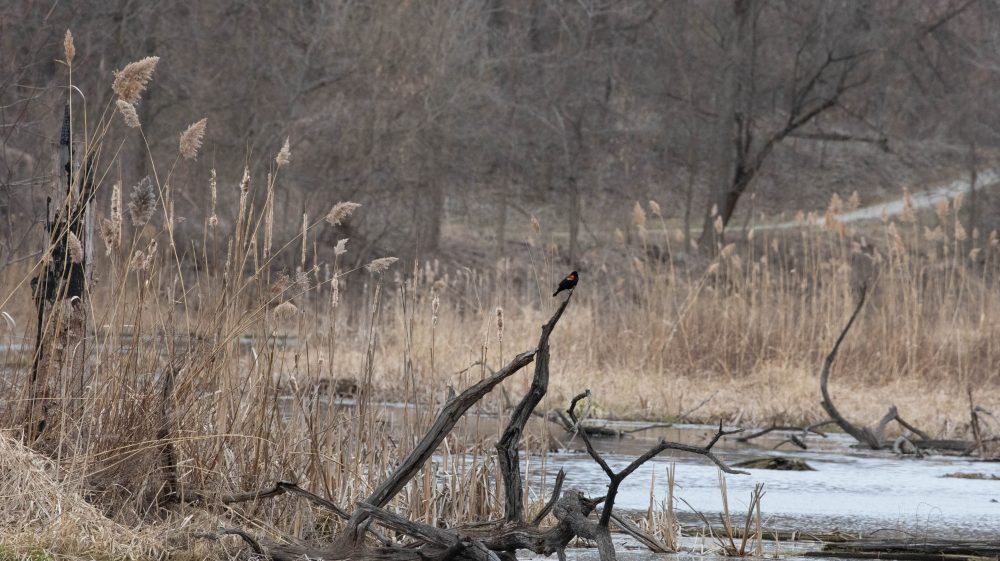
Red-Winged Blackbird

For excitement, on Saturday I focused on the Red-Tailed Hawk below when it landed in a tree across the water, and then got lucky enough to capture its takeoff when it left.

So where are the warbler pictures? I didn’t get them all, but below are a few. The Orange-Crowned was there Saturday. Apparently it is early because I got the “rare” warning from ebird yesterday when I tried to add it before developing my pictures. I hope the image below will be enough proof.

OCWA Portage 09-03-17-4223

Orange-Crowned Warbler

BLWA Portage 09-03-17-4538

Blackburnian Warbler

BAWW Portage 09-03-17-4554

Black-and-White Warbler

I heard several Warbling Vireos and Saturday I managed to photograph one.

WAVI Portage 09-02-17-3641

Warbling Vireo

The Carolina Wren below was a surprise. This appears to be a youngster. I fussed over the image for a while but decided it has to be a Carolina, even if the eyebrow isn’t finished-looking, the bill, the reddish color and the upturned tail indicate Carolina Wren. I also heard one sing, likely it was this one trying out its pipes.

Below is how the Portage looked yesterday.

Portage 09-03-17-4557Abundance below, of Pokeweed berries and Jewelweed blooms. Unfortunately I couldn’t find any hummingbirds enjoying the Jewelweed.

The shelf fungus seemed a bit diminished on this visit.


Shelf Fungus Portage 09-02-17-3790Below, three first-year birds.

RBGR Portage 09-03-17-4398

Rose-Breasted Grosbeak

EUST Portage 09-03-17-4597

European Starling

MODO Portage 09-02-17-3595

Mourning Dove

The cardinal is a likely candidate for first-year status as well.

NOCA Portage 09-02-17-3784

Northern Cardinal

Another view of the Portage, showing off all the native wildflower planting done lately.

Portage 09-02-17-4016I couldn’t decide which photograph of the Common Yellowthroat below to include, so here are both.

COYT Portage 09-02-17-3671COYT Portage 09-02-17-3670And one more of a Tennessee Warbler, adorning Giant Ragweed. Tennessees were most numerous yesterday.

TEWA Portage 09-03-17-4459Apologies for being absent of late. My work situation is in flux, which creates a different kind of distraction. But I promise I’ll be back soon with an update from the yard. It’s been cool enough overnight to leave the windows open all weekend. I think Fall is my Favorite Season.


LaBagh Woods

NAWA LaBagh 5-15-2016-1000I try to get to LaBagh Woods Forest Preserve a couple times a year if not more, at least during migration season. These pictures are from two weeks ago when I went with my friend Susan. It was extremely muddy after recent rains which made some of the trails impassible. Number of species and photographs were not as forthcoming as I might have hoped but we had a good time  Disclaimer: I’m presently suffering from a horrible head cold that started yesterday morning so I will keep this short and sweet.

It was a photo contest between Nashville Warbler (above) and Magnolia (again, show-offs that they are) but it was wonderful to see the elusive and scarce Golden-Winged Warbler. Below are two separate individuals of this species. At least I think they are different birds, we saw them quite a distance from each other.

Rose-Breasted Grosbeaks are always welcome. Below, male and female.

RBGR LaBagh 5-15-2016-0654RBGR LaBagh 5-15-2016-0676I don’t think I stopped bothering to take pictures of American Redstarts and Yellow Warblers (below) but there weren’t many volunteers.

And yes, the Magnolias, posing even when they aren’t.

Below, a Cooper’s Hawk sitting quietly in a tree.

COHA LaBagh 5-15-2016-0822After hearing Northern Parulas in several locations it was gratifying to finally be able to see one or two well and photograph below.

The migrants that likely aren’t going any farther are House Wren and Eastern Phoebe, below.

Also a Swamp Sparrow who could stay in the area.

SWSPLaBagh 5-15-2016-0809The bird below is a male Ruby-Throated Hummingbird – and the lighting is so intense and back-lit there is just no way to show off his ruby throat. But it was nice to see him perched. Welcome back, little fella. Still waiting to see a hummer in my yard…

RTHU LaBagh 5-15-2016-0855

A few more athletic poses by the Nashville Warblers.

If you look closely at the top of the bird’s head below you can see a little rufous in the feathers of a male Nashville Warbler. I don’t know if I have ever seen this with binoculars but the camera lens makes it easier to believe.

NAWA LaBagh 5-15-2016-0964I will be back with more of spring migration. This weekend is probably going to be the last we will see of the warblers that keep going north.

Birding the Hood

AMRO Berwyn 5-24-15-3391A combination of unpredictable weekend weather and outright curiosity caused me to spend some time in the last few weeks walking around the block, so to speak, to see what birds were present. Other factors also pushed me over the edge: reading John Marzluff’s Welcome to Subirdia (still reading it but like three or four other books I’ve started who knows when I’ll finish it), hearing Red-Eyed Vireos singing on my way to work, seeing Rose-Breasted Grosbeaks at my feeder, and not wanting particularly to get up in the middle of the night so I could arrive somewhere farther by daybreak.

AMRO Berwyn 5-24-15-3357

American Robin, 5-24-15

Of course the Robins have been on territory for quite a while, and they pretty much act like they own the place, but they’re still fun to watch.

WODU Berwyn 4-27-15-8748

Wood Ducks, April 27, 2015

One evening I got home from work and saw the two Wood Ducks in the picture above when they landed on top of a chimney across the street. They looked as surprised to be there as I was to see them.

RBGR Berwyn 5-10-15-9739

Rose-Breasted Grosbeaks on the feeder 5-10-15

RBGR Berwyn 5-10-15-9736The three Rose-Breasted Grosbeaks sampling sunflower seeds above appeared to be an adult male, a female and a somewhat immature male (the guy sitting on top of the feeder in the first picture). Maybe the pair were showing junior his first trip north.

RBGR Berwyn 5-16-15-2133

Male Rose-Breasted Grosbeak 5-16-15

A week later there was still a male in the neighborhood. Rose-Breasted Grosbeaks breed in this area, but I think they still prefer the forest preserves.

On May 16 I found two Red-Eyed Vireos but they wouldn’t pose for pictures. However I did manage to engage the cooperative, hungry female Black-and-White Warbler below. She was just down the street from my house.

Black and White Warbler Berwyn 5-16-15-1993

Black-and-White Warbler, 5-16-15

Black and White Warbler Berwyn 5-16-15-1975

Also not far away was the Yellow Warbler below. These are not unusual species but to see them not far from the house is unusual for me, since it never occurred to me that if I was just patient and looked a little harder, I could likely find some warblers in the neighborhood.

YEWA Berwyn 5-16-15-2056

Yellow Warbler, 5-16-15

Blue Jays tend to be heard and rarely seen, but I did get good looks at this one. He probably thought I was a curious sight, walking around with binoculars and a camera.

BLJA Berwyn 5-16-15-2019

Blue Jay, 5-16-15

BLJA Berwyn 5-16-15-2017

Maybe most surprising was seeing a Hermit Thrush dash out from underneath a parked car. I had been seeing one in my neighbor’s yard, so it’s likely the same individual.

HETH Berwyn 5-16-15-2113

Hermit Thrush, 5-16-15

The flowers are all gone now from my Horse Chestnut but that day the bees were enjoying the bounty.

Bee on Horse Chestnut Berwyn 5-10-15-2154Now I’m looking forward to fall migration to see if I can repeat the experiment on those iffy mornings when I don’t necessarily feel like going “somewhere.” It’s certainly easier to take a stroll around the block, and I don’t have to worry about finding my way back to where I started.

RBGR Berwyn 5-16-15-2084Spring migration is pretty much over, although late-comers and late-leavers are still surfacing here and there. Now my focus will turn to breeding birds and, whenever possible, finishing my review of photographs from trips I’ve already taken before I set off for somewhere else…

Hungry Birds

American Robin – Chicago Portage

Fall is upon us. The days are ever shorter, and there’s a chill in the air, all that much more unexpected after the summer heat wave. Although I feel energized by the cooler weather it was not so easy to get up as early as planned yesterday morning to visit the Portage. But maybe my timing was right after all, because I got to see a flock of robins descend into my young Hawthorn Tree to devour its bright red berries. The robins have all but disappeared from the neighborhood, their breeding season over, they’re moving in flocks looking for fruit. I feel honored that they chose my yard (and relieved that the squirrels have not eaten everything). A little piece of heaven on earth.

Ruby-Crowned Kinglet

There were kinglets in good number at the Portage, both Golden-Crowned and Ruby-Crowned. The Golden-Crowned were a little harder to see.

Golden-Crowned Kinglet

Tennessee Warbler

Many warblers were feeding low, the available insects half-asleep and staying closer to the ground.

Northern Waterthrush

A contemplative empidonax flycatcher, most likely a Least, although he refused to vocalize to confirm his species.

Empidonax Flycatcher – most likely a Least

Magnolia Warblers thickened with the Tennessees…

Magnolia Warbler

and a very curious-looking Ovenbird paraded up and down this branch.

Ovenbird

My old friends, White-Throated Sparrows, are returning.

The White-Breasted Nuthatches have been around all summer, but I have never seen one upright.

White-Breasted Nuthatch

And the juvenile Rose-Breasted Grosbeaks are brimming with the promise of their first migration.

Rose-Breasted Grosbeak

A post showing other sides of the Portage will follow shortly.