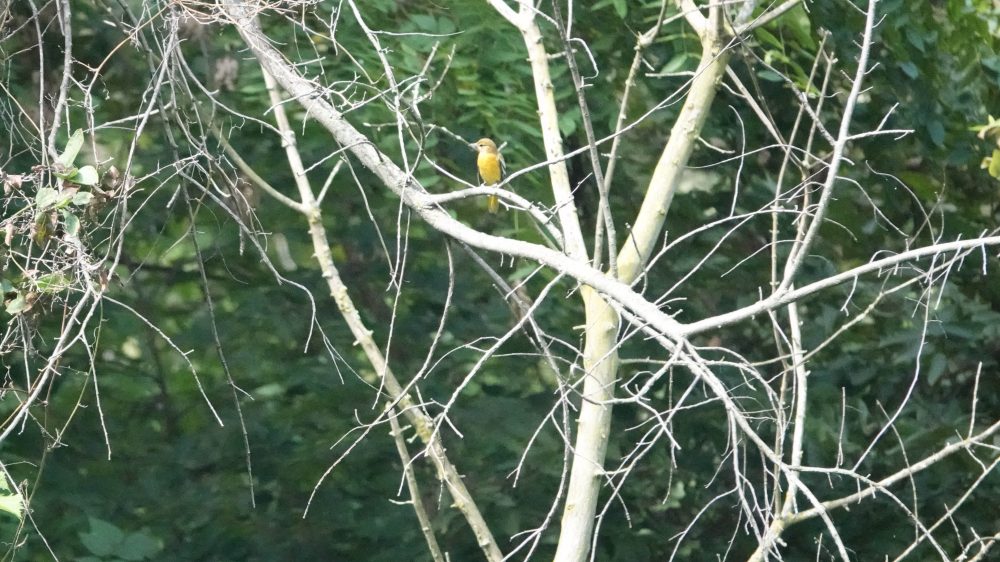
This series of photos is from December 23. I went back on the 26th and will share those photos in a separate post. The weather has since turned a bit more wintry. I decided not to go out today due to early cloud cover and mostly mud – I am getting a bit tired of cleaning the treads of my boots. But I also have so much to do at home that I kept putting off “until I retire” or “until winter” and since I am in both those places, I need to get going on the 20-years-of-accumulated-stuff project.
The sky was dramatic at first but brightened up ever so slightly. There are new piles of chopped wood here and there along the trails. I can only imagine the volunteers were taking care of fallen or about-to-fall trees.
At first this White-breasted Nuthatch was hard to uncover but he came out and made himself known eventually.
Red-bellied Woodpeckers have been more abundant than I remember, but it could just be that for the sake of getting out more, I have become more attuned to their comings and goings. I was delighted to find the flight sequence in my photos, which I put into the carousel below.
A favorite ground-foraging place these days is the trail, and when I’m lucky and the only person on the trail, I can usually stop and watch the birds for some time.
Song Sparrow and female Northern Cardinal
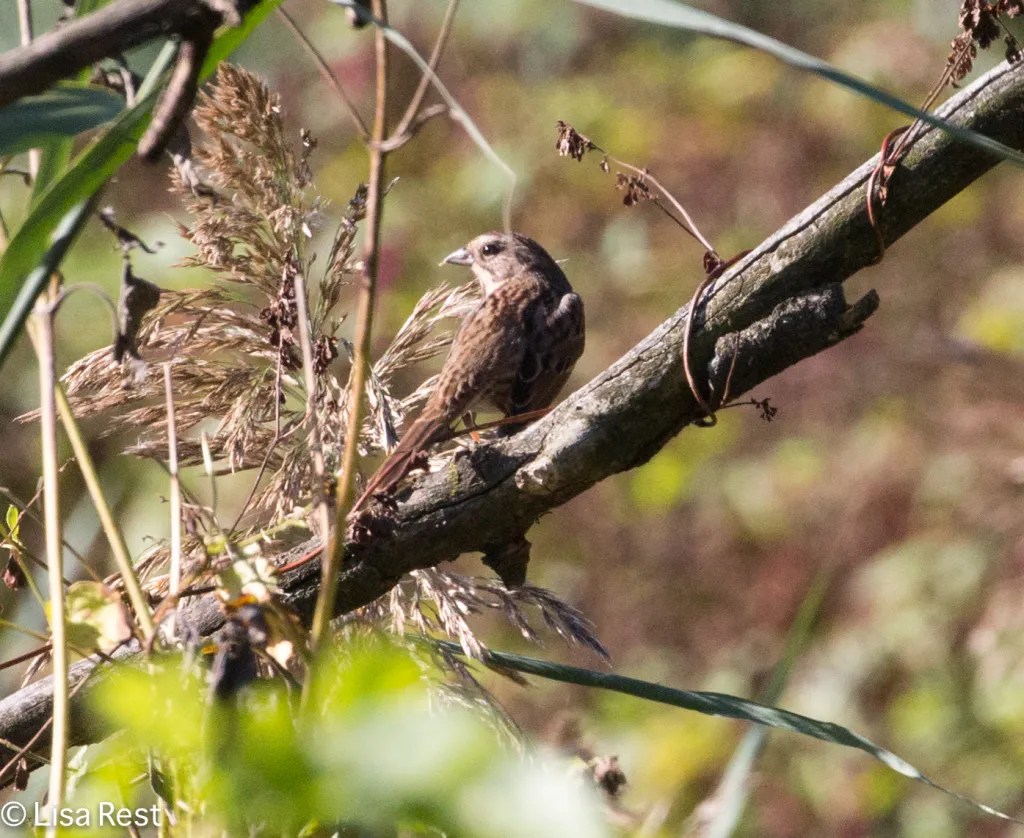
Another Song Sparrow
I was beginning to think my ears were lying to me because I thought I always heard White-throated Sparrows but I was never seeing them. Then this one posed for a picture.
White-throated Sparrow
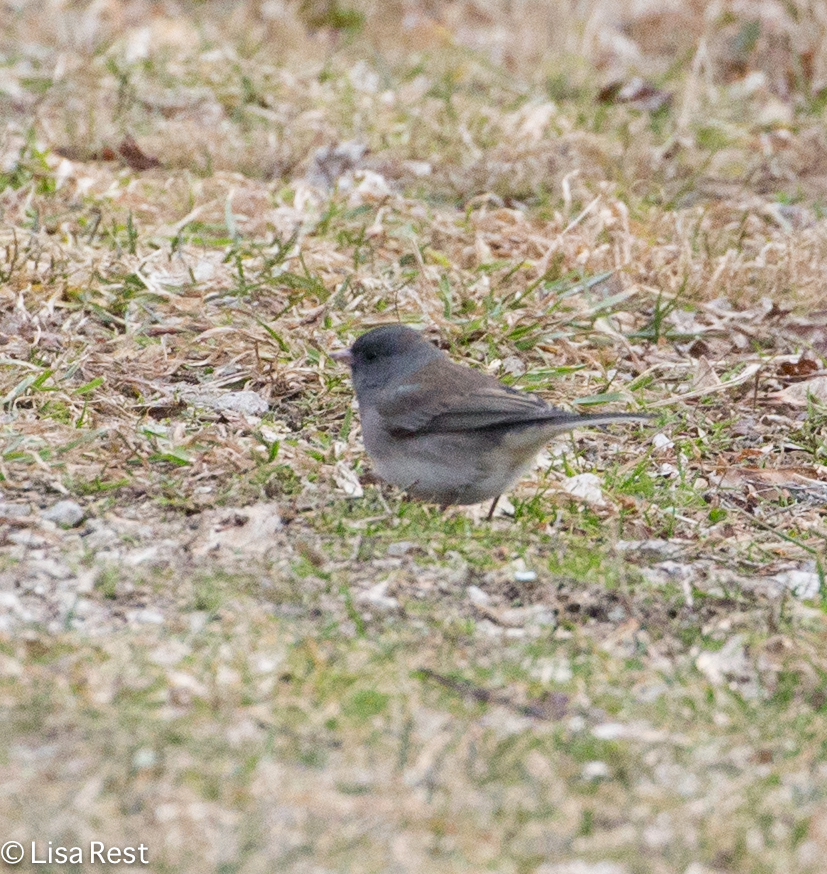
Dark-eyed Juncos are also fond of the gravelly trails.
I could barely focus on this somewhat far-away American Goldfinch, but I so love their muted tones this time of year.
It wouldn’t be Christmas week without a male Northern Cardinal.
I’ll be back shortly with the next installment. The days are getting longer…already!
Even before I dropped the Canon zoom lens, I was starting to feel like at times it might be more comfortable to go out with the mirrorless camera I purchased a few years ago and had stopped using when I was no longer going downtown to the office. Also I had never really figured out how to get the mirrorless to focus on a bird, so it was a good time to start practicing. These photos are from December 1 and 3, at the Riverside Lawn Trail. I have just figured out that the wooded area across the foot bridge that the county reclaimed which has eventually become part of the forest preserves is called Riverside Lawn.
In spite of the lack of light, I managed to get some fairly decent pictures with this camera. Some well spaced-out starlings were actually all in focus individually. It has a very efficient zoom that managed to get quite clear pictures of the Red-tailed Hawk below from across the river. Invariably I have been seeing a Red-tailed Hawk around 10:00 AM both here and at the Portage.
European Starlings
It must have been windy that morning.
Standing on the first bridge, I noticed a flock of American Robins and the European Starlings hanging out in the shallows and bathing. The camera did a good job capturing the action.
Below is a Hairy Woodpecker, which made four woodpecker species on the 3rd – I did not manage to get a picture of the Northern Flicker. A male Downy Woodpecker is in the second gallery, on the same pole.
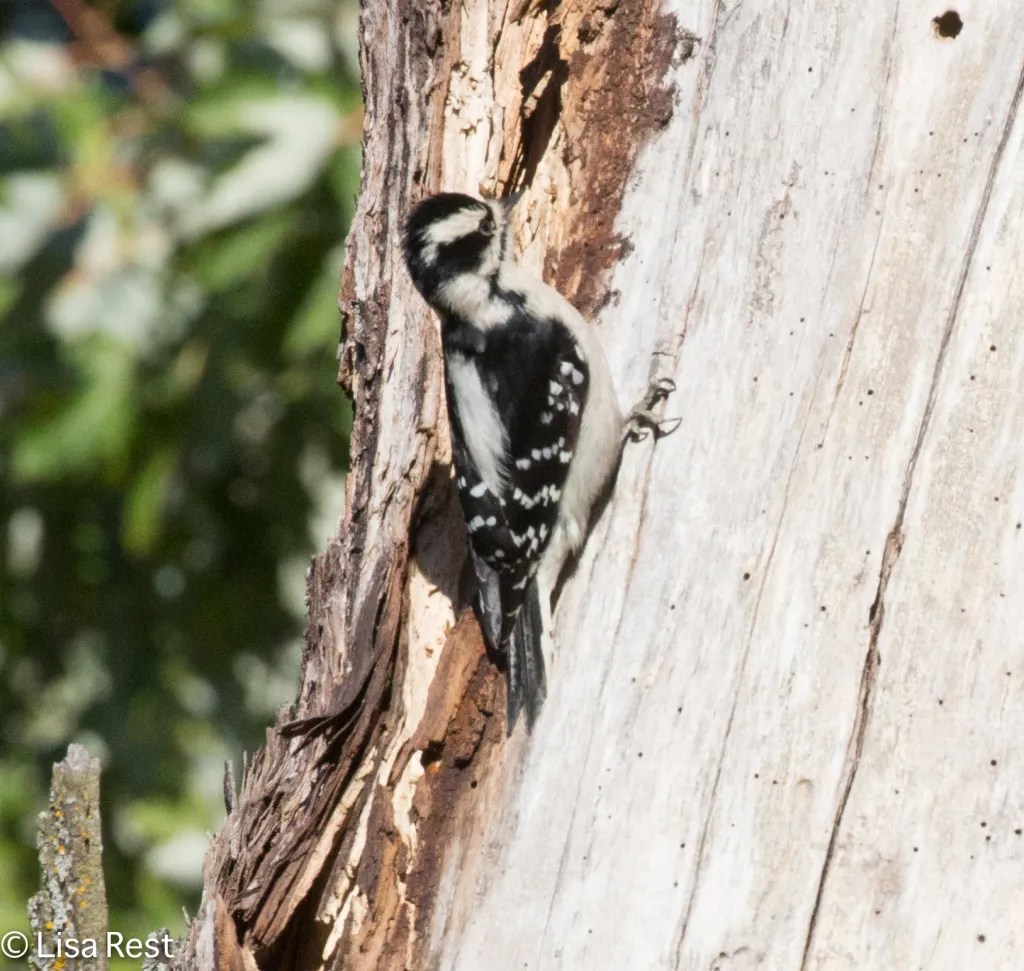
And a female Downy Woodpecker.
Red-bellied Woodpecker
I don’t always see Mourning Doves. But on December 3rd, I was standing just hanging out with the mixed flock and a total of eight Mourning Doves eventually showed up.
There are always a lot of Northern Cardinals, and I was lucky enough to figure out the focus on a few of them after many tries.
A Fox Squirrel and a Gray Squirrel.
For as many Dark-eyed Juncos as I normally have seen – up to 30 or more – they are incredibly difficult to capture more often than not. On the ground, they blend right in.
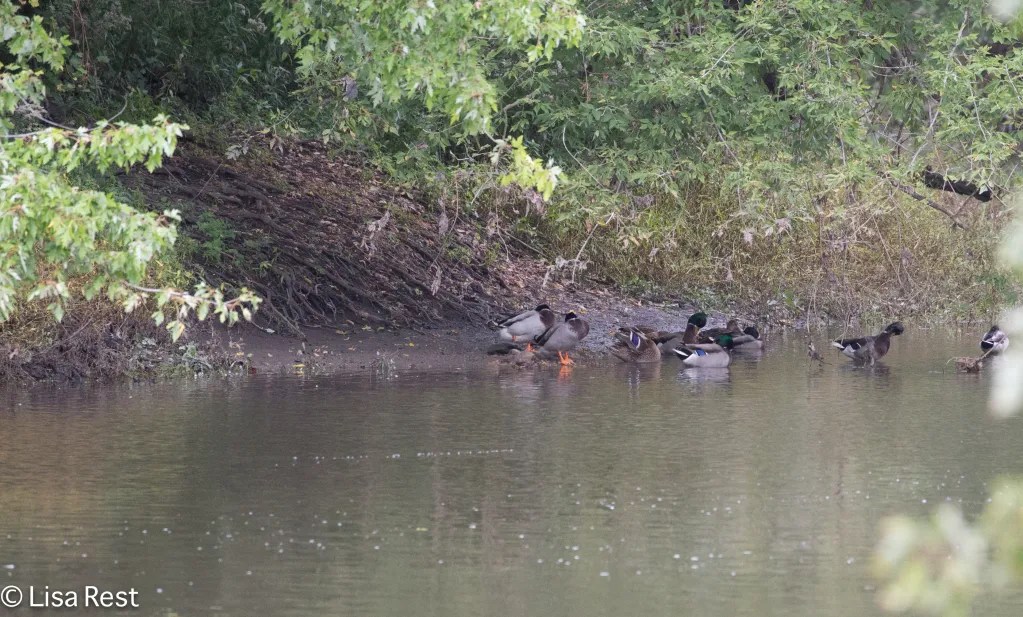
I can always count on Mallards and sometimes Canada Geese.
More dreary views, and the Rock Pigeons that seem to congregate on top of the Riverside Town Hall or the Hofmann Tower.
When it focuses, this camera is great for some really crisp images, so I look forward to using it more often, especially in low light situations. I hope I can get better at focusing all my equipment since I think my ability to determine whether I have the manual focus sharp is diminishing. In this case I gladly welcome artificial intelligence. A wasp nest caught my eye, and I have frequently seen the fungus at the bottom of one tree, which looks like it has been eaten.
I’ll be back shortly with my last visit using my old 100-400mm lens. It’s already proving to be an interesting winter.
A brief but driving squall of freezing rain in the yard yesterday morning supported my decision to not go for a walk. More snow and wind on the way today. A good day to take stock of my indoor life.
Yesterday morning also produced a brief sighting of a Cooper’s Hawk and the appearance of the large gray tomcat I scolded out of the yard as I was refilling the birdbaths before the rain started. I have perhaps 30 or more gallons of water stored in the basement and my rain barrels are still quite full. But we are due for more serious overnight freezing temperatures so I have made this my outdoor project for the weekend, draining the rest of the water and covering up the rain barrels for the winter. If predictions prove correct, we will be getting a little preliminary snow that won’t accumulate but will get us in the mood for winter.
These photographs are from October 17. I was not too surprised to discover I hadn’t processed many of them. I did find another confusing fall warbler which I didn’t report. It appears to be a first-year likely female Black-throated Blue Warbler (below).
Much easier to recognize and still pretty plentiful were Yellow-rumped Warblers.
The bird immediately below appears to have fused with the hackberry leaves.
Then there were the tree-climbing Yellow-rumpeds…
I don’t know why it’s been so hard to get a decent picture of a White-throated Sparrow, but I keep trying.
The Song Sparrow below was a more accommodating.
And another Song Sparrows popping up from the vegetation…
A reminder of how dry it still was in mid-October.
In general, Ruby-crowned Kingets were less prevalent than the Golden-crowned this fall.
Then House Finches started to emerge…
A well-seen Hermit Thrush below…
A momentarily present Northern Cardinal…
Below is an Orange-crowned Warbler… I have yet to see the orange crown on any of these but from what I understand it is barely visible.
It was not easy to get a picture of the Brown Creeper below but this is just further testament to how often I saw at least one almost every time I went out.
And then there were the almost daily White-tailed Deer…
European Starlings were exceptionally striking in the light that day.
I finally broke down and started cleaning up my second bedroom yesterday. It will likely take me the rest of the year – but it’s a wonderfully freeing thought as I plow through an accumulation of treasures and junk. The first and most important motivation seems to be organizing and having one place for all the camera equipment. But hot chocolate seems more important at the moment…
I am sure I have heard a Tufted Titmouse at the Portage on occasion, but I have never seen one until, just as I was about to finish my walk on November 2nd, this one appeared. I had been hanging out with a Black-capped Chickadee and the titmouse insisted on having its picture taken instead.
Black-capped Chickadee
More photos of the Tufted Titmouse are below. In all there are way too any photographs in this post. I am trying to empty them off my hard drive so I can keep up with the present. And there are still pictures of the fall warblers from two months ago. Well. You get the picture.
Birds are moving in flocks now, which generally means you can go for a long time without seeing anything move and then encounter several individuals at once. Below is a flock of Cedar Waxwings.
The 1st was a bit sunnier than the second. Northern Cardinals are easier to see now than they were all summer. Even the females allow themselves to be photographed…as long as they are somewhat hidden and backlit.
Although there are lots of White-throated Sparrows, I don’t often see one well enough to get a picture. This one was a challenge.
Another White-throated Sparrow
One sparrow that has been showing up a lot since I took these first photos below is the Fox Sparrow. They are considerably larger than other sparrows and tend to just sit, so even though this one was behind branches, I could still capture it.
Black-capped Chickadee… and an American Goldfinch
House Finches blend right in to the browns and grays of fall.
Below is a Red-tailed Hawk.
I’ve been delighted to see White-breasted Nuthatches after hearing but rarely seeing them all summer.
Nearly every day I have seen a Brown Creeper.
Here’s about how far away the Brown Creeper was.
American Robins are in flocks too, but every once in a while I spot an individual.
Apologies for Downy Woodpecker overload – it is the start of Visible Woodpecker Season… I love to observe their behavior.
There is a barely-visible House Finch in the two photos below – just to get a feel for how well camouflaged birds can be this time of year.
More Northern Cardinals…
More Downy Woodpecker overload…
Speaking of flocks – Red-winged Blackbirds have been stopping by every day so far, in various-sized groupings.
Some scenes of the fall colors here… The water in the bottomlands has dried up by now, but this was fairly soon after we received a lot of well-needed rain.
Backlit House Finches don’t make very interesting photographs but I liked the surrounding vegetation…
One more Goldfinch…
Below is a well-preserved wasp nest.
This juvenile Red-tailed Hawk was sitting with its back toward me … until it took off.
The Des Plaines RiverThe Portage creek
Thank you for letting me get these off my plate. I will be back soon – either with something more historical or more recent. It’s been exciting for me to go out every day, either way.
This will be brief. I went to McGinnis Slough last Sunday to see if maybe I might be present when some Sandhill Cranes were flying over, or just in general to see what the water levels were like. All the rain had made a difference. Where there was no water to be seen before, now the slough looks like a slough again.
No Sandhills flew over. Indeed, not much was flying.
I saw my last Yellow-rumped Warblers of the season.
Red-winged Blackbirds linger.
I’m always happy to see a Pied-billed Grebe.
.
A Northern Cardinal blended in well with the leaves turning red.
This Song Sparrow wasn’t interested.
It was best to see water again.
For the most part, there were perhaps 200 American Coots scattered all over the slough. They were quite distant, however.
I’m running out of room on the hard drive again so I will be back soon with lots more.
These photos are from two visits to the Riverside trail on October 20 and 27 – both after periods of some significant rain. Although the Des Plaines is nowhere near flood stage, it is good to see it looking more like a river.
Activity around the Hofmann Tower on 10-20 consisted of two flock bursts – the expected Rock Pigeons and also a flock of Blackbirds, mostly Red-Winged.
The bridge
A view from the bridge
I saw an Orange-crowned Warbler on both occasions.
Below is a Nashville Warbler I saw on the 20th.
It was hard to get a good photo of this Double-Crested Cormorant through the trees but still nice to see on the 20th. I saw one flying a week later and wonder if it was the same bird…
It’s somewhat easier to get Northern Cardinals to sit still for a photo this time of year. As long as they feel somewhat shielded by a twig…
I saw Brown Creepers on both occasions, and was lucky to photograph this one on the 27th.
A Mallard here and there…
European Starlings are in groups, as usual.
One of those Red-winged Blackbirds still hanging around.
Below on the left is the sign posted at either end of the trail in Riverside that runs along the river. On the right is a sign opposite the western end of said trail, which denotes the Plank Road Meadow which features a boat launch.
House Finches are more visible now.
A tree full of Mourning Doves…
I expect to see more White-Throated Sparrows, but managed to capture only the one below.
I was going to simply add the photo directly below and call it a Tennessee Warbler – even though the face looked a little suspect to me. Then this morning when I flipped over the Audubon calendar hanging over the kitchen sink to November, the photograph of the bird on it looked like the one below, only it was identified as a Pine Warbler. So I took out The Warbler Guide to confirm – because now it was showing up as “rare” on my ebird checklist – and went to the bill shape again. That’s what made the face of this bird not look at all like a Tennessee.
Just to elaborate, I rescued the photos below from my external hard drive and found a few more clues to the Pine Warbler identification. There’s ever-so-slightly a hint of wing-bar showing on a couple photographs, but best of all is the one I brightened up a bit, where the bird is looking directly at me. That’s a Pine Warbler face if I ever saw one. I have to be more careful going through all these photos!
Below is a lovely little Song Sparrow.
The remaining Great Blue Heron is not as visible now from the bridge.
Catalpa tree seed pods on the left, and well-eaten Pokeweed on the right.
An American Robin for good measure…
Not sure whose web this is but I found it interesting.
I saw the Red-tailed Hawk flying below before it landed in the tree.
A few more scenes of this location as the late fall progresses.
We are flirting with overnight freezing temperatures. Indeed, this morning I had to scrape the frost off the windows of the car before I went for a walk at the Portage. Today I will be draining as much water as I can store into empty vinegar gallon bottles, to be used in the now-heated birdbaths all winter.
And as the days get shorter and I see fewer birds… take fewer photographs… maybe I can start revisiting the reason why I started this blog in the first place: my fascination with bird song and the birds’ reactions to music. For the moment, I would like to share with you a funny incident I happened to record way back on August 29th. I was playing piano – I have been revisiting Schumann’s “Kinderszenen” – and perhaps that day it had become a bit of drudgery – I was likely distracted by the fact that my effective retirement date was 2 days off. In any event, I struck a wrong chord while playing the 9th piece of it (“Ritter vom Steckenpferd”) and my indoor crowd IMMEDIATELY let me know that was not acceptable. Which not only proves they were right, but also that they are always listening! Below is the clip. Enjoy. 🙂
I went to the Riverside trail on October 15. It was extremely cloudy and I had no idea what I could muster photographically under such conditions. I walked as far as I was going to go in one direction along the river and then turned back, and found a very green-looking warbler foraging low in front of me. When I got home to review my photographs, I could not for the life of me figure out what it was. I could only surmise what it wasn’t. The pale-looking eyebrow, the darker green primaries didn’t fit the Orange-crowned Warblers I was used to seeing.
After a good night’s sleep it occurred to me that perhaps the way to approach the bird’s identity was to look closely at the bill shape and size. Color and feather arrangement might seem changeable in a photograph but the bill shape would be constant. And that led me to thinking this was a Mourning Warbler.
As it turned out, when I opened my copy of The Warbler Guide, I found one small photograph that exactly matched my bird. She is a first-year female Mourning Warbler. I was excited as it has been years since I’ve seen a Mourning Warbler altogether. I added some of my photos to my ebird report and made the email-generated Cook County Rare Bird Alert (“RBA”) – I guess she’s a little late making her way south.
A distant Northern Flicker accented the cloudy background.
I have really become familiar with Orange-crowned Warblers this fall. And while I’m looking at bill size and shape, this species has a distinctly small, sharply-pointed bill. Some photos of an Orange-crowned Warbler are below.
For comparison, below are some more photographs of the Mourning Warbler.
Fall is a good time for woodpeckers.
Red-bellied WoodpeckerOrange-crowned Warbler
Fall is also a good time for squirrels and nuts…
A cloudy sky.
I have really enjoyed seeing Great Blue Herons here.
And Great Egrets were present too.
Only Mallards are showing up in the waterfowl department.
There are always some Northern Cardinals but this was not a good day to capture one.
The other bird that made the RBA was the Gray-cheeked Thrush below.
Golden-crowned Kinglets have been fun to follow the past couple weeks.
A fall tangle of leaves.
The river looks a little fuller than it did. I envision being unable to do this trail when we start getting a lot of rain…
Here are a few more photographs of the Orange-crowned Warbler who was my best model.
Below is a female House Finch.
I thought the Great Blue Heron against the clouds was worth capturing.
One more of a Northern Flicker…
I have been back to the Riverside trail twice since this cloudy day. We are finally starting to cool off. This morning the Great Egrets were all gone. To be continued… but now, I need to get ready for choir rehearsal.
Thanks to a dog walker I met twice last week… I visited a new-for-me place which has been in my backyard, so to speak, all along. I had been meaning to check out the Riverwalk on the Lyons side of the Des Plaines but never realized the other side had a park along the river called Indian Gardens. Many thanks to Ken the architect from Riverside who told me about it. It’s actually closer to home than the Portage, even, by about a couple minutes.
These pictures are from two days’ visits. I parked on the Lyons side and then walked across the bridge and through the Indian Gardens park. I didn’t venture past the tennis courts the first day, but on the second day I walked through them and found where there is an “unmanaged” trail along the river where I will be going more often.
The Lyons side has a fantastic Hoffman Tower which provides a place to hang out for a sizable number of feral pigeons. It occurred to me that I hadn’t seen a flock of pigeons in flight for quite some time.
Walking through Indian Gardens
Blue Jays seem to be everywhere lately. They’re carrying on noisily and are even sometimes visible.
Time to get your fill of Magnolia Warbler photographs because I just barely saw one the last couple days – I think they have moved on, after dominating the warbler migration scene for two weeks. You can click on any of these pictures to get a better view.
Monarch Butterflies are still migrating here and there.
There are a lot of Northern Cardinals at this location, but they are more often heard than seen. I did manage to capture a few females, though. I’ve never seen one capture an insect – it looks like a grasshopper. And then the one perched in a tree with its leaves already turning – she nearly blends in.
It’s absolutely wonderful to see the Great Egrets – even if it’s mainly due to the fact that we haven’t had any substantive rain for at least a couple weeks and it’s been hot, so the middle of the Des Plaines River is very low – perfect for waders.
There were 4 Great Egrets on my last visit – only 3 visible in this photograph
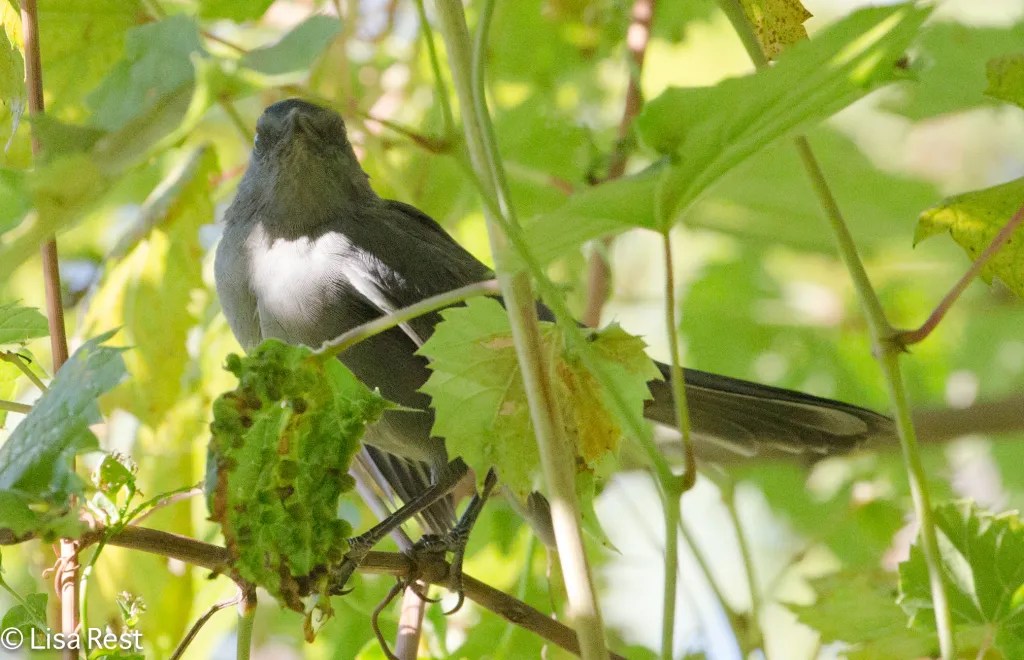
Gray Catbirds have evaded my lens nearly all summer and now they are getting bolder as they prepare to fly south. The young bird amongst all the dead leaves was right at my feet on the Lyons side.
Canada Geese are moving around and I always love to see them in flight.
Not as many Great Blue Herons as Great Egrets but they are also taking advantage of the shallow river.
On occasion, a Double-Crested Cormorant. Since they are divers, I can’t imagine this bird was too happy with the shallow water situation.
European Starlings are not in huge flocks like they were several years ago. Here’s a few staked out on a dead tree.
I was delighted to see a Belted Kingfisher fly by noisily on my second visit, as I crossed the bridge.
A sneaky closer view of this Great Egret.
Below is a busy Blackpoll Warbler, blending in with the leaves.
Blackpoll WarblerAn American Robin – I liked its perch choice
I saw the Osprey on both visits. On my second visit, just as I discovered the access point to the trail closer to the river, I inadvertently disturbed the Osprey – it was perched in a large tree right past the trail head, until I approached – so I will be more careful to look for it before I venture forth next time. The bird flew across the river to perch on the tree below. It was quite something to have a bird with a 63″ wingspan take off right over my head.
I was happy to find a Canada Warbler and took advantage of its willingness to stick around for several shots, albeit at a distance. This looks like a first year bird, with a faint necklace.
Swainson’s Thrush
I was trying to capture the Gray-Cheeked Thrush below and was photo-bombed by a Magnolia Warbler.
I thought it would be easy to combine all these photos into one post but it seems I have overshot my limit again.
Many more photos to come – if I can keep up with it. I have to get used to my new routine, while it lasts anyway. I have a feeling I will be delving into the archives over the winter months playing catch-up. This morning started off cool and cloudy at Columbus Park where we had a scheduled walk. We didn’t see very many birds and those that we did were not easy to capture in low light. I feel like I’ve been given the rest of the morning off to finish this post.
On May 1st, on a somewhat cloudy morning which turned sunnier, I encountered the first of a few Blue-Gray Gnatcatchers coming to claim their territories for the summer. This provided an unusual opportunity to grab some really nice photographs.
Of course there were other birds available, if not all quite as accessible. Below, my last cooperative Ruby-Crowned Kinglet.
Palm Warblers were around – they were in the first wave, so to speak. I may still see one or two but I think for the most part they have moved on to their breeding grounds far north of here.
I did manage to barely capture this Northern Cardinal who was convinced he was pretty hard to see.
I am not sure if Mourning Doves are in decline but according to the U.S. Fish and Wildlife Service their numbers dropped in 2020 from 2018 and 2019. I simply feel as if I have seen fewer of them.
Here’s a little bird I could stand to see more of. Field Sparrow. I likely will see some throughout the summer in their more suitable grassland habitat.
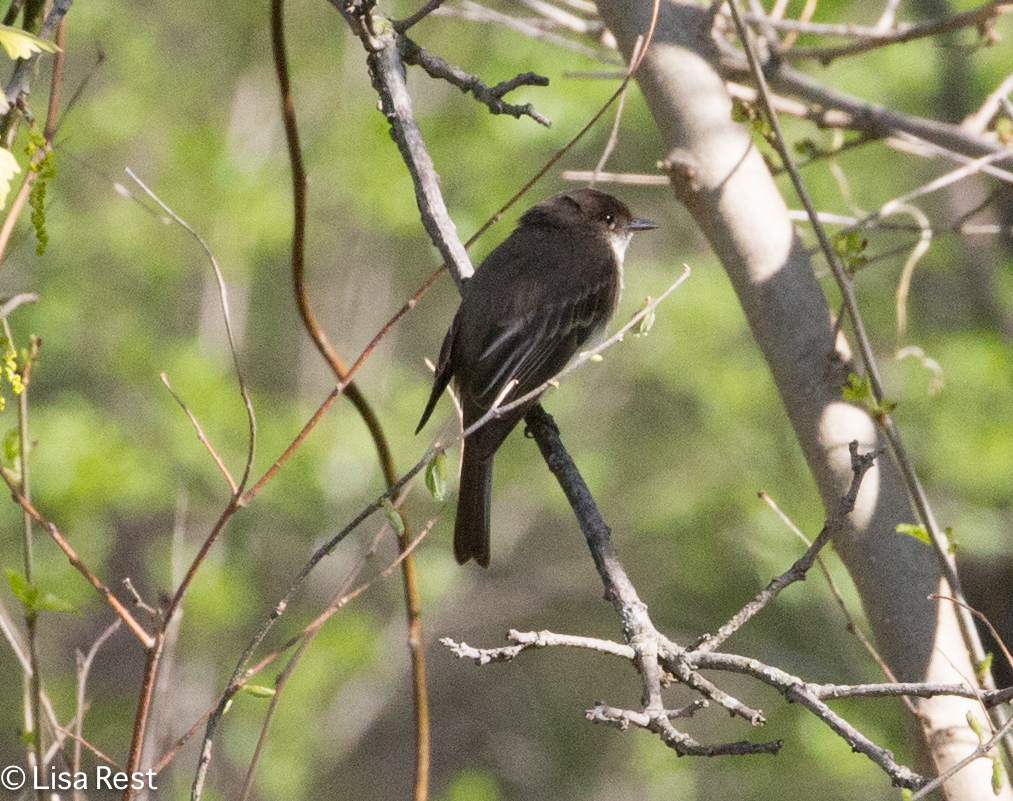
Eastern Phoebes seem to come and go at the Portage so far.
A Canada Goose … and a Turtle. There was slightly more water three weeks ago but the drought was already affecting everyone.
There’s still always a chance to see a Bald Eagle fly over.
Here is a distant Black-Throated Green Warbler that I missed a closer view of while talking to two photographer friends – I was blocked by a tree and thought they were taking pictures of the Palm Warbler I had in the photographs above.
It’s hard not to feel a little disappointed that I have not made it to the Magic Hedge – Montrose – on the lakefront, where as many as 28 warbler species were seen last Saturday. There were also as many as 40 birders. It used to be daunting enough to drive and park when I wanted to go on occasion, and now parking meters are being installed with likely few other options if you don’t find a space. I suppose there are other ways to get to Montrose safely with optics but they all contain extra expense (like an Uber). I would endure public transportation but not with all my gear. I will have to be satisfied with whatever the places I visit have to offer. Birds can still show up anywhere. I hope next year I will not be constrained by my current schedule, and barring any more accidents, I will be able to go out more. Maybe even make a trip to the Magic Hedge.
That said, we are in the 80’s thru Tuesday with a brief drop into the 70’s after that – and praying for rain. I intend to get out early tomorrow for a cloudy walk and see what I can see.
At home, my Zebra Finches are bored with me sitting on the futon working. Up until today I was wearing something they could play with, but today my legs are bare and my half-socks are uninteresting at best. The air conditioning has already come on a couple times to keep us at 79 degrees which is made more comfortable by a couple fans blowing. Summer Mode.
On that warm weekend nearly three weeks ago – I write this as we chill again after a bit of April Snow yesterday morning and into freezing overnight – I went to McGinnis Slough for a few birds and was greeted by a lot of singing in the sunshine. Thankfully, there was not a lot of traffic noise from LaGrange Road. The primary contributors to the recording are Red-Winged Blackbird males.
Birdsong at McGinnis Slough
This time I got to see one of the Sandhill Cranes that I missed the weekend before. I have to wonder if they are nesting there…
No shortage of Red-Winged Blackbirds showing off.
And not showing off…
A male Wood Duck managed to swim by my lens.
Northern Cardinals didn’t offer many looks, but I managed to add these two for the record.
The iridescence of this Common Grackle’s neck caught my eye first.
This was the best I could do for a Song Sparrow, even though I heard a few singing. The song of one is below the picture.
Song Sparrow
This view overlooking a part of the slough perhaps conveys the feeling evoked by the toad chorus below it.
American Toads, I think
Never at a loss for American Coots this time of year. But I was most impressed with the one standing on a log poking out of the water, preening and showing off its pretty green legs.
Mallards… one hen very comfortable in her chosen spot.
It wouldn’t be an authentic visit to the Slough without a Great Blue Heron flying somewhere.
I was excited to see an Osprey, however briefly.
One male Blue-Winged Teal was close enough to capture.
Perhaps my most thrilling bird sighting that day was this lone Tree Swallow. It was actually warm enough for it to catch bugs in the air.
I always have hope to be back to this page sooner than later. Here’s to more sunshine, warmer weather and more reasons to treasure longer days while they last.