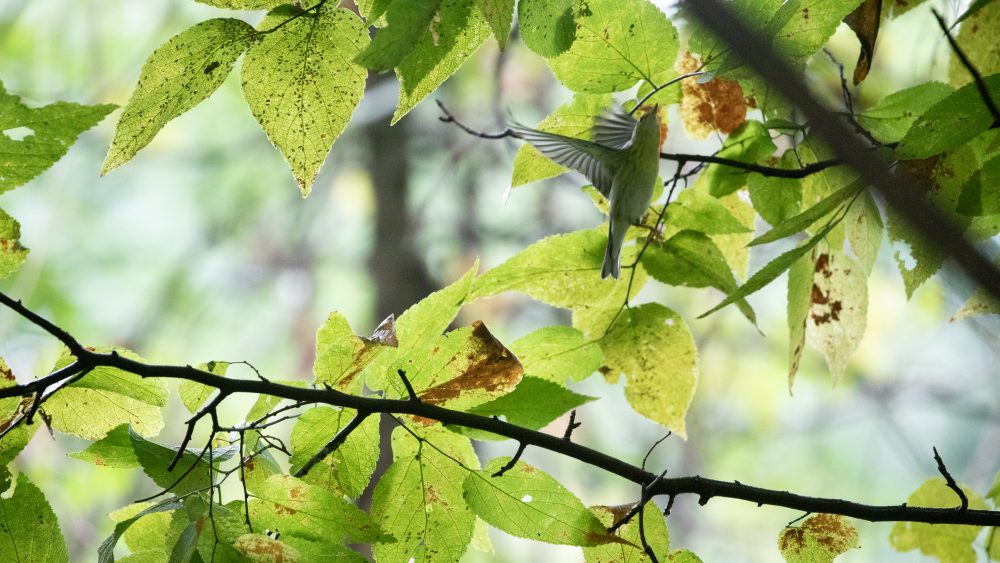

Rose Mallow at McGinnis
As the days get ever-so-slightly shorter, commitments increase. I’m not sure why that is. But suddenly it seems there is less time for more things to do. A visit to McGinnis Slough had been on my mind for weeks ever since the last time I drove by the entrance was closed for paving the driveway, and there was no access. I got up as early as I could Sunday morning to visit the Slough and then the Portage.

A Slough in name only…
I think the last time I posted from the Slough, I was commenting on the low water levels following perhaps a flooding situation. But the summer weather since has not been kind to the Slough. Indeed it is all overgrown and there is barely any water, so all the birds I would normally see have gone somewhere else.


There were Mallards and Wood Ducks. I saw two distant Great Egrets, but no Great Blue Herons. Normally the slough would be hosting scores of these herons. No such luck this year. Perhaps indicative of the situation was the first bird I saw, the bedraggled-looking Northern Cardinal below.
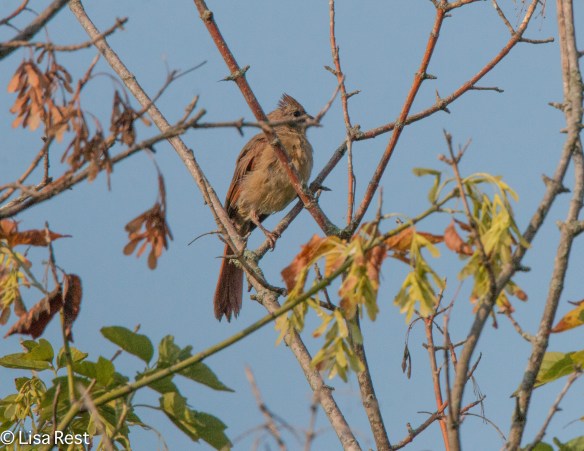 There were a few blackbirds around too, but the breeders are gone.

Red-Winged Blackbird, hiding the red
When not distracted by birds, the vegetation grabs my attention. Could this be a new grass taking over? I think it is Bristly Sedge.


It was then I went to the Chicago Portage. I got there just in time to encounter all the dog-walkers, runners and cyclists, but it is always worth checking out. I have to remind myself sometimes that seeing fewer birds than I might want is still worthwhile from a reporting standpoint…
 There were more Cedar Waxwings (below) than any other species. I can only assume they were cleaning up whatever mulberries the robins, who were absent, had left behind. That’s right, the robins that virtually take over the landscape have all gone somewhere else. I’m envisioning large fruit-eating flocks already in mini-migrations.


There was one distant but distinct Ruby-Throated Hummingbird. I hope to see more, as there is plenty of Jewelweed in bloom, but the window is narrowing for this species. Maybe I’ll have another week or two…
 The theme for the day, perhaps, was shaping up. These were young birds starting to find their way in the big wide world, like the Eastern Kingbird below.


And the scraggly youngster below appears to be a young Great Crested Flycatcher.
 I expect to see a lot of juvenile Indigo Buntings in the next few weeks, but Sunday just about the only bunting I encountered I could barely see.

Indigo Bunting
I was happy to see a Turkey Vulture (adult) in the neighborhood. I think seeing so many different vulture species in East Africa years ago instilled a love and respect for them. Lately I have seen groups of these hanging out by the highways, where I’m sure they make a decent living off of roadkill.
 The most accommodating bird at the Portage was the cardinal below who was singing with his back toward me but I guess that feeling of somebody looking at you caught his attention and he turned his face toward me.

Northern Cardinal
Starting this Saturday, I will be leading weekly bird walks in two alternating locations. I was recruited for this position by a fellow bird-watching choir member. We’ll see how it goes. I plan on taking the camera with me, but the leading and listing responsibilities will make photography challenging. If nothing else, I will become more familiar with the two destinations which up until now I have rarely visited. The whole purpose of this is to catch the fall migration wave. I promise to report back as often as possible.


I almost forgot my little insect sampler from the Portage. Worth mention, perhaps, is the fact that there were at least 20 Monarch Butterflies. But it’s still hard for me to believe that is a larger number than I have seen all summer.
So as we experience the changes in the weather, the environment, the species we see… the changes are unsettling, but that’s still another glass is half-empty/half-full quandary.
My last thought is a little summertime-feeling music – Trois Gymnopedies by Eric Satie. The recording is from almost 4 years ago when I had fewer birds, it was the start of the second flock, and most of the Zebra Finch solos are the beginnings of my star singer, Arturo Toscanini, whose songs have progressed far beyond this and they continue to grow. One of these days I’ll have to see if I can trace the evolution of his song cycle.


 On the drive up I saw a Common Raven and then finally on our last outing one flew over.

 There was no shortage of young Mallards in various stages of development.
 Mute Swans, albeit introduced, are still lovely to look at.


 On our way out we found most of the gulls were on the road in front of us. We estimated 2100 Ring-Billed Gulls and about 100 Herring Gulls mixed in amongst them.
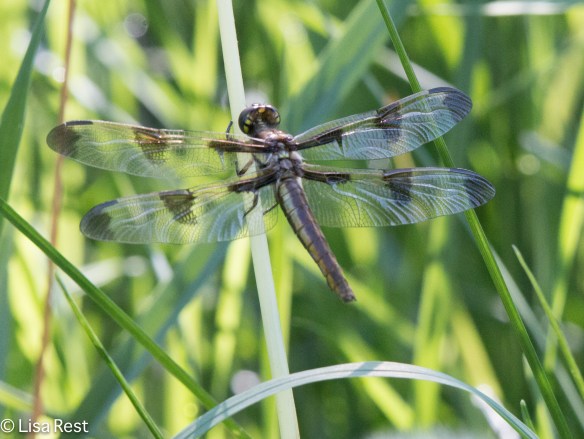
 Here’s another Halloween Pennant. I have seen more of these dragonflies this year and I don’t recall having seen them before. Changes everywhere, big and small, and I guess this could be yet another one of them.
 The woodchuck above was found by Marty, a non-birder in the group, whom we dubbed the Mammal Spotter. I don’t think I’ve ever seen a woodchuck before…!

 Our last bird from Hartwick Pines, the Scarlet Tanager above, offered himself up for a series of photographs. Those tall pines do their best to make lighting difficult but I could not resist trying to capture him since he was at eye level.
 And one more photograph of the Broad-Winged Hawk which started off Part 1, who was also at Hartwick Pines, vying for the Most Memorable Bird award.
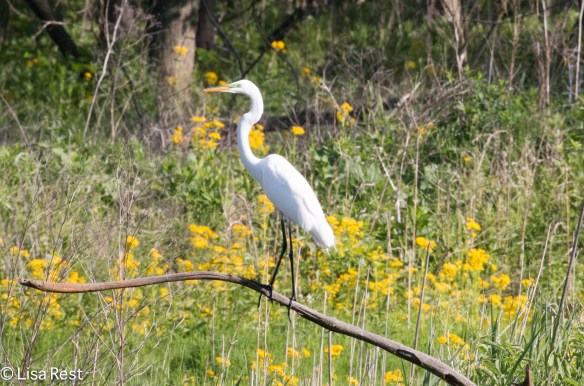 It was nice to get good looks at the Great Egret that seems to be back in the area. The Green Herons were absent this visit but I suspect all the herons go back and forth between the Portage, Ottawa Trail and the Des Plaines River, so I am sure they are still around.


 And the Indigo Buntings did not disappoint.


 Two surprise birds below, neither of which were very visible, but I can now look forward to finding them again. Great Crested Flycatcher on the left, which we saw on our way out, and the camera just barely caught the Yellow-Billed Cuckoo on the right. I had pointed the camera lens at its curious-looking eyes peering out at me from where it was perched, and then it flew. I’ve heard cuckoos before at the Portage but have never seen one there until now.

 There were likely more Common Grackles than we saw, but this one was foraging in the bottomlands by the Des Plaines River.


 Two distinct silhouettes below: Double-Crested Cormorant and Turkey Vulture.


 Waterfowl at McGinnis are usually distant and hard to see. Sometimes I take pictures and blow them up later to see what I was looking at, not that I ever get a very good image. Below the Mallard family are a couple pictures of a Great Blue Heron in flight and more Wood Ducks. I was surprised to not see any Great Egrets yet at McGinnis, as they can be everywhere. Likely they’ve been thrown off by the crazy weather too and I’m more confused than they are. I’m sure I’ll see them as we slide into summer.


 I’ll be staying close to home, there’s much work to do in my yard. Not feeling up to rushing yet. Still savoring life in the slow lane.
 Last year two fellows I run into occasionally at the Chicago Portage, Steve and Mike, told me they had seen a Great Horned Owl. I believe it was Mike who showed me his stunning photo of the owl sitting on a stump over the water. But I never saw the owl until two weeks ago making my return trip on the trail that runs along the south side of the stream, when I flushed it and watched it fly to perch in a tree on the other side.
 So are they a pair? Most likely. I suspect the first owl is the female as it is larger. Then I wonder if they have a nest somewhere or if they’re shopping for one. Will I see baby owls? It’s more excitement than I can handle at the moment. But I do suspect that the owls’ presence will keep the other raptors I normally expect to see at the Portage away.


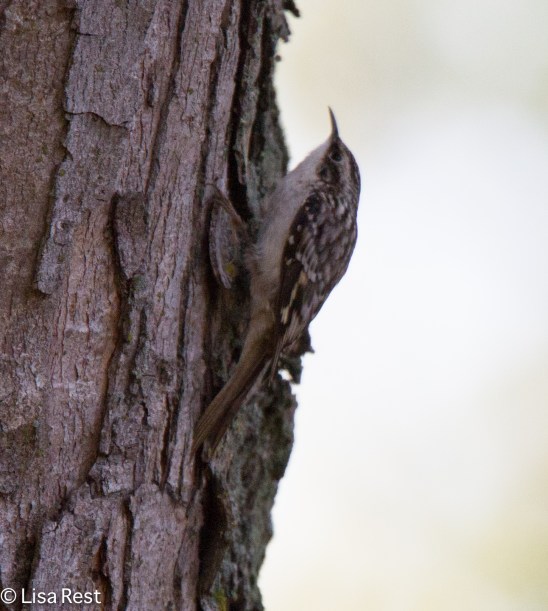 Closer to the end of our walk the intense sunlight started playing tricks with color and it wasn’t until I got home and processed the next few photos that I realized what we had.


 If I’d given it much thought I might have gone to the Little Red Schoolhouse yesterday to chase a lifer. There’s a Prairie Warbler there, and to the best of my knowledge I may have heard one but I’ve never gotten a definitive view. But after a too-long-put-off thorough cleanup of the living room (my putting off has consequences – there are a few new residents), I was too tired to think and the best I could muster was a visit to the Portage, and, after all, I haven’t been there for a couple weeks so it’s always good to see what’s happening. American Robins were everywhere, from busy adults feeding their likely second brood to fledged birds figuring things out. I estimated 50 or more.


 On another note, a section of my yard has been plagued by the plant below for two years and I spent an hour yesterday carefully digging out as much as I could, hoping anything I planted around it will take over. I don’t know what it is, so if you are a wizard and can identify it I would be most grateful.


 McGinnis and the Little Red Schoolhouse are on my mental list for next weekend, weather permitting. Even if the Prairie Warbler isn’t available, there are often Red-Headed Woodpeckers, which I don’t get to see too often. Maybe there will be some butterflies too!


 I hope to be back once more if possible, with an update on my indoor crowd – before I leave for a quick trip to Panama. I’ve been planning this trip for months and unbelievably, all of a sudden it’s here.
 Thanks to you all for checking in. Until next time… Peace and Think Spring.


 Anyway, fatherhood has been good to Drew, who had a twisted and overgrown bill that I kept trimming from time to time when I was able to catch him. His bill seems to be normal now as he is feeding his offspring. Not that I detect an awful lot of feeding going on. It seems to be much more sporadic than with the finches, who clamor for food every waking moment. Instead the Diamond Dovelings tend to sit around all day, waiting patiently for a parent to bestow some food on them. I’m not getting into this, it’s totally up to Dudlee and Drew. They must know what they’re doing because the kids are growing exponentially every day, in spite of my perception that they are being somewhat ignored.
 The four-day weekend had already gone to my head by Thursday, and I could envision retirement being worthwhile if only it was attainable. The relaxation of a long weekend is persuasive. I’ve done all my major cleaning, I made my first loaf of bread in almost a year, playing piano and trying to get back to writing songs with the guitar… But I’m not ready to share that yet, so below are a couple short videos of the Diamond Doves. Drew’s singing to his chicks in the second one.


 Two views of the ever-changing but somehow always familiar Chicago Portage.

 I’ll be back. Looking forward to my remaining cataract surgery on Wednesday, hoping to finally start fixing things up sight-wise. Then I’ll have no excuse for not being focused!

 Yesterday morning was perfect fall weather, the sun was shining, it was cool but comfortable, and it seemed like I should walk around and get used to taking pictures looking through the camera lens with the right eye again. I have had the new prescription for a week.


 Passerine migration is over for all practical purposes. Birds have taken to their breeding grounds and are getting down to business. Here are some photos from the last couple weekends, starting with the Prothonotary Warbler above, seen at Indiana Dunes State Park.
 I’ve been busy writing silly songs, working, gardening and starting to get ready for a trip that will begin on July 1. I am now glad I inadvertently planned to be away before the Democratic National Convention. I’m growing weary of the daily drama and it will be good for my head to be totally oblivious to politics for a couple weeks.