Summer Dreams Close to Home

MALL 6-25-17-0598If I’d given it much thought I might have gone to the Little Red Schoolhouse yesterday to chase a lifer. There’s a Prairie Warbler there, and to the best of my knowledge I may have heard one but I’ve never gotten a definitive view. But after a too-long-put-off thorough cleanup of the living room (my putting off has consequences – there are a few new residents), I was too tired to think and the best I could muster was a visit to the Portage, and, after all, I haven’t been there for a couple weeks so it’s always good to see what’s happening. American Robins were everywhere, from busy adults feeding their likely second brood to fledged birds figuring things out. I estimated 50 or more.

Most of the usual suspects were there but there were notable omissions. I didn’t hear or see one Song Sparrow, nor a Yellow Warbler. The Green Herons don’t consider this a proper place to raise young anymore as the water levels have changed too radically. And I don’t know if it was because it was cool and windy, but there were no butterflies, hardly any insects at all, except for a few dragonflies.

WAVI 6-25-17-0526

Warbling Vireo

Always hearing Warbling Vireos – there’s at least four singing males – but rarely get to see one, so this was the best I could do as this one was navigating a branch. At least you can see its blue legs (if all else fails, this confirms it’s a vireo).

INBU 6-24-17-0462

Indigo Bunting

Indigo Buntings also breed here a lot now, but the only one I could get even half a photograph of was the juvenile above with a strange white patch on his tail feathers.

BAOR 6-25-17-0515

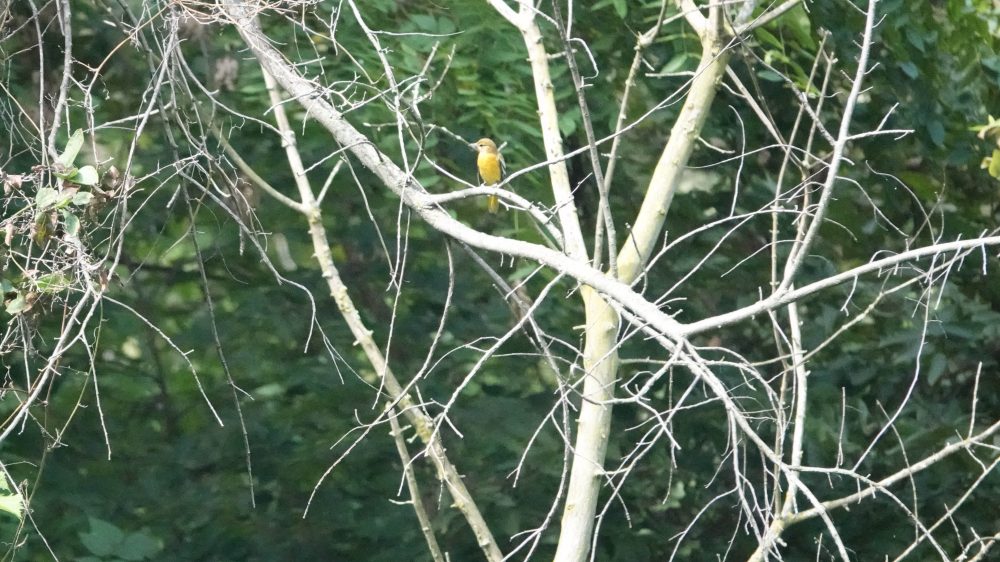
Juvenile Baltimore Oriole

Several Baltimore Orioles and House Wrens …

After weeks of hearing a Carolina Wren and never seeing it, I finally saw two. Although I did not see the singing wren, I believe the two below are his mate and offspring. He was singing clearly from wherever he hides so I’ve included his song below the pictures.

One of the Southwest Airlines flights over the Portage…and thistle in various stages of bloom, unfortunately not occupied by American Goldfinches as in visits past.

Birds were not the only wildlife. A young White-Tailed Deer appeared in front of me on the trail.

And a Beaver swimming quietly through the open water.

Beaver 6-24-17-0506

Above, a Gray Catbird on the left, and a section of a large birch which is one of my favorite trees.

I was surprised to hear and then see the American Redstart below. This is the first time I’ve seen any warblers other than Yellow Warblers here during breeding season, but it’s not out of its range.

One lone Canada Goose sampling the duckweed portion.

CAGO 6-24-17-0720

Meanwhile back at home, blooms are starting to happen. My forest of Purple Coneflowers is off to a good start. I hope some butterflies show up soon.

The bright yellows…of a bee on something I should recognize but somehow almost everything that was planted in my front yard is still strange to me, I have to get out the books and study. On the right below is the Rudbeckia that was budding last week and the first of many sunflowers planted by the inevitable scattering of black oil sunflower seed.

All the milkweed in my front yard has planted itself, and it is blooming beautifully. And it is fragrant. I am not used to smelly flowers, this is quite unexpected. I hope it smells enough to attract Monarch Butterflies.

Swamp Milkweed 6-24-17-0438On another note, a section of my yard has been plagued by the plant below for two years and I spent an hour yesterday carefully digging out as much as I could, hoping anything I planted around it will take over. I don’t know what it is, so if you are a wizard and can identify it I would be most grateful.

Unknown Invasive 6-24-17-0419

Unidentified Invasive Plant

A few more photos of the lovely Mallard family that was swimming around in the low-lying land next to the Des Plaines River. I counted nine ducklings.

And one more of the Carolina Wrens.

CAWR 6-24-17-0630McGinnis and the Little Red Schoolhouse are on my mental list for next weekend, weather permitting. Even if the Prairie Warbler isn’t available, there are often Red-Headed Woodpeckers, which I don’t get to see too often. Maybe there will be some butterflies too!

Brief Blackburnian Blitz


BLWA 5-14-17-2050BLWA 5-13-17-1511

I readily admit to obsession and distraction. Warblers are here. While there has been no definitive all-at-once-get-it-now-or-never rhythm to this spring’s warbler migration, the fits and starts due to divergent weather patterns have made it all the more challenging to find and photograph these elusive creatures.

This is just a quick post devoted to a couple Blackburnian Warblers seen over the weekend. The one in the oak tree directly above was at Jarvis Bird Sanctuary along the lakefront, and the other in what is likely a cottonwood tree, at the Chicago Portage. More of the Portage bird below, showing off striking black and white plumage. This bird was really distant so I apologize for the quality of the photos.

Many more birds to come, just needed to take a breath before diving back in.

BLWA 5-13-17-1519

BLWA 5-13-17-1521

Life Goes On

dove-family-11-24-16-0694Life goes on in the Diamond Dove Department, at least. Barely a week and a half ago, on Tuesday the 15th, I became aware of Dudlee and Drew’s new babies – two lovely little Diamond Dovelings. I came home from work and both parents were off the nest Dudlee had built in a mug, with my help. I assumed they had abandoned the nest yet again, as they had two or three times before, because the eggs were not hatching. But this time, instead of abandoned eggs, I saw two good-sized nestlings in their pin feathers. They must have been a week old. One was noticeably larger than the other. I read online that there is a lag of five to seven days between eggs hatching, so that explained the size difference. The pictures directly below are from the 20th, so they kids already had some feathers happening.

By Sunday, the oldest one had fledged! No wonder Dudlee kept craving small nests. She knew she wouldn’t need a lot of room to raise two chicks.

dove-child-11-20-16-0682

First Fledged Dove Child

I am not used to this at all, having observed finches and budgies procreating for years, never seeing the fledglings until they were nearly as big as their parents, so I am learning a lot from these creatures. It’s a wonderful distraction from the political malaise, a gift of life in the midst of dystopia. It also makes staying at home more attractive. I wonder if the timing of the presidential election — November, with the inauguration postponed until January — was intended to make an uprising less likely, as in when it’s below freezing outside.

dove-kids-11-26-16-0707Anyway, fatherhood has been good to Drew, who had a twisted and overgrown bill that I kept trimming from time to time when I was able to catch him. His bill seems to be normal now as he is feeding his offspring. Not that I detect an awful lot of feeding going on. It seems to be much more sporadic than with the finches, who clamor for food every waking moment. Instead the Diamond Dovelings tend to sit around all day, waiting patiently for a parent to bestow some food on them. I’m not getting into this, it’s totally up to Dudlee and Drew. They must know what they’re doing because the kids are growing exponentially every day, in spite of my perception that they are being somewhat ignored.

Dudlee and Drew seem to be hell-bent on having more children, unfortunately, and I think their timing is off. Not to mention that I think I have enough doves now. But success has gone to their heads and they spend a lot of time flirting. Dudlee has asked me for her mug back several times. I keep telling her she has a family to raise already. Likely wasted effort on my part, but it’s at least nice to see them all waking up together as they were this morning all perched on the microphone cable.

dove-family-11-26-16-0708The four-day weekend had already gone to my head by Thursday, and I could envision retirement being worthwhile if only it was attainable. The relaxation of a long weekend is persuasive. I’ve done all my major cleaning, I made my first loaf of bread in almost a year, playing piano and trying to get back to writing songs with the guitar… But I’m not ready to share that yet, so below are a couple short videos of the Diamond Doves. Drew’s singing to his chicks in the second one.

Yesterday’s weather was better than today’s which was supposed to start out rather pleasant but it’s been chilly and gloomy all day. Nevertheless I went out to the Chicago Portage this morning to see lots of American Tree Sparrows (a couple pictured below) and a few other species. There was evidence of a lot of new fencing, I assume to protect plants. Save for one cyclist, I was the only human present.

House Finches hang out at the Chicago Portage too.

There were perhaps five Downy Woodpeckers. Here’s one.

I always hear more Black-Capped Chickadees than I see but this one wasn’t too skittish.

The duck weed is all gone, so there actually was water underneath it, and there were Mallards in the water.

There were almost as many Dark-Eyed Juncos as Tree Sparrows but they weren’t posing. The overcast contributed to the lack of focus.

deju-11-27-16-4821Two views of the ever-changing but somehow always familiar Chicago Portage.

The statue of Joliet and Marquette wasn’t looking too cheery either.

statue-joliet-marquette-11-27-16-5014I’ll be back. Looking forward to my remaining cataract surgery on Wednesday, hoping to finally start fixing things up sight-wise. Then I’ll have no excuse for not being focused!

bcch-11-27-16-4993

Putzing Around the Portage

amgo-portage-10-23-16-3645amgo-portage-10-23-16-3474Yesterday morning was perfect fall weather, the sun was shining, it was cool but comfortable, and it seemed like I should walk around and get used to taking pictures looking through the camera lens with the right eye again. I have had the new prescription for a week.

mallards-en-scene-portage-10-23-16-3305

In any event I take back whatever I said last time I posted about the Chicago Portage. Perhaps absence does make the heart grow fonder. I noticed when I submitted my bird list to ebird that a month had passed since my last visit. Just seeing the old place in the beginning of its fall colors felt like coming home.

A lot of issues with shadows yesterday. The angle of the sunlight and its brightness made some of the photos almost useless. Above, one of two Cooper’s Hawks, a too-bright White-Throated Sparrow and a House Finch.

The Red-Tailed Hawk above appeared momentarily after the Cooper’s Hawks left. I was glad to have arrived at bird-of-prey time.

Most numerous of all species were Mallards, although there was a group of 26 Canada Geese too.

Above, a Red-Winged Blackbird and a Red-Bellied Woodpecker. As the days grow ever shorter, chances to see both species will diminish.

I was surprised to see so many House Finches, like the two above. Maybe the habitat change is taking effect.

sosp-portage-10-23-16-3525

Song Sparrow

I caught this Song Sparrow too busy eating something to flush, and thankfully for me, he was in better light.

Black-Capped Chickadee and Dark-Eyed Junco… the Junco is proof that winter is on the way.

cawr-portage-10-23-16-3625

Carolina Wren

I heard the Carolina Wren while I had stopped to talk to a fellow Portager, and was very glad to find it later, even if it was somewhat hidden from view. I haven’t seen or heard Carolina Wrens here for at least 2 years. But migration being what it is I shouldn’t get my hopes too high.

Even though I missed the raptors flying, I did get a helicopter. Maybe I scared it away with my lens… The photo on the right is just some marshy overgrowth.

amgo-portage-10-23-16-3580

American Goldfinch

The Goldfinches were numerous and busy eating. I’ve been busy too planting more for them to eat this time of year in my yard, since they seem to have turned their beaks up at the niger seed. But if I can’t attract the flocks I used to with that stuff at least it’s good to see them happy at the Portage.

I’ll be back with Part 3 of the Galapagos.

Ho-hum, Ennui and Fall Migration

RBNU 09-02-16-0153

Red-Breasted Nuthatch, Chicago lakefront park

You’d think I’d be done with processing all those pictures from the two trips in Ecuador by now,  and be happy to just get on with it, but there always seems to be an excuse presenting itself, like hot weather, work, fall migration, information overload, afternoon naps, imminent cataract surgery…

Although I haven’t done a lot of birding lately, it has been impossible to resist the inevitability of fall migration and the days getting shorter, signaling periodicity going on in the birds’ lives, and even if we’re not paying direct attention to it I suspect we’re all somehow getting ready to hunker down for the winter too.

Two weeks ago I was still seeing the female Scarlet Tanager above, at the Portage, but that was the last time.

These pictures, jumping around, are from a couple visits to the Chicago Portage, a few Chicago Loop migrants present last week, and yesterday morning when I went to Brezina Woods before it got unbearably hot. I think this spot may become a new hang-out place for me as the habitat at the Portage has changed so radically in the last year or two, I’m not sure if the birds will ever come back to it. I paid attention to all flying creatures when I was there this past Sunday and managed to get a couple pictures of butterflies and a dragonfly (above).

NOFL 08-14-16-9778

Northern Flicker

AMRO 08-14-16-9827

American Robin

The leaves on the trees start to brown a bit and so do the birds. Fall plumages are sometimes challenging.

Blackpoll Warbler 09-05-16-0414

Blackpoll Warbler, Brezina Woods

Blackpoll Warbler 09-05-16-0429

Blackpoll Warbler, Brezina Woods

The youngsters are sometimes the only ones left to see. Below, from the Portage, a Song Sparrow on the left and an Indigo Bunting on the right. More views of the two species below them. The Buntings all look like their moms right now.

SOSP and INBU 09-04-16-0248

This is the time of year to see large flocks of Cedar Waxwings kibbutzing around the treetops and they have been present every time I’ve been out at the Portage and yesterday at Brezina. Juveniles in the smaller photos and an adult in the larger one.

CEWA 09-04-16-0301Down by the Chicago River last week, a Ring-Billed Gull enjoys his perch on one of the last remaining rotting pilings. And the only bird in the Boeing garden nearby was what appears to be a Yellow-Bellied Flycatcher below, after checking Crossley’s pictures as a reference, but empidonax flycatchers are hard to nail down unless they say something and this guy was silent.

RBGU 09-02-16-0025

YBFL 09-02-16-0037
At 155 N. Wacker on Friday, there was a Nashville Warbler.

Sunday’s visit to the Portage yielded a Tiger Swallowtail and a Monarch Butterfly. I have seen more Monarchs but not so many. What I haven’t seen hardly at all are the usually numerous Red Admirals, Painted Ladies and Mourning Cloaks.

Below, a couple more warblers from my visit to Brezina Woods. The hanging upside-down Redstart, below left, is a challenge to piece together.

Magnolia Warbler 09-05-16-0438

Magnolia Warbler

Two more views of the Red-Breasted Nuthatch. It was a special treat as I got to see two individuals in the remaining black locust trees at the far east end of the Cancer Survivors’ Memorial, the only trees to survive the total decimation of what used to be Daley Bicentennial Plaza and is now Maggie Daley Park.

Last picture of the post below, an adult Cedar Waxwing at the Portage a couple weeks ago.

CEWA 08-14-16-9763I’m looking forward to cataract surgery on my right eye tomorrow morning, because that’s the eye I use to focus the damn camera lens with, so I’m hoping for future sharper images!!

Meanwhile Back at the Portage

SCTA 08-07-16-9432

Scarlet Tanager (female)

I decided to take a walk around the Portage last Sunday. It was my first birding outing since my return from Ecuador. I was almost more interested to see if there were any butterflies since I have noticed a distinct lack of them this year and I am not happy about that.

I got out a bit later than I should have, and I forgot the insect repellent which might have afforded me a few more butterflies, but I came away determined to go back this coming Sunday, get up earlier, and maybe visit McGinnis Slough too. We shall see how far I get with that thought.

There were some butterflies so I have to go through my once-a-year trying-to-identify routine. I figured out the two above, a Silver-Spotted Skipper and an Eastern Comma, but I am stumped by the one below. It appears to be in the Brush-Footed family but I haven’t managed to match it up exactly with anything yet. Identification is most welcome.

There were not a lot of birds, but I found more of them in my pictures later than I could see with my binoculars at the time. A recent visit to the eye doctor has helped me figure out why this is and I am scheduled for the first of two cataract surgeries next month. Maybe I can forego buying new binoculars.

Song Sparrows above, Indigo Buntings (male and female) below…

It’s always encouraging to see a Green Heron, although I haven’t seen two in at least a couple years, but that doesn’t mean there isn’t another one around.

GRHE 08-07-16-9522

Green Heron

Below on the left, two Cedar Waxwings my camera discovered, and a juvenile American Robin.

The water level is very low and what water there is, is covered with duckweed. I guess this is good for the American Goldfinches below.

AMGO 08-07-16-9417

INBU 08-07-16-9496

Indigo Bunting Female

I will be back very soon with more from Ecuador.

Breeding Birds

PRWA IDSP 05-29-2016-2349Passerine migration is over for all practical purposes. Birds have taken to their breeding grounds and are getting down to business. Here are some photos from the last couple weekends, starting with the Prothonotary Warbler above, seen at Indiana Dunes State Park.

Yellow Warblers are common summer residents around here. The one on the left above was hanging out at IDSP and the one on the right was the first bird I encountered at the Chicago Portage last Sunday on a late, gloomy morning.

Even with a lot more light going on at the Indiana location, backlighting was a constant challenge. Above, compare an adult male Scarlet Tanager on the left with what was determined to be a first-year male of the same species.

There were several Red-Headed Woodpeckers at IDSP. I don’t see them too often so they were a nice surprise.

Perhaps the most exciting find was the hardest to photograph. Above is a male Acadian Flycatcher, not far from where his mate is sitting on a cleverly positioned nest underneath a leaf.

Two looks at Eastern Wood-Pewees above.

We had two Pileated Woodpeckers, and the one above was in the best light but this species still eludes my camera, monster lens and all.

Cedar Waxwings above, at IDSP on the left and the other one from the Chicago Portage.

The Portage had at least four male Baltimore Orioles, and I was able to spot a female not entirely hidden on the right, above.

To add to my list of not-often-seen woodpeckers, I had a Hairy Woodpecker at the Portage. Usually I see Downies everywhere, but this was the only woodpecker that I was able to photograph.

Tree Swallows were abundant. And below, it was a good day for turtles at the Portage.

And for Mallard ducklings…looking almost full grown.

Below, a newly fledged American Robin and an adult.

One more look at the Red-Headed Woodpecker.

RHWP IDSP 5-29-2016-2453I’ve been busy writing silly songs, working, gardening and starting to get ready for a trip that will begin on July 1. I am now glad I inadvertently planned to be away before the Democratic National Convention. I’m growing weary of the daily drama and it will be good for my head to be totally oblivious to politics for a couple weeks.

I’ll try to get back to this page a few times before I go. Thanks for stopping by!


Secrets of the Chicago Portage

Portage 5-1-2016-8019The fact that this place always looks like it may have started on another planet never escapes me, and now I may have some insight into why.

BAOR Portage 5-1-2016-7997

Baltimore Oriole

But first I’d like to share a few photos from last Sunday, just as the rain was stopping. I managed to count 40 species, some of which I never saw but recognized by their vocalizations. So spring migration, in spite of whatever weather challenges the birds face, goes on regardless.

Spoted Sandpiper Portage 5-1-2016-7644

Spotted Sandpiper

My first bird willing to pose was this Spotted Sandpiper. I can’t recall ever seeing one so true to its name. Later I encountered two other common shorebird species, the Killdeer and Solitary Sandpipers below.

Waterfowl was present but not much worthy of a photo except for a solitary Blue-Winged Teal.

Blue-Winged Teal Portage 5-1-2016-7661The only warblers willing to engage with the camera were Yellow-Rumped and Black-Throated Green Warblers. All the warblers I saw were in the same tree. I had a Blackburnian Warbler which is always a treat, but the poor light just wouldn’t do him justice.

Still here’s the Blackburnian on the left and a Palm Warbler on the right.

And for a blue-gray day, a Blue-Gray Gnatcatcher.

Below is a Brown Thrasher who was singing enthusiastically. I neglected to take my recorder with me but shot the video beneath his picture which recorded some of his song. This is a mimid species, which means he imitates other calls and recites them, singing each call twice. Toward the end of the video a Red-Winged Blackbird sings.

BRTH Portage 5-1-2016-7945

So I have to hand it to the woodpeckers for keeping things lively.

DOWP Portage 5-1-2016-8273

I was a bit surprised to see a male Belted Kingfisher land and sit still.

BEKIPortage 5-1-2016-8052And this Red-Tailed Hawk became a bit annoyed with me when I noticed him sitting very still and trying to blend in with the tree.

Close to the end of my outing I found the female Scarlet Tanager below.

SCTA Portage 5-1-2016-8444

But now for the surprise. As I was almost leaving, a cyclist stopped on the bridge where I stood to talk about the Portage. He said he had been visiting this place for 40 years. He didn’t look a day over 52 so I guess he’s been visiting since he was a youngster. Anyway, he told me years ago companies were dumping chemicals here and the water turned numerous bright colors. He also said he had talked to some of the Cook County foresters who were removing trees and they told him they had never seen such strange decay in some of the trunks.

I tried to find some documentation about what he told me but so far I have been unable to find anything specific to the Chicago Portage. I suspect the Environmental Protection Agency postdates the dumping, of course. This explains a lot to me about this strange little oasis in development. It’s sad, but then it’s also encouraging to see how nature rebounds, I guess.

It remains to be seen what the county’s plans are for this place. The cyclist also mentioned something about a commuter train going all the way to Joliet running along I-55 and a transportation hub at Harlem. Just a stone’s throw from the Portage. I can wait.

YRWA Portage 5-1-2016-7891

Chicago Portage Surprise

Blue-Winged Teal 04-03-2016-5155

Blue-Winged Teal

I went to the Portage last Sunday and meant to report back earlier but the work week got the better of me. So while I am sitting here sharing the sunshine with the indoor crowd and not feeling too bad about it since there’s about a quarter of an inch of snow on the ground from last night…

The Blue-Winged Teal at the top of the post were swimming around when I first saw them but as I tried to get unobstructed views to photograph, they flushed, and sadly the best picture I got was of two in flight. I hate flushing birds but as I progressed along the path I think all 8 of them would have left anyway.

It’s still surprising to me to see people working on Sunday, but there these guys were, working on the new shelter right off the parking lot.

Chicago Portage Shelter Construction 04-03-2016-5013

With the unseasonal weather confusion, still seeing some winter species like the American Tree Sparrow below.

American Tree Sparrow 04-03-2016-5049

American Tree Sparrow

I took the photos of these two female ducks before identifying them. The one on the left appears to be a female American Black Duck. The one on the right, however, appears to be a hybrid American Black Duck-Mallard female. It took me a while to figure out the second one. My reasoning for the ID on the second one is the plumage.

There was also one Canada Goose sitting in the water but so still she appeared to be sitting on a nest.

An Eastern Phoebe was my first of the year at the Portage. Even though I saw this bird in two locations I suspect it’s the same one.

Such was the grayness of the day that even pieces of wood appeared to be possibly alive.

Portage  04-03-2016-5284

Below, two Mallards dabbling in their bottoms-up fashion and a male Mallard.

There were a few American Goldfinches present, none showing any more color than the one below.

And there are always Downy Woodpeckers.

American Robins are always here too, only now beginning to look fancy.

An average day at the Portage, perhaps. But then The Big Surprise occurred as I approached the parking lot and this Bald Eagle flew over my head. It appears to be an immature bird, Bald Eagles attaining their adult plumage after about five years, so the head, for instance, is not completely white.

But to see a Bald Eagle in my neighborhood – well, it is around the Des Plaines River, but still, barely a mile and a half from where I live – this is really amazing to me. Apparently not unusual, though, because when I reported it to ebird my sighting was not questioned.

BAEA  04-03-2016-5337Below is another shot of the Eastern Phoebe. I love these birds, they’re so cooperative.

EAPH 04-03-2016-5231I owe you one more post from Nicaragua and then maybe the snow will melt for good and we can get started with spring!

We Pause for a Brief Commercial from Spring

I may have said I didn’t want to get distracted in my last blog post, but I felt the need to go out for a little exploration Sunday morning, and so became distracted by a few birds at McGinnis Slough and the Chicago Portage. And if I don’t pay them due respect now they will likely never get another chance.

The Red-Winged Blackbirds are back in force at McGinnis, with likely more to arrive. I counted maybe a dozen males singing on their territories. There were Red-Winged Blackbirds back in Millennium Park downtown yesterday, along with some of their Common Grackle cousins. (The photo below is from McGinnis.)

I have been checking off all my little Signs of Spring since I got back: the appearance of the first American Robin in my yard last week, then hearing Robins singing in the neighborhood yesterday (looking forward to those 2:00 AM serenades!), the Northern Cardinals singing their descending scale song, and I’m even distracted by the return of the Canada Geese to the Jackson Street Bridge. A Horned Grebe on the lakefront. Every year around this time someone sees a Red-Throated Loon by Monroe Harbor. I may have been the first to report one a few years back. I have missed the bird ever since but wonder if it’s the same individual returning year after year.

It was cloudy, cold and windy on Sunday, perfect Red-Tailed Hawk weather at McGinnis. We have warmed up since then and have relatively balmy temperatures predicted for the entire work week, along with attendant rain and thunderstorms.

McGinnis Slough

The other raptor at McGinnis was a juvenile Bald Eagle. There are more and more frequent sightings of these birds in the Chicago metropolitan area.

Not many surprises at the Chicago Portage but it was brimming with the promise of renewal. There were several White-Breasted Nuthatches and Downy Woodpeckers.

One of the pairs of Canada Geese ready to set up housekeeping was the same tagged couple from the last two years, No’s. 16 and 11. If I recall correctly 16 is the male. This time I noticed the bands on their legs as well although they are not decipherable.

Chicago Portage

Among the Mallards and Canada Geese was one Northern Shoveler. I just barely managed to capture him before he took off.

There were about a dozen Dark-Eyed Juncos but with the sweep of warm air coming in, this may be the last time I see them.

It looks as if beavers have been busy,,,

I’m not changing the header on this page because I do intend to get right back to the photographs from Nicaragua! Maybe all the rain this week will keep me inside long enough to finish that task.

Portions of this post were lost during my overreaction to a software update. It’s a long story not worth repeating here. I have tried to reconstruct it as well as possible.