Stragglers in the City

CONW 6-3-15-4297Unexpected. There are reports of migrant warblers every now and then, here and there, but the warblers are, for all practical purposes, gone except for the few that stay to start families. But after reading every day about a Connecticut Warbler that continued to hang out, for over a week, in the parking lot of a Holiday Inn downtown, I finally got on the subway last Wednesday afternoon and went to see it for myself. It was not my first Connecticut Warbler, but its sheer persistence persuaded me.

CONW Clinton & Harrison 6-3-15-4325

Connecticut Warbler, Holiday Inn, Chicago parking lot

If I regret anything about my visit it was my failure to record his song, because he was a strong, adamant singer and he would knock off a few phrases every five minutes or so.

CONW Clinton & Harrison 6-3-15-4317

For those who are into identifying warblers by their undertail coverts…

For all I know the Connecticut could still be there, although there have been no reports since Saturday. Below is a handsome Gray Catbird that popped out at the Holiday Inn parking lot as well.

GRCA Clinton & Harrison 6-3-15-4258

Gray Catbird

The stragglers I encountered almost every day the past two weeks were White-Throated Sparrows. Yesterday they were gone from 155 N. Wacker, but I still heard one singing, of all things, at Union Station. I tried to report it in ebird on my phone app but gave up when it kept challenging me. So much for citizen science.

WTSP 6-4-15-4400

A lingering White-Throated Sparrow

Perhaps my favorite late warbler in terms of chutzpah was the little Ovenbird below who made the berm by the bicycle rack at Union Station his territory. He was still singing last week. His habitat wasn’t all cigarette butts but I found it rather poignant that he could endure them.

OVEN with cigarette butts, Union Station 6-3-15-4381

Ovenbird at Union Station

Also last week, there was a Chestnut-Sided Warbler at 155 N. Wacker. That was a special treat, even if that space, always in the shadows, made him difficult to photograph.

CSWA 155 N Wacker 5-27-15-3853

Chestnut-Sided Warbler

CSWA 155 N Wacker 5-27-15-3845

There was a female Common Yellowthroat too: a furtive, not-always-so-common sight.

Female COYT Union Station 5-27-15-3731

Common Yellowthroat

Below is my last first-year male American Redstart at 155 N. Wacker.

AMRE 155 N Wacker 5-27-15-3770

The Union Station Ovenbird was just a delight to hang out with. I miss his cheery song already.

OVEN 6-4-15-4414

I haven’t heard or seen him this week, so I hope he has moved on to better territory.

OVEN 6-4-15-4420The forecast is for hot, rainy, muggy weather this week. I don’t know if I’m quite ready for the mosquito onslaught.

Unexpected at the Portage

Gray Catbird

Gray Catbird managing to pose nicely but hiding its rufous undertail coverts

After hours spent slaving over a hot laptop (not really, just metaphorically speaking), I am still not entirely finished processing last weekend’s photographs, and there are some from this weekend as well… but the last two visits to the Chicago Portage, last Sunday and yesterday late morning after attending the Douglas Park walk, about which I hope to do my next post, produced surprises.

WITU Portage 9-28-14-7201

Nothing was as surprising as seeing Wild Turkeys on the gravel path yesterday. Even more surprising was the fact that they did not dash off, but rather seemed to keep their slow, cautious pace, as if they were new here and checking out the place. I suspect they are the same turkeys I saw last summer by the railroad track bed.

WITU Portage 9-28-14-7210WITU Portage 9-28-14-7258

The remainder of the photographs here are from last Sunday, the 21st. I am not sure if I realized when I took the pictures of the Canada Geese that three of them very obviously had neck bands, I was so busy paying attention to No. 63B harrassing No. 68B. I have to look up the Fish and Wildlife Service webpage to see if these geese are reportable.
CAGO Portage 9-21-14-6571

Canada Geese with neckbands

Canada Geese with neckbands

Last weekend I finally got a chance to see a few Ruby-Throated Hummingbirds in the gobs of Jewel Weed. Surprisingly they were not far from the south side entrance to the preserve, where I normally hardly see anything. The light was poor so I was not able to get anything sharper or more representative than what is below. I haven’t been able to catch the few hummers that have found my feeders either.

RTHU Portage 9-21-14-6850

Ruby-Throated Hummingbird

Ruby-Throated Hummingbird

RTHU Portage 9-21-14-6891

Below is a Chestnut-Sided Warbler looking nothing like its spring version.

CSWA Portage 9-21-14-6798CSWA Portage 9-21-14-6474CSWA Portage 9-21-14-6469

The turkeys always remind me of Joe Hutto and his book, Illumination in the Flatwoods, upon which the film “My Life As A Turkey” was based.
WITU Portage 9-28-14-7216

Somewhere over the last few days my eyes grazed past an article I have not yet read, in the New York Times: “When Blogging Becomes a Slog.” Maybe I’m afraid to read it. However, there’s apparently an entire whole industry devoted to the phenomenon. I am not burned out on the blog yet, but it has become harder to find the time to devote to it, so I apologize if my posts are getting to be less frequent than twice a week. I am still trying to figure out how to balance life and the new work situation, and now the choir commitment. But I will keep coming  back here because in some small way, it’s good for the birds, and I realized years ago that what’s good for the birds is good for me.


Jewels Hidden in the Trees

Chestnut-Sided Warbler

Chestnut-Sided Warbler

I think I have finally been through all the pictures from the Memorial Day Kirtland’s Warbler weekend with the Chicago Ornithological Society. While I want to put a more representative selection up on my flickr page, for the moment I am sharing some warbler pictures here. Most of the birds were far enough away that I had to use manual focus to follow them around as they flitted through pine needles.

What bird, where?

What bird, where?

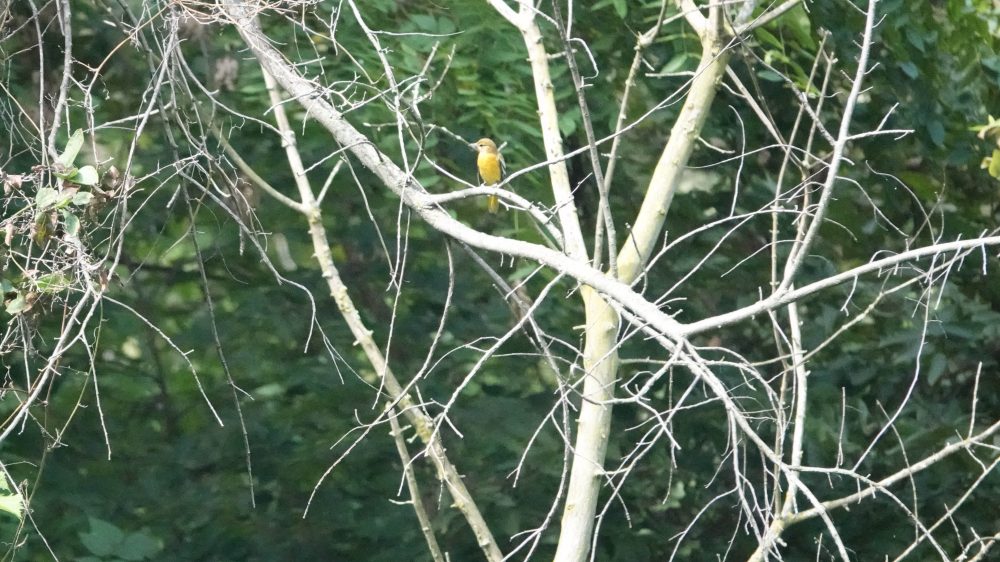
With some photographs it was like reliving getting on the bird in the first place – where is it?

Wilson's Warbler

Wilson’s Warbler

After our visit to the Kirtland’s Warbler on Saturday morning, we drove to Tawas Point State Park and spent the afternoon hours wandering the trails for migrants. These pictures are from that outing as well as other locations in Iosco County, Michigan, visited on the weekend. Some species were the first I saw this year. Indeed by Memorial Day it was almost “Now or Never.”

Black-Throated Blue Warbler

Black-Throated Blue Warbler

A Black-Throated Blue male was definitely on my list of must-sees and although he proved a bit difficult to photograph in the bright light against the sky, he stuck around for more photographs than I care to admit.

Cape May Warbler

Cape May Warbler

The female Cape May Warbler above caused a little confusion until we could be sure all her markings were in the right place. Here is a picture to prove it.

Yellow Warbler

Yellow Warbler

Yellow Warblers abounded, even windblown ones.

Golden-Winged Warbler

Golden-Winged Warbler

Golden-Winged Warbler

Golden-Winged Warbler

It seems increasingly difficult to find Golden-Winged Warblers, and the sunlight proved to be a challenge, but if you click on the second picture above you might be able to see the golden wing field mark a little better.

Magnolia Warbler

Magnolia Warbler

Magnolias and Redstarts are common enough but each individual has something different to offer. I like the way there is a hint of black coming in on the first-year American Redstart below. Next year he will be all black except for the orange on his breast, like the male below him.

American Redstart - First Year Male

American Redstart – First Year Male

American Redstart

American Redstart

I have never seen a Pine Warbler well enough before, which makes me think until this trip I never really saw one. Now I can add it to my list!

Pine Warbler

Pine Warbler

Black-Throated Green Warblers are always welcome.

Black-Throated Green Warbler

Black-Throated Green Warbler

As are Blackburnian Warblers.

Blackburnian Warbler

Blackburnian Warbler

And another species that had eluded me this spring finally came to light: the male Canada Warbler. I did not break into the “Oh, Canada” refrain from “A Case of You” by Joni Mitchell as is my wont whenever I see one of these birds, but he might have heard me anyway.

Canada Warbler

Canada Warbler


Last Looks in the (Chicago) Loop

Common Yellowthroat

Common Yellowthroat

While taking a break from getting organized and trying to locate the title to my old car… Every morning I look out the back window at the dead Ford sitting on the slab and vow to get rid of it. It’s only a matter of weeks before I will have to buy a new city sticker even though I’m not driving it. I’m sure the cat takes refuge underneath its rusting hulk when she isn’t hiding in the hostas. All reasons to motivate me to tear the house apart, calmly, until I find the misplaced title so I can donate the car to a good cause.

Lincoln's Sparrow

Lincoln’s Sparrow

Here are a few pictures taken the end of last week, which was the last time I saw migrants in the city. Some are from 155 N. Wacker on my way into the office. The others were taken in Lake Shore East Park.

Up until Friday there was at least one White-Throated Sparrow at 155 N. Wacker who would start singing whenever I showed up, but Friday I saw a Lincoln’s Sparrow, which is highly unusual this late in the year. I don’t think I’ve ever heard a Lincoln’s Sparrow vocalize, though.

Chestnut-Sided Warbler, 155 N. Wacker

There was a Chestnut-Sided Warbler at 155 N. Wacker as well, but the mainstay had been a male Common Yellowthroat who was on site for a couple weeks. As of Tuesday he was gone.

American Redstart, LSE Park

American Redstart, LSE Park

At Lake Shore East Park among the last migrants I saw last week were the female American Redstart, above, and a Least Flycatcher, below.

Least Flycatcher, LSE Park

Least Flycatcher, LSE Park

But now the newest arrivals are fledgling crows. I think there are two, although I saw only this one being weaned last week. Oddly enough, there was never any sound to go with that wide gaping mouth. Perhaps there is a different protocol at hand for Lake Shore East Park and this youngster was instructed not to draw attention to itself by making a racket.

Crow Fledgling, LSE Park

Crow Fledgling, LSE Park

That wide-eyed look of “now what?” is unmistakable.

AMCR-1170

A series of photographs as the parents’ body language tells the story: “We are not feeding you anymore.” I think I recognize the crow with the bouffant hairdo as a former fledgling from about 4 years ago. Notice how he tries to look profoundly disinterested in the interaction between the fledgling and its mother.

AMCR-0919AMCR-0913AMCR-0919AMCR-0936AMCR-0935AMCR-0937AMCR-0941

The ultimate insult, after waving the peanut around in front of the fledgling, she takes off with it!

On Tuesday I had some time to hang out with the crows. As far as I could tell, the youngster had not figured out how to do its own peanuts yet and was still falling into a bit of the gaping mouth routine.

By next year if it survives, this fledgling may turn into a peanut expert like the bird below.

AMCR-0956

AMCR-0887


Birds on the Brain

Mourning Warbler, LaBagh Woods

Mourning Warbler, LaBagh Woods

All the research done lately points to people finally discovering that birds are indeed a lot smarter than we ever gave them credit for. My personal theory is that somewhere along the line people realized certain birds were smarter than they were and started on that “bird-brain” campaign to make them appear inferior. Now if somebody calls you Bird Brain, take it as a compliment!

Magnolia Warbler, LaBagh

Magnolia Warbler, LaBagh

For all the attention I’ve been paying to birds lately I’d like to think some of their smarts have rubbed off on me… But it’s hard to think about anything else, so I don’t know how that computes.

Female Black-Throated Blue Warbler, LaBagh

Female Black-Throated Blue Warbler, LaBagh

This post features photographs of warblers taken late last week downtown and at LaBagh Woods Forest Preserve on Sunday. The Black-Throated Blue above came as a surprise when I was going through the photos last night, as it was in a small flock containing Wilson’s and Magnolias and I was just trying to capture anything that moved.

Wilson's Warbler, LaBagh

Wilson’s Warbler, LaBagh

The morning started out very slow at LaBagh, it was cool and cloudy, but I stuck it out and later as the sun came out the birds did too.

Chestnut-Sided Warbler, LaBagh

Chestnut-Sided Warbler, LaBagh

We had two days of hot spring and now we’re having cold, almost March-like weather. So I’m trying to cheer myself up a little bit with brightly-colored birds.

Cape May Warbler, Aon Building

Cape May Warbler, Aon Building

Perhaps two of the best were downtown last Thursday at the Aon Building.

Blackpoll Warbler, Aon Building

Blackpoll Warbler, Aon Building

Some of these guys don’t appear fully molted out into their brightest colors, but it has been a long time since I’ve seen a Golden-Winged Warbler.

Golden-Winged Warbler, LaBagh

Female Golden-Winged Warbler, LaBagh

The flowers are all gone from these trees now, but for a moment we had spring.

BPWA Aon 5-9-14.jpg-9632

There are more photos to discover, and I hope to be back with them soon. In a way it’s good the weather is so awful I’m not out taking more pictures, so I get a little catch-up time.


Spring Bird Count

Yellow Warbler, McKee Marsh

Yellow Warbler, McKee Marsh

Saturday was a beautiful day for a bird count. Even though the sun was often shining in our eyes, we saw some great birds at McKee Marsh which is part of the Blackwell Forest Preserve in DuPage County, Illinois.

Baltimore Oriole

Baltimore Oriole

Even though much of the time the birds were too far away or backlit. it was still worth it to take photographs to document the effort.

Chestnut-Sided Warbler

Chestnut-Sided Warbler

In one case, the photographs helped clarify an ID. We couldn’t see the eye-ring on this bird below, and called it a female Mourning Warbler…

Nashville Warbler

Nashville Warbler

Nashville Warbler

But the photographs taken as the bird moved around in the top of the tree proved the bird did indeed have an eye-ring, and so it is a Nashville Warbler.

Although I have done the Christmas Bird Count for years, this was my first Spring Bird Count. I don’t exactly know why I never did one before, but I suspect I was never asked before this year and I never volunteered because Saturday mornings still sometimes carry that sacred sleep-for-the-week designation after an exhausting work week.

Identifying the Plastic Bag Bird

Identifying the Plastic Bag Bird

But this spring has been so long in coming, it’s hard to resist getting out every chance I get, and so far the last two weekends have been rescheduled around birding.

Eastern Kingbird

Eastern Kingbird

Finally we are warming up with spring-like weather and the trees are starting to leaf.

Scarlet Tanager

Scarlet Tanager

Common Yellow-Throat

Common Yellow-Throat

We split into two groups to cover different areas. I’m not sure if my group had Bay-Breasted Warbler on the list, but I found the female below in my photographs. Sometimes it seems prudent to focus on capturing an image before the bird disappears and figuring it out later. I know there are purists who look down on this method, but the photographs help me pay attention to detail I might miss while trying to follow the bird’s movements with my binoculars.

Bay-Breasted Warbler

Bay-Breasted Warbler

The other half of the group likely saw more waterfowl than we did when they took off in the direction of the marsh (we headed towards the woods), but at some point we came around to open water and a flotilla of American Coots seemed to appear suddenly out of nowhere.

American Coots

American Coots

Busy Red-Tailed Hawks were presnet too. One was carrying nesting material in its talons, and another had what appeared to be a snake.

Red-Tailed Hawk with Nesting Material

Red-Tailed Hawk with Nesting Material

Red-Tailed Hawk with Snake

Red-Tailed Hawk with Snake

Toward the end of the morning we found a marshy area which had a few shorebirds. Compare the similarities and differences between Lesser Yellowlegs and Solitary Sandpiper.

Lesser Yellowlegs

Lesser Yellowlegs

Solitary Sandpiper

Solitary Sandpiper

We stopped at a shelter with picnic tables for lunch, and there were Barn Swallows waiting patiently on the grill for us to finish getting settled so they could get back to tending their nest.

Barn Swallows

Barn Swallows

Barn Swallow Nest McKee 5-10-14.jpg-1259I managed to do only the first half day of the count. But I will be better-prepared next year, maybe even take off from work the afternoon or the day before so it will be easier to get up early and last all day.

When I got home after grocery shopping, I took a nap. Later in the afternoon after I got up, I noticed White-Crowned Sparrows in the yard and decided to take my chances at photographing one of them.

White-Crowned Sparrow - Yard Bird

White-Crowned Sparrow – Yard Bird

After taking pictures of one foraging on the ground by the feeders as I sat still on a bench, a White-Crowned Sparrow landed in the tree right in front of me and posed.

White-Crowned Sparrow

White-Crowned Sparrow

Yesterday when I returned from more errands, there were four White-Crowned Sparrows bathing in the bird baths. I’m glad they like my bird-and-breakfast. This morning however there are no signs of them so they may have finally decided to go north to their breeding grounds.

Photos of more spring visitors to come soon. Click on any picture to see an enlargement. 🙂

Migration Madness

Eastern Wood-Pewee

I don’t chase birds, and it seems I have had fewer opportunities than I’d like lately to search for birds even in the most convenient places. So I try to make the most out of the chances I do get.

Wilson’s Warbler

Tuesday morning on the way back to work from the Labor Day weekend, I saw this Wilson’s Warbler at 155 N. Wacker.

American Redstart

The warblers in particular have been scarce in the city parks, if not in the “hot spots,” but I don’t like going back into the city on the weekend after migrating to and from it all week, so today I decided to get to the Chicago Portage early and then go to Palos.

Outside of American Redstarts at the Portage, I had a Connecticut Warbler and a male Black-Throated Blue, but neither of them wanted their pictures taken.

I got a little luckier at Palos, which holds a large area of contiguous forest preserves in southern Cook County. I parked in the south Swallow Cliff lot and took off on the yellow trail. I had looked it up before I went and knew it formed a continuous loop through several forest preserve areas. The entire loop is more than 8 miles. Without realizing the consequences of such a hike, I embarked upon the trek.

Blue Jay

The slowest part of my walk was in the beginning. There were Blue Jays and Eastern Wood=Pewees everywhere. I tend not to think of Blue Jays as migrants, but of course they are. To my delight, several jays sang over the course of my walk, and I always had to stop and listen. Not one song matched another.

Chestnut-Sided Warbler

It took quite a while to hit pockets of warblers and when I did it was sometimes difficult to identify them all. I didn’t get many pictures of them, but this Chestnut-Sided Warbler was most cooperative.

The Yellow Trail is frequented by runners, cyclists and horseback riders. Not necessarily the ideal birdwatching situation. But I got used to it after a while and figured the birds were pretty used to it too.

Red-Bellied Woodpecker

I’m pretty tired and sore from the trek. I know I will be sore tomorrow, but my four plus miles of walking to the train and back are less strenuous than today’s workout. It was good to see some birds.

Eastern Wood-Pewee

My Cerulean Warbler Quest

I rode with three friends to Hastings, Michigan last Thursday for Michigan Audubon’s  Cerulean Warbler Weekend. The goal was to get good looks at Cerulean Warblers, and we did after several tries.

“Rainstart”

However, Friday’s weather was miserable. The rain was constant and temperature below normal. This shot of an American Redstart leaving was a typical view.

Cerulean Warbler

And here is a typical look at a Cerulean Warbler high up in the canopy. About all you can tell is that Ceruleans are white underneath. Fortunately, the looks would improve the next day when the weather did.

Red-Eyed Vireo

The rain never stopped the Red-eyed Vireos from singing. I stood under this bird’s tree and listened to him sing for a long time. In the background, my brain was playing the Bach I’m learning, and the Vireo’s song fit perfectly over it. I wished I could have played for him, we could have had a great jam session.

“Drowny” Woodpecker

This Downy Woodpecker was pretty well-soaked.

Saturday started out cloudy but when the sun came out around 11:00 a.m., the birds woke up and we started to get our first really good looks at Cerulean Warblers. Unfortunately I had few photo opportunities. The birds like to stay up high in the canopy, and just when you think you’re on them, they fly. Rather than stay in one area, they  move from limb to limb or tree to tree. So my best shots turned out to be extremely backlit.

Cerulean Warbler

But now that I have had great looks, I plan to concentrate more on the photography next time.

This Chestnut-Sided Warbler was backlit too, but he had a bit more color to show.

Sunday morning we got up very early to take a bus tour of some birding hot spots of Barry County. I finally managed to get a few pictures.

Acadian on Nest

This Acadian Flycatcher was on her nest right by the road. Still pretty dark in the woods.

Turkey Vultures

Out in a field later, there were six Turkey Vultures in the sky at one point. Here’s two of them.

Eastern Phoebe

Eastern Phoebes win my award for This Spring’s Most Cooperative Bird.

Indigo Bunting

This Indigo Bunting was so busy singing, he sat still.

There were a lot more birds than pictures, but that’s okay. We had a good time.

You know you’re on a birding trip when everyone in the bus yells “Dickcissel!” simultaneously.

Dickcissel

We got great looks.