There’s a huge park in Berwyn — it takes up several blocks! — that I always thought was much farther away than it actually is. I have not been walking as much as I used to the past five years, and definitely feel the need to get out and walk without having to drive somewhere first. So I walked over to Proksa Park a couple times last month and found a few birds to photograph. The round trip is about three-and-a-half miles which only half a mile less than the total mileage I used to walk every day when I worked closer to the lakefront.
I was happy to see a crow flying over on my first visit. I keep hoping to see more crows at home.
There are a lot of native plants and you can always count on American Goldfinches to take advantage of them.
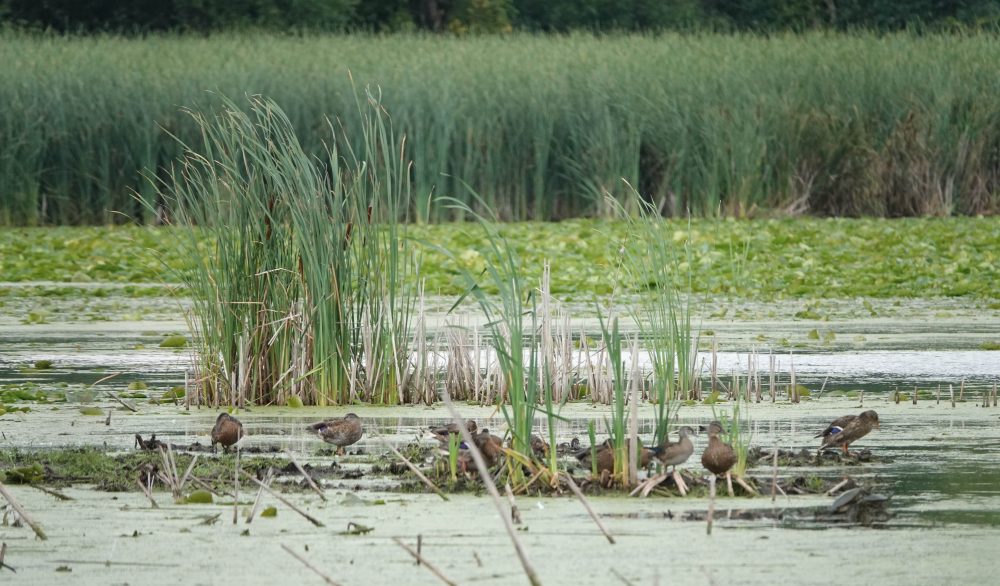
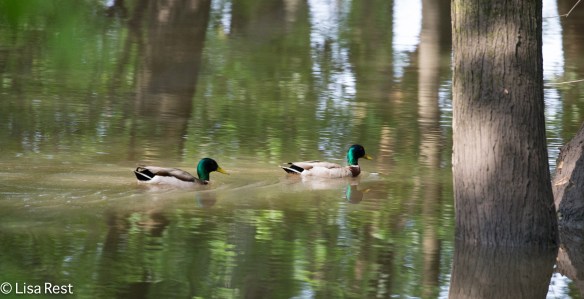
The park has some nice water features that attract Mallards.
And the occasional heron, like this Great Blue Heron in the distance on my first visit.
Spacious, paved paths for walking and running…
I saw a few Magnolia Warblers here as I did almost everywhere last month.
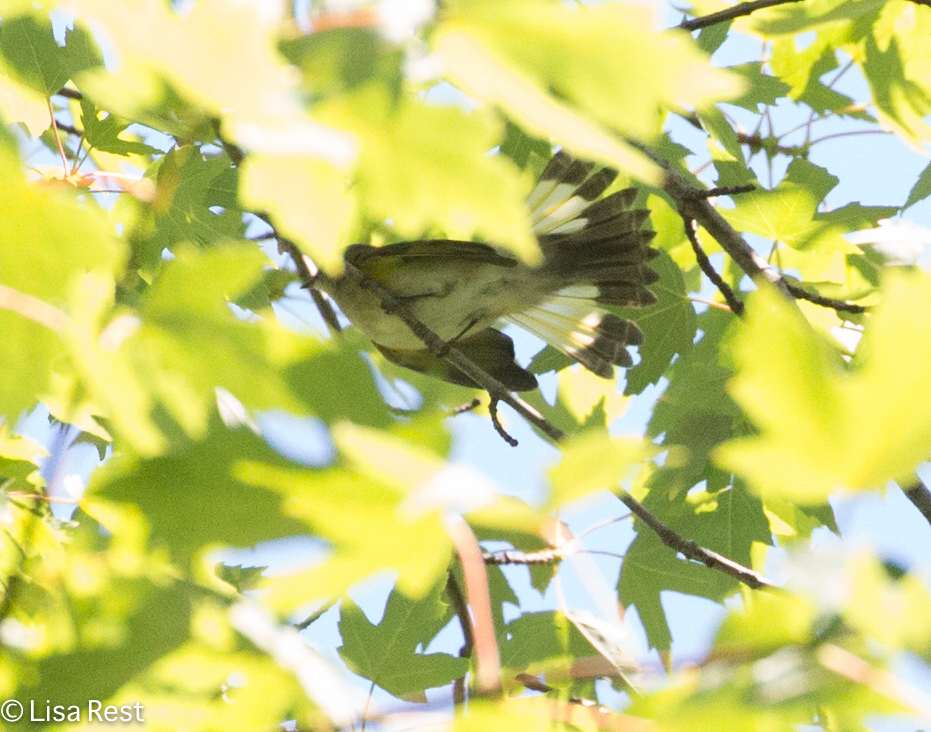
And an American Redstart or two.
Below is a Blackpoll Warbler.
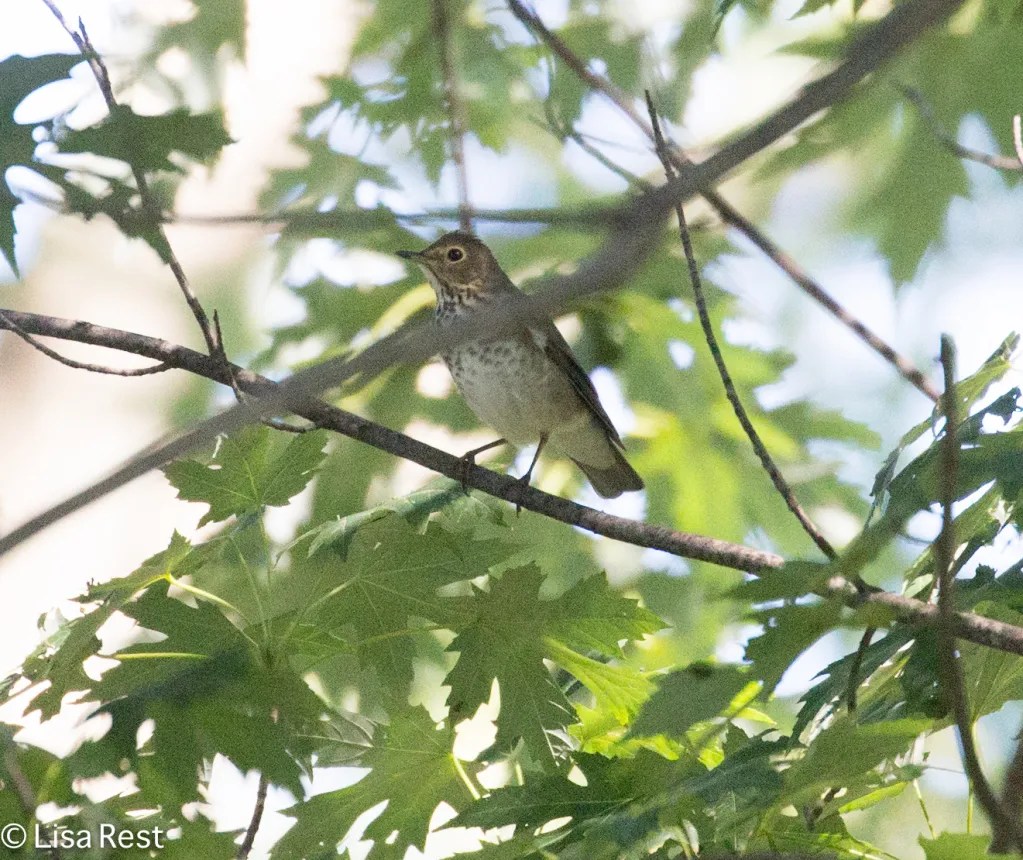
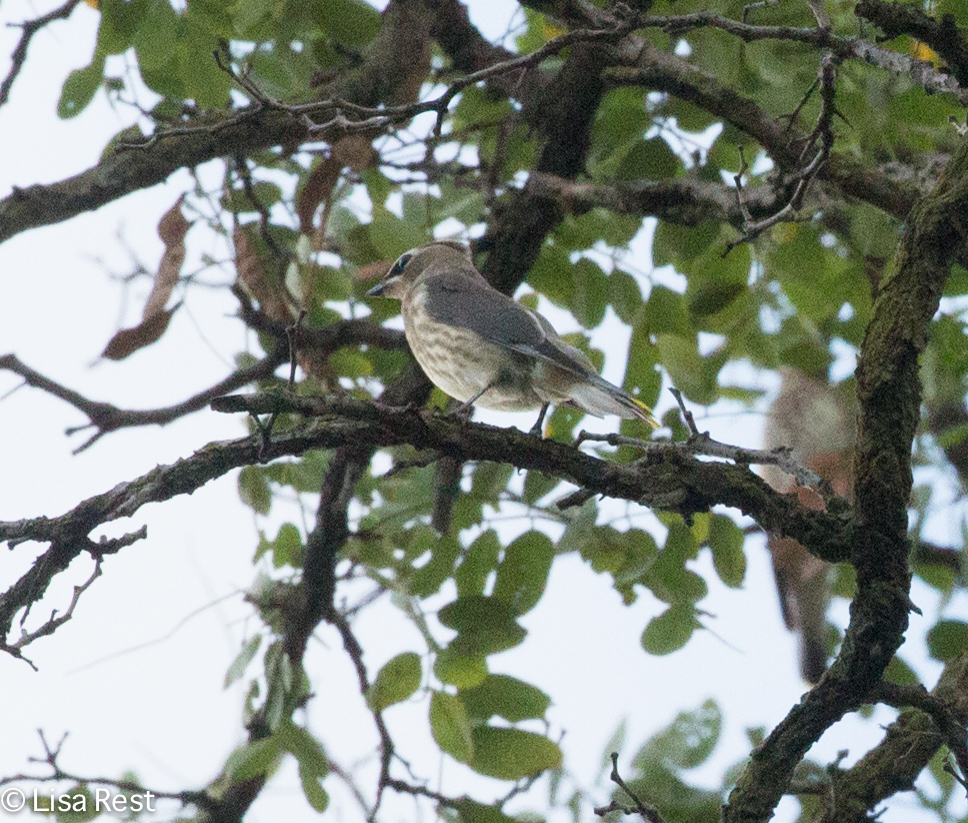
I almost forgot this lovely Gray-Cheeked Thrush. I have corrected the identification thanks to Vera’s comment – I thought it was a Gray-Cheeked to begin with but it was late and I was tired (or that’s my excuse for now). The heavy spotting gives it away and I don’t think the eye-ring is Swainsony enough.
This is a very pleasant destination and I will be visiting off and on throughout the year when I feel like getting out for a good walk.
One more of a Magnolia Warbler.
We just had a downpour, with more rain to come. This is very welcome indeed since I have been removing plants and planting new ones around the yard and the house. We are long overdue for a good soaking. I’ll have to check the river later in the week and see if it made any difference.
I’m taking advantage of the rainy forecast – we’re not getting much rain yet but it is quite cloudy and we could get more. I needed a morning off from birding anyway as my left foot was complaining about something of unknown origin yesterday. It’s better this morning, but I’ll defer the walking part of my day and swim a mile in the pool later this evening.
These photographs are from my second visit to the Portage now almost two weeks ago – on September 8th. The clear skies gave way to intense light which made for some interesting contrasts when I found a cooperative Black-throated Green Warbler.
I found it hard to resist taking one photo of my favorite shelf fungus which is conveniently located close to the trail.
Two-year male American Redstarts have been few and far between and avoiding me, but I sort of managed a furtive representation of this one. The first-year males have been plentiful, but I think that’s a female below as the flank color isn’t quite orangey enough.
Female American Redstart
I have seen a good number of Blackpoll Warblers this fall, like the one below.
Here’s one of my favorite combinations – Canada Goldenrod and Boneset seem to have an affinity for each other. A closeup of the Boneset is below.
Here’s a European Starling in the Pokeweed berries.
I had a nice look at a light morph Red-tailed Hawk.
Certain birds tend to stand out and the number of Eastern Wood-Pewees I have seen well fall into this category.
Swainson’s Thrushes have been everywhere. Period. But sometimes they look like Gray-Cheeked Thrushes and vice versa…
This looks like a Gray-Cheeked Thrush to me.
Here’s what the Des Plaines River looked like two weeks ago – it’s even lower now.
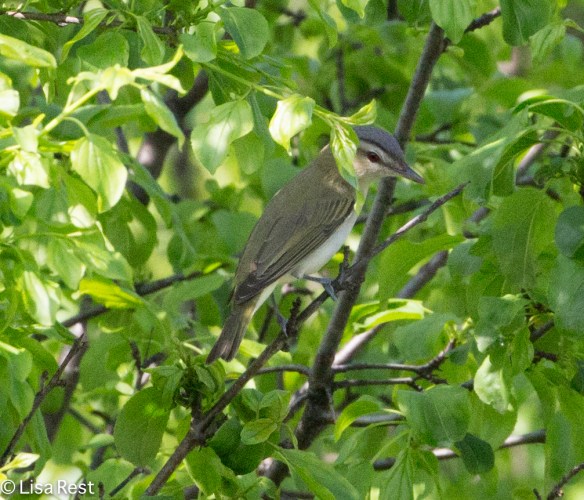
Red-eyed Vireos were abundant.
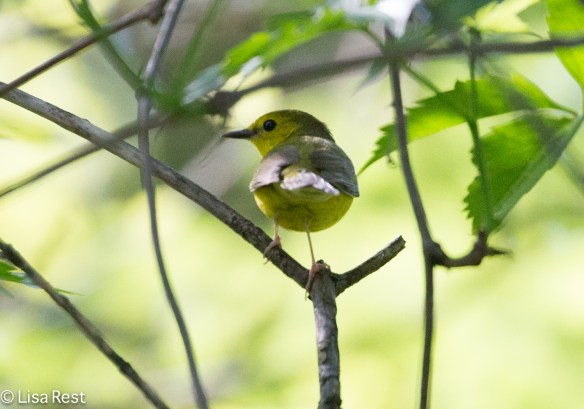
Maybe – just maybe – the bird below was a Wilson’s Warbler. Sadly, I have no other views of it. I am still trying to codify warbler colors. This looks like Wilson’s Warbler Yellow to me.
The Portage colors match the birds.
There was a Canada Warbler that day.
And American Robins are so ubiquitous that when one stands out, I sometimes have to capture it. The bird below looks to be very young and quite curious.
It’s been a rewarding fall migration season so far for me, albeit tucked away in my location limits. Eventually I will have to go down to the lakefront and other places a little more far-flung but for the moment I feel like I am enjoying my morning outings around here.
The anticipation of seeing more birds after the long, hot summer is part of what has driven me to go out every morning. The other part came later – after doing so a few days in a row, it has occurred to me that I need these long, meditative walks every morning to stay sane.
The idea of retirement will be more than just finally having time to do what I want to do. It’s becoming more of a challenge of self-care and survival. I am becoming fiercely protective of what I have carved out to be Time Spent Not Thinking About Work – which to some degree unfortunately still exists and will lurk on the sidelines until I am finally completely done with it.
The Portage had warblers for three days last week and I took way too many pictures. These were all taken on September 6th. In spite of all the ones I discarded there are still too many. I am grateful for the Ovenbird at the top of this post. I have also become familiar with their cute little “blip” calls and I have heard many more than I have seen.
Magnolia Warbler
“Maggies” (Magnolia Warblers) and Redstarts seemed to be everywhere last week. I am beginning to sense the end of that now.
American Redstarts below.
The bright yellow throat of a Blackburnian Warbler is below.
Mixed among the warblers there have been a significant number of Red-Eyed Vireos like the one below.
Below, a far-away Blackpoll Warbler.
A Black-and-White Warbler blending into the tree bark.
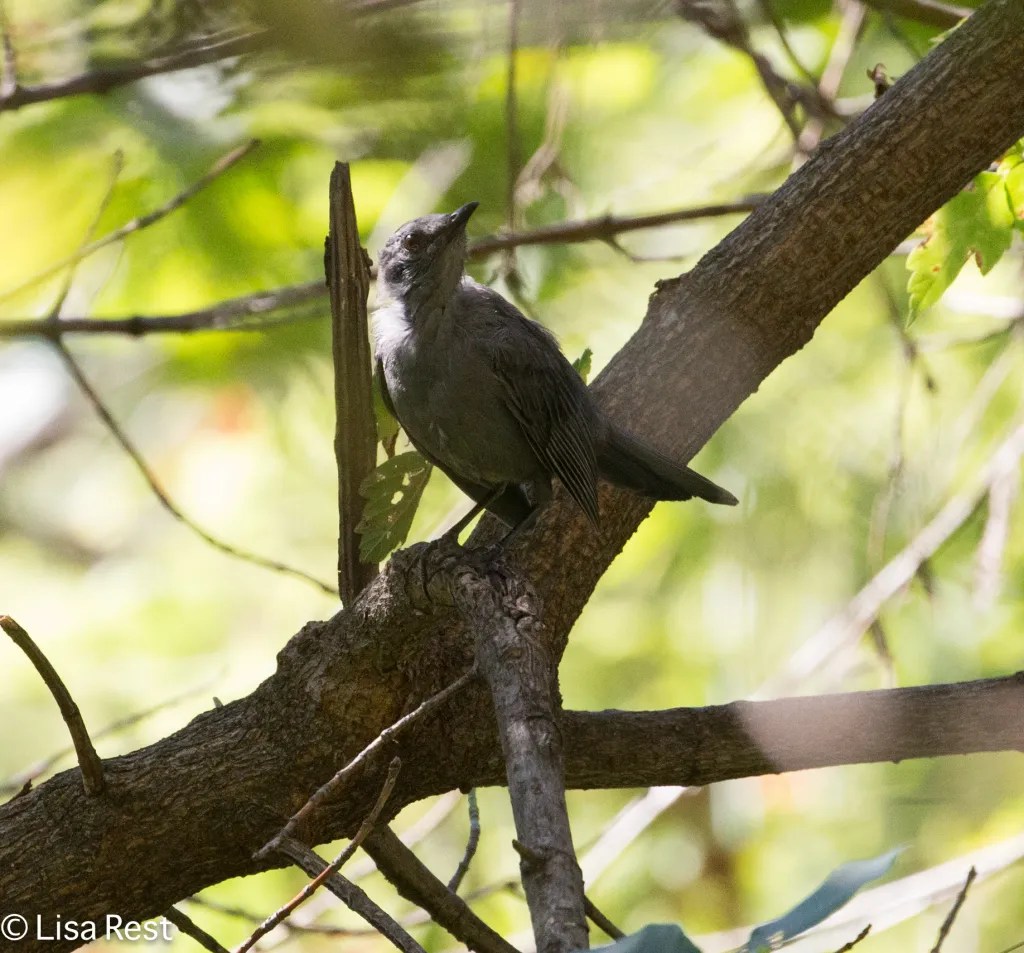
Of course there are other birds besides warblers. Below is a young Gray Catbird.
And the woods have been filled with Thrushes. Below is a Gray-Cheeked Thrush.
Swainson’s Thrushes have been everywhere and every day since.
Swainson’s Thrush
The Thrush below looked like a Hermit Thrush to me but it was way too early. I didn’t feel like challenging my sighting with these photos – I suppose it could be another Swainson’s.
As if you needed more glimpses of the forever moving Redstarts…
Though every once in a while they sit still…
More photos of my one cooperative Ovenbird.
I caught the Starling below just after I got out of my car.
Chestnut-Sided Warbler
I was really surprised to find a Golden-winged Warbler in my photos. They aren’t great images but this is a bird I don’t see too often, so it’s worth posting it.
Below is a Tennessee Warbler.
Baltimore Orioles should have been gone by this date but I heard one call and then saw this one later.
Maybe my best bird of that day was the Yellow-throated Vireo below. I particularly love how its blue legs came through.
Way too many birds in one day. I am exhausted trying to finish this post, so I think I will be back sooner with shorter ventures before I dive into the next day.
For what it’s worth we are having our second choir rehearsal in the sanctuary tonight, masked, socially-distanced, and dressed in our black choir attire (to show off our custom-made stoles) – to be videotaped singing for insertion into the Sunday service. A step forward. It’s so good to sing in the ensemble again.
As promised, here’s my last visit to McGinnis Slough. I have been out birding every morning since, mainly at the Chicago Portage but a couple other places too, and fall passerine migration is in full swing. I don’t know if I will ever get through all my photographs, but I intend to start posting them soon as much as possible.
It was delightful to spend a little time with a Blue-Gray Gnatcatcher at McGinnis.
This Song Sparrow perched nicely for me.
Another bird I felt very privileged to see well was the Marsh Wren below. I could hear wrens in the reeds but they are always nearly impossible to see. Then, while I stood in the same spot looking at whatever waterfowl I could see, this one popped out in a bush to get a closer look at me.
I also saw a Brown Thrasher – a bird I used to see a lot more of but now rarely. And then my first Palm Warbler of the fall season.
A few more of the Marsh Wren…
Finally, a cooperative flower. It appears to be a hibiscus. But I am used to seeing the big pink rose mallow flowers that bloom here every year and they have been few and far between.
More views of the American Redstart that is at the top of the post.
I wonder if the slough will ever have enough water again to host the hundreds of ducks that usually show up in the early spring.
Common Green Darner
Tall Boneset is now blooming with the Canada goldenrod.
Several Barn Swallows took a break from scooping bugs out of the air…
And there was one lone Tree Swallow.
I managed to barely see the Trumpeter Swans – and noticed there was only one Cygnet. I fear the other two did not survive. I suppose the likeliest predator would be a coyote.
Peter Mayer has just written a beautiful song called “Trumpeter Swans” which I have already listened to maybe a hundred times…
The Herons were all hanging out in what little water is left.
And I caught a Wood Duck in flight.
I was a little surprised to see Northern Shovelers.
These fuzzy-looking acorns caught my eye. They are not acorns. They are called “hedgehog galls” and are formed by wasps.
Northern Crescent
This Blue-Gray Gnatcatcher is probably halfway to its winter home by now.
Okay. I hope to be back very soon with a feast of warbler photographs. There have been other interesting birds too. Thanks for checking in!
To celebrate August 31st being my last official day of work, I went to the Portage two mornings in a row, to look for the first signs of fall migration. I didn’t see an awful lot of species on either visit, but there were some nice looks. Best of all was feeling really free to take my time and not worry about checking my work email. I still have to get used to waking up in the dark, though, because I have walks to lead every Saturday in September and October.
Of course the obvious draw this time of year is the fall warblers passing through on their way south from their breeding grounds in the north. I didn’t see a lot of species and missed a couple, but so far I have seen a few warblers each day. They behave differently on their way back to their wintering grounds. They are not foraging in flocks and they are in less of a hurry. So while they may be harder to spot at times, it’s easier to concentrate on one bird at a time. Below are a couple American Redstarts.
American Redstart tails…
are unmistakable.
I felt lucky to find this Bay Breasted Warbler in my photographs.
Magnolia Warbler, also at the head of this post
One of my favorites, a Chestnut-Sided Warbler, was being rather coy.
Not a warbler, but a nice to see Red-Eyed Vireo both days. The bottom photograph was taken the second day when the Vireo was eating poke berries with the Cedar Waxwings.
Thursday morning I managed to capture enough photographs of the Orange-Crowned Warbler below to justify my claim that I had seen one, since it’s very early for this species.
I just barely captured this Nashville Warbler.
Wednesday was cloudy.
Large flocks of Cedar Waxwings were present on both days.
Some closer views of the Waxwings Thursday, when they were busy eating poke berries.
Below is a beautiful wasp’s nest. I have a slightly smaller one in my crabapple tree this year as well…
Something else that I had a lot of in my yard before I removed nearly all of it, below, is Common Beggar Ticks which is native, and an annual – but doesn’t bloom until now.
On the first day I did manage to capture the Swainson’s Thrush below. I also saw a Wood Thrush but that photograph isn’t presentable.
Robins are looking scruffy this time of year. Most of them are juveniles.
When I first walked in on Thursday, there was a deer at the end of the paved path, and then a Cooper’s Hawk with prey landed in a tree above me, but I didn’t see what it had captured.
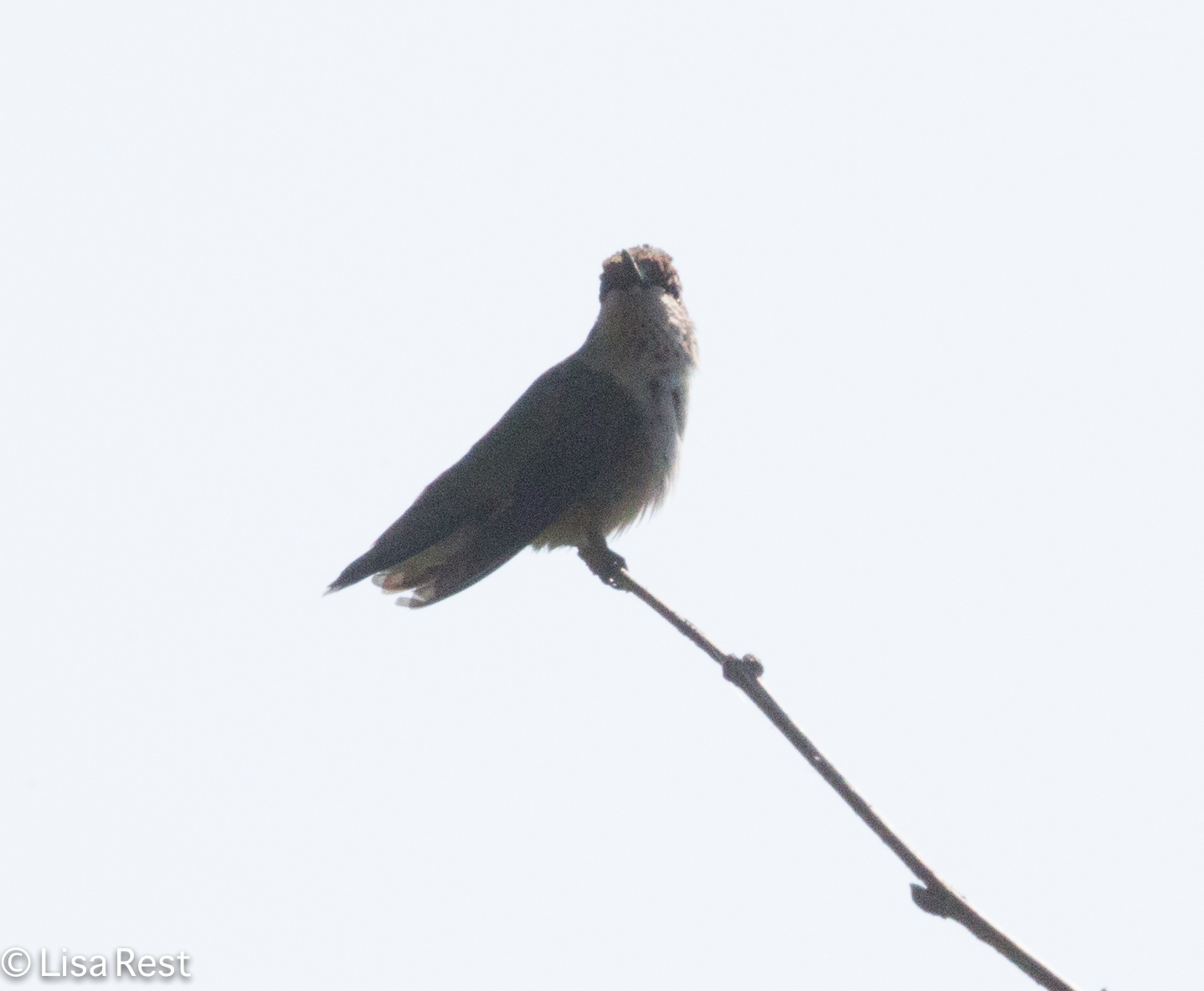
Unfortunately this Ruby-Throated Hummingbird was completely backlit in bright sunshine but it was still nice to see it perch right in front of me.
There were still a couple Indigo Buntings around.
Juvenile Indigo Bunting
Female Indigo Bunting
For once, there were more than one or two Monarch Butterflies. I realize this is probably the last I will see of them but it was nice while it lasted.
Below is a Chipmunk foraging in a tree.
A few scenes of the Portage and one quick look at the Des Plaines River where not much is happening at the moment.
Black-capped Chickadees are around all year but I don’t always see them. Sometimes I don’t even hear them. This one didn’t mind being seen or heard.
I am trying to navigate this new feeling of almost endlessness. Well, it doesn’t last for long. There is much to do, but less of a feeling of urgency or hopelessness as my work duties have all but vanished. I have agreed to remain with the firm as an independent contractor to help out with various projects while they still try to find and train my replacement. My stipulation was to assume any given morning with nice weather would be off limits for my attention as I will likely be out looking for birds somewhere.
Not always sure where I’m coming from with one-handed typing, but the slowness with which I have had to express myself has given berth to more measured thoughts, perhaps, and, like bird-watching, there is something almost meditative in it.
Before I stray further, I want to dedicate this post to my dear friend Linda Rios and her husband Ed who got me through my awful post-injury and surgery situation with loving aplomb. It occurred to me after I struggled to finish the last post that I was bereft in my focus and needed to at least acknowledge how much my friends have meant to me during this blotch on my existence.
These photos are from August 29th, mostly taken at the Portage. After I was done there I checked out what the Army Corps of Engineers has done to the part of Ottawa Trail that runs along the Des Plaines River, expecting there wasn’t much to photograph there except for the habitat destruction.
Below, a very cooperative White-breasted Nuthatch.
Eastern Wood-Pewee
Eastern Phoebe
The Chestnut-sided Warbler below was pretty well-hidden but now that I can’t take any photographs for a while I am glad I managed to get these when I did.
The bird below is a Nashville Warbler.
American Redstart
Red-winged Blackbird
The last of the Baltimore Orioles. I had one visit my feeder later that afternoon…
Baltimore Orioles
A juvenile American Robin
Red-bellied Woodpecker
There were a few Indigo Buntings still around as late as September 19, which was the first bird walk I led after my surgery. Most of them looked like the two below.
On my way out of the Portage on August 29, I spotted this Cooper’s Hawk who just sat, and sat, and I took way too many pictures expecting that it would do something interesting. I was too exhausted by the time it finally took off.
A little Portage flora – I am always amazed at the height of the trees so maybe the cell phone conveys them somewhat. Then there are parts of the trail that are lined with blooming flowers now – a vast improvement over the burdock from years past.
Juvenile Northern Flicker
So this is what Ottawa Trail is looking like now that the levee has been finished on one side of the Des Plaines. It was relatively devoid of birds but I expected that. Others have told me, though, that the levee affords great looks at the Des Plaines River when there are water birds present, so I shall have to check that out another time.
I was able to capture a few signs of life.
On my way out of Ottawa Trail, over the parking area, a Red-Tailed Hawk flew overhead.
Elbow-wise, the cast is gone, stitches removed, and I have 12 weeks of physical therapy ahead. I actually had one physical therapy session on Friday and was reassured I had chosen the right location when I heard a crow calling as I went back to my car. As I mentioned, I managed to lead bird walks these past two Saturdays and I am so grateful to the participants who showed up and helped me feel alive again. I didn’t master the one-handed binocular skill, but now that I am cast-free, I am able to raise my left arm enough so maybe I can go looking for a few more birds this fall even if I cannot commemorate the sightings in photos. In these uncertain times it’s all the more grounding to continue one’s connection with the natural world.
Well here it is, the long-anticipated last act to the Memorial Day weekend of birding at the Chicago Portage. Compared to the previous two days, I didn’t have a lot of photographs. I reported as many species as the previous day (41), but between extremely bright light conditions and my inability to focus, perhaps in part due to the light shining in my eyes, the day had a different feel to it.
But it was a great day for discovery and observation. The bird of the day was a Prothonotary Warbler. I have been looking for this species to appear at the Portage for years every spring or fall when the Des Plaines River floods the lowlands because then the habitat reminds me of the Cache River Basin in southern Illinois where I saw my first of many Prothonotary Warblers.
Flooding on the Des Plaines River
Mallards in the flooded Des Plaines River basin
Prothonotary Warbler
As it turns out, I didn’t see it in the flooded area but directly across the trail from it. Although I got great views with the naked eye, I was not able to capture the bird well with the camera, so going back through these photographs I had my doubts. But the photograph above with the head cut off confirms the ID for me because of the white undertail coverts showing. I confess I still have my doubts about the other photos, but I know I saw the bird, so maybe there will be a next time.
Just so you can appreciate how frustrating this can be and why I sometimes spend entire days thinking about identification challenges, below is a Wilson’s Warbler I photographed on the same day, if not in the exact same spot. I do know the gizz of a Wilson’s since I have seen them frequently enough for years. When I saw the Prothonotary, it appeared larger and moved more slowly and deliberately than the Wilson’s.
And now for another sort-of warbler challenge, the American Redstart below. I have seen this coloration a few times before so I was not confused, only fascinated. The tail immediately gives this bird away as an American Redstart, but it is showing yellow and white with black coming in on the body. What you are seeing is a soon-to-be second-year male American Redstart. When the summer is over he may be entirely black and orange in place of the gray and yellow, and will be considered an adult.
And below is a female American Redstart. She will always be gray, yellow and white. Not the best photograph but you might be able to see just a little of the yellow peeking out on her breast.
That was about it for the warblers that day. I just took a tally for the season and I have seen 24 warbler species this spring. That’s 2/3 of the possible number I might have seen. But given the fact that I was basically birding in only one area I feel pretty fortunate to have seen all these warblers, sometimes even seeing them very well.
On to the rest of the birds I managed to photograph on Memorial Day. Below are some male Brown-headed Cowbirds who don’t seem to have much to do except hang out on bare branches.
I don’t remember how I managed to get the photos below of a flying Red-Bellied Woodpecker but I don’t get this lucky very often! I was probably trying to focus on it perched somewhere and it took off.
Red-winged Blackbirds…are a given. The bird in the second photograph knocked the Northern Flicker in the photos below off its perch, which enabled me to get pictures of some of those elusive but brilliant golden shafts underwing.
There were a couple Eastern Kingbirds for a day or two, and I haven’t seen them since. Maybe they were shopping for nesting spots and decided to go elsewhere.
Below is a trail at the Portage I have only walked recently. For years I stayed away from the gravel road that ran between the official forest preserve and the Metropolitan Water Reclamation District property because it used to be patrolled by police and photographers were not welcome. The past couple years now, I think, restrictions to access have been lifted, but it took this year along with the impression of having extra time to decide to walk the extra mile as it were. The road itself runs along some woods that border the Des Plaines River, and then splits in two, with the one fork below wooded on both sides. This might have been a very good place to look for the earlier warblers back in April. I will definitely keep it on my agenda of places to visit in the fall. Recently, although it’s getting very buggy there were not very many birds available.
Birds that fly over on occasion and if I’m lucky, I can capture them. This time it was more as a record of their presence than anything else.
Great Blue HeronNorthern Harrier – considered rare at this location but I don’t know why, as I have seen them every so often
Indigo Buntings and House Wrens will be available all summer.
The Downy Woodpecker below was challenging to capture.
If you click on the photos below, you will be able to see a Blue-Gray Gnatcatcher that looks more like a Blue-Green Gnatcatcher. This was another ID I struggled with a bit when going through the pictures, but the eye ring in the first photo and the cocked tail in the next give the bird away. It’s a testament to how lighting can change everything. I have never seen this bird look green before.
American Goldfinches foraging in the duckweedAmerican Robin of the Day (there are always at least 20-30 of them about)Baltimore Oriole – too busy now to pose for pictures
I’ve been to the Portage a few times since the big weekend and I will likely be visiting regularly to check up on summertime birds, and I anticipate a return of dragonflies and butterflies. I have been a couple other places too and plan to publish those posts when possible. Lately it’s easier to sit inside on a hot day, slaving over a laptop in air conditioning. Thanks again for stopping by, and congratulations making it to the end of another long post!
There were still some warblers on May 24, but the Bird of the Day for me was Red-Eyed Vireo. I had been wondering where these birds were, and then they all seemed to show up at once. Usually you hear them singing and don’t see them very well as they move through the trees chasing insects. But this time they were more often seen than heard. In some of these photographs you might actually be able to see the red eye for which they are named.
Red-eyed Vireo
Many of the warblers I saw that day were females. The females tend to migrate later than the males who are in a hurry to set up their territories. Spring migration this year seemed strange for many reasons – the pandemic affecting where you could go to find birds, the weather which is always a factor, and I guess the knowledge in the back of your mind that birds are in decline and you wonder just how many you’re going to see anyway.
Magnolia Warbler (male)
Magnolia Warbler (female)
Wilson’s Warbler (female)
Bay-breasted Warbler (female)
Blackburnian Warbler (female)
Below is a Yellow Warbler who likely is on territory for the summer. I recorded him singing, and you can hear him three times in the little clip below his picture. Some people find the mnemonic “sweet sweet sweet I’m so sweet” helpful in distinguishing this song from others they might be hearing.
Yellow Warbler
I feel fortunate to have seen a Canada Warbler more than once this spring. Unfortunately they prefer somewhat shady spots which I guess they blend into better than bright sunlight. I love the steel-gray blue color of their backs. I would support a Pantone color called Canada Warbler Blue.
Canada Warbler
Northern Cardinals are all around but not seen too often. This one was far away but distinct.
A Blue Jay on the fly.
Baltimore Orioles are getting harder to see now that they are busy rearing families.
Baltimore Oriole nest
Indigo Buntings are busy too but there are so many of them, they are easier to see.
Indigo Bunting
Indigo Bunting (female)
This might have been the last time I saw a Blue-gray Gnatcatcher. Actually I’m surprised I got to see more than its tail. I still hear them, but only on occasion, certainly not constantly like a few weeks ago when they first arrived.
Blue-gray Gnatcatcher
Even Red-Winged Blackbirds are assuming a lower profile.
Scenes from the Portage
Two Mallards navigating the flood waters adjacent to the Des Plaines River which were still quite high that day.Double-Crested Cormorant – an occasional flyoverThe back of a Chipmunk
House Wren
A couple more warblers – there seemed to be fewer American Redstarts this year, at least where I was. And I just learned something I never bothered to look up before about distinguishing the female Chestnut-sided Warbler from the male – the bright chestnut sides don’t extend as far down the side on the female. So the pictures below are of a female. And since I continue to hear a male singing at the Portage I can only wonder if there might be an actual breeding pair.
American Redstart (female)
Chestnut-sided Warbler (female)
I still hear the Eastern Wood-Pewee but this might have been the last time I got photo ops.
The big surprise walking back in the opposite direction across the first bridge was to see this Robin’s nest right off the side of the bridge, in plain sight – and I had never noticed it before. Mom was in a nearby tree, waiting to revisit her brood.
A bird more often heard than seen..Gray Catbird.
Red-eyed Vireo
I love this last picture of the Red-eyed Vireo. Having said that, I realized a few days ago that I need to bring more control to my blog posts when I take so many pictures and can’t decide what to do with them and invariably end up with too many – believe it or not, this is a pared-down selection. I really need to use my flickr page more often, so I stuck some other photographs there and if you’re really curious, follow the link to them. I will try to be back sooner with the final installment of the Memorial Day weekend excursions and reports from other destinations since. Hope you are staying safe and well and rising to the daily challenges.
The Memorial Day weekend this year offered three beautiful days of birding at the Portage. I had no desire to go anywhere else; rather, I was interested to see what different birds I might discover each day, enhanced by the fact that a lot of birds were finally on the move to their summer homes. Here are photographs from Saturday, May 23rd.
While I think this was the last day I saw the male Scarlet Tanagers, there were plenty of Indigo Buntings. I am not aware of Scarlet Tanagers breeding at the Portage, but the Indigo Buntings certainly are a presence now every year. I suspect some of them that return may have hatched at the Portage.
Indigo Bunting
Plenty of sunshine
I don’t know where the Green Herons are hanging out – likely on the Des Plaines River or perhaps across the railroad tracks in the low-lying water-collecting areas of Ottawa Trail – but I still see them fly over nearly every visit. I was fortunate enough to capture this one in flight.
This Scarlet Tanager looks orange compared to the other one. I imagine it is a function of the intensity and angle of the light.
Not too many warblers left…
First-year male American Redstart
Bay-breasted Warbler
Wilson’s Warbler
Blackburnian Warbler
Goldfinches are everywhere but not as easy to see.
American Goldfinch
There were plenty of Baltimore Orioles and they looked like they were busy tending to their nesting sites.
I finally managed to capture a singing Song Sparrow.
The turtles never miss a sunny day.
Daisy Fleabane opening up now – I had some in my yard last year, hope it returns
I love this Common Grackle posing, capturing the epitome of grackleness.
I fear for Black-capped Chickadees. Lately I have seen only one at a time.
One of many House Wrens.
A slow-motion Blue-gray Gnatcatcher.
Gray Catbirds are more often heard than seen but I was fortunate enough to enjoy both with this one.
A questioning look from the Great-crested Flycatcher below.
Perhaps this European Starling had just taken a bath in the last photo.
I have seen more Eastern Wood-Pewee’s this year. There’s even one in my neighborhood.
Subsequent visits gave me much better views than the Red-Eyed Vireo below.
Another Indigo Bunting
Then, most exciting of all, as I was sitting down and contemplating leaving, I heard and then saw the Red-Headed Woodpecker below. I have been waiting to see this species for an entire year. I wonder if this is the same one that I have seen on rare occasions only.
I have no idea what kind of caterpillar this is but it was my last subject as I left for the day.
i will be back with Days 2 and 3 which were also quite birdy. My next visit to the Portage will likely be more challenging but I will continue visiting to keep track of the emerging families. I hope we humans find some peaceful solutions. The days are getting so very long now.
It’s all I can do to keep up with migration this spring, let alone the pictures I have taken…So I’m attempting to do this in chronological order but it won’t be easy. This past Saturday started out cool but sunny. I decided to start my walk in the opposite direction of what I normally do. Then I realized that I had forgotten to put my little portable stool in my backpack so I decided to walk back to the car to get it. As I walked, I heard the Great-Crested Flycatcher, and then saw him in one of the Redbud trees bordering the lawn behind the statue. The morning had promise.
Great-Crested FlycatcherI have decided to photograph the statue every time I go to the Portage now to gauge the light conditions.
Last Saturday was a riot of colorful birds. I counted a dozen male Indigo Buntings. They were everywhere and they were not particularly shy, so I took advantage of their fearlessness. You can see how the light affects the hue of the blueness, when actually their feathers are all black.
I ventured out to the gravel road that runs along the MWRD property and found two male Scarlet Tanagers. They were trading songs.
But I discovered a glimpse at a Summer Tanager later in my pictures.
For all the male Baltimore Orioles singing and displaying these last few weeks, I have seen only one or two females so far. But that’s because they’re busy tending the nest.
Yellow Warblers may stay and breed at the Portage. Invariably I hear them but don’t always see them. So I was glad to capture this one.
White-Breasted Nuthatches are present all year, but are not seen or even heard frequently now.
The female Rose-Breasted Grosbeak below is the last one I have seen. I am not aware of any starting families at the Portage, but it could happen.
We have had a lot of rain, and even more after these pictures were taken. There were two Canada Geese trying out the newly flooded waters.
So this time of year of course I’m looking for warblers wherever I can find them. I just calculated that over the last couple of weeks I have seen 21 species total. I haven’t been able to photograph them all, but most, sometimes discovering them in my photographs. I will try to post as many as possible. They won’t always be textbook-looking photos. For example, the Golden-Winged below I barely captured but it was the details from the photographs that I was able to identify it as a likely female.
Nashville Warbler
Magnolia Warbler
Magnolia Warbler
Golden-Winged Warbler
American Redstart (female)
One more Magnolia Warbler
Then there are the flycatchers. They can be confusing. I have since seen the Eastern Wood-Pewee again in the same location looking more like himself so I am guessing he was having an off day (typically he would look more pointy-headed).
Eastern Wood-Pewee
I think this is a Willow Flycatcher…passing through.
On this day I saw this Turkey Vulture being escorted away by a Red-Winged Blackbird.
Song Sparrows are present, singing, and likely staying to raise families.
i keep hearing and sometimes seeing Chestnut-Sided Warblers every time I have been to the Portage since my first intimate encounter with one last Tuesday.
Chestnut-Sided Warbler
There’s a little rapids under the first bridge where the water runs out of the Portage. No water ever runs into the Portage, as far as I can tell, but It’s still nice to see the flow over the rocks.
More often heard than seen, Blue Jays are out and about but rarely available for photos, so it was nice to see this one.
I found this female Common Grackle to be attractive in her own way.
I had noticed this nest before but wasn’t sure anyone was using it until I managed to capture these two Goldfinches. You will probably have to click on the first photo to see the female poking her head out of it. I have since not been able to find the nest, which was not far from the trail, but it could still be there and hidden in all the plant growth that has occurred since.
American Goldfinch
Sadly, Black-Capped Chickadees are getting harder and harder to find. Long taken for granted, I am convinced they are in decline, at least locally. I caught this one in a hurry.
Here’s my Robin photo of the post.
As the leaves are finally coming out, it’s interesting to see how the spaces change.
Below is one of my favorite birds, a Blue-Headed Vireo. I have seen them a couple times this spring which is surprising to me, as I don’t think I have seen one for years.
Woodpeckers are busy everywhere.
Red-Bellied Woodpecker
Hairy Woodpecker
And last for the moment, I finally was able to catch the male Eastern Bluebird in focus. He has a habit of posing in difficult places, but he sat long enough this time. And although I think I heard him this past week, I haven’t seen him since. I hope the pair is still nesting and I will be looking for baby bluebirds this summer.
I have been to the Portage four times since last Saturday! I am beginning to feel like I live there. Every time I have gone, there has been a different species or a special encounter with one I’ve seen so far this spring. As many people have remarked, the cool start has been difficult for the birds migrating to their breeding grounds. I can only hope those who have visited the Portage are finding what they need in this little hotspot and will survive and flourish on the rest of their journey.
I will be back with lots more. Thanks for checking in, and I hope you are safe, well, and able to get out and enjoy this spring.