Two Riverside Visits

I haven’t been to Riverside very often lately. It’s either been too hot or, if after a rain, too wet walking through the tall grasses in Riverside Lawn. Here are some photos from July 18, and then a few from the end of June.

A Double-crested Cormorant flying down river

With the insect apocalypse in the back of my mind, I was encouraged to see a few Chimney Swifts close to the water.

A Double-crested Cormorant was enjoying the sunshine.

I encountered an Indigo Bunting on the paved trail who sang beautifully for me until I tried to record him. I had to follow him as he sought other perches to sing from. I thought he had a rather distinctive twist on an Indigo Bunting song. A short recording is below the photos.

When I got to the swinging bridge, I first noticed a gathering of Canada Geese.

I took too many photos of the male Belted Kingfisher who is also at the top of the post. Between trying to stand on my toes so I did not have the top of the bridge in the photos, I was also having a hard time focusing. I hadn’t gone to pick up my new lenses yet.

A juvenile Common Grackle jumped up for a look.

I had been talking to a fisherman when I first reached the bridge. He called me back to the edge of the bridge to see a Smallmouth Bass sitting in the water. When he told me what it was, I was immediately reminded of Peter Mayer’s song, “Little Jimmy.” If you’re curious, here’s a link to a YouTube version. https://www.youtube.com/watch?v=A_XCOynKJ3M

Smallmouth Bass

So, about the overgrown grasses obscuring the trail. I tried to take a photo or two. Walking through here after a rain is a good way to get soaked. It was dry this time, but I may skip completing this walk for a while during the summer.

From the river’s edge, I tried to capture a Northern Rough-winged Swallow.

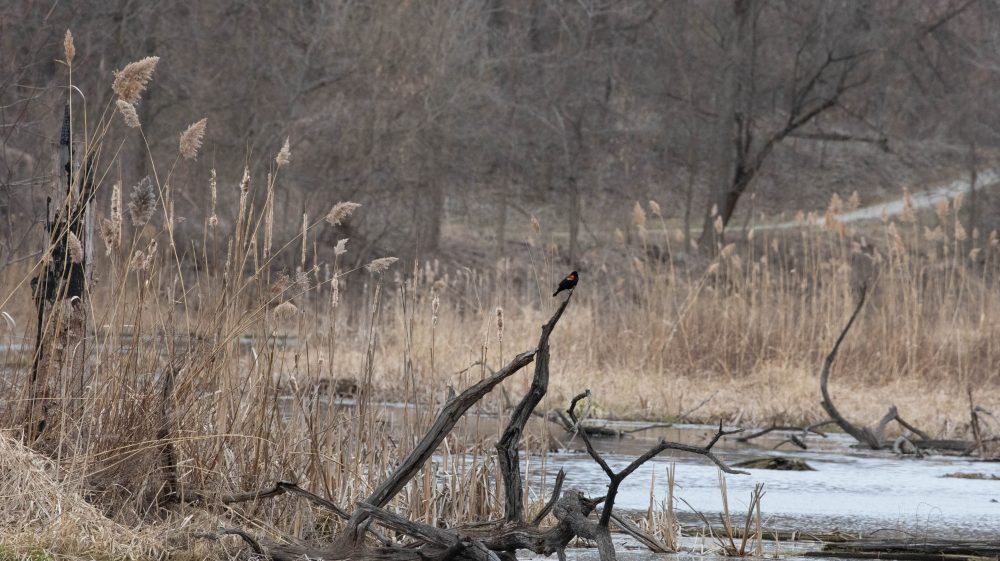
I was attracted to the Red-winged Blackbird below. This is either a female or perhaps a juvenile.

On the Riverside Lawn trail, where I always see them, there were a few Blue-fronted Dancer damselflies. I was thrilled to see them, although there were not as many as previous years.

A Northern Cardinal popped up to sing.

The last birds I saw on my way out were three Double-crested Cormorants sitting in a dead tree. The one easiest to focus on is in the cropped photo below.

Way back on June 25, I saw tagged Canada Goose 98H again.

And a Mallard mom was with her offspring. My, how they had grown. I haven’t seen many Mallards since.

I followed a Ring-billed Gull as it flew over the water.

There was also a Killdeer.

I had a female Belted Kingfisher that day but I had an even harder time focusing on her.

I captured an adult male Common Grackle in semi-flight.

And a fly-by American Robin finished my walk.

It has taken me a while to get temporarily accustomed to not going for a walk every morning. Working in the yard has been a somewhat worthwhile substitute, but I can’t help but wonder what I’m missing. I hope to get back to Riverside soon, but with a lot of heat and rain in the forecast my visits will remain sporadic. Storms are possible tonight, which sounds like a nice, if temporary, break in the heat and humidity. Indoors, my birds have been keeping an eye on me to make sure I don’t take too many naps.

Home, Home in the Yard 🎶

Since I’ve been spending so much of my early morning time working in the yard, it seems only appropriate to do a post about what’s been happening there recently.

This morning was particularly rewarding because, after what seemed like a month not seeing a hummingbird in the yard, I was treated to a female Ruby-throated Hummingbird visiting a nearby feeder while I sat on the stone bench under the shade of the Scotch Pine.

This morning was also good for House Finches and House Sparrows.

Here’s what the front yard looked like this morning. I have thinned out the goldenrod considerably, while leaving some for the butterflies and bees to enjoy as it is about to explode into yellow blossoms. I have left most of the Common Milkweed as well.

I found a bee on the Joe Pye Weed. I could barely see it, as it blends in beautifully with the wildness of the blooms.

This afternoon I took a couple quick photos with the phone of the Culver’s Root and a bee on a specimen that is growing close to the neighbor’s fence.

Also in front earlier, there was a Black Swallowtail Butterfly I captured with the phone camera.

Yesterday morning, I found a young House Finch on the birdbath while I sat cooling off on the stone bench.

Going back to Saturday morning, I had a Monarch Butterfly on the Common Milkweed.

The House Finches were enjoying cracking their own seeds in the sunflower seed feeder.

And a Gray Squirrel was showing off his acrobatics on the peanut feeder.

On July 16, there were insects such as this Red Milkweed Beetle.

A Paper Wasp was flying around.

And a Green Bottle Fly shone in the sunlight.

I found bees on a Pink Coneflower and an Eggplant blossom. I’ve never grown eggplant before, but it sure is pretty,

Google identified this as a Two-spotted Bumblebee on the Monarda.

Going all the way back to July 6, things were just getting started. So the last couple weeks have been like an explosion. Below, photos of the Culver’s Root and a Bumble Bee on the Monarda.

I observed an American Goldfinch that day. I haven’t seen them in the yard very often lately. They are busy nesting in places like the Chicago Portage.

And after years of failure, I have finally managed to grow some Rattlesnake Master. I hope I can keep it going.

We are in for another hot spell the next couple days. Then we are promised rain on Thursday followed by cooler temperatures. I have photos of recent outings and a lot more leftovers from May and June. I am also trying to work on my book. Let’s see what happens.

Summertime at Goose Lake Prairie

A week later than my usual annual visit to Goose Lake Prairie, I decided to visit. The forecast was for halfway decent weather, partly cloudy and not too hot. I arrived a little after 8:00 AM. There was another vehicle in the parking lot overtaken by weeds, and no sign of a Killdeer to greet me. Just as I started walking the trail, I encountered two well-established birders – so well-established I decided to keep quiet and confirm their identity later. Suffice it to say that the one without the wheelchair rattled off a list of birds they had encountered. I did not find everything they saw, but I had a good walk.

The first bird I met was an Indigo Bunting.

Common Yellowthroats were predictably everywhere. American Goldfinches as well.

American Goldfinch

The Red-winged Blackbird below looked so excited to be singing, I had to pay attention. Meanwhile, a merciful cloud cover was making the increasing heat more bearable.

I always have to take this picture of Cragg’s Cabin

I saw a Tree Swallow or two.

Northern Cardinals were hanging out.

There were several Barn Swallows.

I was delighted to find a Halloween Pennant Dragonfly, and then another later. In the panel below the Halloween Pennant, a Common Whitetail and a Black Saddlebags.

I was intrigued by a Common Yellowthroat in thorns.

Now, I nearly always expect to see Dickcissels, but I heard only two, and barely managed to capture this one too far away to be barely distinguishable even with my 400mm lens. Logically I am trying to make up an excuse for their absence: their territories are already established, they’re busy raising young and it’s none of my business.

I nearly always expect to see an Eastern Meadowlark or two as well. There were some foraging ahead in the grass on the trail, and this one flew by.

I was a little surprised to see a single Cedar Waxwing.

More Common Yellowthroats. In addition to the male posing very nicely below, I encountered a couple youngsters. It’s been a long time since I’ve seen juvenile Common Yellowthroats. I had to refresh my memory when I processed the photos.

I was hearing Field Sparrows but didn’t think I saw any until I realized later the camera had captured a few. All these birds were so far away and the cloud cover made it difficult to distinguish them. The two in the bottom photo appear to be juveniles.

Here’s another American Goldfinch.

I haven’t been seeing many butterflies, but this is an Orange or Clouded Sulphur.

I walked quite a ways before I encountered some very noisy Bell’s Vireos.

Willow Flycatchers were also on hand.

Noticeable flowering plants were Great Mullein and Silphium (Rosin Weed). I think this is the first time I have seen the Silphium there. It’s not a tall plant, which intrigues me seeing as how I have encountered problems with my natives growing tall this year. Maybe this is something I should consider in my backyard.

When I finally got all the way around the trail to a view of the Goose Lake as such, I did not see anything in the water. Previous years there has been at least a heron or two. I also noticed that the blind structure had been removed.

I heard Yellow-breasted Chats and did finally come across a juvenile that was willing to be photographed. i think the last bird in flight might be a different individual.

Also in flight, a Killdeer and a Red-winged Blackbird.

As I was coming to the end of my walk, I noticed an Orchard Oriole on some Great Mullein.

Here’s one more of a Bell’s Vireo. It picked such a beautiful spot to sit in, with the colorful sumac berries.

It shouldn’t have taken me a week to write this post, but I have been busy in the yard, among other things. One thing I have definitely noticed: insects seem to be back. I had been bemoaning the dire lack of insects and consequently swallows, swifts and flycatchers, and I am still sure the number of birds has decreased. But I can attest to the return of insects from one very personal observation. When I got home from Goose Lake Prairie, my legs were covered in bites. I was not aware I was being eaten while I was walking. I had tucked my pants into my socks to oblige the warning sign about ticks at the beginning of the trail, but I did not use any spray as it didn’t seem necessary. Suffice it to say I suffered raging itch for days, more like chigger bites (maybe they were) but the itching has subsided and I will live. Now I am using a little eucalyptus bug spray when I venture out. And I am seeing more birds and dragonflies. Apocalypse Not Quite Yet. To be continued.

Back at the Portage

I visited the Chicago Portage a couple times last week. I expected things to be quiet, and they were, but there were still a few interesting things.

I am always excited to see the muskrat. and on July 3rd, it was present. At first it appeared to be eating something. Then I saw it take off, shopping for foliage, and in the photos below you might see where it disappeared behind a log and then emerged swimming off with its bounty.

As I was standing at the bridge near Harlem observing the muskrat, a Brown Thrasher briefly came into view in the distance.

Later, I found a female Orchard Oriole again in the marsh.

American Robins, young and old, are always busy.

I had a chipmunk on the paved trail.

And I saw an Indigo Bunting just barely in the grasses.

An American Goldfinch was enjoying the duckweed.

And a juvenile American Robin was overhead.

July 8 started off as usual, with an American Robin on the paved trail. Robins are getting a lot more notice these days.

An Indigo Bunting was singing.

And then I encountered a family of Orchard Orioles that had gathered in a tree. After seeing the female foraging several times, it was nice to finally see the male and his offspring.

I caught a glimpse of a Warbling Vireo.

Then I was treated to a couple male Indigo Buntings, both of which are in the first photo of the post.

Young Red-winged Blackbirds were at the edge of the water.

As I sat on the picnic table waiting to see if someone else showed up, a Green Heron arrived.

Here’s one more of the male Orchard Oriole.

Early July always feels like an unwanted milestone for me. My reward for surviving the fireworks is to add another year to my existence. It’s a peculiar business, getting older. I planned on finishing this post days ago, but I have been preoccupied with a celebration of life ceremony for my dear friend and sister alto Amanda Thomas, who joined her ancestors on May 21. Those of us in the choir who were able to attend the short rehearsal on Wednesday evening were joined Saturday by additional choir members and people from other choirs in the area who sang with Amanda and under her direction. The service was over two hours long. I finished watching the video recording this morning to better see the speakers and the faces of Amanda’s friends in the sanctuary. It was an amazing tribute to an even more amazing woman. She left a lasting, loving impression on every life she touched.

I went to Goose Lake Prairie in Grundy County on Sunday morning. I will try to be back with a recap of that excursion next. In the meantime, here’s a little long shot from the backyard that I took this morning while working in it. I confess to loving the green, tropical shadiness of it all in the summertime.

After the Fireworks

I went back to Gooselake Natural Area and the Hebron Trail Saturday, getting up early enough to leave so I would arrive by 8:00 AM. I had hopes of perhaps seeing more Yellow-headed Blackbirds among others, but mainly it was just good to get away from everything after the noisy night before.

Unlike my last visit a month ago, there were very few birds to be seen. My list included far more species heard than seen. But I tried to make the best of it and I am glad I made the effort anyway. I first saw a few Barn Swallows such as the one below.

Brown-headed Cowbirds were not shy.

By the time I got to the viewing platform, a Green Heron flew past it.

I decided to walk beyond the platform a bit. Ahead, I saw a Ground Squirrel.

After hearing Song Sparrows but not seeing them, I did finally encounter this disgruntled-looking individual.

Red-winged Blackbirds began to emerge as well, and then as if a switch had been thrown, they were everywhere.

I tried very hard to see any Yellow-headed Blackbirds at all. The few I could make out with my 10×50 binoculars were way beyond the water and barely visible. I remembered trying to take a few photos, but I did not recall capturing any, so I was quite happy to see the two images below after I took them off the camera.

One female Brown-headed Cowbird was close to the trail. I had already started heading back out when her movement – any movement – captured my attention.

I did find a brave male American Goldfinch perched rather calmly. I heard several Common Yellowthroat males, but could not get even one to emerge from whatever bush it was calling from. This is all logical, of course, or so I tell myself. The birds are tending their nests, raising young, and their territories are well-established: they don’t need to advertise anymore.

Right about then, likely the same Green Heron flew in to perch on a nearby dead tree and sat for a while. I took several photographs, and it began to stretch like it was thinking about moving on, and then, when I turned my attention elsewhere, as if it now had my permission to leave, it left.

I spotted a dragonfly, but I haven’t bothered to try to identify it.

Then the most engaged individual bird appeared. I hung out with the Song Sparrow at the top of the post while he sang.

Among the birds heard but not seen were a Vesper Sparrow singing beautifully and a couple Dickcissels. I saw three distant Common Gallinules but I could not get good pictures. I am not discouraged. I will be checking eBird from time to time to see if more birds are being seen and schedule a return trip if possible.

On my way out, I encountered a young Red-winged Blackbird and a juvenile American Crow eating mulberries.

My battle continues with my overgrown yard, but although it will be ongoing, it is no longer so urgent, thanks to the efforts of my alderman to get the citation dismissed. I will receive only a warning, which is as it should be. It was still good to get the wakeup call, and since birding every morning is not so urgent while it’s hot and/or slow, I am committed to taming the beast. And it’s lovely to be out in the yard with the butterflies and bees, even if there are not as many of them.

Cooler Times: A Look Back at April 30

One day’s worth of photos seems worth going back to look at. These were taken on April 30 in Riverside. Spring migration was beginning, the temperatures were much cooler, and there were only a few leaves starting on the trees. I’m taking a break from the heat.

I first encountered a Killdeer by the Hofmann Tower.

I also took note of a Northern Rough-winged Swallow.

I noticed a Solitary Sandpiper on the rocks, and another on the sloping sidewall of the defunct dam.

Then they took off and I got some flight shots, with both of them in the frame of the last photo.

I was seeing Yellow-rumped and Palm Warblers pretty regularly.

Baltimore Orioles stood out.

I found two Tree Swallows perched on the swinging bridge.

A Ring-billed Gull was flying.

More Yellow-rumped Warblers.

A few Black-and-White Warblers were around too. This is the same individual as at the top of the post.

An Osprey flew over.

A female Downy Woodpecker went about her business.

And a Red-winged Blackbird attending to his.

I noticed a Great Blue Heron across the river when I walked through Riverside Lawn. It caught a fish and then swallowed it.

Warbling Vireos were arriving.

I got to see a male Eastern Bluebird who periodically checked with me this spring.

There were Ruby-crowned Kinglets here and there.

Then I noticed a female Scarlet Tanager.

One more of the Great Blue Heron.

Heading back to my car, I found a Northern Rough-winged Swallow on the wall by the Hoffman Tower.

We are promised some cooler weather and even rain later today. I worked in the yard this morning. and slowly but surely, there is more visual breathing space. It seems there is always something surprising going on and it’s not all bad. May we all be surprised by something good these days. I’ll be back shortly with some more recent observations.

Lately Lazy Summer Days

It has been disorienting to wake up every morning wondering whether I should go for a walk or not, and if not, how to plan the rest of the day. I have become such a creature of habit, if I don’t have a plan, it’s depressing, so I try to have likely alternatives for the next day sketched out before I go to sleep. It may sound simple, but the overwhelming heat has made it somewhat daunting. It’s not that I don’t have other things to do. But a walk in the woods or by the river centers and grounds me in a way that helps to make everything that follows fall into place.

Here are some photos from three recent visits to the Chicago Portage, starting with June 17, a bunny rabbit and a cabbage white butterfly.

We always hear Common Yellowthroats singing, but rarely see them. I believe there are two males with distinct territories at the Portage. I was standing at the top of the “hill” looking over the marsh and the water down below and heard one of them singing not too far away. It was not easy to capture his image, but that he was visible at all was remarkable, and he was so enthusiastic.

I captured a couple Red-winged Blackbirds in flight through the marshy area, and caught a glimpse of a deer.

A Northern Flicker seemed interested in the nest hole used last year, and I managed to see the Indigo Bunting I now call “TJ”.

On June 19, an American Goldfinch stood out for a moment.

I saw a couple Cedar Waxwings. I’ve been on the lookout for them.

The Common Yellowthroat at the top of the post is also below, where he was perched and sitting quietly not far from the bridge near Harlem. This is the second male. As I walked around and got to the opening in the fence, I took a peek at the water levels by the river after recent rain.

A male Red-winged Blackbird was hamming it up on the little bridge at the other end of the dirt trail.

I saw some Indigo Bunting action in the vegetation. I was unable to capture a female well, but the males were on display.

I wonder if this is the same turtle that I always seem to see covered in duckweed.

I got good looks at a Yellow Warbler, but I think it was the last time. I suspect they are still here but I have not heard or seen them lately. No doubt they are busy raising families.

One more American Goldfinch sat still.

On June 24, the first bird I found was an Indigo Bunting singing his heart out.

Two Pearl Crescent butterflies appeared: one with badly damaged wings, another in fine shape.

I caught a glimpse of a Red-winged Blackbird female in the marsh.

As I walked back along the paved trail, I found a female Orchard Oriole. I haven’t seen a male in a month or more, but this gives me hope.

A Great Blue Heron flew over.

I have taken to sitting on the picnic table placed under a tree by the water. Often enough, when I am sitting there looking for activity or just chilling, a bird comes into the tree above me and visits for a while. This time was no exception. A juvenile White-breasted Nuthatch offered its company.

Here’s one more photo of an Indigo Bunting. I like this photo because it shows off the blackness of his otherwise blue-appearing feathers.

I will be venturing out less frequently for walks in the next couple of weeks, thereby modifying my routine. One reason is the weather. The other reason is that it is time to try to clean up and contain the immense overgrowth in my front and back yards. I inadvertently have added incentive to do this work, as I found a citation from the city on Friday in my mailbox, demanding my appearance in municipal court on July 16. What convenient timing! I talked with my new alderman today to voice my concerns and sent him a copy of the citation. He will investigate and get back to me. In the meantime, I am enjoying seeing the fireflies in the early evening, and also welcoming back other insects and pollinators as well, even as their numbers seem greatly reduced. I did my part to insure their survival by not cleaning up my yard any earlier this year. I doubt I will have an opportunity to educate the magistrate at my hearing about climate change and the environment, but I am still glad I have a habitat to offer the birds, butterflies and bees.

Fireflies in the front yard

Looking Back a Bit

While I’ve been stuck inside, more or less, during the heat wave, it’s been almost refreshing to look back at photos from the end of April still on the laptop. Spring migration was starting, and even though many of the trees did not yet have leaves and the temperatures were chilly, birds were on the way.

But first, I found even more photos I didn’t know I still had, from April 17 at the Chicago Portage. Below, an American Robin sneaking nesting material, and a late American Tree Sparrow.

Northern Flickers were coming back.

An Osprey flew over.

A Song Sparrow was checking out the marshy area.

On April 21 in Riverside, Yellow-rumped Warblers were easy to find.

A Northern Cardinal, a Song Sparrow and a White-throated Sparrow made the cut.

On April 24 at the Chicago Portage, I found two American Robins preoccupied.

Yellow-rumped Warblers were easy to find.

I noted the return of a Green Heron.

Blue-winged Teal had been at the Chicago Portage for weeks.

Palm Warblers were showing up too.

Palm Warbler

On April 28 in Riverside, I saw an Eastern Bluebird. While they were setting up a territory, I saw the bluebirds quite frequently, but now that they are busy raising young I haven’t seen them lately at all.

An interesting fungus

Palm Warblers were showing up everywhere.

A pair of Northern Cardinals were enjoying the sunshine.

And a Great Blue Heron was in the river.

Then on April 29, back at the Chicago Portage, I had a Field Sparrow.

Warbling Vireos were arriving and claiming territories.

One of several Palm Warblers…

A Yellow Warbler was most likely heard first and then seen. There are at least two if not three breeding pairs at the Chicago Portage this year.

A Green Heron first appeared in a tree and then flew down to the water.

An Osprey flew over.

Then, the surprise bird at the top of this post, a beautiful male Rose-breasted Grosbeak. I don’t believe I have seen one since. If they are nesting here, they are extremely well hidden.

White-throated Sparrows didn’t seem to be as plentiful this spring.

Just before the leaves would make them nearly impossible to see, Warbling Vireos were singing and reminding me they were going to be everywhere.

I managed to go for a walk yesterday before the heat increased again. We did get some rain last night and we’ve cooled off a bit, so I will go for a soggy walk by the river and then immerse myself in the pool. I will be back with more current reports, and I still have a lot of notable leftovers from spring warbler migration to share.

June Mornings in Riverside

The Des Plaines River has been really low, exposing a lot of rocky islands. We were advised of enough rain yesterday to earn a flash flood warning for the area, so it will be interesting to observe the water levels fluctuating between rain and more hot, dry weather. In the meantime, here is a little roundup of scenes from several morning walks, beginning with June 2. Two Killdeer were on the rocks across from the Hofmann Tower which has also been a favorite gathering place for Ring-billed Gulls. The photo sequence below looks like the Killdeer were making more Killdeer. Check out the way the male has stuck out his chest and neck feathers in the third photo: it looks very boastful to me.

A Bald Eagle flew in the distance that morning.

Common Grackles have been quite fond of the rocky shores.

The light was perfect for a Baltimore Oriole.

Then on June 6, the only bird I managed to photograph well was a Warbling Vireo. They’re usually hard to capture, so I’ll take it.

On June 9, a Great Egret was by the wall across from Hofmann Tower, where the dam used to be.

A Ring-billed Gull flew by.

Common Grackles were on rocks emerging from the water.

I often see a Double-crested Cormorant in flight down the river.

I managed to capture a Cliff Swallow.

This Common Grackle almost made me think of a Great-tailed Grackle.

I saw two Chimney Swifts.

And this turtle took a striking pose.

I photographed another Double-crested Cormorant swimming. He looks like he’s smiling with that yellow gape. But I never see the double-crest. I wonder if it takes two cormorants to see the double-crest.

I managed to see a Northern House Wren, which doesn’t happen too often for such a common bird.

I found another Warbling Vireo…

The bird below is a total mystery to me. I caught it flying over the grass by Swan Pond. The Merlin app thought it was a Yellow-headed Blackbird, but it’s definitely not. So much for artificial intelligence. I think it is a swallow and somehow the light is playing tricks with the camera, but I can’t pin down what species it might be.

I also found a Gray Catbird singing his heart out in the open.

On June 11, Red-winged Blackbirds were going after everyone

Most striking was their attention to a close Turkey Vulture.

While all that was going on, another Turkey Vulture was sitting in a tree above the paved trail.

I saw a mother Mallard and her ducklings by the wall that curves around a bend in the river.

On the last visit on June 16, I noticed a tagged Canada Goose that I have not seen before. I have reported it to the USGS. I will be interested to see how long it takes for them to get back to me with the usual certificate and information about the goose and where and when it was tagged, given the current administration’s staffing cuts. So far I have received a lengthy email acknowledging my submission.

A lovely Ring-billed Gull flew by that morning

I crossed the street to walk in Riverside and nearly stepped on a large turtle on the sidewalk at the end of the bridge. After looking around and realizing I was alone without any turtle experts available, I started talking to it, wondering if it needed assistance getting back down to the river as there is a steep drop-off next to the bridge wall. As I explained to the turtle that I was worried for its safety, it started to move off the edge of the sidewalk, and when I asked again if it needed assistance it gave the equivalent of a turtle’s “heck no” and started moving in earnest, sliding slightly down a small part of the incline, in the direction of the river. I then felt reassured that it would make it on its own and continued my walk.

From there my encounters were less exciting.

Eastern Kingbird
Canada Goose family
Mourning Dove
Common Grackle

Baltimore Orioles are a little less visible these days, so I try to capture them when I see them.

Despite the flash flood warning, the rain was welcome. I hope the rain will jumpstart my native plants to flower so I can see if the bees are going to come back. As of this morning, I have only seen more houseflies.

I may be back to this page sooner than later as the heat advisory is asking us to stay inside the next few days. I will try to gather more enthusiasm for indoor pursuits, which always seems strange to me this time of year, but it is what it is.

Indigo Bunting Footnote

I somehow never managed to add an Indigo Bunting to the last post. I guess I was so distracted by the potential finding of a rarity that I lost track. As it turns out, the rarity was discounted by the eBird police, so the bird was likely just an unusual-looking female Baltimore Oriole, which was what I thought it was originally until I consulted my Sibley app. What rabbit holes we birders can go down! This will be a brief post, starting with the return (or not) of one Indigo Bunting in particular.

For the past four years, the Indigo Bunting I named Tadziu returned to the same spot at the Chicago Portage. It had gotten to the point where I could recognize his song. Last year, I noted that one of his likely offspring was singing a lot like him. This year, Tadziu did not come back to his territory. But there is an Indigo Bunting with a territory just down the trail from Tadziu’s, who sits and sings for us just like Tadziu did. Below the photos of the current Indigo Bunting I am calling “Tadziu Junior” or TJ for short, I have posted my last recording of Tadziu and a new recording of the present bird.

Note: Indigo Buntings sing in paired phrases. Both recordings below also have American Robins singing in the background.

Tadziu’s Song 5/23/24
“Tadziu Jr” song 6/12/25

And now for something only slightly different – on June 8, I decided to visit Ottawa Trail North to see what was going on there. It’s part of the same corridor as the Portage, close to the Des Plaines River.

Des Plaines River viewed from the trail

The first bird I photographed was an Indigo Bunting as blue as the sky.

Baltimore Orioles were easy to see, even at a distance.

I photographed a resting Barn Swallow.

I barely managed to see this Blue Jay take off with nesting material.

I found a Red-bellied Woodpecker trying to sit up on an incline.

All the birds were far away, like this Great-crested Flycatcher. That’s because the construction of the levy, on top of which the trail extends, eliminated a lot of trees close to the previous foot trail closer to the river.

I have noticed a reduction in swallow activity over the last week and a half. I did manage to capture a Northern Rough-winged Swallow and later, over the lawn by the parking lot, a Cliff Swallow.

I caught a glimpse of an Orchard Oriole.

A Brown-headed Cowbird took off.

And a Red-winged Blackbird flew by.

Toward the end of my walk, I caught an interesting interaction between two House Sparrows.

And across the river I found a Canada Goose family. The goslings blend in with the rocks, making them very hard to see.

That’s all for now. It’s been quite a week. On Friday, I got the news that Ed O’Brien, who was leading the Oak Park Bird Walks with me during migration seasons, died the day before. This is a terrible shock and an incredible loss to all of us who knew him. I felt like I was just getting to know him better, and now as he’s constantly in my thoughts, I already miss his companionship, birding expertise, good vibes and great sense of humor. Almost as if saying goodbye, Ed made a comment for the first time on my “Farther Afield” post a little over a week ago. Rest in Peace, Ed O’Brien.