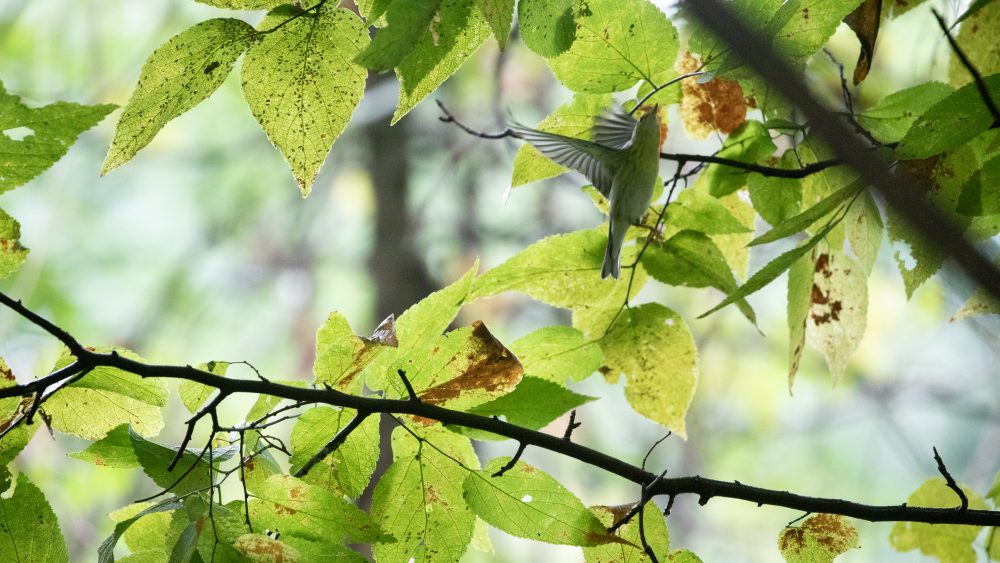

It has been disorienting to wake up every morning wondering whether I should go for a walk or not, and if not, how to plan the rest of the day. I have become such a creature of habit, if I don’t have a plan, it’s depressing, so I try to have likely alternatives for the next day sketched out before I go to sleep. It may sound simple, but the overwhelming heat has made it somewhat daunting. It’s not that I don’t have other things to do. But a walk in the woods or by the river centers and grounds me in a way that helps to make everything that follows fall into place.
Here are some photos from three recent visits to the Chicago Portage, starting with June 17, a bunny rabbit and a cabbage white butterfly.


We always hear Common Yellowthroats singing, but rarely see them. I believe there are two males with distinct territories at the Portage. I was standing at the top of the “hill” looking over the marsh and the water down below and heard one of them singing not too far away. It was not easy to capture his image, but that he was visible at all was remarkable, and he was so enthusiastic.


I captured a couple Red-winged Blackbirds in flight through the marshy area, and caught a glimpse of a deer.


A Northern Flicker seemed interested in the nest hole used last year, and I managed to see the Indigo Bunting I now call “TJ”.


On June 19, an American Goldfinch stood out for a moment.

I saw a couple Cedar Waxwings. I’ve been on the lookout for them.


The Common Yellowthroat at the top of the post is also below, where he was perched and sitting quietly not far from the bridge near Harlem. This is the second male. As I walked around and got to the opening in the fence, I took a peek at the water levels by the river after recent rain.


A male Red-winged Blackbird was hamming it up on the little bridge at the other end of the dirt trail.


I saw some Indigo Bunting action in the vegetation. I was unable to capture a female well, but the males were on display.


I wonder if this is the same turtle that I always seem to see covered in duckweed.

I got good looks at a Yellow Warbler, but I think it was the last time. I suspect they are still here but I have not heard or seen them lately. No doubt they are busy raising families.


One more American Goldfinch sat still.

On June 24, the first bird I found was an Indigo Bunting singing his heart out.

Two Pearl Crescent butterflies appeared: one with badly damaged wings, another in fine shape.


I caught a glimpse of a Red-winged Blackbird female in the marsh.

As I walked back along the paved trail, I found a female Orchard Oriole. I haven’t seen a male in a month or more, but this gives me hope.


A Great Blue Heron flew over.

I have taken to sitting on the picnic table placed under a tree by the water. Often enough, when I am sitting there looking for activity or just chilling, a bird comes into the tree above me and visits for a while. This time was no exception. A juvenile White-breasted Nuthatch offered its company.


Here’s one more photo of an Indigo Bunting. I like this photo because it shows off the blackness of his otherwise blue-appearing feathers.

I will be venturing out less frequently for walks in the next couple of weeks, thereby modifying my routine. One reason is the weather. The other reason is that it is time to try to clean up and contain the immense overgrowth in my front and back yards. I inadvertently have added incentive to do this work, as I found a citation from the city on Friday in my mailbox, demanding my appearance in municipal court on July 16. What convenient timing! I talked with my new alderman today to voice my concerns and sent him a copy of the citation. He will investigate and get back to me. In the meantime, I am enjoying seeing the fireflies in the early evening, and also welcoming back other insects and pollinators as well, even as their numbers seem greatly reduced. I did my part to insure their survival by not cleaning up my yard any earlier this year. I doubt I will have an opportunity to educate the magistrate at my hearing about climate change and the environment, but I am still glad I have a habitat to offer the birds, butterflies and bees.