Summertime at Goose Lake Prairie

A week later than my usual annual visit to Goose Lake Prairie, I decided to visit. The forecast was for halfway decent weather, partly cloudy and not too hot. I arrived a little after 8:00 AM. There was another vehicle in the parking lot overtaken by weeds, and no sign of a Killdeer to greet me. Just as I started walking the trail, I encountered two well-established birders – so well-established I decided to keep quiet and confirm their identity later. Suffice it to say that the one without the wheelchair rattled off a list of birds they had encountered. I did not find everything they saw, but I had a good walk.

The first bird I met was an Indigo Bunting.

Common Yellowthroats were predictably everywhere. American Goldfinches as well.

American Goldfinch

The Red-winged Blackbird below looked so excited to be singing, I had to pay attention. Meanwhile, a merciful cloud cover was making the increasing heat more bearable.

I always have to take this picture of Cragg’s Cabin

I saw a Tree Swallow or two.

Northern Cardinals were hanging out.

There were several Barn Swallows.

I was delighted to find a Halloween Pennant Dragonfly, and then another later. In the panel below the Halloween Pennant, a Common Whitetail and a Black Saddlebags.

I was intrigued by a Common Yellowthroat in thorns.

Now, I nearly always expect to see Dickcissels, but I heard only two, and barely managed to capture this one too far away to be barely distinguishable even with my 400mm lens. Logically I am trying to make up an excuse for their absence: their territories are already established, they’re busy raising young and it’s none of my business.

I nearly always expect to see an Eastern Meadowlark or two as well. There were some foraging ahead in the grass on the trail, and this one flew by.

I was a little surprised to see a single Cedar Waxwing.

More Common Yellowthroats. In addition to the male posing very nicely below, I encountered a couple youngsters. It’s been a long time since I’ve seen juvenile Common Yellowthroats. I had to refresh my memory when I processed the photos.

I was hearing Field Sparrows but didn’t think I saw any until I realized later the camera had captured a few. All these birds were so far away and the cloud cover made it difficult to distinguish them. The two in the bottom photo appear to be juveniles.

Here’s another American Goldfinch.

I haven’t been seeing many butterflies, but this is an Orange or Clouded Sulphur.

I walked quite a ways before I encountered some very noisy Bell’s Vireos.

Willow Flycatchers were also on hand.

Noticeable flowering plants were Great Mullein and Silphium (Rosin Weed). I think this is the first time I have seen the Silphium there. It’s not a tall plant, which intrigues me seeing as how I have encountered problems with my natives growing tall this year. Maybe this is something I should consider in my backyard.

When I finally got all the way around the trail to a view of the Goose Lake as such, I did not see anything in the water. Previous years there has been at least a heron or two. I also noticed that the blind structure had been removed.

I heard Yellow-breasted Chats and did finally come across a juvenile that was willing to be photographed. i think the last bird in flight might be a different individual.

Also in flight, a Killdeer and a Red-winged Blackbird.

As I was coming to the end of my walk, I noticed an Orchard Oriole on some Great Mullein.

Here’s one more of a Bell’s Vireo. It picked such a beautiful spot to sit in, with the colorful sumac berries.

It shouldn’t have taken me a week to write this post, but I have been busy in the yard, among other things. One thing I have definitely noticed: insects seem to be back. I had been bemoaning the dire lack of insects and consequently swallows, swifts and flycatchers, and I am still sure the number of birds has decreased. But I can attest to the return of insects from one very personal observation. When I got home from Goose Lake Prairie, my legs were covered in bites. I was not aware I was being eaten while I was walking. I had tucked my pants into my socks to oblige the warning sign about ticks at the beginning of the trail, but I did not use any spray as it didn’t seem necessary. Suffice it to say I suffered raging itch for days, more like chigger bites (maybe they were) but the itching has subsided and I will live. Now I am using a little eucalyptus bug spray when I venture out. And I am seeing more birds and dragonflies. Apocalypse Not Quite Yet. To be continued.

Annual Visit to Goose Lake Prairie

Saturday morning was absolutely beautiful. In anticipation of its cooler weather, I got up a bit earlier so I could drive to Goose Lake Prairie State Natural Area for my annual July visit. If I can believe my eBird checklists, I have been visiting every July since 2012. This place has rarely seemed to be anyone else’s destination for the 4th of July weekend, so I was not too surprised when I drove into the empty parking lot. The visitor’s center is not open on holiday weekends. But I go there for the trails, so it doesn’t matter.

I took a photo of the trail map so I would have a better idea what direction I was headed in. Starting out, the “Interpretive Trail” shown with numbers on the map is easy enough to follow, but I wanted to walk back to the water, or the Goose Lake, if you will, without getting lost because even if you can see the Visitor Center in the distance, it can get a little difficult to gauge distance and direction.

A phone photo of the Visitor Center

Right off the bat I saw a rabbit on the trail, and then followed a Barn Swallow to its perch behind the Visitor Center.

I then encountered a pair of Brown Thrashers. I was delighted to see them as I don’t seem to see this species all that often.

There were many more Tree Swallows than I could photograph.

I found a Willow Flycatcher close to the trail.

On the way to Cragg’s Cabin, I saw an Eastern Comma Butterfly.

I did not walk behind the cabin to see the windmill as I have in previous years. I did sit down on the bench that looks over a pond next to the cabin where I have seen birds before, but there was nothing to report. So I continued on the Interpretive Trail and encountered a Song Sparrow.

By this time on previous occasions I would have heard and seen fairly well at least a couple Dickcissels, but this time I was surprised by the lack of them. I did manage to barely capture one far away on his thorny perch.

Two Eastern Meadowlarks appeared briefly. Unfortunately they were distant and backlit.

There seemed to be more Common Yellowthroats everywhere, though not quite as easy to capture as they had been in Hebron. I could let most of them go.

But then, I was quite surprised to see a Bell’s Vireo. This is a bird that’s often very difficult to see. Although this one was at some distance, it did me the favor of staying pretty much in the same place long enough for me to capture its image. It seemed that almost every time I had passed by a bush I heard a Bell’s Vireo’s scratchy-sounding little song, never for the bird to appear, but now I was actually seeing one.

I then reached the water, where I found only Tree Swallows and an Eastern Kingbird flying around after my approach flushed a Great Blue Heron.

I encountered a closer Bell’s Vireo.

Then a Tiger Swallowtail Butterfly caught my attention. Bergamot is very attractive to butterflies.

The vegetation in this location is notable. It is the largest remaining stand of Tall Grass Prairie in Illinois. I made note of some old favorites and others I don’t recall seeing before.

I found an American Goldfinch with nesting material. The bird flying away in the last photo appears to be a different individual, however.

Then I encountered a first-year male Orchard Oriole.

And caught a brief glimpse of a Baltimore Oriole.

Red-winged Blackbirds were everywhere but not posing. I did manage to capture what looks like a female on the left and a juvenile on the right.

A young Gray Catbird popped out to see what was happening.

And I got a closer look at an Eastern Kingbird.

I finally caught a glimpse of some of the Field Sparrows I had been hearing, only these appeared to be juveniles.

And then the most exciting part of the visit occurred when I saw a flash of a goldfinch-sized yellow bird with an insect in its beak. Since goldfinches don’t eat bugs, I wondered … could it possibly be a Yellow-breasted Chat, a Nemesis Bird if there ever was one, the most annoyingly elusive grassland species one hears 99.9% of the time but nearly never sees?

Much to my delight and for whatever reason, the Chat decided to come out from behind its cover and show off its catch.

I can’t help myself. This is the best birthday gift I’ve had in a long time.

Young Field Sparrows flew in and I checked them out while the Yellow-breasted Chat was still there.

After that, I was done for the day. Thanks for making it through this long-on-photos post. Here’s one more of an Orchard Oriole.

Ah, the Sewage Ponds

It may sound awful, but sewage ponds are a good place to look for birds. And that is exactly where we went on our first morning outing in San Blas.

If I can trust my camera roll, the first birds we saw were an assortment of seedeaters and kingbirds, but I have given first position to this very attractive Groove-Billed Ani, because I never noticed the unique woven-looking pattern of the nape feathers before.

And now, the Seedeaters…

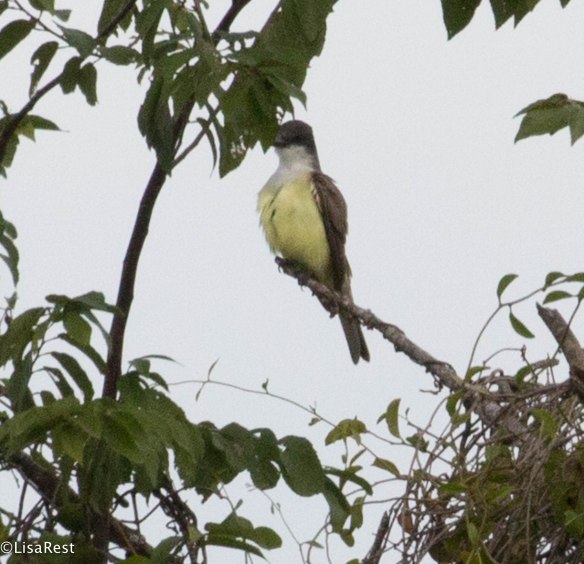
Tropical Kingbirds can be good subjects. Below this one is a Thick-billed Kingbird for comparison, but the name doesn’t seem all that descriptive to me.

Tropical Kingbird
Thick-billed Kingbird

Those of you who know me know I adore Crows, so I was thrilled to observe a new species doing Crow Stuff.

I don’t think a day went by without a Zone-tailed Hawk, either…

I was impressed with the graceful flight of a Wood Stork.

This falcon could have been laughing at me for as long as I waited for him to turn his head for a profile shot.

Laughing Falcon

Unlike my last Texas trip, I don’t recall hearing the incessant chatter of a Bell’s Vireo, but at least we saw this one.

Bell’s Vireo

Great Kiskadees were ever-present but nearly impossible to photograph. I wonder why I bothered with this one.

Great Kiskadee
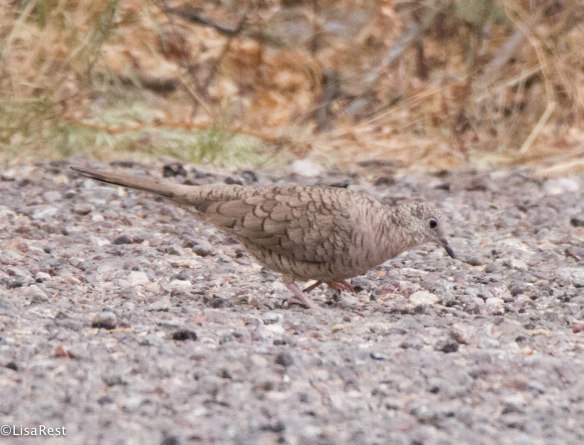
Inca Doves
Great-tailed Grackle

Not sure I have any better images coming of Roseate Spoonbills, but here’s one flying.

All these species would have been way too many for me to get my head around without taking pictures. A new woodpecker!

Below, what an endearing little flycatcher for such a long name. I confess I don’t know what makes it “beardless.”

Not a day went by without a Blue-gray Gnatcatcher distraction. Some days were Blue-grey though.

Blue-gray Gnatcatcher

I think we had a record number of pygmy owls on this trip.

Ferruginous Pygmy-Owl

The remaining images are…more birds seen.

Black-chinned Hummingbird (female)
White-faced Ibis (immature)
Willet

This Yellow-Winged Cacique was having a bad hair day. Lovely flower though.

I didn’t manage to photograph many butterflies with a 100-400mm lens, but these are a few that we saw. I’ve put the Vermilion Flycatcher with them because unlike previous trips, I never got close enough to one to do it justice. I will try to identify the rest of the butterflies when my new butterfly book arrives…

Raptors aplenty – Short-Tailed Hawk is new for me.

Crested Caracara

I was going to include the afternoon river excursion photos, but I think they deserve their own space. So my chronicle of this day in San Blas will continue soon.

All Hail Breaks Loose

I wasn’t too excited about the photographs I found on my laptop for the day after the big hike, but then when I checked my phone I remembered why there were so few. If my memory serves me correctly, we woke up in the middle of the night to the sound of hail hitting the roof and then when we set out for a short local trek before taking vehicles to other trails, finding hail piled up almost a foot high on the gravel road.

So it looks like it was a cloudy, iffy day weather-wise, and eventually we had hail again. Only this time we were safe inside the vehicles.

The video and these images are from the cell phone. A dramatic landscape enhanced by weather.

Two birds willingly posed within range that day: the Audubon’s Yellow-Rumped Warbler at the top of the page and this lovely Say’s Phoebe.

But also ubiquitous on the entire trip were Bell’s Vireos. We didn’t always see them but we definitely heard them every day.

Bell’s Vireo
A distant Yellow-Breasted Chat

Dark, cloudy and distant pictures of two hummingbirds (Lucifer on the upper left and middle and Broad-Tailed below, right) and a Varied Bunting in between them.

We visited this amazing fossil discovery exhibit which is in Big Bend National Park.

Some flora which I might be able to identify if I could just find the laminated checklist of Big Bend wildflowers I purchased at the Visitors Center. Looking through even more pictures on the internet makes it tempting to revisit this area some day. I want to come back as a plant fanatic.

Not sure who this is either…
A distant but very cooperative Loggerhead Shrike.
Black-Chinned Sparrow
This was the vista behind the Bell’s Vireo above.
A Rock Squirrel and his rock.

There are four more days of photographs from the Southwest Texas trip to decipher. Then it’s onward to rejuvenate or replace the travel laptop before I take it on another adventure coming up next month!

Southwest Texas: Building the List

Vermilion Flycatcher

It was challenging for many reasons to get photographs on this day. The birds were far away. They were backlit. They were hiding behind branches of trees or leaves of cactus. It was somewhat cloudy. And yet I was surprised to finally go through all the pictures more thoroughly and find some images I didn’t know I had. Most of all, it is great to get a feel for the landscape where the birds and other creatures were.

Saving the big hike for the following day, we explored the low-lying areas along the Rio Grande.

White-winged Dove

Most of these birds we continued to see throughout the trip, like the Say’s Phoebe below. I like the cactus cover this bird was using.

Say’s Phoebe

Mexican Jays are stunning. I don’t think we ever saw more than two at one time. They were somewhat elusive.

Mexican Jay

We saw Roadrunners on occasion but not close enough or long enough to get really good pictures. Maybe we were too distracted by our search for less common species.

It must be West Texas – there’s a Greater Roadrunner!

Hearing and barely seeing a Bell’s Vireo is a big event where I come from, so witnessing their incessant chatter and then getting such great views was heaven for me.

I adore Ravens and tried to get photographs whenever I could.

Common Raven

We spent some time locating and then looking at this Tropical Parula. It was so far away I wasn’t at all sure I got a photograph so I was surprised to find a few that were in focus. So I guess it was good I was carrying around my monster lens most of the time, although by the end of the trip it was starting to fall apart…

This Turkey Vulture is actually kind of cute. Snazzy pink legs and face to match.

Turkey Vulture, posing

Vermillion Flycatchers were almost everywhere. I like the female’s subdued plumage.

I think Western Wood Pewee was a new bird for me.

Western Wood Pewee

I got only one distant fuzzy shot of the male Varied Bunting, bottom right.

We were privileged to have good, long looks at a perched Zone-Tailed Hawk. You can just barely see the trademark tail band tucked underneath the tips of its folded wings.

Zone-tailed Hawk

Swainson’s Hawks are beautiful. Without the monster lens I would not have captured this detail.

Swainson’s Hawk

The Gray Hawk is…well…very gray.

There were more Scott’s Orioles to be seen, but even though this one was quite far away, I love the vegetation it has decided to perch on.

Scott’s Oriole
The Rio Grande
Inca Dove
House Finch
Golden-fronted Woodpecker

The Cordilleran Flycatcher was a new bird for me. I wish I’d gotten a better photograph, but this at least gives me an idea in case I am lucky enough to see one again.

Cordilleran Flycatcher

The gray day didn’t do this Acorn Woodpecker justice, but I still think of The Joker.

Acorn Woodpecker
Some of the dramatic landscape surrounding the Zone-Tailed Hawk’s perch.

It will take me some time to process the rest of this trip’s pictures, but I get to savor my memories a little bit longer. In the meantime, we keep wondering when summer will arrive in the Chicago area. While I am glad it’s not hot, it’s been colder and wetter than I ever remember for mid-June. I hope your summer solstice is going well.

The Elusive Bell’s Vireo

Bell's Vireo

Bell’s Vireo

Bell’s Vireos have a reputation for sounding like they should be in plain sight but hiding behind the curtain, if you will. At least that has been my experience with those that breed in Illinois, so it was particularly rewarding to get pretty good looks, if not great pictures, of a Bell’s Vireo in Texas the last day of our trip.

Bell's Vireo 4-30-14-9724

We dispersed early in the morning to bird the grounds of Neal’s Lodges individually before leaving for the Austin airport. I thought I had a better recording of this bird’s song, for all the singing he was doing, but there seems to be interference from road noise and several other birds. Anyway, the Bell’s is the intermittent but emphatic little chattery song, if you can hear it.

]

Bell's Vireo 4-30-14-9751

It’s possible one of the other birds singing a bit is a Black-Throated Sparrow. I was delighted to find him and get a few pictures as well. The last time I saw this species was almost two and a half years ago in New Mexico. Hard to believe it’s been that long.

Black-Throated Sparrow

Black-Throated Sparrow

The bird has to be facing you to see the black throat for which it’s named. Otherwise you need to be familiar with its other field marks, like the broad white supercilium.

Black-Throated Sparrow 4-30-14-9666

Black-Throated Sparrow 4-30-14-9670

There was also a cooperative Clay-Colored Sparrow, but I don’t hear his buzzy song on this recording.

Clay-Colored Sparrow 4-30-14-9484

Clay-Colored Sparrow

Clay-Colored Sparrow 4-30-14-9657 Clay-Colored Sparrow 4-30-14-9685

Indoor birds and I are listening to Gluck’s Iphigenie en Tauride on the Tuesday Night Opera with Peter Van De Graaff on WFMT. It seems a good night to stay home, close the windows to retain some heat overnight, turn on the oven and roast veggies. The drop in temperature dictates coziness.