Farther Afield

After three days birding with the Oak Park Migration Bird Walkers and the three early rises that facilitated those walks, you might think I’d had enough for a while. But I found myself thinking about the Goose Lake Natural Area in McHenry County, a/k/a the Hebron Trail, and the Yellow-headed Blackbirds that breed there every summer, and after checking recent reports on eBird, I decided to go there Sunday morning.

I love this place, but it takes me an hour and a half to get to it, so that’s 3 hours of driving already built into an outing. On top of it, with the long walk along the trail, I managed to spend close to another 4 hours while I was there. But as luck would have it, just as I reached the parking lot, I encountered Keith, another birder with camera, and we walked the trail together, eventually running into Barb and Laura, two expert birders that he knows who frequent this trail, so I was in good company and I am sure I saw more than I would have on my own.

The gravel road trail begins advances through farmland on either side, well-shaded by trees. Red-eyed Vireos have been singing everywhere lately, and they were no exception here. We managed to see this one.

As we approached a clearing, we found a male Ruby-throated Hummingbird perched on a bare branch. It was quite far away, and being a small, backlit bird didn’t help these photos, but still it was nice to see. And if memory serves me correctly, I have seen this bird or one like him at the same spot before.

A Killdeer flew by as we walked out into the open area.

Common Yellowthroats are seen easily here, unlike in their more secluded urban habitats, so it wasn’t too surprising to see one perched and singing immediately.

Willow Flycatchers are also prevalent at this location. Although I saw several after this one, for some reason I was intrigued by this guy when we first saw, maybe because he was singing, loudly proclaiming his “Fitz-pew.”

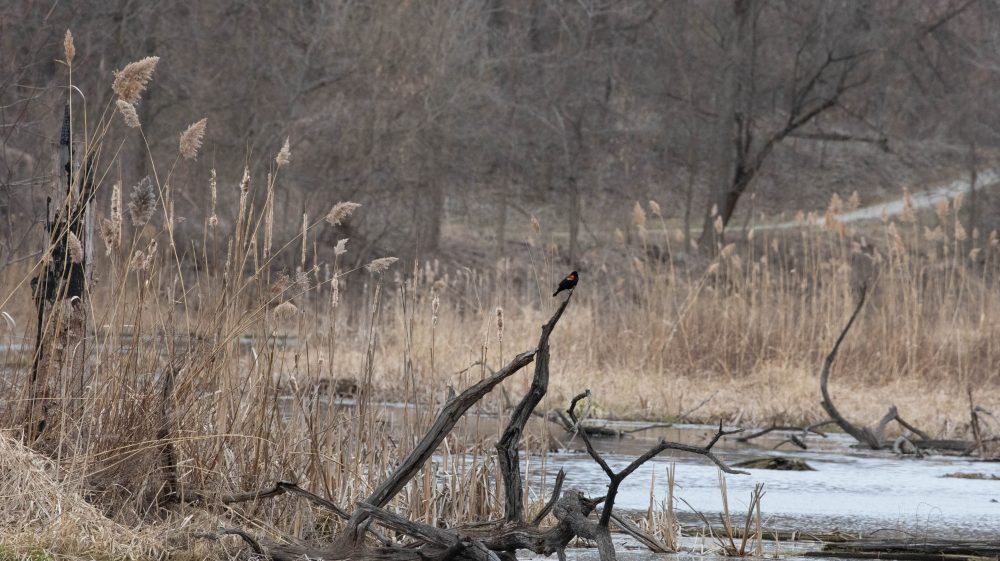
It’s breeding season and with that comes the need to find bugs to feed the nestlings. Red-winged Blackbirds dominate the landscape and it’s hard to ignore them, especially when they’re doing something interesting.

Not to be outdone, Song Sparrows were busy gathering food as well.

There were quite a few Yellow-headed Blackbirds, but they were far away. But they were singing, which is always a delight to my ear, and I did manage to get a few slightly-clear distant shots. I am already considering a return-trip, when the young have fledged. If eBird reports and my memory serve me correctly, I should go back early next month.

Reminding us that the Yellow-headeds are not the only yellow-and-black birds, male Common Yellowthroats popped up constantly and conspicuously.

We spotted a distant Swamp Sparrow in the marsh. We were looking for Marsh Wrens which we heard but could not see.

A Green Heron flew by and then a Red-winged Blackbird chased it further.

Another little Red-winged Blackbird display

After hearing a few Yellow Warblers, we did finally see one perched in the distance.

We also heard and started seeing Brown Thrashers here and there along the trail.

It’s difficult to see the flycatcher surrounded by all the twigs in the photos below, but I managed to get some shots clear enough for Merlin to decide that it was an Alder Flycatcher. It seemed different from the Willows to me, but it didn’t vocalize. I’ll call it an Alder.

Butterflies are starting to emerge. We saw a Pearl Crescent and a Tiger Swallowtail.

On the way out, an Indigo Bunting flew quickly into a tree.

I had been expecting to see a Great-crested Flycatcher in the wooded area and sure enough, we heard one. Thanks to Keith for spotting it. I couldn’t resist the last photo as it left, showing off that gorgeous tail.

I was thoroughly exhausted even the next day, but I am starting to revive. I will be back soon with the Oak Park walk roundup as promised. Birding will get a lot quieter now, but there’s always something happening. And the indoor Zebra Finch Chorus doesn’t hesitate to announce sunrise at 5:00 AM as the days get longer.

Earlier Encounters

I’m going to skip back earlier to April for a moment to relate a couple unexpected encounters. On April 15, I was at the Chicago Portage, and on April 16, I was in Riverside.

Not much was new at the Chicago Portage. I took note of a few appearances from the usual cast of characters.

I had started seeing and hearing Eastern Phoebes like the one below.

Blue-winged Teal were still in the creek,

I was on my way back out along the paved trail when I noticed a Red-winged Blackbird atop a tree fragment. Since there hadn’t been much else happening yet, I was inclined to pay attention.

I then saw that the Red-winged Blackbird was monitoring a Red-shouldered Hawk perched quietly below as the hawk tried to figure out how to eat a snake it had captured.

The next day, I was in Riverside. But on the Lyons side of the river where I park, I saw a very healthy-looking coyote.

A Great Blue Heron was in the river with two Canada Geese. There were also two Herring Gulls.

As I started to walk the paved trail by Swan Pond, a male Eastern Bluebird who has claimed this territory came to see me.

I encountered a Tree Swallow.

I found a Field Sparrow foraging near the trail. I have seen this species a few times this spring.

Then I got several opportunities to photograph a Ruby-crowned Kinglet, ever hopeful that I might see the ruby crown. As it turned out, this individual showed just a bit of it.

My last photos were of a Red-tailed Hawk flying overhead;.

So even though spring migration was in its early stages, these photos are proof that there is always something new to see when you least expect it.

I have been on walks for the past three days with the Oak Park Migration Bird Walkers. I was beginning to feel like I was on a tour, getting up early every morning and birding with some of the same people. I will be back with a little roundup of some of the birds we saw in three different locations. I am also happy to report that I have regained my sense of smell. I was just peeling a couple clementines for brunch this afternoon and I could smell the rind as my fingernail pierced it. What a relief!

Last Sunday after the Rain

It was a little chilly and quite gloomy last Sunday morning after the rain overnight, but I went for a walk anyway at the Chicago Portage, getting there early enough to encounter no other humans for quite a while. From the parking lot, I caught a European Starling leaving the statue where the starlings are nesting in the throat and the sleeve of the cloak. A male Baltimore Oriole was messing around in the grass between the start of the paved trail and the fence.

It was quiet walking to the bridge near Harlem, where I stopped to take a look and see if there was any activity. I found an Eastern Phoebe.

The Merlin app said it heard an Olive-sided Flycatcher. I found this intriguing as I had seen the species with the Oak Park Migration Bird Walkers at Thatcher Woods the day before. As if by command, I soon found the Olive-sided perched on a twig not too far from the trail. It didn’t vocalize, but it was unmistakable. After taking way too many photos of this very cooperative bird, I tried to move just a bit farther left to get a better frontal view, but that was when the Olive-sided decided it had seen enough of me and left. Still, I will treasure this close encounter with a bird I have rarely seen, and hope to call upon my memory of it in the future to more quickly identify the next one I might see.

Next, I found what appeared to be a fledgling Red-winged Blackbird – already! It has none of the color associated with the female so I think this is indeed a very young bird.

Also, well-hidden by vegetation, I found a Song Sparrow.

And then, as if in defiance of the weather and the late date and everything else, I encountered a flurry of activity high in the tree tops along the dirt trail that runs parallel to the chain link fence separating the Chicago Portage from the Metropolitan Water Reclamation District (MWRD). It has occurred to me while I’m sitting here writing that a map would be helpful. I was unable to find a drawn map, but I managed to take a screenshot from Google Maps of the Chicago Portage and some of its surrounding area, which I have inserted below. The “Portage Creek” and “Portage Trail” labels show the preserve and its location next to the Des Plaines River, the MWRD, train tracks and surrounding development. That little purple crown is next to the parking lot.

Peering up into the treetops, I managed to make the camera see what looks like a female Bay-breasted Warbler.

Then I found a female Blackpoll Warbler.

A male Bay-breasted Warbler came into view.

And another Blackpoll Warbler.

A female Yellow Warbler was not too shy.

I found yet another Blackpoll Warbler.

Then a Red-eyed Vireo appeared overhead.

I caught a brief look at a Gray-cheeked Thrush by the chain link fence.

And then I started to see a Canada Warbler.

A Gray Catbird was sitting in the barbed wire, which somehow seems appropriate for this species.

There was yet another Bay-breasted Warbler.

And one of those interesting-looking first-summer male American Redstarts.

I briefly saw a female Blackburnian Warbler. By the way, here’s a thought about why the female warblers are all showing up late. For the most part, the male warblers have already gone farther north to establish their territories. I suspect the females want everything in place before they have to get down to the hard work of choosing a mate, nest-building and egg-laying.

Then I caught up with the Canada Warbler, up close and personal. I have seen some other individuals over the last week or two and their images might eventually make it to this page, but this was the longest look I got this season of a particular individual, and I am grateful (after being greedy).

I had a brief and rather distant view of a male Indigo Bunting. I haven’t seen a female yet but I suspect several have arrived for the summer.

Briefly, a Least Flycatcher. I heard this one, too, with i’s “cheh-BECK” call.

Another Yellow Warbler turned up.

I have seen some deer lately.

This looks like a young Great-crested Flycatcher. Already!

Another first-summer male American Redstart was singing.

And a Swainson’s Thrush made an appearance.

As if all that were not enough, on my way out along the newly paved section of trail that hugs the marsh, I found a male Orchard Oriole. This is exciting, so even though the photos aren’t completely clear, I’m adding them all anyway.

So far this week, nothing has compared to Sunday. Things have slowed down quite a bit. As it happens, I was supposed to get up early and over to Columbus Park this morning to join Henry and the Oak Park Migration Bird Walkers at 7:00 AM, but the walk was called because of rain. As it has been usual lately, the rain is not a downpour but a steady drizzle-to-droplet routine that will be over this afternoon. I am embracing the extra rest – my cold or whatever it is seems to be diminishing, however gradually – and it has been fun writing this post, this morning. I’m going swimming shortly, and I’ll be back again.

Two Walks at Thatcher Woods

Here’s a roundup of the birds I was able to photograph on two visits a month apart. The first was on April 26, and the second just this past Saturday, May 24. There will be one more organized walk at Thatcher this Thursday morning with Henry leading and if I can manage to get up before dawn, I will attend. Here are my photos, starting with last Saturday and a couple high-foraging warblers across the water by the Trailside Museum. A very large number of participants showed up for this walk after we received some publicity in the local Oak Park newspaper, and eventually we broke off into more manageable groups but that meant we didn’t all see the same birds.

I managed to capture the back of a Blue Jay.

A Canada Goose family was on board.

I barely managed to get images to identify this Blackburnian Warbler.

We crossed the street over to the woods and walked along the road, but saw very few birds. By the time we reached the grass where often birds can be seen along the edge of the woods, we started seeing a few species, such as this well-hidden Northern House Wren.

A male Eastern Bluebird was here and there. The female was present for a moment too but I didn’t get a good enough photograph.

Then, much like the edge of the lawn at Columbus Park the week before, we had another flycatcher extravaganza. They were all quite far away, so even with my big lens, some of these photos are unmercifully blown up and cropped.

We saw several Willow Flycatchers. Two had a brief disagreement.

We had a couple Olive-sided Flycatchers. We only see these during migration.

Eastern Kingbirds can be seen all summer, and they are mercifully easy to identify.

Eastern Kingbirds

I captured a Warbling Vireo in the mix.

I eventually added what i think is an Alder Flycatcher to the list.

And I caught a Great-crested Flycatcher in flight. It appears to be a young bird.

We were treated to several views of a young Red-tailed Hawk.

A White-breasted Nuthatch showed up for good measure.

At the end of the walk we were treated to a pair of Hairy Woodpeckers. The male was very vocal.

On April 26, we were treated to good looks of the Great Blue Heron that often hangs out by the Trailside Museum. It had caught a catfish but I was too late to get a good photo of that potential action shot.

We also had wonderful views of a Red-shouldered Hawk.

We also had a Great-crested Flycatcher that morning.

There was a Spotted Sandpiper foraging on the shore.

Back out on the grassy area we found a male Eastern Bluebird.

Ruby-crowned Kinglets are gone now, but we were still seeing them a month ago.

And there was a Red-headed Woodpecker although, between the lack of good light and branches in the way, I could only manage a half-baked photo.

There was also a Red-tailed Hawk present.

One of the last birds we saw well was the Red-bellied Woodpecker below. This photo and the individual in it are noteworthy for the fact that you can actually see the “red” belly.

And Brown Creepers such as the one below were more prevalent a month ago. I haven’t seen one for a couple weeks.

Blue-gray Gnatcatchers like the individual at the top of the post were a lot easier to see without leaves on the trees.

Here’s one more of the Great Blue Heron in flight.

I’m likely to be short on narrative for a few more posts as I don’t want to get in the way of so many photos. I haven’t seen as many birds the last couple days, and we are settling down to breeding season, which means most birds have gone where they intend to stay. I have many more birds to share with you and I’ll try to be back as soon as possible.

‘Round Riverside

Just when I think I’m going to get caught up with all the photos I’ve taken in the last few days, let alone weeks, I go out and take more photos and, well, the rest will be history. I’m going to try one day at a time here. How about May 19?

Swallows are back on the river. There was a profusion of Barn Swallows that day, more than I have seen in a long time. But there were also Northern Rough-winged, Tree and Bank Swallows.

Northern Rough-winged Swallows

I was lucky to find a couple perched young Barn Swallows. They were a shot of welcome color on a gray day.

Bank Swallow

Ring-billed gulls were busy looking for prey in the shallow river.

The gull below looks like a Herring Gull.

I encountered a pair of Baltimore Orioles on the ground in the midst of a courtship display

I caught a brief glimpse of a Brown Thrasher. The camera didn’t do it justice.

After hearing about Wilson’s Warblers from other people, I finally found one.

I kept seeing Swainson’s and Gray-cheeked Thrushes that morning and found quite a bit of variation in the photos.

Swainson’s Thrush

I took note of a Common Grackle. These birds have been hanging out on the shoreline.

The thrush below is a Gray-cheeked Thrush.

I did see one rather distant Indigo Bunting. I hear them more often than I see them at this location.

Red-eyed Vireos have been everywhere and they are singing.

A Blue Jay with nesting material posed for me, a rather uncommon occurrence.

An Eastern Phoebe was blending in with all the gray.

I am always hearing Song Sparrows but I don’t always see them. This little guy wanted me to pay attention to him.

Brown-headed Cowbirds are here and there. I am not seeing lek-like groups of males anymore.

The bird below is a Gray-cheeked Thrush. The last photo of the bird standing on the ground is a different individual but also a Gray-cheeked.

I was quite surprised to find a Wood Thrush hiding in my photos.

I glanced behind me out toward the river and saw a Great Blue Heron being monitored by a Red-winged Blackbird.

I think the light or the lack thereof was playing tricks on me that morning.

Swainson’s Thrush

After having gone quite a while without seeing any warblers, I found a couple. Below is a male Yellow Warbler. I often hear these birds singing but they’re getting harder to find.

The warbler below is a first-summer male American Redstart.

Too much cooperation will yield too many photos. This was such a nice, colorful individual.

At the end of the trail, I found a male Magnolia Warbler.

I will be back sooner, I hope. The frantic pace of spring migration is winding down, and concurrently, so are the demands of my social life. I have a little more time before I start working in the garden. Somewhat frustrated, I have been battling a virus that seems to be going around. I don’t feel so bad, it hasn’t kept me from birding, swimming, or even singing – although maybe I should have abandoned the latter activity – but it’s just a real messy wet cough and beyond that, I can’t smell what I’m cooking. It’s also been surprising to me how many birders I know who have had the same thing, so it almost feels inevitable, even for somebody like me who thinks she doesn’t get sick. I’m sleeping well, I have enough energy, and I am gradually getting better. It looks like a nice weekend – a bit on the cool side, but at least we have sunshine. Choir season is over, so I can quit trying to sing for a while and just get over it. Thanks for checking in.

Columbus Park in Two Visits

I managed to show up for only two organized walks at Columbus Park this spring with the Oak Park Migration Bird Watchers. The second one was this past Saturday on May 17. The first was almost exactly a month earlier on April 19. Both mornings were overcast, making the birds a little harder to see, but they are perhaps fitting bookends to the height of what we hope to see during spring migration. While migration continues, the warblers are fewer and farther between. I will be back later with other outings that produced more warblers, but first, here’s a roundup from Columbus Park, beginning with highlights from last Saturday’s walk.

We always walk across the lawn and look toward the lagoon to see what’s happening out there first. We found several Ring-billed Gulls and a Caspian Tern, along with an occasional Canada Goose on the “island.”

There was also a Great Blue Heron on another, smaller island.

After trying to no avail to make one of the gulls into another species, we began paying more attention to the trees, watching for movement. We began to see some American Redstarts in varying plumages. I got photos of what appear to me to be first spring males, differentiated from females by splashes of black on the face and breast.

To better illustrate the point, but unfortunately with less-clear photos, check out the two pix of the bird below.

I also captured a very pale female individual. These look like young birds, taking a little longer, perhaps, to leave for their first spring migration.

Later, I caught the face of another interesting-looking first-spring male.

We eventually started seeing several flycatchers which I tried to capture and for the most part, figure out later. Flycatchers can be really confusing to identify. One bird that had its back to us was a little difficult to figure out until I was finally able to see a little yellow on its belly feathers later. I also check the bill shape, arrangement of the wingbars, whether there’s an eyering, and general overall appearance, such as how the bird carries itself. It’s a lot easier if you can place a vocalization with a flycatcher, in particular the empidonax species, but we didn’t get very lucky with calls despite many Merlin apps listening. Merlin did hear an Alder Flycatcher, and there might have been one, but I didn’t find it in my photographs.

That said, I used several sources to finally determine some of these IDs. The bird below turned out to be a Yellow-bellied Flycatcher.

My head full of flycatcher photos, I didn’t figure out this one until later when it occurred to me that it had to be an Eastern Phoebe. I’ve been looking at Eastern Phoebes for a month or morel, and yet in the presence of several other species it appeared confusing.

In between the flycatchers, we caught fleeting glimpses at Magnolia Warblers

Returning to the flycatchers, we had a Willow Flycatcher or two. Merlin was helpful with this ID, first telling us the species was present. Again, I am generally quite familiar with Willow Flycatchers, or so I think, but I have to admit it’s more often been where I expected to see them.

To make matters more confusing, here is an Eastern Wood-Pewee. I just started hearing this species, anticipating its return. I am happy to start seeing them.

We saw several Canada Goose families on the lawn as we walked around toward the wildflower garden and the trail that runs through it.

Once inside the wildflower garden enclosure, we saw hardly any small birds, but we noticed a Red-shouldered Hawk in the distance. I should probably take a moment to mention that as of yet we saw only foliage and no wildflowers as it is too early for the natives.

The sequence of my photos tells me I must have seen this Least Flycatcher nearby.

A Mallard was resting inside a log.

A Double-crested Cormorant flew by.

Then, as we started to approach the end of the little winding trail through the wildflower enclosure, we saw a backlit heron that, as we started to approach closer, appeared to be a first-summer Black-crowned Night Heron.

Sitting down low by the first summer bird was an adult. This is the same individual at the top of the post.

And down by the water in the same area was this beautiful individual. This is a cropped closeup of the same bird in the header. In all, we reported five Black-crowned Night-Herons. Since they forage at twilight and at night, then can sit so still during the day, I often wonder if they are asleep with their eyes open.

Now here’s a little roundup of the first visit back in April, for comparison purposes only – I was a bit surprised to find I had never reviewed or processed the photos, and I apparently forgot before taking them to adjust the exposure i my camera settings, so I had to lighten up most of them…

Here’s what the “island” looked like that day. One indomitable Caspian Tern and a few Canada Geese.

We spotted a Black-crowned Night Heron sitting at the edge of a planned island in the lagoon.

Throughout the morning I was paying attention to the Caspian Tern(s).

This was the beginning of spring warbler migration. Basically, all we were seeing on that cool, cloudy day were hearty Yellow-rumped and Palm Warblers. However much we take them for granted, they are still beautiful little birds.

The Palm Warbler below started out singing.

Among other birds that day, we saw a Pied-bllled Grebe.

We can nearly always count on a Great Blue Heron.

An Eastern Phoebe, that earliest of the flycatchers, had returned. Here it doesn’t look particularly like anything at all, but we likely heard it vocalize. Lighting, posture, everything comes into play.

I was surprised to find photos of a Ruby-crowned Kinglet with just a hint of the elusive ruby crown. The crown was a hard thing to see this spring.

We were also introduced to the location of a Red-shouldered Hawk nest. All we could see at the time was the adult’s tail. This nest likely belongs to the bird we saw sitting in a tree on May 10.

For what it’s worth on such a gloomy day, a Red-winged Blackbird’s perch on a stump must have attracted my attention.

And toward the end of our walk. we were fortunate enough to see a Swamp Sparrow. Although not rare, they are less common.

I am not scheduled to return to Columbus Park until the fall migration walks begin, but I might be tempted to take a walk through before then.

We have a forecast of rain and possible storms all day today and tomorrow, and possible into Thursday. We did get some rain overnight which was at least enough to wash the dirt off my car from the rare dust storm on May 16 – yes, that’s right, a dust storm. I am taking advantage of the rainy forecast to get caught up with photos, posts, mail, laundry, cooking. It’s not raining presently, so I put the bird feeders back out in the yard. After a short-lived heatwave last week, we are now experiencing cooler-than-normal temperatures this week, making gardening a little precarious as I don’t want to disturb the bees, for instance. But for now, I’ll settle for rain as we really need it. Send in the clouds.

A Walk at the Chicago Portage, and Rarities

On Saturday morning, I led what has now become my annual bird walk at the Chicago Portage. I have lost track of how many times I have offered this walk as an auction donation for Unity Temple Unitarian Universalist Congregation (UTUUC), but I suspect it’s been at least 5 years now if not more. When I scheduled the date for this walk back in the fall, I was looking for something closer to peak spring migration, totally forgetting that May 10 might likely be the annual Illinois Spring Bird Count, not to mention May 11 being Mother’s Day. To put it mildly, it was a busy weekend to schedule anything. But it was a beautiful day, as we have finally emerged from the cold, gloomy weather of past weeks, and this day proved to be rather unusual for birds as well.

I arrived at the Chicago Portage about 45 minutes early, to walk in a bit and get a feel for the morning. The first bird I photographed was a male Baltimore Oriole. These birds have returned in great numbers this year.

I started following a Nashville Warbler high in the treetops. I’ve seen a lot of Nashvilles this season, but you never know who might be up there with them.

For a moment, I was following another bird with the camera, but I didn’t realize what it was at the time. Too tired to properly review my photographs until Sunday, I then discovered that the bird was a rare individual. I had never seen anything like it before. It turned out to be a Lawrence’s Warbler, which is a hybrid species of a cross between a Blue-winged and a Golden-winged Warbler.

I was still following the Nashville after I took those photos of the Lawrence’s.

Then it was time to go back to the parking lot and greet the walk participants. After a few minutes, we walked in on the paved trail to the bridge closest to Harlem Avenue. And there we saw a muskrat swimming in the water.

There’s often a Yellow Warbler at this spot and we were able to hear it singing and see it flitting about in the trees. I managed a parting photo.

Yellow Warbler

We were hearing Indigo Buntings singing, and soon we saw some. The first bird below was some distance away, but then we had better looks at the second, who is also at the top of this post.

I took a look back toward the bridge where we had first stood

Not too far down the dirt trail that runs parallel to the fence dividing the preserve from the property of the Metropolitan Water Reclamation District (MWRD), we stopped to see an Osprey fly in.

Almost immediately following the Osprey, a Bald Eagle flew in and landed in a tree across the water.

After watching the eagle for some time, the eagle left and we started walking again, and noticed a female Red-winged Blackbird down at the edge of the water.

A couple warblers came into view. The first is a Yellow-rumped Warbler, and the second, a Magnolia Warbler. Because they share the same color scheme, it can sometimes take a while to figure them out.

We encountered two male Rose-breasted Grosbeaks. They started having a bit of a territorial disagreement and the bird in the second photo chased after the other one.

Then we got a better look at a Magnolia Warbler. The black tip of the tail always gives this bird away to me even if I don’t see any other part of it.

The Osprey returned briefly.

Toward the end of our walk, we managed to see a female Blackpoll Warbler. I think this was the first Blackpoll I have seen this spring. After developing my photos, I confirmed the identification even further later with the bird’s orange feet showing in the photos, something unique to this species.

We encountered a Chipping Sparrow in the grassy portion that leads to the parking lot.

I also photographed a late American Tree Sparrow. Apologies to Liz if I remember that she correctly identified it as a tree sparrow, but I said it was too late. It’s not a very flashy-looking individual, but it is definitely a Tree Sparrow, recognizable by it’s bi-colored bill and further by the feather pattern of its wingbars. Anyway, getting back to my “too late” comment – that made it another bird that turned up on the Rare Bird Alert when I reported it with the supporting photo documentation.

After the walk participants left, I continued to bird a while. I found this interesting-looking male Baltimore Oriole.

A female Baltimore Oriole was down on the ground, likely finding nesting material.

A somewhat raggedy Black-and-White Warbler caught my attention.

I had run into Bob on the trail and we were birding together when an Indigo Bunting sang and displayed to us, making me wonder whether this individual knew us from last year. I also caught a photo as he flew down to the ground and have included it for a comparison of how the blue color changes depending on how the sunlight hits it.

That’s it for May 10. And now it’s time for a brief flashback. Here are a few photos from April 1. Yes, all the way back to the beginning of last month. My how things have changed.

A dozen Blue-winged Teal were present for weeks.

An Eastern Phoebe had just arrived.

There were still Golden-crowned Kinglets.

And a Pied-billed Grebe was hanging out for a few days.

In an effort to keep up with the daily overabundance of birds and my overabundant attempts to photograph them, I think I will be including some more photos I never managed to post from the beginnings of 2025 spring migration. We seem to be all-in now for sunshine and warmer weather. I’ll be back as soon as possible.

Two Days in May

I kept trying to get caught up with April, but it’s already May and there are more birds showing up despite some really chilly, windy weather. The other thing is the days keep getting longer and yet there aren’t enough hours in one day. But I can stay inside today after singing two services with the choir this morning, and take some time to recap the last two days of birding before they too become ancient history.

Yesterday morning, the Oak Park Area Migration Bird Walkers (that is such a mouthful, but I think this is the Official Name) met at Columbus Park. It was chilly and partly cloudy, but we found birds. Here are a few photos of some of the birds we saw.

As we stood on the lawn looking over the larger water area, the Great Blue Heron at the top of this post flew in for a landing. Its choice of location was too close to a pair of nesting Red-winged Blackbirds, and I caught some of the action as the male blackbird tried to get the heron to relocate.

I then captured the top photo and the one below as the heron left for another location.

We saw a few Tree Swallows. They were easier to capture perched. I suspect they weren’t catching much for taking so many breaks.

While we saw Palm Warblers in numbers, it took a while before we started to see a few other species across one of the tributaries of landscape architect Jens Jensen’s “Prairie River.” As birds were foraging around near the bank, it was nice to see a male Black-throated Blue Warbler in particular.

A male Common Yellowthroat was more difficult to see.

There were a few Yellow Warblers. Although we heard some singing, I believe the bird below is the first female Yellow Warbler I have seen this season.

Blue-gray Gnatcatchers were showing off for us.

And we heard and saw at least two individual male Baltimore Orioles.

Here’s a token Palm Warbler.

I noticed a singing Warbling Vireo.

A pair of Canada Geese swam by with goslings in tow.

Toward the end of the walk, we got some furtive glimpses of a Cape May Warbler.

I will team up again with the Oak Park group in two weeks. As for now, looking back to Friday morning in Riverside, my walk was pretty tame but eventually rewarding. It only takes one unexpected sighting to make my day. Starting off more predictably, I got close views of a Mourning Dove and a Common Grackle.

As I walked on the paved Swan Pond trail, a Yellow-rumped Warbler was busy trying to catch bugs.

A Pine Warbler sang and sat rather still.

A sidewalk Chipping Sparrow appeared.

I saw a Hermit Thrush after a while.

After I crossed the river and started walking in Riverside Lawn, I was pleased to see a Great Egret across the river and a Double-crested Cormorant as it flew by.

Then suddenly, almost out of nowhere, my surprise bird showed up: a female Ruby-throated Hummingbird. She appeared to have some nesting material in her bill.

I caught a glimpse of a Nashville Warbler, and then the Nashville with a Tennessee Warbler. I didn’t realize I had captured the Tennessee until I developed my photos.

I expect things to get much crazier in the days ahead. That said, yesterday morning around 6:00 AM I was delighted to see one, and then another, beautiful, healthy-looking opossum in my backyard. I went back inside the house to grab the camera and the opossums apparently felt safe enough hanging out by the fence while I took their pictures. You can barely see the second opossum on the left of the third photo.

I know I always say this, but I will try to be back soon with some older photos before I whisk them away to make room for more spring migration.

Sunday at the Chicago Portage

Sunday morning was full of sunshine and the temperatures were warmer than the cold cloudiness of previous days. I decided that a visit to the Chicago Portage was in order and it turned out to be fruitful. I had 39 species on my eBird list. One in particular was the Blue-headed Vireo at the top of the post.

That said, things started out a bit slowly as I stood by the same Box Elder Maple tree as last time, watching for movement. A male Northern Cardinal sat patiently.

Then I barely saw a Warbling Vireo, but they are nearly always elusive, so I settled for a small photos anyway.

I spotted a Pine Warbler.

A Yellow-rumped Warbler appeared and disappeared into the foliage.

I caught a female Red-winged Blackbird in a furtive moment.

There was only one Blue-winged Teal in the open water, but I later discovered some in the flooded marshy area, although they were too far away and obscured by vegetation to photograph properly. For what it’s worth, there was also a Solitary Sandpiper. So the Blue-winged Teal are still present.

Here’s what I saw later from the paved trail looking out onto the marshy area.

Solitary Sandpiper and Blue-winged Teal in the background

And a close-cropped view of two Blue-winged Teal.

Solitary Sandpiper with Blue-winged Teal

I heard and saw several Blue-gray Gnatcatchers.

Then I was pleasantly surprised to see my first Black-throated Green Warbler of the season, even if I had only obscured views.

It took me a while to find a Yellow Warbler, but I managed to capture one rather distant individual.

The turtles were enjoying the abundant sunshine.

I barely saw an American Kestrel as it flew in the distance.

Here’s another Blue-gray Gnatcatcher.

And I found a Ruby-crowned Kinglet – with just a tiny bit of red in the third photo

One more Blue-gray Gnatcatcher. They will quickly become increasingly difficult to see.

Next, I found a Black-and-White Warbler foraging on a Hackberry Tree.

Then a couple Orange-crowned Warblers appeared. They became more evident in my photo review later.

Another Orange-crowned Warbler.

And another Black-and-white Warbler appeared.

I was quite happy to see a Nashville Warbler.

One more Orange-crowned Warbler. They are sometimes confused with other “drab” warblers, such as the Tennessee Warbler. One definite clue to an Orange-crowned is the yellow undertail coverts. Don’t bother looking for an orange crown…

I took a photo of a nearby Palm Warbler, even as I already feel like I have seen enough of them. They don’t try to hide themselves too well, which probably encourages our tendency to dismiss them, but they are still beautiful.

There was yet another Black-and-White Warbler.

My last Ruby-crowned Kinglet of the morning…

As I started to walk along the paved trail toward Harlem, a male Eastern Bluebird came to see me. I wonder if it was my turquoise windbreaker that attracted him.

I went down to the picnic tables by the water and sat down on the one directly under the tree. As I sat there, a Blue-headed Vireo flew into the branches above me.

A male Red-winged Blackbird displayed close to the shore.

On my way back out on the paved trail, I spotted a Field Sparrow.

And the next-to-last bird I photographed was a male Baltimore Oriole.

I apologize for the photo overload. It’s just been so long since last spring. I went back to the Portage this morning and it was warm, cloudy and windy. My Merlin app heard more warbler species than I saw. But the week is young and more birds will continue to appear. To quote Emily Dickinson, “Hope is the thing with feathers.” Indeed.

Here’s the last bird!

Blue-gray Gnatcatcher

After the Rain

The rain stopped Wednesday and it was still mid-morning, so I decided to take a look around Riverside Lawn before I went swimming. I’m glad I did. Even though the light was poor, I had some birds I hadn’t seen among all the Yellow-rumped and Palm Warblers.

I was first greeted by a beautiful female Eastern Towhee.

I saw two Chimney Swifts returning from Chile.

There were a couple Yellow-rumped Warblers bathing in a puddle on the trail.

I noticed a couple Northern Flickers getting ready to make more flickers.

A Yellow-rumped Warbler seemed interested in posing for me.

There were so many Palm Warblers I found it hard to estimate, but eBird would only allow me to enter 20 without requiring documentation, so that was the number I entered. I’m sure there were more than 20, but I would have needed an assistant with a counter to keep track of them all.

Ruby-crowned Kinglets have been abundant. I haven’t been seeing any Golden-crowned Kinglets lately.

Here’s another Palm Warbler and a Yellow-rumped Warbler.

I then felt lucky to see a Swamp Sparrow on the muddy trail.

I heard and then saw this Northern Waterthrush. It sang and posed on a branch right ih froht of me.

Palm Warblers were still pretty to look at.

A couple female Red-winged Blackbirds were hanging out.

This Ruby-crowned Kinglet was cooperative, but I have yet to get a photo with one displaying the crown.

Then I was delighted to see my first Gray Catbird. It was totally silent, but the quiet won’t last as soon as a number of them come to nest. Then I will more likely hear than see them.

Not to be outdone by the Palms, another Yellow-rumped Warbler.

I was going to end the post here, but because the last few days have been increasingly birdy and I am accumulating too many photos already, I have decided to include Friday morning’s visit to Riverside as well.

That morning, before I left, I put out my oriole feeder. Moments after I came back inside, I looked out the kitchen window and saw a male Baltimore Oriole on the feeder. He had first been attracted to the hummingbird feeders that I had put out the night before, but then he saw his preferred color and got busy. I managed to get a few photos through the back porch windows.

When I got to Riverside and parked my car by the Hofmann Tower, I looked out on the rock “island” and saw a Solitary Sandpiper.

This time I walked first on the Swan Pond side of the river following the paved trail. I spotted a Pine Warbler.

Then I encountered a Yellow-rumped Warbler who thought he looked spectacular in a Redbud tree. I agreed and took too many photos of him. Here’s one.

A Great Blue Heron flew to the top of a tree on the other side of the river to survey his options.

The male Eastern Bluebird who knows me came to say hello.

While I was paying attention to the Bluebird, the Great Blue Heron decided to try fishing on my side of the river.

I took note of what appears to be a female Yellow-rumped Warbler.

I found a White-throated Sparrow on the dirt trail that leads to the library. I then stopped to have an engaging conversation with a man who was fishing at the bend in the river.

As I approached the swinging bridge, I heard and saw an Eastern Phoebe. Not far from him, perched on a cable of the bridge was a Tree Swallow making chattering sounds. I mused that they were exchanging bug stories and did a quick recording on my phone (below). The Eastern Phoebe sings his name, “Fee-bee.”

An American Robin thought I should take its picture as it stood on one leg.

On the trail, I sat down on a fallen log and after a moment or two, a male Common Yellowthroat popped up in front of me.

I also got a very good look at a Ruby-crowned Kinglet.

One more Ruby-crowned Kinglet

I finished walking Riverside Lawn with a Black-capped Chickadee, two Downy Woodpeckers and another White-throated Sparrow.

Other highlights of Friday morning’s walk were several more conversations with humans. Maybe we are all eager to talk with each other a little bit more these days. I am always ready to trade bird and (when appropriate) music stories. Spring migration gives us all something to look forward to.

Here’s one more photo of that hammy Yellow-rumped Warbler. I hope to be back soon as there’s lots more to report. Warmer temperatures and rain are in the forecast this week. More birds are on their way.