Meanwhile Back at the Portage

I managed to visit the Chicago Portage briefly yesterday morning before it got too hot. It was cloudy, which helped with the temperature if not with photographs, and it was quite windy as well. We are promised slightly cooler temperatures tomorrow so I might go for a walk there again, although the heat and lack of rain has really slowed things down considerably. Below is what the sky looked like yesterday morning. We have had blistering sunshine since.

Here are some photos from my last 3 visits, starting on June 8, June 11 and yesterday, June 18. To start, there was not much happening on the 8th. I first encountered a doe.

The dragonflies and butterflies were posing on the gravel path ahead of me.

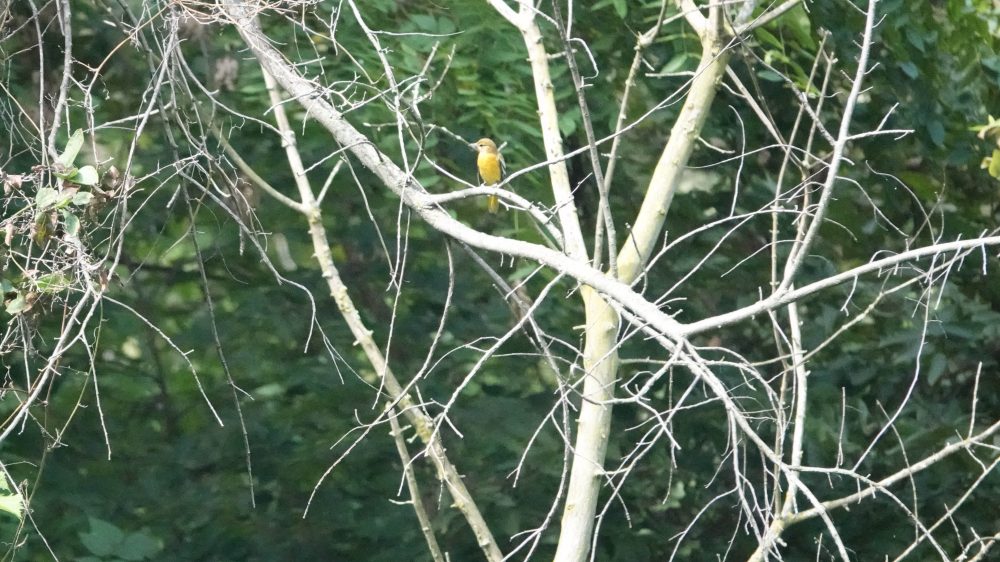
There was a female Baltimore Oriole at work in a tree.

I eventually wound up sitting on the bench of the picnic table that has been down by the water. Looking across to a dead tree stump, I noticed some activity with a couple Northern Flickers. It turned out they had a nest hole and were feeding young. I was reminded of the first chapter in Bernd Heinrich’s book, One Wild Bird at a Time, in which he described his observation of a pair of Northern Flickers nesting in his cabin wall. He estimated the parents made 32 trips a day to feed the nestlings, for a total of 700 feedings over a 22-day period.

When I returned to the Portage on the 11th, there was again some activity at the nest hole.

Here’s what the Portage looked like that day.

I caught a glimpse of a Yellow Warbler. I have heard them on every visit but don’t see them often now.

I was surprised to find two American Crows, a juvenile and its parent. The juvenile is below. I had a harder time spotting the parent but I could hear its calls.

I managed to find Tadziu, the Indigo Bunting on my way out. Unfortunately he was not in a very good spot for a photo.

Then yesterday, the heat and lack of rain was taking its toll.

It was cloudy, and so bird photographs were nearly out of the question, except for the cooperative Indigo Bunting at the top of the post and again below.

I tried to capture a female American Goldfinch.

Then a Great Blue Heron flew by, providing only its silhouette.

Dragonflies and butterflies, again, here and there.

Eastern Comma

12-Spotted Skimmers were everywhere.

For good measure, a rare Red-winged Blackbird – rare only because they are everywhere unseen these days.

Just as I was turned around to leave, a fawn appeared on the path in front of me.

I didn’t see her mother around, and barely captured her image as she took off.

So even in the dead heat and lockdown of breeding season, life goes on at the Chicago Portage. I will continue to walk when I can, but for now the heatwave continues, and I have a weekend full of social engagements. I hope to return soon.

A Visit to Orland Grassland

Since nothing ever goes as planned with the weather, it seemed like a good idea to visit Orland Grassland, which had been on my mind for a week or two, while the heat wave was in remission on Friday morning. I got out early enough to arrive there by 8:15 AM and started walking on the paved trail that surrounds the entire preserve. I had no idea what I was doing. Well, I did, but once I got nearly halfway it seemed ridiculous to turn back, so I walked the whole five mile perimeter with cyclists and rollerbladers whizzing by. I will plan to visit a foot trail or two next time.

But now that we are in the midst of a weeklong heat wave with heat indices around 100 degrees Fahrenheit, which I realize is nothing compared to some other parts of the world but it’s still disturbing, especially when combined with air quality alerts and no rain, maybe it’s just as well I got a 5-mile walk in. I won’t be walking much this week. I clipped off all my hair yesterday morning before I went swimming, though, as it seemed practical.

So on Friday morning, I started following the direction of a group of young runners who had been congregating in the parking lot when I arrived.

I soon saw the sign below.

If I had gone in the opposite direction along LaGrange Road, I might have been better off. I would have immediately seen the last sign below which indicated that I was starting at the parking lot. Instead, the first sign I saw was not until I had walked the entire width of the parcel along 167th Street. As I continued around each corner, I took photos of each sign until I finally got back to where I had started. Luckily, ir wasn’t too hot, but my toes were starting to complain after walking all that distance on blacktop in hiking boots.

So what birds did I see? My list had 41 species but many of them were heard only. I was dismayed that I did not see or hear (and Merlin didn’t hear either) a Henslow’s Sparrow, but now I’m thinking if I go back and do one or two of those inside foot trails I will likely have better luck. I could not find a close singing-but-well-hidden White-eyed Vireo, and I have just about given up on Yellow-breasted Chats.

The first bird I saw clearly was a male Orchard Oriole. The bright sunshine did not help, however.

And soon I saw an Eastern Kingbird.

The quintessential grassland bird that proclaims its presence is the Dickcissel, and there were many of them. This first one was rather distant, as were most, but I liked his surroundings.

I had to pay attention to dragonflies, like the Common Whitetail pair below.

The Common Green Darner below was a focusing challenge for the camera as it blended in with its perch.

And there were at least two 12-Spotted Skimmers perched high on branches like the one below.

I will never quite understand why butterflies are attracted to gravel and blacktop like this Red Admiral.

A Great Egret flew by,

Indigo Buntings were abundant.

I spotted a Common Grackle and what looks like a fledgling. I’m sorry if I distracted them with my attention: I seem to have caught them in mid-sentence.

There were some Cedar Waxwings.

A male Northern Cardinal was hard to ignore, even if he was too far away.

You know it’s a long walk when I’m interested in a House Sparrow with a cicada.

And a couple Mourning Doves…

One of the small bodies of water in the preserve

As I was walking my last leg along LaGrange Road, I spotted this Double-crested Cormorant in the distance.

I got closer to an Indigo Bunting I heard singing nearby.

A Great Blue Heron was being chased by a Red-winged Blackbird that didn’t fit in the frame.

A Tree Swallow was a bit closer.

And I heard a Willow Flycatcher at one point and then saw him.

But in the end it all came down to Dickcissels.

I probably won’t be doing a lot of birding this week, conditions being what they are. It’s disconcerting to have my routine interrupted. But I should at least view this as one of many exercises in adaptability we are faced with as climate change continues. Anyway, now I’m glad I did the five miles. My knees aren’t complaining at all, I have seen Orland Grassland from the perimeter and, when the weather improves, I can go back to it with improved orientation. I want to visit my other grassland sites as well. Oh, and a sort of postscript – this parcel is now considered Orland Grassland North as the next parcel, somewhat smaller, to the south of 179th Street in Tinley Park has been designated Orland Grassland South. What could have been more endless suburban development is being restored for wildlife. The more contiguous habitat, the better for the birds and all of us.

Back in Riverside: Early May

I had plans to visit a grassland habitat today, but the weather and my knee had other ideas. We are in the thick of a heat wave with threats of storm activity. My knee wasn’t too bad, just adding its opinion to my decision to stay close to home. Instead, I took a short walk this morning to visit a friend on her birthday. Cooling off, I may as well write a blog post I’ve been poking at for days as the summertime lull settles in.

These are photos from last month in Riverside when migrants were still coming through. Two visits, one on May 3 and the other on May 6, are in this post.

On May 3, the first creature I saw was not a bird but a groundhog just off the Joliet Avenue bridge. I have never seen one here – or I think anywhere – before.

Baltimore Orioles were showing off in early May.

The bird below looks like an Alder Flycatcher to me. It’s harder to tell without being able to see its wing bars, but empidonax flycatchers are meant to be confusing.

Red-winged Blackbirds are sometimes hare to ignore.

There was a Tree Swallow investigating a hole in this dead tree that leans over the river by the swinging bridge. I continue to watch for further activity.

The last of the Ruby-crowned Kinglets were present.

Maybe this was one of the last of the Yellow-rumped Warblers too, looking like a female.

A House Wren looked busy establishing his territory.

That day may have been the first time I saw a Great Blue Heron on the river.

Then, on May 6, I saw a few more birds to photograph. Somehow, I managed to get this Blue Jay in flight at quite a distance.

Yellow Warblers were easier to see. There are still some around raising families, but now I only hear them.

Here are a couple more photos of the Song Sparrow at the top of the post with its insect snack.

A Warbling Vireo gave me the eye.

Likely there wasn’t anything happening off the swinging bridge that morning except for some turtles.

I found a White-throated Sparrow.

And I just barely managed to see a Lincoln’s Sparrow.

A Northern Waterthrush was close to the water.

Northern Cardinals provide a splash of color all year long.

I found a Nashville Warbler that day.

A dramatically backlit Baltimore Oriole managed to remain half-hidden in the leaves.

Some more photos of the Yellow Warbler are below.

There’s lots more from May and June which I will try to fit in soon. Even though this spring migration season was more than a little “off”, there was always something to see, usually when I least expected it. Maybe it will be a little easier to sit inside and write a post while it’s too hot to be out walking. We shall see.

Early Summer at the Portage

The end of May brought the cicadas, the end of spring migration and a settling down into warmer temperatures and longer days. It portends a long summer season with a lot less activity and more leaves on the trees.

We have had so much more rain than last year’s drought, it seems as if plants are making up for it. That, combined with early warm weather, has accelerated growth and the flowering and fruiting season. Mulberries are already staining the cement. My currant bushes are laden with fruit. And it seems like after every rain, I have to eliminate more plants to walk through the backyard.

Here are photos selected from 3 consecutive visits to the Chicago Portage on May 25, May 28 and May 30.

On May 25, I was happy to see the Green Heron at one of its favorite fishing spots, hanging out on a log with the turtles.

An American Goldfinch was foraging in the duckweed.

And a House Wren was having a quiet moment.

On May 28, I saw the Green Heron again.

Cicadas were impossible to ignore.

Galls were already on the leaves of a hackberry tree. The galls provide a treat in the fall when the warblers come back through.

The bottomlands close to the Des Plaines River have been flooded most of the time.

I found another House Wren.

A distant Hairy Woodpecker

I often encounter American Robins along the trail.

On May 30, my first subject was a young doe.

Two Canada Geese were hanging out with the turtles.

A backlit Indigo Bunting looks nearly black.

I followed a female Brown-headed Cowbird. She matched the color of the branch she sat on.

I had an early Cicada pinup.

I caught a Gray Squirrel with cicada-mouth.

Swallows were flying over the marsh. I managed to photograph a Tree Swallow and then Northern Rough-winged Swallows.

Baltimore Orioles aren’t as easy to see now that they’re nesting.

I found a distant Northern Flicker scaling a dead tree.

Butterflies started to emerge.

Pearl Crescent

Red-winged Blackbirds are everywhere but not always visible either.

I found a female American Goldfinch in a tree.

And then another down by the water.

One more of the very blue-looking Indigo Bunting at the top of the post. In case I haven’t mentioned it before, their feathers are actually all black and the degree of blueness is what you see in light reflection.

The breeding birds are in place. The cicadas are everywhere. The days are getting longer and waking up at 5:00 AM now feels normal, unless I remind myself that had we not set the clocks ahead, it would be 4:00 AM. I’m going back to writing a book, in between navigating a calendar full of summertime concerts and gatherings. And gardening, looking for birds, playing piano, swimming and blogging, of course. Sometimes all I can do is take a nap.

Yellow-headed Blackbirds at Goose Lake Natural Area

The Yellow-headed Blackbirds have been on my mind since April. I was hoping I would not be too late to see them this year. And anyway, I like going to this place for all the other species that make it their summer home. I just needed a day without rain that fell on the weekend so I could avoid rush-hour traffic. Even early on Sunday morning, it still takes an hour and a half to drive there. And then there’s the walk that feels longer than 2-1/2 miles roundtrip and 3 hours.

It was still very cloudy when I arrived at 8:14 AM. As I walked the long tree-lined path, I heard a lot of birds but saw none. One bird I have rarely heard or seen previously was a Vesper Sparrow, singing beautifully. Maybe I could locate it on my way back out.

As I approached the open marshy area where there once was enough water to name it “Goose Lake”, I saw a large group of birders. It turned out they were leaving just as I approached. We exchanged smiles.

The marsh is a vast expanse surrounded by farmland. The sounds of the birds are varied, and I am including one early sample recording below the photo.

Goose Lake Natural Area

The first birds I saw were Yellow Warblers.

It was fairly easy to detect several male Yellow-headed Blackbirds, although they were at quite a distance. By the end of my visit, I estimated 12 males. There were likely even more.

A Willow Flycatcher was singing, and fly-catching. I caught up with him again later.

This place is always good for Song Sparrows and Common Yellowthroats. As difficult as it is to locate Common Yellowthroats almost anywhere else, the bird below was simply sitting quietly right in front of me.

Song Sparrow
Common Yellowthroat

After I got to the viewing platform, a pair of Sandhill Cranes flew by. I barely managed to capture one.

Of course, in addition to the Yellow-headed Blackbirds, there are lots of Red-winged Blackbirds here. It’s really hard to estimate how many, although I wouldn’t be surprised if there were at least 50 nesting pairs.

I noticed a couple Yellow-headed Blackbirds closer to the trail, a little bit farther beyond the viewing platform, so I started to walk that way.

I encountered a Yellow-headed Blackbird just sitting on a dead tree next to the trail. I was able to get fairly close to him and then another showed up. There was also a Song Sparrow singing. In addition to the song in the short video below, he gave me a concert including three more songs. One of those songs is in the short video of the Yellow-headed Blackbird. I was hoping the Blackbird would sing, but he didn’t. He sat there and listened along with me to the Song Sparrow.

Song Sparrow – Song 1
Song Sparrow – Song 2
Song Sparrow – Song 3
Yellow-headed Blackbird listening to Song Sparrow – Song 4

Along the trail on my way back, I saw a Ground Squirrel.

And a lek of Brown-headed Cowbirds…

There was even a noisy murder of American Crows in some distant trees.

Further along my way back to my car through the long tree-lined walk, I heard the Vesper Sparrow singing again. There was a clear spot to the side of the trail that looked like a tractor or truck had trampled the vegetation. I stepped out into the edge of the farm field and found the Vesper Sparrow at the top of a dead tree. He was backlit against the cloudy sky, but I managed to capture him somewhat and his song as well.

Vesper Sparrow

Here’s another Common Yellowthroat I photographed.

Black Terns have also been seen this year, but I did not see them during my visit. I will have to go back in early July, I think, to see more Yellow-headed Blackbirds as their offspring fledge, and maybe I will get to see the Black Terns and who knows who else.

One note: I realized that I didn’t see one periodical cicada the whole time I was there. I suppose it could be that there simply is not enough concentration of trees. The northern part of Illinois and southern tip of Wisconsin are definitely on the Brood XIII range map. It’s okay. I didn’t miss the distraction.

McGinnis Moments

Nearly two weeks ago, on a beautiful Tuesday morning, I set out as usual for a walk at the Chicago Portage only to find the gate was closed.

This doesn’t happen very often, but I had inadvertently noticed that Ottawa Trail Forest Preserve, close by and also with an entrance on Harlem, was closed, which could only mean that the person designated to open up these locations was somehow otherwise detained. I waited for a few minutes and then decided to go to McGinnis Slough instead, as I hadn’t been there for too long.

The first bird I saw was a Cedar Waxwing.

Then I found a first-year male Orchard Oriole who was singing in a tree nearby, off the lawn near the center of the parking lot.

I managed to record his song somewhat. There’s a few other birds in the background, as usual.

There was also a Common Grackle posing.

Perhaps most unexpected and a bit frustrating was the Pileated Woodpecker that swooped in to a tree right in front of me suddenly, just after I turned around to start walking the mowed trail. When he saw me he didn’t stay long, but I managed a few captures through the leaves.

It occurred to me later that a Pileated Woodpecker has been reported at this location enough times this year, so maybe I can hope to see him again. In the last photo above, he took off for the other side of the slough.

As if that wasn’t enough excitement, a very large bird suddenly flew over my head, the trees, and beyond, chased by a Canada Goose. It turned out to be a Trumpeter Swan. I will have to go back soon to see if the Trumpeter Swans are trying to raise a family on this side of the slough as they did before during the drought.

Then a pair of Eastern Kingbirds started frolicking in the grass. The photo at the top of the post was taken right as they turned their backs on each other.

Beyond that, there was the inevitable Warbling Vireo in the confusing pose below.

I barely saw Wood Ducks in their usual spot.

I was happy to see a Tiger Swallowtail butterfly.

The main part of the slough was heavily overgrown with vegetation. We are getting more rain, so that might change things a bit. I’ll have to go back and see how things are going for the summertime occupants. I did hear Marsh Wrens but did not see them. Of course there were plenty of Red-winged Blackbirds.

Today has been rainy and rather chilly. Some warmer weather is coming, but then more rain with it. Cicadas are everywhere. Yet it’s still good to go out and find the real world, still there.

Back to the Chicago Portage

These photos are from May 8. Pre-Brood XIII. I have a feeling that the season will now be defined by the emergence of the 17-year cicadas, so this was pre-emergence. Please bear with me through a rather disjointed but short post.

Warbling Vireos were still visible. That’s over by now.

Warbling Vireo

It was even easier to see a few butterflies Pre-Cicada.

Red Admiral Butterfly

I managed to see a Nashville Warbler, albeit distant.

The highlight of the day was seeing this Broad-winged Hawk. We don’t see them often, and when we do it’s only during the summer, according to the Sibley app on my phone.

White-crowned Sparrows were very accommodating this spring.

Indigo Buntings are abundant. Every once in a while I see a female. But everybody is disappearing into the leaf cover.

I did get to see another Chestnut-sided Warbler, sort of.

And an Eastern Kingbird.

Song Sparrows are bored with me.

I did notice a female Baltimore Oriole looking for nesting material.

I followed her up to a tree where she was fashioning her nest. I couldn’t resist taking all these photos of her beautiful creation. And as far as I could tell, she was singing while she worked.

We slipped into a chilly, rainy pattern of weather over the Memorial Day weekend that looks like it will continue for a while, and temperatures will not begin to increase until Friday. Up until now, it’s been nice to leave the windows open, but I have closed them to conserve warmth in the house. It’s not just weather anymore.

Only one thing is certain: Johann Sebastian Bach. I have to practice the prelude to the English Suite No. 2 in A minor as I have decided to play it tomorrow night for the annual choir appreciation dinner talent show. As many times as I have played this as a prelude to the Evening Snack Service, I will need an extra layer of protection against messing it up.

Highlights of a Spring Bird Count

The Illinois Spring Bird Count was on May 4 this year. I joined the group I have been counting with for years in DuPage County. We had 66 species and counted a total of 940 individuals. We started at McKee Marsh as usual and immediately began seeing the first of the Yellow Warblers which totaled 35 by the end of the day.

Baltimore Orioles demand attention.

Many birds were already busy starting families. We saw a Blue-Gray Gnatcatcher on her nest.

We had plenty of swallows and they were often at eye level. I paid attention to a Barn Swallow.

I managed to capture a Tree Swallow in flight and another in a Bluebird nest box.

Song Sparrows were abundant. So were Field Sparrows, but we heard more than we saw.

Early on, we had a Fox Squirrel looking down at us from its hole in a tree.

The first bird I photographed was a distant Hairy Woodpecker.

Gray catbirds aren’t always even this easy to see.

A brief but welcome Eastern Bluebird sighting…

I can never resist a male Brown-headed Cowbird in good light.

One of those ubiquitous Warbling Vireos:

A Painted Turtle poked its head out to greet us.

Red-bellied Woodpecker
A brief glimpse of a male Wood Duck

A Pileated Woodpecker flew by so fast right in front of me I could only follow its disappearance with the camera.

Three more of the Yellow Warblers…

Another Baltimore Oriole
White-breasted Nuthatch

This Rose-breasted Grosbeak had his back to us but turned around to say hello.

We watched an American Robin feeding nestlings.

We heard some other species of warblers but did not see them in any expected locations. Looking back on it now, this probably signaled the beginning of the end for this warbler migration.

I’m going to stop complaining about the dearth of warbler sightings. Spring is rapidly becoming summer. In the meantime, there have been some exciting encounters. I’ll be back soon. First, yard work.

A Visit to Goose Lake Prairie – Part 2

As promised, here are the rest of too many photographs taken last Tuesday – a week ago already! – at Goose Lake Prairie. The bird at the top of the post is an adult male Common Yellowthroat. Below are two photos of a juvenile Common Yellowthroat negotiating a thorny perch.

I reported 6 Dickcissels but there were likely several more. In any case, I took photos of the closest ones I could find. Once the sun started to emerge from behind the early morning clouds, they were singing everywhere. And they were not shy.

Below is a young Gray Catbird.

And I managed to find an Eastern Kingbird.

More photos of the prairie plants: Ironweed, Blazing Star, Prairie Coneflower and Partridge Pea, which is a new one for me.

Insects enjoying the Rattlesnake Master.

Apologies if I am repeating one of these Dickcissel images from the last post…

Below are a few other individual Dickcissels looking more like females and/or juveniles.

Still searching for Sedge Wrens and finding two more House Wrens…

I made my way over to one of the lakes, but with all the vegetation it was difficult to see much of anything. I did find what appeared to be a female or immature Hooded Merganser.

The photos below stumped me for a day and a half for whatever reason until I realized it was a Red-winged Blackbird.

I was happy to see three American Crows and managed to follow one as it flew over.

Below is a bird I did not expect to see. She’s a female Scarlet Tanager.

Sharing a bush, below, a Dickcissel and yes, a House Wren…

Common Yellowthroat male

I took notice of another Gray Catbird.

Rabbits seem to be ubiquitous this summer.

That’s it for August 1 at Goose Lake Prairie.

On the home front, the day before, I noticed a Monarch caterpillar on a small milkweed plant in the front yard. The next day when I came home from Goose Lake Prairie, I noticed all the leaves off the original plant were gone, and the caterpillar had moved to another small milkweed plant nearby. I have since lost track of it. I hope it is safe and thriving somewhere in the front yard. After years of Common Milkweed appearing in my yard, this is the first Monarch caterpillar I have ever seen. I can only hope there will be more.

And lastly, John L. from the Friends of the Chicago Portage contacted me a couple days ago to tell me about an organized 350-year celebration of sorts of the Chicago Portage National Historic Site, to occur this Saturday, August 12. He has asked me to participate in some fashion, which I envision might include talking to visitors about birds at the Portage, and I guess I could volunteer a little information on the plants I’ve become familiar with too if necessary. I am not contemplating a formal presentation, but I am starting to gather a few facts to have handy. From what John has told me, it sounds like it is going to be quite interesting, including actors reenacting explorers Marquette and Joliet following the lead of Native Americans through the site and representatives from the National Park Service, the Cook County Forest Preserves and others with booths and activities. Needless to say, I will be arriving much earlier to check on the birds before all this occurs.

Below are quick photographs I took this morning of a sign that is now posted by the Harlem Avenue entrance, the famous statue, and one of the storyboards that was added when the shelter was built a few years ago. If nothing else, all this explains the completion of the asphalt trail and the native plantings by the parking lot. Maybe I can find out what the numbers on the trees were for. I promise to (try to) give a full report afterward.

I have since been over to the “other” Goose Lake, a few visits to Riverside, and back to the Portage again. I will try to get caught up with some of these visits. Fall migration is just starting and it almost seems like every day, even in the middle of heat and not a lot of activity, there is always something new.

A Visit to Goose Lake Prairie – Part I

Last Tuesday morning I got up very early and went to Goose Lake Prairie State Natural Area. This is a place I traditionally visit around the 4th of July, but my July was full of too many other things this year.

It was quite cloudy, but that made it cooler, and it was a treat anyway to be able to see uninterrupted sky. It was also much quieter than my usual suburban haunts.

Early on there were few birds visible. Some American Robins.

There were a lot of House Wrens chattering about the lookout ramp attached to the back of the Visitor’s Center.

The clouds kept parting here and there for a bit of sunshine.

There were a considerable number of American Goldfinches. This one caught my attention.

The native wildflowers that dominate this prairie are beautiful. Below, a little Blazing Star.

I saw my first juvenile Eastern Bluebird.

The sun kept making its case.

A Barn Swallow

Below, two Song Sparrows. The second bird appears to be a juvenile.

Young Field Sparrows were everywhere but hard to capture in iffy light.

Common Yellowthroats were abundant.

The Cragg Cabin represents the earliest settlement.

The body of water outside the cabin was at a low level, attracting just a couple shorebirds. I barely got photos of a Solitary Sandpiper…

and a Killdeer.

Rattlesnake Master, one of my favorite plants I am again trying to grow at home, is in bloom here and there.

There were Tree Swallows..

Another male Common Yellowthroat.

American Goldfinch males started accumulating in one tree as if they all wanted to be in the picture.

I saw one juvenile Eastern Meadowlark.

Barn Swallows on break…

A view behind the cabin of the windmill and a conestoga wagon.

I saw a couple more juvenile Eastern Bluebirds.

And more House Wrens. I kept hearing Sedge Wrens but was unable to capture any.

Below, a couple young Field Sparrows.

Red-winged Blackbirds made a brief appearance.

Another House Wren…

The photos below were taken at quite a distance but they’re interesting to me because there’s an adult male Common Yellowthroat and then below him, to the right, is what appears to be a juvenile.

More American Goldfinches showing off.

Well, basically I got through dropping half of the photos into this post and it became too exhausting for me to go on, let alone expect you to wade through any more of it, so I will be back with Part 2 fairly quickly. That’s a Dickcissel at the top of the post, by the way. Many more images of that bird to come in Part 2.