Out and About the Prairies

I keep changing my mind about what to make of a post. It seems crazy to have so many options during the slow breeding season, as it were. But slowness gives one more time to reflect, perhaps, as long as one isn’t melting. The return of extreme heat doesn’t help.

I have been to both Goose Lakes these past two Sundays, and I was delighted to have Joann’s company, as we combed the prairies for grassland birds. Climate change is making things trickier for the birds as well. My annual tradition is to visit Goose Lake Prairie on or about the 4th or the 5th of July, to celebrate quiet before or after the noise of fireworks and acknowledge another year gone on the 5th, which was my birthday, or so I’ve been told. Anyway, recovering from the carpal tunnel surgery, I am still using the Sony RX10 and getting more or less used to it.

At Goose Lake Prairie on July 5, we had many Field Sparrows, if more heard than seen.

Common Yellowthroats were still proclaiming their presence,

We saw an Eastern Meadowlark early on, if briefly.

Flying over us, at first a Great Egret and later, a Great Blue Heron.

There’s still nothing quite like an Indigo Bunting in bright sunshine.

This female Northern Cardinal struck a pose.

Toward the end of our trek, we saw Bald Eagle juveniles playing in the distance. There were 3 or 4 but I only managed to barely capture two at a time.

I used to always visit Goose Lake Prairie expecting to see Dickcissels, but this was the first year I didn’t even hear one. We heard chats and a Henslow’s Sparrow, but didn’t see any. There had been a lot of rain and flooding. Still, were fairly comfortable, it was not too hot, and the prairie flowers were in bloom.

One week later we visited Goose Lake Conservation Area, in the opposite direction, hoping to get lucky and see some Yellow-headed Blackbirds, the main attraction there. Although we did see a few, they were too far away, popping up in the reeds which were that much taller than on my last visit on June 2. I was hoping to start seeing some juvenile birds, but things were still pretty quiet. After the long walk along the Hebron Trail, when we finally reached the open grassland, I found a quiet Song Sparrow to photograph.

We were greeted by a large number of swallows, which turned out to be predominantly Bank Swallows with some Barn and.Tree Swallows. Bank and Barn Swallows below.

Two Tree Swallows, including the one at the top of the post.

We had a couple Willow Flycatchers, and an Eastern Kingbird.

We were standing on the platform that provides somewhat of an overlook facing the water, although we could not even see the water for all the reeds. At some point we noticed a Dickcissel struggling with what appeared to be a grasshopper. I had seen three or more Dickcissels back in June when they were perched proudly and singing, but I had almost forgotten they were here when this bird showed up.

Green Herons were flying over periodically.

I was surprised to have the camera almost focus on an American Goldfinch behind leaves.

Here’s one more of some Barn and Bank Swallows.

I should be out walking, but the sun is broiling, the heat is building, and the air is thick and heavy. I just can’t bring myself to start the car to go for a walk. I am also waiting for a FedEx delivery. If the delivery occurs early enough, I may go out this afternoon to swim. I found a pool where I can swim for the rest of the month before I go back to my regular health club, where the pool and the women’s locker room are currently closed for maintenance and remodeling, respectively. I went swimming on Monday at the temporary pool and surprised myself by doing the entire mile after not being able to swim for three weeks. Even swimming in warmer water than usual is refreshing. I hope you are finding ways to endure the heat, wherever you are.

Annual Visit to Goose Lake Prairie

Saturday morning was absolutely beautiful. In anticipation of its cooler weather, I got up a bit earlier so I could drive to Goose Lake Prairie State Natural Area for my annual July visit. If I can believe my eBird checklists, I have been visiting every July since 2012. This place has rarely seemed to be anyone else’s destination for the 4th of July weekend, so I was not too surprised when I drove into the empty parking lot. The visitor’s center is not open on holiday weekends. But I go there for the trails, so it doesn’t matter.

I took a photo of the trail map so I would have a better idea what direction I was headed in. Starting out, the “Interpretive Trail” shown with numbers on the map is easy enough to follow, but I wanted to walk back to the water, or the Goose Lake, if you will, without getting lost because even if you can see the Visitor Center in the distance, it can get a little difficult to gauge distance and direction.

A phone photo of the Visitor Center

Right off the bat I saw a rabbit on the trail, and then followed a Barn Swallow to its perch behind the Visitor Center.

I then encountered a pair of Brown Thrashers. I was delighted to see them as I don’t seem to see this species all that often.

There were many more Tree Swallows than I could photograph.

I found a Willow Flycatcher close to the trail.

On the way to Cragg’s Cabin, I saw an Eastern Comma Butterfly.

I did not walk behind the cabin to see the windmill as I have in previous years. I did sit down on the bench that looks over a pond next to the cabin where I have seen birds before, but there was nothing to report. So I continued on the Interpretive Trail and encountered a Song Sparrow.

By this time on previous occasions I would have heard and seen fairly well at least a couple Dickcissels, but this time I was surprised by the lack of them. I did manage to barely capture one far away on his thorny perch.

Two Eastern Meadowlarks appeared briefly. Unfortunately they were distant and backlit.

There seemed to be more Common Yellowthroats everywhere, though not quite as easy to capture as they had been in Hebron. I could let most of them go.

But then, I was quite surprised to see a Bell’s Vireo. This is a bird that’s often very difficult to see. Although this one was at some distance, it did me the favor of staying pretty much in the same place long enough for me to capture its image. It seemed that almost every time I had passed by a bush I heard a Bell’s Vireo’s scratchy-sounding little song, never for the bird to appear, but now I was actually seeing one.

I then reached the water, where I found only Tree Swallows and an Eastern Kingbird flying around after my approach flushed a Great Blue Heron.

I encountered a closer Bell’s Vireo.

Then a Tiger Swallowtail Butterfly caught my attention. Bergamot is very attractive to butterflies.

The vegetation in this location is notable. It is the largest remaining stand of Tall Grass Prairie in Illinois. I made note of some old favorites and others I don’t recall seeing before.

I found an American Goldfinch with nesting material. The bird flying away in the last photo appears to be a different individual, however.

Then I encountered a first-year male Orchard Oriole.

And caught a brief glimpse of a Baltimore Oriole.

Red-winged Blackbirds were everywhere but not posing. I did manage to capture what looks like a female on the left and a juvenile on the right.

A young Gray Catbird popped out to see what was happening.

And I got a closer look at an Eastern Kingbird.

I finally caught a glimpse of some of the Field Sparrows I had been hearing, only these appeared to be juveniles.

And then the most exciting part of the visit occurred when I saw a flash of a goldfinch-sized yellow bird with an insect in its beak. Since goldfinches don’t eat bugs, I wondered … could it possibly be a Yellow-breasted Chat, a Nemesis Bird if there ever was one, the most annoyingly elusive grassland species one hears 99.9% of the time but nearly never sees?

Much to my delight and for whatever reason, the Chat decided to come out from behind its cover and show off its catch.

I can’t help myself. This is the best birthday gift I’ve had in a long time.

Young Field Sparrows flew in and I checked them out while the Yellow-breasted Chat was still there.

After that, I was done for the day. Thanks for making it through this long-on-photos post. Here’s one more of an Orchard Oriole.

A Visit to Goose Lake Prairie – Part I

Last Tuesday morning I got up very early and went to Goose Lake Prairie State Natural Area. This is a place I traditionally visit around the 4th of July, but my July was full of too many other things this year.

It was quite cloudy, but that made it cooler, and it was a treat anyway to be able to see uninterrupted sky. It was also much quieter than my usual suburban haunts.

Early on there were few birds visible. Some American Robins.

There were a lot of House Wrens chattering about the lookout ramp attached to the back of the Visitor’s Center.

The clouds kept parting here and there for a bit of sunshine.

There were a considerable number of American Goldfinches. This one caught my attention.

The native wildflowers that dominate this prairie are beautiful. Below, a little Blazing Star.

I saw my first juvenile Eastern Bluebird.

The sun kept making its case.

A Barn Swallow

Below, two Song Sparrows. The second bird appears to be a juvenile.

Young Field Sparrows were everywhere but hard to capture in iffy light.

Common Yellowthroats were abundant.

The Cragg Cabin represents the earliest settlement.

The body of water outside the cabin was at a low level, attracting just a couple shorebirds. I barely got photos of a Solitary Sandpiper…

and a Killdeer.

Rattlesnake Master, one of my favorite plants I am again trying to grow at home, is in bloom here and there.

There were Tree Swallows..

Another male Common Yellowthroat.

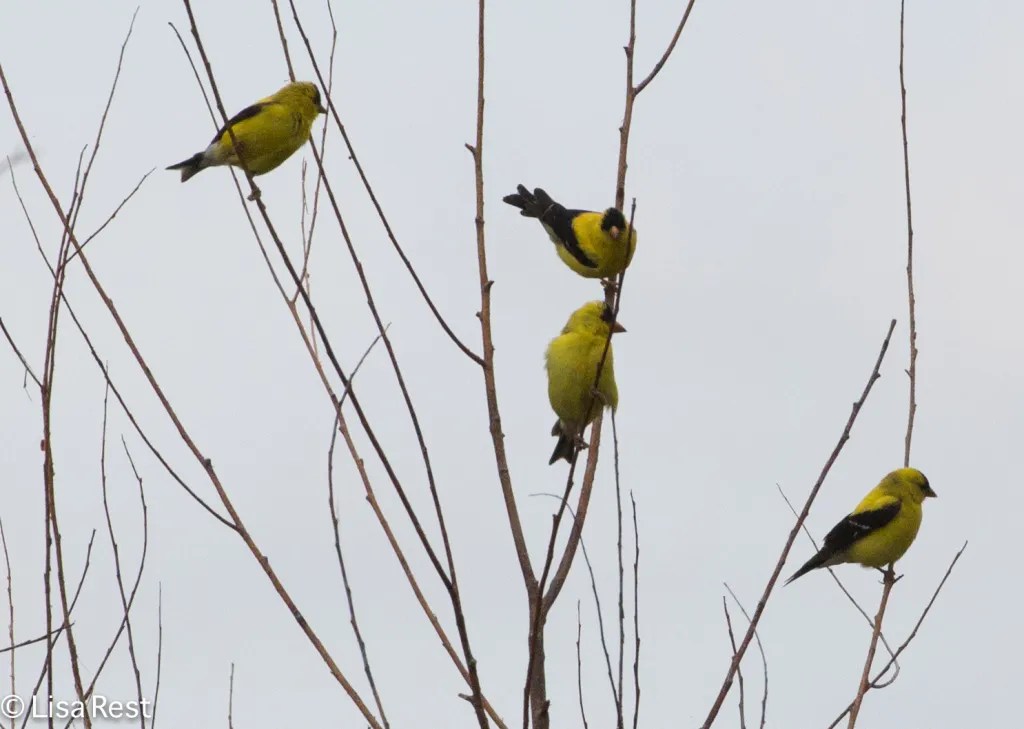
American Goldfinch males started accumulating in one tree as if they all wanted to be in the picture.

I saw one juvenile Eastern Meadowlark.

Barn Swallows on break…

A view behind the cabin of the windmill and a conestoga wagon.

I saw a couple more juvenile Eastern Bluebirds.

And more House Wrens. I kept hearing Sedge Wrens but was unable to capture any.

Below, a couple young Field Sparrows.

Red-winged Blackbirds made a brief appearance.

Another House Wren…

The photos below were taken at quite a distance but they’re interesting to me because there’s an adult male Common Yellowthroat and then below him, to the right, is what appears to be a juvenile.

More American Goldfinches showing off.

Well, basically I got through dropping half of the photos into this post and it became too exhausting for me to go on, let alone expect you to wade through any more of it, so I will be back with Part 2 fairly quickly. That’s a Dickcissel at the top of the post, by the way. Many more images of that bird to come in Part 2.