
The Yellow-headed Blackbirds have been on my mind since April. I was hoping I would not be too late to see them this year. And anyway, I like going to this place for all the other species that make it their summer home. I just needed a day without rain that fell on the weekend so I could avoid rush-hour traffic. Even early on Sunday morning, it still takes an hour and a half to drive there. And then there’s the walk that feels longer than 2-1/2 miles roundtrip and 3 hours.
It was still very cloudy when I arrived at 8:14 AM. As I walked the long tree-lined path, I heard a lot of birds but saw none. One bird I have rarely heard or seen previously was a Vesper Sparrow, singing beautifully. Maybe I could locate it on my way back out.
As I approached the open marshy area where there once was enough water to name it “Goose Lake”, I saw a large group of birders. It turned out they were leaving just as I approached. We exchanged smiles.

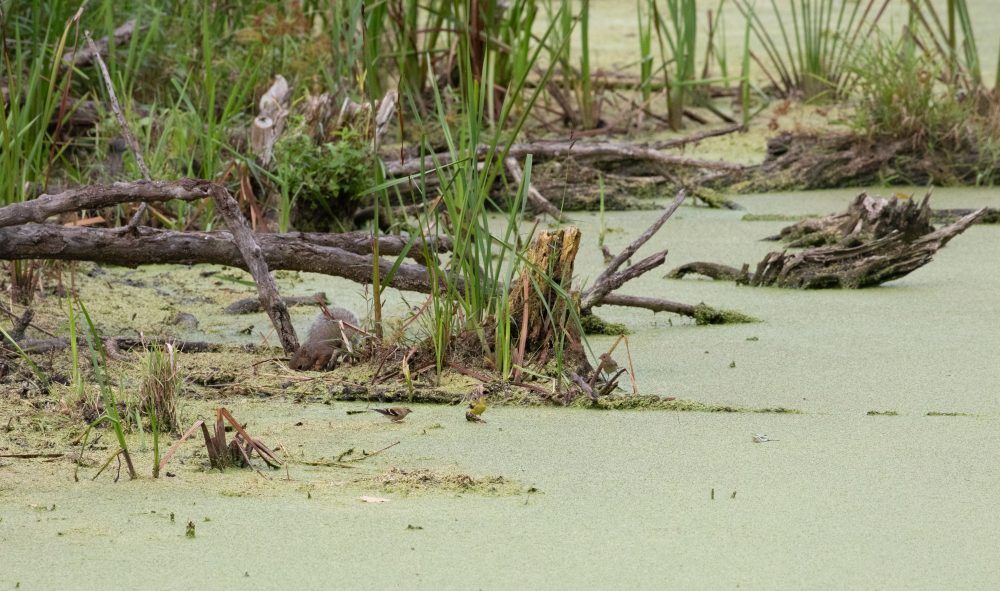
The marsh is a vast expanse surrounded by farmland. The sounds of the birds are varied, and I am including one early sample recording below the photo.

The first birds I saw were Yellow Warblers.


It was fairly easy to detect several male Yellow-headed Blackbirds, although they were at quite a distance. By the end of my visit, I estimated 12 males. There were likely even more.


A Willow Flycatcher was singing, and fly-catching. I caught up with him again later.


This place is always good for Song Sparrows and Common Yellowthroats. As difficult as it is to locate Common Yellowthroats almost anywhere else, the bird below was simply sitting quietly right in front of me.


After I got to the viewing platform, a pair of Sandhill Cranes flew by. I barely managed to capture one.

Of course, in addition to the Yellow-headed Blackbirds, there are lots of Red-winged Blackbirds here. It’s really hard to estimate how many, although I wouldn’t be surprised if there were at least 50 nesting pairs.


I noticed a couple Yellow-headed Blackbirds closer to the trail, a little bit farther beyond the viewing platform, so I started to walk that way.


I encountered a Yellow-headed Blackbird just sitting on a dead tree next to the trail. I was able to get fairly close to him and then another showed up. There was also a Song Sparrow singing. In addition to the song in the short video below, he gave me a concert including three more songs. One of those songs is in the short video of the Yellow-headed Blackbird. I was hoping the Blackbird would sing, but he didn’t. He sat there and listened along with me to the Song Sparrow.


Along the trail on my way back, I saw a Ground Squirrel.


And a lek of Brown-headed Cowbirds…


There was even a noisy murder of American Crows in some distant trees.


Further along my way back to my car through the long tree-lined walk, I heard the Vesper Sparrow singing again. There was a clear spot to the side of the trail that looked like a tractor or truck had trampled the vegetation. I stepped out into the edge of the farm field and found the Vesper Sparrow at the top of a dead tree. He was backlit against the cloudy sky, but I managed to capture him somewhat and his song as well.


Here’s another Common Yellowthroat I photographed.


Black Terns have also been seen this year, but I did not see them during my visit. I will have to go back in early July, I think, to see more Yellow-headed Blackbirds as their offspring fledge, and maybe I will get to see the Black Terns and who knows who else.
One note: I realized that I didn’t see one periodical cicada the whole time I was there. I suppose it could be that there simply is not enough concentration of trees. The northern part of Illinois and southern tip of Wisconsin are definitely on the Brood XIII range map. It’s okay. I didn’t miss the distraction.