Galapagos Part 2: Genovese Island

short-eared-galapagos-owl-7-11-16-7091

Short-Eared (Galapagos) Owl

Life has been getting in the way a bit more lately: my apologies for the delayed post. Every time I go back to these photographs I think it will be easy, that I must have been done with them, and then I find out that is not the case. Then I was looking forward to a weekend without much planned thinking I was going to do a lot of work at the computer and it just didn’t happen.

I think WordPress takes matters into its own hands when I haven’t posted for a while and generates some kind of phenomenal amount of hits, then sends me a message our of the blue saying my blog is really popular. This has happened to me twice lately. I get the hint. Okay, back to work.

These photographs were all taken on Monday, July 11, 2016 as we visited what is called Prince Phillip’s Steps in the morning, on Genovese Island, and Darwin Bay on the other side in the afternoon. Galapagos Dove and Nazca Boobies above.

This was the only island where we could see Red-Footed Boobies.

red-footed-booby-7-11-16-6533

Some Nazca Boobies had youngsters. There seemed to be a problem trying to feed too large a fish to the fledgling.

This Swallow-Tailed Gull below seemed to be having the same problem. I suspect there may be an upset in the availability of smaller prey. But at least they weren’t trying to feed plastic.

The Swallow-Tailed Gulls are quite striking. You will likely see them again in future posts. We even got treated to a pair that was copulating.

It was a real treat to spend time with the Short-Eared (Galapagos) Owl below. Leave it to a Galapagos Mockingbird to bother him. As always, feel free to click on the pictures to get a larger view.

I think I spent the entire trip trying to get a decent photograph of a Red-Billed Tropicbird. There is likely a better flight shot down the line in a future post. In any event we got to see a lot of them on Genovese and even discovered one nesting (below).

nesting-red-billed-tropicbird-gal16b-lisa-spellman-7285Magnificent Frigatebirds also call this island home.

And we got to see what to my uneducated eye is the difference between the Magnificent and the Great Frigatebird: a blue-green sheen to the plumage of the latter.

And of course we had Darwin’s Finches! Four different species on this island. The first, below, is the Large Ground Finch.

Then, the Large Cactus Finch.

And we also had the Sharp-Beaked Ground Finch.

Also, below, the Gray Warbler-Finch.

Not to be confused with the Yellow Warbler.

yellow-warbler-7-11-16-7433

Yellow Warbler

We also saw a Yellow-Crowned Night Heron trying to sleep.

yellow-crowned-night-heron-7-11-16-7540

Yellow-Crowned Night Heron

And I think this was the only time we got to see a Galapagos Fur Seal.

galapagos-fur-seal-7-11-16-7360Not to be confused with the ever-present Galapagos Sea Lion.

More Sally Lightfoot Crabs…

Back at the catamaran, we were treated to another fruit sculpture and received our marching orders for the next day.

I’ll try to be a better blogger and come back sooner. If nothing else, just to escape the landslide into November 8th.

galapagos-mockingbird-7-11-16-7617red-footed-booby-7-11-16-7559

Goose Lake Natural Area and the Hebron Trail

YHBL 6-26-2016-3468

Yellow-Headed Blackbird

I saw a couple birds at the Portage a few weeks ago that reminded me of Yellow-Headed Blackbirds although they were most likely not, but the light was so bad I couldn’t determine what they were, even after enhancing bad pictures. They were definitely large blackbirds but not Grackles.

(For clarification – the pictures above are all Yellow-Headed Blackbirds and were taken at Goose Lake Natural Area in McHenry County.)

I then thought that by the time I get back from Ecuador next month, it could be too late to see the Yellow-Headed Blackbirds that nest in McHenry County close to the Wisconsin border. I went to this area last year for the first time and vowed to go back. So Sunday morning I picked up my friend Lesa and we headed up north into ensuing thunderstorms. By the time we got all the way up there about an hour and a half later, the rain was nearly over, so it was perfectly timed.

On our way out to the marsh through the wooded trail, we saw a distant Ring-Necked Pheasant and light at the end of the tunnel.

Ring-Necked Pheasant on Hebron Trail 6-26-2016-3207

There were other things happening on the gravel trail. Like feeding time for a fledgling Common Grackle.

And birds drying off after the rain.

Grackle and Brown Thrasher 6-26-2016-3225

Common Grackle on the left, Brown Thrasher on the right.

And Empidonax flycatchers, likely Alder or Willow, but unless they say something we can never be really sure.

Willow-Alder Flycatcher 6-26-2016-3214

The other rarity I lured Lesa with was Black Tern, and we definitely saw them.

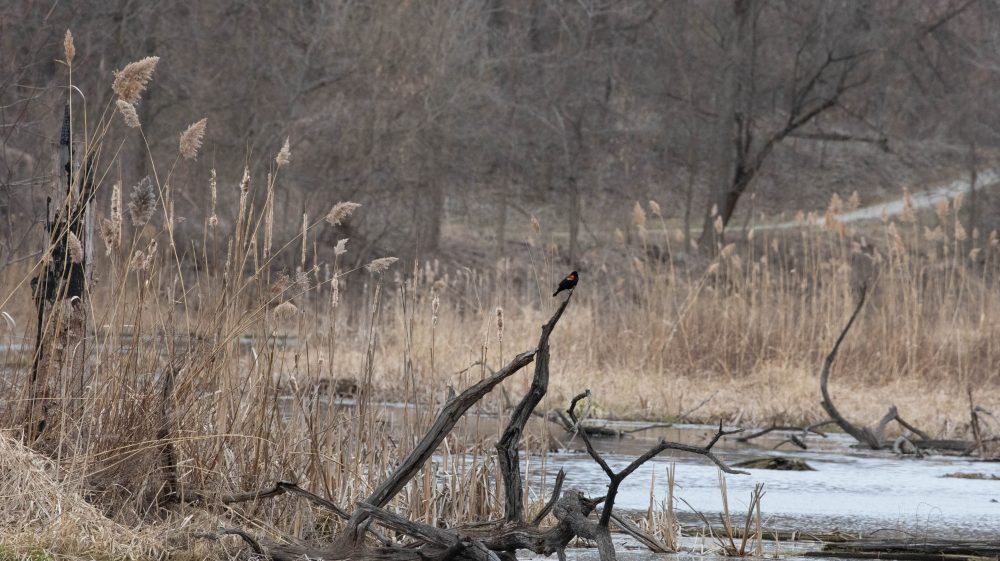
Red-Winged Blackbirds were predictably everywhere.

The marsh had Pied-Billed Grebes (below, top), and some downy Hooded Mergansers (three pictures below) which I needed help to identify, not seeing any parents and forgetting that ducks other than Mallard are a possibility. I should have recognized the behavior of the Mergansers which was what drew our attention to them anyway. One had caught a fish and the others were chasing him or her.

Perhaps the nicest surprise were two Sandhill Cranes. We heard them for the longest time but could not see them until they decided to fly over us.

Predictably we saw American Goldfinch and Eastern Kingbird.

AMGO 6-26-2016-3273

American Goldfinch

EAKI 6-26-2016-3321

Eastern Kingbird

After wishing we’d brought our scopes and maybe even lawn chairs, we finally came to a little deck-like overlook with a bench, near the Song Sparrow pictured below who was sitting with a dragonfly waiting for us to quit paying attention so he could go feed someone at an undisclosed location.

SOSP 6-26-2016-3483

Song Sparrow

We were enjoying the cool cloudiness after the rain but the sun started to break through the clouds and the heat started to build, so it was time to retreat. Next time I think we have to find a way to carry a scope with us as it’s likely we missed a few birds. All in all we had about 33 species on our list.

I wish I’d thought to bring my recorder because the male Yellow-Headed Blackbird below gave us a few brief but beautiful spurts of song. Well, maybe beauty is in the ear of the listener. He sounded perhaps like a rusty crank turning. But it’s complex and probably musical to females. Here’s a link to the Cornell website if you want to hear what one sounds like. I’m entranced by the orange-colored crown on this bird.

YHBL 6-26-2016-3507

The last bird we counted was a Red-Tailed Hawk. We saw another accipiter fly over the trail on the way back but could not identify it quickly enough.

I had intended to do much more posting before my trip, but found I was still going through photos I took weeks ago! Time has flown and soon I must fly to my vacation destination.

I leave Friday for Quito, going to the Amazon and then the Galapagos. This is likely my last big trip. Although I may have said that before. So unless I manage the unthinkable and post once more before I leave, I’ll be back next month to share photos from my trip.

Sandhill Crane 6-26-2016-3242

Breeding Birds

PRWA IDSP 05-29-2016-2349Passerine migration is over for all practical purposes. Birds have taken to their breeding grounds and are getting down to business. Here are some photos from the last couple weekends, starting with the Prothonotary Warbler above, seen at Indiana Dunes State Park.

Yellow Warblers are common summer residents around here. The one on the left above was hanging out at IDSP and the one on the right was the first bird I encountered at the Chicago Portage last Sunday on a late, gloomy morning.

Even with a lot more light going on at the Indiana location, backlighting was a constant challenge. Above, compare an adult male Scarlet Tanager on the left with what was determined to be a first-year male of the same species.

There were several Red-Headed Woodpeckers at IDSP. I don’t see them too often so they were a nice surprise.

Perhaps the most exciting find was the hardest to photograph. Above is a male Acadian Flycatcher, not far from where his mate is sitting on a cleverly positioned nest underneath a leaf.

Two looks at Eastern Wood-Pewees above.

We had two Pileated Woodpeckers, and the one above was in the best light but this species still eludes my camera, monster lens and all.

Cedar Waxwings above, at IDSP on the left and the other one from the Chicago Portage.

The Portage had at least four male Baltimore Orioles, and I was able to spot a female not entirely hidden on the right, above.

To add to my list of not-often-seen woodpeckers, I had a Hairy Woodpecker at the Portage. Usually I see Downies everywhere, but this was the only woodpecker that I was able to photograph.

Tree Swallows were abundant. And below, it was a good day for turtles at the Portage.

And for Mallard ducklings…looking almost full grown.

Below, a newly fledged American Robin and an adult.

One more look at the Red-Headed Woodpecker.

RHWP IDSP 5-29-2016-2453I’ve been busy writing silly songs, working, gardening and starting to get ready for a trip that will begin on July 1. I am now glad I inadvertently planned to be away before the Democratic National Convention. I’m growing weary of the daily drama and it will be good for my head to be totally oblivious to politics for a couple weeks.

I’ll try to get back to this page a few times before I go. Thanks for stopping by!


A Bird Here, A Bird There

AMGO Lurie Garden 12-1-2015 -7722

American Goldfinch, Lurie Garden

Last night WordPress let me know I haven’t been posting enough lately by requesting identification from me when I tried to sign in. So we went through the identification-code-by-text-message routine this morning and I guess I’m back in business for a while.

I seem to have caught my biennial rhinovirus too, which is keeping me from living too dangerously. I made it through choir rehearsal last night without any significant coughs or wheezes but this morning I am draining miserably.

There are next to no birding opportunities on my way in to the office for now and I haven’t been out too much lately, but here are a few pictures taken last week on December 1.

BCCH Millennium 12-1-2015 -7814

Black-Capped Chickadee

BCCH Millennium 12-1-2015 -7808I had stopped at the northwest corner of Millennium Park to see if I could grab a picture of a Yellow-Bellied Sapsucker but that wasn’t going to happen. However there were cooperative Black-Capped Chickadees and White-Throated Sparrows.

WTSP Millennium 12-1-2015 -7817

White-Throated Sparrow

WTSP Millennium 12-1-2015 -7859

At home over the last week or two, I had been trying to grab a picture of the newest arrivals while they were still relatively clueless, but it was difficult to find them sitting in a spot with enough light, and when I did, their immediate reaction was, “No, we are NOT cute! Don’t point that thing at us!” I managed to grab the fuzzy picture below before they started to disperse.

Zebra Kids 11-28-2015 -7578

Zebra Finch Fledglings

Pet birds being what they are, it’s easier to take a picture of a wild bird like the Hermit Thrush below, who was also with the little group of birds at the northwest corner of Millennium. He came down to sit and stare at me to see if maybe we could figure out what was so interesting about each other.

HETH Millennium 12-1-2015 -7851

Hermit Thrush

That’s about it for the moment. I’ll try to be back sooner. ‘Tis the season and all that too, hard to escape holiday revelry.

I haven’t been out yet this week but I think I will go out today and continue the hot dog experiments. In case you’re wondering, no, the squirrels are not interested in hot dogs. Just waiting for the crow to leave so he can sneak a peanut.

Crow's Hot Dog Feast Millennium 12-3-2015 -7916

Inertia (aka Summer Doldrums)

Female Tiger Swallowtail Yard 7-19-15-1137Spoiled by earlier dramatic fluctuations in temperature which at times were chilly, I find myself now wiped out by the heat and humidity, albeit expected weather but nonetheless daunting. The only way to avoid overheating is to remain motionless. I did as much of that as possible on Saturday.

However Sunday morning was sunny, so I felt compelled to see how things are going at the Chicago Portage. Construction persists. Access to the trail entrance that heads west is still blocked, but both bridges are open again, which made it easier to take the loop on the other side of the creek back to where I started. On the way out, my eye caught a sign that referred to construction of a “new” shelter being among the improvements. I am unaware of there ever having been an old shelter, so this will be interesting. Maybe I’m reading too much into the word “new.”

Construction Chicago Portage 7-19-15-7581

Going in from the west makes it difficult to photograph anything early in the morning. But I could not resist a cooperative Indigo Bunting.

INBU Chicago Portage 7-19-15-7603

After that for a while it was simply making a record of what I was seeing, even if the picture wasn’t perfect. The distant Great Blue Heron below took off about ten minutes after I took this picture.

GBHE Chicago Portage 7-19-15-7649

There were two Killdeer skittering about in the duckweedy mud.KILL Chicago Portage 7-19-15-7706

KILL Chicago Portage 7-19-15-7731Also on the other side where I would eventually wind up, a young deer had come down to drink. I have seen deer before but never one so young, alone. I seemed to be catching the last gasp of the early morning activity, which was heartening considering I took my time getting out the door.

Deer Chicago Portage 7-19-15-7678Just about when I started wondering what had happened to all the Baltimore Orioles I saw this young or female bird.

BAOR Chicago Portage 7-19-15-7809

The Red-Winged Blackbird below appeared to have had enough of the heat and humidity.

RWBL Chicago Portage 7-19-15-7793Of course just when I think I’ve seen everything I’m going to see or have been unable to get pictures of something ephemeral like the glimpse of a Ruby-Throated Hummingbird, a surprise occurs. Walking by a large tree at the edge of the water, I saw something huge move in it, determined it couldn’t have been a giant squirrel but had no idea. Then the tree exploded with three large birds scattering in all directions. This turned out to be the Green Heron roosting tree. And one of their offspring flew to a perch in the middle of the water where it sat in surprise for several moments.

GRHE Chicago Portage 7-19-15-7853GRHE Chicago Portage 7-19-15-7870The other great surprise was to run into a human being. Specifically a young man on his bicycle who asked me if there were many birds at the Portage. It then turned out that he was interested in finding out more about birds. What an absolute delight to have been present for him to quiz me on what direction he could take. I sincerely hope he follows his interest. I restrained myself and did not warn him of the addictive nature to this activity. Probably understood anyway if he at all sensed my passion. This is the magic of the Portage for me. I literally never know what to expect.

I should also know better than to expect anything. I was hoping to see butterflies, so I carried around the second camera and lens in my backpack and never took it out. Virtually no butterflies Sunday morning. There were a few dragonflies, but I was unmoved.

But Sunday afternoon seemed to bring butterflies into my garden. The Red Admirals outnumber all the others but at least there were a few more species.

Red Admiral Yard 7-18-15-1111

Red Admiral

Monarch Yard 7-18-15-1113

Monarch Butterfly in swamp milkweed. I can’t believe I managed this shot with a 100mm closeup lens from quite far away.

The swamp milkweed has taken over two areas of the yard. I keep hoping, as in Plant It And They Will Come.

Swamp Milkweed Yard 7-18-15-1085One more picture from the Portage below: an Eastern Kingbird. The background looks like another planet to me.

EAKI Chicago Portage 7-19-15-7746

Eastern Kingbird Fantastical Portage  7-19-15-7748The weather is improving, and I will slowly pull out of inertia into the sunshine.

Another Goose Lake

YHBL Goose Lake NA 7-12-15-7145

Yellow-Headed Blackbird, Goose Lake Conservation Area, McHenry County, Illinois

Somewhat ironically, shortly after I visited Goose Lake Prairie in Grundy County, the local list-serve was on fire about another Goose Lake Conservation Area in McHenry County, not far from the Wisconsin border, where Yellow-Headed Blackbirds and Black Terns were easy to find. Both species are rare in this area. Reading constant reports about it all last week while at work, I decided if the threat of rain was not severe I would just have to drive to this Goose Lake Natural Area on Sunday morning. I had several days to talk myself into getting up no later than 3:30 AM so I could leave the house by 6:00, seeing as how it would take me over an hour and a half to get there.

I plugged a theoretical address into the GPS on my car and got within striking distance. After that it was easy enough to find and I parked in a tiny parking lot that fits about three small cars. No sooner did I park than I was joined by another Prius driver. Diane had her camera with her too and we birded the trail together.

YHBL Goose Lake NA 7-12-15-7156

There is a Goose Lake on the map but as far as I can tell there is no public access. Thus I saw no lake and no geese. However there was more to explore (we perhaps went in 3/4 of a mile) on a 7-mile trail and some day I will have to make a return trip.

Hebron Trail MapThe Hebron Trail has been made from an abandoned railroad bed, specifically the Kenosha Division Railroad which made its last run in 1939. Just off the parking lot where the wide gravel trail starts is a wooded area that was brimming with hungry mosquitoes. We had been forewarned but it made stopping to look at anything we heard prohibitive. Perhaps after a quarter of a mile we were out of the woods and into the marshy area which was miraculously pretty bug-free. It was cloudy but it did not rain.

Ground Squirrel

Ground Squirrel – I’m not sure I’ve seen these before!

There were at least a dozen Yellow-Headed Blackbirds, and when they became active they made dramatic displays.

YHBL Goose Lake NA 7-12-15-7157

The other species we were excited to see was Black Tern. Although not less visible, they were very difficult to photograph from far away, in the poor light, and they never sat still.

Black Tern

Black Tern

I never thought of Red-Winged Blackbirds as small before but compared to the Yellow-headed Blackbirds they are dainty looking.

RWBL Goose Lake NA 7-12-15-7042Plenty going on with other breeders too. Like the Tree Swallow condominium tree below, and then when a Green Heron decided to sit on one of its branches the Tree Swallows started mobbing it.

TRSW Condo Goose Lake NA 7-12-15-7108GRHE Harrassed Goose Lake NA 7-12-15-7307GRHE Goose Lake NA 7-12-15-7276

Song Sparrows were singing everywhere. Also many Marsh Wrens but I did not get a picture of one suitable to post.

SOSP Goose Lake NA 7-12-15-6888There were so many Common Yellowthroats they could have had a singing competition.

COYT Goose Lake NA 7-12-15-6912One Common Yellowthroat male was feeding its foster child, the Brown-Headed Cowbird juvenile below, but it was too hard to get the actual feeding shot with all the branches in the way.

BHCO and COYT Goose Lake NA 7-12-15-6951My only regret is that the Yellow-Headed Blackbirds were not singing, because it would have been a wonderful sound to reproduce for you here. Maybe next year I can get up here when they’re setting up territories.

YHBL Goose Lake NA 7-12-15-7130

Yellow-Headed Blackbird

It’s hard to believe but the Red-Winged Blackbirds were nearly silent as well. Definitely the juveniles below had nothing to say.

RWBL juveniles Goose Lake NA 7-12-15-7407

It took me two hours to get back home. There is no easy way to get to this place, but I guess that’s what makes it a favorite for some birds we rarely see.

Goose Lake NA 7-12-15-7389

A Visit to Goose Lake Prairie for the Fourth of July

Young male Dickcissel, Goose Lake Prairie, 7-4-15

Young male Dickcissel, Goose Lake Prairie, 7-4-15

To celebrate my fourth year of this blog (my how time flies) I am publishing two posts today, which doesn’t hardly make up for my lack of posting lately but it’s good to be relaxed and sitting in the air conditioning and not afraid of falling asleep over a million photos.

Song Sparrow, Goose Lake Prairie

Song Sparrow, Goose Lake Prairie

Juvenile Song Sparrow, Goose Lake Prairie

Juvenile Song Sparrow, Goose Lake Prairie

It took me a while to get to this point, I had two months of pictures to go through or remove from my hard drive just so I could download what’s been accumulating on the camera the past two weeks.

Eastern Meadowlark

Eastern Meadowlark

EAME Goose Lake Prairie 7-4-15-6398

I went to Goose Lake Prairie yesterday morning. I didn’t get there early enough to catch the Blue Grosbeak and Bald Eagle seen by another birder, but I was happy enough to find a cooperative Grasshopper Sparrow, lots of Henslow’s Sparrows that eluded my sight, let alone photographs, Sedge Wrens, and of course a plethora of Dickcissels.

Grasshopper Sparrow, Goose Lake Prairie

Grasshopper Sparrow, Goose Lake Prairie

Sedge Wren, Goose Lake Prairie

Sedge Wren, Goose Lake Prairie

Juvenile Red-Winged Blackbird, Goose Lake Prairie

Juvenile Red-Winged Blackbird, Goose Lake Prairie

I also believe I took really crummy photographs of an American Bittern flying but I am too shy to edit my ebird report seeing as how I would have to write it in. Maybe I’ll gain courage as the week goes on. Least Bittern is on the list for Goose Lake Prairie but for some reason American Bittern is not.

Juvenile Brown-Headed Cowbird

Juvenile Brown-Headed Cowbird

This is the time of year when the youngsters start to get a bit confusing. Like the Brown-Headed Cowbird above.

Common Yellowthroat, Goose Lake Prairie

Common Yellowthroat, Goose Lake Prairie

Common Yellowthroats are always singing and you never see them, so I was happy to have one finally show himself. Ironically, the recording underneath the picture begins with his song, which gets fainter I suppose as he moved farther away, but a Henslow’s Sparrow can be heard clearly in front of him and these were the birds I couldn’t see anywhere. I must have heard five or six of them singing.

Female Dickcissel, Goose Lake Prairie

Female Dickcissel, Goose Lake Prairie

Eastern Phoebe, Goose Lake Prairie

Eastern Phoebe, Goose Lake Prairie

Sedge Wren, Goose Lake Prairie

Sedge Wren, Goose Lake Prairie

Eastern Bluebird, Goose Lake Prairie

Eastern Bluebird, Goose Lake Prairie

The Sedge Wrens were vocal too but I didn’t get a recording of them. And ironically for all the Dickcissels I don’t seem to have them either. I think I just have to start out an hour earlier next time.

DICK Goose Lake Prairie 7-4-15-6616

A pair of Dickcissels

DICK Goose Lake Prairie 7-4-15-6350

Female or juvenile Dickcissel, Goose Lake Prairie

Below is that butterfly I was too lazy to take out my other camera that had the closeup lens attached to it.

Mourning Cloak, Goose Lake Prairie

Mourning Cloak, Goose Lake Prairie

On the way back I stopped at the Lake Renwick Heron Rookery, which I was surprised to find open to the public, if only for half an hour. There were three staff on hand to make sure no one lingered in the park, which is normally off limits entirely during the breeding season. I have seen it from the other side but never this view before. I will have to go back now that I know it’s sometimes accessible.

Lake Renwick Heron Rookery

Lake Renwick Heron Rookery

Thanks to all who visit my blog and followers and friends! It’s been a fun four years and I hope to be back soon with many more observations inspired by my feathered friends.

Grasshopper Sparrow, Goose Lake Prairie

Grasshopper Sparrow, Goose Lake Prairie

Black-Crowned Night Heron (BCNH) on the Chicago River – Part One

BCNH LaBagh 5-23-15-3229

Black-Crowned Night Heron, LaBagh Woods, 5-23-15

Almost every work morning without fail, even in inclement weather, I have hauled the camera backpack downtown so I could be prepared, should the Black-Crowned Night Heron I have been seeing every spring downtown on the Chicago River show up again. Up until now I have not kept track of its visits on ebird, so I don’t know exactly when I saw it the last two or three years. I did find a picture of a piling in the river from June 4, 2014 on my cell phone, which must have been when I saw it last, but it’s hard to even see if there was a bird in it.

So I did take pictures of a Black-Crowned Night Heron at another part of the Chicago River, specifically LaBagh Woods, on May 23 this year when I joined Chicago Ornithological Society on a field trip. This was the first time I had been to the slough part at LaBagh. I hope I can find the slough again on my own next time I visit. It’s a magical place, reminding me of the Chicago Portage. The rest of the pictures in this post are from the LaBagh trip.

Mallard on Nest, LaBagh

Mallard on Nest, LaBagh Woods

I had all but given up on seeing the Black-Crowned Night Heron downtown, but I have been thinking about him, so I decided to do this post anyway today featuring the other one I saw up river last month.

Great Blue Heron, LaBagh, 5-23-15

Great Blue Heron, LaBagh Woods, 5-23-15

Eastern Phoebe, LaBagh

Eastern Phoebe, LaBagh Woods

As luck would have it, this morning, on the way in, as I was walking north along the river which I have started doing now that the work has been completed that the city or the building owners were doing on the west side between Adams and Madison–there are enough trees and low-lying plants that make me think this could turn out to be a good place to visit during migration–I suddenly saw the downtown Black-Crowned Night Heron flying across the river and landing on the other side! By the time I took out my camera and put it together, it had flown back across the river again, underneath me, to where I could not see it.

Swainson's Thrush, LaBagh Woods, 5-23-15

Swainson’s Thrush, LaBagh Woods, 5-23-15

Eastern Kingbird, LaBagh Woods, 5-23-15

Eastern Kingbird, LaBagh Woods, 5-23-15

But I did get pictures when it flew again, and I will post them tonight! I find it amusing that I was focused on seeing the heron and then it showed up this morning. Who was sending who messages?

Gray Catbird, LaBagh Woods

Gray Catbird, LaBagh Woods

In previous years I can recall only seeing the downtown heron for one morning, but now I believe anything can happen.

Blue-Gray Gnatcacher on nest, LaBagh Woods, 5-23-15

Blue-Gray Gnatcacher on nest, LaBagh Woods, 5-23-15

How Blue Is My Indigo?

Indigo Bunting, Chicago Portage

Indigo Bunting, Chicago Portage

Every Sunday the forecast has been the same lately: cloudy, rainy with possible thunderstorms. But every Sunday is a bit different, as the rain and the longer days contribute to the growing of things. I have been trying to conquer the overgrowth in my backyard, but yesterday I decided to take advantage of a break in the storm activity and visit the Chicago Portage.

Chi Portage 6-14-15-4834

18188879913_0cc498745c_zI never know what to expect, and this visit was no exception. For starters, I couldn’t take the trail entrance I normally do because it was entirely blocked off. So instead of there being a way to go through the entire site and wind up back where I started, I wound up taking two parts of the trail up and back.

Eastern Kingbird

Eastern Kingbird

Eastern Kingbird

Eastern Kingbird

Some of the species I expect to see were not present. It could have been the time of day. But I suspect a more likely explanation is the constant habitat disruption being more than some species want to put up with. Consequently I had no Song Sparrows, American Goldfinches, nor White-Breasted Nuthatches. Even Mallards were not present. And not even one Gray Catbird. But this is just one visit and it was nearly mid-day, so perhaps next weekend I can confirm these absences further. In the meantime, I heard Black-Capped Chickadees so my faith in their existence is restored.

Ind Bunting Chi Portage 6-14-15-5201

Indigo Bunting

Female Indigo Bunting

Female Indigo Bunting

Indigo Buntings were everywhere, followed by almost as many Baltimore Orioles, although the orioles were less available for pictures, but they sang constantly. The first one I saw was carrying food, but I had to settle for this far away shot of another one later.

Baltimore Oriole

Baltimore Oriole

My surprise bird of the day was the first-year male Orchard Oriole below. Not only do I think this is the first time I’ve had an Orchard Oriole at the Portage, but I think it might be the first time I’ve realized this is what a first-year male looks like. I tried to get his song too but recording was challenging yesterday with a lot of background noise. Maybe the cloud cover had something to do with it.

First Year Male Orchard Oriole

First Year Male Orchard Oriole

As usual there was no dearth of robins. I estimated 40, but there were probably more, including the clueless young one on the trail.

Am Ro Chi Portage 6-14-15-4851Am Ro Chi Portage 6-14-15-4873AMRO Chi Portage 6-14-15-4920

Of course Red-Winged Blackbirds were abundant too, although a bit less visible. Below could be one of the reasons why.

Fledgling Red-Winged Blackbird

Fledgling Red-Winged Blackbird

I looked for a Green Heron and found it easily.

Green Heron, Chicago Portage

Green Heron, Chicago Portage

Later I had another heron perched way on top of a dead tree hanging over the water. It was hard to get its coloring in this light or the lack thereof but it was apparently wet and going through some trouble to dry off.

GRHE Chicago Portage 6-14-15-5014GRHE Chicago Portage 6-14-15-5019GRHE Chicago Portage 6-14-15-5020GRHE Chicago Portage 6-14-15-5021

If anything became apparent yesterday, it was that next time I should bother to take my closeup lens with me, as there is a lot of little stuff going on that invites more scrutiny. Like the hundreds of tiny froglets or toadlets that suddenly sprang up under my feet.

Toadlet Chicago Portage 6-14-15-5082Toadlet Chicago Portage 6-14-15-5080Toadlets Chicago Portage 6-14-15-5105

Or the dragonflies that I knew so well last year and now have to look up all over again.

Dragonfly 6-14-15-5127Dragonfly 6-14-15-5137

Red-Bellied Woodpeckers seemed to be tolerating the disturbance.

RBWP Chi Portage 6-14-15-4938

I wonder how long it will be before I can walk through this again.

Chicago Portage 6-14-15-4954

As a final note, the Chicago birding community lost a great birder and photographer on Saturday. Steve Spitzer apparently died of a heart attack. I am sorry I did not know Steve personally; I remember we had a short email exchange over a sighting at some point and he was friendly and generous in his communications. He spent a lot of time a Montrose and other lakefront places and took some amazing photographs. You can see some of them here at the link to his flickr page. He also posted a remarkable video of a young Great Horned Owl swimming in Lake Michigan to avoid harassment by two Peregrine Falcons. I hope Steve is flying with the birds now.

Three Weeks: Chicago Portage

Red-Bellied Woodpecker, Chicago Portage, 5-25-15

Red-Bellied Woodpecker, Chicago Portage, 5-25-15

Back on the 10th of May I was at the Chicago Portage and counted 52 species. On the 17th of May, visiting with two friends, we counted 35 species. This afternoon, after gale winds in the morning and some rain, I went over to see what was up and counted 29 species.

Chicago Portage 5-10-15

Chicago Portage 5-10-15

Cape May Warbler, Chicago Portage, 5-10-15

Cape May Warbler, Chicago Portage, 5-10-15

Eastern Phoebe, Chicago Portage, 5-10-15

Eastern Phoebe, Chicago Portage, 5-10-15

Three weeks ago was the height of spring migration, and already by last weekend it was slowing down.

Canada Geese at the Chicago Portage 5-10-15

Canada Geese at the Chicago Portage 5-10-15

CAGO Chicago Portage 5-17-15-2361

Gosling, Chicago Portage, 5-17-15

Last week the goose family had dwindled to four goslings and today I was told by a woman I talked to on the trail that they were down to three. I did run into the geese today, but they were foraging in the grasses and I did not want to bother them, as they were pretty well hidden. So I am taking her word for it.

Red-Eyed Vireo, Chicago Portage, 5-10-15

Red-Eyed Vireo, Chicago Portage, 5-10-15

Lincoln's Sparrow, Chicago Portage, 5-10-15

Lincoln’s Sparrow, Chicago Portage, 5-10-15

Veery, 5-10-15

Veery, 5-10-15

The Red-Eyed Vireos are still present and singing, so they probably breed here, but all the thrushes except for American Robin have left, and the sparrow species as well. There was quite an influx of Veerys this year, I don’t usually see them.

WCSP Chicago Portage 5-10-15-0022

White-Crowned Sparrow, 5-10-15

GRHE Chicago Portage 5-10-15-9934

Green Heron, 5-10-15

But as the last of the sparrows were getting ready to leave, the Green Herons were returning. I believe there are two although I have not yet seen them both on the same visit. I think they also hang out at Ottawa Trail Woods which is also where we went last weekend. I have included a few pictures here are from Ottawa Trail Woods, as it is basically part of the same ecosystem.

SOSA Chicago Portage 5-10-15-9921

Solitary Sandpiper, 5-10-15

SPSA Chicago Portage 5-10-15-9908

Spotted Sandpiper, 5-10-15

Spotted at the Chicago Portage 5-10-15-9854

Spotted Sandpiper at the Chicago Portage, 5-10-15

On the 10th I saw both Spotted and Solitary Sandpipers, not on sandbars or mudflats but on dead wood in the water. The water levels were a bit lower though. I have not seen or heard any shorebirds since.

SCTA Chicago Portage 5-10-15-0145

Scarlet Tanager, 5-10-15

The Scarlet Tanager above basically flew down and sat right in front of me. I was so surprised I barely got his photograph.

YRWA Chicago Portage 5-10-15-0389

Yellow-Rumped Warbler, Myrtle female, 5-10-15 – You cannot see the yellow rump but this is the first year I have noticed they also have yellow on the crown

YEWA Chicago Portage 5-10-15-0350

Yellow Warbler, 5-10-15

The only warblers willing to pose were the most common ones. The Yellow-Rumped Warblers are gone, but the Yellow Warblers stay for the summer.

Chicago Portage 5-17-15-2312

Chicago Portage, 5-17-15

INBU Ottawa Trail 5-17-15-2379

Indigo Bunting, Ottawa Trail Woods, 5-17-15

BASW Chicago Portage 5-17-15-2243

Barn Swallows, Chicago Portage, 5-17-15

BEKI Portage 5-17-15-2256

Female Belted Kingfisher, Chicago Portage, 5-17-15

Indigo Buntings are everywhere. I have not seen the females yet but the Portage has at least four males singing on territory. I have also seen many Barn Swallows, Tree Swallows and Northern Rough-Winged Swallows.

Chicago Portage 5-25-15-3512

Chicago Portage, 5-25-15

BAOR Chicago Portage 5-25-15-3661

Baltimore Oriole, 5-25-15

GRHE Chicago Portage 5-25-15-3640

Green Heron, 5-25-15 – Not as visible today as three weeks ago.

Eastern Kingbird, Portage 5-25-15 - There were two today, sallying for prey over the slough

Eastern Kingbird, Portage 5-25-15 – There were two today, sallying for prey over the slough

TRSW Chicago Portage 5-25-15-3534

Tree Swallow, 5-25-15

Red Admiral Chicago Portage 5-25-15-3562

Red Admiral on a wildflower I have yet to identify – I should know it! But I have never seen it at the Portage before. Is this some kind of monarda?

I included the butterfly picture because to me it signals the end of spring migration and the beginning of summer, when butterflies and dragonflies vie for my attention.

WODU Chicago Portage 5-17-15-2349

Wood Duck, Ottawa Trail Woods, 5-17-15

I didn’t see any ducks today at the Portage. In years past there have always been a breeding pair of Wood Ducks, so I hope they are busy nesting.

A Mallard mom with eleven ducklings (they can't be all hers?)!

A Mallard mom with eleven ducklings (they can’t be all hers?)! (Ottawa Trail, 5-17-15)

I hope to be back soon with a short report on birds in Berwyn. I just saw a Ruby-Throated Hummingbird at my hummingbird feeders this evening, which gave me the perfect reason  to clean and refill the feeders. While I was out in my yard my neighbor appeared and told me he saw the hummer yesterday! Maybe I’ll get a picture this year before September.