October at the Portage

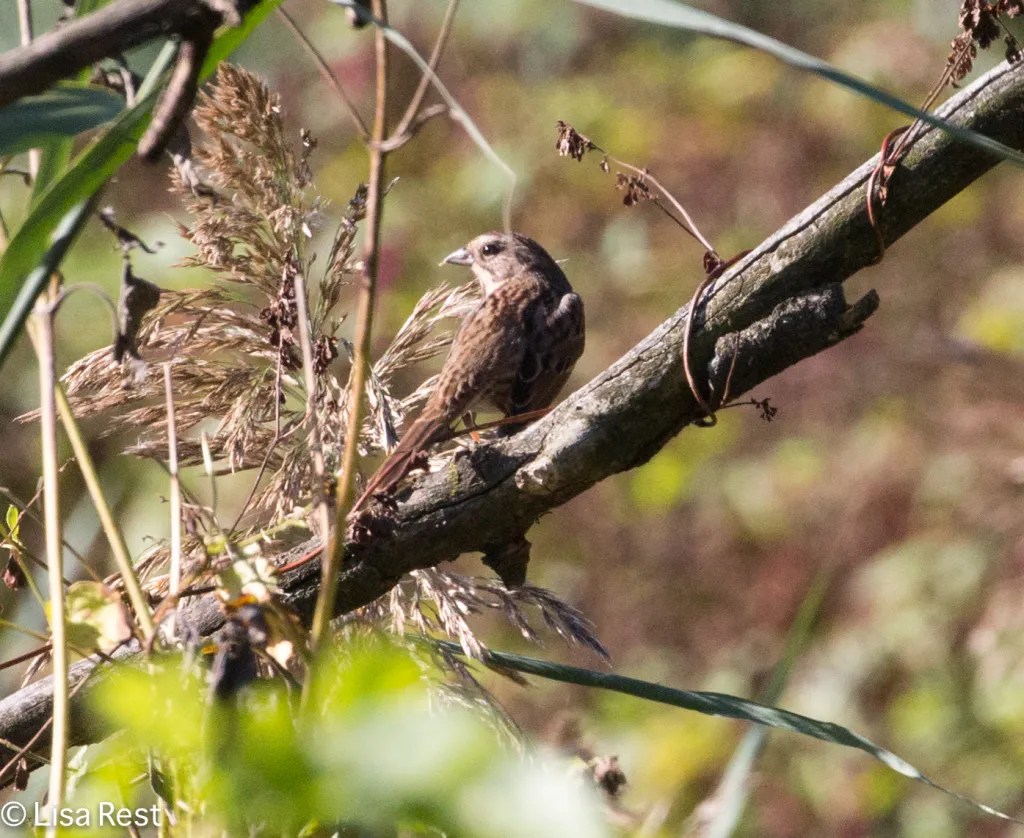
Fox Sparrow

A brief but driving squall of freezing rain in the yard yesterday morning supported my decision to not go for a walk. More snow and wind on the way today. A good day to take stock of my indoor life.

Yesterday morning also produced a brief sighting of a Cooper’s Hawk and the appearance of the large gray tomcat I scolded out of the yard as I was refilling the birdbaths before the rain started. I have perhaps 30 or more gallons of water stored in the basement and my rain barrels are still quite full. But we are due for more serious overnight freezing temperatures so I have made this my outdoor project for the weekend, draining the rest of the water and covering up the rain barrels for the winter. If predictions prove correct, we will be getting a little preliminary snow that won’t accumulate but will get us in the mood for winter.

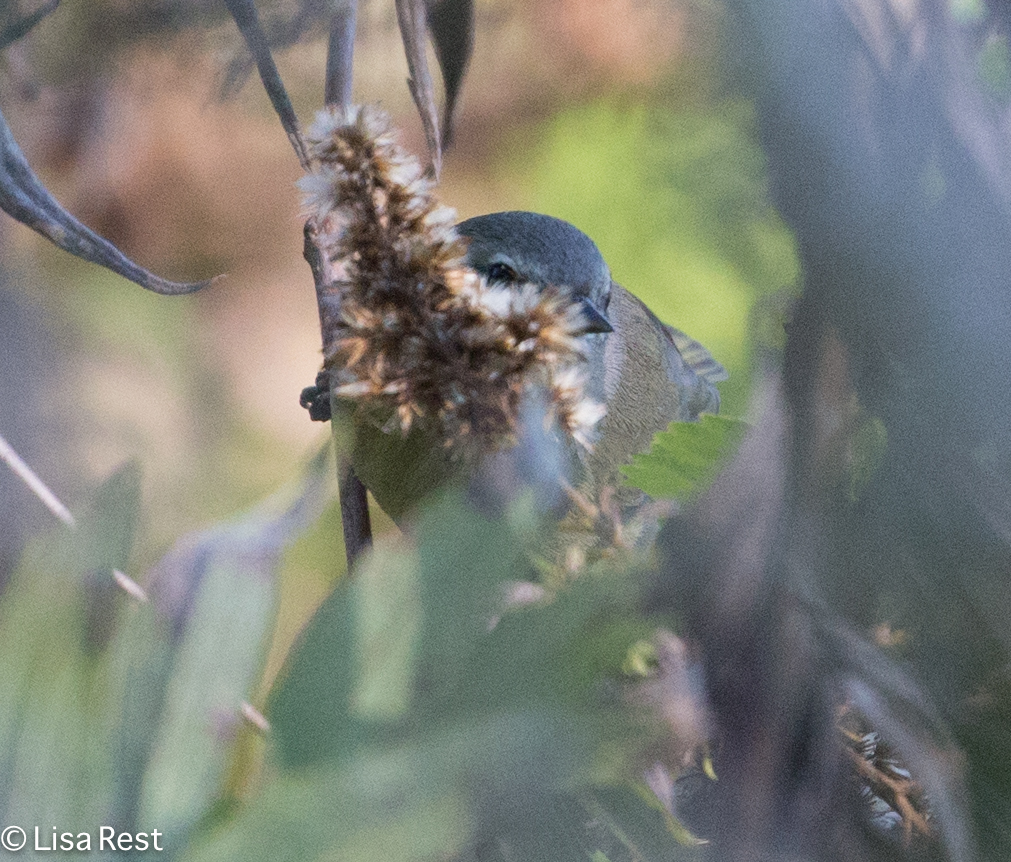
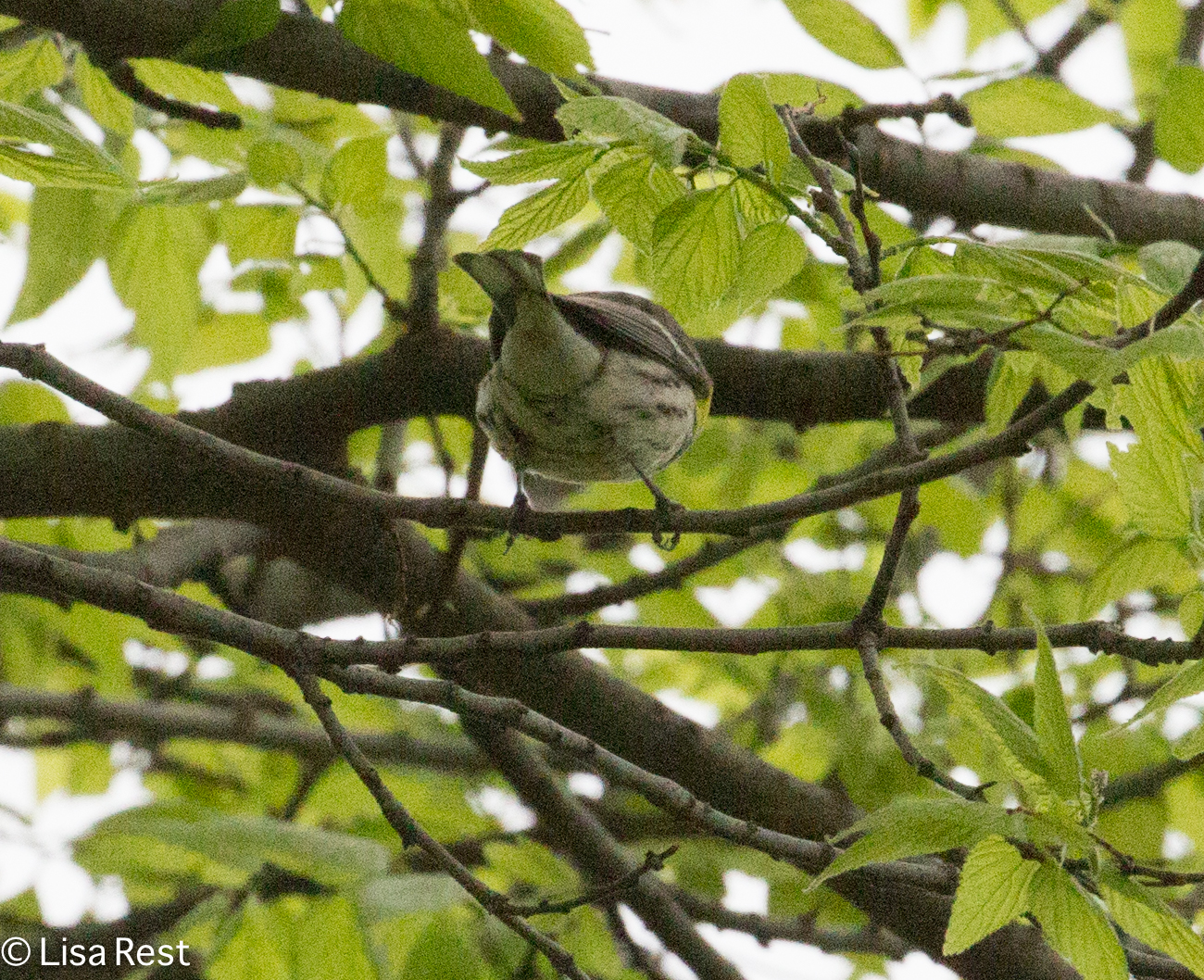
These photographs are from October 17. I was not too surprised to discover I hadn’t processed many of them. I did find another confusing fall warbler which I didn’t report. It appears to be a first-year likely female Black-throated Blue Warbler (below).

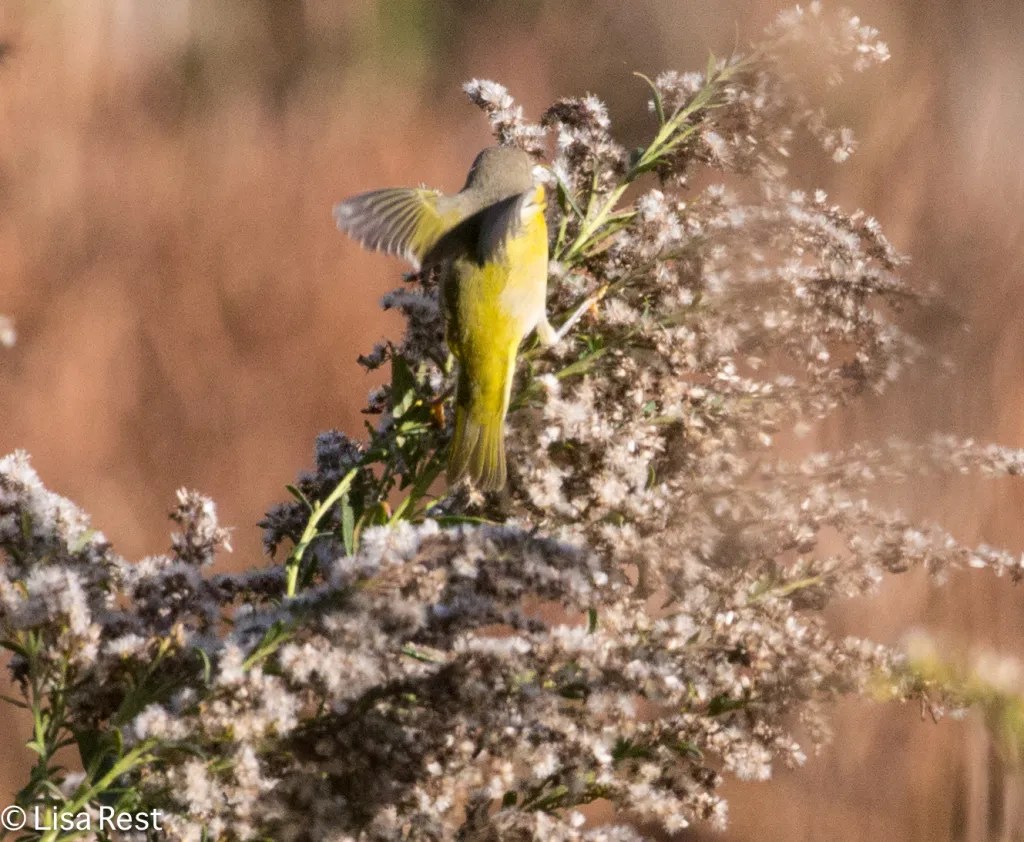
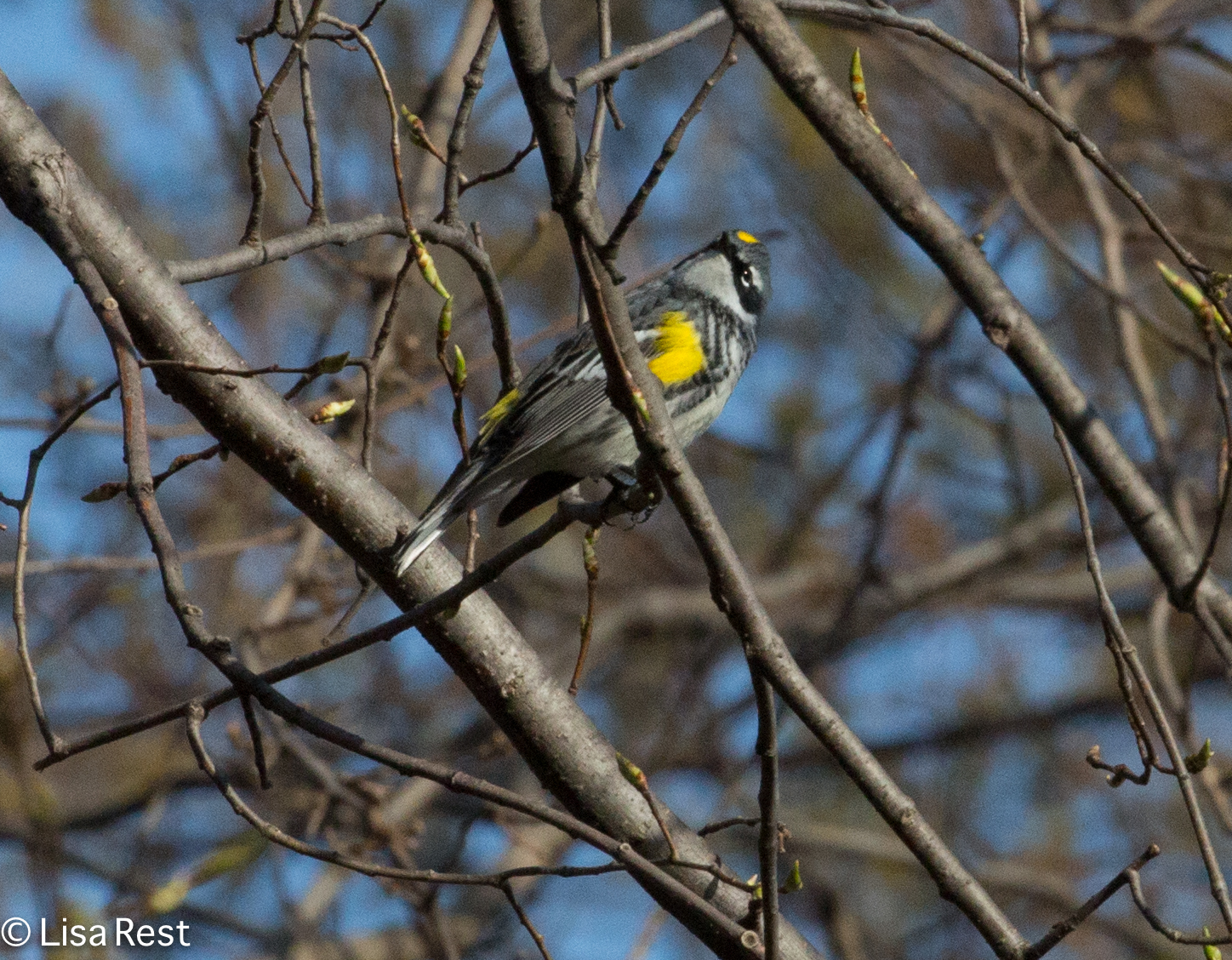
Much easier to recognize and still pretty plentiful were Yellow-rumped Warblers.

The bird immediately below appears to have fused with the hackberry leaves.

Then there were the tree-climbing Yellow-rumpeds…

I don’t know why it’s been so hard to get a decent picture of a White-throated Sparrow, but I keep trying.

The Song Sparrow below was a more accommodating.

And another Song Sparrows popping up from the vegetation…

A reminder of how dry it still was in mid-October.

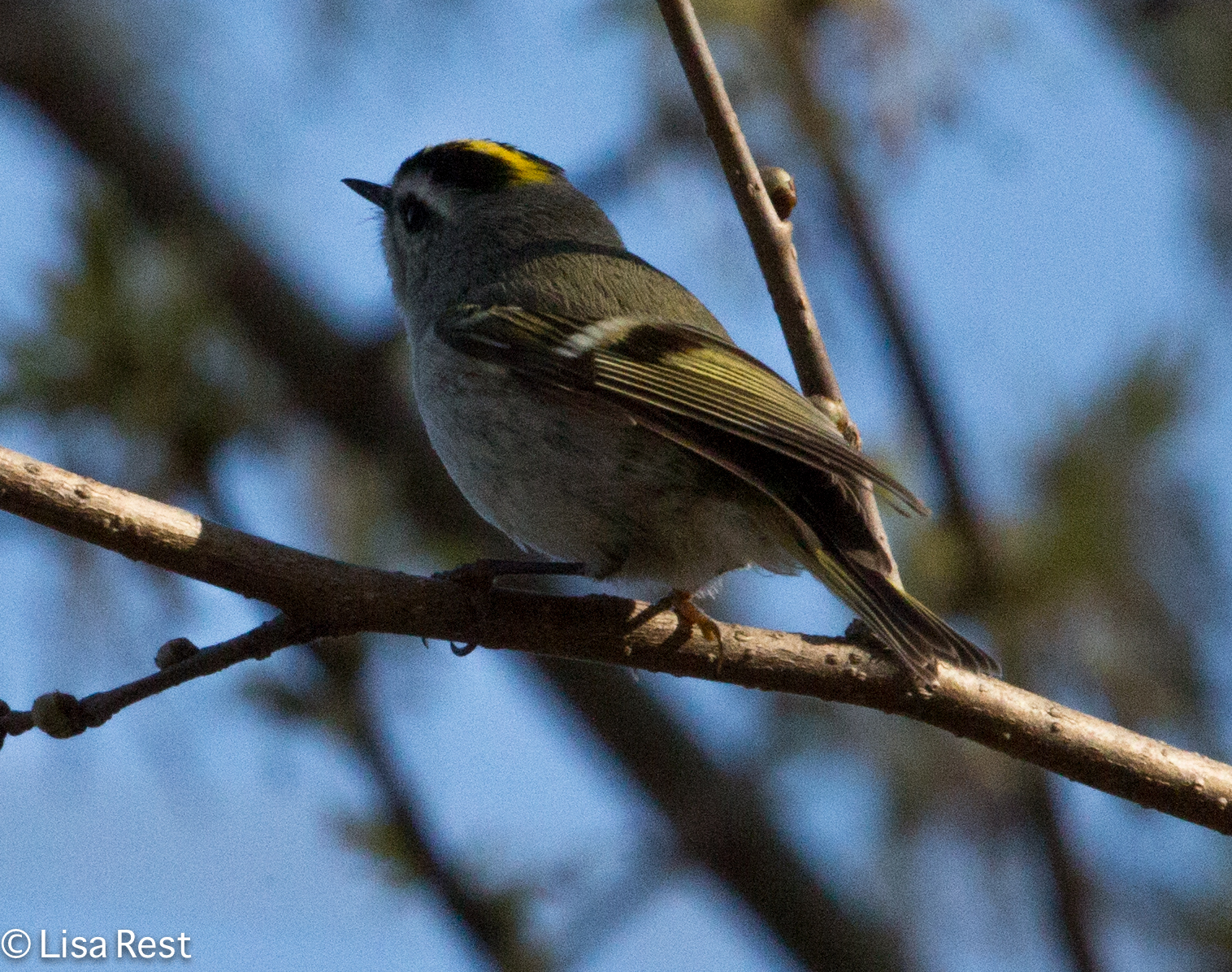
In general, Ruby-crowned Kingets were less prevalent than the Golden-crowned this fall.

Then House Finches started to emerge…

A well-seen Hermit Thrush below…

A momentarily present Northern Cardinal…

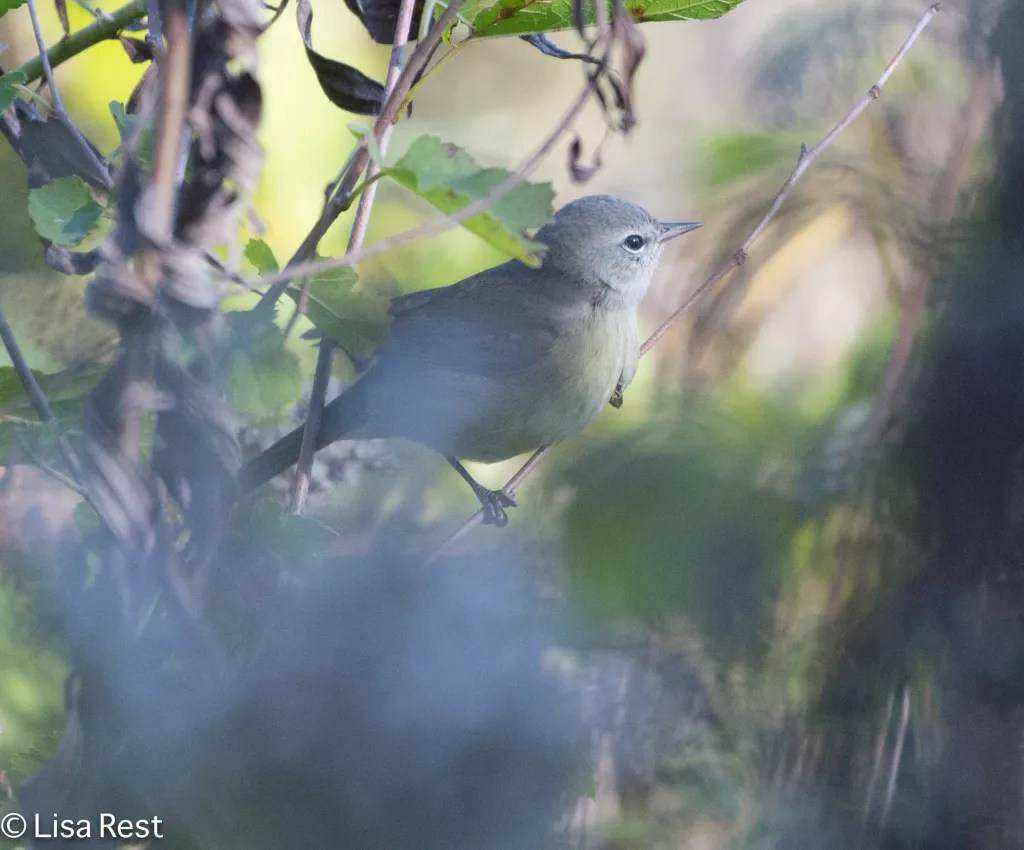
Below is an Orange-crowned Warbler… I have yet to see the orange crown on any of these but from what I understand it is barely visible.

Woodpeckers!

Red-bellied Woodpecker
Hairy Woodpecker
Downy Woodpecker

It was not easy to get a picture of the Brown Creeper below but this is just further testament to how often I saw at least one almost every time I went out.

And then there were the almost daily White-tailed Deer…

European Starlings were exceptionally striking in the light that day.

I finally broke down and started cleaning up my second bedroom yesterday. It will likely take me the rest of the year – but it’s a wonderfully freeing thought as I plow through an accumulation of treasures and junk. The first and most important motivation seems to be organizing and having one place for all the camera equipment. But hot chocolate seems more important at the moment…

Long Before the Rain

It’s been almost 3 months, which seems hard to believe, but this is a more historical account from McGinnis Slough for birds seen on September 19th, when the slough looked more like a marsh at best. Yet there was more bird activity and a couple less common sightings.

It started off inauspiciously with a European Starling.

But at some point I found a Northern Waterthrush, which is a warbler species I haven’t seen in a long time. They aren’t particularly rare but they don’t travel around in warbler flocks and are often close to water and the ground.

One of my first White-throated Sparrows of the season was in the grass.

Perhaps the bird of the day as far as offering itself up for photographs was Palm Warbler.

Among the land birds was this Swainson’s Thrush.

The Double-Crested Cormorant below gave me several expressions of its flight pattern.

More views of the faded-looking Spicebush Swallowtail butterfly at the top of the post.

I never know exactly where I can expect to see a Great Blue Heron here but I practically always do.

More flying birds to capture – a Great Egret and, of all things, a Blue Jay or two, which don’t normally make themselves so available.

Two warblers – a Nashville and then below, a female Common Yellowthroat.

I saw Gray Catbirds at this location more than once.

The light played interesting tricks on these two Wood Ducks flying through the marsh.

The rose mallow flowers seemed late and sparse but they prevailed.

A Yellow-rumped Warbler blending in below.

More flying birds. Cedar Waxwings directly below, and below them, the inevitable Canada Geese.

A couple views of the parched-looking slough.

And a closer-cropped view of the Great Egret seen in the flight sequence above, after it landed.

I have been seeing some amazing birds all week which has kept me more than busy. Even though migration has slowed down, there are still birds to be seen. I will be back as soon as possible with more recent sightings.

Water Returns to McGinnis Slough

This will be brief. I went to McGinnis Slough last Sunday to see if maybe I might be present when some Sandhill Cranes were flying over, or just in general to see what the water levels were like. All the rain had made a difference. Where there was no water to be seen before, now the slough looks like a slough again.

No Sandhills flew over. Indeed, not much was flying.

I saw my last Yellow-rumped Warblers of the season.

Red-winged Blackbirds linger.

I’m always happy to see a Pied-billed Grebe.

.

A Northern Cardinal blended in well with the leaves turning red.

This Song Sparrow wasn’t interested.

It was best to see water again.

For the most part, there were perhaps 200 American Coots scattered all over the slough. They were quite distant, however.

I’m running out of room on the hard drive again so I will be back soon with lots more.

Winds of October

I borrowed this title from Peter Mayer, whose song “Winds of October” runs through my head, encapsulating the chill in my bones over the last few days. Our endless summer is over. Although we are still a way off from an overnight freeze, the temperatures are much cooler and we are cloudy and rainy to boot. I can’t complain about the rain. The ground is parched, we need it.

Hoping I could see some migrating Sandhill Cranes at Goose Lake Natural Area this fall, I drove up there with my friend Lesa on Thursday morning… to find no visible cranes, only the sound of them as they likely flew overhead and landed somewhere else as we were walking through the forested tunnel part of the path. The remainder of the path has been paved with some sort of material which I am sure is better for bikes… The lake is totally gone and overgrown, and apparently nothing feeds into it.

But Lesa noticed the bizarre-looking Giant Puffball mushrooms growing off the wooded part of the trail on the way back to the car. I had never seen them before, so it wasn’t a totally uneventful visit.

We continued on to check out Glacial Park as it was nearby, and we watched the feeder birds from inside the visitor’s center… No Sandhills there either. I am not sure if I was too late again this year or if climate change is throwing off the whole scenario, but I likely will not go all the way back in that direction any time soon. But after all the great birding I have otherwise had the past two months, I really should not complain.

I needed a couple days to get caught up on sleep, to rise again early to meet Ed for the 7:30 bird walk at Thatcher Woods yesterday. Ed, who is the organizer, and I were the only two participants. It was chilly and rather cloudy – what else is new? We moved slowly around the perimeter of the grassy area and stood and observed the usual suspects. Most of them were up high and backlit in poor light.

One of only a few Yellow-Rumped Warblers

A few Yellow-rumped Warblers were barely seen. Golden-crowned Kinglets persisted. It was hard to imagine what the kinglets were grabbing out of the air and from the trees in their usual frenetic manner. But I suppose you have to be that small to find the smallest prey – likely those “no-see-ums.”

Running out of options, I took a picture of the moon. And then, as we stood there watching, a Yellow-billed Cuckoo landed on a branch right in front of us. It was no farther away than the first photo below.

Yellow-billed Cuckoo

I confess I hadn’t seen a Cuckoo in so long, I thought it might be a Black-billed – forgetting what one looked like. But the yellow orbital ring and the big splashy white spots on the tail make it a Yellow-billed Cuckoo.

This is a bird I heard off and on all summer long and never saw. Cuckoos are notoriously reticent – in that they don’t move around much, so if they are sitting somewhere calling, well, good luck finding a bird that blends in with its surroundings and doesn’t move. Every Cuckoo I have ever seen has done something like this – either suddenly appeared, or I would happen upon one just sitting over a trail somewhere. But this one came and sat for us at least three minutes, listening to us talking in admiring tones. Maybe it related to the shutter clicks, which could sound, I suppose, like a very slow Cuckoo.

I managed to get a few photos of the other birds that were around. A Black-capped Chickadee was up high in an oak tree.

A Dark-eyed Junco and its shadow

We got a nice look at a Hairy Woodpecker. A photo of a Downy Woodpecker I saw later is below for comparison.

Downy Woodpecker

A Red-bellied Woodpecker was only partially obscured by a few twigs.

White-breasted Nuthatch

Ed had to leave early and I stayed a few minutes extra before a track team started running through. One of three Hermit Thrushes I saw is below.

A gull flew overhead – it might be a first-year Ring-Billed Gull. The black band on the tail would be reason to believe so…

On Friday, I slept in and only went out to do grocery-shopping. I ventured into my backyard in the afternoon for a few minutes while the sun was shining. I am still waiting for someone to eat the berries off the hawthorn before I cut its branches back – they are laden practically to the ground. The berries look good to me, I don’t know why nobody has eaten them yet. Didn’t the berries suddenly disappear in previous years…?

The other overgrown offering seems to be the asters that bloom this late. I don’t know how many times I cut them back from growing over the walk, but they have grown over it anyway. I can forgive them for the abundance attracting a few bees remaining.

As the rain and cold ensue and my birding travels diminish somewhat, I plan to get caught up with the rest of the fall photograph haul… Thanks for tuning in. I will be back.

Of Yellow-Rumpeds and Kinglets

Fall migration always seems to take a turn with the sudden arrival of scores of Yellow-rumped Warblers and Ruby-crowned and Golden-crowned Kinglets, the latter two species that were called “Old World Warblers.” It turns out that Old World refers to a genus that the kinglets shared with other birds of the world (the Sylviidae) before they got split off into Regulidae. But suddenly all new world warblers – the wood warblers, or Parulidae – you may have seen over the past few weeks are less commonly seen and these species are abundant. Not to confuse you – the Yellow-rumpeds are wood warblers and still being seen.

It was a cloudy morning, ahead of some significant rain in the forecast, and I went to the Portage last Tuesday to see if any birds were about. At first, due to the cloudiness, there were distant Red-Winged Blackbirds moving about and a couple Woodpecker species, but I really didn’t expect to see much of anything. And then, perhaps due to the still-warm temperatures and the sky brightening up a little bit, I found one of those Magic Trees, this time, through the break in the fence and on the trail leading toward the train tracks. Magic Trees host a flock of foragers, and this one was no exception. I should note that it was a Hackberry, as have most active trees been this season.

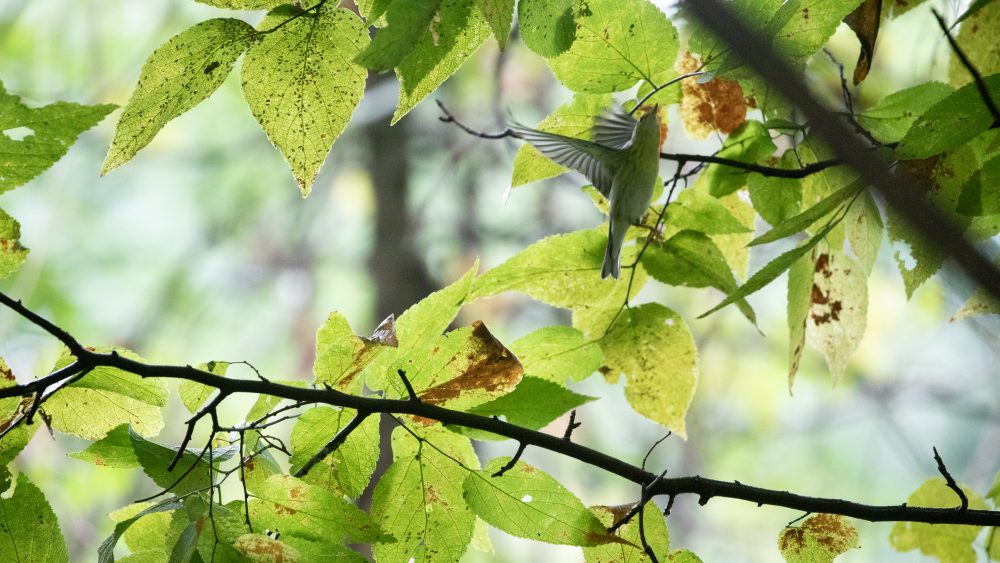
Anyway, I was delighted to find the three photographs below, taken in rapid succession, of a Golden-crowned Kinglet. I love his “ta-da” wingspread in the third photo.

Below are some Yellow-Rumped Warblers. I stole the picture of the one at the top of this post simply because the lighting was better when I took it and the one below was just a little too dark.

Sparrows are starting to come through. Below is a White-Throated Sparrow, often the first to show up.

Below are Ruby-crowned Kinglets. I seem to be seeing fewer of them than the Golden-crowned but it could just be the Golden-crowned getting more of my attention.

The lack of light didn’t do this Nashville Warbler any favors.

Magnolia Warblers have managed to show up the greatest length of time, from the very beginning until just a couple days ago.

Hanging out in the same spot where I found the kinglets this time was a very cooperative, and I guess hungry, juvenile Rose-breasted Grosbeak.

I am trying to remember what the bridges looked like years ago before these were installed, but I can’t seem to conjure images up in my brain. I know the path to them was not paved. Not sure I have squirreled away any photographs either. In any event, they got painted over this summer to cover up some graffiti. But they are still fairly attractive, even if it gets harder and harder for me to peer over them with the camera as I continue to shrink.

Some scenes of the Portage showing what I guess will be the fall colors…

Two more of the Grosbeak.

When I got home I found this bee enjoying the asters blooming in the front yard.

I am taking way too many pictures every day to keep up with this fall deluge of migrating birds, and as long as the weather is good, I will be going out and taking more. I figure I should go for as much sunshine and good weather as I can before the inevitable cold and snow. Maybe I will get caught up some snowy day.

Leading Walks

I led two walks for the Unity Temple Unitarian Universality Congregation (UTUUC) auction again, on September 11 and September 25 this year. I didn’t take a lot of pictures, even though I was in much better shape than I was last time with the broken elbow. The pictures from the 11th are first and the ones from the 25th start with the Yellow-Rumped Warbler.

More than anything, it was good to get out with people from the congregation, most of whom I had not previously connected with, which was the whole point, beyond raising money, of offering a walk as an auction item. We had great conversations and the weather was good on both days, so I find myself looking forward to doing this again. And again.

Not quite the last Indigo Bunting (a juvenile).

I managed to capture this Chestnut-sided Warbler with a bug.

The Yellow Warbler below was deemed “rare” in that it was late to be seen on September 11, so perhaps I developed too many photos of it to prove I had seen it.

A Red-tailed Hawk flew over.

It was nice to see yet another Eastern Wood-Pewee.

I am always grateful to the bees that remind me the Canada Goldenrod, however strident in taking over spaces, is needed and appreciated by them.

A closeup of some galls that attach themselves to hackberry leaves.

Not a representative photograph at all, but below was my first of many Yellow-Rumped Warblers to come.

Below is a somewhat hard-to-see Blackpoll Warbler. You can always click on the image to see it better.

For a few days there was a juvenile Rose-breasted Grosbeak or two.

Finally started seeing some Ruby-crowned Kinglets on September 25th like the one below. I have since captured more – to follow eventually.

Magnolia Warblers just kept popping up all month.

One more of the delicately decorated Swamp Darner also at the top of the post. It was on its way somewhere on September 25th,

I led a walk this morning at Columbus Park – I was the only participant. I think I might return shortly with that adventure before I continue to plow through the accumulated backlog: for instance, I wound up going back to the Portage before and after the second walk and found it to be very birdy, so be forewarned.

Migrant Morning at the Portage

I had a lot of other photographs I was going to post from previous visits but they will have to wait. In spite of the rainy forecast Saturday morning, I went to the Portage and even though it was overcast, it was magical. Within a minute or two I had heard 10 bird species. I saw most of them and many more.

Perhaps the first bird I saw and heard was a Baltimore Oriole. There were easily half a dozen males staking out territories. This was the only one sitting out in the open.

I encountered a small flock of warblers fairly early. I was lucky to be able to sit on a big fallen log that has become permanent enough to attract graffiti. The opportunity to sit and look up into the trees was welcome. Below, couple Yellow-rumped Warblers.

I encountered small groups of White-Crowned Sparrows. They were delightful to see, but they weren’t singing. I have had them in my yard for a couple weeks and they have always started singing the minute I open the door. It was nice enough of these guys to pose for pictures.

I’ve been hearing Yellow Warblers for a couple weeks but hadn’t seen one yet at the Portage. But I found this one in my photos.

Yellow Warbler

And then, of course, the Indigo Buntings. I underestimated their ability to look gorgeous even in poor light.

Below is a series of Black-and-White Warblers. There have been times I haven’t been able to capture these guys and girls, so this was a real treat for me.

I think I’ve decided Hackberries are my favorite trees. The birds like them a lot, and the Portage now seems to be full of them. They are in the elm family and I suspect were planted to fill the gaps left by all the elms we lost over the years to Dutch Elm Disease.

Here’s a Black-capped Chickadee demonstrating why he likes Hackberries. They seem to attract good worms.

A few birds I would expect to see all summer…

This female American Robin looks a bit exhausted. She also appears disheveled with her brood patch.
A male American Goldfinch
Gray Catbird
Great Blue Heron flyover

There were at least 30 swallows over the water. I had three species – Tree Swallows, Barn Swallows and Northern Rough-winged Swallows. They are all represented in the slide show below.

I looked up and saw this Scarlet Tanager. I’m going back to see if I can find another.

I always hear at least one White-Breasted Nuthatch but I haven’t seen any for quite a while. This one made up for all the ones I missed.

Song Sparrow

Here’s what a Magnolia Warbler might look like straight above you. Below I have grouped several views of the “Maggies” who always seem to engage with the camera.

There were some barely-there birds…

Blue Jay
Female Cape May Warbler
Female Downy Woodpecker

With one more Magnolia Warbler photo, I am done with this post. We are going to get warm over the next few days. I wish I didn’t have to work, it would be ideal weather to see more birds. But the somewhat crummy weather this morning created conditions for some nice encounters with beautiful birds. I really can’t complain.

Getting Greener

The rollercoaster ride continues. Has it been anything else this past year? I seem to be plagued with anxiety over work, technological failures, commitments made, unfinished chores…and then the sun comes out, floods the house with brightness, emergencies subsist or in some cases solve themselves and fade into short-term memory, and life is good again. My iPhone was losing charge drastically this morning…which seemed life-threatening, but now I have so far anyway managed to find a better phone charging cord and it is coming back to battery life.

So since I find myself at relative peace, it being Friday and the middle of the day when the world seems to be focusing on the weekend, here are last Sunday’s photos, few and far between, from a cloudy, cool Portage morning. The White-Throated Sparrow at the top of the post didn’t appear to happy with the weather.

This time I was fortunate enough to see two Eastern Phoebes by the second bridge. I suppose I can assume they are a nesting pair returning. They were sort of tucked away and a bit hard to see.

I have heard a Song Sparrow for weeks but this is the first time I caught a glimpse of one.

Only one Black-capped Chickadee offered itself up on this cloudy day.

I saw this pair of Wood Ducks fly into the trees and then could just barely capture them through the branches.

The woodpeckers were hard to see but I found this one early on.

Cloudy Portage scenes…with emerging green…

On my way out, just when I was wondering if I would see anything new at all, I came across half a dozen Yellow-Rumped Warblers on the paved path, in exactly the same spot as last May, I believe, that a similar number of male Indigo Buntings announced their arrival.

I think this is the first time I have seen the new redbuds blooming. They’re in a nice welcoming spot behind the sculpture, breaking up the lawn that sprawls in front of the woods.

To be sure, the Robins are busy and they will continue to be so.

I hope to be back soon – I know, i always say that, and then weeks go by… but Spring Is Upon Us and it seems I must rise to the occasion. I am grateful for the Seasons – they are still with us!

Looking Back to Spring Forward

I started writing this post to coincide with setting the clocks forward, and now it’s taken me over another week to get back to it. But when considering all the photographs were taken a year and a month ago – on April 19th, 2020, to be exact – and I never got a chance to finish processing them until now, it’s taken even longer! I hope it’s kind of a sneak preview of what to expect in the coming days and weeks as spring unfolds at the Portage.

One of my first encounters was a pair of Downy Woodpeckers exhibiting their exuberant version of courtship behavior. At first I thought they were arguing! I have never witnessed this before so I’m glad I was able to capture it. If you click on the right panel and keep going you can see the sequence.

It appears I had way too many photographs from this excursion which might explain why I never managed to post them. Still it’s nice to revisit them, like the female Northern Cardinal below.

Below, often the first warbler to visit, a Myrtle Yellow-Rumped Warbler.

Surprised to find this photograph in the mix – likely my first sighting of an Eastern Bluebird last year.

An Eastern Phoebe, dreaming of flying insects, perhaps.

Another Downy Woodpecker.

Song Sparrows…

Red-winged Blackbirds…

I don’t think there’s enough water on site anymore to attract herons, but there is plenty nearby so I should still see them flying over on occasion.

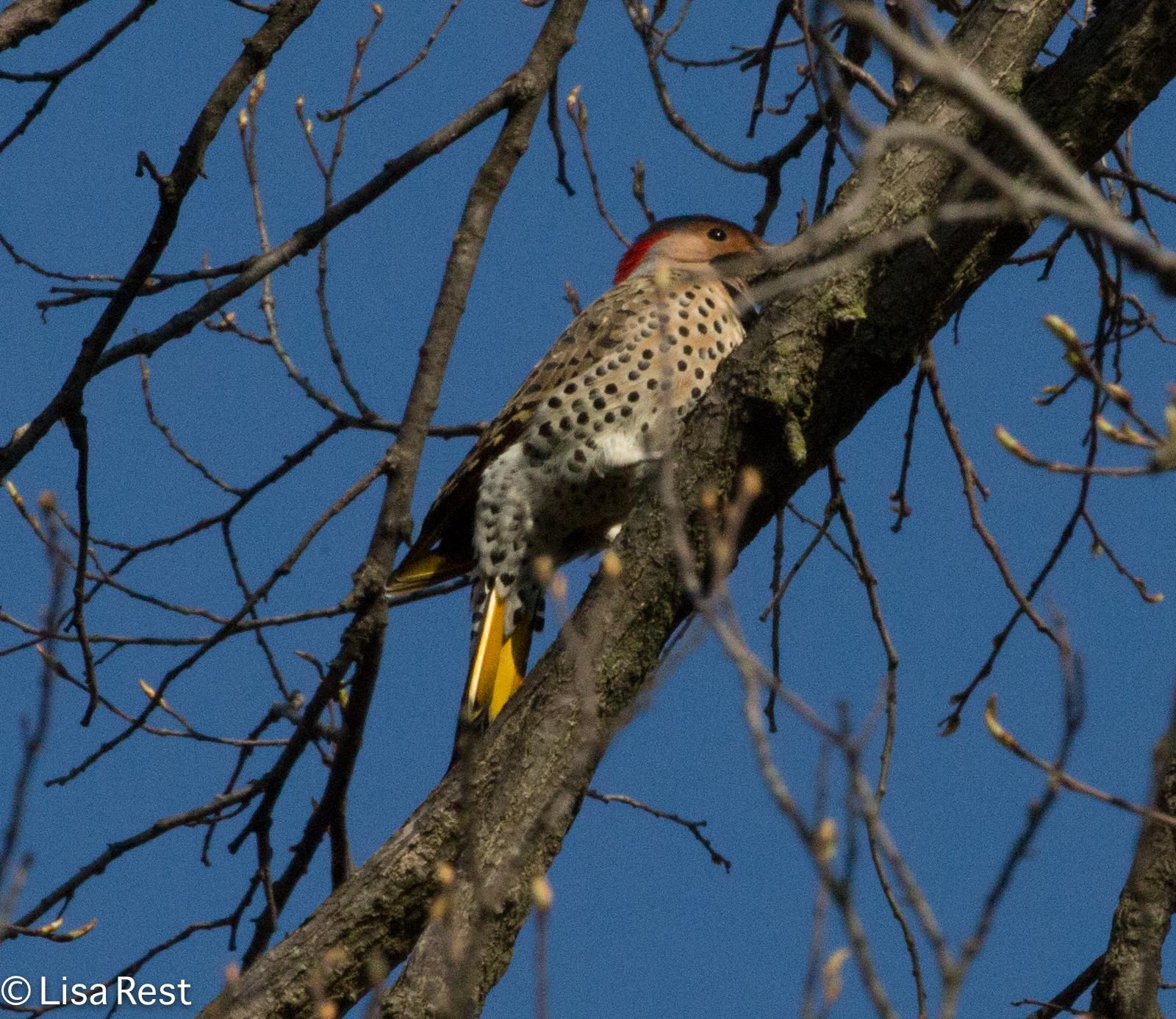
A Northern Flicker showing just a little of its golden shafts.

There were two Yellow-Bellied Sapsuckers on this tree and one flew away.

A Black-capped Chickadee showing off.

A singular turtle…

An assortment of early fungus, moss and flora.

A singing American Robin

Here’s a Golden-Crowned Kinglet – unfortunately the lighting didn’t do its colors justice.

This Brown-headed Cowbird was foraging on the ground.

Canada Geese and the clouds…

Robins often seem like they want to engage in a conversation.

A Wood Duck drake in a tree. I remember trying to get this shot after I saw him land, with a lot of branches between us.

Mallards…

Blue-winged Teal…

So the Portage will still be slowly coming to life, but we’re warming up, the days are getting longer and migration has begun. Springing forward with hope.

Little Brown Jobs

I started writing this post so long ago I almost forgot what it was. But these pictures are from last month, when I visited McGinnis Slough. I never know what to expect as the species change with the water level. The water level was low, so there were primarily land birds to look for. And most of them were sparrows, often referred to fondly as “LBJs” or “little brown jobs” in birder jargon.

At the top of the post is a Swamp Sparrow and there are more photographs below. Swamp Sparrows are distinctly reddish-brown on their wings.

Next, a couple lovely Song Sparrows. Always streaky, but they can often look quite different. The strong, bold malar is their giveaway.

I will never forget how frustrated I felt when I first discovered birds and found out that House Sparrows are not a native species but indeed, there were some thirty-odd native species to worry about. With luck I will see a third of them here. It took years of classes and practice to get them straight. Actually when I first got interested in birds, House Sparrows were still considered weaver finches by some. They are now included in the sparrow family. I’ve never seen a House Sparrow at McGinnis, so they are not featured in this post. But considering they were among the first birds to interact with me, I probably owe them a tribute someday in a future post. Until then, I believe they are all in my backyard…

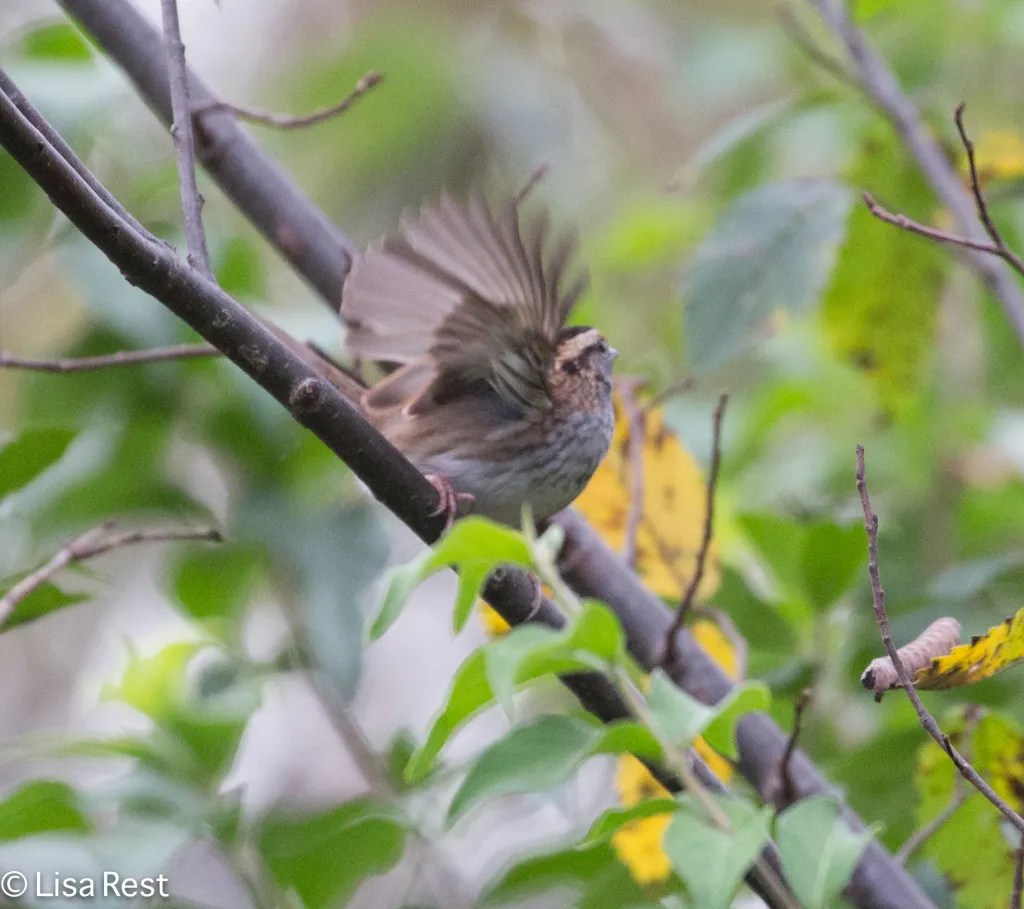
One of my favorite sparrows is below, the Fox Sparrow. There are four subspecies. The one we see is the “Red”.

Fox Sparrow

The handsome sparrow below is a juvenile White-Crowned Sparrow. I have not seen an adult this fall.

Dark-eyed Juncos are part of the sparrow family too. I am always intrigued by the nuances of color in these birds, I don’t find them drab at all. After a while one starts to recognize them by their flash of white tail feathers in flight or their ratchety calls.

To jazz things up a bit, there were a couple of Northern Cardinals handy. I never turn down an opportunity to capture them.

There were a few Yellow-rumped Warblers too. It was the last time I saw them this year.

It was still warm enough for Dandelions to consider blooming. Seeds are scattering from milkweed pods. I was attracted to the red-leafed plant but I don’t know what it is.

Last, here are a few scenes from the slough. All the way at the bottom is the overturned picnic table that used to sit right by the overlook onto the slough at the south end. It was a nice place to sit. I am not letting my imagination run too wild with what caused anyone to throw it into the creek upside-down.

I will try to be back sooner. Work has been busy and all-consuming. But now it seems silly and superfluous to complain about anything. I have started swimming again. Swimming Fixes Everything. I was surprised that I had forgotten how absolutely, sinfully wonderful it feels to get out of the pool with all my cells “woke”. I feel almost guilty admitting it in the midst of such a miserable, suffering year. If I could bottle and sell the feeling I have after swimming, I would be a trillionaire, but of course I can’t because the best things in life, truly, are free.

I hope you have a go-to place that refreshes your spirit and gives you energy to continue. We’re not done yet.