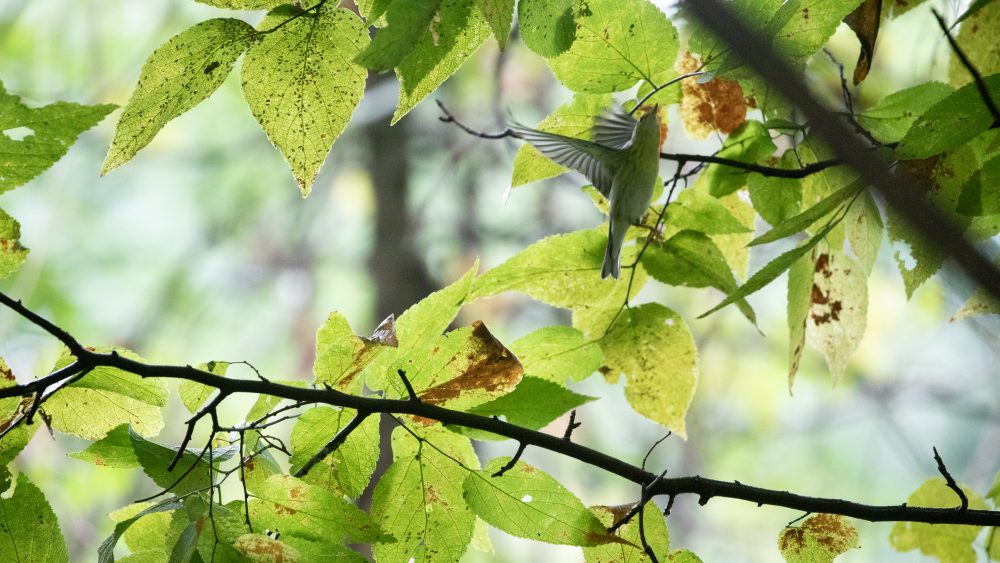

American Goldfinch (female)
I’m finally getting around to these pictures from the Memorial Day weekend. On Saturday morning I led the second walk at the Portage and the weather could not have been more different, shall we say – weather is becoming more than an idle topic for conversation lately as we keep having these 40 degree temperature swings in either direction – than the first walk which was rainy and chilly: this time we had plenty of sunshine and it was getting downright warm. We saw fewer species than the first group, as migration had progressed substantially in the two weeks between walks, but we had a good time.
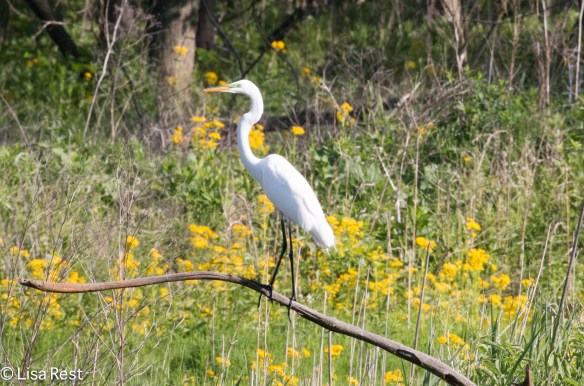 It was nice to get good looks at the Great Egret that seems to be back in the area. The Green Herons were absent this visit but I suspect all the herons go back and forth between the Portage, Ottawa Trail and the Des Plaines River, so I am sure they are still around.
Red-Bellied Woodpeckers were a presence. We didn’t even hear a Downy Woodpecker which is really unusual as I always expect to see or hear at least four any time of year but they must have been very busy being quiet.


It’s occurred to me that Song Sparrows are likely the only breeding sparrows at the Portage. Habitat requirements being what they are, I never thought this was odd but at the same time it seems there are a couple Chipping Sparrows that come back to my neighborhood every year so I wonder even about that. I guess it’s location, location, location.


Early on we saw one of many Warbling Vireos we would hear constantly. And the Indigo Buntings did not disappoint.


This was as close as I could get to a Northern Flicker. Two surprise birds below, neither of which were very visible, but I can now look forward to finding them again. Great Crested Flycatcher on the left, which we saw on our way out, and the camera just barely caught the Yellow-Billed Cuckoo on the right. I had pointed the camera lens at its curious-looking eyes peering out at me from where it was perched, and then it flew. I’ve heard cuckoos before at the Portage but have never seen one there until now.


For all the warmth and midges swarms, there weren’t many swallows that morning. Below is a Tree Swallow taking a break.
 There were likely more Common Grackles than we saw, but this one was foraging in the bottomlands by the Des Plaines River.

Two days later on Memorial Day, I decided to go birding early at McGinnis Slough and then swim in the Orland Park fitness center pool, my dream scenario ever since I’ve had to go to Orland while my usual swimming hole has been under remodeling. I’ve been driving by the Slough at night after work to go swimming, often seeing deer foraging in the grass before the days got longer and thus lighter at that hour, but now I had the entire day free and it was hot so a swim after birding seemed to be the perfect idea. I haven’t been able to swim well with my knee out of whack, but the pool has been excellent therapy.
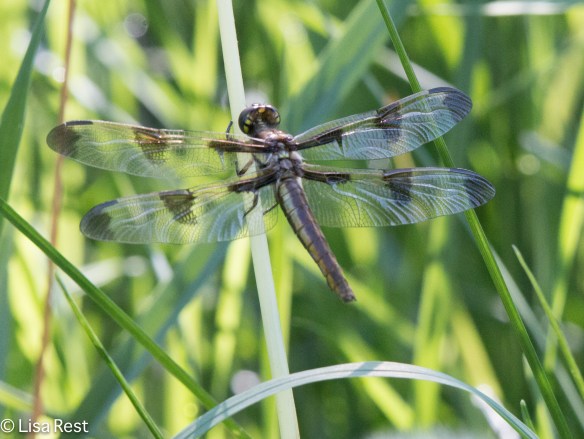
Below is a Widow Skimmer Dragonfly, which we also had at the Portage. A reminder it’s time to get ready for dragonfly identification again.

Wood Duck

Double-Crested Cormorants
It was nice to see families at McGinnis, like the Mallards below.


Red-Winged Blackbirds are more numerous here.

 Two distinct silhouettes below: Double-Crested Cormorant and Turkey Vulture.


Song Sparrows like McGinnis too.


Another Goldfinch…
 Waterfowl at McGinnis are usually distant and hard to see. Sometimes I take pictures and blow them up later to see what I was looking at, not that I ever get a very good image. Below the Mallard family are a couple pictures of a Great Blue Heron in flight and more Wood Ducks. I was surprised to not see any Great Egrets yet at McGinnis, as they can be everywhere. Likely they’ve been thrown off by the crazy weather too and I’m more confused than they are. I’m sure I’ll see them as we slide into summer.


Here’s one more picture of a most accommodating Red-Bellied Woodpecker.
 I’ll be staying close to home, there’s much work to do in my yard. Not feeling up to rushing yet. Still savoring life in the slow lane.
 Last year two fellows I run into occasionally at the Chicago Portage, Steve and Mike, told me they had seen a Great Horned Owl. I believe it was Mike who showed me his stunning photo of the owl sitting on a stump over the water. But I never saw the owl until two weeks ago making my return trip on the trail that runs along the south side of the stream, when I flushed it and watched it fly to perch in a tree on the other side.
 So are they a pair? Most likely. I suspect the first owl is the female as it is larger. Then I wonder if they have a nest somewhere or if they’re shopping for one. Will I see baby owls? It’s more excitement than I can handle at the moment. But I do suspect that the owls’ presence will keep the other raptors I normally expect to see at the Portage away.


 After the Black-Throated Green left, this Swamp Sparrow occupied the same spot for a moment.
 The Black-Throated Green was unusually late for this location, so he earned a citation on the rare bird alert. But the rest of the birds were pretty predictable, like these three Mallards enjoying the open water.
 A Red-Tailed Hawk made a couple backlit appearances… If you click on the images you can see more detail.


 And where the preserves were crowded with kinglets the previous week, I now saw only one, a Ruby-Crowned Kinglet, below.
 On the home front, after a short sprinkle but before ensuing downpours, my yard was full of House Sparrows.
 But I did still have a couple White-Crowned Sparrows who now rely on me to put out some partially chewed-up spray millet sprigs in the compost.


 Hanging out with the House Sparrows by the back fence was a Northern Cardinal.
 A few House Finches managed to forage on the ground.


 Continuing with last month’s visits to nearby Cook County Forest Preserves, young birds like the Cedar Waxwing and Red-Winged Blackbird above were getting ready to leave. It’s become evident to me over the past few years that European Starlings like the one below are not necessarily winter residents either. But the young Mourning Dove blending in with the dead stump below the it will likely stay.
 Hidden in the leaves about waist-length from the ground at Ottawa Trail was the Ovenbird below.
 And there just seemed to be too many ways to capture Northern Flickers. They have likely pretty much disappeared by now too. For a last look you can click on the pictures below for larger images.


 A few more Red-Winged Blackbirds.

 I am grateful for Northern Cardinals. They will be here all winter to brighten up the landscape.
 This time of year I may not be seeing many birds but everything is in a state of growth and worth attention. I visited the Chicago Portage last Saturday because I wanted to go elsewhere on Sunday and still felt like I needed to keep track of whatever was going on there. I was surprised to see the fruits of some restoration efforts in the vegetation. There is a lot of Tall Bellflower I don’t recall seeing before, mixed in with the Burdock which is about to bloom. Last time the Common Burdock was in bloom, butterflies were everywhere, so I will have to go back soon to see if that happens again.


 There have not been a lot of dragonfly species. It’s a female Common Whitetail Skimmer on the left below. I still don’t understand the attraction to gravel. On the right is a type of Spreadwing damselfly, but I am not able to identify it.

 Some juvenile-appearing Flycatchers below: Eastern Kingbird, Eastern Phoebe and what I’m pretty sure is an Eastern Wood-Pewee.


 Below is a Northern Flicker in the most popular tree bearing fruit. Now I’m realizing I was so busy following the birds in it, I didn’t bother to figure out the tree itself. More challenges ahead.
 I fully intended to do a post encompassing all last weekend’s experiences but there’s too much so I will be back shortly with a couple more installments.


 Down by the Chicago River last week, a Ring-Billed Gull enjoys his perch on one of the last remaining rotting pilings. And the only bird in the Boeing garden nearby was what appears to be a Yellow-Bellied Flycatcher below, after checking Crossley’s pictures as a reference, but empidonax flycatchers are hard to nail down unless they say something and this guy was silent.


 I’m looking forward to cataract surgery on my right eye tomorrow morning, because that’s the eye I use to focus the damn camera lens with, so I’m hoping for future sharper images!!
 The fact that this place always looks like it may have started on another planet never escapes me, and now I may have some insight into why.

 The only warblers willing to engage with the camera were Yellow-Rumped and Black-Throated Green Warblers. All the warblers I saw were in the same tree. I had a Blackburnian Warbler which is always a treat, but the poor light just wouldn’t do him justice.

 And this Red-Tailed Hawk became a bit annoyed with me when I noticed him sitting very still and trying to blend in with the tree.


