

Rose Mallow at McGinnis
As the days get ever-so-slightly shorter, commitments increase. I’m not sure why that is. But suddenly it seems there is less time for more things to do. A visit to McGinnis Slough had been on my mind for weeks ever since the last time I drove by the entrance was closed for paving the driveway, and there was no access. I got up as early as I could Sunday morning to visit the Slough and then the Portage.

A Slough in name only…
I think the last time I posted from the Slough, I was commenting on the low water levels following perhaps a flooding situation. But the summer weather since has not been kind to the Slough. Indeed it is all overgrown and there is barely any water, so all the birds I would normally see have gone somewhere else.


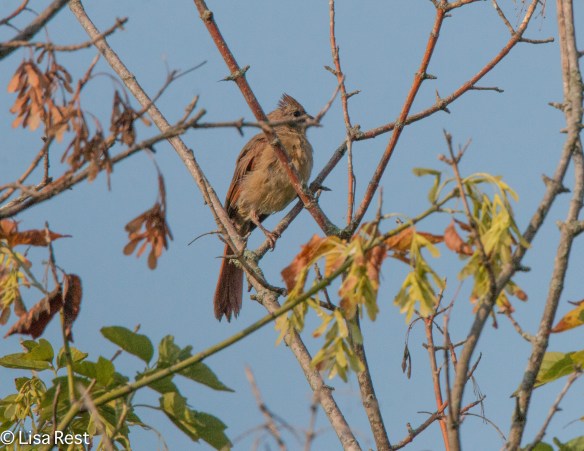
There were Mallards and Wood Ducks. I saw two distant Great Egrets, but no Great Blue Herons. Normally the slough would be hosting scores of these herons. No such luck this year. Perhaps indicative of the situation was the first bird I saw, the bedraggled-looking Northern Cardinal below.
 There were a few blackbirds around too, but the breeders are gone.

Red-Winged Blackbird, hiding the red
When not distracted by birds, the vegetation grabs my attention. Could this be a new grass taking over? I think it is Bristly Sedge.


It was then I went to the Chicago Portage. I got there just in time to encounter all the dog-walkers, runners and cyclists, but it is always worth checking out. I have to remind myself sometimes that seeing fewer birds than I might want is still worthwhile from a reporting standpoint…
 There were more Cedar Waxwings (below) than any other species. I can only assume they were cleaning up whatever mulberries the robins, who were absent, had left behind. That’s right, the robins that virtually take over the landscape have all gone somewhere else. I’m envisioning large fruit-eating flocks already in mini-migrations.


There was one distant but distinct Ruby-Throated Hummingbird. I hope to see more, as there is plenty of Jewelweed in bloom, but the window is narrowing for this species. Maybe I’ll have another week or two…
 The theme for the day, perhaps, was shaping up. These were young birds starting to find their way in the big wide world, like the Eastern Kingbird below.


And the scraggly youngster below appears to be a young Great Crested Flycatcher.
 I expect to see a lot of juvenile Indigo Buntings in the next few weeks, but Sunday just about the only bunting I encountered I could barely see.

Indigo Bunting
I was happy to see a Turkey Vulture (adult) in the neighborhood. I think seeing so many different vulture species in East Africa years ago instilled a love and respect for them. Lately I have seen groups of these hanging out by the highways, where I’m sure they make a decent living off of roadkill.
 The most accommodating bird at the Portage was the cardinal below who was singing with his back toward me but I guess that feeling of somebody looking at you caught his attention and he turned his face toward me.

Northern Cardinal
Starting this Saturday, I will be leading weekly bird walks in two alternating locations. I was recruited for this position by a fellow bird-watching choir member. We’ll see how it goes. I plan on taking the camera with me, but the leading and listing responsibilities will make photography challenging. If nothing else, I will become more familiar with the two destinations which up until now I have rarely visited. The whole purpose of this is to catch the fall migration wave. I promise to report back as often as possible.


I almost forgot my little insect sampler from the Portage. Worth mention, perhaps, is the fact that there were at least 20 Monarch Butterflies. But it’s still hard for me to believe that is a larger number than I have seen all summer.
So as we experience the changes in the weather, the environment, the species we see… the changes are unsettling, but that’s still another glass is half-empty/half-full quandary.
My last thought is a little summertime-feeling music – Trois Gymnopedies by Eric Satie. The recording is from almost 4 years ago when I had fewer birds, it was the start of the second flock, and most of the Zebra Finch solos are the beginnings of my star singer, Arturo Toscanini, whose songs have progressed far beyond this and they continue to grow. One of these days I’ll have to see if I can trace the evolution of his song cycle.
 I got out early last weekend to beat the heat which was nothing compared to what kept me indoors most of this weekend. Last Saturday was a beautiful day. And usually when the weather is good, the birds are out enjoying it too.
 Not to be confused with the juvenile Eastern Phoebe I saw later, below.
 I couldn’t get this Downy Woodpecker kid to turn around and smile for the camera but it was good enough to see his adult feathers coming in…
 The House Wren below just has that newbie look about it.


 I was beginning to wonder if all the Red-Bellied Woodpeckers were gone, but then I found a bunch of them hanging out on the bare limbs of a dead tree. They were all juveniles.



 And if anybody knows the identity of the beautiful wasp below, please chime in. All my reference books have failed me.
 Back to the birds. The fruit-eaters were enjoying the mulberry tree. That’s a Cedar Waxwing on the left and an adult American Robin on the right.

 Some interesting things on the trail for the juvenile Song Sparrow below…
 and for a male House Sparrow. I rarely see House Sparrows at the Portage but there were these two.


 Goldfinches are late breeders, so I haven’t seen many in my yard lately, but I did see this pair at the Portage briefly.
 Always happy to see a Great Blue blending in.
 And it was even pleasant enough for a couple cardinals to make an appearance.
 I heard more Indigo Buntings than I saw, but was finally rewarded by the adult male below.
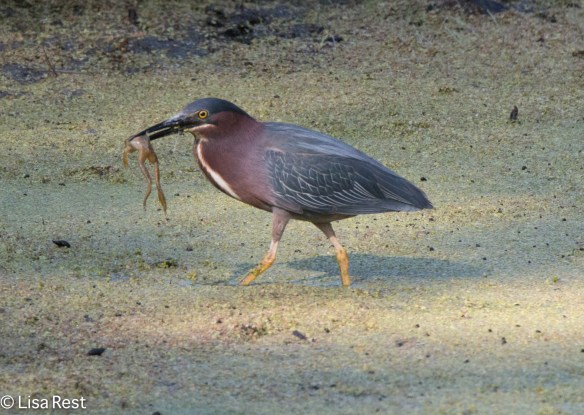
 For as much time as the Green Heron spent on this frog I am not sure he or she managed to eat it.
 I hope the heatwave ends in time for next weekend. In the meantime I guess I can’t complain about being stuck in an air-conditioned office this coming week.
 The heat is here and now more than ever the object of the game is to get up and out as early as possible, before it becomes unbearable. Birds are uniquely qualified to hide in the trees and stay cool that way. But it seemed like I was at last seeing numbers of American Robins and Red-Winged Blackbirds the last time I visited the Portage.
 I didn’t see any adult Baltimore Orioles but there were a couple youngsters like the one below, who was busy trying to take care of all those feathers.
 And in the same color scheme, there were a few Monarch Butterflies making their way through the patches of milkweed.
 A young rabbit paused on the trail.
 And the Indigo Buntings are quite numerous, even if it’s hard to find them. The hen below is showing off her prize which I’m sure she delivered to hungry nestlings.


 I followed this Green Heron when it landed in the tree, only to realize its partner had been there hiding in plain sight all the time as two herons took off a moment later.


 And the Orchard Oriole taking off.
 I have tentative plans to go out early on the 4th if possible, but rain and thunderstorms seem to be in the forecast and that might stop me. It’s awkward to have a day off in the middle of the week, but a day off is a day off. Rain might actually be good enough to quell local firecracker explosions.

 Continuing with last month’s visits to nearby Cook County Forest Preserves, young birds like the Cedar Waxwing and Red-Winged Blackbird above were getting ready to leave. It’s become evident to me over the past few years that European Starlings like the one below are not necessarily winter residents either. But the young Mourning Dove blending in with the dead stump below the it will likely stay.
 Hidden in the leaves about waist-length from the ground at Ottawa Trail was the Ovenbird below.
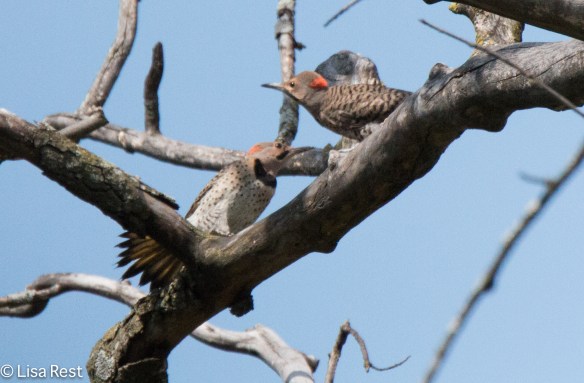
 And there just seemed to be too many ways to capture Northern Flickers. They have likely pretty much disappeared by now too. For a last look you can click on the pictures below for larger images.


 A few more Red-Winged Blackbirds.

 I am grateful for Northern Cardinals. They will be here all winter to brighten up the landscape.


 Indigo Buntings were still a presence but getting a bit harder to find. They are likely getting ready to leave.


 Also nearly absent are Red-Winged Blackbirds.


 Abundance below, of Pokeweed berries and Jewelweed blooms. Unfortunately I couldn’t find any hummingbirds enjoying the Jewelweed.

 Below, three first-year birds.


 I couldn’t decide which photograph of the Common Yellowthroat below to include, so here are both.
 And one more of a Tennessee Warbler, adorning Giant Ragweed. Tennessees were most numerous yesterday.
 Apologies for being absent of late. My work situation is in flux, which creates a different kind of distraction. But I promise I’ll be back soon with an update from the yard. It’s been cool enough overnight to leave the windows open all weekend. I think Fall is my Favorite Season.


 At least one Black-Capped Chickadee is on hand to remind me to keep the sunflower seed feeder full.
 The Northern Cardinals are in various stages of molt.


 Not much going on with birds in the downtown parks these days. It is breeding season and occasionally I hear baby birds, see a youngster here and there, but the warm weather also brings out the tourists and I think the birds are keeping a low profile.


 and Rock Pigeons preening in the shade or sun-bathing in the mulch.


 Here’s one more of the fledgling.


 The little trio below leaves me stumped as to who the sparrow is, again. Since all juvenile sparrows tend to be on the streaky side no matter how they wind up as adults, I think this one has the look of a juvenile Field Sparrow but I’m not going to bet on it.
 Summer simmers on. I’ll be back soon.


