Saturday’s Spring Bird Count and Mother’s Day Rain

Yesterday I was fortunate enough to participate in the Spring Bird Count in DuPage County. I have done this count for a number of years, but this time, with social distancing, it was different. We split up so we each covered one area. I was assigned the Silver Lake part of Blackwell Forest Preserve, a location I was not familiar with, but was easy to navigate with the map Jody gave me, and I can get lost anywhere. Since I could only do the morning and there was no time limit, I had a wonderful experience listening for and spotting all the birds I could identify at a leisurely pace.

One of several Yellow-Rumped Warblers

I felt especially privileged because under the current New Normal, I would not have been allowed to visit DuPage County preserves because I am not a resident. The county decided last month to limit parking to its residents. We speculated there was an overflow of people from Cook County, where I live, due to the closing of the lakefront. So I don’t know when I’ll be able to revisit this lovely place, but now that I am more familiar with it, I plan to do so when restrictions end.

Eastern Bluebird (male)

I was beginning to feel like I am the only person on earth who hadn’t seen a Rose-Breasted Grosbeak yet so I was happy to find one singing high up in a tall tree.

Love was definitely in the air, albeit chilly after freezing temperatures overnight, for local breeders. I usually can’t get a glimpse of a Blue Jay long enough to photograph, but this pair united for some courtship behavior, exchanging some tiny seeds you might be able to see if you click on the images below.

And when it was all over I somehow managed to catch this Blue Jay in flight.

Yellow-Rumped Warblers are usually quite common, however brief the period of spring migration, so it’s easy to overlook how truly beautiful they are. This one was happy to display all his yellow parts except for his namesake.

I have no idea what was going on with this European Starling but I could swear he was dancing and singing.

This Tree Swallow was saving his energy for later when the sun would start warming up the ground and the air and there would be bugs to catch.

At some point Blue-Gray Gnatcatchers are going to become impossible to find, let alone photograph, but that hasn’t quite happened yet.

Here’s two more of the goldfinch pair featured at the top of this post.

This distant Northern Flicker would have been impossible to capture were it not for the bright, clear sunshine.

I kept hearing this Common Yellowthroat and he was confusing me by not singing his “witchety-wichety” song, only a slow trill, if you will. So finally he came and sat right in front of me and continued singing. I have never had a Common Yellowthroat volunteer to be photographed. He must be a novice. Anyway, you can see in the third photo how windy it was.

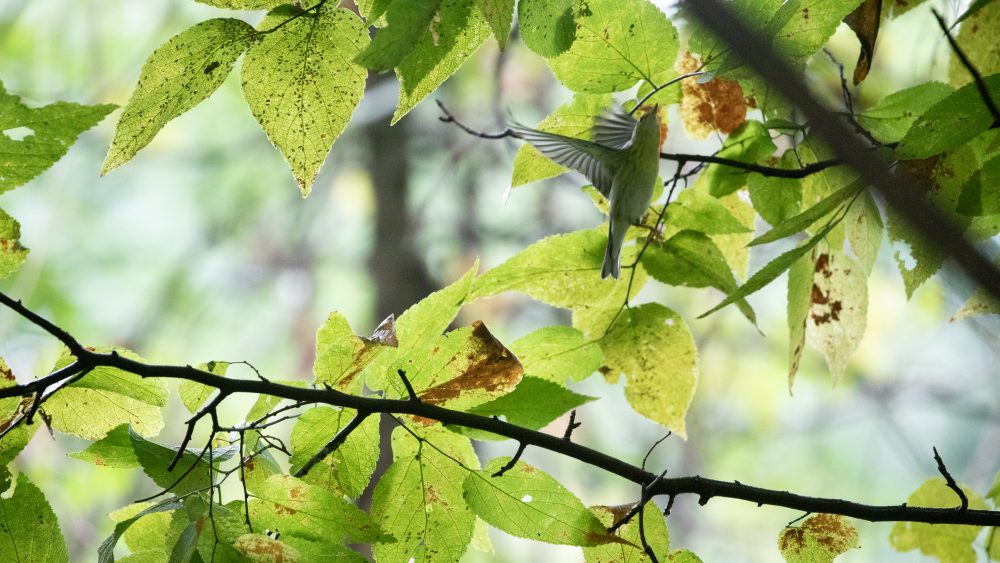
Another warbler, only this one was harder to capture. Black-throated Green Warbler.

Robins are predictably everywhere but they get short shrift. I try not to take them all for granted and capture at least one.

A less-frequently-seen bird, also in the thrush family – a handsome Veery.

Song Sparrow taking a break.

This Canada Goose flew right in front of me so I couldn’t resist.

I heard the Orchard Oriole before I saw him. What a lovely tune.

Palm Warblers become commonplace too, but they are still pretty birds.

I miss seeing spectacles like 150 White-Crowned Sparrows or more on the lakefront, but am glad I was able to report the only White-Crowned Sparrow seen in our area on Saturday.

There were at least four Baltimore Oriole males. These two got into a little bit of a stand-off.

The victor for this spot.

Downy Woodpeckers are busy this time of year and not quite so visible.

Here’s another one of the Bluebird.

So this morning I wasn’t planning on going out at all because of the forecast for all-day rain, but the rain stopped, so I went to the Portage to see if I could find anything. The cloudy sky was a more dramatic backdrop than usual.

I took a snapshot of Pere Marquete from the parking lot sculpture to see what kind of exposure settings I might be able to use.

Just my luck – the male Bluebird who has been at the Portage now for weeks happened to be hanging out. The exciting news which I meant to report a couple weeks ago is that we have a breeding pair. I saw his mate with nesting material a couple weeks ago. As long as I have been going to the Portage, Bluebirds have never nested there. Apparently they found a log or a tree stump with a suitable cavity for a nest. So I will be watching for their offspring in the coming weeks.

It started to rain, and I had to decide what to do – go back to the car, or keep walking? I put my camera in my backpack, kept walking, and then ran into a flock of warblers high up in the trees. Oh great – no light, it’s raining, and the tiny warblers are nearly impossible to see. These few images are what I could capture.

Palm Warbler

Tuesday morning I am going to try to go to the Portage early in the morning – when there is sunshine and warmer temperatures – and come home to work in the afternoon. I hope I get permission to do this because the forecast from Wednesday through the weekend is for rain and thunderstorms. My hope is to see more warblers. You’ll hear about it if I do!

House Finch

Spring Comes to the Portage

Too many birds, too many pictures and not enough time. How can that be? I give up, at least for the moment. Yesterday’s summery sunshiny weather produced some wonderful encounters with birds that simply cannot wait. Pushing all my other planned posts, aside, here we go!

Blue-Gray Gnatcatchers have arrived in abundance and were generally the first to distract me. They are notoriously difficult to photograph but yesterday was the exception. In the sequence below this perched bird, I happened upon a Blue-Gray at waist-level, focused on obtaining web filaments for its nest.

It was a treat to see this Swainson’s Thrush, however briefly..

Another skulker I don’t think I’ve ever seen here before was the Northern Waterthrush below. I was sitting down on a rock-like seat that looks over the water and noticed something moving.

Every year when I hear House Wrens I have to refigure them out, I don’t know why. And then they just sing ad infinitum before I ever see one. I managed to glimpse this one way up high in a treetop.

Not that I’m lacking for pictures, but this Tree Swallow didn’t make it into the last post and is here to represent the ones I saw yesterday but did not get a chance to photograph.

So now we come to the highlight of my day. It had been a sort of slow morning, actually, compared to the day before – which I hope to get around to in a not-too-distant future post – and I was a bit disappointed that I was seeing hardly any warblers. I speculated maybe the warm and calm winds on Saturday night were favorable to migrants continuing their voyages north and they weren’t stopping if they didn’t have to. So as I walked slowly back down the trail from where I’d seen the Waterthrush, I stopped when I heard a call that might be described as a sneezy trill followed by raspberries. It had been so long since I studied warbler calls, I wasn’t sure, so I checked the Sibley app on my phone as quietly as possible, and sure enough, I was in the presence of a Blue-Winged Warbler. I haven’t seen more than an unsatisfying glimpse of a Blue-Winged in years. So when two of them showed up in front of me, I was temporarily transported to bliss, away from the extra weight of being human lately. I could almost hear them saying “Hey, lady, nice Portage you got here.”

Among the other creatures coming back to life at the Portage, turtles and frogs.

Painted Turtle

There was this Chorus Frog American Toad crossing the trail. He sang for me. I have placed a brief recording of his song below him. Unfortunately, there’s a slow-moving freight train in the background. – Thanks to my friend Leslie, I have been corrected. I thought he looked more like a toad but I didn’t know toads sing!

In the sparrow department, a Chipping Sparrow, one of several elusive but very vocal Song Sparrows and a couple somewhat backlit photos of a Swamp Sparrow.

Most numerous at the moment are probably the White-Throated Sparrows but they’re just passing through.

White-Throated Sparrow

Warbling Vireos are back in force. I heard more on Saturday than I did yesterday but I managed to slightly photograph this one.

Warbling Vireo
Northern Cardinal in a nice spot, if distant

A Great Blue Heron flew right over my head.

Two common species of butterfly have been around this week, the Painted Lady and the Red Admiral.

Baltimore Orioles have arrived. I wonder if they’re possibly the same ones that visited my yard for the last time on Friday (I had three at once).

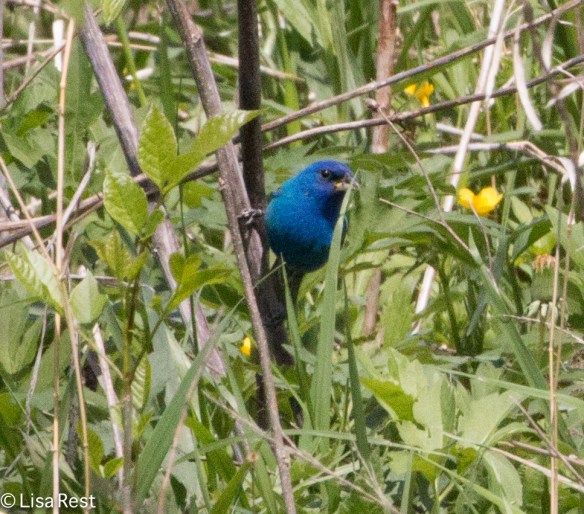
I was almost at the parking lot when I heard, and then saw, three Indigo Buntings – on the paved trail. They must have just arrived – getting their bearings, so to speak, because I have never seen them so tame. I’m sure I’ll be struggling to get any pictures of them the rest of the breeding season.

Here’s another Indigo Bunting I saw a bit earlier.

One of many singing male American Goldfinches

Ruby-Crowned Kinglets are still around, although I think these must be the females as I haven’t seen a red crown patch on any individuals for a week or more. But this one sure is a cutie.

A few views of the landscape.

Turtles basking in the sun.

The Portage is starting to green up. Pretty soon the water will be entirely green with duck weed.

This has to be my favorite photograph – the Blue-Winged showing off his worm.

Maybe you can tell I’ve been writing this post in fits and starts. It’s a bit disorganized because I inadvertently clicked on the “group” feature which seems to have cemented some unintended parts together, but I’m too lazy to start over again.

We have dropped thirty degrees back into cooler temperatures, and I guess that’s okay for Monday, but I want to hold onto the beauty of this past weekend as long as possible. I am thankful for spring migration and for my indoor birds, making it easier to get out of bed in the morning – albeit earlier and earlier as the days get longer!

Afternoon on the Rio San Cristobal

Here’s the rest of the pictures from the day in my previous post. This was our first of two trips in a panga boat down the Rio San Cristobal near San Blas, Mexico. I was more often than not on the wrong side of the boat this time, but as we were slowly and quietly passed through the water, I managed to get some photos.

Though we saw mostly herons of one sort or another, the likely river raptor is the Snail Kite. This one I caught in flight. Yes, they eat snails.

We saw lots of White Ibis nearly every day, but for the most part they weren’t very easy to capture. This one stood out against the dark background from a distance.

White Ibis

It was still possible to see some of the usual passerines. Not so usual were the Red-Billed Pigeons. I wish I’d gotten a closer look at them.

Western Flycatcher
Red-Billed Pigeons

Green Herons are some of the most cooperative subjects. I suspect they are really focused on their quest for food, to not mind me clicking away.

For good measure, more birds I will likely see this spring and summer: Great Egret, Black-Crowned Night-Heron and Great Blue Heron.

Great Blue Heron

It was a real treat to see this Bare-Throated Tiger Heron out in the open.

Little Blue Herons aren’t so blue until they are adults, like the one below.

Little Blue Heron

As dusk curtailed our excursion, we managed to capture good looks at a nocturnal species, the Northern Potoo.

Northern Potoo

A couple more of two foraging herons…

It’s especially nice to look at these photographs today, as a distraction from the accumulating snow that continues into the afternoon, to be followed by drastically dropping temperatures on my way home from work. It’s supposed to be somewhere between 1-2 degrees Fahrenheit tomorrow morning, not counting the windchill, when I walk to the train. But all is not lost. We warm up on Saturday so it can start snowing again. Maybe I can catch a few photographs of the hearty goldfinches at my feeders. The snow was beautiful this morning but it was too early for decent light.

I wish you safety and warmth wherever you are.

Ah, the Sewage Ponds

It may sound awful, but sewage ponds are a good place to look for birds. And that is exactly where we went on our first morning outing in San Blas.

If I can trust my camera roll, the first birds we saw were an assortment of seedeaters and kingbirds, but I have given first position to this very attractive Groove-Billed Ani, because I never noticed the unique woven-looking pattern of the nape feathers before.

And now, the Seedeaters…

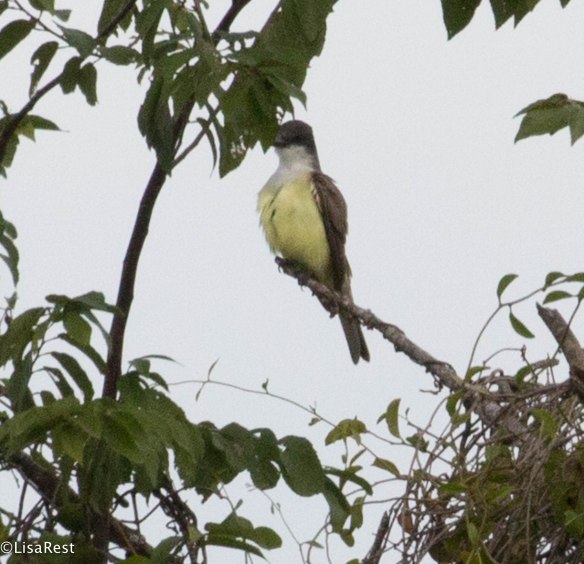
Tropical Kingbirds can be good subjects. Below this one is a Thick-billed Kingbird for comparison, but the name doesn’t seem all that descriptive to me.

Tropical Kingbird
Thick-billed Kingbird

Those of you who know me know I adore Crows, so I was thrilled to observe a new species doing Crow Stuff.

I don’t think a day went by without a Zone-tailed Hawk, either…

I was impressed with the graceful flight of a Wood Stork.

This falcon could have been laughing at me for as long as I waited for him to turn his head for a profile shot.

Laughing Falcon

Unlike my last Texas trip, I don’t recall hearing the incessant chatter of a Bell’s Vireo, but at least we saw this one.

Bell’s Vireo

Great Kiskadees were ever-present but nearly impossible to photograph. I wonder why I bothered with this one.

Great Kiskadee
Inca Doves
Great-tailed Grackle

Not sure I have any better images coming of Roseate Spoonbills, but here’s one flying.

All these species would have been way too many for me to get my head around without taking pictures. A new woodpecker!

Below, what an endearing little flycatcher for such a long name. I confess I don’t know what makes it “beardless.”

Not a day went by without a Blue-gray Gnatcatcher distraction. Some days were Blue-grey though.

Blue-gray Gnatcatcher

I think we had a record number of pygmy owls on this trip.

Ferruginous Pygmy-Owl

The remaining images are…more birds seen.

Black-chinned Hummingbird (female)
White-faced Ibis (immature)
Willet

This Yellow-Winged Cacique was having a bad hair day. Lovely flower though.

I didn’t manage to photograph many butterflies with a 100-400mm lens, but these are a few that we saw. I’ve put the Vermilion Flycatcher with them because unlike previous trips, I never got close enough to one to do it justice. I will try to identify the rest of the butterflies when my new butterfly book arrives…

Raptors aplenty – Short-Tailed Hawk is new for me.

Crested Caracara

I was going to include the afternoon river excursion photos, but I think they deserve their own space. So my chronicle of this day in San Blas will continue soon.

San Blas Bookends

It’s been a longer haul than usual, and I apologize, but I find myself finally ready to start writing some posts from my trip to San Blas, Mexico, which occurred officially between January 6 and 14, 2020. I arrived a day early to take advantage of the weekend, since the tour didn’t begin until Monday. The myriad images in this first post are actually from the very first and last days of the tour. That leaves several days in between with more photographs to sort through.

The trip started in Puerto Vallarta. I went for a walk the morning of the 6th and came back for lunch to sit around the pool area which had its own visiting Green Iguana. Click on the images if you want to see any of them more clearly.

The birds in the immediate hotel vicinity were… a Eurasian Collared Dove, later in the afternoon, an Inca Dove, Great-Tailed Grackles. Then there was a nice Black-Chinned Hummingbird feeding on the red flowers.

Eurasian Collared Dove
Inca Dove

On my way to the beach in the morning, I encountered a tree full of Orchard Orioles, Streak-Backed Orioles and Yellow-Winged Caciques, the latter two species, for all practical purposes, endemic to the region. There were also Blue-Gray Gnatcatchers everywhere. And of course, Yellow Warblers. Now you know where they go for the winter. In any event it was a good start for birds seen practically every day.

At the beach, there were some people things going on…

And the reminder of countless daily Magnificent Frigatebirds…

In the afternoon of Monday the 6th, the group met up to go on a short walk with our guide, none other than the incomparable Steve Howell, who is also the author of the impressive field guide, A Guide to the Birds of Mexico and Northern Central America. We were fortunate to see our first Ferruginous Pygmy Owl, below. The Western Flycatcher, Grayish Saltator and Rufous-Backed Thrush were introductory birds we would see often throughout the tour.

Ferruginous Pygmy Owl
Western Flycatcher (a/k/a Pacific Slope Flycatcher)
Grayish Saltator
Rufous-backed Thrush (an endemic)

Now to the images from our last morning of birding. I am starting off with sketchy-but-the-best-I-could-do-at-quite-a-distance images of the bird that inspired my decision to go on this trip altogether. The Black-Capped Vireo, below, is a beautiful little vireo I missed on the trip to Southwest Texas last spring. I decided to see if I might be able to meet it on its wintering grounds, and this trip to San Blas seemed to be the best opportunity.

I did get a much better first look at the vireo on the Friday of our trip, thanks to Steve who knew I really wanted to see it. I was sick after breakfast the day before so I missed an entire day of the trip, but this made up for it. In any event, I decided not to try taking a picture of it the first time in case I might send it flying a lot sooner than the wonderful view I had.

Other vireos from that last morning I will likely never see again are below, the Plumbeous Vireo, and the Golden Vireo, which is an endemic to Mexico.

Steve found us another pygmy owl, this one, the Colima, also an endemic species.

Colima Pygmy Owl

These are not in any kind of order… we spent some time at the beach that last day.

Royal Tern and (mostly) Heermann’s Gulls

We had seen Magpie Jays off and on flying about but on the last day, this was a rare treat to be able to actually capture one doing its thing. The last Magpie Jays I saw were much closer, hanging out at the breakfast table at the hotel in Nicaragua, which is also very much what jays do, I suppose, depending on their habitat.

We had several Grey Hawks on the trip, but this might have been the only juvenile.

Juvenile Grey Hawk

I still have to tally up all the new species I added to my “life list” but I’m pretty sure this was the first time I have seen a Western Tanager. This one appears to be a young male bird.

One more endemic – the Rusty-Crowned Ground Sparrow. Such a long name! It’s quite flashy-looking for a sparrow, though.

We were taunted by Orange-Fronted Parakeets and other psittacidae throughout the trip, but it was extra special to see these two perched and looking at us.

Orange-fronted Parakeets

I haven’t seen a Masked Tityra in a while. Nice to get a good look at this one.

Masked Tityra
Social Flycatcher
We saw plenty of its cousins, the Great Kiskadees, but Socials are special to me, in particular because now I will always remember their song as “tortilla, tortilla, tortilla” – thanks to Steve.
One more from the Orange-Fronted Parakeets

So I hope to be back with more to report a little sooner. My travel laptop seems to be cooperating, and it probably likes the attention it doesn’t get the rest of the year. I’ve gotten over whatever it was that attacked me, although I think it took maybe a full two weeks to feel totally sound. Work, choir, the birds at home, everything is back in full swing. Thanks for stopping by!

Portage Promise

Never knowing what to expect but full of expectation is how I approach the Portage on a regular basis. So arriving late last Saturday morning was bound to be a mixed bag. I stopped on the bridge to talk with another birder I’ve run into lately there, and snapped the photograph of the female Baltimore Oriole below. And then as I started to walk, an adult Bald Eagle flew over. I didn’t have time to capture it the first time but it came back and so the image above.

Baltimore Oriole (female)

As usual there were more birds heard than seen at this hour but I was content to see what I did. Indigo Buntings are still evading the lens, but I will have many more opportunities to endure their frustrating behavior.

Blue-Gray Gnatcatchers are abundant and usually hard to spot, but I found this busy nesting pair.

Tree Swallows used to nest here…this one looks like he’s thinking about it.

Tree Swallow

Warbling Vireos…I always hear several of them, but they are normally very hard to see. However this one was singing and perched at a comfortable height for me to capture him.

This is the time of year when dandelions get a bad rap, but I found it interesting to see a Song Sparrow eating the seeds before they had a chance to disburse. So there, I have proof that dandelions aren’t just attractive to pollinators but they are also a source of food for birds, and of course humans. We may need them some day!

One of the two Green Herons was hunting. At one point it took off across the water and caused a sunning turtle to slide off its stump. There were a lot of turtles out. Click on the images below and you can see what I mean.

A few more pictures of Portage breeders… I’m leading one more walk tomorrow morning as an auction donation to Unity Temple and the forecast is for thunderstorms. But the weather changes every few minutes. We had the same forecast for this morning and except for a few thunderclaps around 6:15 a.m. and a little rain, now it is cloudy but clear. I am hoping for the same sort of cooperation tomorrow, it will make dealing with the muddy spots a lot easier.

Red-winged Blackbird (female)
American Goldfinch (female)

It’s been a great year so far for robins taking advantage of all the earthworms the rain has stirred up.

Even with all the rain it’s still better to be outside!

In the Vicinity

BGGN 5-19-18-4246

Blue-Gray Gnatcatcher

The weather has turned suddenly hot and it’s hard not to wonder what effect that’s having on spring migration. I sense that to a large degree, no? pun intended, the heat wave has sent those who move farther north packing. I had hoped we would still see a few warblers yesterday on my second time leading a walk at the Portage, but we only heard a couple Yellow Warblers and never saw them. I’ll be back later with a few pictures from yesterday. But this is a more historical post, with a few pictures from the trip two weeks ago to the Portage, and a few more from a walk I took at Ottawa Trail just to see what was going on closer to the Des Plaines River.

Magnolia Warblers move predictably enough to photograph. This time the easiest bird to capture was a female; I caught only glimpses of a male.


One bird that I haven’t seen in quite a while appeared toward the end of our walk two weeks ago. It’s a Yellow-Throated Vireo.


It’s gotten so hot in the last few days it’s hard to believe that last weekend it was still cool enough to warrant layered clothing in the morning.

The Green Herons were both on site two weeks ago, and the turtles were starting to emerge to soak up what little sunlight was occasionally available.


I think this was my last Hermit Thrush of the season.

HETH 5-12-18-3785

Hermit Thrush

I likely won’t see another Lincoln’s Sparrow until fall either.

LISP 5-12-18-3749

Lincoln’s Sparrow

But it looks like I might be seeing a Great Egret from time to time at the Portage this year. We saw it a couple times yesterday.


The pictures below are hardly worth sharing, but this is my last Ruby-Crowned Kinglet.


I used to see shorebirds more frequently but in the last couple years they have been few and far between, so I was happy we had a Spotted Sandpiper on the left, and the Killdeer on the right. I usually hear or see Killdeer flying, but sandpipers have been generally absent.


House Wrens are here to stay for the summer.

HOWR 5-19-18-4292A female American Redstart below.


And more shots of a Blue-Gray Gnatcatcher. Yesterday we heard them constantly but didn’t see one.


Deer 5-19-18-4267

White-Tailed Deer at Ottawa Trail

It’s rare to see a Chipmunk sitting still but this one wasn’t self-conscious at all.

Chipmunk 5-19-18-4137Indigo Buntings, male and female.


And the surprise two weeks ago was an Orchard Oriole.


Often more heard than seen, the Northern Cardinal below, an Eastern Wood-Pewee, and a Song Sparrow, all at Ottawa Trail.


The heat may keep me indoors more than I’d like. That could mean more blog posts, however. For the moment it’s time to get out in the yard before the heat of the day takes over. Lots of work to do there. Happy Summer to All…

AMRO 5-19-18-4394

Slow Walks through the Portage

BAOR 5-6-18-3219

Baltimore Oriole

I have never been a hurry-up-let’s-get-this-over-with birder, but I am certainly moving more slowly these days because of my knee. But life in the slow lane has its advantages and the reduced speed has paid off. Two weeks ago I managed to count 55 species when I visited the Portage for four hours instead of the usual two, and last week with my first group we had 51 species in nearly about the same amount of time due in part to the fact that we got off to a late start because of the weather. Between the two lists I had 73 different species total. Of course it is spring migration, and it is not hard to spend a lot of time when you keep seeing more birds. Needless to say I did not get pictures of them all, or some pictures were useful later only for the purpose of identification. But in spite of having hardly any time or place to bird during the week, I feel as if I have seen some nice migrants in spite of my physical limitations. I took these pictures two weeks ago. I felt bad about not being able to do the Spring Bird Count, but I’m glad I managed to get out.

Breeding birds are back, and the most numerous after the Robins, Red-Winged Blackbirds and Goldfinches are probably Blue-Gray Gnatcatchers.

Lots of Indigo Buntings are on site too. Many of them are first-year males like the ones below.

There are also several Warbling Vireos that have set up territories. I usually hear them more than I see them, but I got good views of this individual.

Some Yellow Warblers will likely breed here too.

I don’t think the Portage has breeding Ovenbirds but it was nice to see this one out in the open.

Two more warblers I was able to photograph…but they won’t be staying.

NOPA 5-6-18-2875

Northern Parula

AMRE 5-6-18-2837

Male American Redstart

My best surprise was to briefly see a Hooded Warbler and manage to get a picture of him. These are far less common. I used to see them on the lakefront occasionally. This was a real treat.

HOWA 5-6-18-2754

Hooded Warbler

The Great-Horned Owls appear to have just one owlet but it’s gotten pretty big and last week we saw all three of them all take off from their tree. I took these pictures of junior and mom two weeks ago.

The Downy Woodpeckers are busy.

Migrant thrushes, like the Gray-Cheeked on the left and the Swainson’s on the right, below, are passing through.

I don’t think there are enough places left at the Portage for Tree Swallows to nest.

Goldfinches are in full breeding plumage now.

AMGO 5-6-18-2820

On the sparrow front, I found a Chipping Sparrow, a few White-Crowned Sparrows who have all flown north by now, and one hard-to-see Song Sparrow. The Portage is home to breeding Song Sparrows, but I’m not sure about Chipping Sparrows.

SOSP 5-6-18-3128

Song Sparrow

As ubiquitous as Red-Winged Blackbirds are, they can still be beautiful.

House Wrens breed at the Portage. They’re always singing a lot, and every once in a while I might even see one… But it always takes me a few repeats to remember their song.

I have one more walk to lead at the Portage this coming Saturday. The last time I checked the weather the prediction was for thunderstorms, but that was the forecast last Saturday and we still managed to dodge the rain and see a lot of birds, so I am hopeful. It should be warmer too, which will add a whole new dimension – mosquitoes – after all the rain. As much as I find mosquitoes a nuisance, I also realize they’re food for a lot of birds.

INBU 5-6-18-3185

Suddenly Spring

NOWA 5-1-18-1834

Northern Waterthrush

I almost could have called it “Suddenly This Summer” because on May 1 we skipped spring and went straight into summer temperatures by noon. But along with the sudden push of warm air from the south came a lot of migrating birds, and after all, it was finally the real start to Spring Migration.

As luck would have it I was near the lakefront for the last part of the stem cell procedure on my right knee, which consisted of a blood draw early in the morning and then having a few hours before a return to the doctor’s office for the final injection. I realized the location’s potential the week before when I had the major procedure done. The medical building is virtually right across the street from North Pond, which is a favorite hot spot with lakefront birders. The week before it was blustery and cold with only a few of the hardiest migrants. But now I had a birder in my friend Lesa to whom I am grateful for being my chauffeur for the day. I was walking without crutches if moving slowly, but I was walking, and slow is generally good for birding. The slower you move, the more birds you eventually will see. And seeing birds was a great distraction from whatever pain I was feeling.

Perhaps the first warblers to greet us were four or five Ovenbirds poking about in the grass. Even though the weather was warmer, the trees and accompanying insects had not caught up with it yet and so a lot of birds were foraging on the ground for something to eat. The ground is an Ovenbird’s preferred foraging spot anyway. Ovenbirds can be nearly impossible to see on their breeding grounds, but in migration on the lakefront they are all over the place this year. I have seen them since everywhere I go for midday walks near my workplace.

Then it seemed there were Black-Throated Green Warblers everywhere.

Predictably, especially in the grass, were Palm Warblers. A note about these pictures, being my first warbler photographs of the season. The morning started off a bit overcast, and then I had only my 75-300mm lens as it seemed ridiculous to be carrying around anything larger in my compromised condition, so I didn’t get quite the clarity I wanted for many of these birds. But it was just such a joyous way to spend a medical day and provided an extra therapeutic perk altogether.

I am always so happy to see a Lincoln’s Sparrow. It’s not quite rare, but you never see more than one of them at a time, and they’re such delicate-looking little birds.

Yellow-Rumped Warblers were predictable, but not easy to capture as they frantically searched for food.

Our look at the Pine Warbler below was brief, but this is a more unusual species in migration so I am glad I got this shot.

PIWA 5-1-18-1893The three species below are Yellow, Black-and-White, and Nashville Warblers.

Another spring migrant that seems to be showing up in force is the Blue-Gray Gnatcatcher.

Meanwhile, on their way out were Golden-Crowned Kinglet on the left and Ruby-Crowned Kinglet on the right, below.

Then there are the migrating Thrushes. Two below are a Swainson’s Thrush on the left and a Gray-Cheeked Thrush on the right.

I have been out since last Tuesday and have a lot more pictures to process and share with you, but it’s been really difficult to get caught up. All I can say is every day I’m a little bit better and there have even been a few moments when I’ve forgotten about my knee altogether!

WCSP 5-1-18-1792

White-Crowned Sparrow

Below, two glimpses of a female Eastern Towhee…

I will be back soon with more from Instant Spring Migration. Until then, spring on!

TEWA 5-1-18-1675

Tennessee Warbler


Wish Fulfillment

RTHU 08-19-17-2963I’ve had hummingbird feeders up since May. Three feeders in the backyard, and a couple weeks ago after a hummingbird hovered in my front yard, I added another feeder for the front porch. The best feeder for me is the one I can see while I’m standing at the kitchen sink looking out the window to the branch of the sumac tree it’s hanging from. And Saturday early evening my eye immediately followed that quick, darting flight of a hummingbird to that exact feeder. I grabbed the camera, went out the back door and waited. The hummingbird, a female Ruby-Throated Hummingbird, to be exact, decided she’d rather be at another feeder that hangs from the redbud tree, so that’s where I got these few pictures. But at last my wish was granted and hanging the feeders was no longer in vain.

I didn’t see a hummer on Sunday, but last night after work I did see a hummer come to the farthest feeder hanging from the crabapple tree.

Also in the yard late Saturday was a female Downy Woodpecker and a female cat that I often catch lounging on my back cement slab where once a tiny garage stood, but it seems she now has a new observation deck across the fence by the neighbor’s garage. She closed her eyes for the camera.

After all this excitement I figured my chances might be good for finding a hummingbird at the Portage Sunday morning. so I got there a little earlier than I have been (when I pulled in, there were no cars in the parking lot) and sure enough, right around the first bridge over the duckweed, I found this lovely individual.

RTHU 08-20-17-3018

Female Ruby-Throated Hummingbird

I should mention that I mustered up the courage to take the Tamron 100-600mm lens now that I’ve enabled the back button focus feature, so I was able to get more pictures from farther away after being frustrated by the distances last week. Below, a couple Indigo Buntings.

And juvenile American Robins in their ever-changing plumage are always interesting to see.

There seemed to be a lot of juvenile Blue-Gray Gnatcatchers too. I think I caught this one after a bath.

It wasn’t too difficult to find an obliging Cedar Waxwing. This one is enjoying Pokeweed berries and a staring match with the camera lens.

CEWA 08-20-17-3189I didn’t get great pictures of any individual American Goldfinches but they stand out against the duckweed palette below.

AMGO 08-20-17-3044Below, one very distant Tiger Swallowtail butterfly and another Indigo Bunting.

When I stopped by the second bridge, I heard a White-Breasted Nuthatch but saw this Black-and-White Warbler foraging like a nuthatch on a tree.

BWWA 08-20-17-3264I lost track of the warbler but then found the nuthatch, below.

I still had a little time so I decided to see if anything was up at McGinnis Slough.

McGinnis 08-20-17-3357There was not a lot of activity. The large numbers of swallows and swifts were gone and nothing else had noticeably replaced their activity. But I did get a couple interesting photographs of three of the same species I had at the Portage.

INBU 08-20-17-3314

Indigo Bunting

BGGN 08-20-17-3347

Blue-Gray Gnatcatcher

CEWA 08-20-17-3253

Cedar Waxwing

One more bird from the Portage…

SOSP 08-20-17-3111

Juvenile Song Sparrow

I have decided seeing hummingbirds at my feeders is appropriate consolation for not being able to view the partial solar eclipse yesterday. The safety glasses I ordered over a week ago never arrived, and I never received a reply to any of my email inquiries, so now I am digging in for a refund. Even if the glasses do finally arrive, I can’t plan to be around for the next eclipse, which is in 2024 and I’d have to travel to see it, let alone find the glasses 7 years from now. I did receive a camera filter in time for yesterday, maybe I can find another reason to play with it.