
Sora behind duckweed-covered Mallards
Last Sunday I got up early enough to pick up Susan at 7:15 and get to the Chicago Portage, only to find the cable barring entry to the parking lot was still strewn across the entrance. I locked the car and we walked around the parking lot area for about 10 minutes before the designated person showed up. It was well past sunrise, which is when the preserves are supposed to be open… But it was still early enough to see a Sora Rail across the duckweed not long after we started down the trail.
I have never seen a Sora at the Portage. Rails are hard enough to see just about anywhere. The usual scenario is that I might hear their beautiful song and take for granted I will never find them. This one was silent, but virtually out in the open. Susan looked across the water with her binoculars and said, “Is that a Sora?” and then I spent the next several minutes trying to get a decent picture of it.
The other surprise Sunday was a Marsh Wren, also a first for me, for the Portage. But though we saw it well for a half second, it was not interested in seeing us again so I got no photographs.
I do have one more surprise, though, from the previous weekend. I saw a juvenile Red-Headed Woodpecker, another species I have never seen at the Portage and only infrequently anywhere, and I managed to get the pictures below. I can’t help but wonder if the change in habitat, the opening up, so to speak, of more marshy areas, will attract this species more often.

Juvenile Red-Headed Woodpecker 9-30-17
Birds became visible from their foraging behavior. The tiny Golden-Crowned Kinglet below was interested in something contained in the bark of a tree down the trail from us.
I caught the Ruby-Crowned Kinglet below in a more contemplative phase.
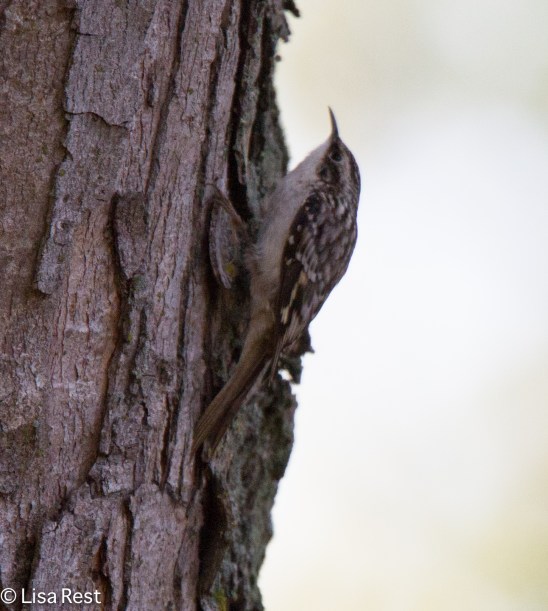
Not to be outdone by other species adopting its favorite foraging spots, here is one of two Brown Creepers we saw.
 Closer to the end of our walk the intense sunlight started playing tricks with color and it wasn’t until I got home and processed the next few photos that I realized what we had.

White-Throated Sparrow
The Yellow-Rumped Warbler below looked so blue in the light, I didn’t recognize it while taking the pictures.
The Black-Capped Chickadee below would not show its face but I was intrigued by its foraging calisthenics anyway.
And we managed to find one more Magnolia Warbler to add to the list.
Downy Woodpeckers are common all year round at the Portage but not always available for picture-taking. But this one was so busy with whatever it was working on, she put on a little show.
When we checked the Des Plaines River, the Belted Kingfisher was still hanging out.
Yellow-Rumped Warblers were the most numerous species on our visit, but it was still tempting to take the pictures below. At least you can see the yellow rump…
Shadowy images of a White-Breasted Nuthatch on the left and a Cedar Waxwing on the right. We didn’t have a huge flock of waxwings but there will still a dozen or so.
We saw some other thrushes but this was the only one I managed to capture. I have never seen more than one Gray-Cheeked Thrush at a time which makes me think maybe they tend to be solitary.

Gray-Cheeked Thrush
Others have been to the Portage since our visit and a couple rarities, at least for the time of year, have been reported. I want to go back soon but this weekend is already booked with people activities, unless the forecast for rain and thunderstorms changes Saturday morning.





 On the radio this morning I heard that this date last year, we were in the 80’s. Likely I was complaining about that. Oh well. We won’t be getting anywhere near that for a while, I suspect, but with any luck we are done with snow until – dare I say it – November.


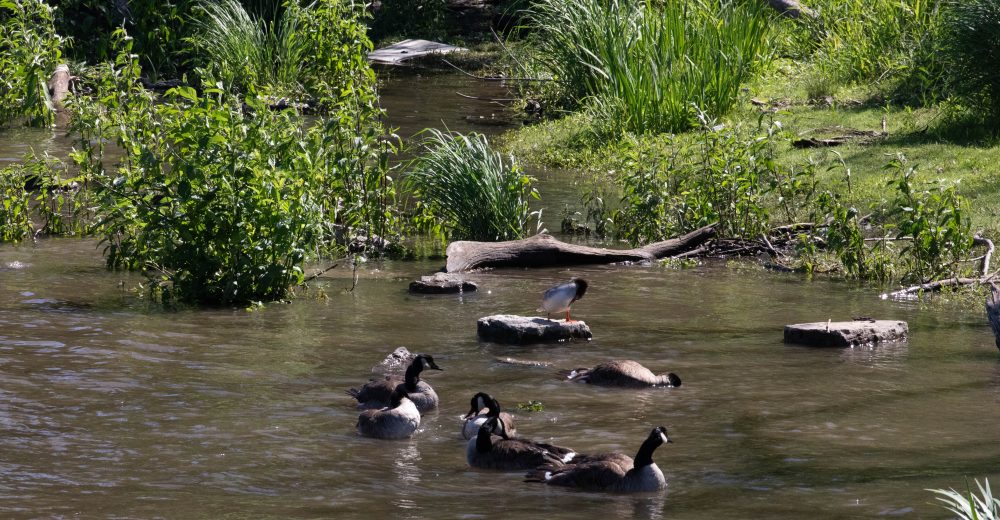
 Continuing with last month’s visits to nearby Cook County Forest Preserves, young birds like the Cedar Waxwing and Red-Winged Blackbird above were getting ready to leave. It’s become evident to me over the past few years that European Starlings like the one below are not necessarily winter residents either. But the young Mourning Dove blending in with the dead stump below the it will likely stay.
 Hidden in the leaves about waist-length from the ground at Ottawa Trail was the Ovenbird below.
 And there just seemed to be too many ways to capture Northern Flickers. They have likely pretty much disappeared by now too. For a last look you can click on the pictures below for larger images.


 A few more Red-Winged Blackbirds.

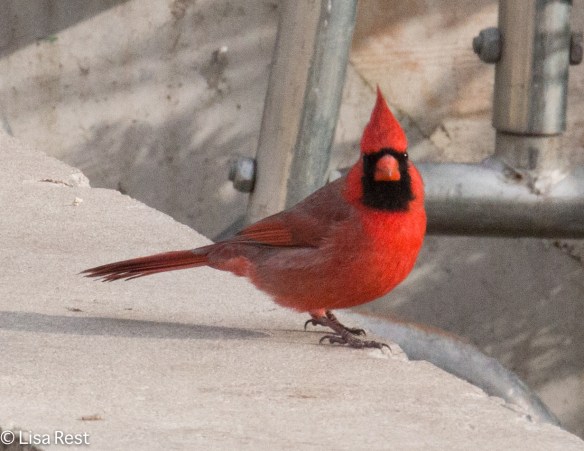
 I am grateful for Northern Cardinals. They will be here all winter to brighten up the landscape.


 At least one Black-Capped Chickadee is on hand to remind me to keep the sunflower seed feeder full.
 The Northern Cardinals are in various stages of molt.


 Have I ever said I adore bumblebees? If not, now I am proclaiming it, and they are some of the friendliest creatures in my yard. Last weekend the one in these pictures was definitely enjoying the Wild Senna, making me take extra notice of the brown spots on the blooms which make the flowers almost look like bees themselves.


 And just as I had had enough and was about to go inside, this lovely Black Swallowtail showed up. I had seen one in the yard before but leaving, not hanging around.
 I had a staring match with the Fox Squirrel. The sunflowers growing from spilled seed are too numerous to photograph, so here’s a close-up of one.


 I’ve discovered one or two Snow on the Mountain flowers in the yard, not where it was coming up for years, but now scattered, after it disappeared entirely. Glad to have it back.
 And if you made it this far you might recognize the flower below as the invasive monster I was trying to eradicate earlier. I discovered the name of this nefarious plant yesterday while scrolling through the Audubon Wildflower App on my cell phone. The app isn’t new, but my use of it now is a new diversion. I’ve decided to scroll all the way through everything from A to Z to find things that I can’t remember, can’t identify otherwise, or discover new. So far, this was a fortuitous decision because I was close to the beginning of the alphabet with this one. And it is every bit as terrible as I suspected. Well, maybe not where it belongs, but it’s from Europe, and here’s part of the description from the app: “spreads by underground stems and forms sizable colonies. The plant contains poisonous sapnonins (soap-like substances) that inspired the genus name (from the Latin sapo, meaning ‘soap’) and the alternate common name Soapwort. Lather can be made from its crushed foliage. The common name Bouncing Bet is an old fashioned nickname for a washerwoman.”
 Still wishing for a Monarch Butterfly and/or a Ruby-Throated Hummingbird or Sphinx Moth to show up on a weekend when I’m in the yard…with the camera. 🙂
 Today may be Monday, but it was also a beautiful day, with ample sunshine at least in the morning and early afternoon hours, and we warmed up to 54 degrees, which is downright balmy. So I went for a walk this afternoon in search of…birds.
 Yes, they were Crows. And there they sat, silent and still. I wondered if maybe one of them was the individual that had flown by on Thursday and since today was such a nice day, it gathered friends to hang out with to see if I was for real.


 This really has nothing to do with Groundhog Day except that, according to the official Groundhog, we are in for 6 more weeks of winter. I can tell you that as annoying as that prospect might be, it’s nothing compared to dreading the “what next?” incredulity of news coming from the nation’s capitol.


 I put a new feeder up this week, and it’s apparent I didn’t assemble it too tightly so I’ll have to take it down one of these nights and see if I can make it more secure, but the House Finches seem to be enjoying it.

 In the mad rush to the end of the year there hasn’t been much time for birding or posting but I am here to wish you all happy, good-cheer holidays, whatever you are celebrating. Last night I sang with the Unity Temple Choir for their Christmas Eve service and today I am catching up on bread gifts to distribute around the neighborhood. So while the house smells of cinnamon and yeast, Handel’s Messiah playing on the radio, and snow still on the ground even though we’ve warmed up quite a bit, I will try to compile a brief photographic history of the last few weeks.


 I have seen birds in the yard today now that I’m home, and I’m starting to think that a good deal of the absences probably have to do with the local raptors’ hunger more than the weather. We shall see. The birds come, but they don’t stay long. I’ll try to do a census tomorrow in the yard since I would like to see my favorites beyond the inevitable House Sparrows. I may even go out to the Portage for a walk-around early in the morning. We’re supposed to have relatively balmy temperatures tomorrow morning before we go back to normal. A seesaw December. And only one week left of it.