City Visitors, or Where the Birds Are

Black-and-White Warbler, Lake Shore East Park

Black-and-White Warbler, Lake Shore East Park

Apologies to all my followers for not posting sooner (and all those I follow for not showing up), but I have been busy with work and trying to spend every free moment paying attention to birds indoors and out, so by the time I get around to reviewing photos I fall asleep. So there have been about 10 potential blog posts running out of my head over the last two weeks before I could hang onto them.

American Redstart, 155 N. Wacker Drive

American Redstart, 155 N. Wacker Drive

So before I fell asleep again last night as it was past my bed time, I decided to simply share with you some of my favorite subjects over the past week from a couple city parks and green spaces. Except for the Least Flycatcher, I have limited this post to warbler species.

Black-Throated Green Warbler, Union Station

Black-Throated Green Warbler, Union Station

Black-Throated Green Warbler, Union Station

Black-Throated Green Warbler, Union Station

The first day I found the Black-Throated Green Warbler at Union Station, there was also a Black-Throated Blue Warbler singing and a Baltimore Oriole singing as well. Actually it was the Baltimore Oriole’s song that drew my attention to the now-fenced-in-for-no-obvious-reason garden area. The fact that the garden area was inaccessible to me and the smokers who like to sit on the benches probably made it more attractive to the bugs and the birds who were eating them. I did not get a great picture of the Black-Throated Blue, but was glad to see him. The Oriole was coy but uncooperative.

Common Yellowthroat, Lake Shore East Park

Male Common Yellowthroat, Lake Shore East Park

Lake Shore East Park has been my most constant afternoon destination, and there were a couple good days, but it doesn’t seem as birdy as last year or the year before. The weather has been a factor all spring too, with alternating warm fronts and cold fronts confusing everything. We are presently about thirty degrees cooler than we were on Monday. Monday was hot.

Least Flycatcher, Lake Shore East Park

Least Flycatcher, Lake Shore East Park

Least Flycatchers were fairly common for a couple days. Catbirds have been regular sightings in every nook and cranny.

Gray Catbird, Lake Shore East Park

Gray Catbird, Lake Shore East Park

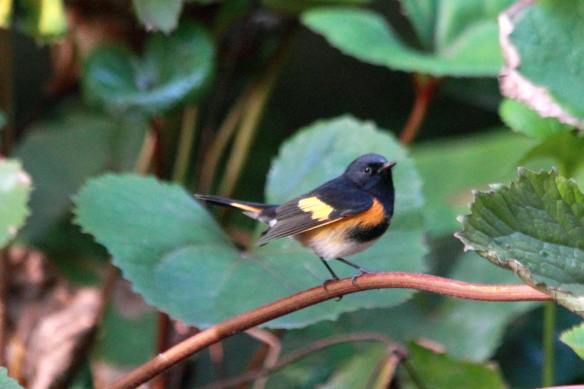
Male American Redstarts come in two plumages. The first-year males still look a bit like the females, only orangey instead of a paler yellow. The after-first-year males are black and orange-red.

American Redstart

American Redstart

American Redstart, first-year male

American Redstart, first-year male

Hardly a day has gone by that I have not seen or heard a Northern Waterthrush. I usually see them on the lawn, so it was nice to catch one resting on a branch.

Northern Waterthrush, Lake Shore East Park

Northern Waterthrush, Lake Shore East Park

Ovenbirds are still around, too.

Ovenbird, Lake Shore East Park

Ovenbird, Millennium Park

Spring would not be spring without male Magnolia Warblers.

Magnolia Warbler, Millennium Park

Magnolia Warbler, Millennium Park

Magnolia Warbler, Millennium Park

Magnolia Warbler, Millennium Park

Redstarts are everywhere now. The adult males seem to like to show off.

AMRE 5-13-15-1671

Below is a first-year male, looking eager to start his first breeding season.

AMRE LSE Park 05-13-15-1512

I hope to get another post or two in order over the Memorial Day weekend (thunderstorms are predicted for Memorial Day). As always I think I will be able to conquer my entire to-do list because I have an extra day. So far Saturday’s weather looks best, so that will be a birding day. Passerine migration is nearly over, but I need proof.

Autumn Leaves at Douglas Park

PHVI Douglas 9-28-14-7071

Philadelphia Vireo, Douglas Park, 9-28-14

Last Sunday’s Chicago Ornithological Society/Illinois Young Birders Field Trip to Douglas Park in Chicago was well-attended. Fall colors had just begun, enhancing the park’s landscaping. Upon reviewing the warbler photographs, it’s interesting to see how the subtleties of the birds’ fall colors blend so well with the trees. For the most part the birds were too far away to get good photos but I’m including a few blenders-in anyway.

Douglas Park 9-28-14-6941

MAWA Douglas 9-28-14-6993

Magnolia Warbler

American Redstart

American Redstart

Bay-Breasted Warbler

Bay-Breasted Warbler

BBWA Douglas Park 9-28-14-6901Warblers are always a challenge to photograph. As it turned out, the Bay-Breasted Warbler above was the only one that sat out long enough, and still I am not entirely sure it’s not a Blackpoll.

Birders Douglas 9-28-14-6942

I couldn’t help but photograph the back of this participant’s shirt.

BEKF Douglas Park 9-28-14-6958

Belted Kingfisher

BEKF Douglas Park 9-28-14-6961

Birds in flight were at least easier to find against the blue sky background. I don’t think I’ve ever seen that much white on a Cooper’s Hawk before, with this particular angle and the light.

Cooper's Hawk

Cooper’s Hawk

There were so many Chimney Swifts, all filling up to start that long flight back to Chile. It’s only because they were so numerous and at times flying low that I was able to manage a fairly clear shot.

Chimney Swift

Chimney Swift

Canada Geese flying might not be anything spectacular, but I like the way this flight pattern plays against the tree branches.

Canada Geese

Canada Geese

CAGE Douglas Park 9-28-14-7113

and later, three coming in for a landing…

I could not resist taking a picture of the back of this participant’s shirt.

Birders Douglas 9-28-14-6942Below, the last Eastern Phoebe I’m likely to see this year.

Eastern Phoebe

Eastern Phoebe

All in all, it was the trees’ fall colors reflecting on the water that stayed with me.

Douglas Park 9-28-14-6915

Douglas Park 9-28-14-6920I’m falling asleep sitting on the futon listening to the New York Philharmonic on the radio with intermittent thunderclap accompaniment going on outside. I’ll be back with more city visitors.

Fall Frustrations

NAWA Columbus Park 9-13-14-5655

Nashville Warbler, Columbus Park

The days are getting shorter, there are still fall migrants coming through, the weather has been beautiful the last day or two and I feel like I’m running around in circles just trying to get normal things accomplished, and then I’m out of time for everything. Everything being the moment to sit still, observe, reflect, be…

Magnolia Warbler, Columbus Park

Magnolia Warbler, Columbus Park

Palm Warbler

Palm Warbler

Northern Waterthrush

Northern Waterthrush

Black-and-White Warbler

Black-and-White Warbler

Tennessee Warbler

Tennessee Warbler

Truth be told I did not stay in last Sunday because the rain was threatening but not really materializing, so I managed to visit the Portage and almost envisioned doing a post about what surprises were there, but I keep succumbing to that temptation (“What’s your favorite photograph?” “The one I just took”) and then I never get back to documenting previous outings. So while I have been recalcitrant catching up with other bloggers I am going to try at least to catch up a bit with myself.

AMRE Columbus Park 9-13-14-5645

American Redstart

AMRE Columbus Park 9-13-14-5638AMRE Columbus Park 9-13-14-5640

Whatever my obsession to try to hold on to the last experience, these pictures are more from the 13th trip to Columbus Park, which is a park on the west side of Chicago, making it barely a stone’s throw away. There’s a nice water feature going on at the park, and perhaps the star was a juvenile Black Crowned Night Heron contemplating how to make a living.

Black-Crowned Night Heron

Black-Crowned Night Heron

Columbus Park

Columbus Park

Also present, a Pied-Billed Grebe and a Great Blue Heron. I don’t recall if I realized the Blue-Winged Teal was eating a crabapple when I took the picture but it seems a little odd.

Pied-Billed Grebe

Pied-Billed Grebe

Great Blue Heron

Great Blue Heron

Blue-Winged Teal eating crabapple

Blue-Winged Teal eating crabapple

There were two young Cooper’s Hawks present.

Cooper's Hawk

Cooper’s Hawk

COHA Columbus Park 9-13-14-5836

A fellow participant pointed out the caterpillar to me. I did not have my macro lens handy so it’s not a great picture, but I think it looks like a sphinx moth. I confess to being very lazy and I have not tried to look it up.

Caterpillar

Caterpillar

I must leave this page, it’s getting late and I have to get up and go to work. I hope to return in a better mood. Tomorrow night is the first rehearsal for the choir I have signed up for. I have received the first email from Bill Hilton about November’s Costa Rica trip. There’s room for more participants: he didn’t say how many we were but the optimum number is 12. Time for me to start thinking about this trip. I’m looking forward to contributing to Bill’s research for a week.

Juv BCNH Columbus Park 9-13-14-5547

Jewels Hidden in the Trees

Chestnut-Sided Warbler

Chestnut-Sided Warbler

I think I have finally been through all the pictures from the Memorial Day Kirtland’s Warbler weekend with the Chicago Ornithological Society. While I want to put a more representative selection up on my flickr page, for the moment I am sharing some warbler pictures here. Most of the birds were far enough away that I had to use manual focus to follow them around as they flitted through pine needles.

What bird, where?

What bird, where?

With some photographs it was like reliving getting on the bird in the first place – where is it?

Wilson's Warbler

Wilson’s Warbler

After our visit to the Kirtland’s Warbler on Saturday morning, we drove to Tawas Point State Park and spent the afternoon hours wandering the trails for migrants. These pictures are from that outing as well as other locations in Iosco County, Michigan, visited on the weekend. Some species were the first I saw this year. Indeed by Memorial Day it was almost “Now or Never.”

Black-Throated Blue Warbler

Black-Throated Blue Warbler

A Black-Throated Blue male was definitely on my list of must-sees and although he proved a bit difficult to photograph in the bright light against the sky, he stuck around for more photographs than I care to admit.

Cape May Warbler

Cape May Warbler

The female Cape May Warbler above caused a little confusion until we could be sure all her markings were in the right place. Here is a picture to prove it.

Yellow Warbler

Yellow Warbler

Yellow Warblers abounded, even windblown ones.

Golden-Winged Warbler

Golden-Winged Warbler

Golden-Winged Warbler

Golden-Winged Warbler

It seems increasingly difficult to find Golden-Winged Warblers, and the sunlight proved to be a challenge, but if you click on the second picture above you might be able to see the golden wing field mark a little better.

Magnolia Warbler

Magnolia Warbler

Magnolias and Redstarts are common enough but each individual has something different to offer. I like the way there is a hint of black coming in on the first-year American Redstart below. Next year he will be all black except for the orange on his breast, like the male below him.

American Redstart - First Year Male

American Redstart – First Year Male

American Redstart

American Redstart

I have never seen a Pine Warbler well enough before, which makes me think until this trip I never really saw one. Now I can add it to my list!

Pine Warbler

Pine Warbler

Black-Throated Green Warblers are always welcome.

Black-Throated Green Warbler

Black-Throated Green Warbler

As are Blackburnian Warblers.

Blackburnian Warbler

Blackburnian Warbler

And another species that had eluded me this spring finally came to light: the male Canada Warbler. I did not break into the “Oh, Canada” refrain from “A Case of You” by Joni Mitchell as is my wont whenever I see one of these birds, but he might have heard me anyway.

Canada Warbler

Canada Warbler


Last Looks in the (Chicago) Loop

Common Yellowthroat

Common Yellowthroat

While taking a break from getting organized and trying to locate the title to my old car… Every morning I look out the back window at the dead Ford sitting on the slab and vow to get rid of it. It’s only a matter of weeks before I will have to buy a new city sticker even though I’m not driving it. I’m sure the cat takes refuge underneath its rusting hulk when she isn’t hiding in the hostas. All reasons to motivate me to tear the house apart, calmly, until I find the misplaced title so I can donate the car to a good cause.

Lincoln's Sparrow

Lincoln’s Sparrow

Here are a few pictures taken the end of last week, which was the last time I saw migrants in the city. Some are from 155 N. Wacker on my way into the office. The others were taken in Lake Shore East Park.

Up until Friday there was at least one White-Throated Sparrow at 155 N. Wacker who would start singing whenever I showed up, but Friday I saw a Lincoln’s Sparrow, which is highly unusual this late in the year. I don’t think I’ve ever heard a Lincoln’s Sparrow vocalize, though.

Chestnut-Sided Warbler, 155 N. Wacker

There was a Chestnut-Sided Warbler at 155 N. Wacker as well, but the mainstay had been a male Common Yellowthroat who was on site for a couple weeks. As of Tuesday he was gone.

American Redstart, LSE Park

American Redstart, LSE Park

At Lake Shore East Park among the last migrants I saw last week were the female American Redstart, above, and a Least Flycatcher, below.

Least Flycatcher, LSE Park

Least Flycatcher, LSE Park

But now the newest arrivals are fledgling crows. I think there are two, although I saw only this one being weaned last week. Oddly enough, there was never any sound to go with that wide gaping mouth. Perhaps there is a different protocol at hand for Lake Shore East Park and this youngster was instructed not to draw attention to itself by making a racket.

Crow Fledgling, LSE Park

Crow Fledgling, LSE Park

That wide-eyed look of “now what?” is unmistakable.

AMCR-1170

A series of photographs as the parents’ body language tells the story: “We are not feeding you anymore.” I think I recognize the crow with the bouffant hairdo as a former fledgling from about 4 years ago. Notice how he tries to look profoundly disinterested in the interaction between the fledgling and its mother.

AMCR-0919AMCR-0913AMCR-0919AMCR-0936AMCR-0935AMCR-0937AMCR-0941

The ultimate insult, after waving the peanut around in front of the fledgling, she takes off with it!

On Tuesday I had some time to hang out with the crows. As far as I could tell, the youngster had not figured out how to do its own peanuts yet and was still falling into a bit of the gaping mouth routine.

By next year if it survives, this fledgling may turn into a peanut expert like the bird below.

AMCR-0956

AMCR-0887


Local Color

Scarlet Tanager, Chicago Portage

Scarlet Tanager, Chicago Portage

Here are just a few pictures taken over the last week or two in various places. I still need to get back to the Texas pictures, and the Belize pictures, and the East Africa pictures…but spring migration is happening here and now, and as luck would have it I am traveling yet again for more birds over the weekend.

American Redstart, Lake Shore East Park

American Redstart, Lake Shore East Park

Packing lists seem to be everywhere. I will be return to work on Tuesday and to this blog by Wednesday or Thursday…

American Redstart, Lake Shore East Park

American Redstart, Lake Shore East Park

The female Summer Tanager below was a surprise sighting at Lake Shore East Park on May 15. Otherwise I have seen many Scarlet Tanagers this year, perhaps even more than usual.

Summer Tanager, Lake Shore East Park

Summer Tanager, Lake Shore East Park

There have been many Palm Warblers over the last week or two as well, although yesterday I did not see even one (no pictures here from yesterday, they’re not even off the camera yet). Perhaps the Palms have finally moved on.

Palm Warbler, Lake Shore Easst Park

Palm Warbler, Lake Shore Easst Park

One last look from the Summer Tanager. She was there for only one day.

Summer Tanager

Summer Tanager

Best wishes to all in the U.S. for a wonderful Memorial Day Weekend, and to everyone everywhere else, may you continue to spring forth!


City Stopovers

Yellow-Bellied Flycatcher, Lake Shore East Park

Yellow-Bellied Flycatcher, Lake Shore East Park

Fall is suddenly upon us with cooler temperatures, shorter days, and finally some rain. It has been raining all day today, true to the weather predictions which the past couple weeks have not held, at least in my neighborhood. So we were pretty dry until now. I finally gave in to reality and decided to get caught up on indoor chores, rather than go out on the migrant quest. But over the past week there have been birds arriving at the two spots I can visit regularly downtown, 155 North Wacker Drive on my way in to work and Lake Shore East Park on my lunch hour, in particular on Friday after the cold front pushed more birds down to us.

Northern Waterthrush

Northern Waterthrush, 155 N. Wacker Drive

Tennessee Warbler behind glass at 155 North Wacker deli

Tennessee Warbler behind glass at 155 North Wacker deli

At 155 North Wacker I never know where I’m going to see birds, so the waterthrush flew up onto the top of a wall on Wednesday, and on Friday, the Tennessee Warbler was stuck inside the deli. I called the Chicago Bird Collision Monitors without realizing I had not told them exactly where I was but by the time they got there the worker inside the deli whom I had been trying to help get the bird down and out the door managed to catch the warbler in something net-like, brought it out to me, and as soon as I could say “it’s fine” the Tennessee escaped his hand and flew into the trees. I would have rather gotten a picture of him free, but he was not having anything to do with us after all that.

Female American Redstart, Lake Shore East

Female American Redstart, Lake Shore East Park

Redstarts have been most abundant. Of course this time of year a lot of them look more like Yellowstarts. The first year males are distinguishable from the females such as the one above by their more brightly-colored feathers and the prescient orange look to the yellow on the side of the breast. The young male below was a bit puffed-out looking through a lot of the shots; I hope he’s feeling better.

First-Year Male American Redstart

First-Year Male American Redstart

Swainson’s Thrushes have also been here and there. Not as many as I would have seen in the larger park space but still you could pretty much count on seeing or hearing one somewhere.

Swainson's Thrush

Swainson’s Thrush, Lake Shore East Park

Below is a not great picture of what may be the first Blackpoll I’ve seen this fall. There were other shots that fill out the whole bird a bit more but none as revealing. That’s one thing about taking pictures of warblers. You might end up with the tail feathers in one picture and the breast or head in another. Or you might just get a good look at the underside.

Blackpoll Warbler, Lake Shore East Park

Blackpoll Warbler, Lake Shore East Park

Below is a Female Wilson’s Warbler. Again not a great picture but a nice bird to see, nevertheless.

Female Wilson's Warbler, 155 N. Wacker Drive

Female Wilson’s Warbler, 155 N. Wacker Drive

Friday there were at least a dozen Palm Warblers foraging in the grass and in the trees in Lake Shore East Park.

Palm Warbler, Lake Shore  East Park

Palm Warbler, Lake Shore East Park

The third most common bird has been Magnolia Warbler. Below is what looks to me like a nice first-year male.

Magnolia Warbler, Lake Shore East Park

Magnolia Warbler, Lake Shore East Park

If I can get up early tomorrow I might try the lakefront before work. If nothing else, I owe my crows a visit.

More Chicago Visitors – Lake Shore East Park

The parade of colorful birds continues…

Magnolia Warbler

Magnolia Warbler, May 15, 2013

Unfortunately, I have had so much to do lately I have not been swimming (which makes me crabby) and I have not been blogging (which makes me feel guilty).

Gray Catbird

Gray Catbird

So I am taking a short break from my sorry state of affairs and going back in time about a week, the day before the St. Louis trip to be exact, to share some images from Lake Shore East Park, the new bird oasis.

Lincoln's Sparrow

Lincoln’s Sparrow

I try to take pictures every workday, starting at Union Station and 155 North Wacker Drive on my way in to the office, and then going to Lake Shore East Park on my lunch hour (and working late to make up for my lingering).

Common Yellowthroat

Common Yellowthroat

On the day the picture above was taken, I counted 12 male Common Yellowthroats in the park – they were everywhere. Such a dilemma: “Oh no, not another Yellowthroat.”

Magnolia Warbler

Magnolia Warbler

There were several Magnolia Warblers too. Above, a beautiful female.

American Redstart

American Redstart

The American Redstarts have been downright exhibitionists lately. This adult male gave me several photographs to choose from.

White-Crowned Sparrow

White-Crowned Sparrow

And my last image for now is a White-Crowned Sparrow. I have still heard them singing a bit too. They have a lovely, distinctive song, and if I find I have a recording of one I’ll add it later.

This is probably my last post until I return from the Chicago Ornithological Society trip this weekend, which has the Kirtland’s Warbler as its theme. I hope to see the Kirtland’s and a lot of other birds I don’t normally see, like Common Ravens! 🙂


First-Year Migrants

Northern Parula

Northern Parula

Imagine what it’s like to experience your first spring migration. Maybe you have some idea of where you’ve stopped since you made it through fall migration, but it’s been a while. After birding LaBagh Woods this morning, where I found these first-year warblers, I could barely remember where I parked my car. These guys are flying hundreds, maybe thousands, of miles and they’re not lost.

American Redstart

American Redstart

I knew about first-year male American Redstarts, but this is the first time I’ve thought about first-year Northern Parulas since I haven’t seen that many Parulas in my birding lifetime.

It was a beautiful day in Chicago, if a bit on the chilly side this morning. The birds became more active when the sun took hold.

I will try to post more from LaBagh and some other spring haunts, but I’ll be out of town two days for work this week and in northern Michigan for Memorial Day weekend. The garden has suffered through all this: I just started digging out my vegetable patch this evening – but at least that made my robins ecstatic.

A few more pictures of the Northern Parula and the American Redstart. For one year, they almost look alike.

N Parula IMG_0111_1

Northern Parula

Redstart IMG_0080_1

American Redstart, first-year male

N Parula IMG_0113_1

Northern Parula, first-year male

Redstart Reverie

American Redstart

The latest star appearing at 155 N. Wacker Drive is an adult male American Redstart. I started seeing his brethren a week and a half ago, later than the females and immatures. And like his kin, he has eluded my gaze and the camera lens, much as I expected.

This morning I got to his selected green space a little earlier than usual. It was windy and dark in the shade of other buildings; the sun wasn’t making much of an appearance yet, and I wondered what good it would do me with the days getting shorter. Then I heard the redstart’s chip note, so I knew he was around, but I didn’t see him for several minutes, and then when I did it was only the suggestion he made by quickly rustling a few leaves.

After I’d been waiting patiently for about ten minutes, as if to taunt me, he suddenly landed right in front of me on the ground and left just as quickly! I was too slow with the camera. I consoled myself with the thought that it wouldn’t have been a very spectacular shot anyway on that dull background.

I had been standing around for about 20 minutes now. The only other bird I saw at the corner this morning was a Swainson’s Thrush. There might have been another warbler, but I could not see it clearly enough. I practiced my imitation of the Redstart’s chip note, until I could wait no longer.

I checked my watch for the last time, and then said to the redstart, wherever he was, that it was time for me to leave. Now was his last chance if he wanted his picture taken. So what did he do?

He flew into the plants right in front of me, and posed for about 15 shots. I don’t know why, but he suddenly seemed intrigued by the whole affair.

Did he see his beautiful reflection in my camera lens? Did he feel my admiration for his colorful self through the viewfinder? Or did he finally decide to have a word with me since I’d been paying attention to the thought of him for so long, while scores of other humans passed by not noticing him?

Whatever it was, we bonded in that moment or two. And I got enough good vibes off the encounter to carry me through the entire week.