 If I’d given it much thought I might have gone to the Little Red Schoolhouse yesterday to chase a lifer. There’s a Prairie Warbler there, and to the best of my knowledge I may have heard one but I’ve never gotten a definitive view. But after a too-long-put-off thorough cleanup of the living room (my putting off has consequences – there are a few new residents), I was too tired to think and the best I could muster was a visit to the Portage, and, after all, I haven’t been there for a couple weeks so it’s always good to see what’s happening. American Robins were everywhere, from busy adults feeding their likely second brood to fledged birds figuring things out. I estimated 50 or more.


Most of the usual suspects were there but there were notable omissions. I didn’t hear or see one Song Sparrow, nor a Yellow Warbler. The Green Herons don’t consider this a proper place to raise young anymore as the water levels have changed too radically. And I don’t know if it was because it was cool and windy, but there were no butterflies, hardly any insects at all, except for a few dragonflies.

Warbling Vireo
Always hearing Warbling Vireos – there’s at least four singing males – but rarely get to see one, so this was the best I could do as this one was navigating a branch. At least you can see its blue legs (if all else fails, this confirms it’s a vireo).

Indigo Bunting
Indigo Buntings also breed here a lot now, but the only one I could get even half a photograph of was the juvenile above with a strange white patch on his tail feathers.

Juvenile Baltimore Oriole
Several Baltimore Orioles and House Wrens …


After weeks of hearing a Carolina Wren and never seeing it, I finally saw two. Although I did not see the singing wren, I believe the two below are his mate and offspring. He was singing clearly from wherever he hides so I’ve included his song below the pictures.


One of the Southwest Airlines flights over the Portage…and thistle in various stages of bloom, unfortunately not occupied by American Goldfinches as in visits past.
Birds were not the only wildlife. A young White-Tailed Deer appeared in front of me on the trail.


And a Beaver swimming quietly through the open water.


Above, a Gray Catbird on the left, and a section of a large birch which is one of my favorite trees.
I was surprised to hear and then see the American Redstart below. This is the first time I’ve seen any warblers other than Yellow Warblers here during breeding season, but it’s not out of its range.


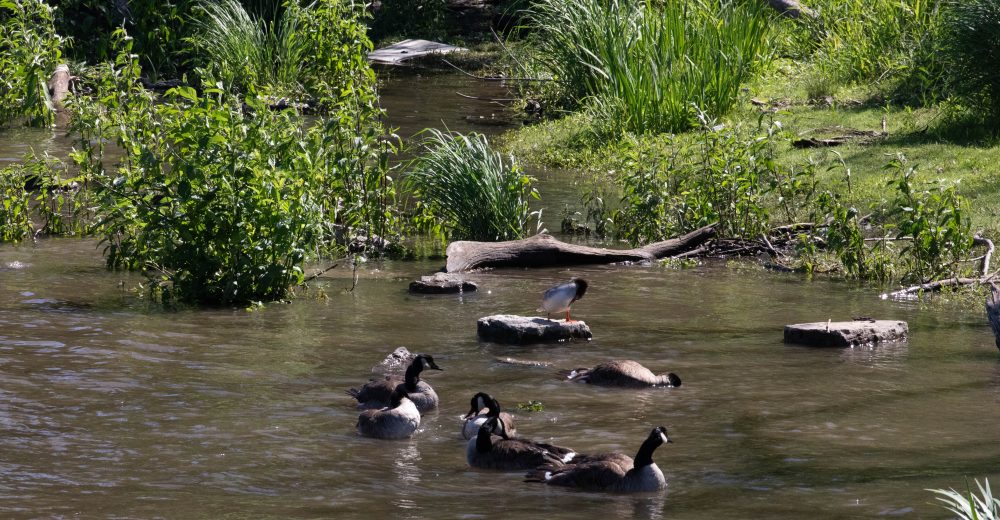
One lone Canada Goose sampling the duckweed portion.

Meanwhile back at home, blooms are starting to happen. My forest of Purple Coneflowers is off to a good start. I hope some butterflies show up soon.


The bright yellows…of a bee on something I should recognize but somehow almost everything that was planted in my front yard is still strange to me, I have to get out the books and study. On the right below is the Rudbeckia that was budding last week and the first of many sunflowers planted by the inevitable scattering of black oil sunflower seed.


All the milkweed in my front yard has planted itself, and it is blooming beautifully. And it is fragrant. I am not used to smelly flowers, this is quite unexpected. I hope it smells enough to attract Monarch Butterflies.
 On another note, a section of my yard has been plagued by the plant below for two years and I spent an hour yesterday carefully digging out as much as I could, hoping anything I planted around it will take over. I don’t know what it is, so if you are a wizard and can identify it I would be most grateful.

Unidentified Invasive Plant
A few more photos of the lovely Mallard family that was swimming around in the low-lying land next to the Des Plaines River. I counted nine ducklings.


And one more of the Carolina Wrens.
 McGinnis and the Little Red Schoolhouse are on my mental list for next weekend, weather permitting. Even if the Prairie Warbler isn’t available, there are often Red-Headed Woodpeckers, which I don’t get to see too often. Maybe there will be some butterflies too!


 But after hearing the bird in my yard, which unfortunately I did not see and because I had to go to work I couldn’t hang out long enough to look for it, I wondered if perhaps Redstarts might pass around a new “hit song” every spring – sort of like the Humpback Whales that come up with new songs they spread around, or like European Starlings that decide their new “hit” is to imitate a Killdeer, for instance, which was a phenomenon I observed a few years ago.


 I wonder if the Common Grackle below could be a molting adult, without its long tail.
 Magnolia Warblers have been coming through for weeks.


 On the 29th I saw this presumably female Wilson’s Warbler, below, at Lake Shore East Park, and am glad I had pictures to prove it to ebird – apparently it’s late in the season to see a Wilson’s. Others reported seeing them too, in the area.


 Down by the Chicago River last week, a Ring-Billed Gull enjoys his perch on one of the last remaining rotting pilings. And the only bird in the Boeing garden nearby was what appears to be a Yellow-Bellied Flycatcher below, after checking Crossley’s pictures as a reference, but empidonax flycatchers are hard to nail down unless they say something and this guy was silent.


 I’m looking forward to cataract surgery on my right eye tomorrow morning, because that’s the eye I use to focus the damn camera lens with, so I’m hoping for future sharper images!!
 I try to get to LaBagh Woods Forest Preserve a couple times a year if not more, at least during migration season. These pictures are from two weeks ago when I went with my friend Susan. It was extremely muddy after recent rains which made some of the trails impassible. Number of species and photographs were not as forthcoming as I might have hoped but we had a good time Disclaimer: I’m presently suffering from a horrible head cold that started yesterday morning so I will keep this short and sweet.
 I don’t think I stopped bothering to take pictures of American Redstarts and Yellow Warblers (below) but there weren’t many volunteers.
 After hearing Northern Parulas in several locations it was gratifying to finally be able to see one or two well and photograph below.
 The bird below is a male Ruby-Throated Hummingbird – and the lighting is so intense and back-lit there is just no way to show off his ruby throat. But it was nice to see him perched. Welcome back, little fella. Still waiting to see a hummer in my yard…
 I will be back with more of spring migration. This weekend is probably going to be the last we will see of the warblers that keep going north.
 After all the Yellow-Rumped Warblers appear to have moved on, below is a female. You can make a comparison to the male below her.
 Common as they are, Common Yellowthroats are still pretty.
 I’ll be back with more Warblers and other birds of 2016 Spring Migration.


 I
I


