The river was too frozen for much of February, so I missed seeing some of the ducks that usually come to visit. With the recent warmer temperatures and the ice melting, it was rewarding to start seeing Red-breasted Mergansers again. And just two days ago, there were two male Buffleheads with them.
There was ample sunshine that morning and I had the best look at a Red-bellied Woodpecker that I’ve had for weeks.
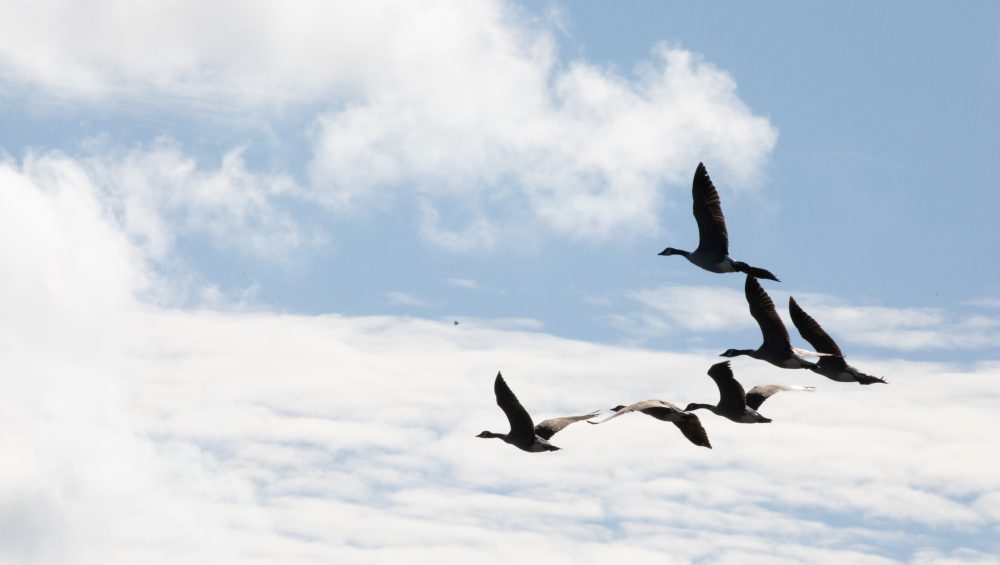
Going back a bit, on February 27, I started seeing pairs of Canada Geese. There was one of a pair that like to stand on the wall leftover from the Hofmann dam.
A couple Red-breasted Mergansers were a bit closer that day.
I started seeing Brown Creepers again.
A Red-winged Blackbird was foraging in the leaf litter right in front of me as I sat on my favorite log,
Going back a bit to February 16, just before the water started flowing in the river again, the same pair of geese by the Hofmann Tower, practicing thermoregulation.
I also saw a Merlin that day.
A pair of Mallards found some open water next to the ice.
Three more quick photos from Monday: a Mallard drake, an American Robin, and the full moon that evening. I got up early Tuesday morning to ln hopes of seeing the lunar eclipse, but we were under cloudy skies with drizzle.
We are scheduled to get some rain the next few days. While it might discourage a morning walk or two, we need the rain as the promise of spring continues.
I don’t have much to show for the last week, but since snow seems to be the dominant feature this winter and will be continuing, I may as well pay a little attention to it. I went for a walk after the first accumulation in Riverside. A Downy Woodpecker was on the paved trail, investigating some sort of nut that he couldn’t crack open. I think he was hoping I could help out, but I was useless when I tried stepping on it and nothing happened…
I noticed two Mourning Doves and started to take their picture when an American Robin tried to get in as well.
The Song Sparrow at the top of the post was foraging in the snow.
Canada Geese were gathering in the Des Plaines River, which is still pretty low.
On December 2, I took a walk around the Chicago Portage, sticking to the paved trail areas.
I found a white-breasted Nuthatch and a White-throated Sparrow.
A Red-shouldered Hawk flew by.
And a Northern Cardinal showed up at the parking lot.
The next day in Riverside I saw the tagged Canada Goose 21N.
A female Northern Cardinal blended in with her surroundings.
A distant Merlin flew over the river.
And a White-throated Sparrow foraged in a thicket.
Snow and cold continues. I had to shovel and unbury my car yesterday morning before driving off to Unity Temple to sing in the choir. It was so cold in the sanctuary, many of us were wearing coats when not performing. But it was a service so worth doing. We sang “Song of the Earth” by Craig Hella Johnson and it was a moving experience to be part of. It was a service welcoming new members, which is always a happy occasion. Conversely, the theme this week was how hard it is to find and hold onto hope. It’s as if we are in the cold and dark spiritually as well as physically. We have to continue poking around, shoveling the snow and stirring up the leaves.
Two parting shots from a cold, snow-filled walk in Jackson Park Saturday morning. I will try to show up more often…now that I’m snow-broken.
These are photos from two fairly recent visits to Riverside, on August 30 and September 2. I was happy to see more warbler activity in the treetops. There are likely too many photographs below. But here they are, in mostly chronological order.
I always start out by checking to see if the two fishing friends, a Great Egret and a Great Blue Heron, are by the remnants of Hofmann Dam.
Then a Merlin appeared briefly. I was still by the Joliet Avenue bridge.
I followed a rather distant Blackpoll Warbler in the trees on the Swan Pond side of the river. The warblers are particularly attracted to the black locust and oak trees.
An Osprey flew overhead.
I didn’t see much of anything in Riverside Lawn after almost not proceeding after I encountered hundreds (thousands?) of maggots on the trail off the Swinging Bridge. (I’m going to try to remember to capitalize this now as what I have invariably referred to on other times as the “footbridge” but have encountered enough Riverside habitants who refer to it by this name.)
I did not observe an animal carcass, but I didn’t look that hard either. I just walked through the rest of Riverside Lawn which was very quiet, and I checked behind the Hofmann Tower again to see if there were any herons. Here’s my last photo of three Great Egrets in the trees by the river in Indian Gardens.
I went back to the same location on September 2, Labor Day, and saw a lot more. This time, my first warbler after I crossed the Joliet Avenue Bridge into the paved Swan Pond trail was a Bay-breasted Warbler.
There was a Blackpoll too. I’m including all these photos for their identification points. You can see the bird’s orange feet in several of the photos.
Then I encountered three Blackburnian Warblers, but they were harder to capture. The bird below is the same one at the top of post.
I had a brief view of a Cape May Warbler.
Then I found a bird that defies definite identification from these views. I speculate it could be a female Black-throated Blue Warbler although I never got to see the white patch on the wing.
I found another Blackpoll Warbler.
When I finally got to the Swinging Bridge, I found it had a family fishing on it.
A Great Blue Heron was standing watch in a nearby tree.
The trail was clean where the maggots had been, but the skull remains of their likely host were off to the side. Later in the week, I encountered my friend Chris who walks his white dog Isabel and he told me she found a dead raccoon about 10 days earlier. That solved the mystery for me.
I spotted an American Goldfinch.
And now there were Tennessee Warblers.
Here’s another Tennessee Warbler in what unfortunately looks like buckthorn.
Another Blackpoll Warbler was also in the buckthorn. The fact that buckthorn doesn’t provide anything except a resting place could be why I was able to obtain these photographs.
A Swainson’s Thrush popped up.
And a Warbling Vireo made a rare appearance. I have still been hearing them singing.
I found a Bay-breasted Warbler.
And then a Gray-cheeked Thrush appeared.
A Magnolia Warbler nearly defied my ability to follow it.
Here’s another Gray-cheeked Thrush.
Birds have been showing up at the Chicago Portage too. Maybe I can take you there next.Yesterday morning was a very chilly one with the Oak Park Bird Walkers at Thatcher Woods. It’s been a busy weekend with a choir party last night and then our return to singing in Unity Temple this morning. We are back to singing two services like we did years ago, pre-Covid. It’s like reinventing the wheel.
I’ll try to be back soon. I already have too many photos and need to make room for more.
July 25 was a good morning to observe behavior and juvenile birds trying out their wings, if you will. I first spotted the European Starling clan that nested in the statue.
Butterfly action was confined to the Pearl Crescents that I have seen frequently this season.
Eastern Kingbirds were busy that morning. From the youngest…
…to an adult wrestling with what looks like it might have been a cicada.
Then I spotted a raptor across the water. It didn’t look like a Cooper’s Hawk. but it was so far away and difficult to see, I couldn’t be sure.
I followed it as it flew from its perch. It turned out to be a juvenile Merlin. I admit to even asking the Merlin app on my phone to identify the Merlin from one of my photos. I wondered if it could be objective.
It kept flying and I managed to follow it.
Another Pearl Crescent was resting on the path in front of me.
Tadziu the Indigo Bunting was sitting patiently on his newest favorite perch. He wasn’t singing. He just seemed to be asking me something…
Back to the Eastern Kingbird at the top of the post, who flew in the photo below.
Then two birds interacting, both juveniles, could be an Eastern Kingbird and a Baltimore Oriole.
A few more of the Eastern Kingbirds…
Juvenile Cedar Waxwings were available, but I didn’t see any adults.
American Goldfinches posed in the duckweed.
And Baltimore Orioles were here and there.
I will be back with more from recent visits. Beyond that, I have run out of ways to use the weather as an excuse. Yesterday I drove around the Morton Arboretum with a friend in an air–conditioned car, to see a sculpture exhibit that spans the acreage. This morning I tackled some more of the overgrowth in my yard while I await a promised visit from my tree trimming person. It takes a leap of faith to visualize fall, cooler temperatures and more birds but the days are getting shorter.
Yesterday’s last walk at Thatcher Woods began very cool and cloudy. We saw several birds but not all that well. And then by the time we reached the open meadow, the sun had emerged from the clouds and it was easier to see whatever birds came to the edge. The best part of the walk was perhaps the very end when first one very dark Merlin flew right over us and then another flew in and perched atop a dead tree. I kept expecting it to leave, but it didn’t, so I took way, way too many photographs of it as it changed its viewpoint.
This post is a celebration of a few more or less unusual birds that appeared yesterday and on September 1 when I participated in another walk led by Henry Griffin. On that day, the grand finale bird, if you will, was a Black-billed Cuckoo.
That day also started off with a bang when we spotted a distant Red-headed Woodpecker.
And September 1 was also a good day for flycatchers.
Eastern Wood-Pewee
And a Least Flycatcher.
And just now reviewing the photos I think I found an Olive-sided Flycatcher. I’m not sure we reported it. But Merlin – the app, not the bird – seems to agree with my identification.
Olive-sided Flycatcher
One more bird from that day was a Gray-cheeked Thrush.
Gray-cheeked Thrush
And from yesterday, I barely captured this Hermit Thrush, even though it behaved exactly like all Hermit Thrushes I have ever met by sitting for quite a while staring right at me.
Hermit Thrush
Another surprise bird at the end of our walk yesterday turned out to be a juvenile Purple Finch. Perched pretty far away, the photo doesn’t do it justice.
Purple Finch
One more bird from the September walk.
Rose-breasted Grosbeak 9-1-2022
So that leaves me with more images of the Merlin. I so rarely see these birds, I couldn’t help myself.
Today is sunny and crisp, but I was singing in the choir this morning, so I won’t be going out for a walk until tomorrow. However, there is much to do outside in my backyard. I think I will go out and disperse more bucketsful of dirt and wood shavings. We’ve warmed up a bit, but I am already embracing the inevitability of hot cocoa.
I find myself taking stock of things and at the same time wondering how I got here.
I’ve been trying to get back to finishing my review of the New Brunswick-Grand Manan photographs, but it’s always a struggle with the travel laptop, so the task inevitably fell to today when I had some extra time, if there is such a thing, or at least I felt like I could afford it. Ironically years ago when film was the medium, I never would have had this problem. I certainly would not have had hundreds of photographs to go through. Okay, enough complaining. It only took half an hour to install a software update before I had to start and restart Lightroom several times. These are photographs from August 18 when we first visited the Sackville Waterfowl Park in the morning, in the rain, and then later we went to Johnson’s Mills.
Sackville Waterfowl Park
The inclement weather bonus was this sighting of Virginia Rails crossing the path to feed their young.
By the time we moved on to Johnson’s Mills, there was sunshine. And lots of shorebirds.
Semi-Palmated Plover
To sufficiently stir up things, there was a Merlin.
I am always happy to capture a Raven, anywhere.I must have known I would be processing these photographs late and would need want to see some flowering plants…One more of a Semi-Palmated Sandpiper. You never really get very close to a shorebird so I am thankful for this image, however cropped it may be.
I hope to be back very soon with photos from the next day at Koucibouguac National Park – Kelly’s Beach. Don’t you love that name?
But this will be a very busy week, so don’t hold your breath. Our choir has a big dress rehearsal Wednesday night with soloists and musicians for our upcoming two performances of the Bach Magnificat on Sunday. The reassuring thing is knowing that no matter whatever else happens this week, music triumphs over all.
And to feel better after a long, mostly dreary weekend, I just baked this loaf of bread. Another bonus from a Why Not, I Have Time Day.
Reports came last weekend from Coles County, Illinois–farm country about 3 hours south of Chicago–of sightings for two rare visitors: Snowy Owl and Prairie Falcon.
Even though Illinois is a “prairie” state, a Prairie Falcon sighting is a rarity. I saw one fly by in New Mexico last year but it’s a bird I would definitely like to see again. So I gladly joined three friends (as an aside, when we go out on expeditions together we call ourselves the 4 L’s or the Four Elles, all of our names beginning with “L”) for a day trip Sunday to comb the farm roads searching for these elusive creatures.
Farm Road wih Horned Lark – can you find it?
Alas, we did not find our target birds. An hour or two into our drive, in fact, we read a report of two Snowy Owls at Northerly Island back on the Chicago lakefront, the direction we were driving away from. But they were being harassed by…my crows, I’m afraid, and eventually left. I have reason to believe they are my crows evicted from the former Daley Bicentennial Plaza now under current destruction; earlier this winter an increase in the crow population was reported at Northerly Island. Crows would be the first to notice the Snowy Owls. But I’m also thinking if they had not harassed the owls, the owls might have gone unnoticed. There’s nothing like crows to detect the presence of predators and call your attention to them. Come to think of it, we could have used a few crows on Sunday to find the falcon for us…
Our first bird was an American Kestrel, hunting in a field, then perched on the wire,
that just would not become a Prairie Falcon. It had a vole and was trying to eat its prey, but we couldn’t get close enough for decent photographs.
I’m afraid he got tired of us watching him.
After several more Kestrels, which I was still thrilled to see as they have all but disappeared from the Chicago area, we did have another falcon… this solitary creature, which might have been a Merlin. The bird appeared to be a juvenile, whatever it was. No matter how much we tried to make it into the sought-after species, it sat quietly in the middle of the field, no doubt amused by all the people peering at it, by now, with scopes from both sides, knowing we were too far away to get really decent looks.
Even though these pictures are hardly worth publishing, we Four Elles had a great time, over the course of the day getting great if brief looks at Rough-Legged Hawk and Northern Harriers, lots of American Tree Sparrows and Horned Larks, and it was our last chance for sunshine for quite a while. The days are getting longer, but it seems the winter weather is just beginning.