Something Else from the Chicago Portage

I fully intended to do this post a week and a half ago, while we were still romancing the idea of a warm fall migration season. I’ll still be looking back, but I’ve been busy with the upcoming choir concert and the impending arrival of a house guest – something that doesn’t happen all that often when you live with birds, not that anything in their lives will change – and as life becomes evermore complicated, I find I have an intense determination to simplify things. I’m sorry that doesn’t seem to have made its way into my writing.

So here are some photos from the end of September at the Chicago Portage. The 28th and the 30th, to be exact. I almost wrote the end of December. Our weather has finally and suddenly taken a chilly turn.

There weren’t many birds on the 28th. Perhaps the least common was the Rose-breasted Grosbeak below.

Red-winged Blackbirds started to show up here and there in preparation for joining flocks moving south.

And Common Grackles were amusing themselves with the abundance of huge walnuts.

I caught a glimpse of an American Redstart. Actually, this is the most common view of this species in any season.

And on my way out, a White-tailed Deer crossed the path.

On September 30, I first noticed a Yellow-rumped Warbler on the bridge by Harlem.

Then as I looked out from the bring into the shallow stream covered in duckweed, I saw a Muskrat. I had somehow managed to get out of the house a bit earlier that morning, and I suspect that I might have been keeping Muskrat hours.

Another Yellow-rumped Warbler was in the duckweed.

Then, I caught a new view of a Rose-breasted Grosbeak. I have never seen the red under the wings before!

The camera found an Indigo Bunting or two.

I got lucky with Lincoln Sparrows and took far too many photos of them. This was the first individual I saw.

I saw a Song Sparrow across the water.

Then I found another interesting Song Sparrow that almost looked strongly striped like a Fox Sparrow, while its belly was unstreaked. It’s sometimes amazing to me how varied individuals in this species can be.

Yellow-rumped Warblers can look quite different too.

I found a Downy Woodpecker working hard on a tree limb. The first photo is blurred by how fast she was drumming.

Another Yellow-rumped Warbler was fading into the leaves.

Here’s the second Lincoln’s Sparrow. This might also be the same one at the top of the post. I was sitting on the picnic table close to the water when the sparrow popped up on a nearby log.

I watched a Red-bellied Woodpecker grab something to eat.

And then, when I returned to the bridge near Harlem, I found an Ovenbird foraging in the leaf litter. It was then joined by a Yellow-rumped Warbler.

I caught another view of the Ovenbird after that.

Palm Warblers have been somewhat scarce this fall. I was used to seeing them everywhere in previous years.

Here’s another Palm Warbler, and a Yellow-rumped Warbler below it. The Palm Warbler has yellow underneath its tail, and you can’t always see the yellow on the other’s rump.

Well, that’s about it for the moment. I have lots more to share, I just have to find the time and the mental space to do so. It feels good to be sitting here with some coffee after singing this morning in choir while the temperature fell and it rained steadily. It’s easier to be inside under those circumstances. It looks like we will be much cooler now than we have been, but not freezing yet. I am thankful for the rain on the new plants I put in the ground last week. And I’m looking forward to digging into a challenging week ahead, with rehearsals, arrivals, laughter, tears, more birds, more music, more reasons to keep going.

Last Week in Riverside

Today is a quiet, cloudy, rainy day and I am trying to stay distracted enough by getting some things done around the house. But while I sit here sipping coffee with an ice pack on my knee, I may as well send off another blog post. Here are some relatively recent photos from three visits to Riverside on October 25, October 28 and November 1.

October 25. I always check first by the Hofmann Tower to see if the Great Blue Heron who hangs out along this part of the river is present. I didn’t see it right away, but after looking from the bridge at Joliet Avenue I found it tucked in one of its favorite locations off the edge of the former dam.

It was a quiet walk through Swan Pond, with a Red-bellied Woodpecker investigating a nearby tree.

Dark-eyed Juncos like this side of the river and I have often seen them foraging not too far from the paved trail.

I managed to find a Golden-crowned Kinglet.

And a male House Finch was somewhat available.

The second Great Blue Heron that was around through the end of last month was over by the bend in the river near the library.

Canada Geese and Mallards were there too.

I decided to take a photo of the Swinging Bridge while it was surrounded in some autumn color. It looks like we got a little rain the day before.

In Riverside Lawn, I was quite happy to find a young-looking Lincoln’s Sparrow.

There were a couple Hermit Thrushes as well but they proved difficult to see.

On October 28, I counted two Great Blue Herons but took photos of only one. I reported only 14 species for that day and most of them were Canada Geese and Mallards that must not have commanded my attention. I suspect I heard more birds than I saw.

A Downy Woodpecker was busy as usual. And that was about It.

Then on November 1, there were three Killdeer by the Hofmann Tower.

This time I saw only the Great Blue Heron by the Hofmann Tower.

The shadow outlining the Dark-eyed Junco’s chin below makes an interesting comment.

I heard, and then saw at quite a distance, a male Belted Kingfisher.

This was a great day for a White-throated Sparrow to sit perfectly lit for a photo session.

Mallards were preening.

In Riverside Lawn, pretty convinced the kingfisher was going to be bird-of-the-day, I was surprised to suddenly see a Carolina Wren investigated a crevice in a tree, not too far off the ground. It disappeared into the thickness of twigs and fallen logs by the river’s edge. I stood still, made a few little pishing noises to see if I could get it to pop back out again. And then, it did, landing on a log right in front of my camera, posing for a few pictures before it took off again. I have been looking for a Carolina Wren all year at this location, so I was quite happy about this encounter.

I barely managed to capture a Golden-crowned Kinglet.

And I had a hungry Black-capped Chickadee.

I hope to get back out tomorrow morning after all the rain. It will be interesting to see how high the river will be after this prolonged drought. I hope it will also be interesting to see the looks on people’s faces as they walk by with their dogs and perambulators. We could all use some more smiles.

Another Day in May

Here are photos from May 15 in Riverside. It was another beautiful for day for warblers, several thrushes and yes, Common Grackles. The Grackles remain for the summer. People kid me about the Grackles but I think they are beautiful birds in their iridescence. And I’m trying to stay on their good side so maybe they won’t rain acorns on me like they did last fall.

These photos are arranged pretty much in the order that I took them. So my first warbler was a Chestnut-sided Warbler.

It got a good if distant look at an Eastern Phoebe.

Below is a Swainson’s Thrush.

The Scarlet Tanagers were in town that week and I had to obey.

The photo below of a Palm Warbler intrigues me particularly because of the green catkins on the walnut tree.

And now for the star of the show that day. It’s always a joy to find a beautiful male Blackburnian Warbler in the spring.

I have seen more Gray-cheeked Thrushes this year than I have in a long time.

I encountered a singing White-crowned Sparrow. I was only able to capture a snippet of his song in the video below the photographs, but I love it, it always sounds a little jazzy to me with its syncopation.

Here’s another Palm Warbler.

I have heard about the snakes that like to warm up in the sunshine on the riverbank, but I had never seen or been able to capture them with a quick photo until that day. I believe they were Common Watersnakes.

I had a few brief looks at a female American Redstart.

I was particularly happy to see and hear a Canada Warbler.

This Swainson’s Thrush picked a lovely fallen log close to the river’s edge.

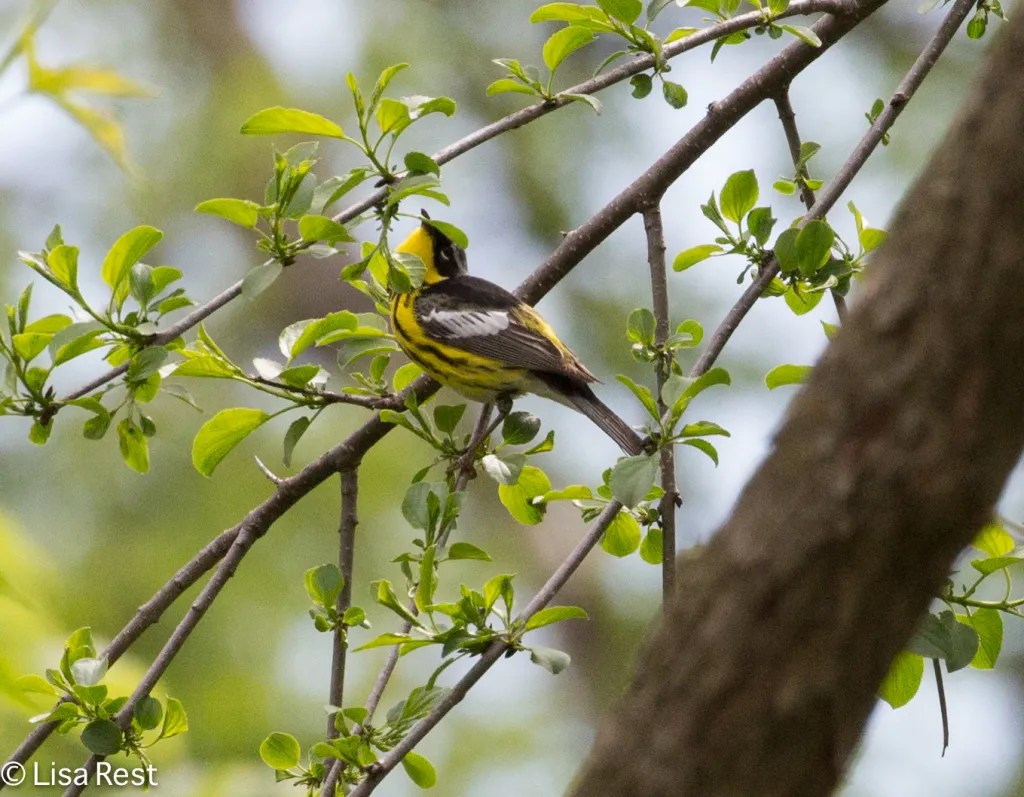
I never ignore Magnolia Warblers

I don’t think I’ve ever seen the view below before.

Chipmunks are back in full force.

A nice-looking Yellow-rumped (Myrtle) Warbler showed up to remind me that Magnolias are not the only black-white-and-yellow option

I found a fairly friendly White-throated Sparrow.

I think I have seen more Veerys this year too.

House Wrens are Everywhere. Rarely so easy to see as this one, but they sing almost constantly to let you know they’re there. This one wasn’t singing, however!

Gray Catbirds can be a reclusive bunch too.

Yes, another Gray-cheeked Thrush.

I try not to take our year-round red birds for granted…

Northern Cardinal

I was very pleased to find a Lincoln’s Sparrow.

The second male Magnolia Warbler that posed was also singing. I barely managed a snippet of his song in the video below. By the way, I’m doing the videos almost more for the sound recording which is much clearer than what I get with my phone’s voice recorder.

Lastly, I was very happy to find a somewhat reclusive Wood Thrush.

Here’s another shot of the Common Grackle at the beginning of the post, showing off a variety of colors.

Oh there is so much more to report. I will return with something a little more current before I wade through any more photos from the peak of migration.

We have cooled off a little bit, but it’s still too dry. The next promise of precipitation is Sunday morning. I may have to go to church. A song we sang during the pandemic, written by Jan Garrett and JD Martin, “I Dreamed of Rain”, has come back to haunt me.

Going Back a Bit

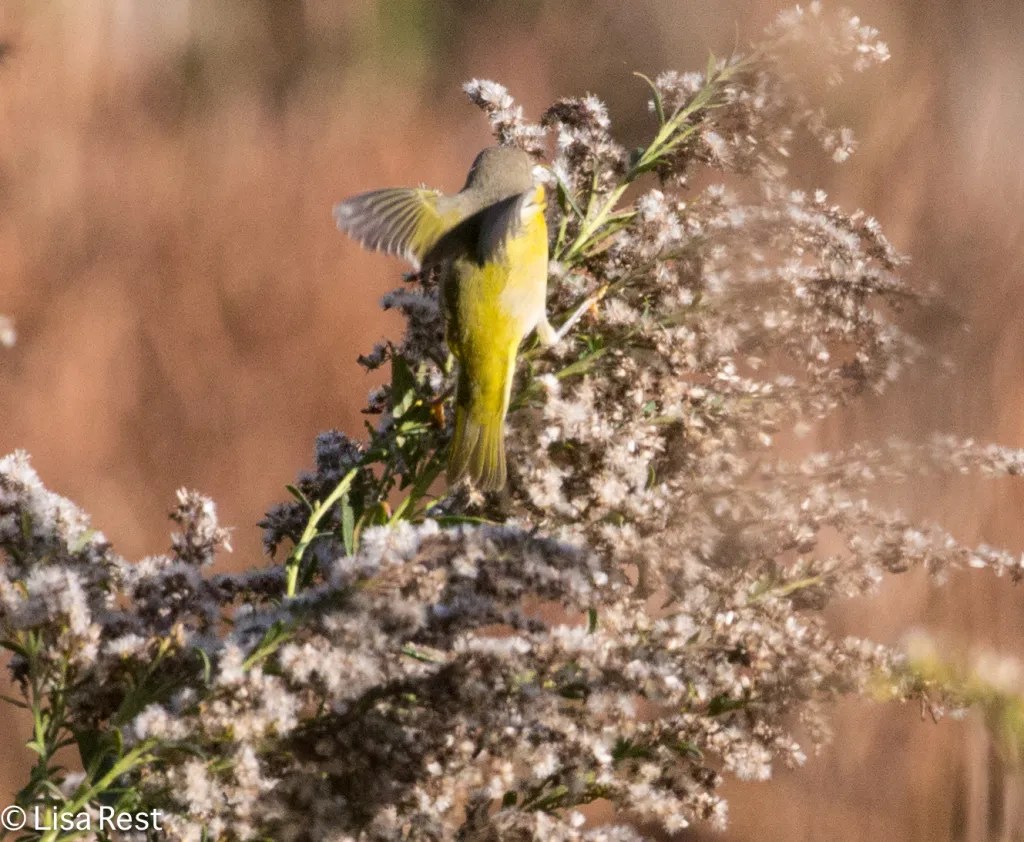
I have been out locally the past two weeks and there is much to post about, but I thought it might be time to take a historical break. These pictures are all from October 19th at the Portage. Only a little over a month ago, there was still more color among the birds than the leaves. I spent a lot of time with this Nashville Warbler.

Perhaps in the instance below the leaves outshone the bird – a pretty drab-looking American Goldfinch.

The other late fall warblers were on hand. Below is a Yellow-rumped Warbler.

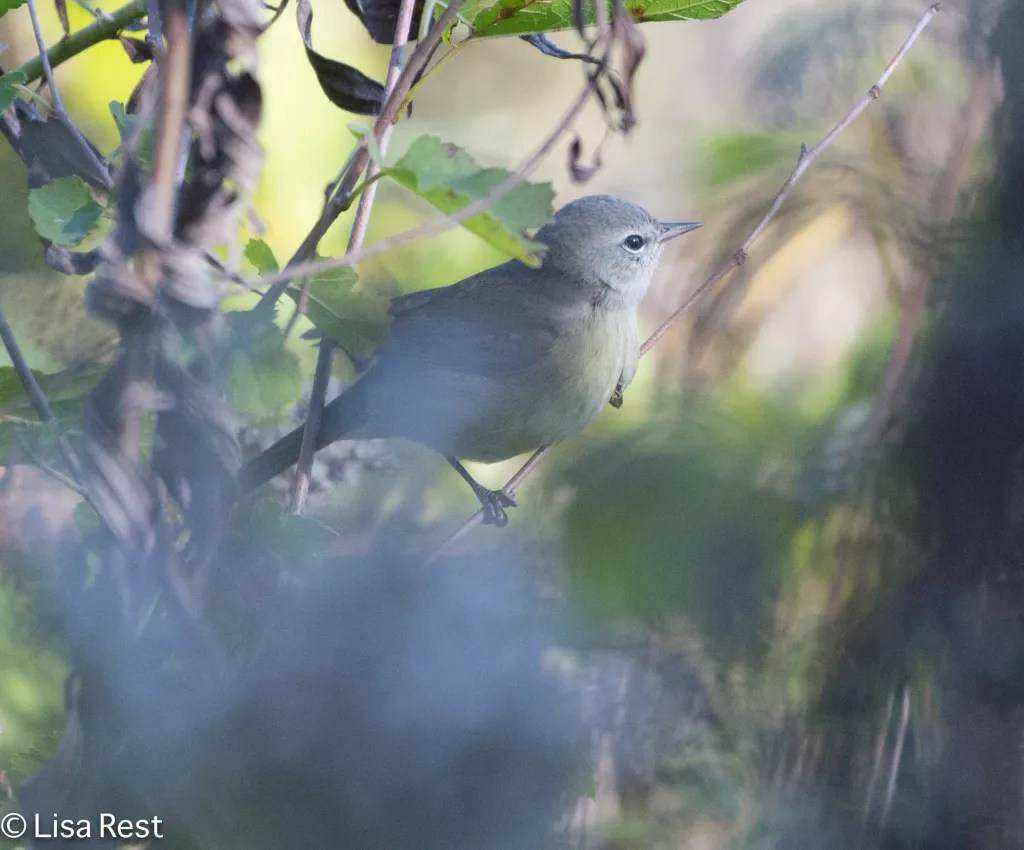
And the one I kept seeing later and later into the season, an Orange-crowned Warbler…

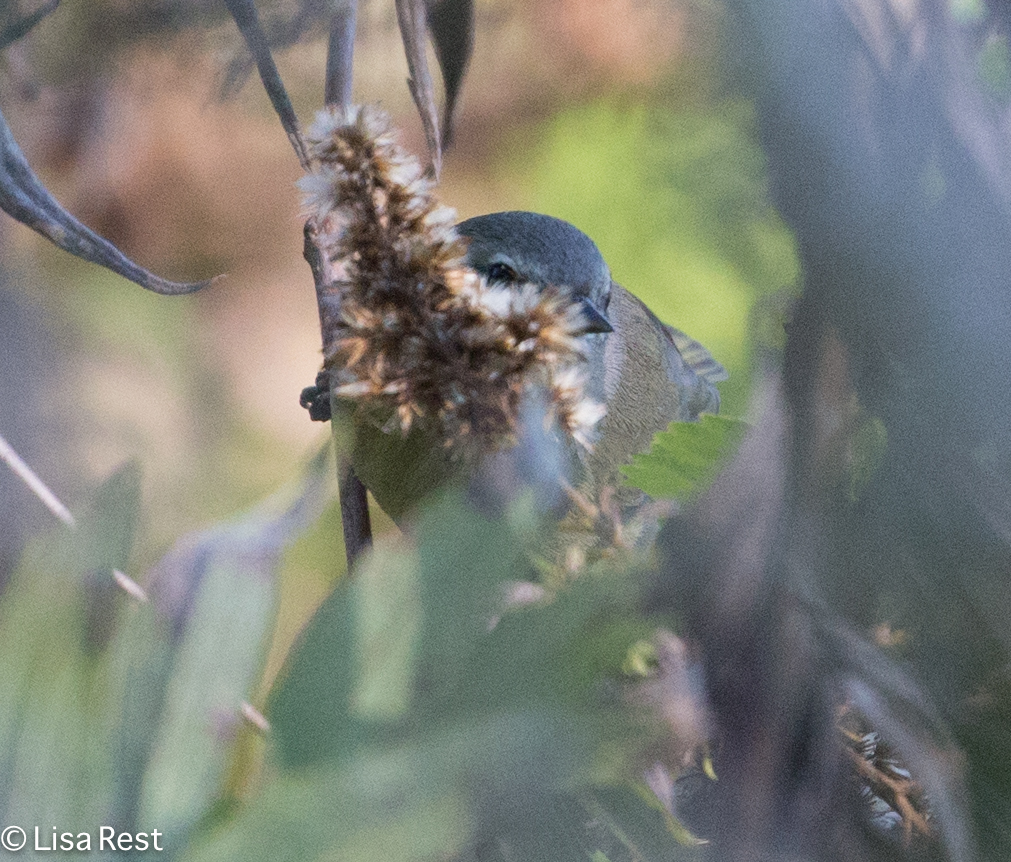
Barely visible but I would know that face anywhere (Orange-crowned Warbler)

Not a lot of sparrows on hand but I managed to capture these two.

White-throated Sparrow
Lincoln’s Sparrow

And the Kinglets – Golden-crowned and Ruby-crowned…

It’s been wonderful to see Brown Creepers on so many occasions.

Always glad to see a Black-capped Chickadee who seems to return the sentiment.

This could have been the only Great Blue Heron I saw here for months since the drought caused the water level to drop so drastically.

Not a wonderful place for a Hermit Thrush to pose but I was glad to see it.

It wasn’t quite woodpecker “season” yet but I managed to see this female Downy Woodpecker.

There are lots more historical visits to make sense of – indeed a flurry of fall warblers that I was so busy taking pictures of I barely have barely had time to go through them, so they may periodically provide a little visual warmup during the cold.

I am mourning the death of my beloved singer/songwriter/implacable musician Zebra Finch male to whom I gave the name of Arturo Toscanini. He died Thursday morning. I found him on his back, on the floor of the dining room by the windows. He was still warm when I picked him up. He had been singing a lot lately, and I think perhaps he had been telling me his time was coming because I found myself thinking about how old he had to be, even though he had no signs of aging or impairment, other than it seemed his little goatee was getting whiter and whiter. The blessing in all of this is that I have one of his offspring who is singing an abbreviated version of his Arpeggio Song and an even shorter memory of his TaTaTaTaTAH Song. Also, other birds have taken up the actual Toscanini Song that he used to sing a long time ago. And there are many more songs among them to catalogue and follow. At some point I hope to go through the years of recordings (I determined I must have gotten Arturo sometime in late 2014) to see if I can put together a timeline of his compositions. In the meantime, I am incredibly thankful for all the avian musicians I still have with me. Singing is their raison d’etre, and music is life.

Once More with Sunshine

I went back to the Portage Sunday to see if abundant sunshine would allow me to see more birds. As it turned out, it was harder to capture most of the birds – except for the Indigo Buntings who were readily available – but in going through my photographs later I discovered the camera saw more birds than I did and I found some unexpected species. Nothing rare – it’s spring migration, so just about anybody can show up.

Vesper Sparrow

Not only was the Vesper Sparrow unexpected, but I was also surprised to see a Black-Billed Cuckoo, although I have seen them at the Portage on occasion before.

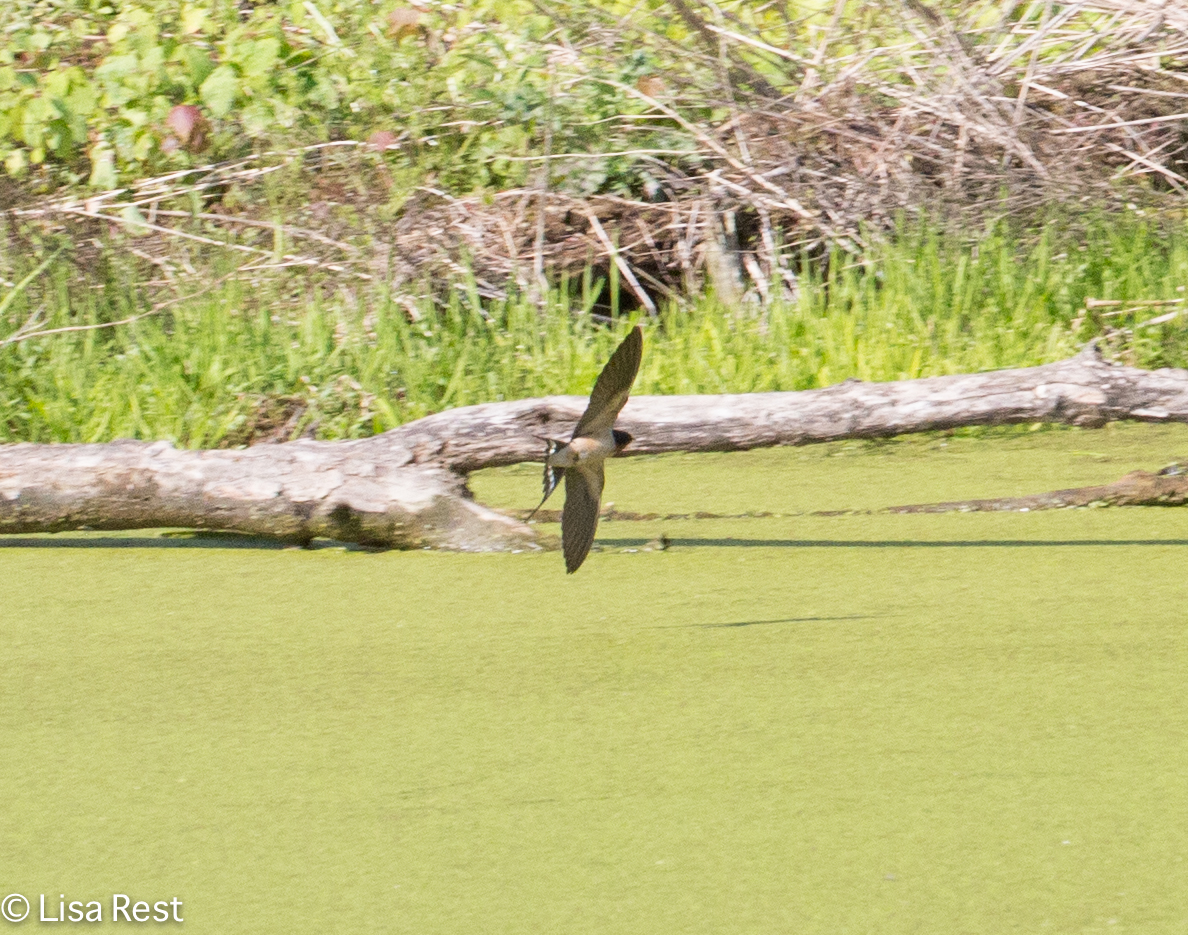
There were swallows like the day before, although not as many. I have concluded that the Northern Rough-winged Swallows fly in a more deliberate fashion which makes them easier to capture. Still I managed to snap one photo of a Barn Swallow in the lower right-hand corner.

So the Indigo Buntings were busy singing in the sunshine. I am convinced they have an artistic sense of the best places to perch for photos. I love the way this one was initially framed by the split of the tree trunk.

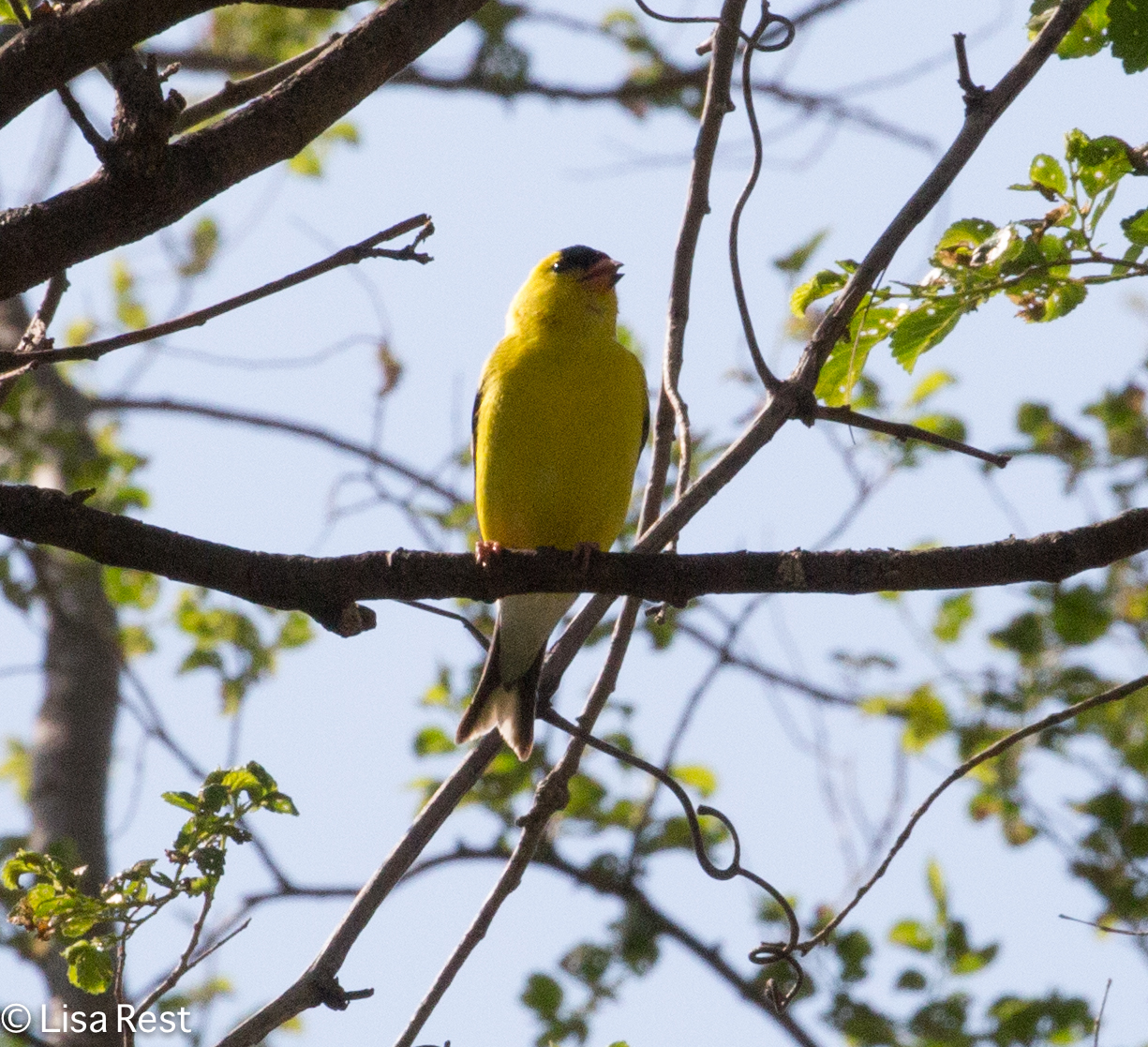
Male American Goldfinches are in full bloom too.

The Red-winged Blackbirds are looking a little tired of it all already.

Gray Catbird

I thought I was hearing the tail end of an Eastern Towhee’s song – and then I spotted one way up high (used to seeing them closer to the ground). Below the shots of the male is a partially visible female Eastern Towhee.

I was also hearing an Eastern Wood-Pewee for the first time this spring. I barely captured a picture of one below.

Red bird of the day turned out to be a male House Finch.

The Baltimore Orioles are busy gathering nesting material. Both female and male birds are below.

This is a really unfortunate place for a Lincoln’s Sparrow to show up but I’m glad one was on site anyway.

I walked around back by the water reclamation district and saw three Killdeer. Below is one of them.

There were quite a few Brown-headed Cowbirds. I got closer shots of the female in the grassy area by the parking lot on my way out.

So we really, really need some rain. This is how the Des Plaines looked on Saturday. You can walk down to it easily because the bottomlands are all dried out. Unfortunately because of the lack of water, there were no birds by the river.

So it wasn’t a great day for warblers, but I did manage a few pictures of a female Bay-breasted Warbler.

Can’t leave without a Robin. It’s got to be getting harder and harder to find those worms. The Robin below has a not-so-tasty-looking worm in its bill.

With a little luck I will be back with the prelude to all this before the weekend when I will likely be outside again. There is rain in the forecast but I have learned to become skeptical of the outcome. At least it is still fairly cool, but that will change too. This is all affecting my mood, to say the least. I am looking forward to swimming tonight – a sure antidote to depression.

Spring Returns

Black-throated Green Warbler

When I came back from Texas two weeks ago, the weather in Chicago was fairly pleasant and I mused I could have two springs! No matter that the Saturday before I got home there was snow on the ground. But just as we slipped into May, when it seemed reasonable to expect things would start warming up a bit, northeast winds picked up and although we weren’t freezing, the windchills were in the 30’s. It’s an understatement to say there has been a lot of rain. The downpours have brought most of the trees into leaf and encouraging emerging plant life everywhere. Then, this past Thursday morning, a lot of migrant birds were down from the skies from the previous evening’s rainstorm.

I’m too far away from the lakefront now to go off searching for rarities on my lunch hour, but I took Friday off so that I could scope out the Portage before my bird walk on Saturday. It turned out to be the nicest day of my three-day weekend. Although it started off chilly and windy, when the sun emerged a little before 10:00 AM all was forgiven.

Magnolia Warbler

I just finished getting through Friday’s pictures last night – it seemed there were way too many, but I discovered three more species in them to add to the list with a grand total of 54 species, 13 of them warblers. Which isn’t super fantastic but it’s credible for the Portage.

As for the Texas pictures, I managed to send some to Field Guides Saturday night and now with that off my plate I can go back through all of them and start developing for my own purposes. Time, technology and energy being available in inconsistent quantities, this will take me a while.

So in the meantime, here are some of the spring migrants from my walk on Friday, and there will likely be some more from this visit and Saturday’s outing as I try to keep up with everything that seems to be happening this month.

American Redstart
Chestnut-sided Warbler
Wilson’s Warbler
Palm Warbler
Yellow-rumped Warbler (Myrtle) (robber baron pose)

This is all I can manage for now. I hope to report back soon with lots more!

Black-throated Green Warbler

Fall Migration Continues II

YRWA Portage - 10-13-18-2668

Yellow-Rumped Warbler at Chicago Portage

And continues and continues and…I have been so busy birding every weekend it’s taking even longer to process the pictures. These are from last week – October 13 – Thatcher Woods and the Chicago Portage.

WTSP 10-13-18 Thatcher-2188

White-Throated Sparrow at Thatcher Woods

The birds blend in more and more with their surroundings, but I find it so intriguing. Although it does take almost twice as much effort to get the camera to focus on the bird.

LISP 10-12-18 Thatcher-2303

Lincoln’s Sparrow, Thatcher Woods

I was very pleased to find a Winter Wren hanging out with the sparrows and remaining warblers at Thatcher Woods. I always think of Don Kroodsma and The Singing Life of Birds when I see a Winter Wren, even if it’s not singing.

Much like two weeks earlier, there were still a lot of Palm Warblers and Yellow-Rumped Warblers at Thatcher Woods.


Here’s what the Portage looked like when I got there.

10-13-18 Portage-2436The Yellow-Rumpeds were foraging in the duckweed.


It was a pleasure to see several Hermit Thrushes. And nice to see them somewhere other than hopping around on park lawns downtown.

HETH 10-13-18 Portage-2477

Hermit Thrush, Portage

I got a brief, lucky look at a Belted Kingfisher flying over the pond.

BEKI 10-13-18 Portage-2466

Belted Kingfisher

Some Song Sparrows are already practicing singing for next spring, which might explain why I have heard more than I have seen.

SOSP 10-13-18 Portage-2458

Song Sparrow

Out on the road overlooking the compost piles that now decorate the Metropolitan Water Reclamation District property, I saw this Red-Shouldered Hawk land in the tree and sit for a long period of time.

RSHA 10-13-18 Portage-2640

Red-Shouldered Hawk

Other raptors flew overhead, including the Sharp-Shinned Hawk below.

SSHA Portage - 10-13-18-2702

Sharp-Shinned Hawk

It took me a while to realize that the birds below are Purple Finches. There seem to be quite a lot of them at the Portage this fall.


PUFI Portage - 10-13-18-2521

Purple Finch

Not to be confused – much – with House Finches…

HOFI Portage - 10-13-18-2583

House Finch

Ruby-Crowned Kinglets are still abundant. But the bird below right is a Golden-Crowned Kinglet. It was perched about a foot and a half in front of me and we bonded for a while, but it was much too close to get a picture of it then!

Still seeing Eastern Phoebes, although I expect fly catching is becoming more difficult as temperatures drop.

EAPH Portage - 10-13-18-2664

Eastern Phoebe

My last two photos are of Hermit Thrushes. The second one is for the russet color of its back in the sun…

HETH 10-13-18 Portage-2760HETH 10-13-18 Portage-2770I’ll be on a mission to get through my photos from this past weekend… Our weather seems to have calmed down a bit and we are in a crisp but sunny period. I love fall, maybe for its nostalgia…!


In the Vicinity

BGGN 5-19-18-4246

Blue-Gray Gnatcatcher

The weather has turned suddenly hot and it’s hard not to wonder what effect that’s having on spring migration. I sense that to a large degree, no? pun intended, the heat wave has sent those who move farther north packing. I had hoped we would still see a few warblers yesterday on my second time leading a walk at the Portage, but we only heard a couple Yellow Warblers and never saw them. I’ll be back later with a few pictures from yesterday. But this is a more historical post, with a few pictures from the trip two weeks ago to the Portage, and a few more from a walk I took at Ottawa Trail just to see what was going on closer to the Des Plaines River.

Magnolia Warblers move predictably enough to photograph. This time the easiest bird to capture was a female; I caught only glimpses of a male.


One bird that I haven’t seen in quite a while appeared toward the end of our walk two weeks ago. It’s a Yellow-Throated Vireo.


It’s gotten so hot in the last few days it’s hard to believe that last weekend it was still cool enough to warrant layered clothing in the morning.

The Green Herons were both on site two weeks ago, and the turtles were starting to emerge to soak up what little sunlight was occasionally available.


I think this was my last Hermit Thrush of the season.

HETH 5-12-18-3785

Hermit Thrush

I likely won’t see another Lincoln’s Sparrow until fall either.

LISP 5-12-18-3749

Lincoln’s Sparrow

But it looks like I might be seeing a Great Egret from time to time at the Portage this year. We saw it a couple times yesterday.


The pictures below are hardly worth sharing, but this is my last Ruby-Crowned Kinglet.


I used to see shorebirds more frequently but in the last couple years they have been few and far between, so I was happy we had a Spotted Sandpiper on the left, and the Killdeer on the right. I usually hear or see Killdeer flying, but sandpipers have been generally absent.


House Wrens are here to stay for the summer.

HOWR 5-19-18-4292A female American Redstart below.


And more shots of a Blue-Gray Gnatcatcher. Yesterday we heard them constantly but didn’t see one.


Deer 5-19-18-4267

White-Tailed Deer at Ottawa Trail

It’s rare to see a Chipmunk sitting still but this one wasn’t self-conscious at all.

Chipmunk 5-19-18-4137Indigo Buntings, male and female.


And the surprise two weeks ago was an Orchard Oriole.


Often more heard than seen, the Northern Cardinal below, an Eastern Wood-Pewee, and a Song Sparrow, all at Ottawa Trail.


The heat may keep me indoors more than I’d like. That could mean more blog posts, however. For the moment it’s time to get out in the yard before the heat of the day takes over. Lots of work to do there. Happy Summer to All…

AMRO 5-19-18-4394

Suddenly Spring

NOWA 5-1-18-1834

Northern Waterthrush

I almost could have called it “Suddenly This Summer” because on May 1 we skipped spring and went straight into summer temperatures by noon. But along with the sudden push of warm air from the south came a lot of migrating birds, and after all, it was finally the real start to Spring Migration.

As luck would have it I was near the lakefront for the last part of the stem cell procedure on my right knee, which consisted of a blood draw early in the morning and then having a few hours before a return to the doctor’s office for the final injection. I realized the location’s potential the week before when I had the major procedure done. The medical building is virtually right across the street from North Pond, which is a favorite hot spot with lakefront birders. The week before it was blustery and cold with only a few of the hardiest migrants. But now I had a birder in my friend Lesa to whom I am grateful for being my chauffeur for the day. I was walking without crutches if moving slowly, but I was walking, and slow is generally good for birding. The slower you move, the more birds you eventually will see. And seeing birds was a great distraction from whatever pain I was feeling.

Perhaps the first warblers to greet us were four or five Ovenbirds poking about in the grass. Even though the weather was warmer, the trees and accompanying insects had not caught up with it yet and so a lot of birds were foraging on the ground for something to eat. The ground is an Ovenbird’s preferred foraging spot anyway. Ovenbirds can be nearly impossible to see on their breeding grounds, but in migration on the lakefront they are all over the place this year. I have seen them since everywhere I go for midday walks near my workplace.

Then it seemed there were Black-Throated Green Warblers everywhere.

Predictably, especially in the grass, were Palm Warblers. A note about these pictures, being my first warbler photographs of the season. The morning started off a bit overcast, and then I had only my 75-300mm lens as it seemed ridiculous to be carrying around anything larger in my compromised condition, so I didn’t get quite the clarity I wanted for many of these birds. But it was just such a joyous way to spend a medical day and provided an extra therapeutic perk altogether.

I am always so happy to see a Lincoln’s Sparrow. It’s not quite rare, but you never see more than one of them at a time, and they’re such delicate-looking little birds.

Yellow-Rumped Warblers were predictable, but not easy to capture as they frantically searched for food.

Our look at the Pine Warbler below was brief, but this is a more unusual species in migration so I am glad I got this shot.

PIWA 5-1-18-1893The three species below are Yellow, Black-and-White, and Nashville Warblers.

Another spring migrant that seems to be showing up in force is the Blue-Gray Gnatcatcher.

Meanwhile, on their way out were Golden-Crowned Kinglet on the left and Ruby-Crowned Kinglet on the right, below.

Then there are the migrating Thrushes. Two below are a Swainson’s Thrush on the left and a Gray-Cheeked Thrush on the right.

I have been out since last Tuesday and have a lot more pictures to process and share with you, but it’s been really difficult to get caught up. All I can say is every day I’m a little bit better and there have even been a few moments when I’ve forgotten about my knee altogether!

WCSP 5-1-18-1792

White-Crowned Sparrow

Below, two glimpses of a female Eastern Towhee…

I will be back soon with more from Instant Spring Migration. Until then, spring on!

TEWA 5-1-18-1675

Tennessee Warbler


Down by the River

BCNH 10-12-2017-6467

Juvenile Black-Crowned Night-Heron

I miss my crows. Terribly. I miss their inventive, gentle camaraderie and sense of humor. And their joy for peanuts. I will have to see if I can find them one of these weekends when I’m not conscripted to be elsewhere and it’s not pouring rain.

Crow LSE 06-27-2017-0782I started writing this in the midst of a constant downpour. Contemplating how I am getting more used to the new workplace. My mood improved about the new gig after managing to get out for a couple short walks along the river last week. Birding along the river wasn’t half bad.

It turns out the Black-Crowned Night Heron at the top of this post was a rarity for this time of year. I had no idea what it was when I took the picture, I only pointed my camera lens at it and followed it as it flew by. It was darker than a first cycle gull and that’s all I knew about it until I took the picture. And then checking it on the camera when I got back into the office I misidentified it, but kept thinking it over and later it occurred to me that it was a juvenile Black-Crowned Night Heron.

Below, a more likely suspect for a darker bird – a first cycle Herring Gull.

Not to be confused yet, at least, with the more prevalent adult Ring-Billed Gulls that have not yet left the area.

RBGU 10-12-2017-6332I got over to the Boeing garden a couple times last week. On Thursday I was faced with convincing two security guards that I was not taking pictures of the building, but of birds. Not sure if showing them my American Birding Association cap helped, but they left me alone after kindly admonishment.

I pondered a spy novel about a terrorist disguised as a bird photographer but decided it wasn’t worth the effort. The Yellow-Rumped Warbler above was still hanging out in one of the young oak trees. (No suspense in that sentence.)

Below is one of my favorite migrating sparrows, a Lincoln’s Sparrow. This one has been hanging out by the train station.

LISP 10-12-2017-6319

Lincoln’s Sparrow

Likely the last Golden-Crowed Kinglet I will see before spring.

GCKI 10-12-2017-6373

Golden-Crowned Kinglet

A Gray-Cheeked Thrush…

GCTH 10-12-2017-6345

Gray-Cheeked Thrush

And a more ubiquitous Hermit Thrush…

HETH 311 S Wacker 10-13-2017-6479

Hermit Thrush

The White-Crowned Sparrow below flew into a plexiglas barrier and then I found it hiding in a dark spot by some low vegetation on Friday morning. I called Chicago Bird Collision Monitors and then, following their instructions, dropped it off in their parked vehicle, after placing the bird in a paper sandwich bag I have been carrying around for weeks just for this very purpose. It was taken with other survivors to Willowbrook Wildlife Center for rest and rehabilitation.

WTSP taken to CBCM 10-13-2017-6473

White-Throated Sparrow requiring help

Below, another White-Throated Sparrow and a Hermit Thrush foraging in the not-so-pristine leaf litter at Boeing.

Thursday was the last time I saw the Blackpoll Warbler that was there for a few days.

BPWA 10-13-2017-6543

Blackpoll Warbler

At last we are experiencing fall-like weather, finally, following the spate of weekend thunderstorms. As the weather changes, so will migration. I hope to find more birds following the river’s path.

RBGU 10-12-2017-6457

Ring-Billed Gull